Required Minimum Distributions: When to Start, How Much, and How to Cut the Tax
RMDs start at 73, or 75 if born in 1960 or later. At 73 you divide last year-end's balance by 26.5: $18,868 on $500,000. The April 1 trap and QCDs.
Required minimum distributions start in the year you turn 73 if you were born from 1951 through 1959 (1959 under proposed IRS rules), and in the year you turn 75 if you were born in 1960 or later, under the SECURE 2.0 rules as of September 2026. Each year's minimum is last December 31's balance divided by an IRS life-expectancy divisor: 26.5 at age 73, so a $500,000 traditional IRA must pay out at least $18,868. The biggest levers on the tax are to give it to charity directly through a qualified charitable distribution (up to $111,000 in 2026), shrink the pre-tax balance before the RMDs start, and time the first withdrawal so two RMDs never land in the same tax year.
The rest of this guide is the detail, built around a worked example with real balances and the actual 2026 divisors that you can check line by line.
A line of scope honesty before the numbers: this is general information built on stated assumptions (a hypothetical couple, 2026 federal tax brackets, a 5 percent assumed return), not personal tax advice. Your custodian or plan administrator will usually calculate the figure, but under the IRS RMD FAQs the account owner, not the custodian, is responsible for taking the right amount.
Who this is for, and who it is not for
This guide is for anyone with pre-tax retirement money in traditional, rollover, SEP or SIMPLE IRAs, or in 401(k), 403(b) and 457(b) plans, who is taking RMDs or will be soon. It is equally for people in their 60s, because most of the ways to cut the tax work best before the first RMD.
It is not a guide to inheriting an account. Beneficiaries follow a separate set of rules, summarized in one section below and covered more fully in our entry on inherited IRAs. Our older reference entry on RMD terminology defines the terms without the decision math. It does not cover defined-benefit pensions, which meet the rules through their annuity payments. And if you are still choosing between Roth and traditional contributions in your working years, the Roth vs traditional IRA guide is the better starting point.
When required minimum distributions start: 73 or 75 by birth year
The start age depends only on your birth date. The 2024 final regulations, published in Internal Revenue Bulletin 2024-33, set the applicable age at 73 for people born from January 1, 1951 through December 31, 1958, and at 75 for anyone born on or after January 1, 1960. The statute, as drafted, put people born in 1959 in both groups. Proposed regulations issued alongside the final rules would settle that cohort at 73.
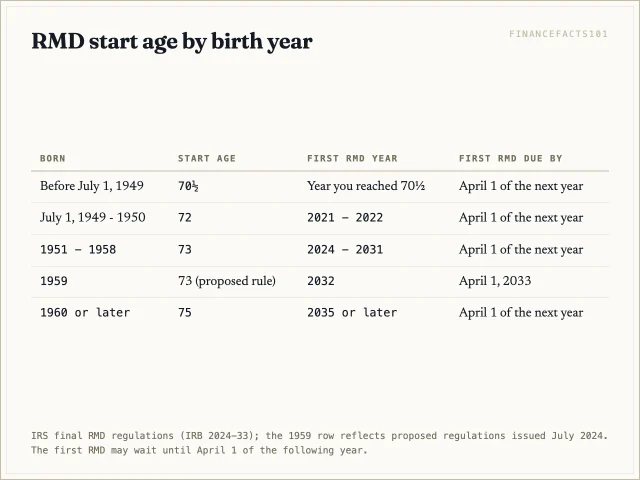
The statute is written by calendar year instead: age 75 applies to anyone who reaches 74 after December 31, 2032, which is where the "rises to 75 in 2033" shorthand, including the note on our RMD calculator, comes from. Either way, the first RMDs under the age-75 rule fall in 2035, when the 1960 cohort turns 75.
Your first RMD year is the year you reach the start age, whatever the month: someone born in December 1953 has a 2026 RMD though she is 73 for only a few days of it.
The first-year trap: April 1 and two RMDs in one year
The first RMD has a grace period. Per the IRS page on RMD rules, you may postpone the first one until April 1 of the year after you reach the start age. Every later RMD is due by December 31 of its own year.
The catch is that postponing does not skip anything. The year-two RMD is still due by December 31 of year two, so a postponed first RMD puts two distributions, and two slices of taxable income, in the same tax year. The IRS says so directly: taking the first withdrawal by December 31 of the year you turn 73 instead "would allow the distributions to be included in your income in separate tax years."
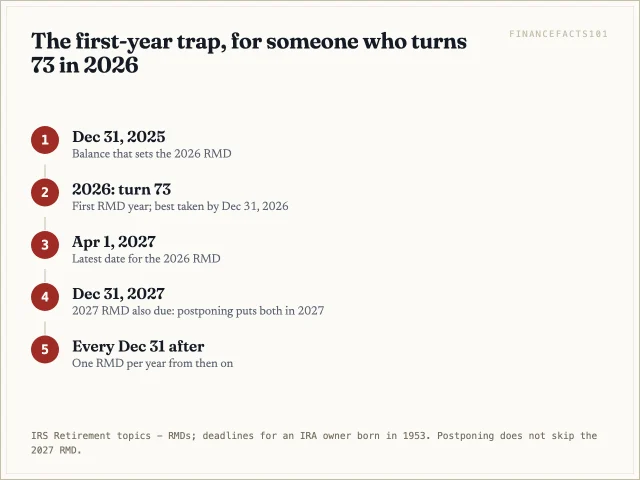
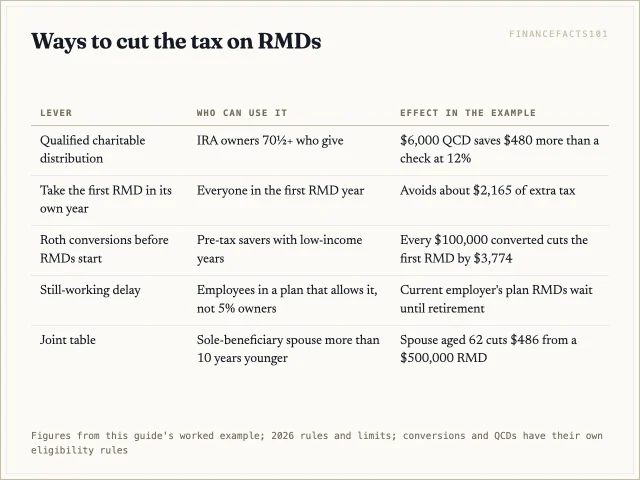
Postponing can still make sense in one situation: the year you turn 73 is an unusually high-income year (a final year of salary, a large capital gain) and the following year will be much lower. Otherwise, doubling up tends to push the second RMD into a higher bracket. The worked example below prices that out at about $2,165 for a typical couple.
How much: the Uniform Lifetime Table
The formula is one division. Take the account's fair market value on December 31 of the previous year and divide it by the "applicable denominator" for the age you reach this year. Most owners read that denominator from Table III, the Uniform Lifetime Table, in IRS Publication 590-B. It applies to unmarried owners, to married owners whose spouse is not more than 10 years younger, and to married owners whose spouse is not the sole beneficiary.
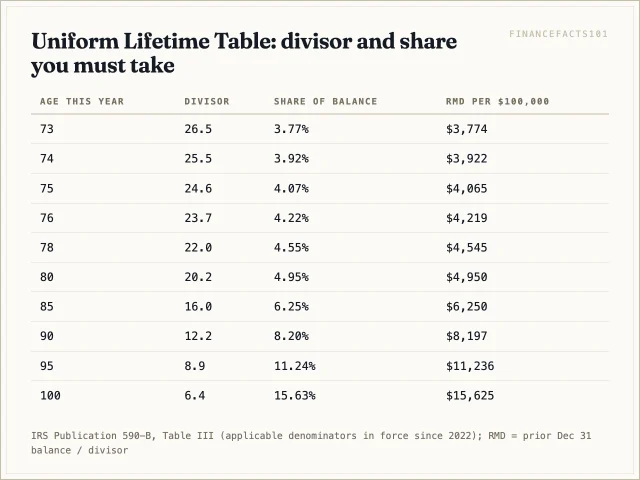
Because the divisor shrinks every year, the share of the account you must take rises: 3.77 percent at 73, 4.95 percent at 80, 8.20 percent at 90 and 11.24 percent at 95. The dollar amount can keep climbing for years anyway, because growth outruns the withdrawal, until the rising percentage finally drains the account faster than it grows.
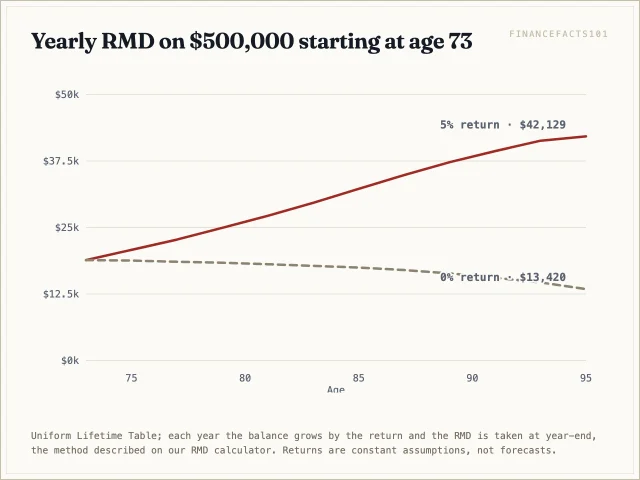
On a $500,000 balance at an assumed 5 percent annual return, the RMD starts at $18,868, passes $26,000 at 80 and peaks near $42,100 at 95. Added up, the RMDs from 73 through 95 come to about $712,000, more than the starting balance, and about $352,000 is still in the account afterward. At a 0 percent return the RMD drifts down slowly, and the account still holds about $119,000 at 95.
Worked example: $650,000 across three pre-tax accounts
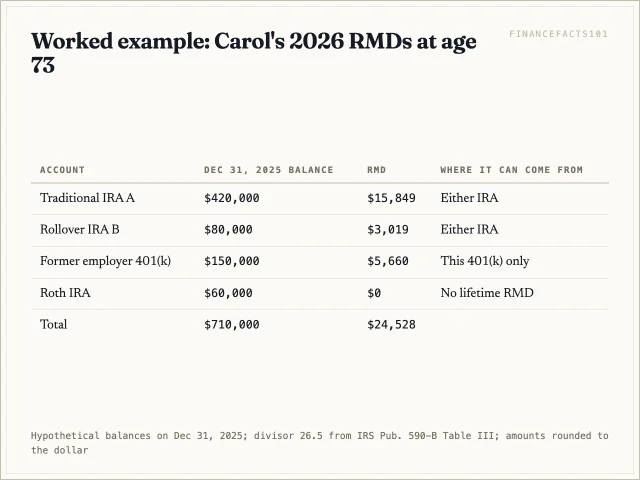
Take Carol, born in May 1953, so she turns 73 in 2026 and 2026 is her first RMD year. Her husband Tom is two years younger, so the Uniform Lifetime Table applies. On December 31, 2025 she held:
- Traditional IRA A: $420,000
- Rollover IRA B: $80,000
- A 401(k) from her former employer: $150,000
- A Roth IRA: $60,000
The Roth IRA has no RMD while Carol is alive, so it drops out. The two IRAs are figured separately and can then be combined: $420,000 ÷ 26.5 = $15,849 and $80,000 ÷ 26.5 = $3,019, or $18,868 in total, which she may take from either IRA or split any way she likes. The 401(k) is its own calculation and must be paid from the 401(k): $150,000 ÷ 26.5 = $5,660. Her 2026 total is $24,528.
Now the timing decision. Assume the couple has $70,000 of taxable income from other sources after deductions, and each account earns 5 percent a year. If Carol takes her 2026 RMDs in December 2026, her year-end balances are $506,132 in the IRAs and $151,840 in the 401(k), so her 2027 RMDs at age 74 (divisor 25.5) are $19,848 and $5,955, a total of $25,803. Both years stay inside the 12 percent bracket, which in 2026 runs to $100,800 of taxable income for joint filers per the IRS 2026 inflation adjustments. The tax on the two years of RMDs is $2,943 plus $3,096, or $6,040.
If she instead postpones to April 1, 2027, nothing comes out in 2026, her December 31, 2026 balances are a full $525,000 and $157,500, and 2027 carries two RMDs: the postponed $24,528 plus a second one of $26,765. That is $51,293 on top of $70,000. The first $30,800 fills the rest of the 12 percent bracket and the other $20,493 is taxed at 22 percent, for $8,204. Postponing costs about $2,165 more tax to distribute only $962 more.
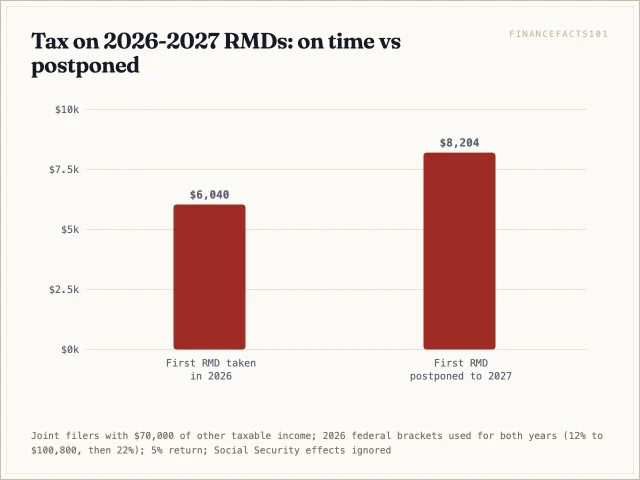
The comparison uses 2026 brackets for both years because 2027's have not been published. It also leaves out an effect that would make postponing look worse: extra income can make more of the couple's Social Security taxable.
A spouse more than 10 years younger: the joint table
One exception gives you a larger divisor and a smaller RMD. If your spouse is the sole beneficiary of an account and is more than 10 years younger than you (marital status is fixed as of January 1 each year), you use Table II, the Joint and Last Survivor table, for that account instead of the uniform table. Pub. 590-B's own example: an owner turning 75 in 2026 whose spouse turns 64 uses a divisor of 25.3 instead of 24.6, so a $100,000 IRA owes $3,953 instead of $4,065.
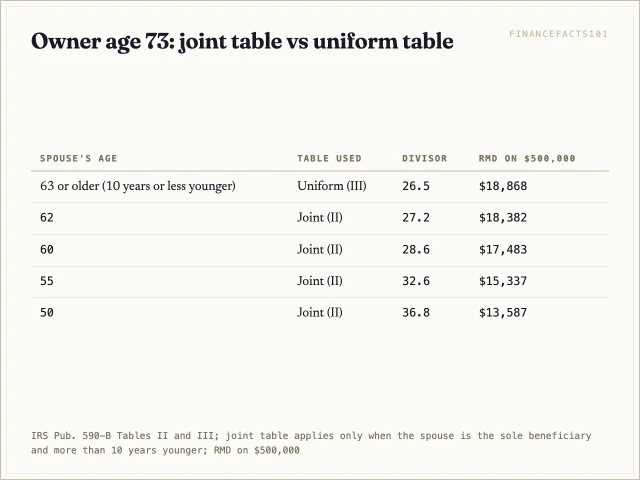
The benefit grows with the age gap. If Carol's IRAs named a spouse aged 62 as sole beneficiary, her divisor at 73 would be 27.2 and her $500,000 would owe $18,382, only $486 less. A spouse aged 50 would set it at 36.8 and the RMD at $13,587. At exactly 10 years younger the joint table gives 26.5, the same as the uniform table, which is why the rule starts at more than 10.
The exception follows each account's beneficiary designation. Naming anyone else as a co-beneficiary alongside the spouse generally puts that account back on the uniform table.
Which accounts you can combine
Aggregation is where accidental shortfalls come from. The IRS FAQs set it out: you calculate each IRA's RMD separately but can withdraw the total from any one or more IRAs; 403(b) contracts work the same way among themselves; and 401(k) and 457(b) plans must each pay their own RMD. The groups never mix: an extra IRA withdrawal does not satisfy a 401(k) RMD.
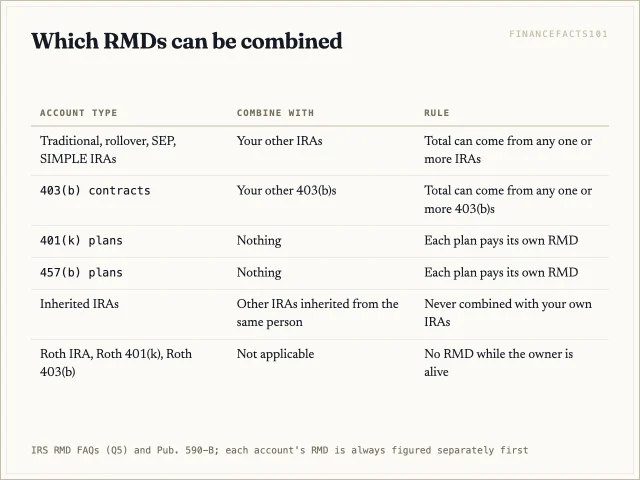
Federal employees should treat the Thrift Savings Plan as a plan account with its own RMD, not something that can be netted against IRAs; the TSP guide covers how the TSP pays it and how separation from service interacts with the start date. For simplicity, many retirees roll old 401(k)s into one IRA so a single withdrawal covers everything. That works for future years, but the current year's RMD must come out first: amounts that must be distributed in a year are not eligible for rollover.
Roth accounts: no RMDs while you are alive
Roth IRAs have never required lifetime distributions, and since 2024 designated Roth accounts inside 401(k) and 403(b) plans don't either: section 325 of SECURE 2.0 removed the requirement for taxable years beginning after December 31, 2023, as summarized in IRB 2024-33. In Carol's case, a Roth 401(k) balance would drop out of the RMD calculation exactly as her Roth IRA does. It did not need to be rolled to a Roth IRA to escape RMDs, which was the standard workaround before 2024.
Beneficiaries are different: the IRS is clear that people who inherit Roth IRAs and designated Roth accounts are subject to RMD rules.
Still working past 73
If you are still employed, your current employer's plan can let you delay RMDs until April 1 of the year after you retire. Three limits make this narrower than it sounds. It does not apply if you own more than 5 percent of the business sponsoring the plan. It never applies to IRAs, which follow the age-based schedule whether or not you work. And it depends on the plan: the IRS notes that a plan document may require distributions at 73 even while you are still employed.
It also covers only the current employer's plan; Carol's old 401(k) gets no deferral from a new job. Some people roll old balances into the current plan, where it accepts roll-ins, to bring that money under the exception. Take any RMD already due for the year before the rollover.
Missing an RMD: 25 percent, or 10 percent if you fix it
The penalty for a shortfall is an excise tax on the amount not withdrawn. Under SECURE 2.0 it is 25 percent, and Pub. 590-B describes a reduced 10 percent rate if you take the missed amount and file a return reflecting the tax during the "correction window." That window generally ends on the last day of the second tax year after the year the tax is imposed, or earlier if the IRS mails a deficiency notice or assesses the tax. For a 2026 shortfall, that means December 31, 2028 at the latest.
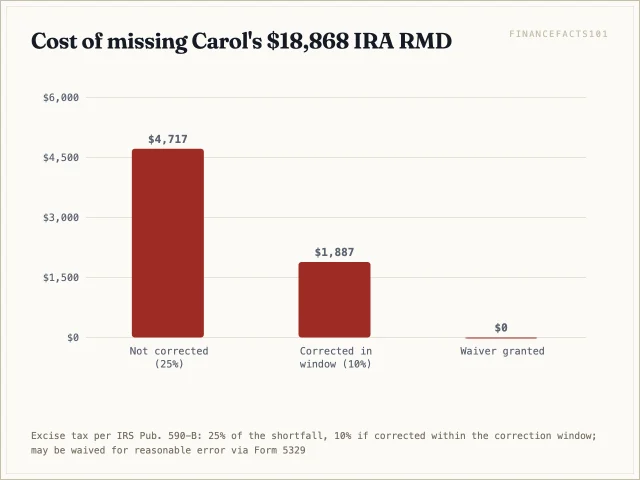
On Carol's missed $18,868 IRA RMD, that is $4,717 at 25 percent or $1,887 at 10 percent. The tax can also be waived entirely if the shortfall came from reasonable error and you are fixing it: file Form 5329 with a letter of explanation. In practice: withdraw the missed amount as soon as you notice, then file the form.
One related rule trips people up: taking more than the minimum in one year earns no credit toward the next year's RMD.
Cutting the tax: qualified charitable distributions
For anyone who gives to charity, this is the most efficient tool in the guide. From age 70½, you can have your IRA trustee pay a charity directly. The amount counts toward your RMD but is excluded from taxable income, up to $111,000 per person in 2026, up from $108,000 in 2025, per Notice 2025-67 in IRB 2025-49. The same notice raised the one-time QCD to a split-interest entity, such as a charitable gift annuity, to $55,000.
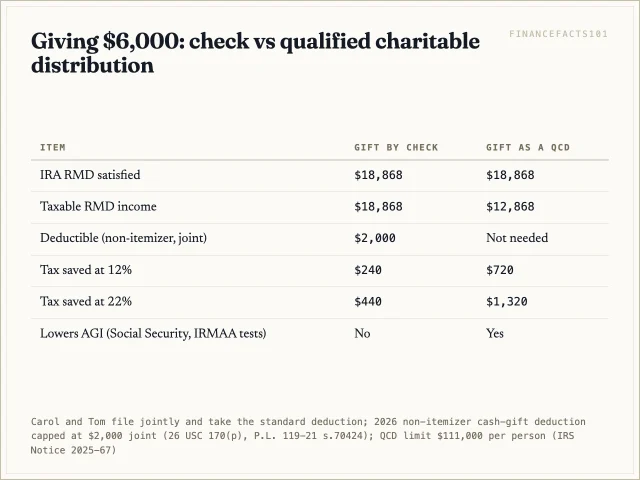
A retiree who takes the standard deduction ($32,200 for joint filers in 2026, before the extra amounts for age 65 and over) can still deduct cash gifts, but only up to $1,000, or $2,000 on a joint return. That is the non-itemizer deduction in section 170(p), which Public Law 119-21, section 70424 raised from $300 ($600 joint) and made permanent for tax years beginning after December 31, 2025. Say Carol and Tom give $6,000 a year. By check, $2,000 is deductible, saving $240 at 12 percent. Sent as a QCD from Carol's IRA, the gift covers $6,000 of her $18,868 IRA RMD and the whole $6,000 stays out of income, saving $720. The QCD comes out $480 ahead, or $880 ahead in the 22 percent bracket. It also lowers adjusted gross income, which feeds the Social Security and Medicare tests below; the non-itemizer deduction, like an itemized one, does not.
The rules are strict. Under section 408(d)(8) the money must go from the IRA trustee directly to a charity described in section 170(b)(1)(A); the statute excludes supporting organizations and donor-advised funds. You need the same written acknowledgment as for a deduction. QCDs come only from IRAs, not from an ongoing SEP or SIMPLE IRA, so a 401(k) owner must roll money to an IRA first. Order matters as well: a QCD made after you have already withdrawn your full RMD in cash is still tax-free, but it cannot make the cash you already took tax-free.
Cutting the tax: shrink the balance before 73
The RMD is proportional to the balance, so every $100,000 you move out of pre-tax accounts before your first RMD year removes $3,774 from the first RMD and a growing amount from every later one. The usual way is a Roth conversion in the low-income years between retirement and the start age, filling the 12 or 22 percent bracket each year rather than letting RMDs force the income out later, possibly at a higher rate. How much to convert each year, and when conversions don't pay, is covered in the Roth conversion guide; run your own numbers on the Roth conversion calculator.
Two limits. Conversions after RMDs begin are still allowed, but the year's RMD must come out first and cannot itself be converted. And the trade only wins if the tax rate you pay on conversion is lower than the rate the RMD dollars would have faced, including the knock-on effects covered next.
Where RMDs ripple: Social Security and Medicare
An RMD's cost is often more than its bracket rate. Under IRS Topic 423, Social Security benefits become taxable once your modified adjusted gross income plus half your benefits passes a base amount for your filing status, and RMDs count in that sum. A retiree in that range can pay tax on the RMD and on extra benefits that it pulls into income at the same time. When to claim is its own decision, covered in the Social Security claiming guide.
Medicare premiums are the other effect. The CMS 2026 premium fact sheet sets the standard Part B premium at $202.90 a month and adds an income-related surcharge (IRMAA) above $218,000 of modified AGI for joint filers or $109,000 for single filers, using the tax return from two years earlier. The first tier adds $81.20 a month per enrolled person. Carol's postponed year, about $121,000 of taxable income, stays well below that line even with deductions added back, but a large IRA with a doubled first-year RMD can cross it, and the surcharge lands two years later.
Inherited IRAs: the 10-year rule in brief
If the account owner died after 2019, most non-spouse beneficiaries must empty an inherited IRA or plan account by December 31 of the year containing the 10th anniversary of the death. The IRS FAQs list the exceptions, called eligible designated beneficiaries: a surviving spouse, the owner's child who has not reached the age of majority, a disabled or chronically ill person, and anyone not more than 10 years younger than the owner.
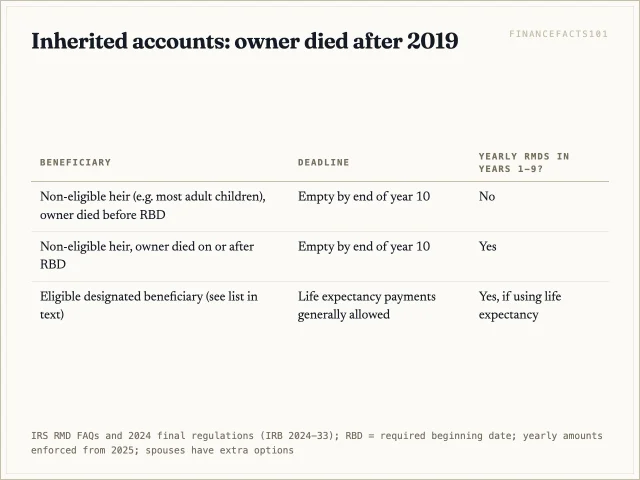
The detail that caught many heirs: if the owner died on or after the required beginning date, the 2024 final regulations require annual distributions in years one through nine as well as the year-10 deadline. IRS notices waived the excise tax on those missed annual amounts for 2021 through 2024 for affected beneficiaries, and the final rules apply from 2025, so beneficiaries in that position now need a withdrawal every year. If the owner died before the required beginning date, nothing is required until the 10th year.
The decision, step by step
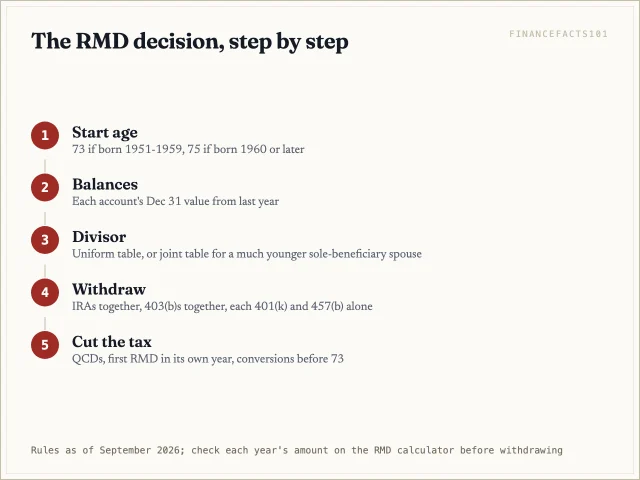
The mechanics are the first four steps and take ten minutes once a year. The tax side is where the money is: take the first RMD in its own year unless that year is unusually high-income, route charitable giving through QCDs, and use the years before 73 to convert where your bracket is lower than your RMD bracket will be. The RMD calculator runs the same division for any age and balance, and its chart shows the multi-year path on its default inputs; use it to check each year's number before you withdraw.
FAQ
Can I take my RMD in monthly installments?
Yes. The rule is only that the year's total must come out by December 31 (or by April 1 of the following year for the first RMD). Many custodians offer monthly or quarterly automatic distributions, and you can take more than the minimum at any time, but the excess never counts toward a future year's RMD.
Does my RMD count if I convert it to a Roth IRA?
No. Required amounts are not eligible for rollover, and a Roth conversion is treated as a rollover, so the year's RMD must be taken as an ordinary distribution first. After the RMD is satisfied, you can convert additional pre-tax money in the same year.
What happens if my custodian calculated my RMD wrong?
The IRS holds the account owner responsible for the correct amount, even when the custodian does the math. If you find a shortfall, withdraw the missing amount promptly and file Form 5329. The excise tax is 25 percent, reduced to 10 percent if corrected within the window, and it can be waived for reasonable error with a letter of explanation.
Do I need to take RMDs from my Roth 401(k)?
Not since 2024. SECURE 2.0 removed lifetime RMDs from designated Roth accounts in 401(k) and 403(b) plans for years after 2023, matching the Roth IRA rule. Your beneficiaries will still face RMD rules after your death.
Sources
- IRS, Retirement plan and IRA required minimum distributions FAQs (last reviewed January 29, 2026)
- IRS, Retirement topics: Required minimum distributions (last reviewed April 8, 2026)
- IRS, Publication 590-B, Distributions from Individual Retirement Arrangements (Tables II and III; QCD, excise tax and first-year rules)
- IRS, Internal Revenue Bulletin 2024-33 (2024 final and proposed RMD regulations; applicable age by birth year; SECURE 2.0 section 325)
- IRS, Internal Revenue Bulletin 2025-49, Notice 2025-67 (2026 QCD limits of $111,000 and $55,000)
- IRS, Tax inflation adjustments for tax year 2026 (brackets and standard deduction)
- IRS, Topic no. 423, Social Security and equivalent railroad retirement benefits
- CMS, 2026 Medicare Parts A & B premiums and deductibles (November 14, 2025)
- US Congress, Public Law 119-21, section 70424 (non-itemizer charitable deduction of $1,000, or $2,000 joint, from 2026)
- Legal Information Institute, 26 U.S. Code § 170 (section 170(p) as amended)
- Legal Information Institute, 26 U.S. Code § 408 (statutory text of section 408(d)(8), qualified charitable distributions)
 Next entry · No. 5,971Car Loan Term: 48, 60, 72 or 84 Months - Which to Choose
See also
-
 No. 5,973
07 Oct 2026
16 min
How Much Do I Need to Retire? Spending, Social Security and the 4% Rule
Retirement
No. 5,973
07 Oct 2026
16 min
How Much Do I Need to Retire? Spending, Social Security and the 4% Rule
Retirement -
 No. 5,950
17 Sep 2026
17 min
Thrift Savings Plan: How Much to Contribute, Which Fund, and Whether to Roll It Out
Retirement
No. 5,950
17 Sep 2026
17 min
Thrift Savings Plan: How Much to Contribute, Which Fund, and Whether to Roll It Out
Retirement -
 No. 5,944
14 Sep 2026
18 min
When to Claim Social Security: Break-Even at 62, 67 and 70
Retirement
No. 5,944
14 Sep 2026
18 min
When to Claim Social Security: Break-Even at 62, 67 and 70
Retirement -
 No. 5,969
03 Oct 2026
19 min
Should I Do a Roth Conversion in 2026? How Much to Convert
Retirement
No. 5,969
03 Oct 2026
19 min
Should I Do a Roth Conversion in 2026? How Much to Convert
Retirement -
 No. 5,941
12 Sep 2026
16 min
401(k) Employer Match: How Much of Your Salary to Defer
Retirement
No. 5,941
12 Sep 2026
16 min
401(k) Employer Match: How Much of Your Salary to Defer
Retirement -
 No. 4,431
18 Jun 2025
17 min
Retirement Income Certified Professional (RICP): Your Go-To Expert in Retirement Planning
Retirement
No. 4,431
18 Jun 2025
17 min
Retirement Income Certified Professional (RICP): Your Go-To Expert in Retirement Planning
Retirement