When to Claim Social Security: Break-Even at 62, 67 and 70

Break-even is 78 yr 8 mo vs claiming at 67 and 80 yr 5 mo vs 70 on a $2,400 benefit — but for couples the survivor benefit decides it instead.
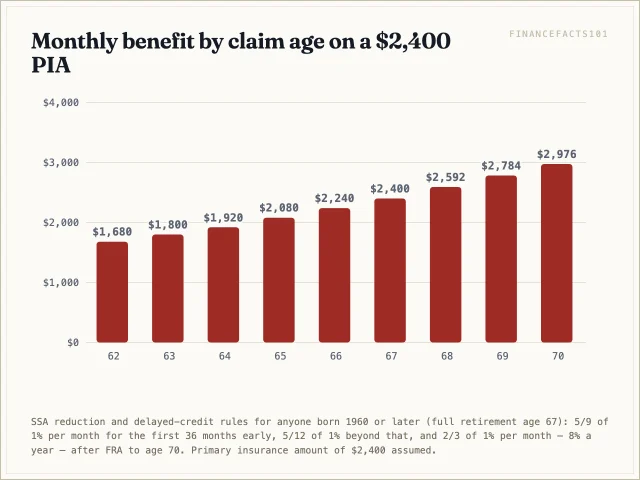
The decision is not whether to take Social Security but which month to start, anywhere from the month you turn 62 to the month you turn 70. It moves real money: on a $2,400 primary insurance amount the age-62 check is $1,680 and the age-70 check is $2,976 — $1,296 a month apart, indexed for inflation, for as long as you live. Most guidance on when to claim Social Security stops at the break-even age, which for that earner lands at 80 years and 5 months.
That break-even is computed below, then set aside — because for anyone married it is the wrong sole criterion. The higher earner's claim date sets the survivor's check for the rest of the survivor's life, which makes it an insurance decision rather than an investment one. Scope honesty up front: general information with stated assumptions and 2026 rules, not personal advice.
When to Claim Social Security: What the Rules Actually Pay
Two rules set every number here. Claim before your full retirement age and the benefit is cut 5/9 of 1% for each of the first 36 early months, then 5/12 of 1% beyond — 30% in total for an FRA of 67 claimed at 62, per SSA's early-retirement reduction tables. Wait past FRA and you earn delayed retirement credits of 2/3 of 1% a month, 8% a year for anyone born in 1943 or later, stopping at 70.
Put together, on an FRA of 67 the range runs from 70% of your primary insurance amount at 62 to 124% at 70. The age-70 check is 77% larger than the age-62 check for the same work record.
Two details people get wrong. Delayed credits stop dead at 70 — waiting to 71 buys nothing. And credits earned during a calendar year are usually not added until the following January, so a benefit starting mid-year can look short for months before catching up retroactively.
Full Retirement Age Is Not 65, and It Is Not 67 for Everyone
Full retirement age climbed from 65 to 67 in two steps, and the second is only now finishing. Anyone born 1943 through 1954 has an FRA of 66; from 1955 it rises two months per birth year, reaching 67 for everyone born in 1960 or later. FRA is the pivot that defines what 100% means, and every reduction or credit is measured from it.
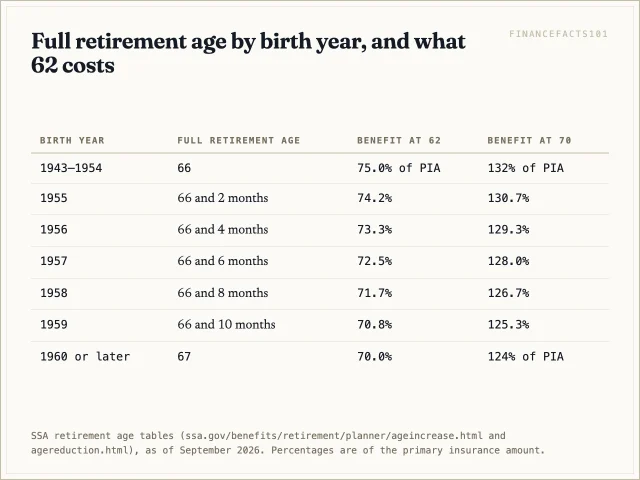
So the same claim age costs different people different amounts. A 1957 baby claiming at 62 kept 72.5% of PIA; a 1962 baby keeps 70%. With an FRA of 66 and 6 months, the credits to 70 run 42 months rather than 36, making the age-70 figure 128%. Background sits in the guide to Social Security retirement, disability and survivor benefits.
Who This Is For — and Who It Isn't
This fits a US worker aged roughly 58 to 70 with a real work record and some flexibility about when income arrives. The worked examples assume an FRA of 67 and a $2,400 primary insurance amount — close to the average retired-worker benefit of about $2,071 a month in 2026, well below the $4,152 maximum at FRA.
It is not for disability claimants, whose benefits follow different rules and convert at FRA automatically. It is not a guide to whether the trust fund will pay: the arithmetic assumes scheduled benefits. It skips government pensions, divorced-spouse claims, and non-citizen residency tests, any of which can change the answer. And it is no substitute for your own earnings record from a my Social Security account.
Ellen's Numbers: Claiming at 62 vs 67 vs 70
Name the assumptions. Ellen Rowe, born March 1963, has a full retirement age of 67 and a primary insurance amount — what she gets starting exactly at FRA — of $2,400 a month. No pension. She is deciding among claiming at 62 vs 67 vs 70.
At 62 she gets 70% of PIA: $1,680 a month, $20,160 a year. At 67 she gets 100%: $2,400 a month, $28,800 a year. At 70 she gets 124%: $2,976 a month, $35,712 a year. Waiting from 62 to 70 costs her eight years of checks — $161,280 of income she does not receive — in exchange for $15,552 more per year afterward, before any inflation adjustment.
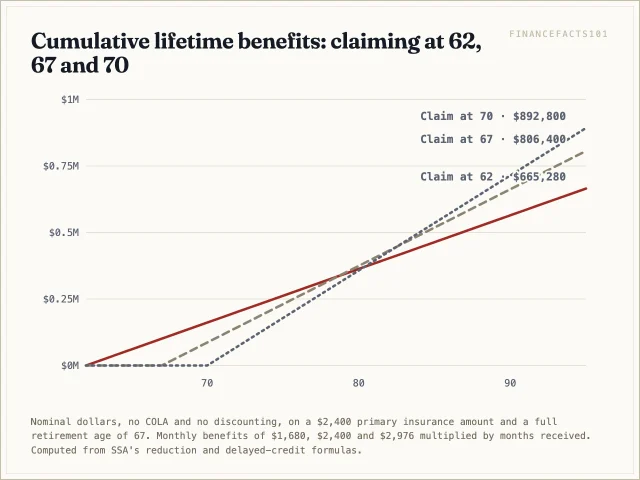
Each line is total dollars received since age 62. Claiming early wins for a long time, because it starts moving while the others sit at zero. Then the steeper lines catch it.
The Social Security Break-Even Age, Computed
The Social Security break-even age is where the later claimer's running total overtakes the earlier claimer's, and it solves in one line. Setting $1,680 × (t − 62) equal to $2,400 × (t − 67) gives t = 78.67 years — 78 years and 8 months. Against age 70, $1,680 × (t − 62) = $2,976 × (t − 70) gives t = 80.37, or 80 years and 5 months. Comparing 67 with 70 alone: exactly 82 years and 6 months.
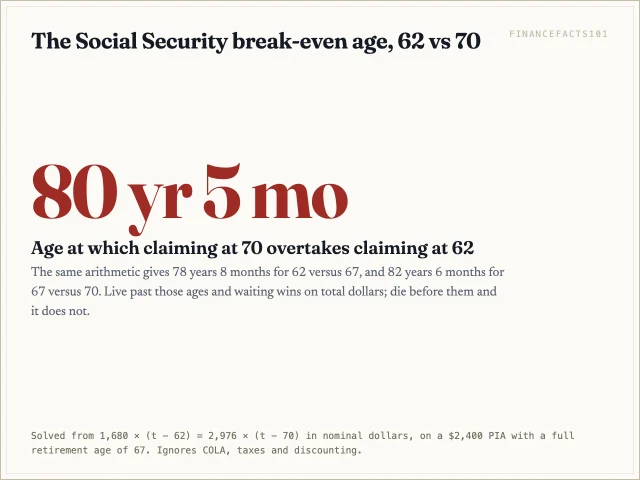
Those three ages are stable across benefit sizes, because both sides scale with PIA: change the earner and they do not move. Past 90 the gaps are not subtle — by 90 Ellen has collected $564,480 claiming at 62, $662,400 at 67, and $714,240 at 70, putting the age-70 path $149,760 ahead. Run your own PIA and birth year through the Social Security break-even calculator rather than borrowing Ellen's.
Why Discounting Moves the Break-Even and COLA Barely Does
The break-even above is nominal. Two adjustments matter, and they pull in opposite directions.
Cost-of-living adjustments — 2.8% for 2026 — apply to your record from 62 whether or not you have claimed, scaling both streams by the same index. They move the crossover by less than a month. What they change is the size of the prize.
Discounting is the real objection. A dollar at 82 is not a dollar at 63: if you would otherwise be spending down a portfolio, delaying means selling assets that might have earned a return. Applying a real discount rate to every payment pushes the crossover later, steeply.
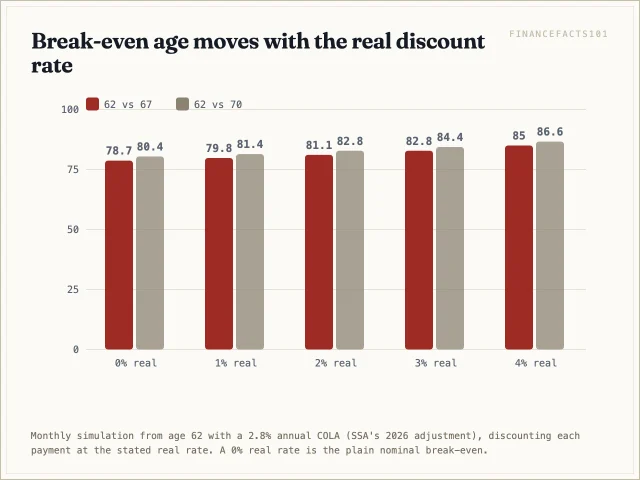
At a 2% real rate the 62-versus-70 break-even slips from 80.4 to 82.8 years; at 4% it reaches 86.6. Delaying is a purchase of inflation-indexed longevity insurance backed by the federal government — priced attractively at low real rates, unattractively if you truly believe your alternative earns 4% real after tax. Model the portfolio side with the retirement calculator.
The Earnings Test: Withheld Is Not Lost
Claim before FRA and keep working, and SSA withholds benefits above an earnings limit: in 2026, $1 for every $2 above $24,480 under FRA all year, and $1 for every $3 above $65,160 in the year you reach FRA. From the month you hit FRA there is no limit at all, per SSA's guidance on working while receiving benefits.
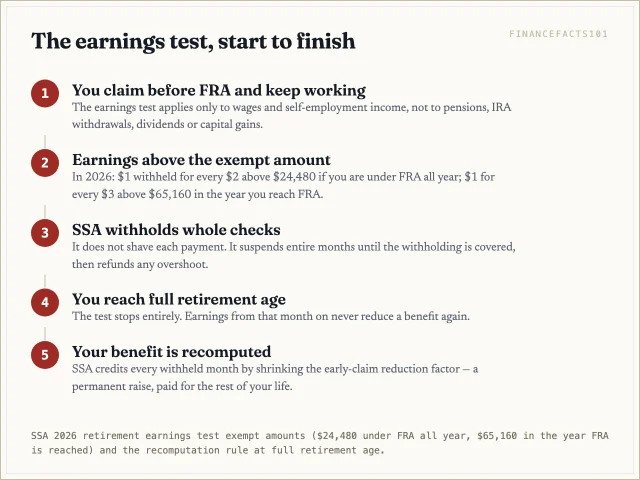
Here is the part almost everyone gets wrong, professionals included: the withheld money is not confiscated. At FRA, SSA recomputes the benefit to credit every withheld month, permanently shrinking the early-claiming reduction — the agency's program explainer calls the test a withholding, not a tax.
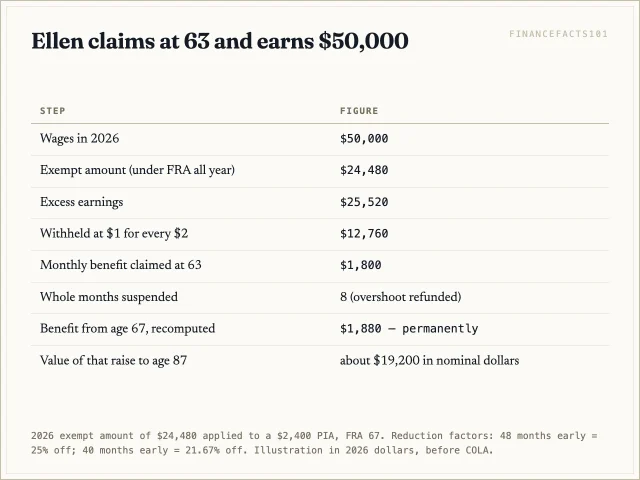
Ellen claims at 63 and earns $50,000 in 2026. Her excess is $25,520, so $12,760 is withheld — about eight whole checks of $1,800, overshoot refunded. At 67 her claim is recomputed as though she had started 40 months early instead of 48, lifting her benefit from $1,800 to $1,880 for life. She still loses the time value of eight delayed checks, so it is close to a wash. What she should not do is turn down work to protect benefits that were never going to disappear.
COLA Compounds on a Bigger Base
The same percentage adjustment on a bigger check produces a bigger dollar raise, every year, forever — the quiet argument for delaying that break-even charts hide.
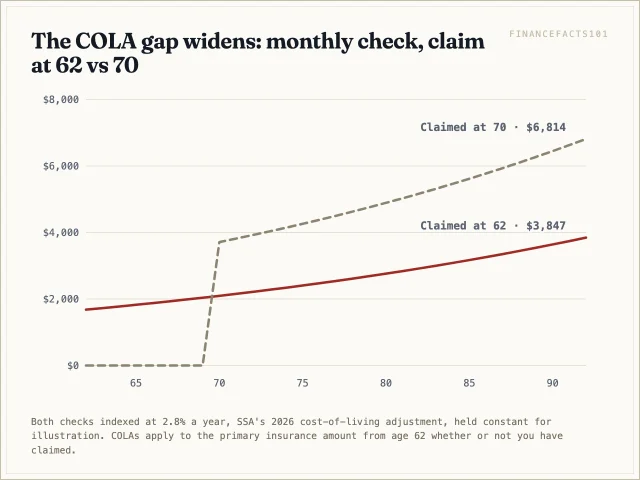
Hold 2.8% constant for illustration. Ellen's age-62 check of $1,680 grows to about $2,095 by 70 and $3,640 by 90; her age-70 check starts near $3,712 and reaches $6,448 by 90. The monthly gap widens from $1,296 in current dollars to $2,808 at 90 — the delay buys a larger inflation adjustment as well as a larger check, which is the risk retirees can least self-insure. The mechanics are in the entry on cost-of-living adjustments.
Spousal Benefits Are a Second Claim on the Same Record
A spouse can draw up to 50% of the worker's primary insurance amount, reduced 25/36 of 1% per month for the first 36 months before her own FRA and 5/12 of 1% beyond — 32.5% of his PIA rather than 50% at 62 with an FRA of 67. Meet the Whitfields: Marcus's PIA is $2,400, Dana's is $900, both FRA 67.
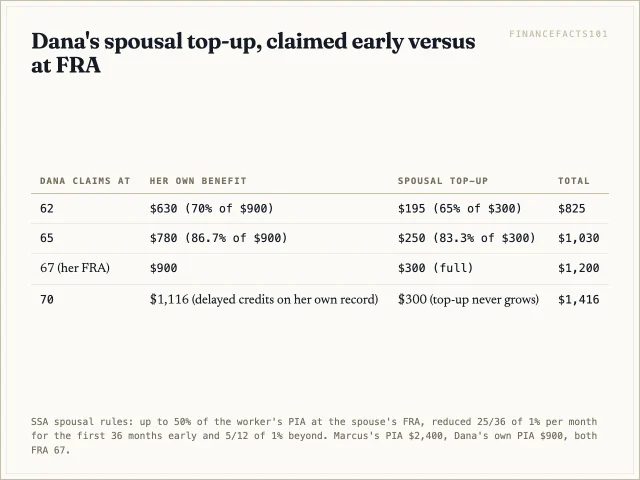
Two rules do the work. Dana receives her own benefit plus the spousal excess — 50% of Marcus's PIA minus her own PIA, or $300 — not both in full. And delayed credits never apply to the spousal portion, so a purely spousal claim should never wait past FRA. One real cost of Marcus delaying: Dana cannot collect the $300 top-up until he files, forgoing $10,800 across those three years.
The Survivor Benefit Turns This Into an Insurance Decision
Here is the reframing. When Marcus dies, Dana's own benefit stops and a survivor benefit replaces it — the larger of her own or his. At her survivor FRA it equals what he was actually receiving, delayed credits included, and it is reduced to 71.5% if claimed at 60. One floor protects her: under the widow's limit in 20 CFR 404.338, if he claimed early her benefit is never below 82.5% of his PIA.
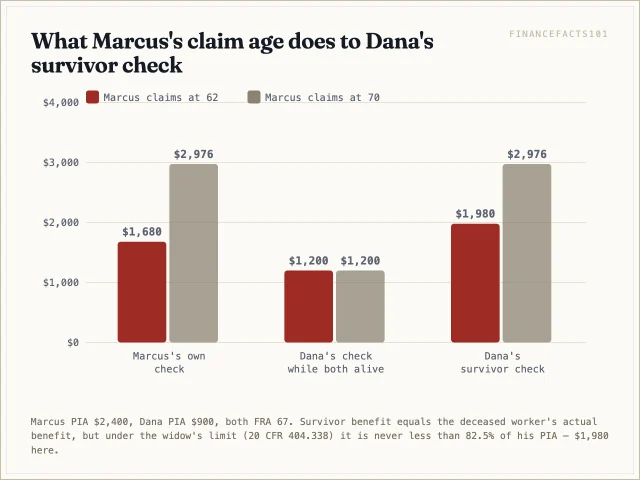
So if Marcus claims at 62, his $1,680 becomes a survivor check of $1,980 for Dana — the 82.5% floor, not his actual benefit. Wait to 70 and her survivor check is $2,976. That is $996 a month, indexed, for however long she outlives him. His claim date is barely about him: it is a premium insuring the longer-lived of two lives, which is why break-even arithmetic computed on one head answers the wrong question.
The Whitfields: The Household Arithmetic
Test it against the case that should embarrass the delay strategy. Marcus dies at 78 — two and a half years before his personal 62-versus-70 break-even of 80 years 5 months, so by the individual measure waiting was a mistake. Dana lives to 92, claiming her own record at 67 in both paths.
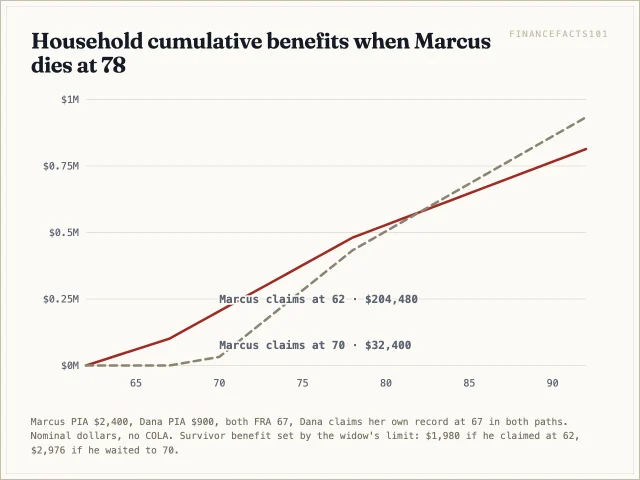
Path A, Marcus claims at 62: the household collects $813,600 by Dana's 92nd birthday. Path B, Marcus claims at 70: $933,264. Delaying leaves them $119,664 ahead despite his early death, and the household crossover falls at Dana's age 82 — nine years after he is gone.
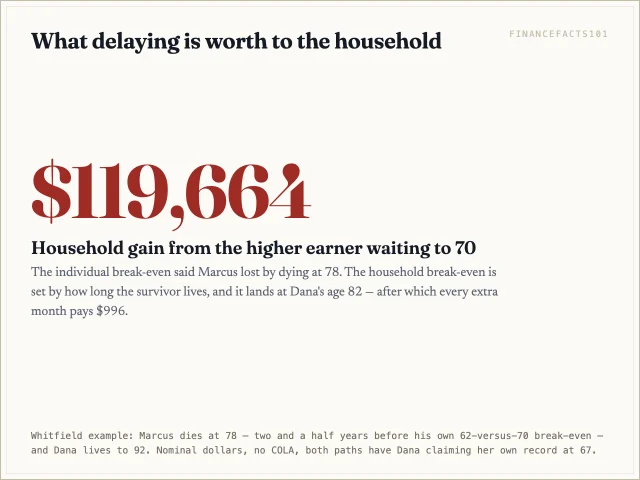
Change the survivor's lifespan and the sign flips — the honest limit of the argument. Had Dana died at 80, Path B would have lost $23,760. The household break-even is not set by how long the higher earner lives but by how long the survivor lives past about 82. Two implications follow. The lower earner should usually claim early, funding the household while the higher earner's credits accrue. And a large delayed benefit substitutes in part for life insurance on the higher earner.
Taxes: Four Thresholds Frozen Since 1984
Benefits are taxed on provisional income: AGI excluding benefits, plus tax-exempt interest, plus half your benefits. Cross $25,000 single or $32,000 joint and up to 50% becomes taxable; cross $34,000 or $44,000 and up to 85% does, per IRS Publication 915 and the IRS benefit-taxation FAQ.
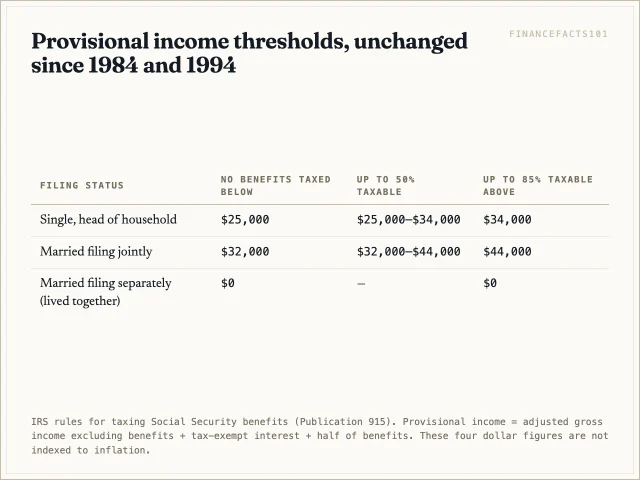
Those four numbers have never been indexed — $25,000 and $32,000 date to 1984, $34,000 and $44,000 to 1994 — and wage growth has pulled a rising share of retirees over them every year since. Ellen at 70, with $35,712 of benefits and $30,000 of IRA withdrawals, has provisional income of $47,856 and $16,278 of taxable benefits; the same withdrawals against her age-62 benefit produce $9,668. Delaying raises the tax, though not proportionally.
The planning move is the gap. Years between retirement and 70 are low-income years, the cheapest time to do Roth conversions or realize gains — and every dollar out of a traditional IRA now is one not forced out later as a required distribution. Check it against the RMD calculator and the trade-offs in Roth vs traditional IRA.
Medicare at 65 and the IRMAA Cliff
Medicare starts at 65 regardless of when you claim Social Security; the initial enrollment window runs three months before through three months after the birthday month, and missing it without other creditable coverage carries a permanent Part B penalty.

The standard 2026 Part B premium is $202.90 a month with a $283 annual deductible. If you have claimed, it comes out of the check; if not, Medicare bills you. Two consequences. A delayed claimant pays those premiums from cash — a real bridge cost to budget. And IRMAA surcharges, starting above $109,000 of modified AGI single or $218,000 joint in 2026, are cliffs assessed on the tax return from two years earlier, so a large Roth conversion at 63 raises the Part B premium at 65. Size conversions to stop short of the line.
Longevity and Health, Honestly
It all turns on one unknowable number. SSA's 2026 Trustees Report period life table puts remaining life expectancy at 65 at about 18.5 years for men and 21.0 for women — roughly ages 83 and 86. Both clear the 62-versus-67 break-even of 78 years 8 months. The female figure clears the 62-versus-70 break-even of 80 years 5 months; the male figure misses it by about three years.
Averages hide the tails, and the tails are what insurance is for. A meaningful share of 65-year-olds reach 95, and that person's problem is not maximizing expected dollars but avoiding a small, inflation-eroded check at 93. Delaying is the only way to buy more government-backed, inflation-indexed lifetime income, and no annuity on the market matches its price. Conversely, a serious diagnosis or a smoking history moves your personal distribution left by years, and the crossover may never arrive. Deciding on a population average when you hold private information about your own health is the commonest error here.
The Real Case for Claiming at 62
Age 62 remains one of the most common start ages, as SSA's claiming-age data shows, and the reflex to call it a mistake is condescending and often wrong.
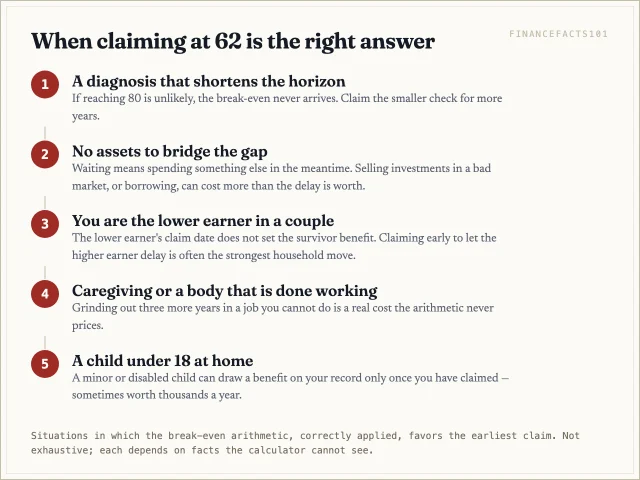
With no assets to bridge the gap, delaying is not free — it is funded by selling investments, possibly into a bad market, or by working in a body that has had enough. As the lower earner in a couple, your claim date does not set the survivor benefit, so claiming at 62 to keep the household solvent while the higher earner delays is the strongest move available. A minor child at home can draw on your record only once you file. And in poor health the arithmetic favors more checks, not bigger ones. Before claiming to cover a short-term shortfall, though, check whether the gap is a cash-flow problem an emergency fund should have covered.
How to Decide
Start with your own primary insurance amount from a my Social Security statement, not an estimate. Then answer four questions: are you married, is your benefit the larger of the two, does either of you have a realistic chance of reaching 85, and do you have assets or wages to live on until your chosen claim date.
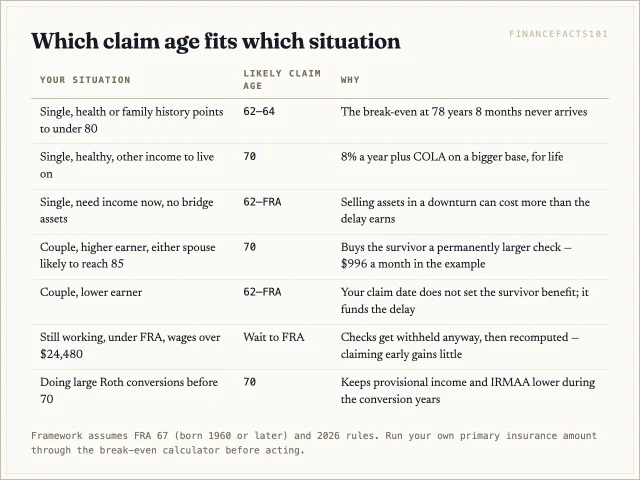
For a single person the decision is the break-even against an honest health assessment — 78 years 8 months against FRA, 80 years 5 months against 70. For a couple, the higher earner should treat delaying as buying survivor insurance and lean toward 70 unless both spouses have short life expectancy, while the lower earner claims early to fund the wait. Nor is it always irreversible: SSA allows a full withdrawal of an application within 12 months if you repay everything received, and lets you suspend benefits between FRA and 70 to accrue credits. Model your two dates side by side in the Social Security break-even calculator before you file.
FAQ
What is the break-even age for claiming Social Security at 70 instead of 62?
About 80 years and 5 months in nominal dollars, for anyone with a full retirement age of 67. It barely changes with the size of your benefit, because early and delayed amounts both scale from the same primary insurance amount. A 2% real discount rate pushes it to roughly 82 years 9 months; 4% pushes it to about 86 years 7 months.
If I claim at 62 and keep working, do I lose those benefits permanently?
No. In 2026 SSA withholds $1 for every $2 earned above $24,480 while you are under full retirement age, then at FRA recomputes your benefit to credit every withheld month. An earner whose checks were suspended for eight months at 63 sees the reduction shrink from 25% to 21.67%, lifting a $1,800 benefit to $1,880 for life. It returns as a permanently larger check, not a lump sum.
Does delaying help my spouse if I die first?
Yes, and it is usually the strongest reason to delay. The survivor receives the larger of her own benefit or the deceased worker's actual benefit, delayed credits included. On a $2,400 PIA, claiming at 62 leaves her $1,980 a month under the 82.5% widow's limit; waiting to 70 leaves her $2,976 — $996 more every month, indexed, for life.
Will claiming later make more of my Social Security taxable?
Often, because a bigger benefit raises provisional income. On $30,000 of other income, a $35,712 benefit produces $16,278 of taxable benefits against $9,668 for a $20,160 benefit. The thresholds — $25,000 and $34,000 single, $32,000 and $44,000 joint — have not moved since 1984 and 1994, so more retirees cross them each year. The offset: the years before 70 are the cheapest time to convert or withdraw from a traditional IRA.
Should I claim early because I am worried about the trust fund?
The arithmetic here assumes scheduled benefits. An across-the-board reduction would apply proportionally to early and delayed benefits alike, so it does not obviously favor claiming at 62 — a percentage cut to a larger check still leaves a larger check. Claiming early to pre-empt a cut converts a political uncertainty into a certain, permanent 30% reduction.
Sources
- SSA, Retirement Age and Benefit Reduction — the 5/9 and 5/12 of 1% early-claiming reduction, and 70% of PIA at 62 with an FRA of 67
- SSA, Retirement Age Calculator — full retirement age by year of birth, 66 through 67
- SSA Office of the Chief Actuary, Effect of Early or Delayed Retirement on Retirement Benefits — delayed retirement credits of 8% a year to age 70
- SSA, Program Explainer: Benefit Claiming Age — distribution of claim ages
- SSA, Receiving Benefits While Working — 2026 earnings-test limits of $24,480 and $65,160
- SSA, Program Explainer: Retirement Earnings Test — recomputation of withheld benefits at full retirement age
- SSA, Cost-of-Living Adjustment information — the 2.8% COLA for 2026
- SSA Office of the Chief Actuary, Benefits for Spouses — 50% of PIA at FRA, reduced 25/36 of 1% per month early
- SSA, What you could get from survivor benefits — survivor benefit amounts and the age-60 reduction to 71.5%
- SSA, 20 CFR 404.338 — the widow's limit: never less than 82.5% of the deceased worker's PIA
- SSA, Period Life Expectancy, 2026 OASDI Trustees Report — remaining years at age 65
- IRS, Publication 915, Social Security and Equivalent Railroad Retirement Benefits — provisional income and the 50%/85% tiers
- IRS, Social Security income FAQs — the $25,000/$32,000 base amounts
- Medicare.gov, Medicare costs — 2026 Part B premium of $202.90 and $283 deductible
- Medicare.gov, When does Medicare coverage start — the initial enrollment period at 65
- Kiplinger, Medicare premiums 2026: IRMAA brackets and surcharges — IRMAA thresholds and tiers
 Next entry · No. 5,945How Much House Can I Afford? Approval Price vs Affordable Price
See also
-
 No. 5,973
07 Oct 2026
16 min
How Much Do I Need to Retire? Spending, Social Security and the 4% Rule
Retirement
-
 No. 5,995
29 Oct 2026
21 min
Medicare IRMAA: How It Is Calculated and How to Avoid It
Retirement
-
 No. 5,984
18 Oct 2026
17 min
Are Annuities Worth It? What They Pay, What They Cost
Retirement
-
 No. 5,970
04 Oct 2026
17 min
Required Minimum Distributions: When to Start, How Much, and How to Cut the Tax
Retirement
-
 No. 702
24 May 2024
21 min
Understanding Cost-of-Living Adjustments (COLAs): How Inflation Impacts Your Social Security Benefits
Financial Tools
-
 No. 6,005
08 Nov 2026
18 min
Pension Lump Sum vs Monthly Payments: Which Pays More in 2026
Retirement