Medicare IRMAA: How It Is Calculated and How to Avoid It
IRMAA uses MAGI from two years back. In 2026, $1 over $109,000 single or $218,000 joint adds $1,148.40 a year per person with Part D. How to stay under it.
Medicare IRMAA, the income-related monthly adjustment amount, is a surcharge on Part B and Part D premiums that Social Security sets from your modified adjusted gross income on the federal tax return from two years earlier, so 2026 premiums are based on 2024 income. Under the CMS 2026 premium figures, MAGI above $109,000 on a single return or $218,000 on a joint return raises Part B from the standard $202.90 a month to between $284.10 and $689.90, and adds $14.50 to $91.00 a month on top of your Part D plan premium.
Each tier is a cliff, not a phase-in: one dollar over $109,000 costs a single person the whole first step, $1,148.40 a year at 2026 amounts (with Part D). Avoiding IRMAA therefore means keeping MAGI under the next line in the years that count, starting with the calendar year you turn 63, and, when income has fallen for a reason the rules recognise, asking Social Security to use a more recent year on Form SSA-44.
This is general information built on stated assumptions: 2026 figures from CMS, Social Security's IRMAA regulations in 20 CFR part 418 as they read on October 1, 2026, and hypothetical households. It is not personal tax or Medicare advice.
Who this is for, and who it is not for
This guide is for anyone 63 or older, or already on Medicare, whose income sits near or above the first line: retirees with pensions and large IRAs, people planning Roth conversions or a big sale of stock, a business or a house, and anyone who has just opened an IRMAA notice after retiring and wants to know whether they can get it reduced.
It is not for households comfortably below $109,000 single or $218,000 joint who will stay there. CMS says the Part B surcharge affects roughly 8% of people with Part B. It also does not compare Medigap with Medicare Advantage, and it does not cover the Marketplace subsidy cliff for retirees under 65, which the Roth conversion guide works through. If you are still working with employer coverage and have put off Part B, there is no Part B surcharge until you enroll: under 20 CFR 418.1110 it applies to the months you are enrolled.
How Medicare IRMAA is calculated
Social Security needs three facts: your MAGI, your filing status and which tax year to use.
MAGI. For IRMAA, 20 CFR 418.1010(b)(6) defines modified adjusted gross income as adjusted gross income plus tax-exempt interest, plus four rarer items: savings-bond interest excluded for tuition, foreign earned income, and income from Guam, American Samoa, the Northern Mariana Islands or Puerto Rico. For most retirees that is line 11 of Form 1040 plus line 2a, which is exactly how the SSA-44 instructions describe it. Municipal bond interest is tax-free for income tax and fully counted for IRMAA.
The year. Under 20 CFR 418.1135, Social Security generally uses the MAGI the IRS reports for the tax year two years before the premium year. If the IRS has nothing for that year yet, which happens to new enrollees whose return has not been processed, it temporarily uses the return from three years back and corrects the premium back to January once the newer return arrives.
Filing status. Single, head of household, qualifying surviving spouse, and married filing separately while living apart all year use one table. Joint filers use a second table whose lines are twice as high, except the top one: $750,000 rather than $1,000,000. Married couples who file separately and lived together at any time in the year get a third, harsher table.
Your MAGI then places you in a tier. The standard premium covers about 25 percent of the expected cost of Part B for enrollees 65 and over; the 2026 Federal Register notice says the five IRMAA tiers raise that to about 35, 50, 65, 80 or 85 percent. The Part D add-on is computed from the national base beneficiary premium using the same income tiers, and under 42 CFR 423.286(d)(4) it applies to anyone enrolled in a Part D plan, a term that includes the drug coverage built into a Medicare Advantage plan. Medicare Advantage members also keep paying the Part B premium, as Medicare.gov's cost page notes, so the Part B surcharge reaches them too.
The surcharge is charged per enrolled person. A couple who both have Part B and Part D pay two surcharges; if only one spouse is enrolled, the joint lines still apply but only that spouse pays.
The 2026 Part B and Part D IRMAA brackets
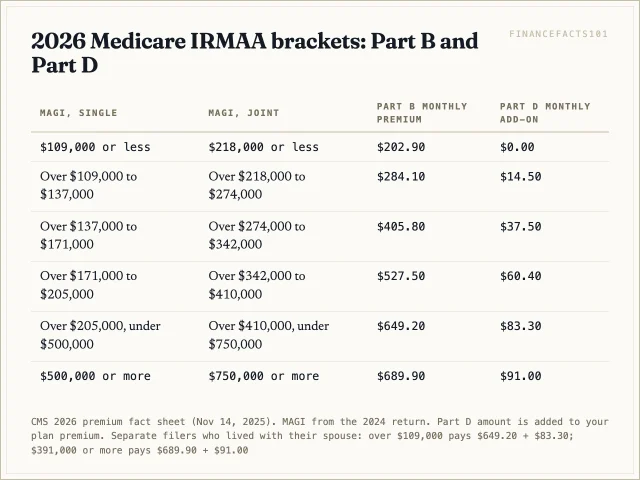
The table is the CMS fact sheet published November 14, 2025. "Greater than" matters: a single filer at exactly $109,000 pays the standard premium, and $109,000.01 pays the first tier, as the dollar ranges on the SSA-44 form spell out. The top tier starts at $500,000 single and $750,000 joint, while married filing separately starts at the second-highest tier for anyone above $109,000.
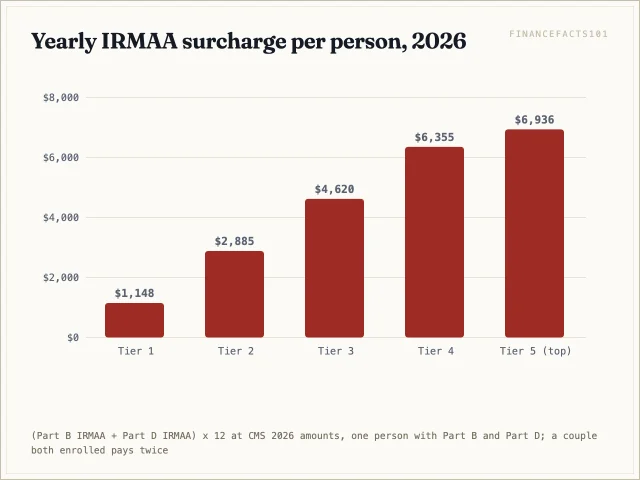
Annualised, the surcharge per person runs from $1,148.40 in the first tier to $6,936.00 at the top. For a couple who both have Part B and Part D, double each figure: $2,296.80 to $13,872.00 a year.
2027 and 2028 IRMAA amounts: what is published and what is not
As of October 3, 2026, CMS has not published the 2027 premiums or IRMAA brackets. In recent years the Federal Register notice has appeared between late September and late November: September 29, 2022 for 2023, October 17, 2023 for 2024, November 14, 2024 for 2025 and November 19, 2025 for 2026. Until the 2027 notice appears, any 2027 table you see is a projection.
What is already fixed is which income counts. 2027 premiums will use 2025 returns, which most people have already filed, so for most households the 2027 tier is decided and only the dollar lines are unknown.
The single and joint lines are indexed to consumer prices. Under 42 USC 1395r(i)(5), each line is raised by the percentage by which average consumer prices for the 12 months to August of the prior year exceed their average in a fixed base period, rounded to the nearest $1,000. The single line has risen from $85,000, where 20 CFR 418.1105 fixed it through 2019, to $109,000 for 2026, and it would fall only if average prices fell, so the 2026 single and joint lines are a reasonable planning floor for 2027 and 2028. One line moves the other way: for married people who file separately and lived together, 42 USC 1395r(i)(3)(C)(iii) subtracts the single threshold from the $500,000 line, so their top line, $391,000 for 2026, drops each time the single threshold rises. The $500,000 and $750,000 top lines themselves have been fixed since 2019, and under 20 CFR 418.1115(e)(2) they start rising with inflation in 2028.
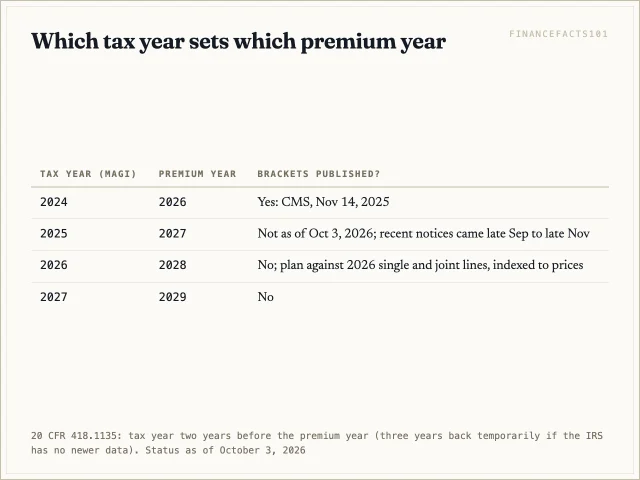
The practical rule: test this year's income against the latest published lines. If the lines rise by the time your premium year arrives, the increase becomes a free cushion.
The cliff: what one dollar over a threshold costs
Take a single retiree whose 2024 MAGI was $109,000. Her 2026 Part B premium is the standard $202.90 a month, and her Part D plan carries no surcharge. Had a fund paid her one more dollar of dividends that year, MAGI of $109,001 would put her in the first tier: Part B of $284.10 plus a $14.50 Part D add-on, $95.70 a month more for all twelve months of 2026. One dollar of income cost $1,148.40.
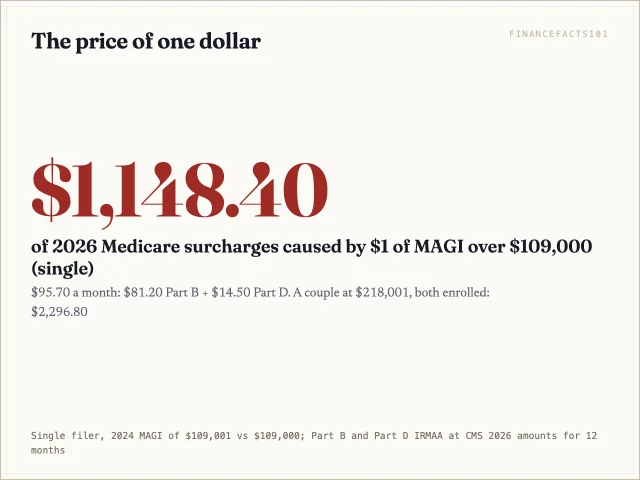
For a married couple filing jointly, the first line is $218,000. At $218,001 both spouses move up, and the surcharge is $2,296.80 a year if both have Part D, or $1,948.80 if neither does. The next cliffs cost more per person, $1,735 to $1,736 a year each at $137,000, $171,000 and $205,000 single, then $580.80 at the top line.
The flip side is less often explained. Once you are over a line, the rest of that tier costs no more IRMAA. A couple who cross $218,000 and use the whole tier up to $274,000 spread the $2,296.80 over $56,000 of income: 4.1 cents a dollar. The next two tiers add 5.1 cents a dollar each, and the wide band from $410,000 to $750,000 adds about 1 cent.
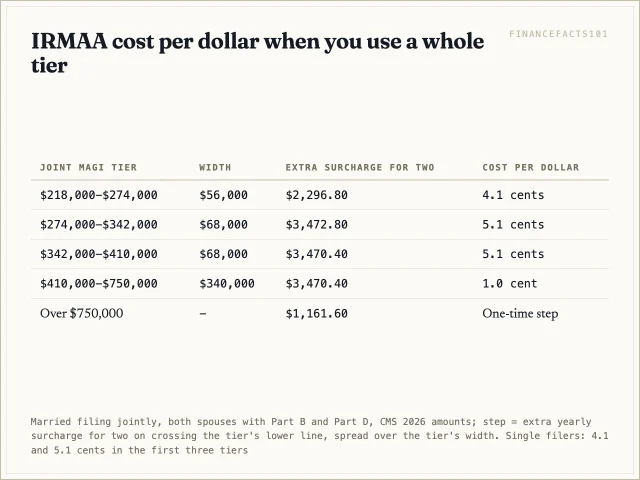
So the worst place to be is a few thousand dollars over a line. If you cross one, crossing it by a lot spreads the cost; if you are just over, trimming income to get under is the best-paid dollar you will ever save.
What counts in MAGI, and what does not
The trap is income that does not feel like income. A Roth conversion, a required minimum distribution, a mutual fund's December capital-gain distribution and municipal bond interest all count. So does the taxable part of Social Security, which IRS Publication 915 caps at 85 percent of benefits, and the gain on a home sale above the $250,000 single or $500,000 joint exclusion described in IRS Topic 701.
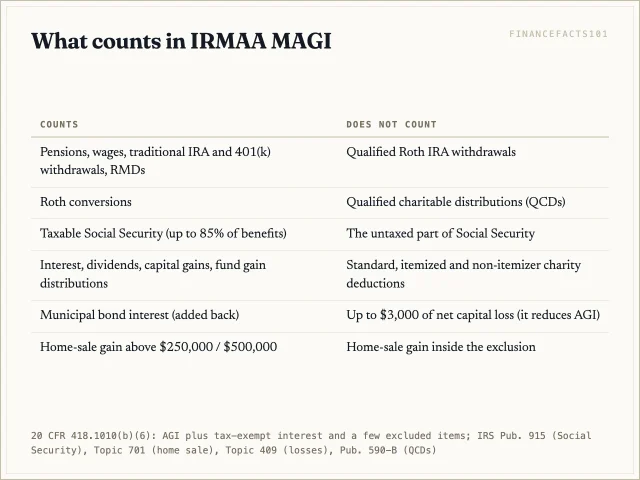
What stays out is just as useful. Qualified Roth IRA withdrawals are not in AGI. A qualified charitable distribution is excluded from income. The untaxed part of Social Security is not counted. Deductions taken after AGI, the standard deduction, itemized deductions and the new $1,000 ($2,000 joint) non-itemizer charity deduction, do nothing for IRMAA. Above-the-line items do: under IRS Topic 409, a net capital loss reduces other income by up to $3,000 a year ($1,500 married filing separately).
The lookback calendar: why 63 is the first year that counts
Medicare usually starts at 65, and your first premium year uses the return from two years before. That makes the calendar year you turn 63 the first one whose income sets a premium. Income in the year you turn 62 or earlier does not set the premium of someone who joins Medicare at 65, apart from the exceptions below.
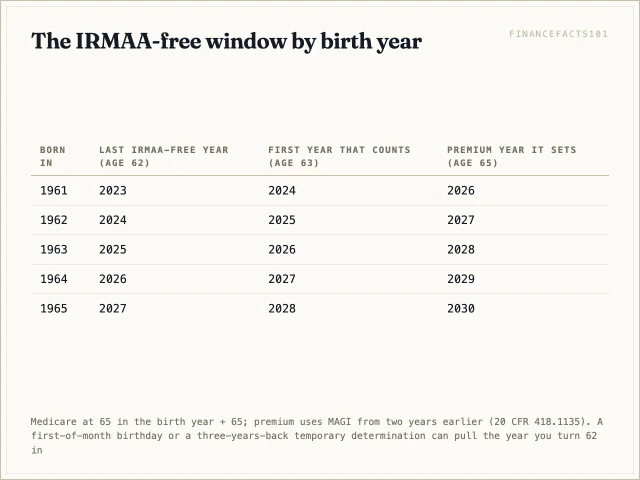
Three exceptions. If your birthday is on the first of a month, Medicare.gov says premium-free Part A starts the month before you turn 65; if Part B starts then too, a January 1 birthday puts your first premium month in December of the previous year, and income from the year you turned 62 sets that one month. A new enrollee whose two-years-back return is not yet on file can be billed temporarily on the three-years-back return, then corrected. And anyone on Medicare through disability has no window at all.
Outside those exceptions, conversions, gains and lumpy withdrawals moved into the years up to 62 carry no Medicare cost.
Roth conversions: fill the years before 63 first
The Roth conversion guide sizes conversions by tax bracket and shows how 2026's senior deduction phase-out and IRMAA change the real rate per slice. The short version for IRMAA: before 63 only the brackets limit you, and from 63 on every year's conversion has to fit under a Medicare line or pay to cross it.
To see what crossing costs, put the IRMAA into the Roth conversion calculator as extra tax paid now. Take a couple, both 65 or older, who take the standard deduction, have no tax-exempt interest and convert a $56,000 slice that uses the whole first tier, from $218,000 to $274,000 of MAGI. Under the 2026 brackets in Rev. Proc. 2025-32 that slice straddles the $211,400 top of the 22 percent bracket, and its lower part also uses up the last of the senior deduction, so its federal tax is $13,707: 24.5 percent, not 22. IRMAA adds 4.1 points, for 28.6 percent. Over 15 years at 3 percent growth, with tax paid from outside funds, the break-even future rate rises from 22.5 percent to 25.9 percent.
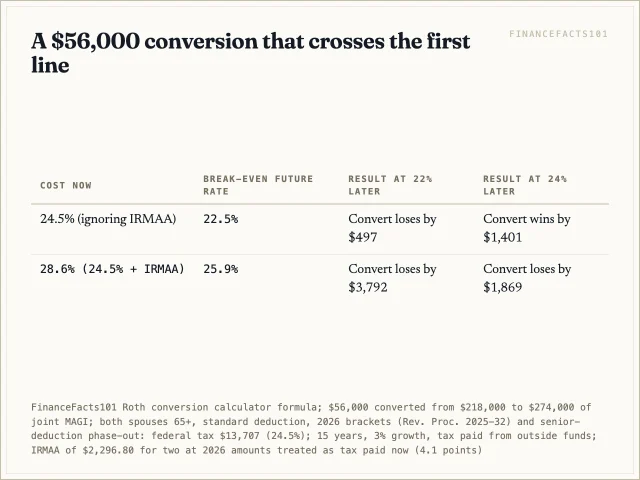
If the couple will face 22 percent later, the $56,000 slice loses by $497 even without IRMAA, and by $3,792 with it. At 24 percent later it wins by $1,401 without IRMAA and loses by $1,869 with it; with IRMAA it breaks even only at about 26 percent. A conversion that has to cross a Medicare line is rarely worth it unless you expect a rate of about 26 percent or more later, which under federal brackets alone means the 32 percent bracket, such as a survivor filing single on very large RMDs.
Worked example: the Hales' 2026 MAGI budget
Mark Hale is 66 and on Medicare; Diane is 64 and joins Medicare in 2027. They file jointly. Their 2026 income: Mark's $72,000 pension, his $36,000 of Social Security, $12,000 of taxable interest and dividends, and $8,000 of municipal bond interest. With that much other income, 85 percent of Mark's benefit, $30,600, is taxable, the Publication 915 maximum, so extra income does not raise it further.
Their AGI is $114,600 and their IRMAA MAGI, adding the muni interest back, is $122,600. Their 2026 return sets both spouses' 2028 premiums, so the room under the latest published joint line is $218,000 minus $122,600: $95,400.
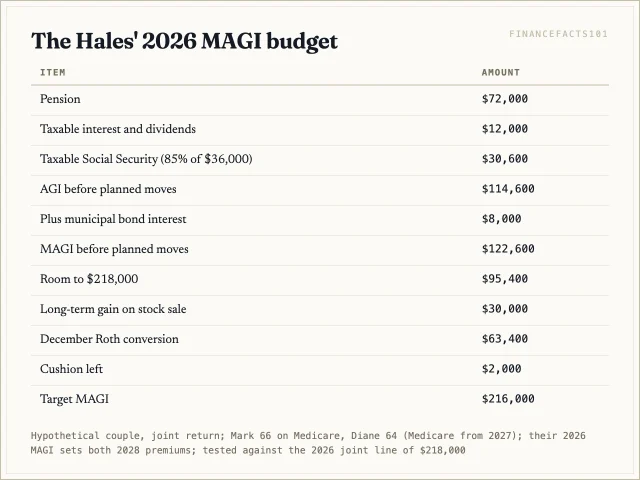
They want two things this year: a Roth conversion, and a sale of stock with a $30,000 long-term gain to pay for a new roof. Both draw on the same $95,400. Leaving $2,000 of cushion for a surprise fund distribution, they target $216,000. That allows the $30,000 gain plus a $63,400 conversion, done in December once the year's other income is known.
Overshooting would be expensive. At $218,001 of MAGI, both would pay the first tier in 2028: $2,296.80 for the year at 2026 amounts. If 2028's line is higher than $218,000, as the regulation implies it will be if prices rise, the cushion grows.
QCDs: give from the IRA and keep the gift out of MAGI
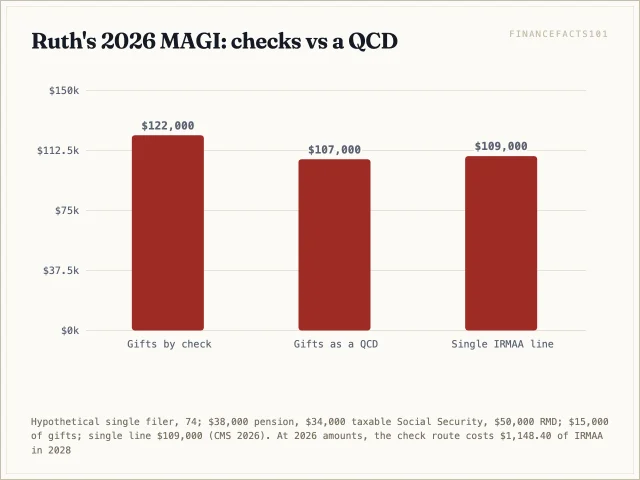
Ruth is 74 and single. Her 2026 income is a $38,000 pension, $40,000 of Social Security, $34,000 of it taxable, and a $50,000 RMD: her $1,275,000 IRA balance at the end of 2025 divided by the IRS divisor of 25.5 at age 74. Her MAGI is $122,000. She tithes $15,000 a year.
Written as checks, the gifts leave her MAGI at $122,000, above the latest single line of $109,000, and at 2026 amounts that costs her $1,148.40 of IRMAA in 2028. Sent as a qualified charitable distribution, $15,000 of her RMD goes straight from the IRA to the church and never enters AGI. MAGI falls to $107,000, $2,000 under the line, so a little unexpected bank interest does not cost her $1,148.40. Her taxable Social Security stays at the 85 percent maximum either way.
The rules are in IRS Publication 590-B: you must be at least 70½, the IRA trustee pays the charity directly, and the QCD counts toward your RMD. The annual cap is $111,000 per person for 2026 under Notice 2025-67 in Internal Revenue Bulletin 2025-49. The income-tax side of a QCD compared with writing checks, and the charities that do not qualify, are covered in the RMD guide.
Capital gains and other lumpy income: choose the year
A gain is income in the year you sell, so the lever is timing. Splitting a large sale between December and January spreads it over two tax years, each tested separately. Selling losing positions in the same year offsets gains dollar for dollar and up to $3,000 of other income; the tax-loss harvesting guide covers the wash-sale rule. Giving shares you have held more than a year to charity, rather than selling and giving cash, means the gain is never realised on your return.
Some spikes are worth paying for. A one-time event costs one year of surcharge, not a permanent one. A couple who sell a rental property and land in the top tier for one year pay $13,872 at 2026 amounts. Weigh that against the tax or investment cost of contorting the sale to avoid it. What you should not count on is relief: under 20 CFR 418.1205, losing income-producing property qualifies only when the loss is not at your direction, such as a sale, and is not ordinary investment risk.
The married-filing-separately trap
Couples who live together and file separate returns lose the stepped tiers. Under the CMS table, anyone in that position with MAGI above $109,000 jumps straight to the second-highest tier: $446.30 of Part B surcharge and $83.30 of Part D, $529.60 a month. At $391,000 or more, it is the top tier.
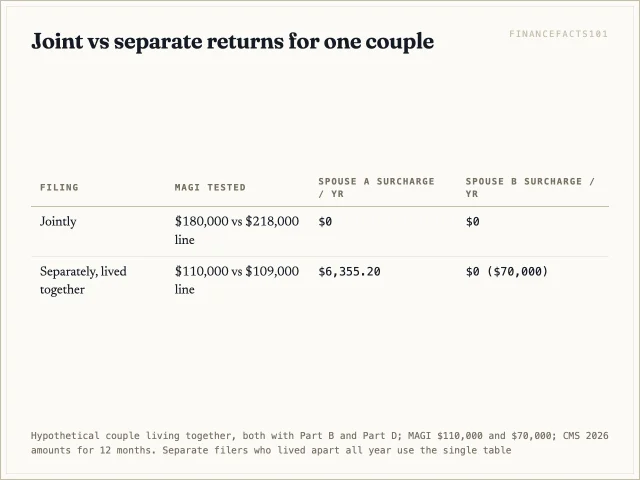
Take a couple, both on Medicare, with MAGI of $110,000 and $70,000. Filing jointly, $180,000 is under the $218,000 line and neither pays a surcharge. Filing separately while living together, the first spouse pays $6,355.20 a year at 2026 amounts. Publication 915 adds a second penalty: a separate filer who lived with their spouse at any time in the year has a $0 base amount, so up to 85 percent of their Social Security becomes taxable.
If you were married but lived apart for the whole year, the single table applies. Under 20 CFR 418.1140(e), Social Security asks for a signed statement that you lived apart and both addresses.
Life-changing events and Form SSA-44
If your income has dropped since the year Social Security used, you can ask it to use a more recent year, but only for one of seven events listed in 418.1205: your spouse dies; you marry; your marriage ends by divorce or annulment; you or your spouse stop working or cut hours; loss of income-producing property that you did not direct and that is not ordinary investment risk; a scheduled end, termination or reorganisation of an employer pension; or a settlement from an employer because of its closure, bankruptcy or reorganisation.
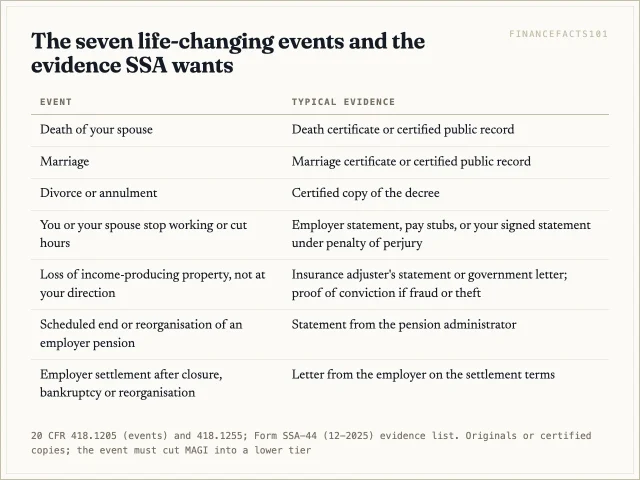
The drop must also be significant, which 20 CFR 418.1215 defines as moving you to a lower tier or below the line. Section 418.1210 rules out events that change your expenses but not your income, and dividend losses from ordinary investment risk. A Roth conversion, a large capital gain or a one-off IRA withdrawal is not on the list.
The request goes on Form SSA-44, currently the December 2025 edition. Social Security's IRMAA page lets you upload it after signing in, fax or mail it to a local office, or call 1-800-772-1213. You name the event and its date, give AGI and tax-exempt interest for the newer year (an estimate is allowed if you have not filed yet), add next year's estimate if it will be lower still, and attach evidence. For a work stoppage that can be an employer's statement, pay stubs or, failing those, your own statement under penalty of perjury.
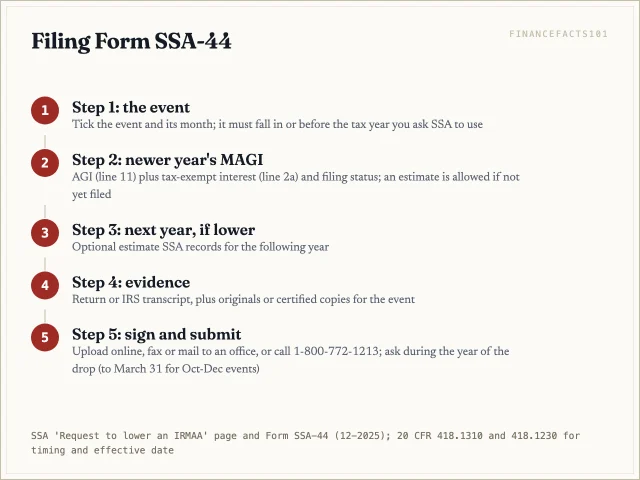
Timing follows 20 CFR 418.1310(a)(4): you can ask at any time during the calendar year in which the reduction happens, or until March 31 of the next year if the event fell in October through December. Under 418.1230, a granted request is generally effective January 1 of the year you make it, so months already paid are corrected.
Take Paula and Jim Lee, both 66 and on Medicare. Paula stopped working in June 2025. Their 2024 MAGI of $290,000 put both in the second tier for 2026: $240.40 a month each, $5,769.60 a year for the couple. Their 2026 MAGI will be about $120,000. If Social Security approves an SSA-44 filed in 2026 citing "work stoppage" with the 2026 estimate, the surcharge is removed back to January. Their 2025 MAGI of $185,000, half a year of salary included, is already under the line, so 2027 needs no form. Social Security later checks the estimate against the IRS and corrects in either direction.
When the notice is wrong, and when a spouse dies
If you amend the return Social Security used, send the amended return and the IRS's acknowledgement within three calendar years after that tax year closes, per 20 CFR 418.1150. If the IRS figure itself is wrong, get proof of the correction from the IRS; under 20 CFR 418.1330, Social Security will dismiss a reconsideration request that argues only that the IRS data is wrong and send you to the IRS for that proof.
Widowhood needs planning ahead. For the year a spouse dies, the survivor who has not remarried can still file jointly, per IRS Publication 501. After that, the survivor files single against a line half as high, often on nearly the same pension and RMD income. A survivor with $140,000 of MAGI lands in the second single tier, $2,884.80 a year at 2026 amounts. The death is a life-changing event, but SSA-44 helps only if the newer year's MAGI falls into a lower tier under the survivor's filing status. Conversions done while both spouses are alive are the main defence, and how much you need to retire should budget for the surcharge if it is likely.
Social Security timing and IRMAA
Up to 85 percent of Social Security benefits enter AGI, so claiming earlier adds MAGI in exactly the years you might want for conversions. The trade-off belongs in when to claim Social Security, but IRMAA tilts it: each year of delay before 70 is a year with more MAGI room. Once benefits start, the Part B surcharge is generally withheld from your benefit under the Medicare premium-collection rules that 418.1110 points to, and under 20 CFR 418.2112 the Part D surcharge is deducted too when the benefit is large enough, so the cost shows up as a smaller deposit rather than a bill.
The decision, step by step
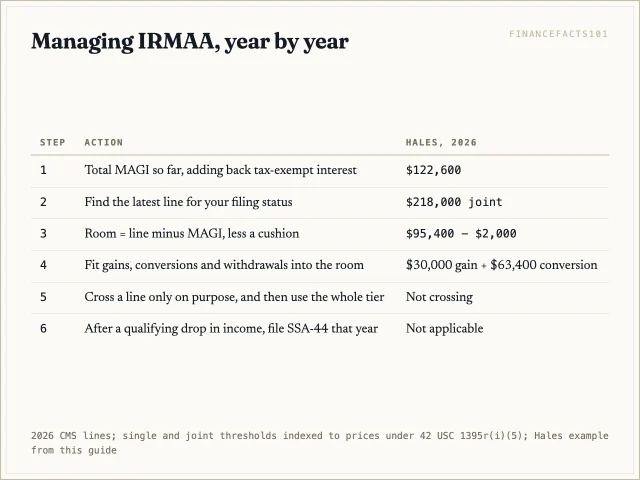
Do it once a year, in November or December when the year's income is mostly known. Total your MAGI so far, including muni interest, check it against the latest published line for your filing status, and plan conversions, gains and withdrawals to stop below it with a small cushion. Cross a line only when the move is worth the tier's cost per dollar, and then use the whole tier. If your income has dropped because of one of the seven events, file SSA-44 the year it happens.
FAQ
What income year is used for IRMAA in 2026?
Your 2024 modified adjusted gross income, meaning AGI plus tax-exempt interest from the 2024 federal return, as reported by the IRS. If that return was not available, Social Security used 2023 temporarily and corrects the premium once 2024 arrives. 2027 premiums will use 2025 returns, and 2028 premiums 2026 returns.
Does a Roth conversion count toward IRMAA?
Yes. A conversion is taxable income in the year you do it, so it raises AGI and MAGI and can raise your premiums two years later. It is not a life-changing event, so Form SSA-44 cannot remove the surcharge it causes. Conversions done in the years you turn 62 or younger generally do not affect IRMAA if Medicare starts at 65; a January 1 birthday, a temporary three-years-back determination or Medicare through disability are the exceptions.
Can I lower IRMAA after I retire?
Usually, yes. Stopping work or cutting hours is one of the seven life-changing events. If retirement moves your current-year MAGI into a lower tier, file Form SSA-44 with Social Security that year and the change is generally effective January 1 of the year you ask.
When will the 2027 IRMAA brackets be announced?
CMS had not announced them as of October 3, 2026. The 2026 figures came out on November 14, 2025, and recent Federal Register notices have appeared between late September and late November. The single and joint thresholds are indexed to inflation and would fall only if prices fell, so the 2026 single and joint lines are a reasonable planning floor. The top line for married people filing separately while living together moves the other way, falling as the single threshold rises.
Does IRMAA apply to Medicare Advantage?
Yes. Medicare Advantage members keep paying the Part B premium, including any income-related surcharge, and drug coverage inside a Medicare Advantage plan counts as a Part D plan, so the Part D surcharge applies too. It is paid to Medicare or withheld from Social Security, not to the plan.
Sources
- CMS, 2026 Medicare Parts A & B premiums and deductibles; 2026 Part D income-related monthly adjustment amounts, November 14, 2025: every 2026 bracket and amount
- Federal Register, Medicare Part B monthly actuarial rates, premium rates and annual deductible beginning January 1, 2026: 25 percent standard share; 35 to 85 percent tiers
- eCFR, 20 CFR 418.1010: definition of MAGI for IRMAA
- eCFR, 20 CFR 418.1105 and 418.1115: $85,000 threshold through 2019; ranges; top lines indexed from 2028
- U.S. Code, 42 USC 1395r (govinfo): (i)(5) inflation indexing of the thresholds; (i)(3)(C)(iii) the separate-filer table
- eCFR, 20 CFR 418.1110, 418.1135, 418.1140 and 418.1150: enrolled months, two-year and three-year lookback, living apart, amended returns
- eCFR, 20 CFR 418.1205, 418.1215 and 418.1230: life-changing events, significant reduction, effective date
- eCFR, 20 CFR 418.1310: when to request a new determination
- eCFR, 20 CFR 418.2112: how the Part D surcharge is paid
- eCFR, 42 CFR 423.286: Part D IRMAA applies to Part D plan enrollees
- Social Security, Request to lower an IRMAA and Form SSA-44 (12-2025): how to file, the event list, evidence
- Medicare.gov, When does Medicare coverage start? and Costs: first-of-month birthdays; Part B premium for Medicare Advantage members
- IRS, Publication 590-B and Internal Revenue Bulletin 2025-49 (Notice 2025-67): QCD rules; $111,000 limit for 2026
- IRS, Publication 915: 85 percent maximum; $0 base amount for separate filers living together
- IRS, Topic 409, Capital gains and losses and Topic 701, Sale of your home: $3,000 loss limit; $250,000 / $500,000 exclusion
- IRS, Publication 501: joint return in the year a spouse dies
- IRS, Rev. Proc. 2025-32: 2026 tax brackets, standard deduction and additional standard deduction at 65
- IRS, Schedule 1-A (Form 1040): the senior deduction and its 6% phase-out above $150,000 joint MAGI
 Next entry · No. 5,994How Much Car Can I Afford? Price Ceilings at Three Incomes
See also
-
 No. 5,970
04 Oct 2026
17 min
Required Minimum Distributions: When to Start, How Much, and How to Cut the Tax
Retirement
-
 No. 5,969
03 Oct 2026
19 min
Should I Do a Roth Conversion in 2026? How Much to Convert
Retirement
-
 No. 5,973
07 Oct 2026
16 min
How Much Do I Need to Retire? Spending, Social Security and the 4% Rule
Retirement
-
 No. 5,987
21 Oct 2026
19 min
Should I Do a Backdoor Roth IRA? How to Avoid the Pro-Rata Tax
Retirement
-
 No. 5,984
18 Oct 2026
17 min
Are Annuities Worth It? What They Pay, What They Cost
Retirement
-
 No. 5,979
13 Oct 2026
17 min
Roth 401(k) vs Traditional 401(k): Which Should You Choose?
Retirement