How Much Car Can I Afford? Price Ceilings at Three Incomes
The 20/4/10 rule of thumb caps an $85,000 household near a $25,000 car at 7.54%; AAA puts the 2026 cost of owning a new car at $12,863 a year.
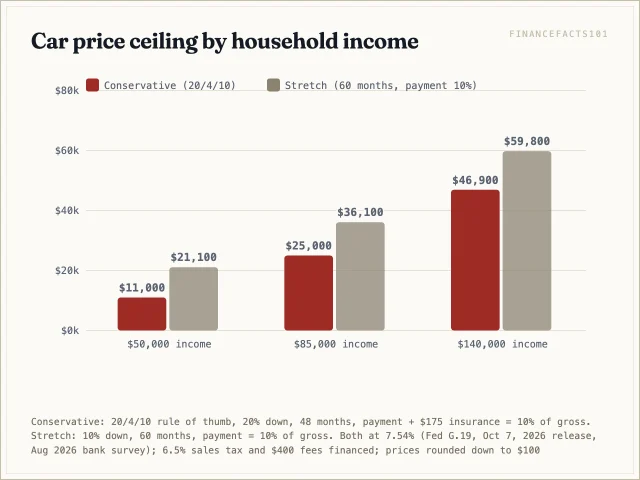
How much car can I afford? Under the 20/4/10 rule of thumb (20% down, a loan of four years or less, and payment plus insurance at no more than 10% of gross income), a household earning $85,000 tops out near a $25,000 car at 7.54%, the new-car rate banks reported in an August 2026 survey published in the Federal Reserve's consumer credit release of October 7, 2026, while $50,000 supports about $11,000 and $140,000 about $46,900. This guide's looser test, inside the range lenders routinely approve, is a 60-month loan with the payment alone at 10% of gross income; it stretches those ceilings to $21,100, $36,100 and $59,800, but once insurance, fuel and upkeep are added the stretch car takes 14.5% to 22.6% of gross income every month.
The gap between those two answers is the decision. This guide shows where each number comes from, how a lender reads them, what the car costs beyond the payment according to AAA's 2026 Your Driving Costs study, and how buying used or the temporary car loan interest deduction moves the ceiling.
Scope honesty: this is general information built on stated assumptions and rates dated between December 2025 and October 2026, not personal advice. Your insurance quote, your loan rate and the car itself will move every number.
Who this is for — and who it is not for
This guide is for a US household setting a price limit before it shops for a car for personal use, whether new or used, financed or partly financed. It is most useful before you talk to a dealer, because a salesperson will usually ask what monthly payment you want, and almost any price can be made to fit a payment by stretching the term.
It is not for business vehicles, where depreciation deductions change the math, or for leases, which are priced differently; if you are weighing a lease, our lease vs buy guide runs that comparison over three, six and ten years. It also does not settle how long the loan should be once the price is set. That is a separate decision, covered in our car loan term guide.
Three ways to size a car budget
Three measures answer the question, and they disagree.
Payment-to-income is the monthly loan payment as a share of gross monthly income. It is quick and lenders use it, but it ignores everything you pay after you drive away.
Debt-to-income counts every required debt payment, including the new car, against gross income. It matters most if a mortgage application is coming.
Total cost of ownership adds depreciation, financing, insurance, fuel, maintenance and fees. It is the most complete measure and the one most buyers skip. The CFPB's guide to auto loans lists "Factor in all the costs of ownership" as a budgeting step, naming "Insurance, gas, registration fees, maintenance, and repairs, plus other costs you pay for as long as you own the vehicle."
The 20/4/10 rule sits between the first and the third. It caps the payment plus insurance, so it reaches past the loan without pricing fuel or repairs.
What lenders look at: payment-to-income and DTI
Auto lenders do not publish a single industry cutoff. The CFPB, describing typical underwriting in a 2024 report on auto finance, lists the applicant's "credit score, payment-to-income ratio, debt-to-income ratio, history of delayed payments, the number of auto loans outstanding, and documentation that the borrower has at least 24 months of credit history."
What lenders actually approve is visible in the CFPB's auto finance data pilot, which covers almost 34 million loans originated from 2018 to 2022 at nine lenders: three banks, three finance companies and three automakers' captive lenders. In its June 2024 report on negative equity, the median payment-to-income ratio for buyers with no trade-in was 7.4%, and a quarter of them paid more than 10.9% of income.
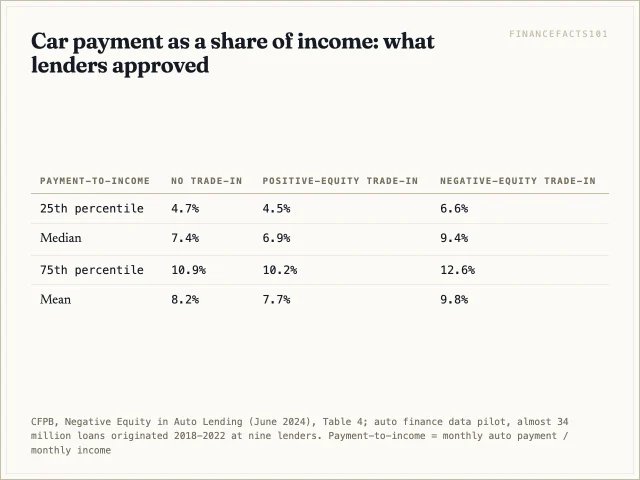
Those are approvals, not recommendations. The CFPB notes that "A higher payment-to-income ratio indicates a reduction in a consumer's ability to weather a financial shock."
Debt-to-income is the broader test. The CFPB defines it as "all your monthly debt payments divided by your gross monthly income," and says different loan products and lenders set different limits. Our debt-to-income calculator shows your ratio with a car payment added.
The 20/4/10 rule of thumb, and what it leaves out
The 20/4/10 rule is a rule of thumb, not a regulation or a lender requirement: at least 20% down, a loan of no more than four years, and total car costs under 10% of gross income. Versions differ on what the 10% covers. This guide uses the common version that counts the loan payment and insurance, and adds fuel and maintenance as a separate check.
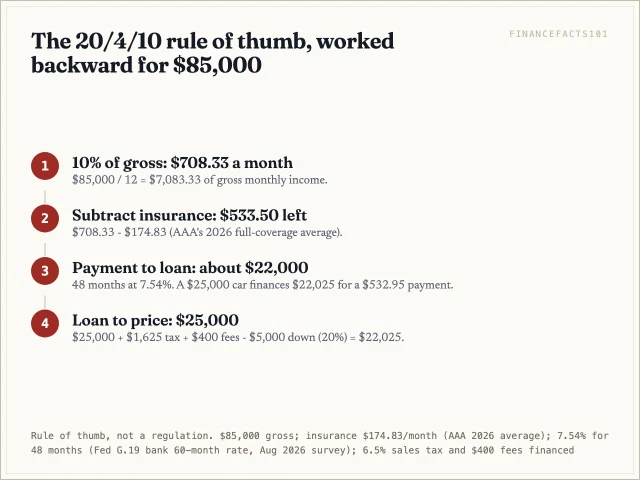
The rule works backward from income to price:
Twenty percent down makes it less likely you owe more than the car is worth early on. Four years stops a long term from disguising an expensive car as an affordable payment. Ten percent of gross keeps the car from crowding out savings and housing.
What it leaves out is fuel, maintenance and repairs, which for an average new car run about $350 a month on this guide's assumptions. It also ignores income level. At $140,000 a year, 10% leaves plenty of room; at $50,000, the same 10% buys about an $11,000 car. Treat the rule as a conservative ceiling, not the only defensible one.
Total cost of ownership: AAA's 2026 numbers
AAA's Your Driving Costs 2026 fact sheet, published in September 2026, puts the average cost to own and operate a new car at $12,863 a year, or $1,071.92 a month, on a weighted average MSRP of $39,376. AAA averages each cost over five years and 75,000 miles, using five top-selling models in each of seven vehicle categories. It is an industry estimate, not a government statistic.
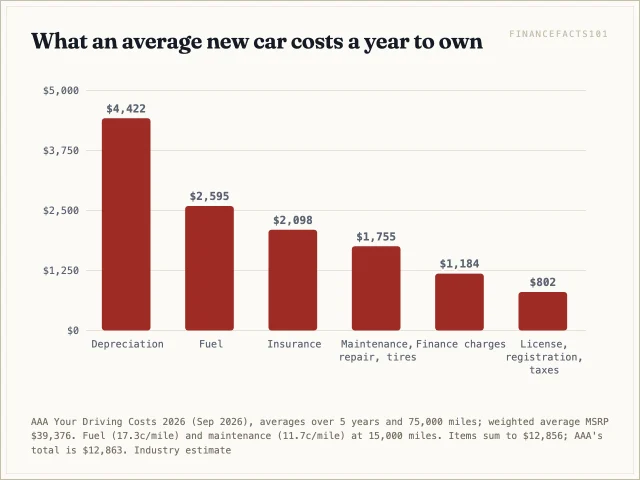
Depreciation is the largest item at $4,422 a year, about a third of the total. Fuel at 17.3 cents a mile and maintenance, repair and tires at 11.7 cents a mile come to $2,595 and $1,755 at 15,000 miles a year.
The vehicle matters as much as the income. AAA's per-mile averages run from 61.73 cents for small sedans to $1.10 for half-ton pickups:
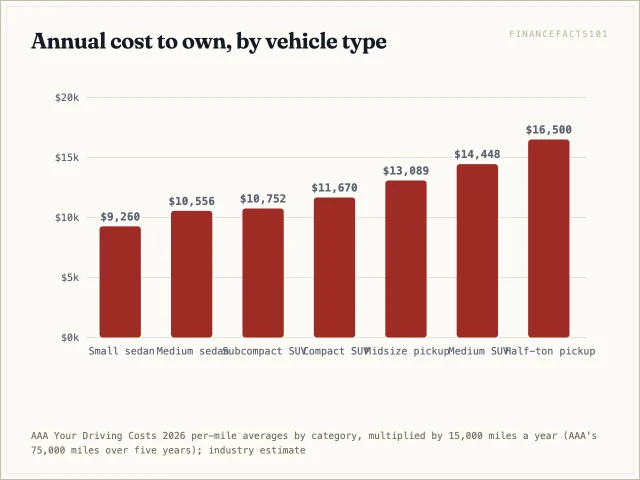
At 15,000 miles a year, that is about $9,260 a year for a small sedan against $16,500 for a half-ton pickup. The $7,240 difference is more than the average annual insurance bill and the average annual fuel bill combined.
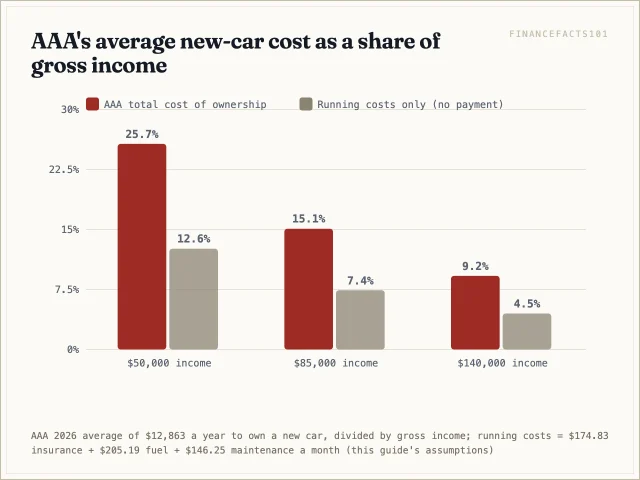
Measured against income, AAA's average new car takes 25.7% of a $50,000 gross income, 15.1% of $85,000 and 9.2% of $140,000.
Insurance and fuel: the costs that move most right now
Two running costs moved sharply over the past year, in opposite directions. In the Bureau of Labor Statistics' August 2026 consumer price index, gasoline prices were up 27.4% from a year earlier, while motor vehicle insurance was down 5.1%.
Fuel. The Energy Information Administration's weekly survey put regular gasoline at $4.465 a gallon in the week of September 28, 2026, against $3.118 a year earlier. The average model year 2024 new vehicle achieved a record 27.2 mpg in real-world driving, according to the EPA's Automotive Trends Report. At 15,000 miles a year, that is $2,462 a year, or $205 a month. A 22-mpg SUV costs $254 a month at the same price; a 35-mpg hybrid, $159.
Insurance. AAA's estimate is $2,098 a year, or $175 a month, for a full-coverage policy for a driver under 65 with more than six years of experience and no accidents. Young drivers, drivers with claims and expensive cars pay more. Get a quote for the exact model first: a $100 difference in monthly insurance moves the 20/4/10 price limit by about $4,800.
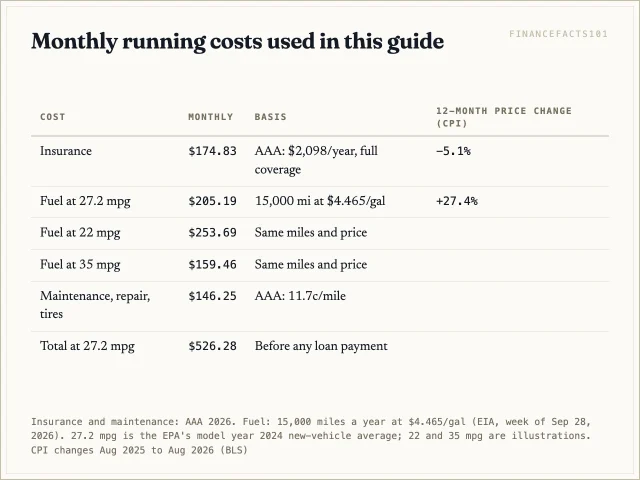
Maintenance. AAA's 11.7 cents a mile, or $146 a month at 15,000 miles, covers routine service, wear items and one set of tires over five years, and includes an extended warranty. That is a new-car figure; a used car past its warranty is no cheaper to keep running, so do not budget less.
This guide leaves AAA's $802 a year for license, registration and taxes out of the monthly running cost. That figure includes taxes paid at purchase, which the worked examples already finance through the loan, so counting it again would double-count the sales tax. Annual registration fees vary by state; add yours.
Depreciation: the biggest cost you never write a check for
AAA measures depreciation as the gap between the purchase price and the estimated trade-in value after five years and 75,000 miles. At $4,422 a year, the average new car loses $22,110, or 56% of its $39,376 price, in five years.
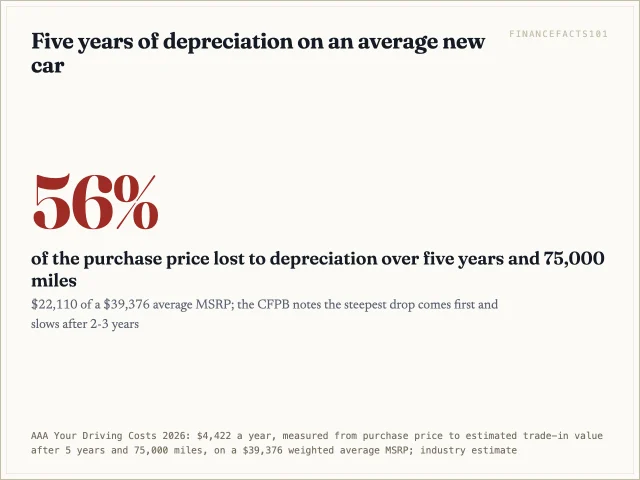
The loss is not spread evenly. In the CFPB's words, "For new cars, the vehicle value drops sharply the moment the consumer takes ownership of the vehicle, then the depreciation rate slows after the first 2-3 years of ownership." That early drop is why a small down payment and a long loan leave many buyers owing more than the car is worth, a risk the car loan term guide measures month by month.
It is also the cost you can shrink most by choice: a cheaper car, a used one, or keeping the car longer. The CFPB's guide advises buyers to "look at the estimated resale value for similar vehicles" before deciding what to pay.
How much car can I afford at $50,000, $85,000 or $140,000?
The assumptions:
- Two ceilings. Conservative is the 20/4/10 rule: 20% down, 48 months, payment plus insurance at 10% of gross monthly income. Stretch is a 60-month loan with 10% down and the payment alone at 10% of gross, between the median and 75th-percentile payment-to-income ratios in the CFPB data.
- Rate. 7.54%, the commercial bank average for 60-month new-car loans in the Fed's G.19 release of October 7, 2026. Banks were surveyed in August 2026, before the Federal Open Market Committee raised the federal funds target range to 3.75%-4.00% on September 16; its next meeting is October 27-28, ending the day this guide was published. The G.19 has no 48-month bank rate, so the 48-month case uses 7.54% too; banks in the NCUA's December 26, 2025 comparison priced 48 months 0.08 points below 60, so that is slightly conservative.
- Purchase costs. 6.5% sales tax and $400 of title and doc fees, financed, minus the down payment: the same method as our auto loan calculator.
- Running costs. Insurance $174.83, fuel $205.19 and maintenance $146.25 a month, from the section above: $526.28 in all.
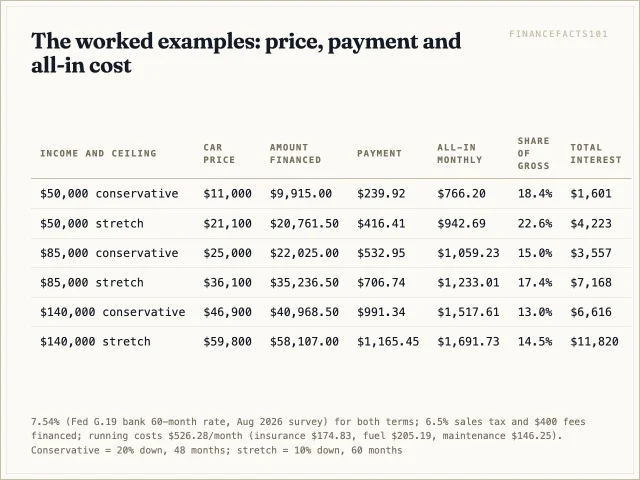
At $85,000, the conservative ceiling works like this. Ten percent of $7,083.33 is $708.33; less $174.83 of insurance, that leaves $533.50 for the payment. A $25,000 car with $5,000 down, $1,625 of tax and $400 of fees finances $22,025, which at 7.54% over 48 months is a $532.95 payment. Payment plus insurance is $707.78, 9.99% of gross. Add fuel and maintenance and the all-in monthly cost is $1,059.23, or 15.0%.
The stretch ceiling for the same household is a $36,100 car: $3,610 down, $35,236.50 financed, a $706.74 payment over 60 months. All-in, it costs $1,233.01 a month, 17.4% of gross, and $7,168 of interest against $3,557.
Running costs are close to a fixed dollar amount, so they weigh hardest on the smallest income: $526 a month is 12.6% of gross monthly income at $50,000 a year before any car payment, 7.4% at $85,000 and 4.5% at $140,000. And the stretch ceiling buys 28% to 92% more car than the conservative one, which is exactly why it feels affordable at the dealership.
How a car payment shrinks the house you can buy
If a home purchase is a few years off, the car payment is also a mortgage decision. Fannie Mae's Selling Guide sets a maximum total debt-to-income ratio of 36% for manually underwritten loans, which can be exceeded up to 45% if the borrower meets its credit score and reserve requirements, and a 50% maximum for loans run through its Desktop Underwriter system.
At 36% of $7,083.33, the $85,000 household can carry $2,550 of total debt a month; a $706.74 stretch car payment leaves $1,843 for housing.
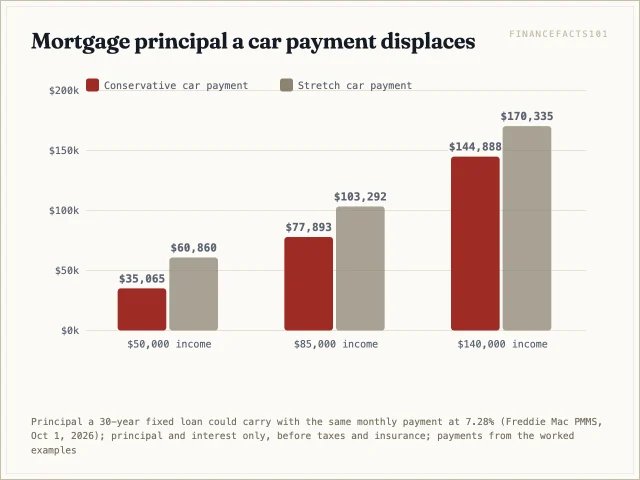
At the 7.28% average 30-year fixed rate in Freddie Mac's Primary Mortgage Market Survey for October 1, 2026, each $100 of monthly payment supports about $14,615 of mortgage principal, before taxes and insurance. The $706.74 stretch payment uses up the payment that would carry about $103,300 of mortgage; the $533 conservative payment, about $77,900. Our house affordability guide works through the housing side.
New vs used: what the same budget buys
A used car lets someone else absorb the steepest depreciation, but it usually costs more to finance. Experian, a credit bureau reporting its own loan data, put the average used-car loan at 11.19% in the second quarter of 2026, against 6.35% for new; the average used-car payment was $542 on $27,852 borrowed, the average new-car payment $765 on $43,610.
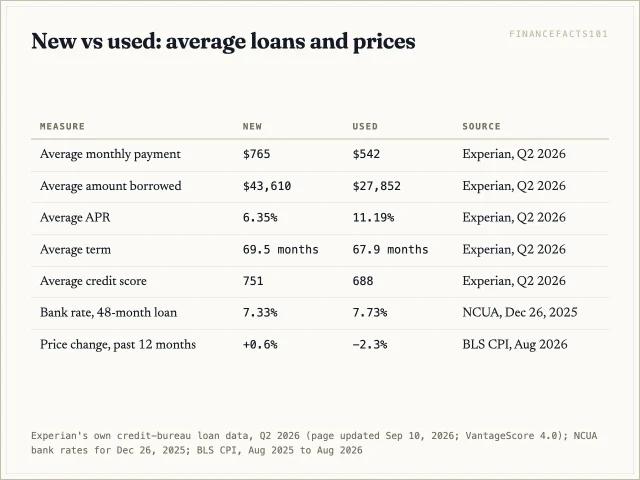
Part of that rate gap reflects who borrows: Experian's average VantageScore 4.0 credit score was 688 for used-car loans and 751 for new. Among banks alone, the gap is smaller: in the NCUA's December 2025 data, banks charged 7.73% on 48-month used-car loans against 7.33% on new.
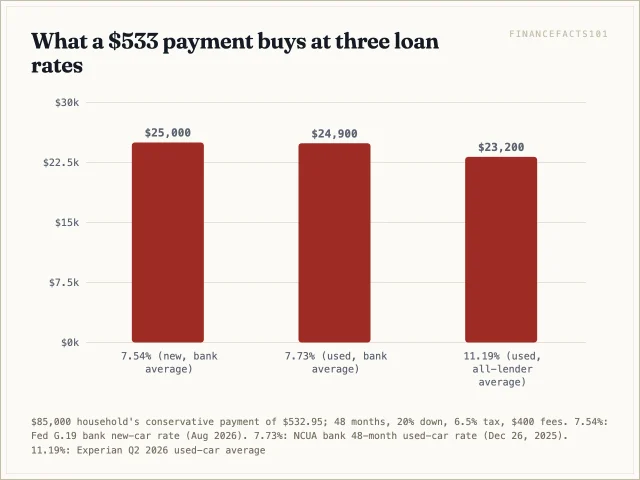
The rate gap moves the ceiling only modestly. For the $85,000 household, the conservative $533 payment over 48 months with 20% down buys a $25,000 car at 7.54%, about $24,900 at 7.73% and about $23,200 at 11.19%.
Prices moved in the buyer's favor over the past year: the August 2026 CPI showed used cars and trucks down 2.3% from a year earlier and new vehicles up 0.6%. The trade-offs are warranty coverage and condition. The FTC's used-car buying guide explains that a dealer's Buyers Guide must show whether the car is sold "as is" or with a warranty, and that "A vehicle history report is not a substitute for an independent vehicle inspection."
Does the car loan interest deduction raise your price limit?
For tax years 2025 through 2028, section 70203 of Public Law 119-21 and the final regulations in Internal Revenue Bulletin 2026-39 let you deduct interest on a first-lien loan taken out after 2024 to buy a new, US-assembled vehicle for mostly personal use, with the VIN reported on your return; used cars and leases do not qualify. The deduction is capped at $10,000 a year, and that capped amount (not the cap) is then reduced by $200 for each $1,000, or part of $1,000, of modified adjusted gross income above $100,000 ($200,000 joint); our car loan term guide sets out every condition.
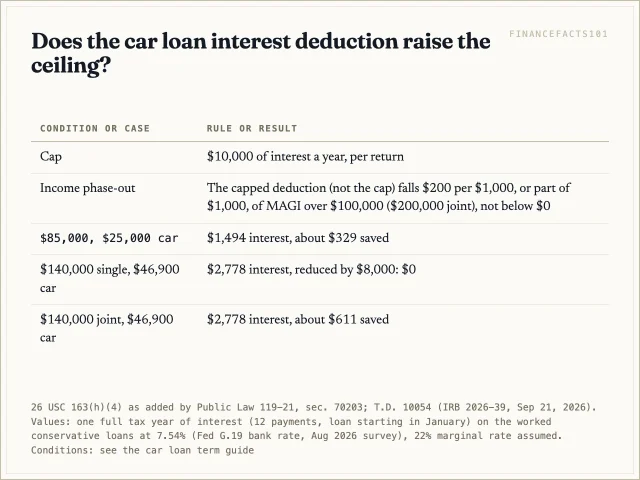
What it is worth is modest. If the $85,000 household's $25,000 conservative car qualifies, twelve payments in a full tax year (a loan starting in January) include $1,494 of interest; at a 22% marginal rate that saves about $329. A single filer with $140,000 of MAGI is $40,000 over the threshold, so the deduction is reduced by $8,000, and the year's $2,778 of interest on the $46,900 car is wiped out entirely. A joint filer at the same income keeps all of it, worth about $611 at 22%. The deduction trims a few hundred dollars a year off a qualifying new car's interest, through 2028; it does not raise the ceiling.
Setting your own ceiling in five steps
The worked numbers are a template for your own:
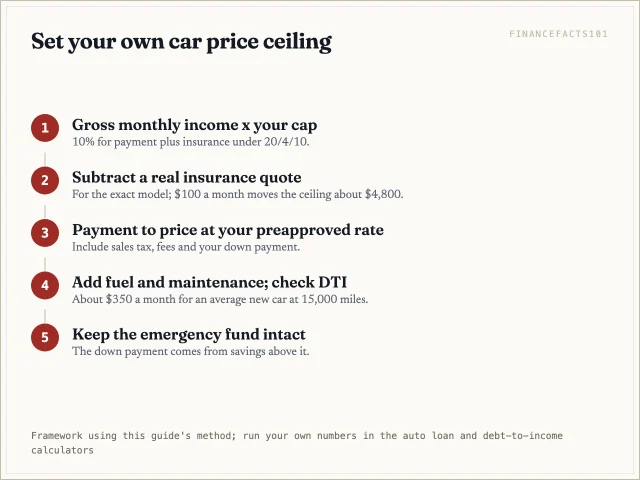
- Start from gross monthly income and pick your cap: 10% for payment plus insurance under 20/4/10, or an all-in share you can defend.
- Subtract a real insurance quote for the exact model.
- Get a preapproval. The CFPB's guide notes that a preapproval "also helps you set a budget without the pressure you might feel" at the dealership. Its rate turns the payment into a price in the auto loan calculator.
- Add fuel and maintenance and check the all-in share, and your DTI if a mortgage is coming.
- Protect your cushion. The down payment should come from savings above your emergency fund; our emergency fund guide covers how big that should be.
If the car you want only fits at 72 or 84 months, the payment is telling you the price is too high for now.
FAQ
What percentage of income should go to a car payment?
There is no federal limit. The 20/4/10 rule of thumb keeps payment plus insurance under 10% of gross income. In the CFPB's 2018-2022 loan data, the median buyer without a trade-in had a payment of 7.4% of income, and a quarter paid more than 10.9%.
How much car can I afford on $50,000 a year?
Under 20/4/10, about $11,000 with $2,200 down, a 48-month loan at 7.54%, and $175 a month of insurance. The looser 60-month test, with the payment alone at 10% of gross, stretches that to about $21,100, but its all-in monthly cost, at about $943, would take 22.6% of gross income.
Is a car payment counted in debt-to-income?
Yes. Lenders count required monthly debt payments, including car loans, against gross monthly income. Fannie Mae's maximum total DTI is 36% for manually underwritten mortgages, up to 45% with qualifying credit and reserves, and 50% through its automated system.
Should car insurance count in the 10%?
Versions of the 20/4/10 rule differ, and counting insurance is the stricter one. For the $85,000 household, a payment-only 10% cap at 48 months with 20% down allows about a $33,300 car and a $706.68 payment, but adding $174.83 of insurance takes the total to 12.4% of gross. Counting insurance holds the ceiling at $25,000, and since insurance must be paid either way, it is the more honest test.
Sources
- Federal Reserve, Consumer Credit - G.19 (release of October 7, 2026; bank rates surveyed August 2026)
- Federal Reserve, FOMC statement of September 16, 2026
- NCUA, Credit Union and Bank Rates 2025 Q4 (rates for December 26, 2025)
- CFPB, Negative Equity in Auto Lending (June 2024; auto finance data pilot, loans originated 2018-2022)
- CFPB, Auto Finance in the Electric Vehicle Transition (April 2024)
- CFPB, Take control of your auto loan (March 2024)
- CFPB, What is a debt-to-income ratio?
- Bureau of Labor Statistics, CPI detailed expenditure categories, August 2026 (released September 11, 2026)
- U.S. Energy Information Administration, Gasoline and Diesel Fuel Update (week of September 28, 2026)
- EPA, Highlights of the Automotive Trends Report (model year 2024 data)
- Fannie Mae, Selling Guide B3-6-02, Debt-to-Income Ratios
- Freddie Mac, Primary Mortgage Market Survey (October 1, 2026)
- U.S. Government Publishing Office, Public Law 119-21, section 70203 (July 4, 2025)
- IRS, Internal Revenue Bulletin 2026-39: T.D. 10054, final regulations on qualified passenger vehicle loan interest (September 21, 2026)
- FTC, Buying a Used Car From a Dealer
- AAA, Your Driving Costs 2026 fact sheet (September 2026; industry estimate)
- Experian, Average Car Payment (Q2 2026 data; Experian credit-bureau loan data)
 Next entry · No. 5,995Medicare IRMAA: How It Is Calculated and How to Avoid It
See also
-
 No. 5,971
05 Oct 2026
18 min
Car Loan Term: 48, 60, 72 or 84 Months - Which to Choose
Personal Finance
-
 No. 5,972
06 Oct 2026
18 min
Lease or Buy a Car? The 3-, 6- and 10-Year Cost Math
Personal Finance
-
 No. 4,218
31 May 2025
19 min
Understanding Qualifying Ratios: Debt-to-Income and Housing Expense Ratio
Mortgage
-
 No. 1,144
03 Aug 2024
19 min
Understanding Debt-to-Income (DTI) Ratio: The Importance and Limitations
Consumerism
-
 No. 5,980
14 Oct 2026
21 min
Pay Off Debt or Invest? Compare Two After-Tax Rates
Personal Finance
-
 No. 5,942
13 Sep 2026
19 min
How Long It Takes to Pay Off a Credit Card at $8,000 and 22.15%
Personal Finance