Understanding Qualifying Ratios: Debt-to-Income and Housing Expense Ratio

Learn about qualifying ratios (debt-to-income and housing expense) and their role in loan underwriting processes, affecting borrowers' eligibility.
Introduction to Qualifying Ratios
Qualifying ratios serve as essential tools that financial institutions and lenders employ during their loan underwriting process. These measuring devices are crucial in determining whether an applicant will be granted financing approval, with the terms of the loan potentially influenced by these ratios as well. Lending organizations utilize qualifying ratios to assess a borrower’s current debt obligations against their income. In this comprehensive guide, we delve into two fundamental qualifying ratios: Debt-to-Income Ratio and Housing Expense Ratio, their significance in the loan underwriting process, and the impact on borrowers.
Understanding Qualifying Ratios
Qualifying ratios are percentages that compare a borrower’s debt obligations to their income. While each lender sets its own qualifying standards, generally desirable figures for debt-to-income ratio is 36% or less, and housing expense ratio is 28%. These ratios play a crucial role in the underwriting process of various loan types such as personal loans, credit cards, and mortgages.
The importance of qualifying ratios extends beyond just loan approval; they can also influence interest rates and overall loan terms. A strong debt-to-income ratio demonstrates financial responsibility to lenders, potentially securing better financing terms for the borrower. On the contrary, a high ratio may indicate potential financial instability or excessive debt burden.
The Debt-to-Income Ratio: Key Element in Underwriting
Debt-to-income ratio is calculated by dividing total monthly debt payments by gross monthly income. This figure is commonly used to assess the ability of a borrower to manage their existing debts and new loan obligations. In underwriting personal loans, credit cards, and mortgages, lenders evaluate both a borrower’s debt-to-income ratio and credit score equally.
To calculate the debt-to-income ratio monthly:
- List all current debt payments, such as car loans, student loans, minimum credit card payments, and mortgage payments (if applicable).
- Add up these monthly debt payments.
- Divide the total monthly debt payments by your gross monthly income.
The housing expense ratio is another vital qualifying ratio used primarily in underwriting mortgages. It compares a borrower’s total housing-related expenses to their gross or pre-tax income, ensuring they can afford both the mortgage and other monthly debt obligations.
In summary, understanding qualifying ratios plays an essential role in the loan approval process for various types of loans and demonstrates financial responsibility. In the following sections, we will further explore these ratios’ importance, calculation methods, and impact on borrowers in more detail.

The Basics of Debt-to-Income Ratio
When evaluating loan applications, financial institutions employ various qualifying ratios to assess an applicant’s ability to repay debts. Among the most critical indicators for both consumers and mortgage loans are debt-to-income ratio and housing expense ratio. In this article section, we focus on understanding the role, calculation, and significance of debt-to-income ratio in personal loans, credit cards, and mortgage underwriting.
Debt-to-Income Ratio: Calculation and Significance
The debt-to-income ratio (DTI) is a crucial financial benchmark that lenders use to evaluate loan applications for various types of credit products. This ratio determines how much of an applicant’s income goes towards debt repayment, as compared to their total earnings. To calculate the debt-to-income ratio:
- Determine your monthly debt payments – This includes your minimum monthly payment amounts for all loans (credit cards, student loans, car loans, and mortgage) and other regular debts such as alimony or child support payments.
- Divide your total monthly debt obligations by your gross monthly income. For example: Total Monthly Debt / Gross Monthly Income = Debt-to-Income Ratio.
This calculation helps lenders assess an applicant’s financial health and their capacity to manage new debts. The lower the ratio, the better a borrower looks in terms of their debt load. Ideally, maintaining a debt-to-income ratio below 36% is recommended for high-quality lenders when applying for personal loans or credit cards. However, subprime and alternative financing providers may approve applications with debt-to-income ratios up to approximately 43%.
Debt-to-Income Ratio in Mortgage Underwriting
Mortgage underwriting follows a similar approach as evaluating debt-to-income ratios for personal loans and credit cards. However, mortgage lenders also consider another ratio called the housing expense ratio when making decisions regarding mortgage applications.
Housing Expense Ratio vs. Debt-to-Income Ratio: Comparing the Differences
Though both debt-to-income ratio and housing expense ratio are essential components of loan underwriting, they serve distinct purposes for different types of loans.
Debt-to-Income Ratios (Personal Loans & Credit Cards)
- Focuses on the borrower’s total monthly debt payments versus their gross monthly income.
- Calculated to determine a borrower’s overall ability to repay new credit obligations.
- Ideally, maintaining a ratio below 36% is recommended for high-quality lenders.
- A lower ratio demonstrates better financial health and improved chances of approval.
Housing Expense Ratios (Mortgage Loans)
- Compares the borrower’s total monthly housing expenses to their gross monthly income.
- Calculated to assess a borrower’s capacity to manage mortgage payments, including principal, interest, insurance, and property taxes.
- Ideally, maintaining a ratio below 28% is recommended for most mortgage lenders.
- A higher ratio may be acceptable based on compensating factors like excellent credit history or low loan-to-value ratios for the property.
Understanding how these ratios apply to your specific financial situation can help you make informed decisions about applying for loans and managing debt.

How Debt-to-Income Ratio Is Used in Personal Loans
Personal loans and credit cards represent two common types of consumer financing where the lender will consider a borrower’s debt-to-income ratio to determine eligibility. The debt-to-income ratio, a critical factor alongside the borrower’s credit score, provides insight into their financial health. By evaluating their current debt obligations in relation to their income, lenders can assess a borrower’s ability to manage additional debt.
To calculate this ratio, monthly or annual debt payments are divided by total or gross income. The resulting percentage figure demonstrates the portion of income that goes toward debt repayment. For instance, if someone has $1,500 in monthly debt obligations and a monthly income of $6,000, their debt-to-income ratio would be 25%.
High-quality lenders generally prefer a debt-to-income ratio of 36% or less, as it suggests that the borrower’s income can sustain additional debt. However, alternative financing options may consider ratios up to approximately 43%, allowing individuals with higher debts an opportunity for credit access.
Qualifying Ratios in Personal Loans: An Examination of High-Quality Lenders and Subprime Financing Alternatives
High-quality lenders prioritize borrowers with a strong financial history, including low debt levels, a good or excellent credit score, and a well-diversified income stream. These institutions typically adhere to strict underwriting guidelines and offer favorable loan terms.
The ideal debt-to-income ratio for high-quality lenders is 36% or less; however, subprime financing alternatives catering to individuals with poor credit scores may accept a slightly higher ratio of up to approximately 43%. Keep in mind that each lender sets its unique qualifying standards, and these figures should be viewed as general guidelines.
Borrowers looking for alternative financing solutions when their debt-to-income ratio exceeds the ideal range can explore various options such as peer-to-peer loans, installment loans, and payday advances from alternative lenders. While these financing choices may have higher interest rates or less favorable loan terms, they offer a potential solution for individuals looking to access credit in the short term.
Understanding Debt-to-Income Ratio’s Role in Personal Loans: Eligibility Criteria and Implications
The debt-to-income ratio plays a crucial role in personal loan applications and credit card approval processes. By evaluating an applicant’s existing debt obligations, lenders can assess whether they have the financial capacity to repay additional debt without jeopardizing their long-term financial wellbeing. A high debt-to-income ratio indicates that a significant portion of income is already committed to debt repayment, potentially reducing a borrower’s ability to manage future obligations.
When considering applying for a personal loan or credit card, it’s essential to evaluate your current debt situation and assess potential new debt obligations in light of your income and financial goals. By maintaining a low debt-to-income ratio, you position yourself as an attractive borrower to high-quality lenders and may secure favorable loan terms, ensuring long-term financial stability.

Understanding Housing Expense Ratio
Housing expense ratio is a crucial metric used in mortgage underwriting to assess the affordability of potential borrowers. Mortgage lenders use this ratio, which represents housing-related expenses divided by gross income, to determine the maximum loan amount that can be granted. The housing expense ratio’s significance lies in evaluating a borrower’s capacity to handle monthly mortgage payments and other related expenses. In this section, we will explore the components of the housing expense ratio, ideal ratios, and real estate market implications for borrowers.
Calculation of Housing Expense Ratio
Lenders use several mortgage-related expenses when calculating a borrower’s housing expense ratio. The primary focus is given to principal and interest payments on a potential mortgage loan. However, other regular costs like homeowners insurance, property taxes, utility bills, association fees, and mortgage insurance are also taken into consideration. To calculate the housing expense ratio, these housing expenses are summed up and then divided by the borrower’s gross or pre-tax income. Monthly and annual figures can be used for this calculation.
Ideal Housing Expense Ratios
Most lenders prefer a housing expense ratio of 28% or less. This threshold reflects a borrower’s ability to maintain a manageable housing burden while also addressing other financial obligations. Nevertheless, there are exceptions when the underwriter may consider higher ratios due to compensating factors like low loan-to-value ratios and an excellent credit history for the applicant.
Real Estate Market Factors
The housing market plays a significant role in setting the ideal housing expense ratio benchmark. In regions where housing expenses are generally high, such as major metropolitan areas, borrowers may find it difficult to meet the 28% threshold. In these cases, lenders may consider various factors to accommodate local market conditions while maintaining responsible underwriting standards.
The Importance of Housing Expense Ratio in Mortgage Underwriting
Lenders use housing expense ratios to assess a borrower’s capacity to meet monthly mortgage payments and related expenses. This metric is crucial for understanding the financial profile of potential homebuyers, helping ensure a sustainable and responsible lending environment. In the following sections, we will dive deeper into how housing expense ratio impacts mortgage underwriting and the differences between various loan programs.
Section Title: Housing Expense Ratio vs. Debt-to-Income Ratio
Comparing debt-to-income ratio with housing expense ratio is essential in understanding the full scope of underwriting metrics. Although both ratios are used to assess a borrower’s ability to manage their financial obligations, they differ in their primary focus and calculation methods. Stay tuned for the next section to learn more about these differences and their implications for loan applicants.
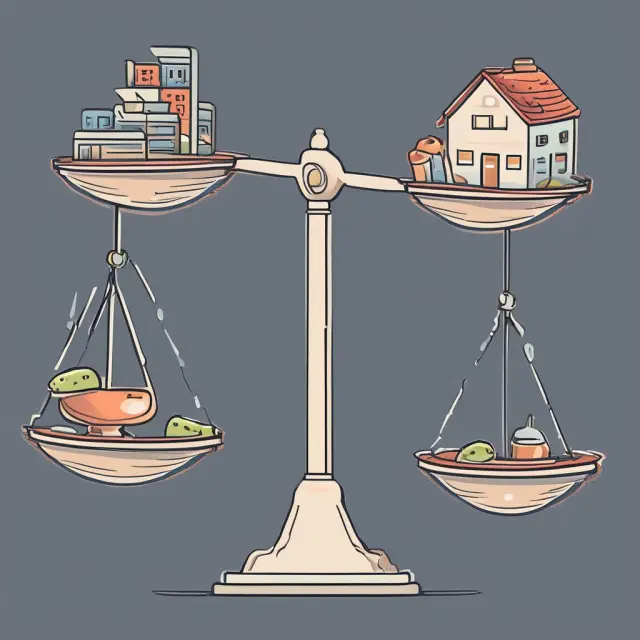
Debt-to-Income Ratio vs. Housing Expense Ratio
When it comes to loan underwriting, both debt-to-income ratio and housing expense ratio are crucial measurements used by financial institutions to assess a borrower’s eligibility for various credit products. Although similar in nature as they both evaluate the relationship between a person’s income and their debt obligations, these two ratios serve different purposes and have distinct applications in the world of finance.
Debt-to-Income Ratio
The debt-to-income (DTI) ratio is a widely used metric for evaluating an individual’s ability to manage their current debts against their income, making it essential for determining eligibility for personal loans and credit cards. In essence, the debt-to-income ratio provides insight into an applicant’s capacity to meet their existing monthly debt obligations while also considering potential new loan payments.
Calculation of Debt-to-Income Ratio
To calculate the debt-to-income ratio, borrowers need to divide their monthly debt payments by their gross monthly income. Gross monthly income represents a person’s total earnings before any deductions or taxes are applied. For instance, if an applicant has $1,500 in monthly debt payments and a gross monthly income of $6,000, the debt-to-income ratio would be 25% ($1,500 / $6,000 = 0.25 or 25%).
Differences in Debt-to-Income Ratio Requirements
Typically, lenders prefer a borrower’s debt-to-income ratio to be below 36%. However, some alternative financing options and subprime lenders might allow for higher ratios of approximately 43%.
Housing Expense Ratio
In contrast to the debt-to-income ratio, which is applicable to a wide range of consumer credit products, the housing expense ratio specifically pertains to mortgage underwriting. The housing expense ratio, also known as the front-end ratio, measures the proportion of an applicant’s gross monthly income that goes towards their housing costs.
Calculation of Housing Expense Ratio
To calculate the housing expense ratio, lenders consider various housing-related expenses like mortgage principal and interest payments, property taxes, homeowners insurance premiums, and private mortgage insurance (PMI) fees. These costs are then divided by a borrower’s gross monthly income to yield the housing expense ratio.
Differences in Housing Expense Ratio Requirements
Mortgage underwriters generally look for a borrower’s housing expense ratio to be below 28%. However, lenders might consider approving higher ratios when compensating factors like an excellent credit history or a low loan-to-value (LTV) ratio come into play.
In conclusion, while debt-to-income and housing expense ratios share similarities in their approach to assessing a borrower’s capacity to manage debts and expenses, these two ratios serve unique purposes in the lending world. Understanding the intricacies of these qualifying ratios is crucial for consumers seeking various credit products and can make all the difference in securing favorable loan terms.

Lenders’ Qualifying Standards for Debt-to-Income Ratios
When considering a loan application, lenders evaluate several factors to determine an applicant’s financial health and suitability for repaying the debt. Two primary indicators of a borrower’s financial capacity are the debt-to-income ratio (DTI) and housing expense ratio. Though each lender sets its own qualifying standards, understanding these ratios and their significance can help applicants prepare for the loan application process.
In personal loans and credit cards, the lender primarily focuses on a borrower’s debt-to-income ratio to assess their ability to meet debt obligations. Mortgage loans, however, require both the debt-to-income ratio and housing expense ratio evaluations.
High-Quality Lenders: Debt-to-Income Ratios
High-quality lenders generally favor a debt-to-income ratio of around 36% or less for personal loans and credit card applications. A lower debt-to-income ratio signifies that the borrower’s regular monthly expenses do not exceed a considerable portion of their income, suggesting they have ample capacity to manage new debt obligations.
Subprime Financing Alternatives: Debt-to-Income Ratios
While high-quality lenders maintain stringent debt-to-income ratio standards, subprime financing alternatives may allow ratios up to 43%. These loan programs cater to applicants who, due to lower credit scores or insufficient income, may not meet the criteria for traditional loans. However, these alternatives often come with higher interest rates and less favorable repayment terms.
Mortgage Loans: Debt-to-Income and Housing Expense Ratios
For mortgage loans, both debt-to-income ratio and housing expense ratio assessments are crucial components of the underwriting process. To secure a mortgage, applicants typically need to meet requirements for both ratios, with most lenders looking for debt-to-income ratios around 36% and housing expense ratios at or below 28%. A lower housing expense ratio indicates that a borrower’s monthly mortgage payments will not burden their income significantly.
In conclusion, understanding a lender’s qualifying standards for debt-to-income ratios is an essential aspect of loan applications. While each lender may have varying thresholds, maintaining a low debt-to-income ratio can position applicants favorably in the loan application process.

Qualifying Ratios in Mortgage Loans
Mortgage underwriting is a critical step in obtaining financing for real estate purchases. Understanding the importance of qualifying ratios, specifically the debt-to-income ratio and housing expense ratio, in mortgage loan approval can help potential homebuyers navigate this process effectively.
Debt-to-Income Ratio vs. Housing Expense Ratio: Both Important Indicators for Mortgage Underwriting
When evaluating a mortgage application, lenders assess two key qualifying ratios: the debt-to-income ratio and housing expense ratio. While each lender sets its own qualifying standards, the debt-to-income ratio (DTI), which compares your monthly debt payments against your gross monthly income, plays a vital role in determining whether you’ll qualify for a mortgage loan. The second indicator, housing expense ratio or front-end ratio, focuses on your monthly housing expenses, such as mortgage principal and interest, property taxes, homeowners insurance, and other related costs.
Impact of Debt-to-Income Ratio (DTI) on Mortgage Approval: Eligibility Criteria & Loan Amount
To calculate the debt-to-income ratio, lenders divide your monthly debt payments by your gross monthly income. High-quality mortgage lenders often prefer a maximum debt-to-income ratio of 36%, but some government-sponsored loans like those backed by Fannie Mae or Federal Housing Administration (FHA) might allow ratios up to 45% or even 50%.
The ideal debt-to-income ratio may depend on the specific loan type and your creditworthiness. For instance, some loan programs catering to borrowers with lower incomes or higher debt levels will have more lenient debt-to-incidence requirements. However, keep in mind that a higher debt-to-income ratio can potentially lead to longer loan terms, higher interest rates, and larger monthly mortgage payments.
Understanding the Significance of Housing Expense Ratio (Front-End Ratio) in Mortgage Underwriting: Eligibility Criteria & Loan Amount
Housing expense ratios measure your housing expenses against your gross monthly income. Lenders typically prefer a maximum housing expense ratio of 28%. This ratio covers mortgage principal and interest, property taxes, homeowners insurance, private mortgage insurance (PMI), mortgage insurance premiums, and other housing-related expenses. A higher housing expense ratio may result in a reduced loan amount or disqualification.
Factors Impacting Mortgage Underwriting: Differences between Conventional & Government-Sponsored Loans
The qualifying ratios and the underwriting process for conventional mortgage loans (conforming mortgages, jumbo mortgages) may differ from those of government-sponsored loan programs like FHA or VA loans. For example:
- Conventional loans typically require a lower debt-to-income ratio compared to government-backed loans, but they also have more stringent credit score requirements.
- Government-backed loans may allow for higher debt-to-income ratios and have more flexible income and employment history guidelines. However, these programs often come with additional fees or mortgage insurance premiums.
In summary, a solid understanding of qualifying ratios like the debt-to-income ratio and housing expense ratio is crucial when seeking mortgage financing. These financial measures help lenders assess your ability to repay a mortgage loan while balancing your overall debt burden and housing expenses.

Compensating Factors Impacting Qualifying Ratios
Besides evaluating an applicant’s debt-to-income ratio (DTI) and housing expense ratio, mortgage lenders consider several compensating factors that can positively influence the qualification process. These factors may help offset a less-than-ideal debt-to-income ratio or a higher-than-preferred housing expense ratio. Let’s examine the three most common compensating factors:
1. Credit History
Credit history is among the most crucial factors determining an applicant’s loan eligibility, and it can influence the lender’s assessment of their debt-to-income ratio. A strong credit history signals that a borrower has managed their debts responsibly in the past. If an applicant has consistently made on-time payments on existing loans and credit card accounts, even with a slightly less than desirable debt-to-income ratio, lenders may overlook this shortcoming to approve the mortgage application.
2. Loan-to-Value Ratio for Property
A loan-to-value (LTV) ratio is another factor that plays an essential role in mortgage underwriting. It’s a measure of how much you borrow from the lender compared to the value of the property being financed. For example, if you wish to buy a house worth $300,000 and can make a down payment of $60,000, the LTV ratio would be 0.8 (or 80%). A lower LTV ratio reduces the risk for the lender as it means that the borrower has put down more money as a down payment compared to the loan amount, thus providing collateral security against potential default. A favorable LTV can help offset an applicant’s debt-to-income ratio or housing expense ratio above preferred limits.
3. Local Real Estate Market Conditions
Real estate market conditions in the location where a borrower is applying for a mortgage can also influence qualifying ratios. In regions with high living costs, such as New York City or San Francisco, it’s not uncommon for housing expenses to take up a significant portion of an applicant’s income. In these situations, lenders may accept higher housing expense ratios if they are justified by local real estate market conditions. For instance, a borrower with a debt-to-income ratio that is marginally above the preferred 36% limit and a housing expense ratio close to the standard 28% threshold might still be approved if they can demonstrate that their income is sufficient to meet all necessary living expenses in the expensive area where they plan to reside.
These are just a few examples of compensating factors that mortgage lenders consider when evaluating an applicant’s qualifying ratios. By taking these factors into account, lenders make more informed decisions and increase their chances of approving loan applications for qualified borrowers while minimizing their risk.

Automated Underwriting Systems: Debt-to-Income and Housing Expense Ratios
An essential aspect of loan underwriting is the utilization of automated underwriting systems (AUS) by lenders to evaluate the applicant’s debt-to-income ratio and housing expense ratio. These sophisticated computer algorithms analyze the borrower’s financial data, including income, debt payments, and housing expenses, to determine their eligibility for loan approval. This process often results in quick approvals as loans can be assessed within minutes.
When it comes to consumer financing, both personal loans and mortgages undergo evaluation using these automated underwriting systems. Personal loans and credit card issuers primarily focus on a borrower’s debt-to-income ratio (DTI), while mortgage lenders assess their applicants’ housing expense ratios (HER) along with the DTI.
The use of AUS in underwriting personal loans and credit cards:
For personal loans, credit card applications, and other consumer financing products, automated underwriting systems calculate the borrower’s debt-to-income ratio. The DTI is calculated by dividing the total monthly debt payments by the applicant’s gross monthly income. This figure indicates how much of their monthly income goes towards servicing debts. High-quality lenders generally look for a debt-to-income ratio of approximately 36% or less when considering an application. In some cases, subprime and alternative financing options may approve loans with higher debt-to-income ratios, up to approximately 43%.
The significance of AUS in underwriting mortgage loans:
In the context of mortgage lending, automated underwriting systems evaluate both the housing expense ratio and the debt-to-income ratio. These ratios play crucial roles in assessing a borrower’s ability to repay their loan obligations comfortably. The housing expense ratio (HER) is calculated by dividing the total monthly housing expenses by the applicant’s gross monthly income. This figure illustrates how much of their monthly income goes towards housing-related expenses, including mortgage payments, property taxes, insurance premiums, and other related costs.
The role of AUS in determining approval and loan amount:
Mortgage underwriting systems use these ratios to determine whether a borrower is eligible for mortgage financing based on the lender’s predefined qualifying standards. Additionally, these systems help determine how much principal the borrower can qualify for by assessing their financial situation and comparing their debt-to-income ratio against the desired threshold. Generally speaking, most lenders prefer a debt-to-income ratio of 36% or less for mortgage loans, with some government-sponsored programs having more lenient standards (Fannie Mae: 45%, Federal Housing Administration: 50%).
In conclusion, automated underwriting systems play a critical role in the loan underwriting process by assessing debt-to-income ratios and housing expense ratios. These measurements help lenders efficiently evaluate applications for personal loans, credit cards, and mortgages while maintaining a strong focus on the borrower’s ability to repay their loan obligations.

FAQ: Debt-to-Income and Housing Expense Ratios
What are qualifying ratios in finance?
Qualifying ratios refer to the measuring devices used by financial institutions in their loan underwriting process. They help determine whether a borrower is eligible for financing, and they often influence the terms of the loan as well. Debt-to-income ratio (DTI) and housing expense ratio are two common qualifying ratios used in lending.
What is debt-to-income ratio?
The debt-to-income ratio is a calculation that shows how much an individual owes compared to their income. It’s widely used by lenders when evaluating personal loan and credit card applications, as well as mortgage loans. The most common method for calculating DTI is dividing monthly debt payments by gross monthly income. High-quality lenders typically prefer a debt-to-income ratio of 36% or less.
What is the role of housing expense ratio in mortgage underwriting?
The housing expense ratio, also known as the front-end ratio, compares a borrower’s total housing expenses to their gross income. Lenders consider various mortgage-related expenses when determining an applicant’s housing expense ratio, such as principal and interest payments, homeowners insurance, property taxes, homeowners association fees, and mortgage insurance. A lower housing expense ratio is generally preferred by lenders—ideally, around 28%.
How do debt-to-income and housing expense ratios differ?
Debt-to-income ratios measure an individual’s overall debt obligations against their income, while housing expense ratios focus specifically on a borrower’s housing expenses. Both ratios are crucial in the loan underwriting process and can influence financing decisions and terms.
How do lenders use qualifying ratios?
Lenders often utilize qualifying ratios, alongside a borrower’s credit score, to evaluate loan applications. For personal loans and credit cards, debt-to-income ratios are the primary concern. Mortgage loans require both debt-to-income and housing expense ratios for approval. Automated underwriting systems can quickly analyze these ratios to grant or deny approvals, usually within minutes.
What is a good debt-to-income ratio?
Generally, high-quality lenders prefer a debt-to-income ratio of 36% or less, while subprime and other alternative financing sources may accept ratios up to 43%. Mortgage loans require a more stringent standard: typically, a debt-to-income ratio of 36%, along with a housing expense ratio below 28% is desirable.
What happens if I have a high debt-to-income ratio?
A higher debt-to-income ratio may negatively impact your ability to secure financing or result in less favorable loan terms, such as a higher interest rate. Improving your debt-to-income ratio through budgeting and reducing debts can make you a more attractive borrower.
 Next entry · No. 4,219Mastering Investment: A Comprehensive Guide to Understanding Qualitative Analysis for Institutional Investors
See also
-
 No. 5,794
08 Oct 2025
16 min
Workout Agreements: A Mutual Solution for Borrowers and Lenders
Business Finance
No. 5,794
08 Oct 2025
16 min
Workout Agreements: A Mutual Solution for Borrowers and Lenders
Business Finance -
 No. 4,469
21 Jun 2025
22 min
Revolving Credit: Understanding the Flexible Financial Tool for Institutional and Professional Investors
Business Finance
No. 4,469
21 Jun 2025
22 min
Revolving Credit: Understanding the Flexible Financial Tool for Institutional and Professional Investors
Business Finance -
 No. 3,994
13 May 2025
20 min
Understanding Pledged Assets: A Comprehensive Guide
Business Finance
No. 3,994
13 May 2025
20 min
Understanding Pledged Assets: A Comprehensive Guide
Business Finance -
 No. 3,863
02 May 2025
18 min
Understanding Over-Limit Fees: What They Are and How to Avoid Them
Personal Finance
No. 3,863
02 May 2025
18 min
Understanding Over-Limit Fees: What They Are and How to Avoid Them
Personal Finance -
 No. 3,851
01 May 2025
16 min
Overdrafts: Fees, Protection, Pros and Cons, and How Each Option Works
Banking
No. 3,851
01 May 2025
16 min
Overdrafts: Fees, Protection, Pros and Cons, and How Each Option Works
Banking -
 No. 4,336
10 Jun 2025
23 min
Understanding Refinancing: Types, Pros, Cons, and Strategies for Lowering Debt Payments
Mortgage
No. 4,336
10 Jun 2025
23 min
Understanding Refinancing: Types, Pros, Cons, and Strategies for Lowering Debt Payments
Mortgage