How Much House Can I Afford? Approval Price vs Affordable Price
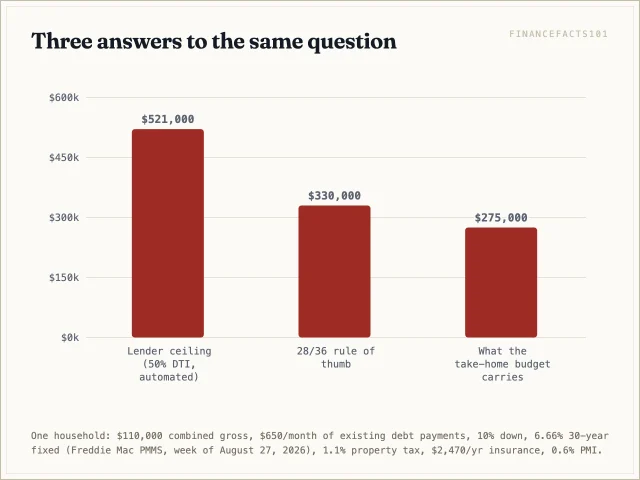
On $110,000 of income a lender may approve $521,000, the 28/36 rule says $330,000, and the take-home budget carries $275,000. The gap, worked.
Ask how much house can I afford and you get two different numbers, and the distance between them is the whole problem. On $110,000 of combined income with $650 a month of existing debt payments and 10% down, an automated underwriting approval can reach a $521,000 purchase price; the old 28/36 rule of thumb says $330,000; and the household's actual take-home budget — the one with childcare, retirement contributions and a roof fund in it — carries about $275,000. That is a $246,000 spread on the same borrower, on the same day, at the same 6.66% rate.
The gap is not random. It is systematic, and it runs in one direction: underwriting counts your debts but not your life. This guide computes all three numbers on one named household, shows exactly which line items the ratio never sees, and gives you the arithmetic to redo it at your own income. Scope honesty first: this is general information built on stated assumptions and rates as of September 2026, not personal advice.
Who this is for — and who it is not for
This is for a US buyer with W-2 income shopping a primary residence with a conventional or FHA 30-year fixed loan, somewhere in the $200,000–$600,000 price band, who has been pre-approved for more than feels comfortable and wants to know whether that feeling is right. It assumes you are choosing a price, not choosing between renting and owning — that question is worked separately in rent vs buy — and that you already know you want a fixed rate rather than the shorter-term trade in 15-year vs 30-year mortgages.
It is not for self-employed or commission-heavy borrowers, whose qualifying income is a two-year average of net profit and can land far below what their bank balance suggests. It is not for jumbo borrowers, where overlays tighten and 43% total DTI often becomes a hard wall. And it is not a VA guide: VA underwriting runs primarily on residual income — dollars left after all obligations, by family size and region — which is a better test than any ratio and deserves its own treatment.
How much house can I afford under the 28/36 rule
The 28/36 rule is two ratios applied to gross monthly income. Take $110,000 combined: that is $9,166.67 a month before anything comes out.
- Front-end (28%): housing costs — principal, interest, taxes and insurance — must stay under 28% of gross. That is $2,566.67.
- Back-end (36%): housing plus every other required monthly debt payment must stay under 36% of gross. That is $3,300.00; subtract the household's $650 car and credit-card payments and $2,650.00 is left for housing.
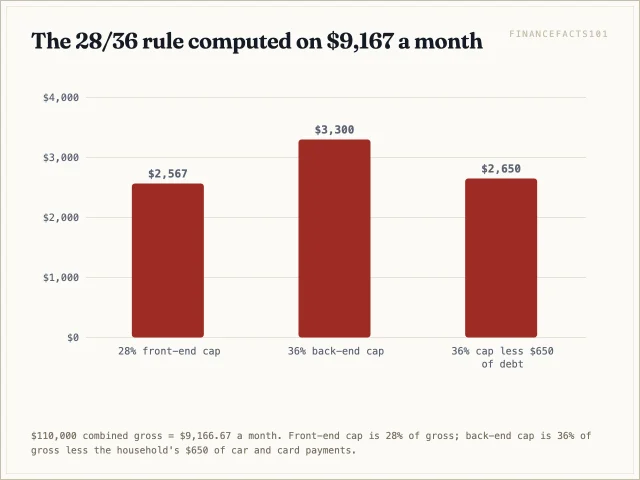
The binding constraint here is the front-end ratio, by $83 a month — a coincidence of this household's debt load, not a general truth. The crossover is easy to compute: the back-end ratio binds whenever your other debt payments exceed 8% of gross income (36% − 28%), which here is $733 a month. Below that, the 28% housing cap sets your price; above it, every extra dollar of car payment comes straight out of your housing budget. Both ratios are treated at length in the entries on qualifying ratios and the front-end ratio.
Turn $2,566.67 of monthly housing into a price and, at 10% down, 6.66%, a 1.1% property tax and $2,470 of annual insurance, it buys a $330,000 house with a $297,000 loan and a $1,909 principal-and-interest payment. Run your own income through the mortgage affordability calculator before reading further; the rest of this article is about why $330,000 is still too high for this household.
What PITI actually includes, and which part is moving
PITI is principal, interest, taxes and insurance — the four things a servicer collects in one debit. Principal and interest are fixed for thirty years on a fixed-rate loan. Taxes and insurance are not fixed at all, and they are the reason a payment that fit in year one stops fitting in year four.
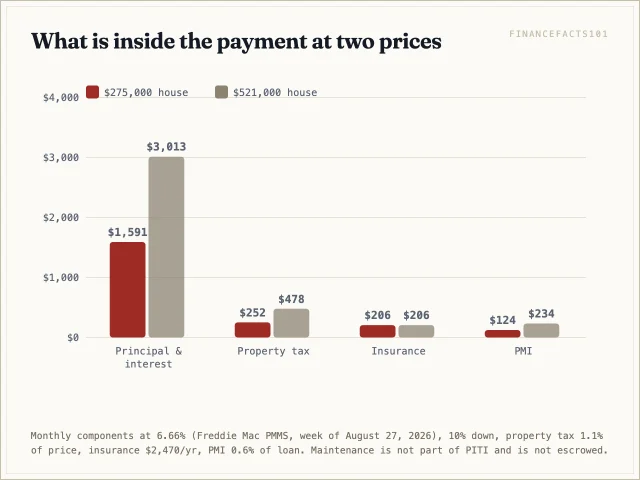
On the $275,000 house this article ends up recommending, the payment is $1,591 of principal and interest, $252 of property tax, $206 of insurance and $124 of PMI — $2,172 in total, of which $582, or 27%, reprices without asking you. Taxes and insurance sit in an escrow account that is re-analysed annually, and that annual analysis is where payment shock actually arrives — see the entry on how escrow works.
The insurance line has been the fast mover. Treasury's Federal Insurance Office, working from state regulator data covering 246 million policies, found homeowners premiums rose 8.7% faster than inflation between 2018 and 2022, with the highest-climate-risk ZIP codes paying 82% more than the lowest. That has not stopped: industry projections put 2026 growth near 4% nationally after a roughly 12% jump in 2025. Property taxes move too, and hardest right after you buy, because many jurisdictions reassess to your purchase price. A budget built on the seller's tax bill is built on a number that is about to change.
DTI is the real gate, and it is looser than you think
The 28/36 rule is a rule of thumb, not a rule. What actually decides your approval is debt-to-income — all your monthly debt payments divided by gross monthly income, as the CFPB puts it — and the thresholds that matter are the ones written into each program's guidelines.
For conventional loans, the Fannie Mae Selling Guide sets a 36% maximum total DTI on manually underwritten loans, exceedable to 45% for borrowers who meet the credit score and reserve requirements in the Eligibility Matrix. But the guide then says the number that governs almost every loan actually written: for casefiles run through Desktop Underwriter, the maximum allowable DTI is 50%. FHA is structured differently — HUD Handbook 4000.1 sets benchmark ratios of 31% for housing and 43% for total debt, with either exceedable when the lender documents compensating factors such as substantial cash reserves, minimal payment shock, or strong residual income. In practice, FHA approvals through automated underwriting reach the mid-50s.
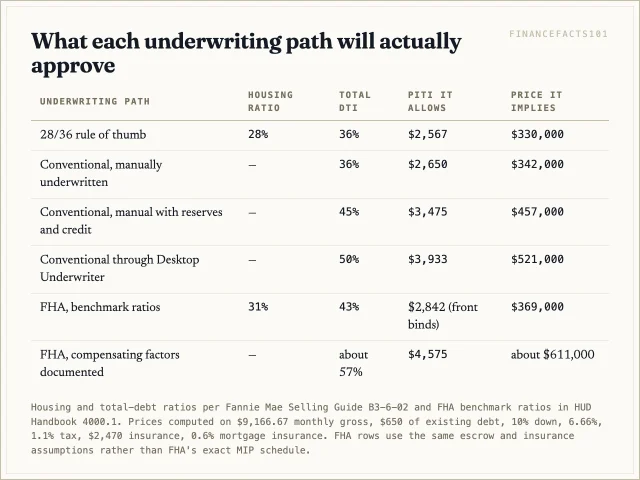
Read that table as a range of legally clean outcomes for one borrower. The same $110,000 household is approvable at $330,000 or at $611,000 depending on which door it walks through, and nothing about the household changes in between. Check your own ratio with the debt-to-income calculator — and note what it is blind to, laid out in the entry on the DTI ratio.
The gap between what a lender will approve and what you should borrow
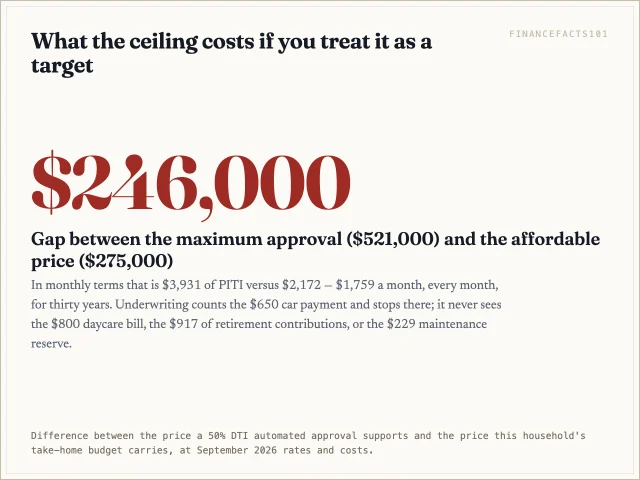
The mechanism, stated plainly: a DTI ratio counts exactly two things — gross income, and payments that appear on your credit report. It does not subtract income or payroll tax. It does not subtract retirement contributions, health premiums, commuting, or the maintenance a house generates by existing. And it does not subtract childcare, which the Department of Labor's National Database of Childcare Prices shows costing more than rent in some counties.
So the ratio is not wrong — it is measuring a different thing than you are. It measures whether the loan is likely to be repaid, which is a question about the lender's risk. You are asking whether you can pay it and still fund a retirement account, replace a furnace, and absorb a bad year. Both questions are legitimate; only one is answered by the pre-approval letter.
The cost of confusing them compounds. Take the $521,000 approval and the loan is $468,900:
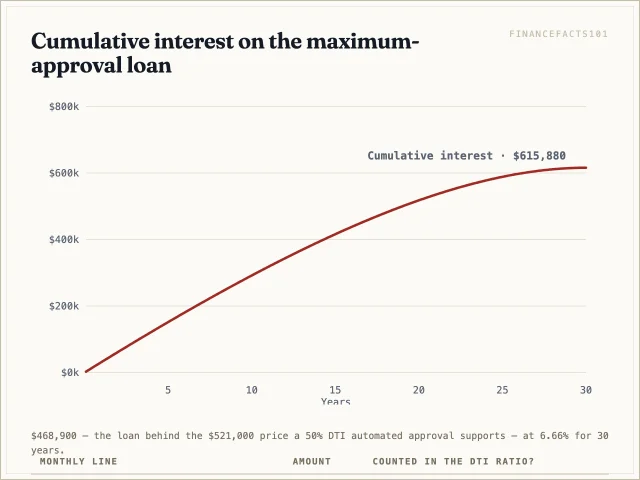
By year seven — roughly the tenure of a first home — that borrower has paid $209,297 in interest and retired $43,818 of principal. Over the full term the interest bill is $615,880, against $325,081 on the $247,500 loan behind the $275,000 house. Nearly $291,000 of extra interest is the price of treating a ceiling as a target.
The down payment and what each tier actually changes
A down payment does four things at once: it shrinks the loan, decides whether you pay mortgage insurance, nudges your rate tier, and drains the cash reserve that protects the purchase. Those pull in opposite directions, which is why "put down as much as possible" is bad advice.
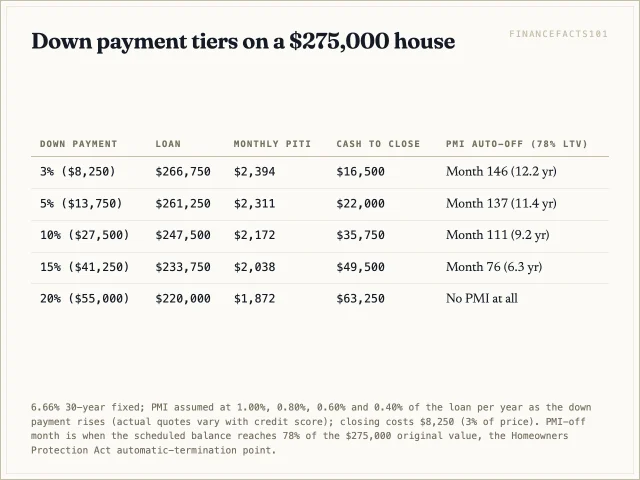
At 3% down on the $275,000 house the payment is $2,394 and you keep $47,000 of the cash you would otherwise have spent. At 20% down the payment is $1,872 — $522 a month cheaper — but $63,250 has left the building, and the PMI line that vanished accounts for only $222 of that saving. The other $300 comes from borrowing $46,750 less — which you could equally have achieved by buying a cheaper house.
The threshold worth naming is 20%: below it, conventional loans carry private mortgage insurance, quoted here at 0.6% of the loan a year for a 10%-down borrower and running roughly 0.3%–1.2% by credit score and LTV. FHA is a different bargain — a 1.75% upfront premium plus 0.55% annually, and with less than 10% down that annual premium lasts the life of the loan. What a down payment does across loan types is set out in the entry on down payments.
How PMI comes off, and when
PMI on a conventional loan is temporary by federal statute. The Homeowners Protection Act of 1998 — Public Law 105-216, codified at 12 U.S.C. 4901 — gives borrowers three exits, summarized by the CFPB in its guidance on removing PMI and by the NCUA in its compliance guide to the Act.
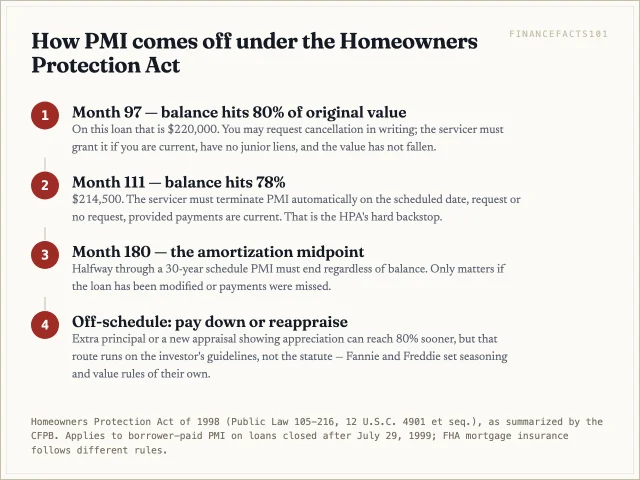
The timing is the part buyers get wrong. Amortization is slow at the front, so 78% of original value is a long way off:
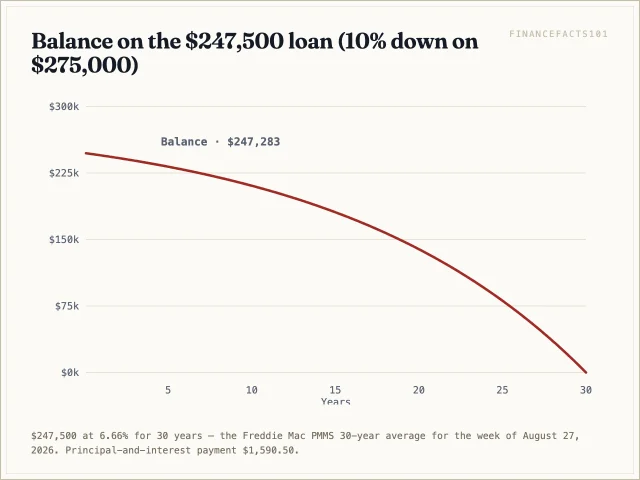
On the $247,500 loan the balance is still $232,109 after five years and $210,656 after ten. It first touches 80% of the $275,000 original value in month 97 and 78% in month 111 — more than nine years of paying $124 a month, about $13,800 in total. Put 15% down instead and automatic termination arrives in month 76. Rising prices can shortcut this through a reappraisal, but that route runs on investor guidelines rather than the statute, and the FHFA House Price Index recorded just 2.1% national appreciation in the year to 2026 Q2 — not the kind of market that rescues an LTV in a hurry.
Closing costs and the cash that has to survive the closing
Closing costs run 2% to 5% of the loan per the CFPB's home-buying guidance — origination, appraisal, title insurance, recording, prepaid interest, and the first year of homeowners insurance and several months of taxes deposited into escrow. On a $275,000 purchase, 3% is $8,250, and it is due in the same wire as the down payment.
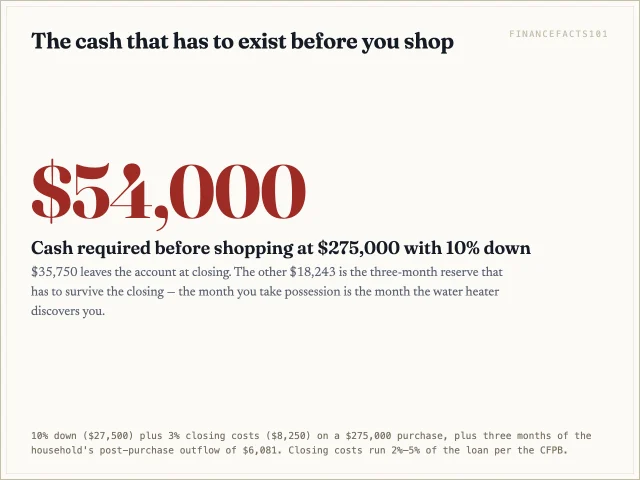
The rule people break is spending the reserve. Buying at $275,000 with 10% down takes $35,750 out the door, and what matters most is what is left the next morning. Three months of this household's post-purchase outflow is $18,243; six months is $36,486. A buyer who closes with $2,000 left has bought a countdown — the first uncovered repair goes on a card at 22%, which raises next year's DTI and forecloses the refinance that would have helped. Size that reserve before you shop, with the emergency fund calculator or the reasoning in how big an emergency fund should be.
What a one-point rate move does to your price
At a fixed monthly budget, the rate is a purchasing-power dial, and most buyers have never seen it quantified.
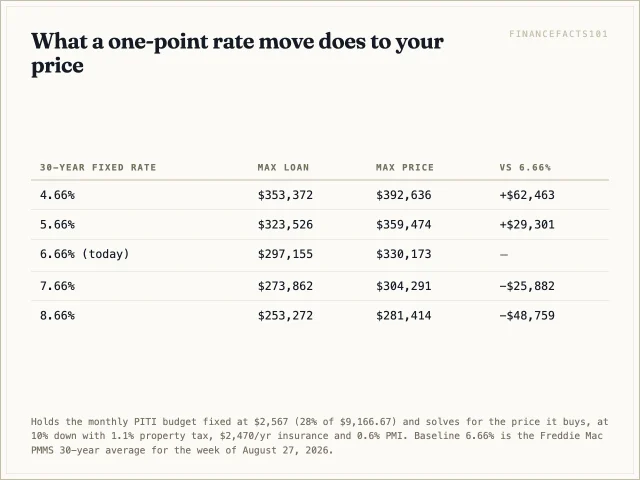
Holding PITI at $2,566.67, a move from 6.66% to 7.66% cuts the affordable price by $25,882; a move down to 5.66% raises it by $29,301. Call it $26,000–$29,000 of price per percentage point — roughly 8–9% of purchasing power, or about $7,000 per quarter point. Two consequences follow. Waiting for a better rate is a bet with real stakes in both directions: if prices rise 2.1% a year while you wait, a full point of rate improvement is roughly cancelled out in four years. And the quarter-point you might win by shopping three lenders is worth as much as $7,000 of haggling on the price, for an afternoon's work. Model a specific quote with the mortgage payment calculator.
The maintenance reserve: 1% a year is a floor, not a forecast
The common rule sets aside 1% of the home's value per year for maintenance — $2,750 a year, $229 a month, on a $275,000 house. Treat that as a floor for three reasons.
It is a rule of thumb, not a measured statistic; the Census Bureau's American Housing Survey collects actual improvement and repair spending, and the dispersion around any average is enormous. It scales with value, when the real driver is the cost of components: a roof runs $10,000–$20,000, an HVAC system $7,000–$12,000, a water heater $1,500–$3,000, and none of them charges less because the house was cheap. And it averages quiet years with catastrophic ones — you bank $229 a month for four years, then write a $14,000 check. On a house over about thirty years old, or in a freeze-thaw climate, budget 2%.
Underwriting counts none of this. Not a dollar.
The budget test: what $110,000 actually supports
Now the honest version. Same household, but measured against take-home rather than gross.
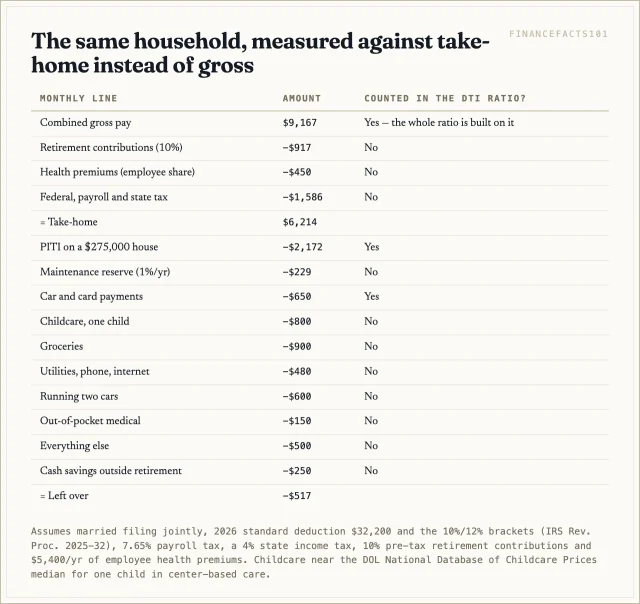
Assume 10% going to retirement, $5,400 a year of employee health premiums, the 2026 married-filing-jointly standard deduction of $32,200 and the 10%/12% brackets from the IRS inflation adjustments for 2026, 7.65% payroll tax and a 4% state income tax. Take-home is $6,214 a month — 68% of the gross that the 28% ratio was computed on.
Against that, the $275,000 house leaves the household $517 short every month while the $650 car loan is still outstanding. At the 28/36 rule's $330,000 they are $956 short. At the lender's $521,000 ceiling the shortfall is $2,481 a month and the question stops being interesting.
Retire the car loan before closing and the arithmetic flips: the $650 comes back, the household clears $275,000 by $133 a month, and $330,000 is still $306 short. That is the recommendation in one line — shop at $275,000, and pay off the car first — and it lands 47% below what the lender would sign.
Stress test the payment before you sign it
A payment that works on the day of closing is not the test. Two shocks are worth pricing explicitly.
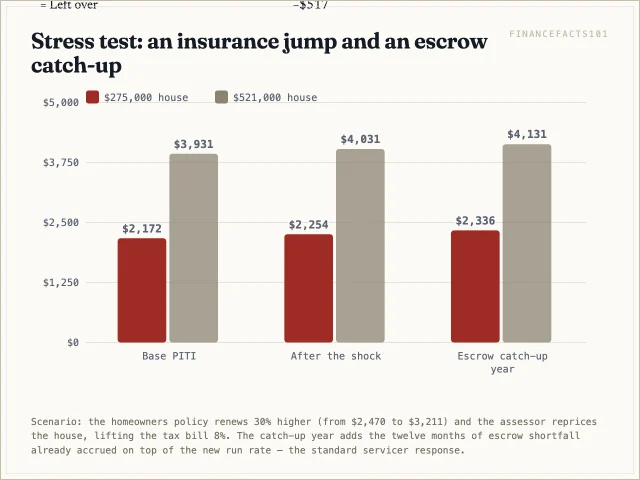
The escrow shock. Suppose the policy renews 30% higher — well within recent experience — and the assessor reprices the house, lifting the tax bill 8%. PITI rises $82 a month at $275,000. Manageable. But servicers do not just raise the run rate; they also recover the twelve months of shortfall already accrued, spread over the next twelve, so the first year after the analysis costs $164 a month more, not $82. At the $521,000 house the same shock costs $200 a month in the catch-up year. This is the single most common source of "my mortgage payment went up and I have a fixed-rate loan."
The income shock. If the lower earner's $45,000 stops, gross income falls to $5,417 a month. At the $275,000 house the housing ratio jumps to 40% and total DTI to 52% — painful, survivable with a reserve. At the 28/36 rule's $330,000 house it is 47% and 59%. At the $521,000 approval it is 73% and 85%, which is not a budget problem but a sale.
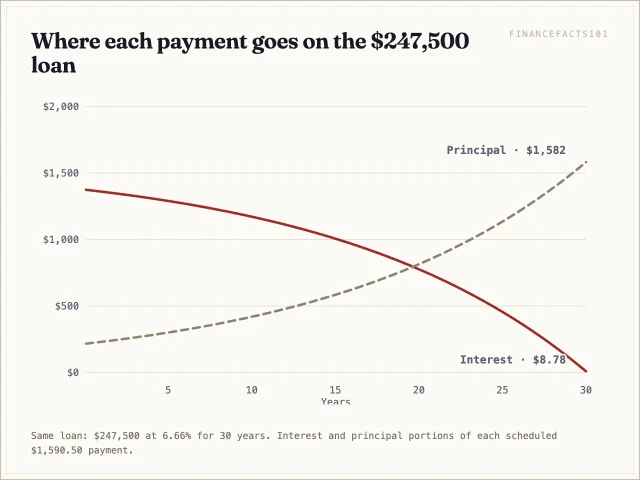
And selling early is expensive precisely because equity builds so slowly. The first payment on this loan is $1,374 of interest against $217 of principal — 86% interest — and principal does not exceed interest until month 236. Add 6%–7% of transaction costs to sell, and a forced exit inside five years usually costs more than the down payment. That, not the monthly figure, is the real risk of borrowing to the ceiling. A refinance can reset the payment if rates fall, but it carries its own bill — see what a refinance actually costs.
How to set your own number
Four steps, in order, and the order matters.
- Start from take-home, not gross. Subtract taxes, retirement contributions and health premiums first. Everything after that is real money.
- Subtract the whole life. Childcare, groceries, transport, medical, the maintenance reserve at 1%–2% of the target price, and a savings line that is not retirement. What remains is your true housing budget.
- Convert it to a price at today's rate, remembering that taxes, insurance and PMI added $582 a month on this $275,000 example — about 27% of the payment.
- Then check it against the ratios, using the mortgage affordability calculator. If your number is below the 28/36 result, you are done. If it is above, the ratio is telling you something.
Two levers move the answer more than anything else: clearing an installment payment before you apply, which frees the cash and lifts the ratio, and the down payment, which trades the monthly figure against the reserve that protects it. A maximum approval is the highest number a computer would not object to, computed from a version of your finances that has your car loan in it and nothing else.
FAQ
What is the 28/36 rule and is it still used?
It caps housing costs at 28% of gross monthly income and total debt payments at 36%. Lenders no longer underwrite to it — Fannie Mae's automated system allows 50% total DTI and FHA regularly approves above that with documented compensating factors — but it remains a reasonable personal ceiling. On $110,000 of income it allows $2,567 of housing and buys about $330,000 at September 2026 rates.
Why will a lender approve more than I can comfortably pay?
Because DTI counts gross income and only the debts on your credit report. It ignores income and payroll tax, retirement contributions, childcare, health premiums and home maintenance. On the household in this article those omissions total about $3,980 a month — the entire difference between a $521,000 approval and a $275,000 budget.
How much do I need for a down payment and closing costs?
Conventional loans go to 3% down and FHA to 3.5%, so a $275,000 purchase can close with $8,250–$9,625 down plus 2%–5% of the loan in closing costs. At 10% down the total wire is about $35,750. The number that matters more is the reserve left afterwards: three months of your new total outflow, $18,243 in this example.
When does PMI come off?
Under the Homeowners Protection Act you may request cancellation when the scheduled balance reaches 80% of the home's original value, and the servicer must terminate it automatically at 78%. On a 10%-down, 30-year loan at 6.66% that is month 97 and month 111 — over nine years. FHA mortgage insurance follows separate rules and lasts the life of the loan when the down payment is under 10%.
How much does a 1% rate change move what I can buy?
About $26,000–$29,000 of purchase price at a fixed $2,567 monthly budget — roughly 8–9% of purchasing power per percentage point. Going from 6.66% to 7.66% drops the affordable price from $330,173 to $304,291; dropping to 5.66% raises it to $359,474.
Sources
- Freddie Mac Primary Mortgage Market Survey — 30-year fixed average 6.66%, week of August 27, 2026.
- Fannie Mae Selling Guide B3-6-02, Debt-to-Income Ratios — 36% manual maximum, 45% with reserves and credit, 50% through Desktop Underwriter.
- CFPB, What is a debt-to-income ratio? — definition and calculation.
- CFPB, When can I remove PMI from my loan? — the 80% request, 78% automatic termination and amortization midpoint.
- CFPB, Owning a Home — closing costs of 2%–5% of the loan.
- Homeowners Protection Act of 1998, S.318 / Public Law 105-216 — the PMI cancellation statute, 12 U.S.C. 4901 et seq.
- NCUA, Homeowners Protection Act (PMI Cancellation Act) compliance guide.
- U.S. Treasury, Federal Insurance Office report on homeowners insurance — premiums rose 8.7% faster than inflation, 2018–2022; 82% gap between highest- and lowest-climate-risk ZIP codes.
- FHFA House Price Index, 2026 Q2 — US house prices up 2.1% year over year.
- U.S. Department of Labor, National Database of Childcare Prices — county-level childcare prices, exceeding rent in some counties.
- IRS, Tax inflation adjustments for tax year 2026 — $32,200 standard deduction for married filing jointly, 2026 brackets.
- Census Bureau, American Housing Survey — home improvement and repair spending.
- HUD, FHA Single Family Housing Policy Handbook 4000.1 — 31%/43% benchmark ratios and compensating factors.
 Next entry · No. 5,946Student Loan Repayment Plans: Cheapest Payment vs Cheapest Total
See also
-
 No. 5,933
05 Sep 2026
15 min
15-Year vs 30-Year Mortgage: The Total-Cost Math
Real Estate
-
 No. 5,966
30 Sep 2026
12 min
Assumable Mortgage Value: What a 3% Loan Is Worth in a 6.76% Market
Mortgage
-
 No. 5,967
01 Oct 2026
12 min
2-1 Buydown: What a Seller-Paid Teaser Rate Is Actually Worth
Mortgage
-
 No. 5,960
24 Sep 2026
12 min
10% vs 20% Down: What the Extra $40,000 Is Actually Worth
Mortgage
-
 No. 5,958
22 Sep 2026
12 min
Discount Points Break-Even: When Buying Down the Rate Pays
Mortgage
-
 No. 5,957
21 Sep 2026
15 min
Mortgage Payment Levers: What Actually Moves the Number
Mortgage