Home Equity Loan vs HELOC: Which Is Better in 2026?

Home equity loan vs HELOC: a 10-year fixed loan averaged 8.16% and HELOCs 8.19% on Oct 1, 2026. Payment shock, freeze rules and the 0.30-point crossover.
A home equity loan is the better choice when you need one known amount and want a payment that cannot change; a HELOC is better when the money goes out in stages or the total is uncertain, and only if you will repay principal from the first month. In the home equity loan vs HELOC comparison the two start at almost the same price: on October 1, 2026 a 10-year fixed home equity loan averaged 8.16% and a HELOC 8.19%, a line priced at the 7.00% prime rate plus a margin. So the real decision is who carries the rate risk, and what the payment does when the HELOC's draw period ends.
Below, both are priced on one household borrowing $80,000, with the year-ten payment jump, the prime level at which the fixed loan wins, and what federal rules let a lender do to an open line. Scope honesty: this is general information built on stated assumptions and rates as of early October 2026, not personal advice. Your quotes, equity, credit and tax position will differ.
Home equity loan vs HELOC: two contracts against the same equity
Both are usually second liens, and both put the house at risk if you stop paying. The CFPB's comparison draws the line at how the money arrives. A home equity loan pays the whole amount once, often at a fixed rate (the CFPB notes it can also be adjustable), with level payments over a set term. A HELOC is revolving credit: you draw what you need, repay it, and can draw again, at a rate that usually floats.
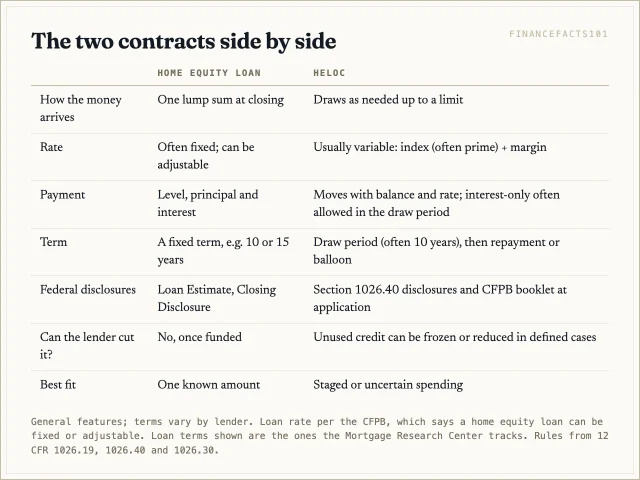
A fixed loan comes with a Loan Estimate and a Closing Disclosure, and nothing in its terms moves afterwards. A HELOC has its own rulebook, 12 CFR 1026.40, because its rate, balance and even its credit limit can change.
Who this is for, and who it is not for
This is for a homeowner who owes well below the home's value, has already decided to borrow against it, and is choosing between the two second-lien products.
It is not for someone deciding whether to replace the first mortgage. A cash-out refinance reprices the whole balance, and on a 3% loan that costs several times what either product here does; the cash-out refinance vs HELOC guide works that case. Nor is it for borrowing against the house for spending you could not cover from income: the CFPB's HELOC page warns that falling behind can cost you the home, with either product.
Where rates stood on October 1, 2026
The Federal Reserve raised the federal funds target range a quarter point to 3.75%–4.00% on September 16, 2026. Prime followed to 7.00% on September 17 and was still 7.00% on October 1, per the Fed's H.15 release, which defines it as the rate "posted by a majority of top 25 (by assets in domestic offices) insured U.S.-chartered commercial banks." The next scheduled FOMC decision is October 28, 2026 (Fed meeting calendar). This guide does not predict it; the scenarios below price moves in both directions.

The averages are the Mortgage Research Center's for October 1, 2026, as reported by Fortune: 8.164% on a 10-year home equity loan, 8.503% on a 15-year and 8.194% on a HELOC, assuming 80% loan-to-value and FICO scores of 620 or higher. All four numbers in the chart are from the same day. Other surveys differ (Bankrate's HELOC average has run about a point lower), so compare loan and line quotes from the same lender on the same day.
A HELOC rate is the index plus a margin; at 7.00% prime, the 8.19% average implies a margin of about 1.2 points. U.S. Bank, as one example, says on its HELOC page that its variable APRs, priced off the Wall Street Journal prime rate, ranged from 6.20% to 11.10% as of September 17, 2026. How a prime move reaches your statement is covered in the prime rate changes guide.
The surprise in October 2026 is how little the fixed rate costs. On a 10-year term the average fixed rate was 0.03 points below the average HELOC rate; on a 15-year term it was 0.31 points above. On those numbers, fixing the rate is close to free insurance.
How much you can borrow: the CLTV limit
Lenders size both products from combined loan-to-value (CLTV): every loan secured by the home, divided by its appraised value. The CFPB's HELOC booklet says you can typically borrow "up to a specified percentage of your equity"; the cap differs by lender. As one example, DCU advertises its 15-year fixed home equity loan at up to 90% CLTV. The entry on combined loan-to-value defines the ratio.
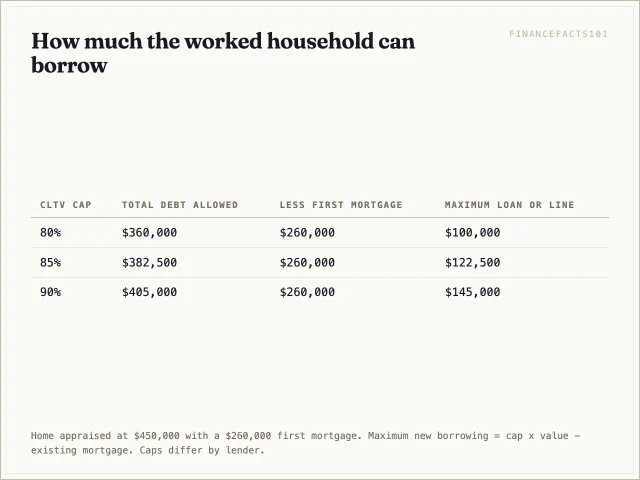
The worked household: a home appraised at $450,000 with a $260,000 first mortgage. At an 85% cap the most it can borrow is $382,500 − $260,000 = $122,500. Ask whether a lender counts a HELOC's full limit or only the drawn balance (the example counts the full line), and note that CLTV feeds the price: U.S. Bank reserves its lowest HELOC rate for a 60% loan-to-value, a 730 credit score, a line of $50,000 or more and autopay from a U.S. Bank account.
The worked example: $80,000 for a renovation
The household needs $80,000 for a kitchen and bathroom remodel and is offered:
- Home equity loan: $80,000 at a fixed 8.50% for 15 years, about the 15-year average on October 1.
- HELOC: a $100,000 line at prime + 1.20 = 8.20%, about the average, with a 10-year interest-only draw period and a 20-year repayment period. The household draws $80,000.
The extra $20,000 of line is a cushion for overruns; it takes CLTV to ($260,000 + $100,000) ÷ $450,000 = 80%, against 75.6% for the loan.
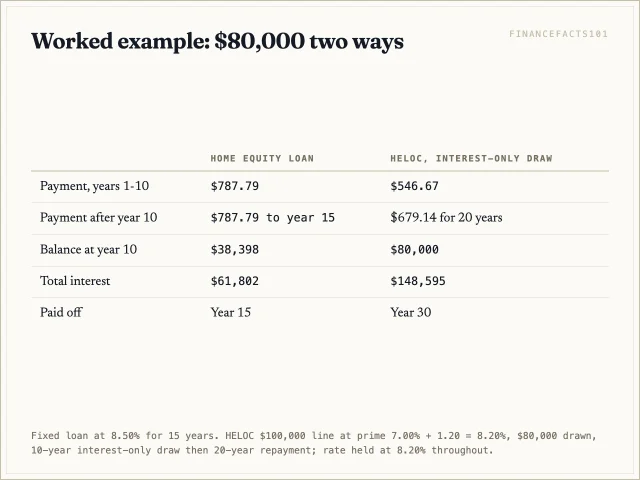
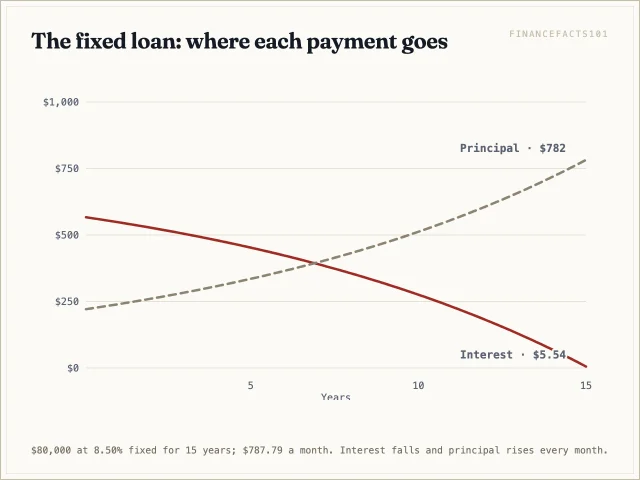
The fixed loan costs $787.79 a month and $61,802 of interest over 15 years; its balance is $63,539 after five years and $38,398 after ten. Check the payment on the mortgage payment calculator: set the home price to $80,000, the down payment, tax, insurance, PMI and HOA to zero, the rate to 8.5% and the term to 15 years, and read the principal-and-interest line.
The interest-only HELOC costs $546.67 a month ($80,000 × 8.20% ÷ 12), $241 less. That gap is the attraction, and it is not a saving. After ten years the household has paid $65,600 of interest and still owes all $80,000, while the fixed-loan borrower is $41,602 closer to owning the house.
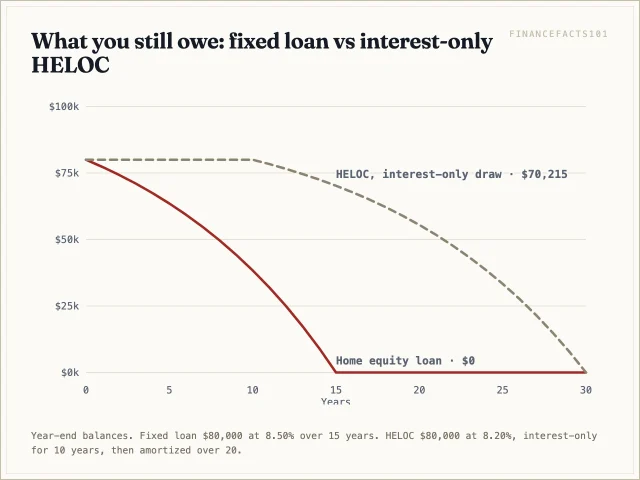
At a constant 8.20%, the interest-only route costs $148,595 of interest over 30 years, against $61,802 for the fixed loan. Most of that gap is the extra 15 years of borrowing, not the rate.
Payment shock at the end of the draw period
When the draw period ends, you cannot borrow more and the payment is recalculated to repay the balance. Under § 1026.40(d)(5), the application disclosures must give both periods' lengths and, if minimum payments may not repay principal, "a statement that a balloon payment may result." Per the CFPB booklet, the lender "may set a schedule so that you repay the full amount, often over ten or 15 years. Or, you may have to pay the entire balance owed, all at once, which might be a large amount called a balloon payment."

For the worked HELOC the change comes in month 121. At an unchanged 8.20%, the $80,000 amortized over 20 years costs $679.14 a month, up $132.48 or 24%. If prime is two points higher by then, the 10.20% rate makes it $782.65, 43% above today's $546.67 and about $5 below the fixed loan's payment, five years after the fixed loan would have been paid off.
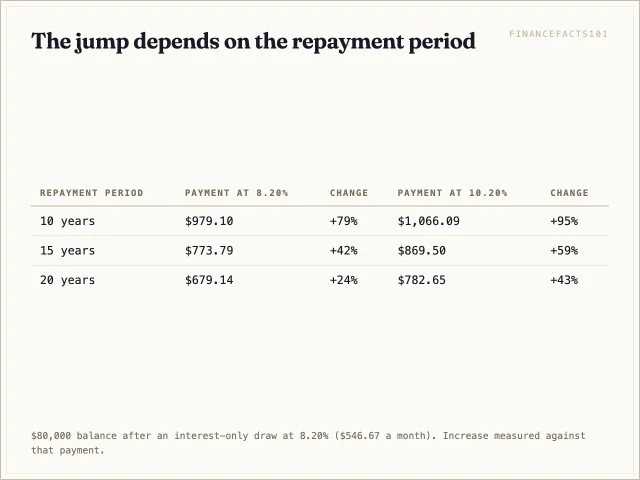
The repayment period sets the size of the jump: at 8.20%, a 10-year period takes the payment to $979.10, 79% above the interest-only payment. U.S. Bank's disclosure warns that interest-only payments "may cause your monthly payment to increase, possibly substantially" at that point. The cure is to pay principal from the start: on a 15-year schedule the line costs $773.79 a month at 8.20%, and the payment moves only when prime does.
The balance can also be refinanced into a fixed loan at year ten, if your equity and credit still qualify. The mortgage refinance calculator prices it: enter $80,000 at the line's 10.20% with 20 years left, then a new 20-year rate of, say, 8.50% and $1,500 of costs. The payment falls to $694.26, the costs are repaid in 17 months, and the 20-year saving is $19,713. Nobody knows 2036's rates; that is the method, not a forecast.
What a moving prime does to the line
Take the disciplined HELOC: $80,000 repaid over 15 years, the payment recalculated as the rate moves. Its only difference from the fixed loan is the rate, and at today's prime it is cheaper: $59,282 of interest against $61,802.

Prime 1 point lower for all 15 years: the HELOC costs $51,047, $10,755 less than the fixed loan. One point higher: $67,773, $5,971 more. Two points higher: $76,510, $14,708 more, with a payment of $869.50. A 2-point rise arriving in year three and staying costs $10,819 more. Prime has moved further than that before: per H.15 it was 3.25% as recently as early 2022 and 8.50% from mid-2023 to September 2024.

The crossover is narrow: if prime averages 7.30% over the 15 years, 0.30 points above today, the two cost the same; counting the fees in the next section, about 0.35 points. On a 10-year term there is no crossover to speak of: a HELOC at 8.20% repaid over ten years costs $37,491 of interest, $204 more than a 10-year fixed loan at 8.16%, before prime moves at all.
Two features soften the variable rate. Every variable-rate loan secured by a dwelling must state a maximum rate; U.S. Bank's is 18% APR. And many lines let you fix part of the balance: U.S. Bank allows up to three locks of up to 20 years, $2,000 minimum each. The CFPB booklet notes that the fixed rate "is typically higher than the variable rate, but it means more predictable payments."
Closing costs and the fees that come after
A home equity loan's costs arrive itemized on the Loan Estimate: appraisal, title, recording and origination charges, some or all of which a lender may absorb. A HELOC's § 1026.40 disclosures must itemize the lender's own fees and estimate third-party fees, and the CFPB booklet adds that some plans charge annual or transaction fees or require a minimum draw (for example, $300).

"No closing costs" usually moves the cost somewhere else. U.S. Bank, as one example, charges no application fees or closing costs on its HELOC, but adds a $75 annual fee after the first year (waived with one of its checking packages) and an early closure fee of 1% of the original line, up to $500, if the line is paid off and closed within 30 months. The worked example assumes $1,500 of closing costs on the loan and that fee structure on the line: over 15 years, $1,500 against $1,050. The mortgage refinance cost guide breaks down the title, appraisal and recording items in a closing.
Two rules protect HELOC applicants: no nonrefundable fee until three business days after you receive the disclosures (§ 1026.40(h)), and a full fee refund if a disclosed term other than the index changes before opening and you walk away (§ 1026.40(g)).
When the lender can freeze the line
A funded home equity loan cannot be taken back. A HELOC's unused credit can be. Section 1026.40(f)(3)(vi) lets a lender "prohibit additional extensions of credit or reduce the credit limit" while the home's value "declines significantly below the dwelling's appraised value," while it reasonably believes a material change in your finances will stop you repaying, while you are in default of a material obligation, or after certain government or regulatory actions.
The official commentary to Regulation Z sets a threshold: "if the value of the dwelling declines such that the initial difference between the credit limit and the available equity (based on the property's appraised value for purposes of the plan) is reduced by fifty percent, this constitutes a significant decline." No appraisal is required before the freeze.

For the worked household, available equity is $450,000 − $260,000 = $190,000, and the $100,000 line leaves a $90,000 cushion. Half is $45,000, so a fall to $405,000, just 10%, settles the question. A smaller fall can qualify too; the commentary says it "will vary according to individual circumstances." It has happened at scale: as prices fell in 2008, the FDIC wrote to banks (FIL-58-2008) about cutting lines, noting that automated valuation models or tax assessments could support the finding.
The protections are procedural. Written notice must go out "not later than three business days after the action is taken" with "specific reasons for the action" (§ 1026.9(c)(1)(iii)). The line must be restored when the condition ends (or, if the notice says so, promptly checked when you ask), with no reinstatement fee beyond actual appraisal or credit-report costs. The lesson: undrawn HELOC credit is a poor emergency fund, because a falling market or lost income is exactly what permits the freeze. The emergency fund guide prices a cash reserve instead.
What Regulation Z guarantees for each
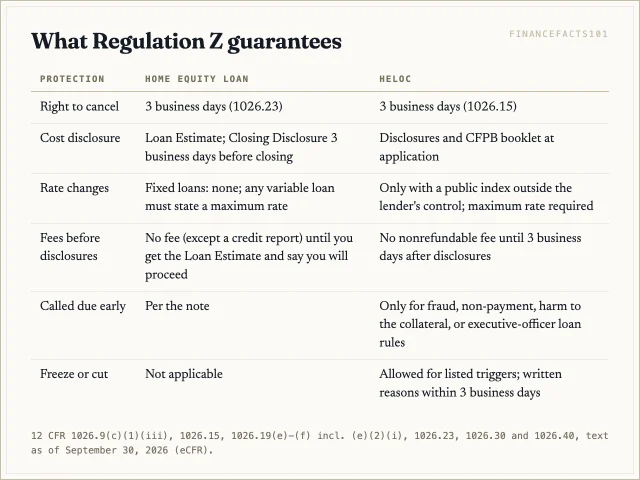
HELOC borrowers have more protection than many assume. The rate can change only with "an index that is not under the creditor's control" that is "available to the general public" (§ 1026.40(f)(1)), and other terms, the margin included, cannot change except in narrow cases such as replacing a vanished index or a change you agree to in writing. The balance cannot be called early except for fraud, non-payment, harm to the lender's security, or rules on loans to a bank's own executives (§ 1026.40(f)(2)). At application you get the CFPB booklet and a 15-year history of the rate and payment on a $10,000 balance. Both products carry a three-business-day right to cancel on a principal dwelling: § 1026.15 for the line, § 1026.23 for the loan; the right of rescission entry explains how.
The fixed loan's advantage is simpler: nothing changes after closing, and the standardized Loan Estimate is easier to compare than HELOC fee schedules. In any HELOC agreement, check whether the plan ends in a repayment period or a balloon.
Is the interest tax-deductible in 2026?
Tax treatment is the same for both; what matters is how the money is used. IRS Publication 936 states: "Interest on home equity loans and lines of credit are deductible only if the borrowed funds are used to buy, build, or substantially improve the taxpayer's home that secures the loan."
That rule is now permanent. The 2017 tax law had suspended the deduction for "home equity indebtedness" only through 2025, after which up to $100,000 of it, used for anything, would again have qualified. Section 70108 of Public Law 119-21, signed July 4, 2025, struck that end date from IRC § 163(h)(3)(F) for tax years beginning after December 31, 2025. It also made permanent the $750,000 cap on acquisition debt ($375,000 if married filing separately), and debt incurred before December 16, 2017 keeps the older $1 million limit.

Four conditions apply: you itemize, the loan is secured by your main or second home, the money goes into that same home, and total acquisition debt stays under the cap. Pub 936 treats an improvement as substantial if it adds to the home's value, prolongs its useful life or adapts it to new uses; repainting and routine repairs do not count on their own. The worked remodel qualifies, and $340,000 of total debt is well under the cap. In 2026, itemizing beats the standard deduction only if your deductions total more than $32,200 for a married couple filing jointly or $16,100 for a single filer. If the household already itemizes, the fixed loan's $6,694 of first-year interest is worth $1,473 at a 22% bracket. If not, it may be worth little or nothing.
One practical difference: a HELOC that pays for the kitchen and later a car becomes mixed-use debt whose interest you must split; a single-purpose loan keeps the records simple.
Staged projects: where the HELOC earns its keep
Draw timing is the HELOC's real advantage. Say the contractor bills $30,000 at the start, $30,000 in month four and $20,000 in month seven. On interest-only payments, the HELOC charges $5,125 of interest in the first year, because it charges only on what has been drawn. The fixed loan charges $6,694, because it charges on the full $80,000 from day one. Even if the idle loan money earns an assumed 4.00% in savings while it waits ($700), the line comes out $869 ahead in year one.
On a one-off project that is the honest scale of the advantage: hundreds of dollars, not thousands. It grows when spending is open-ended, such as a multi-year renovation or tuition paid each semester.
Home equity loan or HELOC: the decision table

For one known amount in October 2026, the fixed home equity loan is usually the safer buy: on a 10-year term it costs the same as the average HELOC, and on a 15-year term it costs more unless prime averages above about 7.30%, but it removes the payment jump, the rate risk and the freeze risk. The HELOC wins when spending is staged or uncertain and you will repay principal from the start. Either way, get three written quotes in the same week and compare margins, fees and repayment terms on the lines, rates and Loan Estimate totals on the loans.
FAQ
Is a HELOC or a home equity loan cheaper right now?
On October 1, 2026 they started at almost the same price: 8.19% for the average HELOC, 8.16% for a 10-year fixed home equity loan and 8.50% for a 15-year. Repaid over 15 years, an $80,000 HELOC at 8.20% costs $2,520 less interest than the fixed loan at 8.50% if prime never moves. The HELOC loses that edge if prime averages more than about 7.30%.
What happens when a HELOC's draw period ends?
You can no longer draw, and the balance is either amortized over a repayment period, often 10 to 20 years per the CFPB, or due in full as a balloon, depending on the agreement. An $80,000 balance paid interest-only at 8.20% ($546.67 a month) becomes $679.14 over 20 years, or $782.65 if the rate has risen to 10.20%.
Can a lender freeze or cut my HELOC?
Yes, within limits. Regulation Z allows it if the home's value declines significantly, if the lender reasonably believes a material change in your finances will stop you repaying, or if you default on a material obligation. A decline that halves the original gap between your credit limit and your equity counts as significant. The lender must send written reasons within three business days and restore the line when the condition ends.
Is home equity loan or HELOC interest tax-deductible in 2026?
Only if you itemize and the money buys, builds or substantially improves the home that secures the loan, within the $750,000 acquisition-debt limit. Public Law 119-21 made the disallowance for other uses permanent from 2026, so interest on money spent on a car, tuition or credit card debt is not deductible.
Sources
- Federal Reserve, H.15 Selected Interest Rates — bank prime loan rate 7.00% through October 1, 2026 (release of October 2, 2026), and its definition
- Federal Reserve, FOMC statement, September 16, 2026 — target range raised to 3.75%–4.00%, 12–0
- Federal Reserve, FOMC meeting calendar — next meeting October 27–28, 2026
- eCFR, 12 CFR 1026.40, requirements for home equity plans — disclosures, fee refunds, limits on rate changes, termination and freezes
- eCFR, Supplement I to Part 1026, official interpretations — comment 40(f)(3)(vi)-6, "significant decline" defined; reinstatement and fee comments
- eCFR, 12 CFR 1026.9 — notice within three business days of a freeze or reduction
- eCFR, 12 CFR 1026.15 and § 1026.23 — right of rescission for open-end and closed-end credit on a principal dwelling
- eCFR, 12 CFR 1026.19 — Loan Estimate and Closing Disclosure for closed-end credit secured by real property
- eCFR, 12 CFR 1026.30 — maximum rate required in variable-rate dwelling-secured credit
- CFPB, What you should know about home equity lines of credit — the booklet required by § 1026.40(e), last updated August 2022
- CFPB, Home equity loan vs HELOC and What is a HELOC
- FDIC, FIL-58-2008, reducing or suspending home equity lines of credit
- IRS, Publication 936 (2025), Home Mortgage Interest Deduction — home equity interest rule, substantial improvement, $750,000 limit
- Public Law 119-21, section 70108 — limits on qualified residence interest made permanent from 2026
- IRS, 2026 inflation adjustments (IR-2025-103) — standard deduction $32,200 joint, $16,100 single; 22% bracket
- Bankrate, Current HELOC rates — a second survey whose HELOC average runs about a point below MRC's
- Fortune, Home equity loan and HELOC rates, October 2, 2026 — Mortgage Research Center averages as of October 1, 2026
- U.S. Bank, Home equity line of credit and fixed-rate option — one lender's rates, fees, cap and locks
- DCU, 15-year fixed-rate home equity loan — one lender's 90% CLTV limit
 Next entry · No. 5,992Will vs Trust: Do You Need a Revocable Living Trust?
See also
-
 No. 5,965
29 Sep 2026
12 min
Cash-Out Refinance vs HELOC: The Blended-Rate Math on $50,000
Mortgage
-
 No. 5,962
26 Sep 2026
12 min
Biweekly Mortgage Payments: The Saving Is Real, the Fee Is Not
Mortgage
-
 No. 5,961
25 Sep 2026
12 min
Extra Mortgage Payments: What $200 a Month Actually Saves
Mortgage
-
 No. 5,932
04 Sep 2026
16 min
How Much It Costs to Refinance a Mortgage
Mortgage
-
 No. 5,945
14 Sep 2026
18 min
How Much House Can I Afford? Approval Price vs Affordable Price
Real Estate
-
 No. 5,933
05 Sep 2026
15 min
15-Year vs 30-Year Mortgage: The Total-Cost Math
Real Estate