Will vs Trust: Do You Need a Revocable Living Trust?

Will vs trust on a $600,000 estate: full probate fees run $30,000 in California and $36,000 in Florida, yet small-estate rules often avoid them.
As of October 2026, the will vs trust answer for most people is that a will is enough when their property either passes by beneficiary designation or fits their state's small-estate procedures. Neither one saves federal estate tax, which starts only above $15 million per person in 2026 under Public Law 119-21, because a revocable trust's assets still count in your taxable estate and stay reachable by your creditors. A revocable living trust earns its extra cost when you own real estate that would otherwise go through full probate (especially in more than one state), when you want someone to run your finances without a court if you become incapacitated, or when privacy matters.
This guide prices that decision. For a $600,000 estate, California's statutory probate fees come to $30,000 and Florida's presumed-reasonable fees to $36,000 when all $600,000 is probate property going through full administration. The worked example below shows why a real family in either state may pay far less, and when the trust pays for itself.
A line of scope honesty first: this is general information, not legal advice. Wills and trusts are governed by state law. Every state rule below is cited to that state's statute or court, and only California, Florida and the Uniform Probate Code are covered in detail. Have a lawyer licensed in your state check any plan before you sign it.
Who this is for — and who it is not for
This guide is for a US adult with a home, some savings and investments, and perhaps a retirement account, who is choosing between a simple will and a revocable living trust. That covers most estates from about $150,000 to a few million dollars, single or married, with or without children.
It is not for estates near the $15 million federal exemption, which need tax planning that goes well beyond this comparison. It does not cover irrevocable trusts, Medicaid planning, special-needs trusts for a disabled beneficiary, or business succession. If you already know you need one of those, you need a lawyer, not a comparison article.
What a will does, and what a revocable living trust does
A will is a set of instructions that takes effect only at death. It names who gets what, names an executor to carry it out, and is the usual place for parents to nominate a guardian for minor children. In California, a court appoints the guardian but gives the parent's signed nomination "due weight" under Probate Code section 1502. A will does not avoid probate. It is the document probate carries out.
A revocable living trust is a legal arrangement you set up during your life. You transfer property into it, usually serve as your own trustee, and name a successor trustee to take over when you die or can no longer manage. The California courts' self-help site puts the deal plainly: when you die, "as long as you have put your assets into the trust, they should go to the beneficiaries without having to go to probate court" (California Courts). You can change or revoke it at any time while you have capacity.
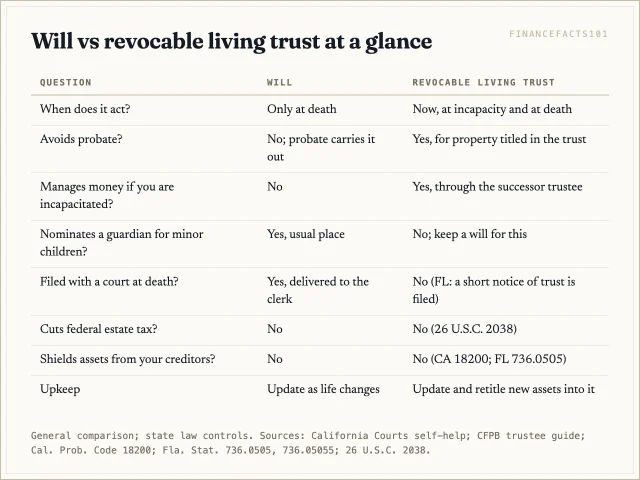
Most people with a trust also have a will. A "pour-over" will sends anything left outside the trust into it at death, and California expressly allows that kind of gift to a revocable trust under Probate Code section 6300. The catch is that what pours over goes through probate first. If you die with no will at all, state intestacy rules decide; see what happens when you die without a will.
Will vs trust: what probate costs and how long it takes
Probate is the court process that proves a will, appoints the executor (the "personal representative"), gives creditors a deadline and then distributes what is left. Its cost depends on the state, and some states write fee schedules into law. California and Florida are two of them.
California sets the fees by statute. For ordinary services, the personal representative (section 10800) and the attorney (section 10810) each receive 4 percent of the first $100,000, 3 percent of the next $100,000, 2 percent of the next $800,000 and 1 percent of the next $9 million. The base is the gross value of the property accounted for, "without reference to encumbrances." A $600,000 house with a $400,000 mortgage is charged on $600,000.
Florida publishes a presumed-reasonable schedule instead. Attorneys get $1,500 for estates up to $40,000, rising in two $750 steps to $3,000 at $100,000, then 3 percent of the next $900,000 (section 733.6171). The personal representative gets 3 percent of the first $1 million (section 733.617). The schedule is negotiable, and a representative may give up the commission.

Both schedules cover ordinary services only. Selling a house, litigation and tax work can be billed as extraordinary services on top. Court filing fees and, in California, a probate referee's appraisal fee of 0.1 percent of the property the referee values (section 8961) are separate.
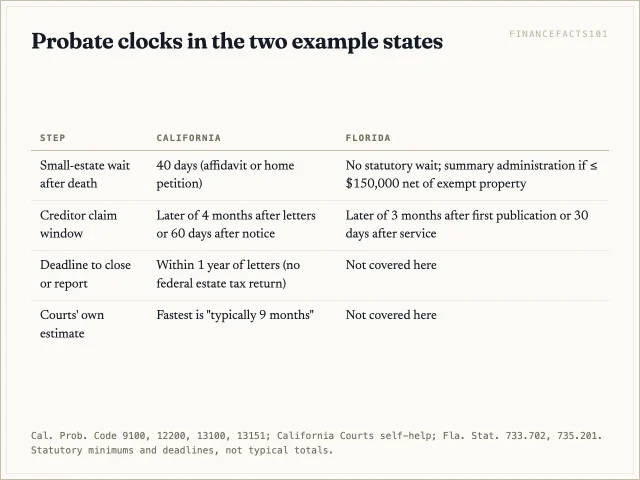
Time is the other cost. In California, creditors have until the later of four months after letters are first issued or 60 days after notice is sent to them (section 9100). The state's own courts say the fastest a probate can happen "in California is typically 9 months." In Florida, most claims are barred unless filed by the later of three months after the notice to creditors is first published or 30 days after a creditor who must be served receives it (section 733.702).
Small-estate shortcuts: why many wills never reach full probate
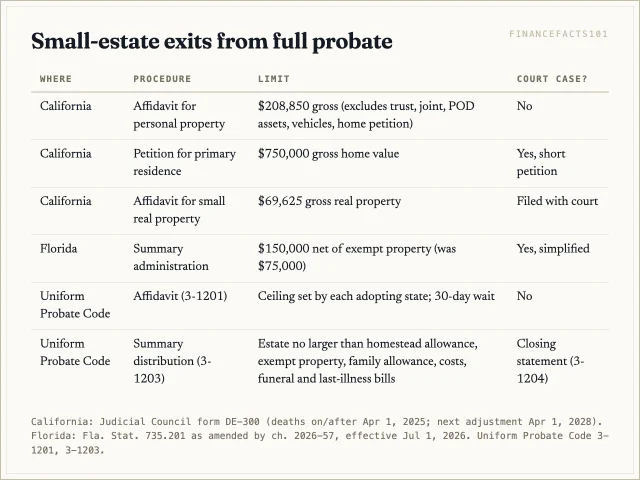
The fee schedules above apply to full administration. California and Florida, like many states, also have cheaper paths for smaller estates, and both raised their limits sharply in 2025 and 2026. The Federal Trade Commission made the same point when it testified about living-trust sales pitches. Whether avoiding probate "is a major advantage varies by the size of the estate and by state and locality; for small estates, many states have an informal probate process that minimizes cost and delay" (FTC, 2000).
California's Judicial Council form DE-300 lists the current limits for deaths on or after April 1, 2025. Heirs can collect personal property with a sworn affidavit, with no court case, if the decedent's California property is worth no more than $208,850 at gross value, not counting a home that passes by the petition described next. A primary residence worth up to $750,000 can pass by a court petition that is far shorter than probate (section 13151; form DE-310). Both paths require a 40-day wait after the death, and the limits next adjust April 1, 2028. Property held in joint tenancy, in a revocable trust or in a payable-on-death account, plus registered vehicles, does not count toward the affidavit limit (section 13050).
Florida allows summary administration when the estate subject to administration, less property exempt from creditors, is $150,000 or less, or the decedent has been dead more than two years, and the will does not direct formal administration (section 735.201). Chapter 2026-57, Laws of Florida (CS/HB 1337), raised the limit from $75,000 effective July 1, 2026.
The Uniform Probate Code, a model act many states have adopted in some form, offers an affidavit after 30 days (section 3-1201) and summary distribution for estates no larger than the homestead allowance, exempt property, family allowance, administration costs, funeral costs and last-illness medical bills (section 3-1203); each adopting state sets its own limits (Uniform Law Commission text).
What passes outside both a will and a trust
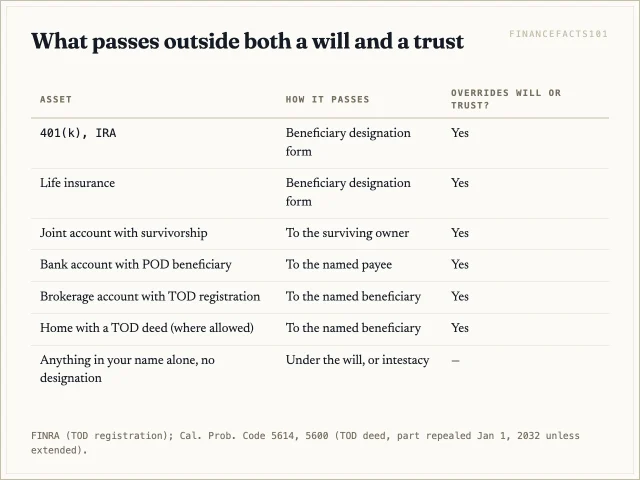
A large share of most estates never touches either document. Retirement accounts and life insurance go to the beneficiaries named on the form. Joint accounts with right of survivorship go to the surviving owner. Bank accounts with a payable-on-death beneficiary and brokerage accounts with transfer-on-death (TOD) registration go straight to the named person.
FINRA notes that a TOD registration generally avoids probate for those holdings and that the designation overrides a will or trust. Its example: if a will splits brokerage assets equally between two children but the TOD form names one, that child takes all of it and does not have to share (FINRA). Some states also allow transfer-on-death deeds for real estate. California's revocable TOD deed (section 5614) is scheduled to sunset on January 1, 2032 unless extended. Deeds signed before then stay valid (section 5600).
Two consequences follow. First, an out-of-date beneficiary form beats a new will every time, so review the forms whenever you update either document. Sizing the policy itself is covered in how much life insurance you need. Second, a retirement account stays in your own name and passes by its form whichever document you choose. Naming a trust as an IRA beneficiary brings in special distribution rules, and the 10-year rule for most non-spouse heirs is explained in required minimum distributions.
Worked example: a $600,000 estate in California and Florida
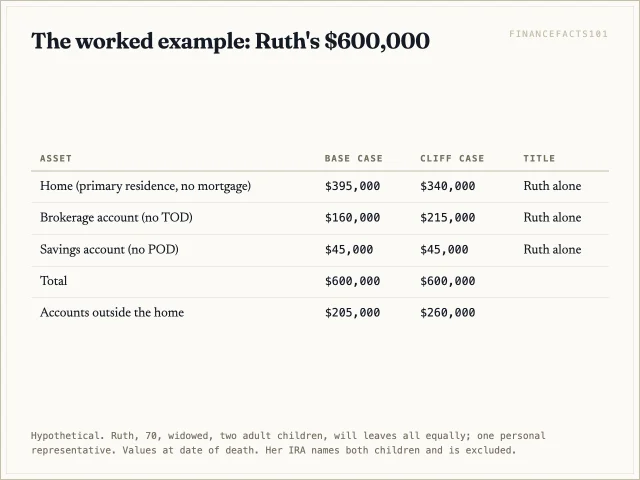
Ruth is 70, widowed, with two adult children. Her will leaves everything to them equally and names her daughter as executor, with one personal representative assumed throughout. At her death she owns, in her name alone: a home she lives in worth $395,000, with no mortgage; a brokerage account worth $160,000, with no TOD registration; and a savings account holding $45,000, with no payable-on-death beneficiary. That is $600,000 in total. Her IRA names both children and passes outside the will either way, so it is left out. Values are at the date of death. Fees are the statutory or presumed schedules above, computed by script.
California, will only. The home is under $750,000, so her children can petition for it under section 13151. A probate referee (appointed by the State Controller) must appraise it, at 0.1 percent: $395. The two accounts total $205,000, which is $3,850 under the $208,850 affidavit limit, so they can be collected by affidavit with no court case. Full probate is not needed. The costs are the referee's fee, the court's filing fee and whatever help the family pays for.
Florida, will only. The home is her Florida homestead. Her heirs are her children and the will leaves it to them, so it should qualify as "protected homestead" (section 731.201(33)), which is not an asset in the personal representative's hands (section 733.608). The $205,000 of accounts is over the $150,000 summary limit, so formal administration is needed for them. Presumed attorney fees: $3,000 on the first $100,000 plus 3 percent of $105,000, or $6,150. Personal representative: 3 percent of $205,000, also $6,150. That is $12,300, or $6,150 if the daughter gives up her commission. Handling protected homestead is listed as an extraordinary service that can add to the commission.
The cliff. Now give Ruth the same $600,000 split differently: a $340,000 home and $260,000 in the two accounts. California's affidavit no longer works, because the accounts are $51,150 over the limit. At least the $260,000 needs full administration: $16,400 in statutory fees if the home still goes by separate petition and stays out of the representative's inventory (the DE-310 form allows this with the personal representative's consent), or $30,000 if all $600,000 is administered. In Florida the presumed fees on $260,000 rise to $15,600.
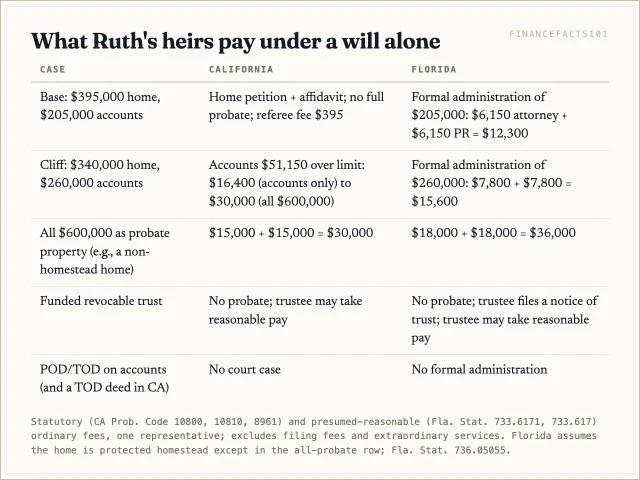
With a funded trust. If Ruth had retitled the home and both accounts to her trust, neither state's probate court would administer anything (Florida requires only a notice of trust). Her daughter, as successor trustee, would collect, pay final bills and distribute. She is entitled to "reasonable compensation" in both states (California section 15681; Florida section 736.0708), and she may decline it.
With designations only. A payable-on-death beneficiary on the savings and TOD registration on the brokerage account would take $205,000 out of probate in either state at little or no cost. In California, a TOD deed could do the same for the house. Ruth's estate would then need no court case at all, and she would have no trust to maintain.
Funding the trust: where most trusts fail
A trust controls only what is titled in its name. The CFPB's guide for family trustees says it bluntly: "A living trust is ineffective unless Rose puts her money or property into it," and the trustee has no "legal authority over any money or property that is not in the trust" (CFPB). A signed trust with the house still in your own name is, for that house, a will with extra paperwork. The pour-over will catches the house, and the house then goes through probate.

Funding means recording a new deed for real estate, asking each bank and brokerage to re-register accounts in the trustee's name, and assigning personal property. It is not one task. Anything bought or opened later needs the same step: a refinance that moves the house back into your own name, an inheritance, or a new brokerage account. Retirement accounts are the exception. They stay in your name and are coordinated through the beneficiary form.
Incapacity: the trust's strongest argument
A will does nothing while you are alive. A funded trust names someone who can step in. The CFPB explains that a successor trustee can act when the person who made the trust "can no longer make decisions," and tells trustees to check whether the document says how that will be known. In California, once no one holding the power to revoke is competent, the trustee must send the beneficiaries a copy of the trust within 60 days and account to them (section 15800).

The gap a trust leaves is everything outside it. A durable financial power of attorney covers that: retirement accounts, the car, tax returns, and anything you forgot to fund. Without either document, the family may need a court-appointed conservator or guardian. The CFPB publishes separate guides for agents under a power of attorney, trustees and court-appointed guardians. For a single person or a widow like Ruth, this is often the deciding factor. Probate happens once, and if it is small it may be cheap. Incapacity can last years.
Privacy: real, but narrower than the sales pitch
A will ends up with the court. Whoever holds it must deliver it to the court clerk within 30 days of learning of the death in California (section 8200) and within 10 days in Florida (section 732.901). A funded trust's terms are not filed with any court unless someone sues over it. Florida does require the trustee to file a short notice of trust naming the settlor and trustee after the death (section 736.05055).
The gap is smaller than it sounds in at least one state. Florida makes probate inventories and accountings confidential, open only to the representative, the attorney, interested persons or someone with a court order (section 733.604). A trust is not secret from the family either. In California, the trustee must notify every beneficiary and every heir when a revocable trust becomes irrevocable at the settlor's death (section 16061.7).
Federal estate tax in 2026: $15 million, and a revocable trust changes nothing
Section 70106 of Public Law 119-21, signed July 4, 2025, raised the basic exclusion amount in 26 U.S.C. 2010(c)(3) to $15,000,000 for people dying after December 31, 2025, indexed for inflation after 2026. The IRS confirms $15,000,000 for 2026, up from $13,990,000 in 2025, and puts the annual gift exclusion at $19,000 per recipient (IRS). The first spouse's executor can elect, on a filed estate tax return, to pass the unused exclusion to the survivor (IRS).

A revocable trust is not a tax shelter. Federal law puts any property you could revoke back into your gross estate (26 U.S.C. 2038). The income-tax side works the same in reverse: property in a revocable trust is treated as passing from the decedent, so heirs get the same basis reset at death as they would under a will (26 U.S.C. 1014(b)(2)). The mechanics are covered in our step-up in basis entry. Some states levy their own estate or inheritance taxes at much lower thresholds, so check your state's revenue department.
Creditors: a revocable trust is not a shield
Your creditors can reach a revocable trust's property while you live (California section 18200; Florida section 736.0505, for property not otherwise exempt). After death, the trust is still liable for the estate's debts and expenses to the extent the probate estate cannot cover them (California section 19001; Florida section 733.707(3)).
This is where trust sales pitches go wrong. In 1997 the FTC charged two living-trust sellers with falsely claiming that a trust "avoids all probate and administrative costs," "cannot be challenged" and "protects against catastrophic medical costs," among other things. The consent orders required them to disclose, where state law made it true, that creditors can have longer to file a claim against a living trust than against a probated estate.
What each costs to set up
Online services publish their prices, so here are two, each as one example on October 3, 2026. Trust & Will lists a will plan from $199 and a trust plan from $499, plus a $49 yearly membership. LegalZoom lists a basic living trust package at $399 for one person or $499 for a couple, which includes a pour-over will, a financial power of attorney and a healthcare directive.
Attorney-drafted plans are priced by each firm and market, so ask for a written flat-fee quote. Check whether it includes preparing and recording the deed and the letters that retitle each account. A trust's price is the documents plus the funding work, and the funding is the part a document package cannot do for you. California's courts say "living trusts are complicated and you usually need to have a lawyer help you."
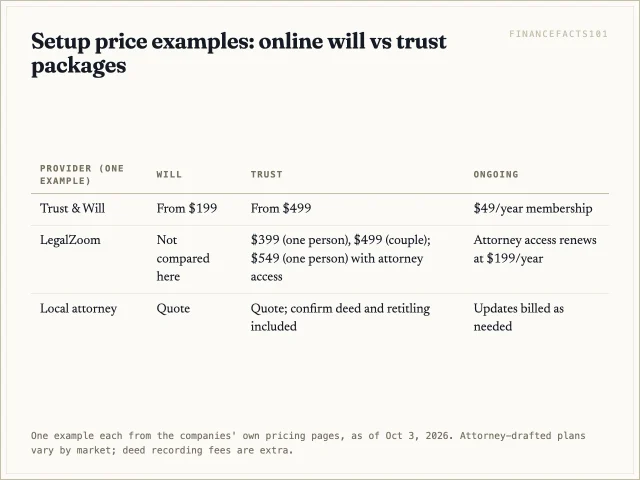
The test is simple arithmetic. Compare the one-time difference in setup cost against the probate your heirs would actually face, after small-estate exits and designations, and add the value of avoiding a conservatorship. For Ruth in California with her original mix, the probate saving is near zero. With the cliff mix, it is $16,400 to $30,000 in statutory fees alone.
The decision

A will plus up-to-date beneficiary forms and a durable power of attorney is enough when your probate exposure fits your state's small-estate route, or when designations can cover most of it. A revocable trust is worth it when real estate would otherwise go through full administration, when you own real estate in a second state (Florida, for example, provides for ancillary administration when a nonresident dies leaving assets there, section 734.102), when you want a successor manager without court oversight, or when you want staged or conditional gifts that run for years. Whichever you choose, the executor or trustee still does real work; our entry on the executor's role covers what that involves.
FAQ
Does a living trust avoid probate completely?
Only for property actually titled in the trust or passing to it by designation. Anything left in your own name passes under the pour-over will, which goes through probate unless it fits a small-estate procedure. The CFPB's guide puts it flatly: a living trust "is ineffective" for property not put into it.
Do I still need a will if I have a trust?
Yes. A pour-over will catches property you never retitled. For many parents it is also where a guardian for minor children is nominated, though California, for one, accepts the nomination in any signed writing. Without a will, anything outside the trust passes by your state's intestacy rules.
Will a revocable trust protect my house from creditors or nursing-home costs?
No. California (section 18200) and Florida (section 736.0505) both let your creditors reach a revocable trust's property while you are alive, and the trust can be liable for estate debts after death. Protection, where it exists, comes from irrevocable arrangements or state exemptions, which are different tools.
Is a revocable living trust worth it for a $600,000 estate?
It depends on how the $600,000 is held, not on the total. In the worked example, the same $600,000 costs Ruth's heirs almost nothing in California under one split and $16,400 to $30,000 in statutory fees under another, and $12,300 to $15,600 in Florida. Beneficiary designations can remove most of that for free; the trust adds incapacity management that designations cannot.
Sources
- US Congress, Public Law 119-21, section 70106 (estate and gift exclusion of $15,000,000 from 2026; enacted July 4, 2025)
- IRS, What's new — Estate and gift tax (2026 basic exclusion $15,000,000; 2025 $13,990,000; annual exclusion $19,000)
- IRS, Estate tax (gross estate, filing thresholds by year, portability)
- Legal Information Institute, 26 U.S. Code § 2038 (revocable transfers included in the gross estate) and § 1014 (basis of property acquired from a decedent)
- CFPB, Managing someone else's money: Help for trustees under a revocable living trust and guide series
- FTC, Prepared statement on living trust scams (Senate Special Committee on Aging, July 11, 2000)
- FINRA, Plan ahead to smooth the transfer of your brokerage account assets on death
- Judicial Council of California, Form DE-300, maximum values for small estates (rev. April 28, 2025) and Form DE-310, petition to determine succession to primary residence
- California Courts Self-Help, Wills, estates, and advance care planning
- California Probate Code sections 1502, 5600, 5614, 6300, 8200, 8961, 9100, 10800, 10810, 12200 (one-year deadline in the timeline table), 13050, 13151, 15681, 15800, 16061.7, 18200, 19001 (California Legislative Information)
- Florida Statutes sections 731.201, 732.901, 733.604, 733.608, 733.617, 733.6171, 733.702, 733.707, 734.102, 735.201, 736.0505, 736.05055, 736.0708 (Online Sunshine, 2026 text)
- Florida Senate, CS/HB 1337 (2026), enacted as chapter 2026-57, Laws of Florida (approved April 29, 2026; section 7 raises the summary-administration limit to $150,000; effective July 1, 2026)
- Uniform Law Commission, Uniform Probate Code, sections 3-1201 to 3-1204 (official text with comments)
- Trust & Will, pricing, and LegalZoom, living trust packages (one example each, prices as of October 3, 2026)
 Next entry · No. 5,993Home Equity Loan vs HELOC: Which Is Better in 2026?
See also
-
 No. 4,944
30 Jul 2025
20 min
Understanding Testamentary Trusts: An Effective Tool in Estate Planning
Financial Education
-
 No. 4,096
21 May 2025
22 min
Understanding Probate Court: A Comprehensive Guide for Professional and Institutional Investors
Business Finance
-
 No. 2,935
15 Feb 2025
22 min
Understanding Living Trusts: A Comprehensive Guide
Financial Education
-
 No. 5,094
11 Aug 2025
20 min
Understanding Trust Property: A Comprehensive Guide for Institutional Investors
Business Finance
-
 No. 3,576
09 Apr 2025
19 min
Understanding Notice to Creditors: A Guide for Professional Investors
Business Finance
-
 No. 2,539
14 Jan 2025
20 min
Understanding Irrevocable Trusts: A Comprehensive Guide for Institutional Investors
Business Finance