How Much Umbrella Insurance Do I Need? The Exposure Math

Add reachable assets to five years of garnishable pay: our $1.17M-net-worth household is exposed to $679,500, so $1M over 250/500 auto fits.
How much umbrella insurance do I need? For most households the answer is $1 million, the usual starting limit, and you need more only when the assets a creditor could actually reach plus about five years of garnishable pay exceed $1 million plus your auto liability limit. Insurance Information Institute guidance, viewed in October 2026, puts that first $1 million at roughly $200 to $350 a year, which is why the real question is whether you need a second million, not the first.
The household worked through below has a net worth of $1,172,000. Its exposure to a lawsuit, counted the way a judgment creditor would count it, is $679,500. A $1 million umbrella stacked on a $250,000 auto policy covers that with $570,500 to spare, while the popular rule of matching your umbrella to your net worth would have sold it $2 million.
One line of scope honesty: this is general information built on a stated example household and on federal law as of October 2026. It is not legal or personal advice, and state law changes several of the numbers.
Who this is for, and who it is not for
This guide is for a US household that owns a home, drives, and has built savings or a solid income: the balance sheet that makes a serious injury claim worth pursuing past your insurance limits. It matters most with a teenage driver, a pool, a dog, a rental or a high-earning career ahead.
It is not for business liability, which a personal umbrella generally excludes. Nor is it a substitute for life insurance: an umbrella protects what you have from other people's claims, while life insurance replaces your income for people who depend on it. That sizing is in our guide to how much life insurance you need, and the permanent-versus-term question is in term vs whole life.
What umbrella insurance does: higher limits and broader coverage
An umbrella does two jobs: it pays after your auto, homeowners or boat liability limit is used up, and it covers some claims those policies may not cover at all.
The Insurance Information Institute describes it as "an additional layer of coverage beyond what standard homeowners, auto, or other vehicle coverage might provide" that may also cover "libel or slander." The Texas Department of Insurance says it might also cover false arrest, defamation and slander, and that umbrella policies cover everyone in your household. The NAIC's consumer page says an umbrella can pay defense costs and liability that exceed your primary policy's limits, for bodily injury, property damage or personal injury.
The New Jersey Department of Banking and Insurance gave a clean example: a driver with $500,000 of auto liability causes $750,000 of property damage, injuries and lost wages to several people. The auto policy pays $500,000 and the umbrella the other $250,000, which would otherwise fall on the driver personally.

As one insurer's example, Travelers' umbrella page lists $1 million to $5 million of liability, claims "like libel, slander, defamation of character and invasion of privacy," legal defense costs, and liabilities outside the United States. Other insurers' forms differ, so read the policy, not the marketing.
The underlying limits you must carry first
Umbrella insurers generally will not sit on top of thin primary coverage. The Insurance Information Institute says most insurers want at least $250,000 of liability on your auto policy and $300,000 on your homeowners policy before selling a $1 million umbrella. Auto requirements are usually written as split limits like 250/500: $250,000 per injured person and $500,000 per accident.
Those requirements are far above what states make you carry. California raised its minimum to $30,000 per person, $60,000 per accident and $15,000 of property damage on January 1, 2025, the first update in 56 years as the Insurance Commissioner put it in 2023, according to California Department of Insurance Bulletin 2023-1 and the California DMV. A typical umbrella requirement is more than eight times that per-person minimum.
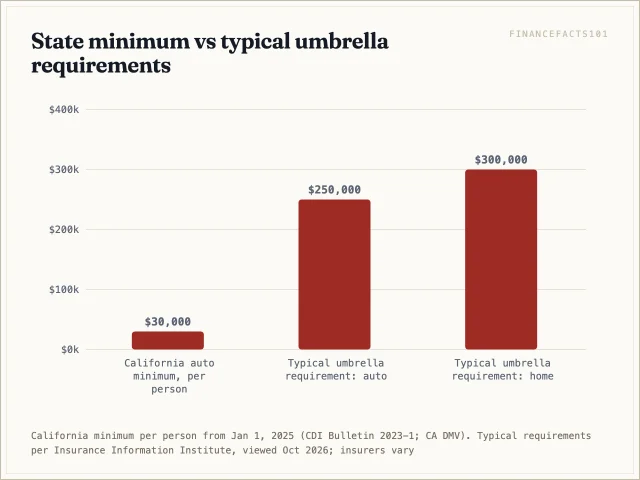
That gap matters for the price. If your auto policy is at 100/300 today, raising it to 250/500 is part of what the umbrella costs, so quote both and add them together.
How much umbrella insurance do I need: the exposure method
The common shortcut is to buy an umbrella equal to your net worth. It gets the logic half right. A plaintiff who wins a judgment above your insurance can collect only what the law lets them reach: assets that are not exempt, and a slice of your future pay. Net worth overstates the first and ignores the second.
The exposure method counts both:
- Reachable assets: your net worth minus the assets federal and state law protect from creditors.
- Garnishable future income: the share of your pay a creditor can take, multiplied by a planning horizon.
- Exposure: the sum of 1 and 2.
- Umbrella limit: exposure minus your lowest underlying limit (usually auto per person), rounded up to the next $1 million.
- Adjust upward for the risk factors covered later in this guide.
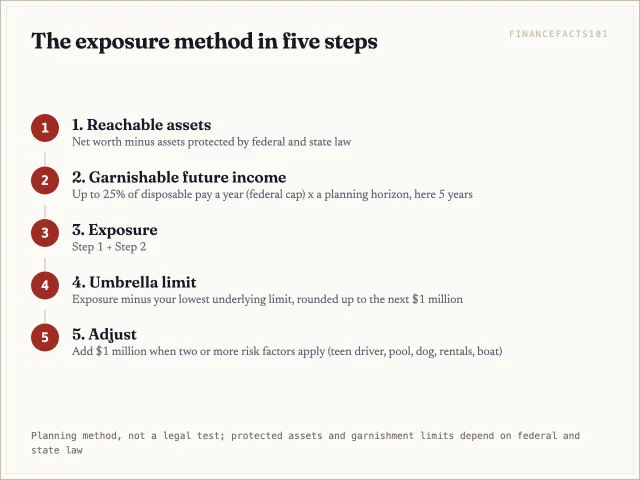
The method is a floor, not a forecast: a claim is sized by the injury, not your balance sheet. Exposure tells you how much of it could land on you.
Step 1: what a creditor can actually reach
Start from a full balance sheet. Our net worth calculator does the arithmetic; this guide only needs one extra column, protected or reachable.
The worked household: a married couple, both 46, with two cars, a teenage child and one main earner. Their home is worth $620,000 against a $340,000 mortgage, so equity is $280,000. Their 401(k) plans hold $510,000, their traditional and Roth IRAs hold $145,000, a taxable brokerage account holds $165,000 and cash is $48,000. Two cars are worth $42,000 with an $18,000 loan, so $24,000 net.
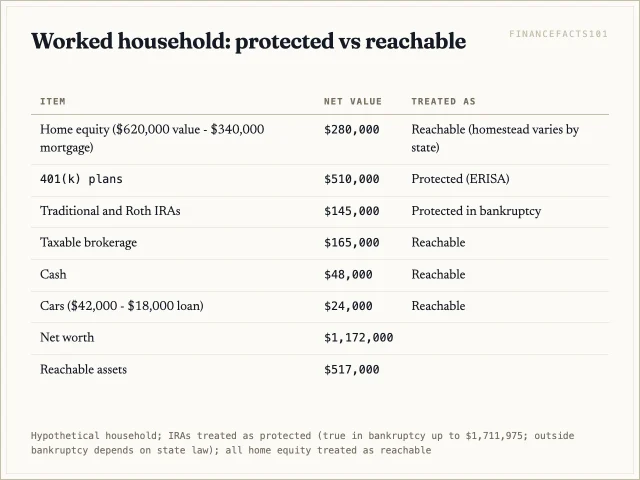
Total assets are $1,530,000 and debts $358,000, so net worth is $1,172,000. The 401(k) plans and IRAs, $655,000 together, sit under the federal protections described below. Reachable assets are the other $517,000. That counts all home equity as reachable (homestead protection depends on the state) and the IRAs as protected (true in bankruptcy; outside it, state law decides). The three-scenario check below tests both assumptions.
Step 2: future income, the part most people forget
A judgment does not expire when your savings run out. Federal law caps how much of each paycheck an ordinary creditor can garnish. Under 15 USC 1673, as summarised in the Department of Labor's garnishment fact sheet, the weekly amount may not exceed the lesser of 25% of disposable earnings or the amount by which disposable earnings exceed 30 times the federal minimum wage. At $7.25 an hour, that floor is $217.50 a week.
Disposable earnings are what is left after legally required deductions such as income taxes and Social Security. The DOL says voluntary deductions, including retirement plan contributions and health insurance, usually may not be subtracted, so your 401(k) deferral does not shrink the base. Where a state garnishment law differs, the law producing the lower garnishment applies. The federal 25% is a ceiling, not a prediction.
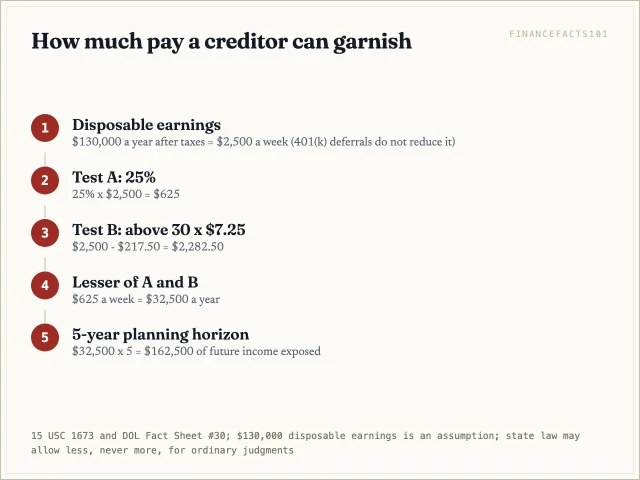
For the worked household, the main earner makes $185,000 gross; assume $130,000 of disposable earnings after taxes. That is $2,500 a week. Twenty-five percent is $625, and $2,500 minus $217.50 is $2,282.50, so the lesser figure, $625 a week, is the cap. Over a year that is $32,500.
How long a judgment stays collectible is set by state law and varies. Five years is a planning horizon, not a legal rule: at $32,500 a year it puts $162,500 of future income on the table. That is a ceiling: an ordinary negligence judgment can generally be discharged in bankruptcy, at the cost of your non-exempt assets, and some states allow less garnishment than the federal cap.
The worked household, start to finish
Add the two pieces: $517,000 of reachable assets plus $162,500 of garnishable income is $679,500 of exposure.
Subtract the lowest underlying limit. Suppose the main earner causes a crash that seriously injures one person (a crash by the teenager can also reach the parents, depending on state law). The auto policy pays up to $250,000 per person. That leaves $429,500 of exposure above the auto limit, and the smallest umbrella layer, $1 million, covers it. Total protection per injured person becomes $1,250,000, which is $570,500 more than the household's exposure.

Now compare the shortcut. Matching the umbrella to the $1,172,000 net worth means rounding up to $2 million. That second million protects nothing a creditor could collect today. At roughly $75 a year in one outside estimate it is not a foolish buy, but buy it for the risk factors, not because the net-worth rule demanded it.
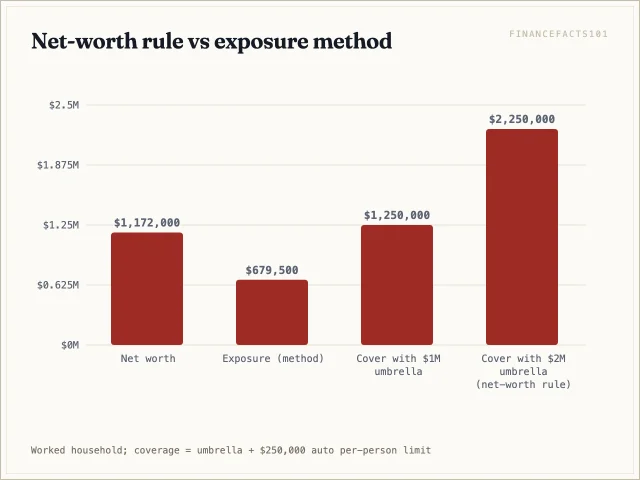
The method also says when to revisit. Once exposure passes $1,250,000, through a growing brokerage account, a paid-off mortgage, an inheritance or a big raise, the second million becomes necessary rather than optional.
State law changes the answer: homestead, IRAs and 401(k)s
401(k)s and other ERISA plans. 29 USC 1056(d)(1) requires that "benefits provided under the plan may not be assigned or alienated." In Patterson v. Shumate (1992), the Supreme Court held that this anti-alienation rule lets a debtor's interest in an ERISA-qualified plan be excluded from the bankruptcy estate. The statute has exceptions, including qualified domestic relations orders and offsets for crimes or fiduciary breaches involving the plan. The protection attaches to money inside the plan; a withdrawal sitting in checking is generally just cash.
IRAs in bankruptcy. 11 USC 522 exempts retirement funds held in tax-exempt accounts, but subsection (n) caps traditional and Roth IRAs. The cap leaves out SEP and SIMPLE IRAs and amounts rolled over from employer plans, with their earnings, and a court may raise it "if the interests of justice so require." The Judicial Conference's adjustment, published February 4, 2025, set the cap at $1,711,975 for cases filed on or after April 1, 2025. The next scheduled adjustment is April 1, 2028.
IRAs outside bankruptcy, and inherited IRAs. The federal cap applies only in bankruptcy. Whether a judgment creditor can reach an IRA outside bankruptcy depends on your state's exemption law. Inherited IRAs are weaker still: in Clark v. Rameker (2014) the Supreme Court held that funds in inherited IRAs are not "retirement funds" under the federal exemption.
Homestead. State homestead rules vary enormously. Florida's constitution, Article X, Section 4, exempts a homestead from forced sale with no dollar cap, up to half an acre inside a municipality or 160 acres outside one. Taxes and assessments, debts for the home's purchase, improvement or repair, and labor performed on it are excepted. A debtor using the federal bankruptcy list can protect only $31,575 of home equity per debtor under section 522(d)(1) (a married couple filing jointly can each claim it). And a debtor using state exemptions cannot shield more than $214,000 of homestead interest acquired in the 1,215 days before filing, with limited exceptions, under section 522(p). Our homestead exemption primer covers the property-tax side.

Section 522(b)(2) lets a state replace the federal exemption list with its own, and section 522(b)(3)(A) generally applies the law of the state where you lived for the 730 days before filing. The federal courts' Chapter 7 guide advises consulting an attorney about the exemptions available where you live.

Run the worked household through three legal settings and the umbrella answer holds. With all home equity protected, as in Florida, exposure falls to $399,500. With IRAs unprotected outside bankruptcy, it rises to $824,500. All three sit under the $1,250,000 that $1 million of umbrella plus the auto limit provides.
What umbrella insurance costs
Premium data is thinner than it should be, and much of it is old. The Insurance Information Institute's renters insurance guide, viewed in October 2026, says umbrella policies generally cost $200 to $350 a year for an extra $1 million of liability protection. Progressive's cost page (updated September 12, 2024) quotes two outside figures: a $383 average from an undated ACE Private Risk Services report, a brand that predates ACE's 2016 merger with Chubb, and about $75 more per additional $1 million from Money.com. Neither is Progressive's own price.
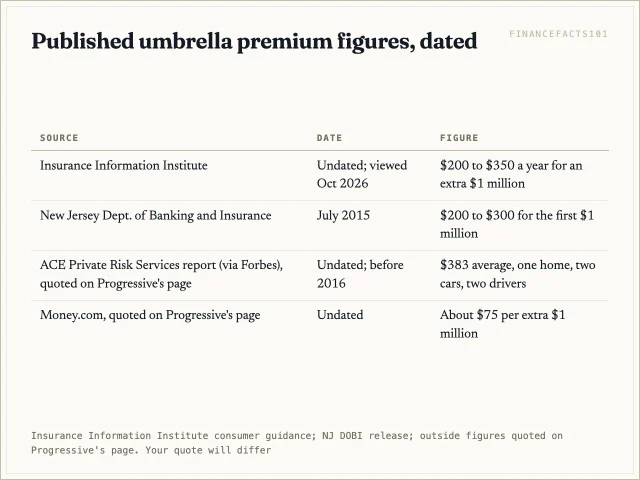
Quotes typically move with the number of drivers (especially young ones), vehicles, homes, rental units and boats, and with your claims record. At $300 a year, $1 million of cover costs 30 cents per $1,000, and higher layers cost less because they pay only after the first is exhausted.
What umbrella insurance does not cover
The NAIC lists two exclusions plainly: umbrellas do not pay for damage to your own home or vehicle, and they do not cover punitive damages, giving drunk driving as its example. Travelers, as one insurer's description, excludes business losses "even if your business is operated out of your home," and intentional acts, such as intentionally harming a visitor to your home.

The business exclusion is the one most likely to surprise a household. A consulting practice run from the spare bedroom, paid side jobs and professional errors are business activity, and a personal umbrella is not built for them. If you own rental units, confirm they are listed on the umbrella and that the landlord policy carries the underlying liability the umbrella requires.
The intentional-acts exclusion has a bankruptcy twin. Under 11 USC 523, debts for "willful and malicious injury" and for death or injury caused by driving while intoxicated cannot be discharged. Those are the claims an umbrella is least likely to pay and bankruptcy least likely to erase.
Risk factors that justify a higher limit
The Insurance Information Institute names the usual reasons to consider an umbrella: a swimming pool and pool parties, renting out a property, a dog, or a teenage driver in the house.
Dogs are a concrete example. Triple-I and State Farm research published April 13, 2026 found insurers paid $1.86 billion on 28,450 dog-related injury claims in 2025, an average of $65,450 each.

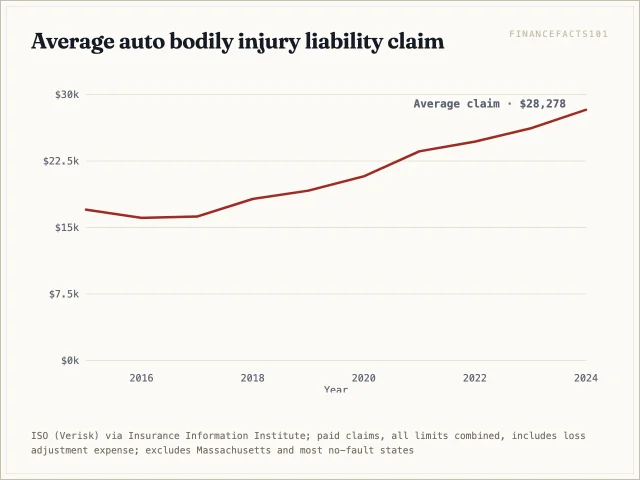
Auto claims are rising too. ISO data published by the Insurance Information Institute show the average bodily injury liability claim rose from $17,014 in 2015 to $28,278 in 2024, up 66%. A typical claim still fits easily inside a $250,000 per-person limit. The umbrella is for the rare claim that does not, and averages say nothing about how large that one can be.
This guide's rule of thumb, not an industry standard: add $1 million to the method's answer when two or more of these apply: a newly licensed driver, a pool or trampoline, a dog with a bite history, rental units, a boat, or a public role that invites defamation claims. For the worked household, the teenager alone is a judgment call; add a pool and the second million is cheap insurance.
When umbrella insurance is not worth it
An umbrella is poor value when there is little to protect and little income to garnish. A renter in their twenties with $8,000 saved and modest pay has almost no exposure, and the real price includes raising auto liability to 250/500. That money does more good in an emergency fund. It is also the wrong tool when your main exposure is a business, which a personal umbrella generally will not cover.
The exception is income. A medical resident with no assets but a large salary ahead has real exposure in Step 2, which is why the method counts future pay.
Mistakes that leave a gap
- Letting underlying limits slip. If you drop below the underlying limits the umbrella lists, it may pay only above the limit you were supposed to keep, leaving the difference to you.
- Forgetting a new car, home or driver. Tell the umbrella insurer, not just the auto or home carrier.
- Assuming defense costs are unlimited. Ask whether defense costs reduce the limit or are paid in addition to it.
- Assuming uninsured motorist cover. The Texas Department of Insurance lists uninsured or underinsured auto claims among what an umbrella might pay. Whether yours does depends on the form, so ask.
The decision, step by step
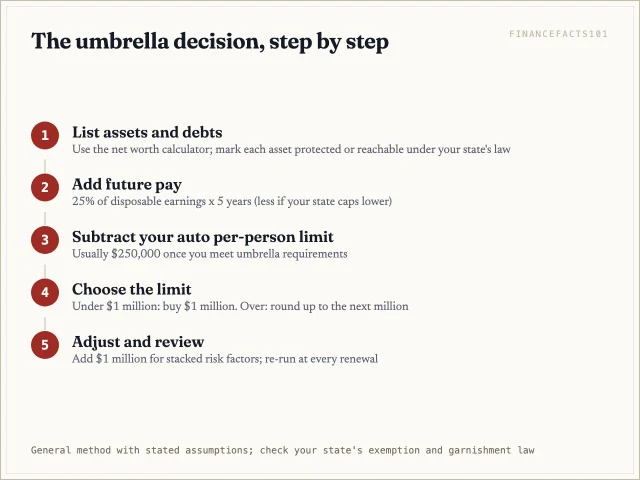
Under $1 million of exposure above your auto limit, buy $1 million; over it, round up, and re-run the numbers at every renewal. The earlier primer on umbrella insurance policies covers the definitions; the liability insurance overview explains the primary coverages the umbrella sits on.
FAQ
Is $1 million of umbrella insurance enough?
For most households, yes. With a $250,000 auto limit underneath, $1 million covers exposure up to $1,250,000; in the worked example a $1,172,000 net worth produced only $679,500. Buy more when your exposure passes that line or you stack risk factors like a teen driver and a pool.
Do I need umbrella insurance if most of my money is in a 401(k)?
Less than your net worth suggests. ERISA's anti-alienation rule shields 401(k) plans, and traditional and Roth IRAs are protected in bankruptcy up to $1,711,975 for cases filed on or after April 1, 2025 (rollovers from employer plans are not counted against that cap). But taxable accounts, home equity above your state's homestead exemption, and up to 25% of your disposable pay remain reachable.
Does umbrella insurance cover my home business?
Generally no. Personal umbrella forms typically exclude business activity, and Travelers says its exclusion applies even when the business runs from your home. That risk needs business coverage such as a business owner's policy or commercial general liability.
How much does a $2 million umbrella policy cost?
No current official survey prices higher limits. One outside estimate quoted by Progressive puts each additional $1 million at about $75 a year, against $200 to $350 for the first million in the Insurance Information Institute's range. Your quote depends on your drivers, vehicles, homes and claims history.
Sources
- Insurance Information Institute, Should I purchase an umbrella liability policy? (viewed October 2026)
- Insurance Information Institute, Renters insurance (umbrella cost range; viewed October 2026)
- Insurance Information Institute, Facts + Statistics: Auto insurance (ISO claim severity, 2015-2024)
- Insurance Information Institute, Dog-related injury claims on the rise in 2025 (April 13, 2026)
- NAIC, What's an Umbrella Policy? (December 15, 2022)
- Texas Department of Insurance, Umbrella policy: What is it and when do you need one? (last updated April 10, 2025)
- New Jersey Department of Banking and Insurance, Tips to consumers considering umbrella insurance (July 8, 2015)
- California Department of Insurance, Bulletin 2023-1: SB 1107 financial responsibility increase (January 30, 2023)
- California DMV, Auto insurance requirements
- Judicial Conference of the United States, Adjustment of Certain Dollar Amounts Applicable to Bankruptcy Cases (Federal Register, February 4, 2025; effective April 1, 2025)
- 11 USC 522, Exemptions (govinfo)
- 11 USC 523, Exceptions to discharge (govinfo)
- 29 USC 1056, Form and payment of benefits (govinfo)
- 15 USC 1673, Restriction on garnishment (govinfo)
- US Department of Labor, Wage and Hour Division, Fact Sheet #30: Wage Garnishment Protections of the CCPA (December 2024)
- United States Courts, Chapter 7 – Bankruptcy Basics
- Florida Senate, Constitution of the State of Florida, Article X, Section 4
- Supreme Court, Patterson v. Shumate, 504 U.S. 753 (1992) and Clark v. Rameker, 573 U.S. 122 (2014) (via Cornell LII)
- Travelers, Umbrella insurance coverage (one insurer's description; viewed October 2026)
- Progressive, How much does umbrella insurance cost? (page updated September 12, 2024; quotes an undated ACE Private Risk Services report and Money.com)
 Next entry · No. 5,992Will vs Trust: Do You Need a Revocable Living Trust?
See also
-
 No. 5,935
07 Sep 2026
17 min
How Much Life Insurance You Actually Need
Insurance
-
 No. 133
07 Apr 2024
21 min
Understanding All Risks Insurance: What It Covers, Exclusions, and Benefits
Insurance
-
 No. 5,185
18 Aug 2025
17 min
Understanding Underinsured Motorist Endorsements: Protecting Against Uninsured or Underinsured Drivers
Insurance
-
 No. 5,142
15 Aug 2025
18 min
Umbrella Insurance Policy: A Valuable Addition to Your Existing Insurance Coverage
Insurance
-
 No. 4,794
17 Jul 2025
24 min
Understanding Subrogation: A Legal Right for Insurance Companies
Insurance
-
 No. 3,378
23 Mar 2025
17 min
The Needs Approach to Life Insurance Planning: A Comprehensive Guide
Insurance