CD Ladder: Is It Worth It, and How Do You Build One?
A five-rung $25,000 CD ladder at October 3, 2026 rates earns $1,093 in year one and frees $5,000 a year. When it beats one CD, savings or Treasuries.
A CD ladder is worth it when you have at least $10,000 you will not need for one to five years and you want both a locked rate and a payout every year: split into five $5,000 rungs at the rates Synchrony Bank posted on October 3, 2026 (4.20% for one year up to 4.50% for five), $25,000 earns about $1,093 in its first year, $205 more than the 3.55% Synchrony paid on savings that day, and $5,000 comes free of penalty every twelve months. The CD ladder is not worth it for an emergency fund, or for anyone willing to hold Treasuries, which paid 4.46% to 5.06% for the same terms on October 2 and carry no state income tax.
Below: how the rungs and rolling work, a five-rung example with every rate dated, how a ladder compares with one CD, a savings account and a Treasury ladder, what it costs to get out early, brokered versus bank CDs, and how to keep every rung inside FDIC coverage. This is general information built on stated assumptions and rates as of October 3, 2026, not personal advice.
Is a CD Ladder Worth It? The Short Answer
A ladder solves one problem: it lets you earn something close to a long-term CD rate without locking all your money up for the long term. Whether that matters depends on how much the bank pays for length, and right now it pays little. At Synchrony the five-year CD beats the one-year by 0.30 point. Ally's five-year High Yield CD pays 4.10%, less than its 18-month CD at 4.25%. When long terms pay barely more than short ones, a ladder's yield edge shrinks to its liquidity edge.
That liquidity edge is real, though. In the worked example below, the ladder trails a single five-year CD by $78 over five years if rates never move, yet it caps the cost of a surprise $5,000 withdrawal at about $52 instead of $225 to $1,125. It is never the best result in hindsight and never the worst, and that is the reason to build one.
Who This Is For — and Who It Isn't
This guide fits a US saver with roughly $10,000 to $250,000 of cash that has jobs spread over the next five years: a car in two years, a tuition bill in three, a cushion for retirement income, or simply cash you want earning a fixed rate while staying partly reachable. It assumes you already hold an emergency reserve somewhere you can reach this week; how big that should be is covered in how much emergency fund you need.
It is not for money you may need any given month. That belongs in a savings or money market account, compared in money market vs savings. It is not for a single dated expense either; one CD that matures the week before the bill is simpler. And if you are choosing only between one CD and a high-yield savings account, high-yield savings vs CDs works through that two-way choice in more depth.
How a CD Ladder Works: Rungs and Rolling
A ladder splits one pile of cash into equal pieces, called rungs, and buys each piece a CD with a different maturity. The standard version uses five rungs maturing in one, two, three, four and five years.
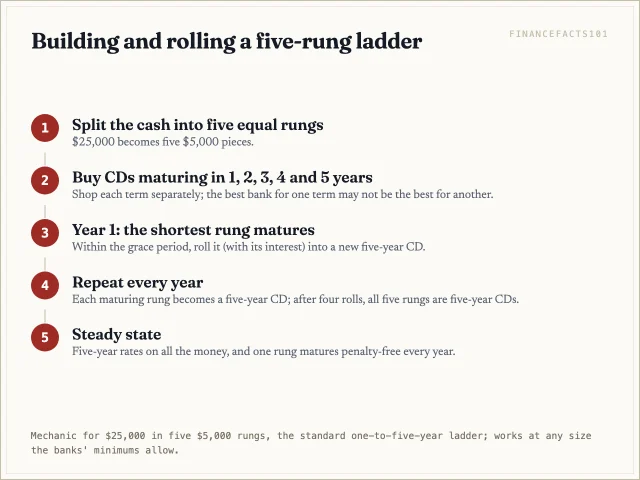
The trick is what happens at each maturity. When the one-year rung comes due, you do not buy another one-year CD; you roll it into a new five-year CD. A year later the original two-year rung matures and gets the same treatment. After four rolls every rung is a five-year CD, but because they were bought a year apart, one of them still matures every twelve months.
So the steady-state ladder pays five-year rates while giving you a penalty-free exit for a fifth of the money each year. Shorter ladders work the same way: three rungs of one, two and three years, or six-month spacing with two-year CDs. The longer the top rung, the higher the rate you are reaching for and the longer each dollar is locked. The general mechanic for bonds as well as CDs is set out in the entry on laddering fixed income.
Today's CD Rates by Term, October 3, 2026
A ladder is only as good as the rates on its rungs, so here is one day's menu. Every number below was posted on October 3, 2026, except Treasury yields, which are Friday October 2's close; October 3 was a Saturday, so Friday's close was the latest available that day.
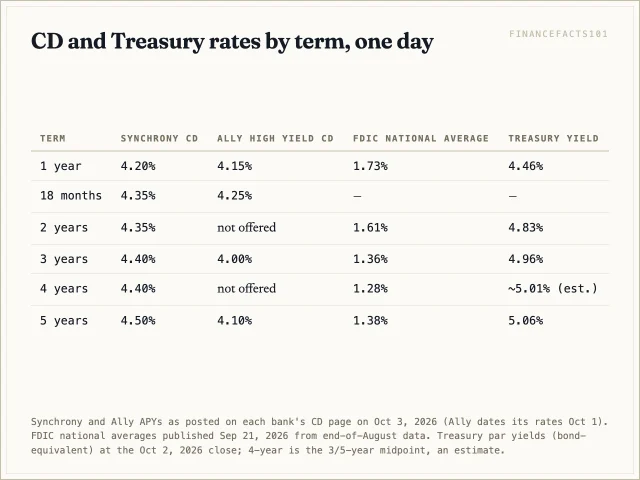
Synchrony Bank's CD page posted 4.20% for 12 months, 4.35% for 24, 4.40% for 36 and 48, and 4.50% for 60. Ally Bank's High Yield CD page, whose rates are dated October 1 and were still posted on October 3, shows 4.15% for 12 months, 4.25% for 18, 4.00% for three years and 4.10% for five; Ally offers no two-year or four-year High Yield CD. These are two banks' prices on one day, not the market's best, and your own bank may pay far less.
How much less is visible in the FDIC's national rates, published September 21, 2026 from end-of-August data: 1.73% for a 12-month CD, 1.61% for 24 months, 1.36% for 36, 1.28% for 48 and 1.38% for 60. The national average curve slopes down. The single biggest decision in a CD ladder is not its shape but whether you buy at an online bank's posted rates or at the average.

Treasury's daily par yield curve for October 2 runs the other way: 4.46% at one year, 4.83% at two, 4.96% at three and 5.06% at five. Treasury quotes no four-year point; this guide uses 5.01%, the midpoint of the three- and five-year yields, and labels it as an estimate. These are bond-equivalent yields, which run slightly below the same rate stated as an APY (4.46% works out to about 4.51% as an annual effective yield), so the comparison flatters CDs a little if anything. The Treasury curve rises 0.60 point from one year to five. Synchrony's rises 0.30, and its 13-month CD already paid 4.40%, the same as its three- and four-year CDs: a 13-month first rung earns the three-year rate for one extra month of lock-up.
Worked Example: Building a $25,000 Ladder at Synchrony
The assumptions, named: $25,000 split into five $5,000 CDs at Synchrony at its October 3, 2026 rates, interest left in each CD, each APY treated as an annual effective yield, no withdrawals. That is the same method as the site's compound interest calculator with yearly compounding, so you can check each rung there.

Year one earns $5,000 × (4.20% + 4.35% + 4.40% + 4.40% + 4.50%) = $5,000 × 21.85% = $1,092.50, a blended 4.37%. Each October from 2027 to 2030 the maturing rung rolls into a new five-year CD. If five-year rates stay at 4.50%, the ladder's blended yield climbs to 4.43%, 4.46% and 4.48% and reaches 4.50% in year five, and the $25,000 is worth $31,077 after five years.
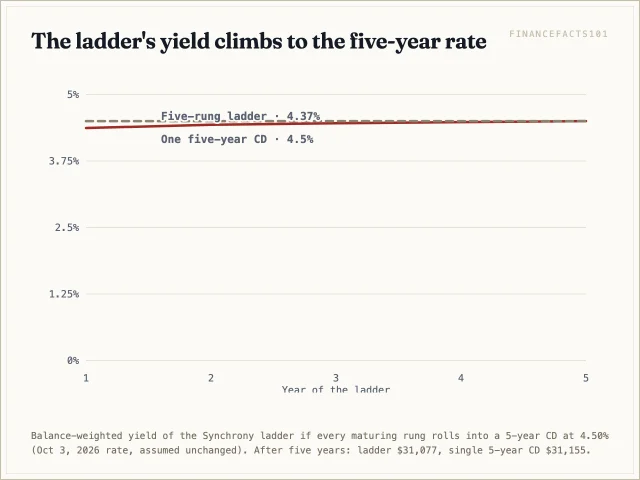
That climb is the cost of building the ladder: for four years some money sits in shorter, lower-paying rungs. Put all $25,000 in one five-year CD at 4.50% and it grows to $31,155, which is $78 more. Seventy-eight dollars over five years is the price of having $5,000 or more come due penalty-free every October.
If the money is meant for a goal, work backward with the savings goal calculator: enter the target, the years and 4.37% to see whether the ladder's interest closes the gap or whether monthly deposits still have to.
CD Ladder vs One CD, Savings and a Treasury Ladder
Same $25,000, same day, first-year interest before tax:

Against Synchrony's own savings account at 3.55%, the ladder earns $205 more in year one ($1,092.50 against $887.50). Against a savings account paying 4.00%, the gap is $92.50. A savings rate floats, so this gap can widen or close within weeks; the CD rates are fixed for each rung's term.
Against one five-year CD, the ladder gives up $32.50 in year one and $78 over five years in exchange for annual access. Against a one-year CD renewed each year, the ladder earns $42.50 more in year one, but whether it stays ahead depends on what one-year rates do next, which the scenarios below test.
Against a Treasury ladder built from the October 2 yields, the CD ladder loses. Five $5,000 rungs at 4.46%, 4.83%, 4.96%, 5.01% (estimated) and 5.06% pay about $1,216 in coupons in year one, $124 more than the CD ladder, and IRS Publication 550 states that interest on Treasury bills, notes and bonds "is exempt from all state and local income taxes." In a state taxing interest at 5%, the CD ladder also loses about $55 of its $1,092.50 to state tax. The fuller after-tax comparison for short terms is in T-bills vs CDs.
The first bar is the warning. A ladder built at FDIC-average rates earns about $368 a year, a third of what the online-bank ladder pays.
What It Costs to Get Out Early
The ladder's best feature shows up on a bad day. Say you need $5,000 six months in.
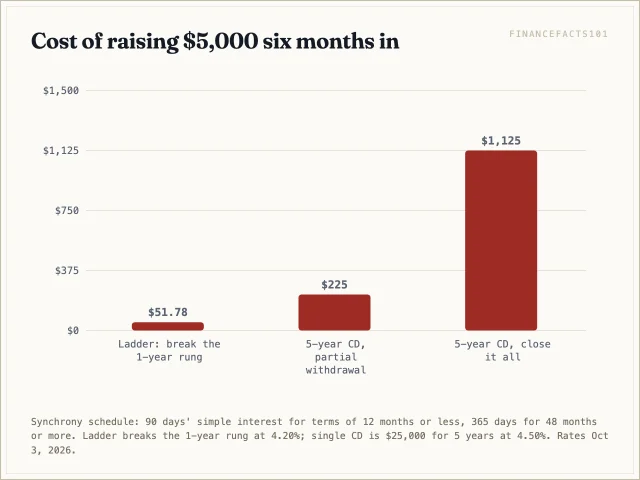
With the ladder, you break the shortest rung, the one-year CD at 4.20%. Synchrony's penalty schedule, on its CD page and in its early-withdrawal explainer, is 90 days of simple interest for terms of 12 months or less, 180 days for terms over 12 and under 48 months, and 365 days for 48 months or more. Ninety days at 4.20% on $5,000 is $51.78, about half the $103.92 the rung has earned by then. The other four rungs keep earning.
With a single $25,000 five-year CD the same need costs $225 if the bank lets you withdraw $5,000 of it (365 days of interest on $5,000 at 4.50%), and $1,125 if it makes you close the whole CD. Some banks do not allow partial withdrawals at all; Ally's page says so plainly. Ally's own schedule is gentler than Synchrony's: 60 days of interest for 3- to 24-month terms, rising to 150 days for terms of 49 months or longer.
Penalties are a contract term, not a federal number. Regulation D sets only a floor, requiring at least seven days' simple interest on money withdrawn within six days of deposit (12 CFR 204.2). Above that floor the bank sets the penalty, and the Truth in Savings rules require it to disclose how the penalty is calculated and when it applies before you open the account (12 CFR 1030.4). Read the schedule for each rung's term before you buy.
If Rates Fall, Rise or Stand Still
The ladder is a hedge, and the plainest way to see that is to run it against the alternatives under three rate paths. Assume rates move once, a year from now, by 1.5 points, and stay there. Every rate moves by the same amount: five-year CDs, one-year CDs and savings.
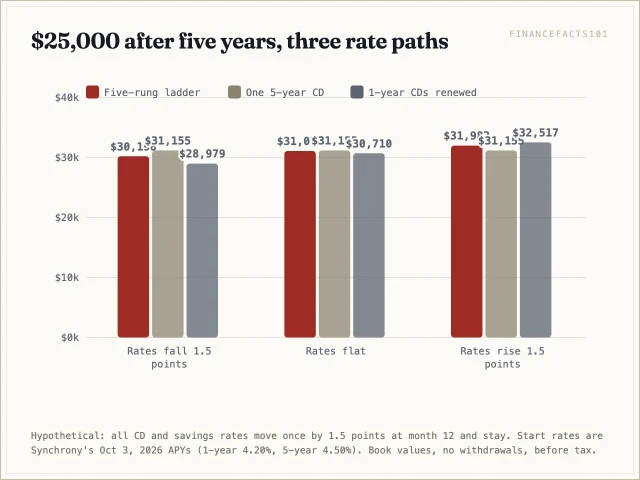
If rates fall 1.5 points, the single five-year CD wins at $31,155, the ladder ends at $30,198 because four rungs roll into 3.00% CDs, and one-year CDs renewed at 2.70% end at $28,979. If rates rise 1.5 points, renewing one-year CDs at 5.70% wins at $32,517, the ladder reaches $31,982, and the five-year CD stays at $31,155. A savings account that follows the same path ends at $28,076, $29,764 or $31,526 across the three cases.
So the ladder never comes first and never comes last. That is a description of a hedge, and it is the honest case for a CD ladder: you are not forecasting rates, because you have admitted you cannot.
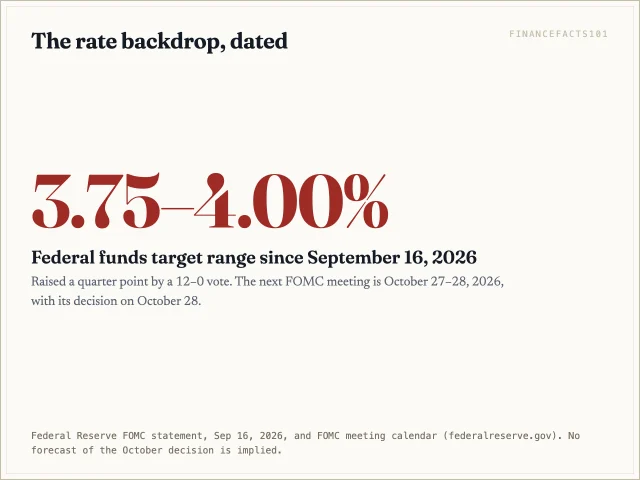
That admission fits the moment. On September 16, 2026 the Federal Reserve raised the federal funds target range to 3-3/4 to 4 percent by a 12–0 vote. The next decision comes at the end of the October 27–28 meeting on the FOMC calendar, four days after this guide publishes. This guide makes no forecast of it. Bank CD rates can change on any day, before or after a Fed decision, so the rates above are a dated snapshot rather than a quote you can count on.
The Treasury Ladder Alternative
A Treasury ladder uses the same rungs-and-rolling mechanic with government securities instead of bank deposits. TreasuryDirect sells Treasury notes in terms of 2, 3, 5, 7 and 10 years, with interest paid every six months, a $100 minimum, and no state or local tax on the interest. The one-year rung is a 52-week bill. There is no four-year note, so a four-year rung means buying an older note on the secondary market through a brokerage, or making do with four rungs.
On October 2 the Treasury ladder out-yielded the Synchrony ladder at every rung, by 0.26 point at one year and 0.56 point at five, with the four-year rung compared on the estimated 5.01%. The trade-offs are three:
- Coupons are paid out, not compounded. Interest arrives in cash twice a year, and you have to reinvest it yourself.
- There is no penalty schedule, but there is a price. You get out early by selling at whatever the market pays that day, which can be more or less than you paid.
- The credit backing differs. Treasuries are backed by the full faith and credit of the United States directly, not through deposit insurance, so the $250,000 FDIC limit does not apply to them.
For a saver in a high-tax state with no plans to sell early, the Treasury ladder is hard to beat on these numbers. The bank ladder's edge is simplicity, and an exit price you know in advance.
Bank CDs vs Brokered CDs on the Rungs
A third way to fill the rungs is brokered CDs: CDs issued by banks but bought through a brokerage account. On October 3, Schwab's CD page showed brokered CD rates of up to 4.60% for one year and 5.05% for two years. Schwab notes that those figures may lag the latest rates and may include callable CDs, which the issuing bank can redeem early.
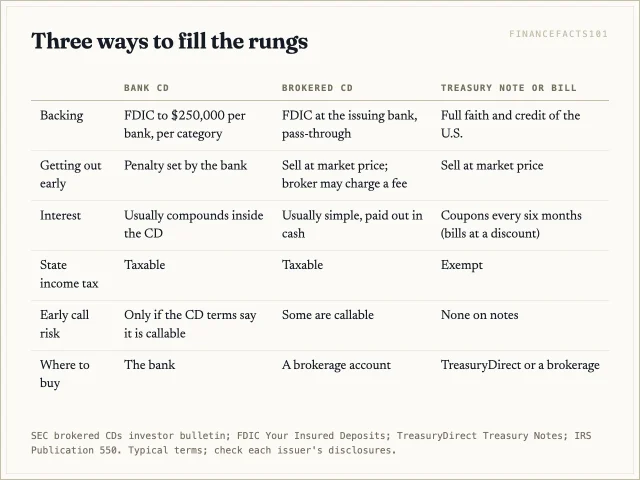
The differences run deeper than rate. The SEC's investor bulletin on brokered CDs says they "generally do not have early withdrawal penalties like CDs purchased directly from a bank". Instead you sell them in a secondary market, where "you may lose some of your original investment" if rates have risen. The same bulletin says brokered CDs "generally pay simple interest rather than compound interest", paying it out in cash at set intervals. It also warns that your broker may charge a fee to sell before maturity.
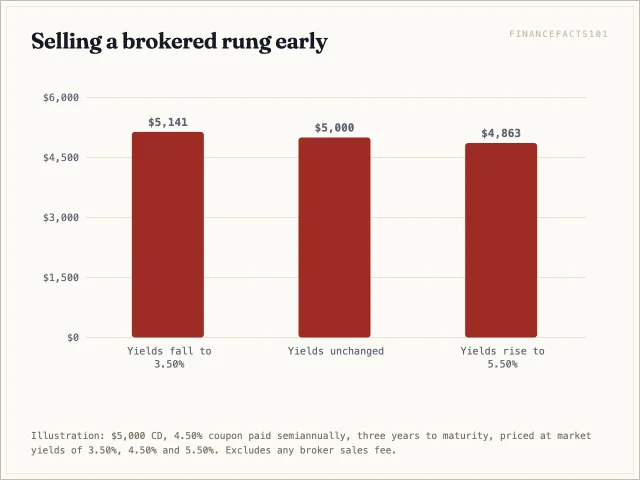
Here is that price risk on one rung. A $5,000 brokered CD paying 4.50% with interest twice a year and three years left sells for about $4,863 if comparable yields have risen to 5.50%, a $137 loss, or about $5,141 if they have fallen to 3.50%. Compare a bank CD of the same length: breaking a three-year Synchrony rung at 4.40% costs 180 days of interest, or $108.49 on $5,000. The bank rung's exit cost is known in advance, while the brokered rung's can be lower or higher. The bond-style mechanics are worked through for five-year terms in adjustable-rate CDs, which also covers callable CDs.
Brokered CDs do have a structural edge for big ladders: one brokerage account can hold five rungs from five different banks, and each bank carries its own insurance limit.
FDIC Coverage Across Every Rung
The standard limit is "$250,000 per depositor, per insured bank, for each account ownership category," in the words of the FDIC's Your Insured Deposits guide. All the rungs at one bank, plus your checking and savings there in the same ownership category, share that one limit. And the FDIC's CD shopping guide says the $250,000 limit "includes the principal and accrued interest."
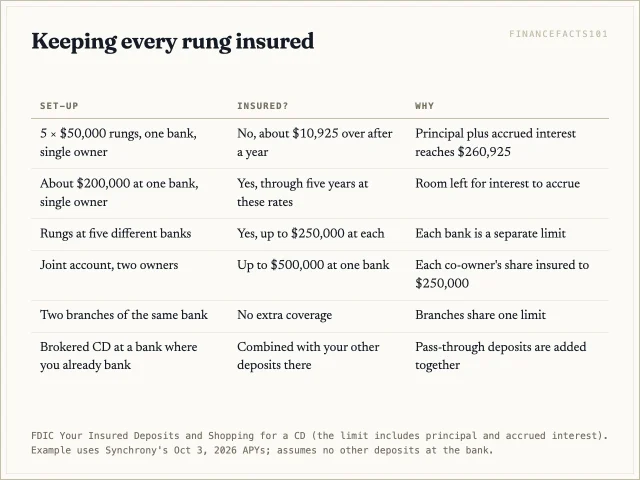
That last point catches ladders that start near the line. Five $50,000 rungs at Synchrony's October 3 rates total $250,000 on day one and $260,925 a year later, so about $10,925 would be uninsured for a single owner with nothing else at the bank. Leaving room for interest means capping one bank at about $200,000 of principal per ownership category for a five-year ladder at these rates. Above that, put rungs at different banks, use a joint account (each co-owner's share is insured up to $250,000), or use brokered CDs from several issuers. Brokered CDs are insured on a pass-through basis when the broker's records meet FDIC requirements, and they count toward the same per-bank limit as any deposits you already hold at the issuing bank. Two branches of one bank are not separately insured. Credit union certificates carry the same $250,000 through the NCUA, per the CFPB.
Running the Ladder: Maturities, Grace Periods and Taxes
A ladder is an annual chore, and the chore has deadlines. Most bank CDs renew automatically. Under 12 CFR 1030.5, a bank must send renewal disclosures at least 30 days before an auto-renewing CD longer than a month matures, or at least 20 days before the grace period ends if that period is five days or longer. Ally and Synchrony each give a 10-day grace period after maturity. Miss it, and the rung renews into whatever term and rate the bank's contract specifies, which may not be a five-year CD. Ally currently adds a 0.05% loyalty reward when you renew into any Ally CD. Calendar every maturity date the day you open the rung.
Taxes come every year, not at maturity. Per Publication 550, a CD with a term over one year is treated like original issue discount: you include part of the interest in income each year even if you cannot spend it, and the bank reports it on Form 1099-INT or 1099-OID. On the example ladder that is about $1,093 of taxable interest in year one; at a 22% federal bracket, that is roughly $240 of tax paid from other money. If you do break a rung, the penalty appears in box 2 of the 1099-INT, and Publication 550 says you can deduct it on Schedule 1 (Form 1040), line 18. That is an adjustment to income, so you do not need to itemize.
Is a CD Ladder Worth It for You? The Decision
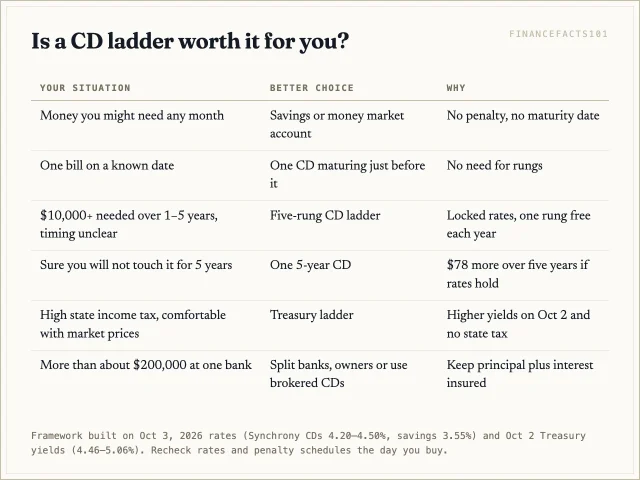
Build the ladder if you have $10,000 or more that will not be needed for at least a year, want deposit insurance and a fixed exit price rather than market prices, and cannot say whether rates will be higher or lower in two years. Buy each rung where its term pays most, not at one bank out of loyalty. On October 3 that meant Synchrony across the board over Ally, whose missing two- and four-year terms would force substitutions. If you are comfortable holding Treasuries, compare the Treasury ladder first; on these numbers it pays more at every rung (the four-year one on an estimated yield) and avoids state tax. And recheck every rate the day you buy, because none of the numbers in this guide is a quote.
FAQ
How much money do you need to build a CD ladder?
Less than most guides suggest: Synchrony and Ally both list no minimum deposit to open a CD, so the mechanic works at any size. In practice a ladder earns its bookkeeping at about $10,000 and up. Below that, each $1,000 rung earns roughly $44 a year at October 2026 rates, and one CD or a savings account is simpler.
Is a CD ladder better than a high-yield savings account?
For money you will not touch for at least a year, usually yes on rate. The example ladder earns $1,092.50 in year one against $887.50 at Synchrony's 3.55% savings rate, and its rates cannot be cut mid-term. For money you might need next month, no: savings has no penalty and no maturity date.
What happens to a CD ladder if interest rates go up?
Each maturing rung reinvests at the higher rate, so the ladder captures rising rates gradually, one rung a year. In this guide's 1.5-point rise scenario, the ladder ends five years at $31,982, ahead of a five-year CD ($31,155) but behind one-year CDs renewed annually ($32,517).
Are brokered CDs safer or riskier than bank CDs for a ladder?
They carry the same FDIC insurance at the issuing bank, provided the broker titles and records them properly. What differs is the exit: a bank CD charges a fixed penalty, while a brokered CD is sold at market price, which can be a loss if rates have risen. Brokered CDs also usually pay simple interest in cash rather than compounding inside the CD.
Sources
- FDIC, National Rates and Rate Caps, September 21, 2026 — national average CD rates by term, from end-of-August data
- FDIC, Your Insured Deposits — $250,000 per depositor, per insured bank, per ownership category; joint accounts; branches; pass-through coverage for brokered CDs
- FDIC, Shopping for a Certificate of Deposit? — limit includes principal and accrued interest; auto-renewal; brokered CDs
- U.S. Treasury, Daily Treasury Par Yield Curve Rates, October 2026 — October 2, 2026 close
- TreasuryDirect, Treasury Notes — terms, $100 minimum, semiannual interest, no state or local tax
- Federal Reserve, FOMC statement, September 16, 2026 — target range raised to 3-3/4 to 4 percent, 12–0 vote
- Federal Reserve, FOMC meeting calendars — October 27–28, 2026 meeting
- SEC Office of Investor Education, Brokered CDs investor bulletin — secondary-market sales, simple interest, sales fees, call features
- IRS, Publication 550 (2025) — CDs over one year, penalty deduction on Schedule 1 line 18, Treasury interest exempt from state and local tax
- eCFR, 12 CFR 204.2 — Regulation D time-deposit definition and seven-day minimum penalty
- eCFR, 12 CFR 1030.4 and 12 CFR 1030.5 — Truth in Savings disclosure of penalties and pre-maturity renewal notices
- CFPB, What is a certificate of deposit? — FDIC and NCUA coverage of CDs
- Synchrony Bank, Certificates of Deposit — CD rates by term as posted October 3, 2026; penalty schedule; 10-day grace period; no minimum deposit
- Synchrony Bank, CD early withdrawals explained — penalty schedule by term (the same schedule appears in the CD page's FAQ)
- Ally Bank, High Yield CD — rates dated October 1, 2026; available terms; penalty schedule; no partial withdrawals; 10-day grace period; loyalty reward
- Charles Schwab, Certificates of Deposit — brokered CD rates shown October 3, 2026; insurance aggregation note
 Next entry · No. 5,991How Much Umbrella Insurance Do I Need? The Exposure Math
See also
-
 No. 5,953
18 Sep 2026
17 min
Adjustable-Rate CDs: What the Bump-Up Option Really Costs
Banking
-
 No. 658
16 May 2024
22 min
Understanding Certificates of Deposit (CDs) and Their Benefits
Investments
-
 No. 5,930
02 Sep 2026
14 min
High-Yield Savings vs CDs: Where Cash Earns More
Personal Finance
-
 No. 5,985
19 Oct 2026
20 min
Money Market vs Savings: Account, Fund or High-Yield Savings?
Banking
-
 No. 5,955
19 Sep 2026
20 min
Deposit Accounts: Checking vs Savings vs Money Market vs CD
Banking
-
 No. 5,968
02 Oct 2026
18 min
T-Bills vs CDs vs High-Yield Savings: Where 3-12 Month Cash Goes
Investments