Brokerage Account vs Roth IRA: Where Should You Invest?

Brokerage account vs Roth IRA: $7,500 a year for 25 years at 7% ends $50,803 ahead in the Roth after tax. When the brokerage wins, under 2026 rules.
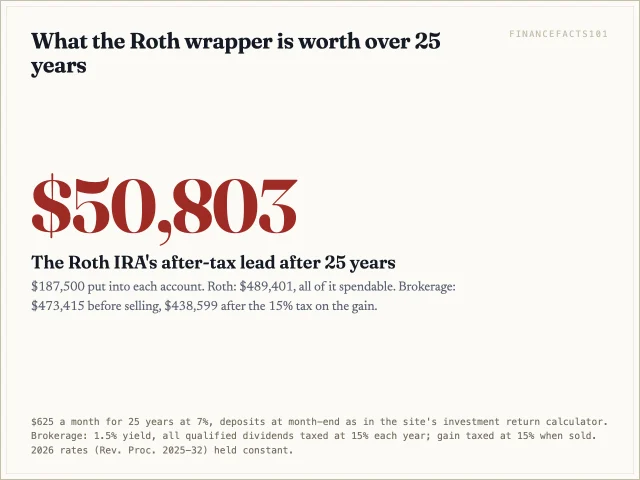
For money you will not need before age 59½, the Roth IRA wins the brokerage account vs Roth IRA decision: under the 2026 limits the IRS announced on November 13, 2025, it takes up to $7,500 a year ($8,600 at 50 or older) if your modified AGI is below $153,000 single or $242,000 joint, and $625 a month invested for 25 years at 7% ends $50,803 ahead of the same money in a taxable account, assuming a 1.5% dividend yield and a final sale both taxed at 15%. Fill the Roth first, after any 401(k) match and an HSA, and send the brokerage account the money above the cap, the money you cannot put in a Roth, and the money for goals that arrive before 59½.
The gap comes from two taxes the Roth never charges: tax on dividends every year, and tax on the gain when you sell. This guide prices both with 2026 federal rates, runs a 25-year worked example you can reproduce in the site's calculators, shows how the step-up at death narrows the gap, and sets out the access rules that decide the cases where the brokerage account wins. It is general information built on stated assumptions, not personal advice.
Brokerage Account vs Roth IRA: Same Fund, Different Tax Wrapper
Neither account is an investment. Both are wrappers, and you can hold the same total-market index fund in either one. On the way in neither gives a deduction, so both are funded with dollars you have already paid income tax on. That makes this a cleaner comparison than Roth vs traditional IRA, which turns on today's tax rate against your rate in retirement; here the rates on the way in are the same, and only what happens afterwards differs.
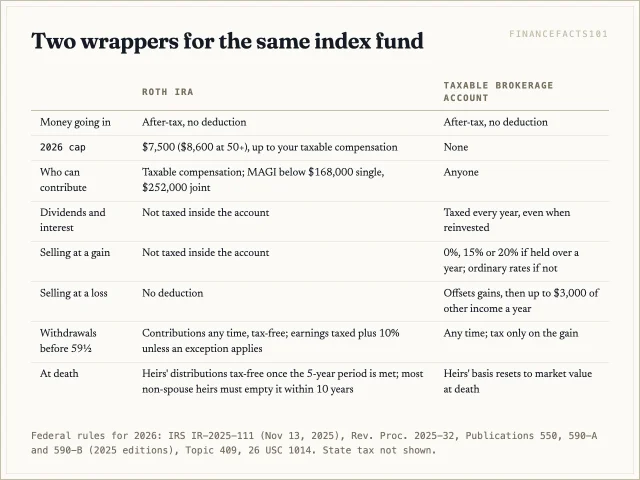
Inside the Roth, dividends and gains are never taxed, and IRS Publication 590-B says you "don't include in your gross income qualified distributions or distributions that are a return of your regular contributions from your Roth IRA(s)" (Publication 590-B). In the brokerage account, every dividend is taxable in the year it is paid, and every sale at a gain is a taxable event. The Roth's price is a set of limits: a small annual cap, an income ceiling, a compensation requirement, and rules on when earnings can come out.
Who This Is For — and Who It Isn't
This guide is for a US investor with money left over after the basics who is deciding where the next dollars should go: someone with earned income, a 401(k) or no workplace plan, and a horizon of five years or more. It assumes you will hold broad stock index funds and that high-interest debt is already gone.
It is not for money you need within a few years; that belongs in cash or Treasuries, not stocks in either wrapper. It is not the Roth-versus-traditional decision, which is about deducting now or later. And if your income is already above the Roth limits, the route in is the backdoor Roth IRA, which has its own pro-rata trap; this guide assumes you can contribute directly unless it says otherwise.
The 2026 Roth IRA Limits and Income Phase-Outs
The IRS set the 2026 numbers in IR-2025-111, released November 13, 2025. The IRA limit is $7,500, plus a $1,100 catch-up from age 50, and that cap is shared across all your traditional and Roth IRAs. The Roth phase-out runs from $153,000 to $168,000 of modified AGI for single filers and heads of household, and from $242,000 to $252,000 for joint filers. Inside those ranges you can contribute a reduced amount; above them, nothing directly.

Two more rules from Publication 590-A matter for this decision. You need taxable compensation, such as wages or self-employment income, at least equal to what you put in; a spouse without earnings can use the joint-return spousal rule. And the deadline for a 2026 contribution is the due date of your 2026 return, not including extensions, which for most people is April 15, 2027. Age is no barrier: "Contributions can be made to your Roth IRA regardless of your age."
A brokerage account has none of these limits. No cap, no income test, no earnings requirement, no deadline. Over-contributing to a Roth costs a 6% excise tax each year the excess stays in, per Publication 590-A; over-contributing to a brokerage account is not a concept.
How a Brokerage Account Is Taxed in 2026
Three kinds of income come out of a stock fund held in a brokerage account. Qualified dividends and long-term gains, on shares held more than a year, are taxed at 0%, 15% or 20% depending on taxable income. Short-term gains and non-qualified dividends are taxed as ordinary income. The 2026 brackets for the lower rates are in section 4.03 of Rev. Proc. 2025-32.
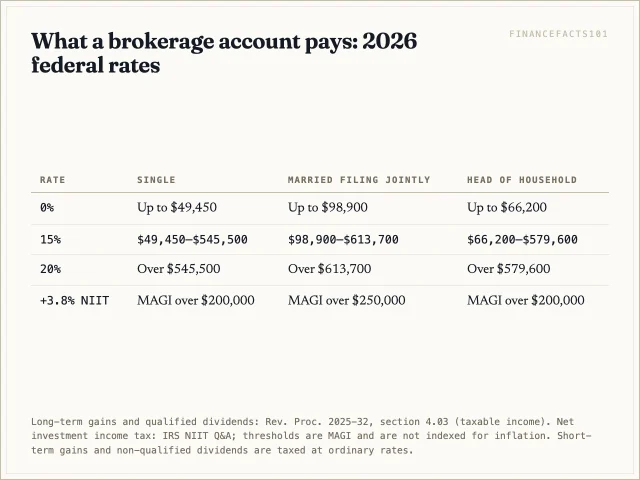
A single filer pays 0% on qualified dividends and long-term gains while taxable income stays at or below $49,450, and 15% up to $545,500. On top sits the 3.8% net investment income tax, which applies to the smaller of your investment income or the amount by which modified AGI exceeds $200,000 single or $250,000 joint. The IRS's NIIT questions and answers note that "these threshold amounts are not indexed for inflation," so more savers cross them every year. Roth IRA distributions are on the IRS's list of income that is not net investment income.
Reinvesting does not defer anything. Publication 550 is blunt: "If you use your dividends to buy more stock at a price equal to its fair market value, you must still report the dividends as income." A dividend counts as qualified only if you held the shares more than 60 days of the 121-day period around the ex-dividend date, which a buy-and-hold investor meets without trying. Short-term trading does not.
Tax Drag: The Cost You Pay Every Year
Tax drag is the return you lose each year to tax on income the fund pays out. For a holding that pays a yield and is taxed at a flat rate, the drag in percentage points is simply the yield times the rate. A broad stock index fund yielding an assumed 1.5%, all of it qualified, taxed at 15%, loses 0.225 points a year: a 7% return becomes 6.775%.
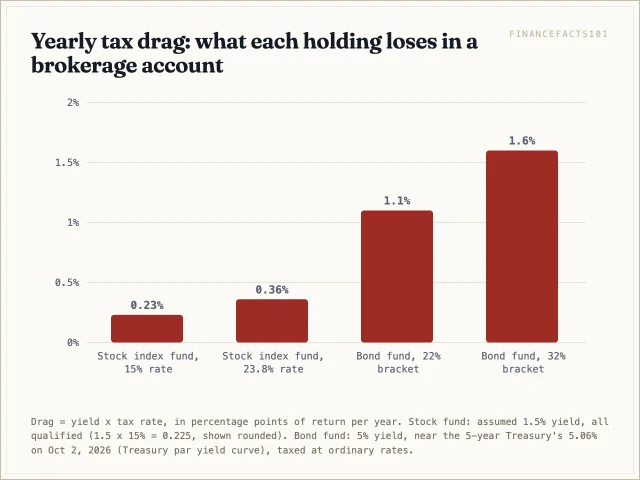
That is small for stocks and large for bonds. A bond fund yielding about 5%, in line with the 5.06% five-year Treasury yield on October 2, 2026 in the Treasury's daily par yield curve, pays interest taxed at ordinary rates: 1.1 points of drag in the 22% bracket, 1.6 in the 32% bracket. That is the case for asset location: if you hold both, keep the bonds in the Roth or another IRA and the stock index fund in the brokerage account.
Two things push stock-fund drag above the 0.225 points used here. A fund that distributes capital gains adds tax you did not choose to trigger; the record on that is in index funds vs ETFs, where the ETF structure wins in a taxable account and is worth nothing in an IRA. And if your state taxes dividends and gains, its tax adds a second layer of drag that the federal figures here leave out.
Worked Example: $7,500 a Year for 25 Years
Sam is 35, single, earns $85,000 and takes the 2026 standard deduction of $16,100, for taxable income of $68,900. That puts Sam in the 22% ordinary bracket, which for a single filer runs from $50,400 to $105,700, and in the 15% band for qualified dividends and long-term gains. MAGI is far below $153,000, so the full Roth contribution is allowed.
The plan: $625 a month, $7,500 a year, for 25 years, until Sam is 60. Two versions of Sam run side by side, one investing in a Roth IRA and one in a brokerage account, in the same index fund. The stated assumptions:
- 7% total return a year, 1.5 points of it qualified dividends;
- dividends in the brokerage account taxed at 15% every year, with the tax paid out of the dividend so 85% is reinvested;
- deposits at the end of each month, compounded at the effective monthly rate of the annual return, the convention the site's investment return calculator uses;
- the brokerage account sold at year 25, its gain taxed at 15%; salary and tax rates held at 2026 levels.
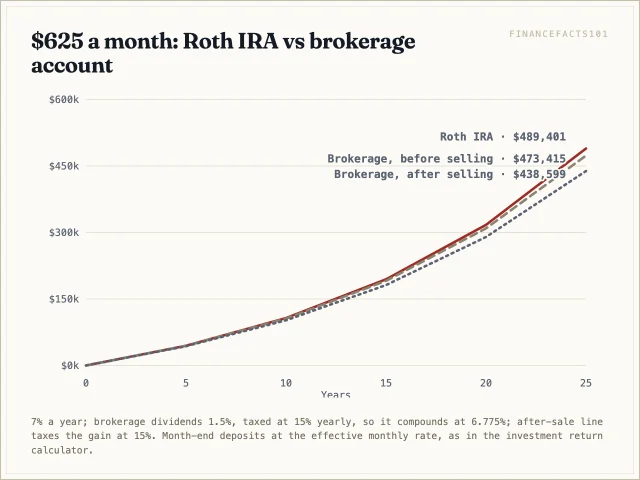
The Roth reaches $489,401. To reproduce it, enter $0 initial, $625 a month, 7% and 25 years in the investment return calculator with the fee set to zero. Then set the fee box to 0.225, standing in for the dividend tax, and it returns $473,415: the brokerage balance before Sam sells. The $15,986 between them is what 25 years of dividend tax cost.
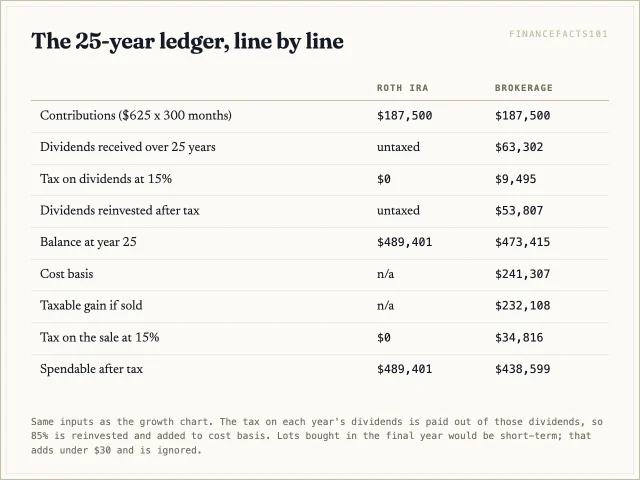
Selling is the second bill. Sam put in $187,500 and reinvested $53,807 of after-tax dividends, for a cost basis of $241,307. The gain is $232,108, and 15% of that is $34,816. After tax, the brokerage account leaves $438,599. The Roth leaves all $489,401, a lead of $50,803, or 10.4% of the Roth's value. Put another way, the brokerage account behaves like a Roth that earned about 6.25% instead of 7%. To end with the Roth's after-tax total, Sam would have to put about $697 a month into the brokerage account instead of $625.
What Moves the Gap: Your Tax Rate, How You Sell, How Long You Hold
The 15% rate is the middle case. If Sam's income stays above the NIIT threshold for the whole period, every dividend and the final gain are taxed at 18.8%, and the brokerage account ends $63,340 behind. At the top rate of 23.8% the gap is $79,637. Both cases describe a higher earner than Sam: the $200,000 single NIIT line sits above the $168,000 Roth ceiling, so that saver's Roth money goes in through the backdoor. At the 0% rate, which applies only while taxable income including the gains stays at or below $49,450 single, the two accounts tie on investment tax. Below $40,250 of AGI single ($80,500 joint), though, a Roth contribution can also earn the Saver's Credit under the 2026 limits in IR-2025-111, which a brokerage deposit cannot, so for many low-income savers the Roth still comes out ahead.
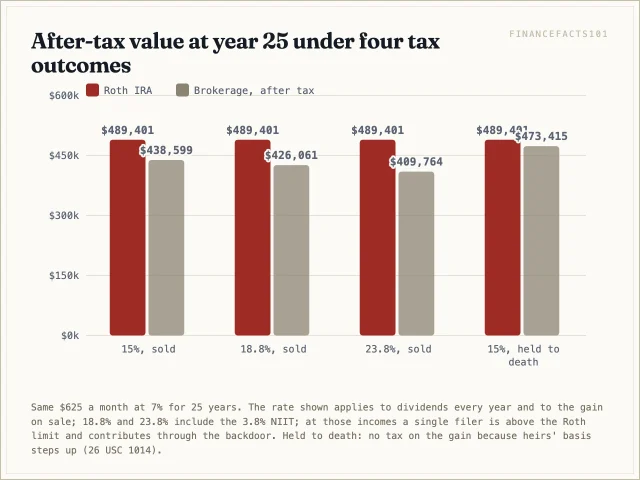
How Sam sells matters as much as the rate. The ledger assumes the gain is taxed at 15%, as it would be if Sam sold gradually over several years, keeping MAGI below $200,000. Selling the whole account in one year while still earning $85,000 lifts MAGI to about $323,700, and the 3.8% tax then applies to the $123,701 excess: about $4,700 more. A Roth withdrawal adds nothing to that calculation. On the other side, a retiree with little other income can take part of the gain at 0%, which is the gain-harvesting move a brokerage account allows and a Roth does not need.
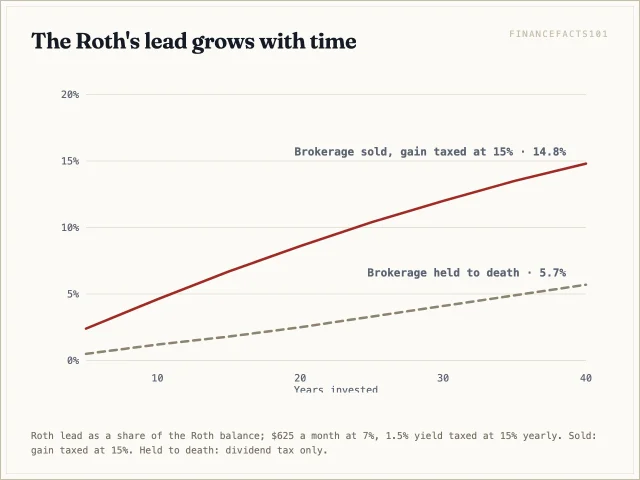
Time is the third lever. The Roth's lead is 2.4% of the balance after 5 years, 10.4% after 25 and 14.8% after 40, because the dividend drag compounds and the unrealised gain grows. A 25-year-old with a 40-year horizon gains more from the Roth than a 50-year-old with 15 years.
The Step-Up at Death vs Tax-Free Growth
One rule cuts the brokerage account's biggest bill to zero. Under 26 USC 1014, the basis of property inherited from a decedent is generally "the fair market value of the property at the date of the decedent's death." Heirs who sell Sam's fund soon after Sam's death owe little or no capital gains tax, and Publication 550 treats inherited property as long-term whatever the holding period. The $34,816 sale tax in the ledger simply never happens.
What does not go away is the dividend drag. Held until death, the brokerage account ends at $473,415 against the Roth's $489,401: the Roth still leads by $15,986, or 3.3%. The Roth has its own estate advantages and one cost. Publication 590-B says: "You aren't required to take distributions from your Roth IRA at any age." A Roth inherited by an heir pays out tax-free once the original owner's five-year period is met, but most non-spouse heirs must empty it by the end of the tenth year after the death, while a stepped-up brokerage account can stay invested as long as the heir likes. If the money is meant for heirs and you have more than the Roth will take, the brokerage account is a good second home for it.
Getting the Money Out Before 59½
This is where the brokerage account earns its place: you can sell any time and pay tax only on the gain. A Roth is more generous than its reputation, though, because of the order in which money comes out.
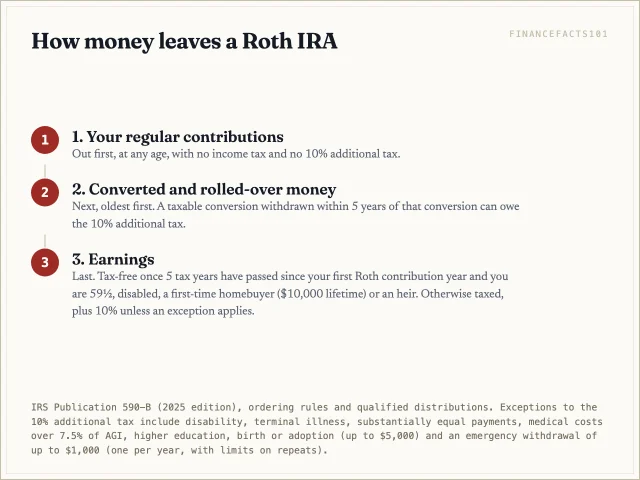
Your regular contributions come out first, at any age, with no tax and no 10% additional tax, because they are not included in income. Earnings come out last, and are tax-free only in a qualified distribution: made after the five-year period that begins with the first year you contributed to any Roth IRA, and on or after age 59½, on disability, to an heir, or for a first home up to a $10,000 lifetime limit. Earnings taken in any other case are taxed as ordinary income, plus the 10% additional tax unless an exception applies. Publication 590-B lists the exceptions, among them substantially equal periodic payments, medical costs above 7.5% of AGI, higher education expenses, a birth or adoption ($5,000 per taxpayer) and an emergency personal expense withdrawal of up to $1,000, one a year. An exception waives the 10% tax, not the income tax.

Run Sam's plan to year 10, when Sam is 45 and wants the money for a house. If Sam needs every dollar, the brokerage account wins: selling it costs $3,735 in tax on a $24,902 gain and leaves $101,939, while emptying the Roth exposes $31,907 of earnings to 22% income tax and the 10% additional tax, $10,210 in all, leaving $96,697. If Sam qualifies as a first-time homebuyer, $10,000 of the Roth withdrawal is tax-free and the Roth leaves $99,897, still behind. If Sam needs only $75,000, the answer flips: the Roth hands back $75,000 of contributions with no tax and keeps $31,907 compounding, while selling $75,000 of the brokerage fund, with shares sold in proportion to their cost, realises about $17,700 of gain and $2,651 of tax.
So the Roth works as a reserve for money you might need, and the brokerage account is the better home for money you will certainly spend in full before 59½.
The Order: Match, HSA, Roth, Then Brokerage
For retirement money, the brokerage account is the last stop, not the first. A 401(k) match is typically an instant 50% or 100% return on the matched dollars, which no tax wrapper competes with; the 401(k) employer match guide shows how to defer exactly enough to collect it. Next comes an HSA if you have an eligible high-deductible health plan: under Rev. Proc. 2025-19 the 2026 limits are $4,400 self-only and $8,750 family, and the account is federally deductible going in and tax-free coming out for medical costs, as HSA vs 401(k) works through.
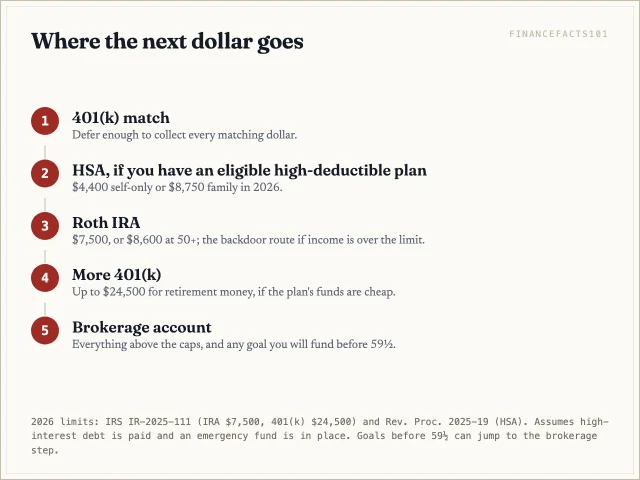
Then the Roth IRA, up to $7,500. Then more 401(k), up to the $24,500 deferral limit, if the plan's funds are cheap; if they are expensive, the brokerage account can reasonably come before it. Only then the brokerage account, which takes everything else. The separate choice between Roth and traditional contributions is one the Roth vs traditional IRA calculator prices. Its "Invest the tax savings?" option puts the traditional deduction into a taxable side account, a brokerage account under another name, and the page notes that taxing that account only once, at retirement, flatters it.
When the Brokerage Account Wins
The brokerage account wins outright in three situations, and it is the only option in a fourth.
Goals before 59½ that need the whole balance. A down payment at 45, a business at 50, early retirement at 52: if the plan is to spend all of it, the brokerage account's 15% on the gain beats 22% plus 10% on the Roth's earnings, as Sam's year-10 numbers show. Early retirees can reach Roth earnings through substantially equal payments, but those lock you into a schedule.
Money above the cap. Once the Roth has its $7,500 and the 401(k) its share, the brokerage account is where additional savings go. It has no ceiling.
Flexibility the Roth cannot offer. Losses in a brokerage account offset gains and then up to $3,000 of ordinary income a year ($1,500 married filing separately), per IRS Topic 409, and the excess carries forward; a loss inside a Roth is simply lost. Tax-loss harvesting is worth something only in a taxable account. So is realising gains in a year when your taxable income is under the 0% ceiling.
Income above the limit. Above $168,000 single or $252,000 joint you cannot contribute to a Roth directly. The backdoor route usually solves that; if a pre-tax IRA makes the backdoor expensive, the brokerage account is the fallback.
The Decision Framework

Start with the date you need the money. For retirement, fund the Roth after the match and the HSA, and put bonds in the Roth before stocks if you hold both. For a goal before 59½ that will use all of it, use the brokerage account with tax-efficient index funds. If you are unsure, the Roth's contributions double as a reserve. Then check the two thresholds that change the answer, the Roth phase-out and the NIIT line, and rerun the example in the investment return calculator with your own yield times tax rate in the fee box.
FAQ
Is a Roth IRA a brokerage account?
A Roth IRA is a tax wrapper that is usually held at a brokerage firm, which is where the confusion comes from. The same broker can hold a Roth IRA and a taxable brokerage account side by side, with the same funds in each. Only the tax treatment and the withdrawal rules differ.
Can I take money out of a Roth IRA before 59½?
Your regular contributions, yes, at any time and with no tax or penalty, per IRS Publication 590-B. Earnings taken before 59½ are generally taxed and owe a 10% additional tax unless an exception applies, such as disability, a first home up to $10,000, or substantially equal payments.
Should I max out my Roth IRA before investing in a brokerage account?
For retirement money, yes, once you have collected any 401(k) match and funded an HSA if you are eligible. In this guide's example the Roth ends 10.4% ahead after 25 years. The exception is money you will spend in full before 59½, where the brokerage account's lower tax on early withdrawals wins.
How much tax do I pay on a brokerage account each year?
Tax on whatever the fund paid out: qualified dividends at 0%, 15% or 20% depending on your 2026 taxable income, other dividends and interest at your ordinary rate, plus 3.8% above $200,000 of MAGI single or $250,000 joint. For a broad stock index fund yielding 1.5% at the 15% rate, that is about 0.23% of the balance a year. Gains are taxed only when you sell.
Sources
- IRS, IR-2025-111: 401(k) limit increases to $24,500 for 2026, IRA limit increases to $7,500, November 13, 2025
- IRS, Rev. Proc. 2025-32 — 2026 brackets, capital gains rate thresholds and standard deduction
- IRS, Rev. Proc. 2025-19 — 2026 HSA limits
- IRS, Publication 590-A — Roth contribution rules, compensation, deadline, excess contributions
- IRS, Publication 590-B — qualified distributions, ordering rules, exceptions, beneficiaries
- IRS, Publication 550 — dividends, reinvestment, qualified dividend holding period, inherited property
- IRS, Topic 409, Capital gains and losses
- IRS, Questions and answers on the net investment income tax
- U.S. Code, 26 USC 1014, Basis of property acquired from a decedent (govinfo)
- U.S. Treasury, Daily Treasury par yield curve rates, 2026
 Next entry · No. 5,990CD Ladder: Is It Worth It, and How Do You Build One?
See also
-
 No. 5,987
21 Oct 2026
19 min
Should I Do a Backdoor Roth IRA? How to Avoid the Pro-Rata Tax
Retirement
-
 No. 5,969
03 Oct 2026
19 min
Should I Do a Roth Conversion in 2026? How Much to Convert
Retirement
-
 No. 5,931
03 Sep 2026
14 min
Roth vs Traditional IRA: Which Saves You More Tax
Taxation
-
 No. 5,983
17 Oct 2026
18 min
Target-Date Fund vs Index Funds: Which Should You Hold?
Investments
-
 No. 4
28 Mar 2024
20 min
Understanding Average Annual Return (AAR) in Mutual Funds: Share Price Appreciation, Capital Gains, and Dividends
Investments
-
 No. 5,986
20 Oct 2026
19 min
Is Tax-Loss Harvesting Worth It? The Math and the Wash-Sale Rule
Taxation