Should I Do a Roth Conversion in 2026? How Much to Convert
Our example retired couple converts $130,300 in 2026 for $11,600 of federal tax by filling the 12% bracket. Past that, IRMAA and phase-outs cost more.
A Roth conversion in 2026 pays off when the tax rate you pay on the converted dollars this year is lower than the rate those dollars would face coming out of a traditional IRA later, and the practical way to size one is to convert up to the top of a chosen bracket — for a married couple, $100,800 of taxable income for the 12% bracket or $211,400 for the 22% bracket under the IRS's 2026 rate schedule. For the retired couple worked below, converting $130,300 in 2026 costs $11,600 of federal tax, 8.9 percent, and is a clear win; the next $69,700 costs 24.6 cents a dollar and is close to a coin flip; and past $218,000 of income, Medicare's premium surcharge turns the next slice into a loss.
So the answer to "should I do a Roth conversion in 2026" is usually "yes, some" for anyone with a low-income stretch before Social Security and required distributions, and the answer to "how much" is a dollar figure you can compute from four lines: the bracket top, your deductions, your other income, and the first income threshold that charges you for crossing it.
This is general information built on stated assumptions — 2026 federal figures as published by the IRS and CMS, a hypothetical couple, a 3 percent growth rate after inflation, no state tax — not personal tax advice. A conversion cannot be undone, so run your own return before moving money.
Who this is for — and who it is not for
This guide is for someone holding pre-tax money in a traditional IRA or old 401(k) who has a year, or a run of years, when taxable income is lower than it will be later: early retirees, people between retirement and Social Security, anyone in the years before required minimum distributions begin, and workers in a gap year or a year with business losses. It assumes federal tax only and a household that can pay the conversion tax from a taxable account.
It is not for the choice between contributing new money to a Roth or a traditional IRA — that decision, including the backdoor route, is covered in Roth vs traditional IRA. It is also not for anyone who will need the converted money within five years while under 59½, for inherited IRAs, which follow their own distribution rules, or for someone already drawing a large pension who will stay in a high bracket for life.
The four rules that frame a Roth conversion in 2026
There is no income limit. Before 2010 only households with modified AGI of $100,000 or less could convert; the IRS confirmed in its January 2011 fact sheet that "income limits no longer apply to rollovers or conversions to Roth IRAs." A $900,000 earner can convert; only direct Roth contributions remain income-limited.
The tax is owed in the year of the conversion. Per IRS Publication 590-A, you include in gross income whatever you would have had to include had the money simply been withdrawn, and those amounts are normally included on your return for the year you converted. A conversion completed on December 30, 2026 is 2026 income; there is no April grace period like the one for contributions.
There is no undo. Publication 590-A is blunt: a conversion "made in tax years beginning after December 31, 2017, cannot be recharacterized as having been made to a traditional IRA." Before 2018 you could reverse a conversion if the market fell afterwards. Now a conversion followed by a 20 percent drop means tax paid on value that no longer exists.
Required distributions cannot be converted. In any year an RMD applies, Publication 590-A says you "can't convert amounts that must be distributed" — take the RMD first, then convert on top of it. That is one reason the years before RMDs are the prime window.
The 2026 brackets you are filling
Bracket-filling means converting just enough to reach the top of a bracket and stopping. The 2026 thresholds come from the IRS's 2026 inflation adjustments: the 12% bracket ends at $100,800 of taxable income for married couples filing jointly and $50,400 for single filers; the 22% bracket ends at $211,400 and $105,700.
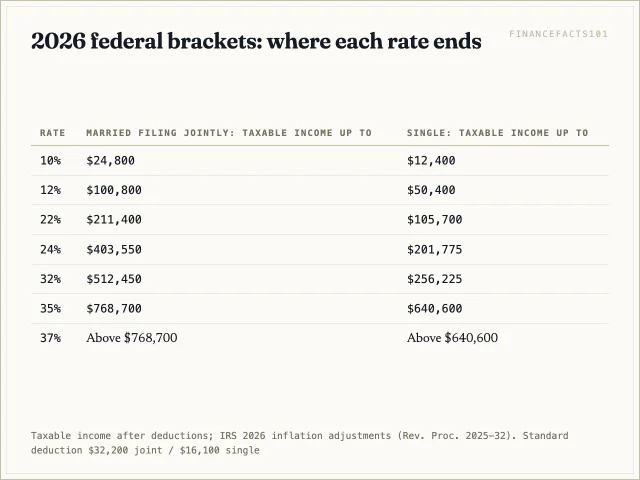
Taxable income is what is left after deductions, so the conversion that reaches a bracket top is larger than the bracket top minus your other income. The 2026 standard deduction is $32,200 for a joint return and $16,100 for a single filer. Add $1,650 per spouse aged 65 or older on a joint return, or $2,050 for an unmarried filer, per the Rev. Proc. 2025-32 text. The formula is:
- Target taxable income (the bracket top you choose)
- plus your total deductions
- minus your other income already on the return
- equals the conversion that lands exactly on the target
The 22% and 24% brackets are the interesting ones. From 12% to 22% is a 10-point jump; from 22% to 24% is only two points, so a household whose future RMDs will land at 22 percent or higher should look at the 24% bracket too. The worked example shows why the stated rate is not the rate you actually pay.
Worked example: the Brennans' 2026 conversion, slice by slice
Paul and Anne Brennan are both 66 in 2026, married filing jointly, retired, and on Medicare. They hold $1,400,000 in traditional IRAs, all pre-tax. Their only other 2026 income is $18,000 of taxable interest from a brokerage account that will also pay the conversion tax. They plan to claim Social Security at 70, in 2030, at $40,000 and $32,000 a year in 2026 dollars.
Their 2026 deductions: the $32,200 standard deduction, $3,300 of age-65 additions, and the $12,000 senior deduction explained in the next section — $47,500 in all. With only $18,000 of income they owe nothing before converting.
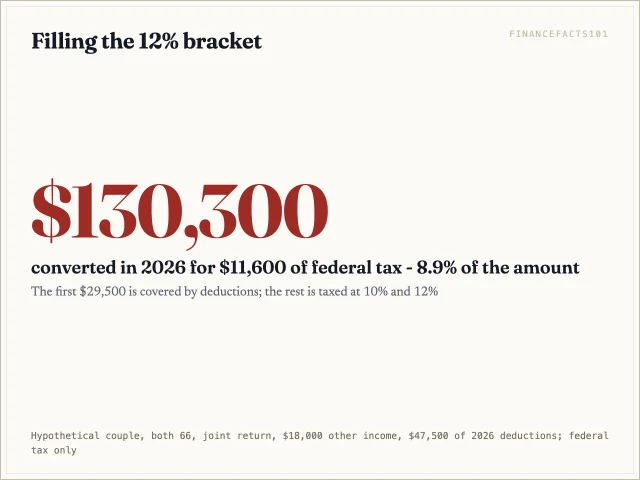
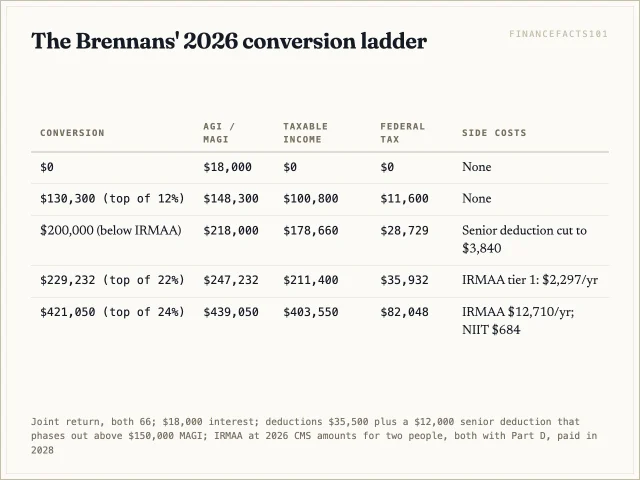
Slice 1 — fill the 12% bracket. A conversion of $130,300 lifts AGI to $148,300 and taxable income to exactly $100,800. The tax is $2,480 on the first $24,800 plus 12% of $76,000, or $11,600 — 8.9 percent of the amount converted, because the first $29,500 is sheltered by deductions and the next $24,800 is taxed at 10%.
Slice 2 — into the 22% bracket, stopping under Medicare's first surcharge. Converting $200,000 instead lifts AGI to $218,000. Tax rises to $28,729. The extra $69,700 cost $17,129: 24.6 percent, not 22.
Slice 3 — the rest of the 22% bracket. Reaching the true top of 22% takes a $229,232 conversion and $35,932 of tax. But AGI of $247,232 crosses the first IRMAA tier, adding $2,297 of Medicare premiums in 2028 at 2026 rates. On those last $29,232 the combined cost is 32.5 percent.
Slice 4 — the top of 24%. A $421,050 conversion reaches $403,550 of taxable income and $82,048 of tax. It also lands in the second-highest IRMAA tier ($12,710 a year for two) and triggers $684 of net investment income tax — IRA money is not investment income, but it lifts MAGI past the $250,000 joint threshold, exposing the $18,000 of interest. The slice from $229,232 up costs about 29.8 percent all in.
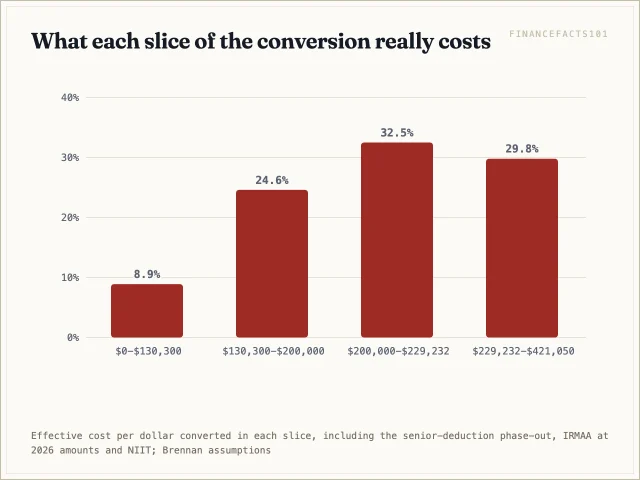
Why the 22% bracket costs the Brennans 24.6%
The 2025 tax law added a deduction for people 65 and older: $6,000 per eligible person, or $12,000 for a couple who both qualify, for tax years 2025 through 2028, per the IRS's explainer on the enhanced deduction for seniors. It phases out above modified AGI of $75,000 single or $150,000 joint, and Schedule 1-A shows the mechanism: each person's $6,000 is reduced by 6% of the MAGI above the threshold.
For a couple who both qualify, that is 12 cents of lost deduction per dollar of income above $150,000. At 22% that adds 2.64 points — 24.64 percent. The Brennans' 12%-bracket conversion stops at AGI of $148,300, just short of the phase-out; every dollar above $150,000 pays its bracket rate times 1.12 until the deduction is gone at $250,000.
Two consequences. The deduction expires after 2028 under current law, so 2029 conversions will face plain bracket rates. And single retirees start losing it at $75,000 of MAGI, which is inside the 22% bracket for them as well.
IRMAA: the conversion that raises Medicare premiums two years later
Medicare's income-related monthly adjustment amounts are the side effect most likely to surprise anyone 63 or older. Under 20 CFR 418.1135, Social Security generally uses your modified AGI from the tax year two years before the premium year. MAGI here is AGI plus tax-exempt interest and a few excluded savings-bond and foreign amounts, per 20 CFR 418.1010(b)(6), so a 2026 conversion sets your 2028 premiums.
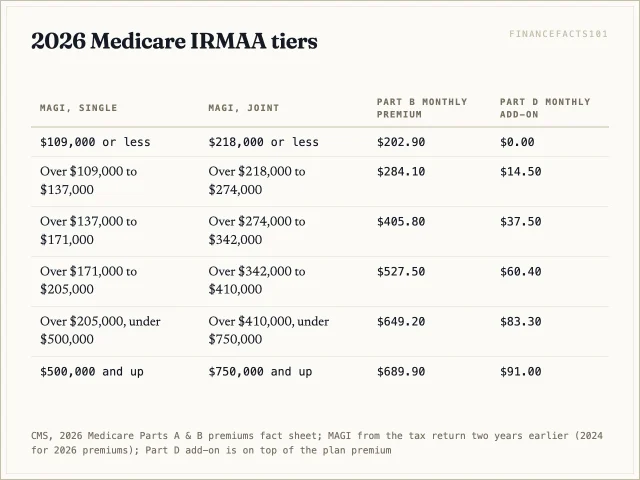
The 2026 CMS figures put the standard Part B premium at $202.90 a month. Above $109,000 of MAGI single or $218,000 joint, it rises to $284.10, plus a $14.50 Part D add-on. The top tier is $689.90 plus $91.00. These are cliffs, not phase-ins: one dollar over $218,000 costs a couple the full $2,296.80 a year at 2026 amounts if both have Part D coverage, or $1,948.80 without it.
Two cautions. The 2028 thresholds will not be published until late 2027, so leave a cushion of a few thousand dollars below the current line. And a conversion is not a "life-changing event" that lets you appeal: the list in 20 CFR 418.1205 covers events like a spouse's death, divorce and stopping work — not voluntary one-time income.
ACA premium credits: for early retirees, the cliff comes first
Retirees under 65 who buy Marketplace coverage face a harder wall. For tax years 2021 through 2025 Congress removed the income cap on the premium tax credit; for 2026 it is back. The IRS premium tax credit Q&A, updated February 19, 2026, says household income must be no more than 400 percent of the federal poverty line. For tax years after 2025 there is no cap on repaying excess advance credits.
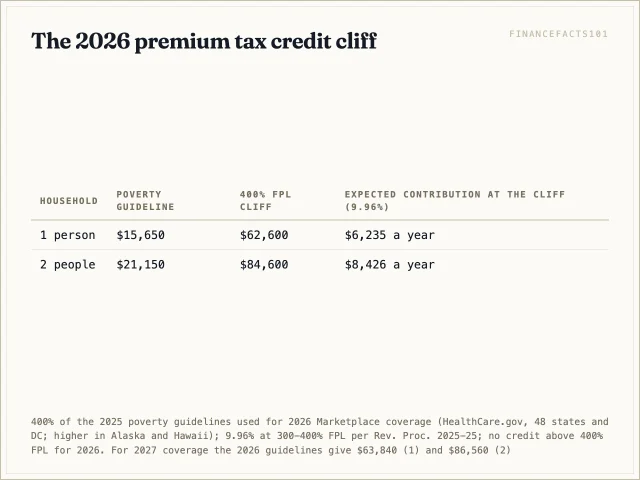
For 2026 coverage the poverty line used is the 2025 guideline: $15,650 for one person and $21,150 for two, per HealthCare.gov. The 400 percent line is therefore $62,600 and $84,600 (48 states and DC; the guidelines are higher in Alaska and Hawaii). For 2027 coverage the same page lists the 2026 guidelines, $15,960 and $21,640, which put the line at $63,840 and $86,560. Under Rev. Proc. 2025-25, a household between 300 and 400 percent is expected to pay 9.96 percent of income toward the benchmark silver plan. The credit covers the rest.
That creates two costs. Inside the 300–400 percent band, each extra dollar of conversion raises your expected contribution by about 10 cents — as long as some credit remains — so a 12%-bracket conversion really costs about 22 percent. And one dollar over the line wipes out whatever credit remained. For a 60-year-old couple with $30,000 of other income, the room below the cliff is $54,600 of conversion, well short of the 12% bracket top — the cliff sizes the conversion, not the bracket.
The window: low-income years before Social Security and RMDs
Conversions are cheapest in the years when your paycheck has stopped but Social Security and required distributions have not started. Under the IRS RMD FAQs you generally must begin withdrawals at 73. The final SECURE 2.0 regulations, printed in Internal Revenue Bulletin 2024-33, set the age at 75 for anyone born on or after January 1, 1960. The Brennans, born in 1960, have nine conversion years, 2026 through 2034.
Delaying Social Security widens the window — the claiming math itself is in when to claim Social Security. Once benefits start, conversion income can pull up to 85 percent of them into taxable income. Per IRS Publication 915, that happens once half your benefits plus other income exceeds $44,000 on a joint return. In that phase-in zone each extra IRA dollar can add 85 cents of taxable benefits, so a 12% bracket behaves like 22%.
Conversions also compete with the 0% long-term capital gains rate, which covers taxable income up to $98,900 on a 2026 joint return. Every dollar of conversion stacked under that line can push a dollar of gains or qualified dividends into the 15% rate. Tax-deductible investments explains that 0% bracket; decide which use of the room is worth more before spending it twice.
What the conversion buys later: smaller RMDs and a lower bracket
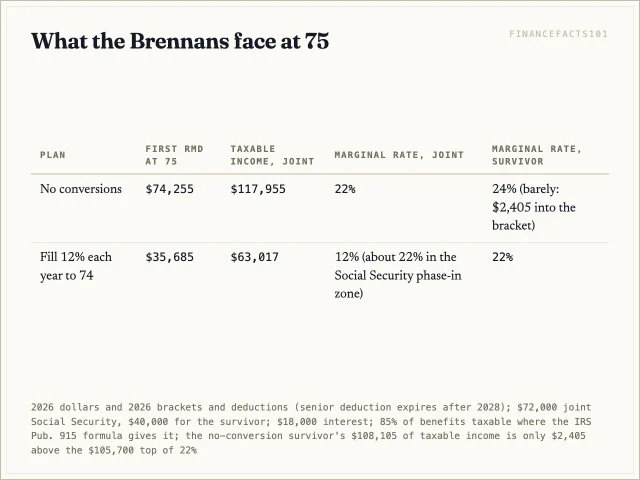
The case for converting rests on the future rate, so project it. Leave the Brennans' $1,400,000 untouched at 3 percent real growth and it reaches about $1,827,000 by the end of 2034. Their first RMD at 75, using the IRS Uniform Lifetime Table's 24.6 divisor that the RMD calculator applies, is about $74,300 in 2026 dollars. It climbs to roughly $92,800 by 85.
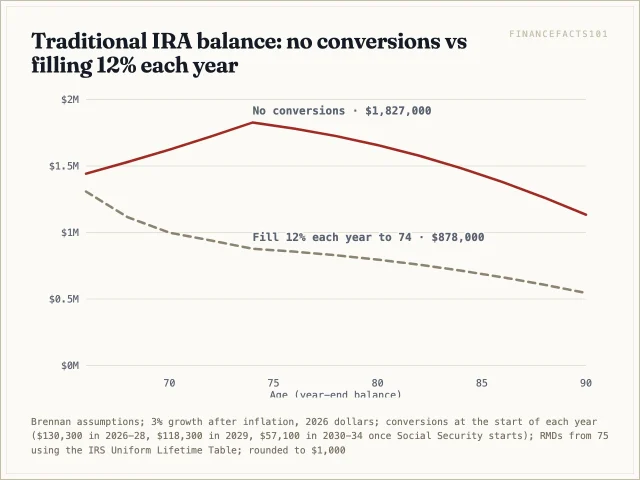
Stack that RMD on $61,200 of taxable Social Security and $18,000 of interest and the couple's marginal rate at 75 is 22 percent. When one spouse dies, the survivor files single with nearly the same RMD and lands just inside the 24 percent bracket on less total income — $108,105 of taxable income, only $2,405 above the $105,700 top of 22%, so a slightly smaller RMD or survivor benefit would leave the rate at 22. Filling the 12% bracket every year through 74 moves about $795,000 to the Roth and cuts the first RMD to about $35,700.
Running the slices through the calculator
The Roth conversion calculator compares converting with not converting at flat rates. It credits the "wait" side with the tax dollars invested in a taxable account, so it is a fair test of each slice. Enter the slice's effective cost as the current rate, a 15-year horizon, 3 percent growth and tax paid from outside funds.
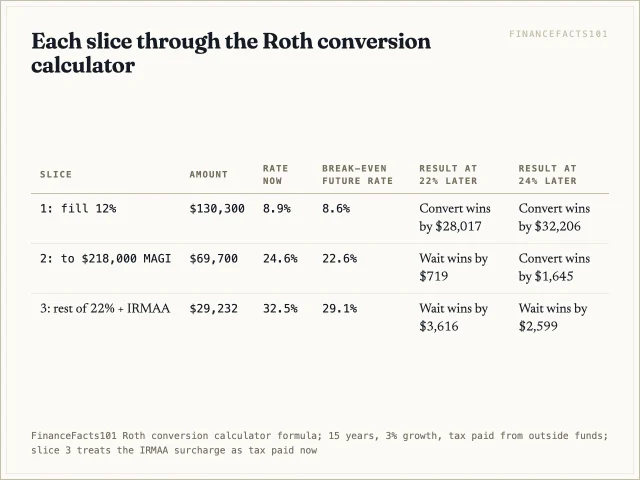
Slice 1 wins by $28,017 if the Brennans' later rate is 22 percent, and still wins by $7,070 if it is only 12. Its break-even future rate is 8.6 percent, so almost any future beats it. Slice 2 is the honest coin flip: its break-even is 22.6 percent, so it loses $719 if the couple stays at 22 percent and wins $1,645 at the survivor's 24 — a rate the survivor only barely reaches. Slice 3, carrying the IRMAA surcharge, needs a future rate above 29.1 percent and loses on any plausible path.
The verdict for 2026: convert $130,300 without hesitation. Go to $200,000 if the survivor years — or heirs in high brackets — weigh heavily. Stop before $218,000 of MAGI.
Paying the tax from outside funds
Paying the tax from a taxable account is what makes a conversion efficient. If the Brennans pay slice 2's tax from the IRA instead, only $52,554 reaches the Roth, and the calculator's loss at a 22 percent future rate widens from $719 to $2,823. With outside funds, the full $69,700 goes into the Roth and the roughly $17,100 of tax comes out of an account whose growth would have been taxed anyway.
Under 59½ the penalty adds a second reason. Publication 590-A says any part of a distribution you keep rather than convert is generally taxable and may be subject to the 10% additional tax on early distributions — and tax withheld from a conversion is money you kept. A 50-year-old who converts $50,000 and has $11,000 withheld has in effect converted $39,000 and taken an $11,000 early distribution. If there is no cash outside the IRA to pay the bill, convert less.
The 5-year rule for converted amounts
Each conversion starts its own clock. IRS Publication 590-B says that if you take a distribution within the 5-year period starting on the first day of the tax year of a conversion, you may owe the 10% additional tax on the taxable part of that conversion. The clock starts January 1 of the conversion year, so a conversion on December 15, 2026 is clear on January 1, 2031. Reaching 59½ is one of the listed exceptions, which is why the Brennans can ignore this rule.
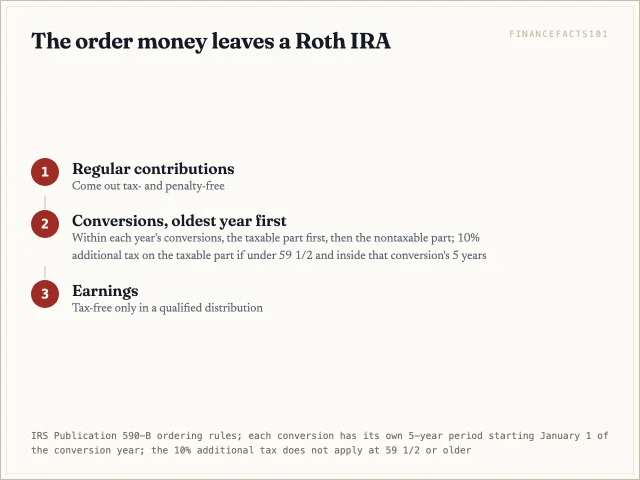
Withdrawals come out in a fixed order: regular contributions first, then conversions oldest-first (the taxable part of each before any nontaxable part), then earnings. For someone under 59½, that means a withdrawal draws on converted dollars before earnings — plan conversions you might need to tap at least five calendar years ahead. There is a second, separate five-year clock for tax-free earnings, explained with the contribution rules in Roth vs traditional IRA.
The pro-rata rule when you have after-tax IRA money
If you ever made nondeductible IRA contributions, you cannot convert just those after-tax dollars (the backdoor version of this trap is in Roth vs traditional IRA). The Form 8606 instructions have you total every traditional IRA — a term that includes SEP and SIMPLE IRAs — at its December 31 value, and the untaxed share of any conversion follows the ratio of your basis to that total. The math is in the table below.
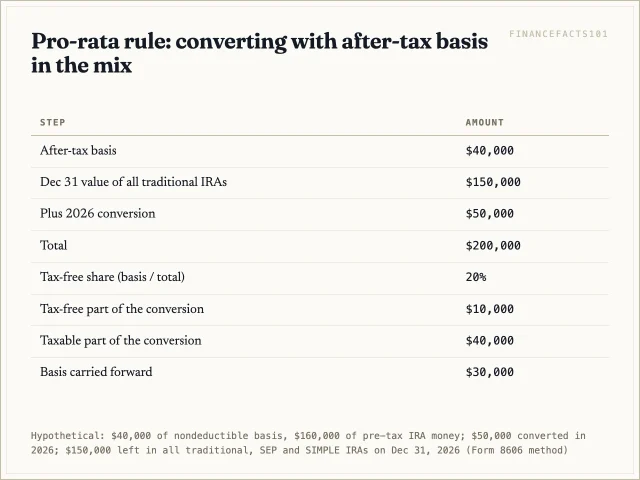
Two practical points. The test uses December 31 values, so rolling pre-tax money into an employer plan before year-end changes the ratio even if the conversion happened in March. And the basis follows you: the $30,000 left over in the example is recorded on Form 8606 and reduces the tax on future conversions or withdrawals.
Timing inside the year, and paying the tax on time
Converting in November or December, once the year's other income is known, lets you size the conversion precisely. Converting after a market decline moves more shares for the same taxable dollars — but since 2018 that decision can only follow a fall, never be undone by one.
A large conversion also needs its tax paid during the year. The IRS's estimated tax guidance says most taxpayers avoid the underpayment penalty by paying at least 90 percent of this year's tax or 100 percent of last year's. Publication 505 raises the prior-year figure to 110 percent when prior-year AGI exceeded $150,000. The final 2026 installment is due January 15, 2027. Report the conversion on Form 8606 with the 1099-R your custodian sends.
When a Roth conversion is the wrong move
If you are in your peak earning years at 32 percent or more, conversions usually wait for retirement. If you plan to leave the IRA to charity, the charity pays no income tax on it, so converting prepays tax nobody would have owed. If you expect to move from a high-tax state to one without an income tax, waiting can erase the state bill entirely.
The same goes if paying the tax means selling assets with large gains or dipping into the IRA itself, or if your projected RMDs already fit inside the 12% bracket.
The decision, step by step
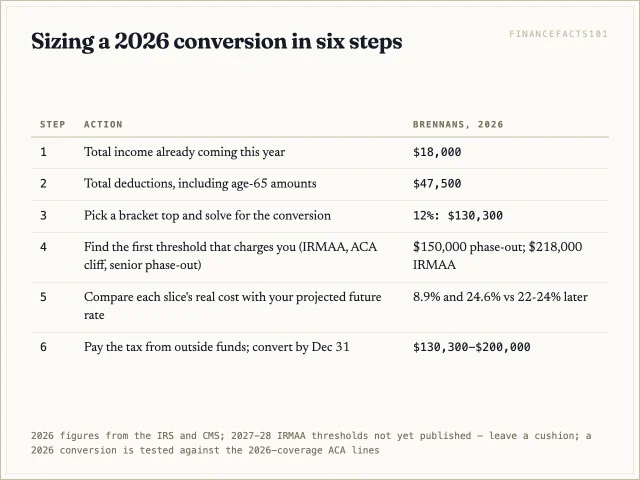
Work it once with last year's return beside you: list the income already coming in 2026, add your deductions, pick the bracket top, then check the first threshold — IRMAA for anyone 63 or older, the 400 percent line for Marketplace buyers, $150,000 for senior couples — and stop below whichever arrives first. Re-run the numbers every year of the window. The conversion that made sense at 66 may be too large at 70 once Social Security starts.
FAQ
Is there an income limit on Roth conversions in 2026?
No. The IRS removed the $100,000 modified AGI limit starting in 2010, and it has not returned. The income limits you may have read about apply to direct Roth IRA contributions — $153,000 to $168,000 for single filers in 2026 — not to conversions. That gap is what makes the backdoor Roth possible.
Can I undo a Roth conversion if the market falls?
No. Conversions made in 2018 or later cannot be recharacterized back to a traditional IRA, per IRS Publication 590-A. If the account falls 20 percent after you convert, you still owe tax on the value at conversion. Converting in smaller pieces through the year, or after a decline has already happened, limits the regret.
How much tax will I owe on a $100,000 Roth conversion?
It depends on where the $100,000 lands in your brackets, not on a flat rate. For a married couple with $18,000 of other income and $47,500 of deductions, the first $29,500 is untaxed and the rest falls in the 10% and 12% brackets — roughly $8,000. For a couple already at $150,000 of taxable income, the same conversion is taxed at 22% and 24%, about $22,800, before any IRMAA effect or phase-outs.
Does a Roth conversion affect Medicare premiums?
Yes, two years later. Social Security generally sets your Part B and Part D premiums using modified AGI from two years earlier, so 2026 conversion income determines 2028 premiums. In 2026 the first surcharge starts above $109,000 single or $218,000 joint and costs $95.70 a month per person.
Sources
- IRS, IRS releases tax inflation adjustments for tax year 2026 — 2026 brackets and standard deduction
- IRS, Rev. Proc. 2025-32 — additional standard deduction of $1,650 / $2,050; 0% capital gains threshold of $98,900 joint
- IRS, Fact Sheet FS-2011-01, 2010 changes offer expanded tax benefits — income limits no longer apply to conversions
- IRS, Publication 590-A — conversions, income inclusion, no recharacterization after 2017, RMDs cannot be converted
- IRS, Publication 590-B — 5-year rule on conversions, exceptions, ordering rules
- IRS, Instructions for Form 8606 — December 31 value of all traditional, SEP and SIMPLE IRAs for the pro-rata calculation
- IRS, Check your eligibility for the new enhanced deduction for seniors — $6,000 per person, 2025–2028, phase-out above $75,000 / $150,000
- IRS, Schedule 1-A (Form 1040) — Part V, the 6% phase-out computation
- CMS, 2026 Medicare Parts A & B premiums and deductibles — IRMAA tiers for Part B and Part D
- eCFR, 20 CFR 418.1135 — IRMAA uses MAGI from two years before the premium year
- eCFR, 20 CFR 418.1205 — the list of major life-changing events
- IRS, Questions and answers on the premium tax credit — 400% FPL limit restored for 2026; no repayment cap after 2025
- IRS, Rev. Proc. 2025-25 — 2026 applicable percentage table (9.96% at 300–400% FPL)
- HealthCare.gov, Federal poverty level — 2025 guidelines of $15,650 and $21,150
- IRS, Retirement plan and IRA required minimum distributions FAQs — RMDs generally begin at 73; none for Roth IRA owners
- IRS, Internal Revenue Bulletin 2024-33 — final RMD regulations; applicable age 75 for those born on or after January 1, 1960
- IRS, Publication 915 — taxation of Social Security benefits, the $32,000 / $44,000 joint base amounts and the 85% maximum
- IRS, Questions and answers on the net investment income tax — IRA distributions excluded from NII; $250,000 joint threshold
- IRS, Estimated taxes and Publication 505 — safe harbors and the January 15, 2027 installment
 Next entry · No. 5,968T-Bills vs CDs vs High-Yield Savings: Where 3-12 Month Cash Goes
See also
-
 No. 5,931
03 Sep 2026
14 min
Roth vs Traditional IRA: Which Saves You More Tax
Taxation
No. 5,931
03 Sep 2026
14 min
Roth vs Traditional IRA: Which Saves You More Tax
Taxation -
 No. 5,944
14 Sep 2026
18 min
When to Claim Social Security: Break-Even at 62, 67 and 70
Retirement
No. 5,944
14 Sep 2026
18 min
When to Claim Social Security: Break-Even at 62, 67 and 70
Retirement -
 No. 1,480
21 Sep 2024
19 min
Federal Income Tax: Understanding How the U.S. Government Collects and Utilizes Your Earned Income
Personal Finance
No. 1,480
21 Sep 2024
19 min
Federal Income Tax: Understanding How the U.S. Government Collects and Utilizes Your Earned Income
Personal Finance -
 No. 925
02 Jul 2024
21 min
Understanding Tax Deductions: What They Are and How They Work
Taxation
No. 925
02 Jul 2024
21 min
Understanding Tax Deductions: What They Are and How They Work
Taxation -
 No. 304
09 Apr 2024
23 min
Maximizing Retirement Savings with a Backdoor Roth IRA: A Strategy for High-Income Earners
Personal Finance
No. 304
09 Apr 2024
23 min
Maximizing Retirement Savings with a Backdoor Roth IRA: A Strategy for High-Income Earners
Personal Finance -
 No. 301
09 Apr 2024
21 min
The Economic Impact and Retirement Challenges of Baby Boomers
Personal Finance
No. 301
09 Apr 2024
21 min
The Economic Impact and Retirement Challenges of Baby Boomers
Personal Finance