Is Tax-Loss Harvesting Worth It? The Math and the Wash-Sale Rule
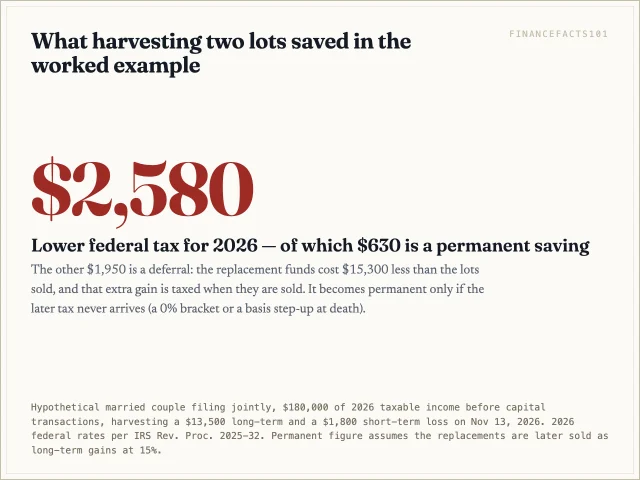
Tax-loss harvesting cut our example couple's 2026 tax by $2,580, but only $630 of it is permanent. When it pays, and how to clear the 61-day wash-sale window.
Is tax-loss harvesting worth it? Under 2026 federal rules it pays when a realized loss offsets short-term gains or up to $3,000 of ordinary income taxed at a higher rate than you will owe when you eventually sell the replacement, and in our worked example it cuts a married couple's 2026 tax by $2,580, of which $630 is a permanent saving and the rest a deferral. To keep the loss you must not buy the same or a "substantially identical" security in the 30 days before or the 30 days after the sale, whether in your own taxable account, your IRA or Roth IRA, or your spouse's account, and the sale's trade date must fall on or before Thursday, December 31, 2026.
The rest of this guide prices those two sentences, including the cases where harvesting is worth little or costs money. Tax figures are 2026 federal amounts from IRS Revenue Procedure 2025-32; prices in the example are hypothetical. This is general information with stated assumptions, not personal tax advice.
Is Tax-Loss Harvesting Worth It? The Rate Gap Decides
Harvesting means selling an investment worth less than you paid, using the loss on your tax return, and reinvesting in something similar enough to keep your portfolio roughly where it was. The tax position changes twice: once now, when the loss reduces this year's tax, and once later, because the replacement has a lower cost basis and will produce a larger gain when you sell it.
So the honest value of a harvested loss is the tax rate it saves today minus the rate the extra future gain will be taxed at, plus whatever the tax saved today earns before the later bill arrives. A $1,000 loss that wipes out a short-term gain taxed at 22% saves $220 now and costs $150 later if the replacement is eventually sold as a long-term gain at 15%: a permanent $70, plus whatever the $220 earns in the meantime. A loss that offsets a long-term gain at 15%, followed by a 15% sale later, is pure deferral.
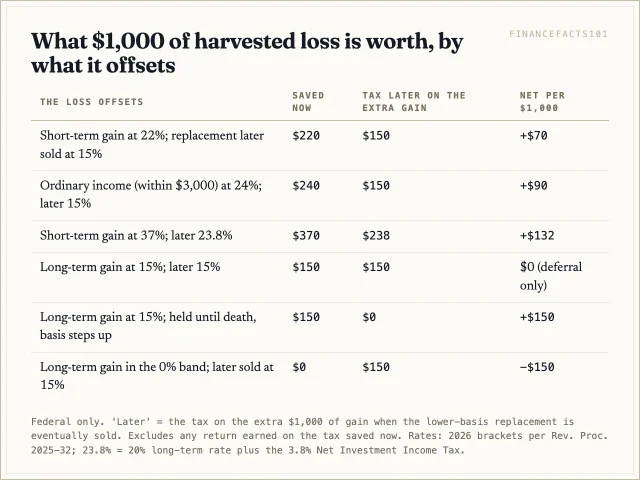
The table shows the two outcomes that change everything. If you never pay the deferred tax, because the shares pass to heirs with a basis reset at death or you are in the 0% bracket when you sell, the whole saving becomes permanent. If the loss is absorbed by a gain that would have been taxed at 0% anyway, harvesting can leave you worse off.
Who This Is For — and Who It Isn't
This is for an investor with stocks, ETFs or mutual funds in a taxable brokerage account, at least one of them below its purchase price, deciding whether selling it this year is worth the trouble. It assumes a US filer and federal tax only.
It is not for losses inside an IRA, Roth IRA, 401(k) or other retirement account: sales there produce no deductible loss at all. The one-year holding clock, short-term versus long-term rates and gain harvesting in the 0% band are covered in capital gains tax on stocks; this guide summarizes them only where harvesting depends on them. Securities dealers, traders using mark-to-market accounting and section 1256 futures follow different rules and are excluded.
The 2026 Brackets That Set What a Loss Is Worth
A loss is worth the rate on the income it removes, so the brackets come first. Long-term gains are taxed at 0%, 15% or 20% depending on taxable income; short-term gains are taxed with your wages at the ordinary rates of 10% to 37%. The 2026 thresholds below are from section 4.03 of Rev. Proc. 2025-32, published in Internal Revenue Bulletin 2025-45.
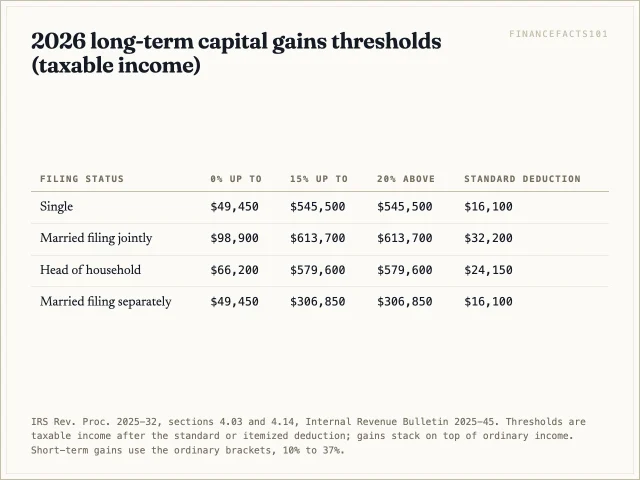
Two consequences follow for harvesting. First, a loss that ends up offsetting short-term gains or ordinary income is usually worth more than one that offsets long-term gains, because the ordinary rate is higher at almost every income. Second, a married couple with taxable income under $98,900 pays nothing on long-term gains that fit beneath that line. For them, a loss that cancels a long-term gain saves nothing. The 3.8% Net Investment Income Tax adds to the value of a loss for anyone whose modified AGI is above $250,000 joint or $200,000 single.
How Losses Offset Gains: The Netting Order
You do not choose which gain a loss cancels. Schedule D does it in a fixed order, described in IRS Publication 550 and Topic 409.
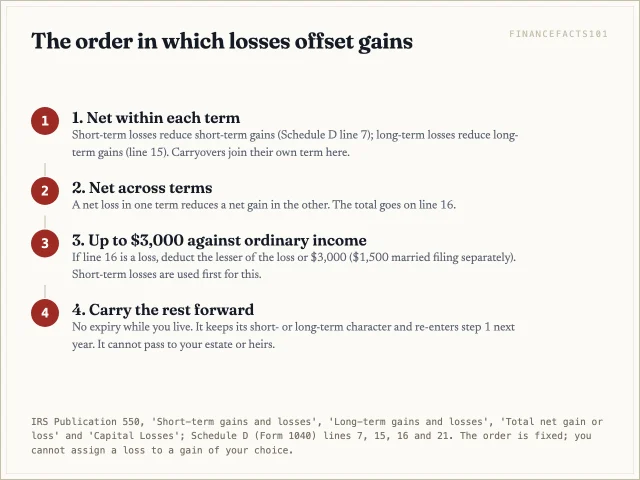
Short-term losses first reduce short-term gains, and long-term losses first reduce long-term gains. Only then do the two net figures meet: a net long-term loss reduces a net short-term gain, or a net short-term loss reduces a net long-term gain. If the total is still a loss, up to $3,000 of it comes off ordinary income and the rest carries forward.
The forced order matters for value. A long-term loss harvested in a year when you also have long-term gains goes against those gains first, at 15%, even if you also have short-term gains taxed at 24% sitting on the other side. The way to aim a loss is through which lots you sell, not through any election on the return.
The $3,000 Ordinary Deduction and the Carryforward
Section 1211(b) of the tax code allows individuals to deduct capital losses "only to the extent of the gains from such sales or exchanges, plus (if such losses exceed such gains) the lower of" $3,000 ($1,500 married filing separately) or the excess loss, per the text on govinfo. The $3,000 is a fixed figure in the statute; nothing in that text indexes it for inflation.
The excess carries forward, and Publication 550 says a carried loss "remains long-term or short-term," which is why the worked example's carryforward stays long-term. Short-term losses are used first against the $3,000. A carryforward ends at death: a decedent's loss "can be deducted only on the final income tax return." How slowly $3,000 a year drains a large loss is shown in the capital gains guide, and the older entry on capital loss carryover covers the record-keeping.
The Wash-Sale Rule: a 61-Day Window
The statute is 26 U.S.C. 1091. It denies the deduction for a loss on stock or securities where, "within a period beginning 30 days before the date of such sale or disposition and ending 30 days after such date," you have acquired, or "entered into a contract or option so to acquire, substantially identical stock or securities." Thirty days on each side plus the sale day is 61 days.
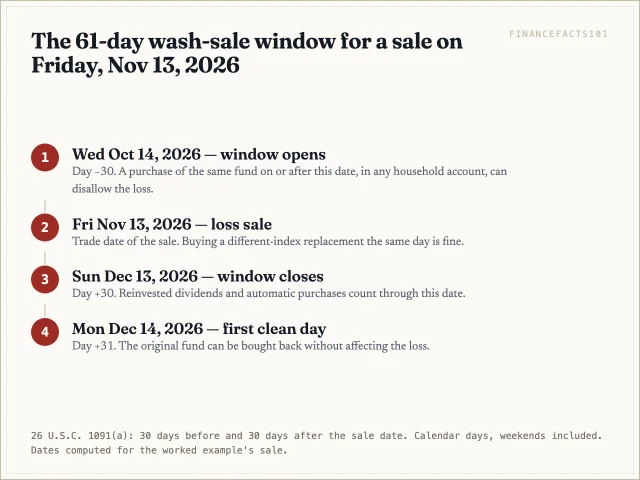
Publication 550 lists four triggers inside that window: buying substantially identical stock or securities, acquiring them in a fully taxable trade, acquiring "a contract or option to buy" them, and acquiring them "for your individual retirement arrangement (IRA) or Roth IRA." It then adds: "If you sell stock and your spouse or a corporation you control buys substantially identical stock, you also have a wash sale."
The half people miss is the 30 days before. A purchase three weeks before the sale, from an automatic investment plan, a reinvested dividend or a top-up you forgot about, is enough to disallow the loss on that many shares. A monthly buying schedule of the kind discussed in lump sum vs dollar-cost averaging will almost always put a purchase inside the window unless you pause it.
Do not rely on your broker to catch it. Publication 550 says box 1g of Form 1099-B shows a disallowed wash-sale loss if the securities were covered and the replacement had the same CUSIP and was bought in the same account. A purchase in your IRA, your spouse's account or at another broker will not appear there, and "you cannot deduct a loss from a wash sale even if it is not reported on Form 1099-B."
Substantially Identical: Where Funds Get Hard
The IRS has never published a bright-line test. Publication 550 says only that "you must consider all the facts and circumstances in your particular case," and that "ordinarily, stocks or securities of one corporation are not considered substantially identical to stocks or securities of another corporation." That makes single stocks easy: selling one bank's shares at a loss and buying another bank's is not a wash sale on the face of that guidance.
Funds are where the uncertainty sits. Two ETFs tracking the same index from different sponsors hold nearly the same securities in the same weights; a fund on a different index is a much weaker case for the IRS. No ruling settles either, so the table below is a reading of the risk, not a rule.
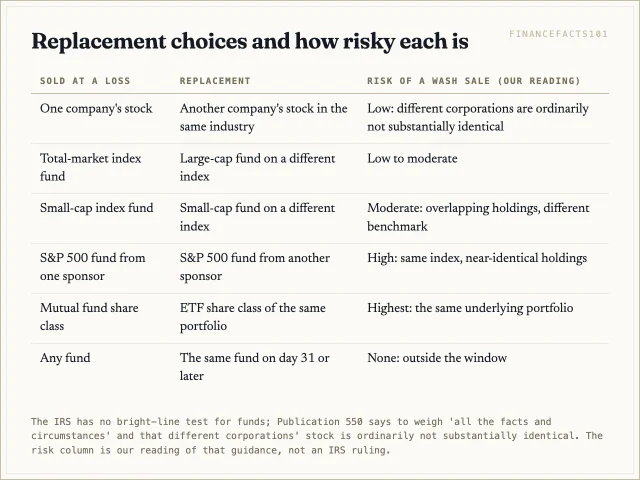
The share class point surprises people. Many fund families offer the same portfolio as a mutual fund and an ETF; index funds vs ETFs explains the structure. Selling one share class at a loss and buying another class of the same portfolio is the swap hardest to defend, because the underlying holdings are literally the same.
IRAs, Roth IRAs, 401(k)s and Your Spouse's Accounts
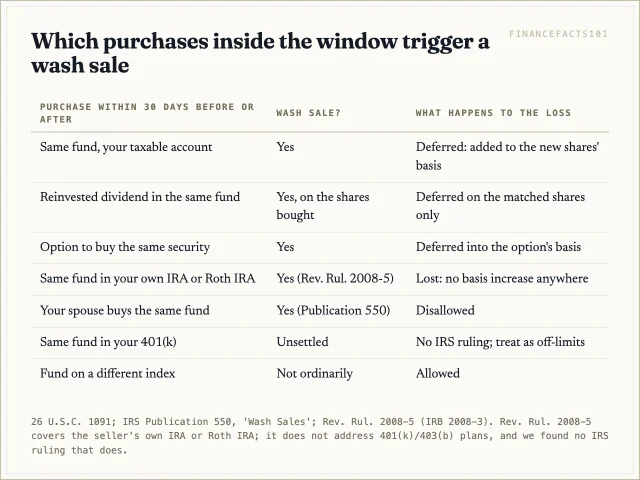
The IRA case is settled, and it is the worst outcome. In Rev. Rul. 2008-5, an individual sold 100 shares at a $400 loss and the next day caused an IRA held for his or her benefit to buy 100 shares of the same stock. The holding: "The loss on the Sale of stock is disallowed under § 1091. A's basis in the individual retirement account or Roth IRA is not increased by virtue of § 1091(d)." An ordinary wash sale defers the loss into the new shares' basis; a wash sale through your own IRA destroys it. In the worked example below, having Sam's IRA rebuy his 300 Lot A shares three days after the sale would shrink the couple's 2026 saving from $2,580 to $396, and the $13,500 would never be deductible.
The ruling covers an IRA or Roth IRA held for the seller's benefit. It does not discuss 401(k) or 403(b) accounts, and we found no published IRS ruling that does, so the treatment of a purchase inside an employer plan is unsettled. A spouse's IRA is not addressed by the ruling either, but Publication 550 treats a spouse's purchase as yours. The safe practice is the same in each case: during the 61 days, point new contributions in every account the household owns at a fund that is clearly not substantially identical.
What a Wash Sale Costs: Basis and Holding Period
If you trip the rule in a taxable account, the loss is postponed, not forfeited. Publication 550: "add the disallowed loss to the cost of the new stock or securities," which "postpones the loss deduction until the disposition of the new stock or securities," and the new shares' holding period "includes the holding period of the stock or securities sold."
When you buy fewer shares than you sold, only part of the loss is caught. Publication 550 matches the shares bought in the window, in the order bought, against an equal number of shares sold; the loss on those shares is disallowed and the rest is allowed.
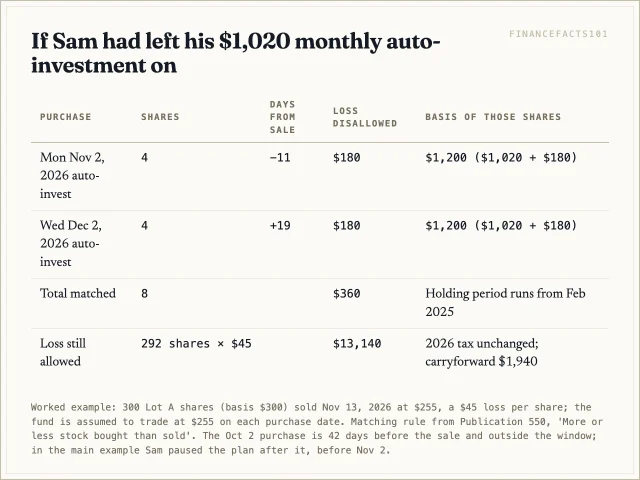
That proportional treatment is why small automatic purchases usually cost little, while a full repurchase cancels the whole harvest. Selling the entire position and rebuying it inside the window pays two trading costs to claim nothing this year. The legacy entry on wash sales covers short sales and options in more depth.
Worked Example: The Haddads Harvest Two Lots
Nadia and Sam Haddad file jointly. Their 2026 taxable income before any capital transactions, after the $32,200 standard deduction, is $180,000, which puts their ordinary income in the 22% bracket ($100,800 to $211,400) and any long-term gain in the 15% band. Earlier in the year they realized two gains: Lot C, a stock sold in June for a $6,000 short-term gain, and Lot D, a fund sold in March for a $4,000 long-term gain. On November 13, 2026 (a Friday), Sam reviews his taxable account and finds two lots below cost.
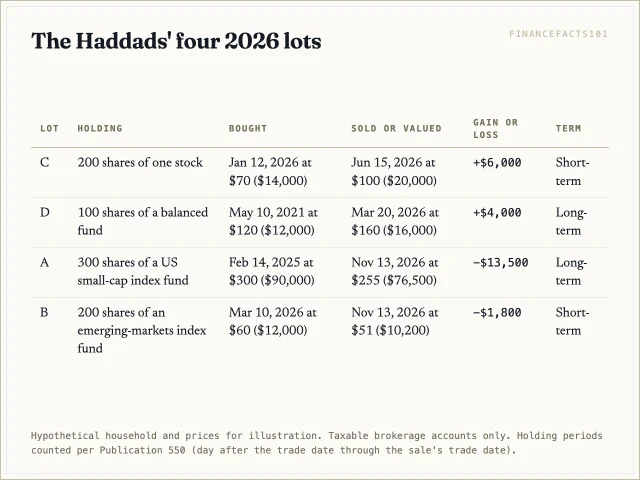
Lot A is 300 shares of a US small-cap index fund bought February 14, 2025 at $300, now $255: a $13,500 long-term loss. Lot B is 200 shares of an emerging-markets index fund bought March 10, 2026 at $60, now $51: a $1,800 short-term loss. He sells both and, the same day, puts the $86,700 of proceeds into a small-cap fund and an emerging-markets fund that track different indexes. He had paused his monthly auto-investment in the Lot A fund in October, after its October 2 purchase and before the November 2 one, and moved his IRA contributions to a bond fund. Nadia's accounts hold neither fund. So nothing substantially identical is bought anywhere in the household between October 14 and December 13.
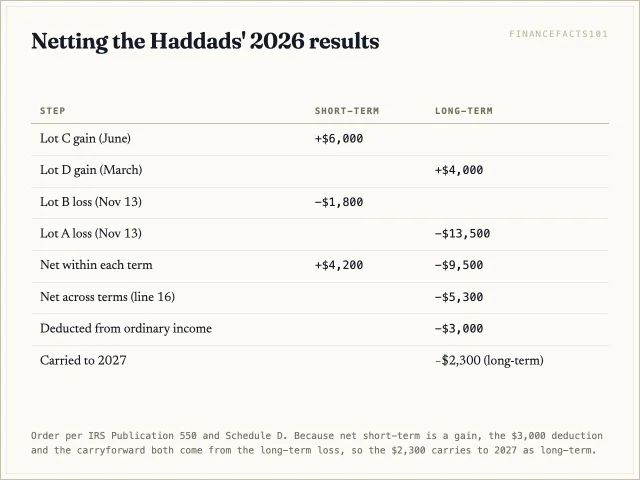
Netting runs exactly as the order above prescribes. Short-term: the $6,000 Lot C gain less the $1,800 Lot B loss leaves $4,200. Long-term: the $4,000 Lot D gain less the $13,500 Lot A loss leaves a $9,500 loss. Across terms that is a $5,300 net loss. They deduct $3,000 from ordinary income, and $2,300 carries to 2027 as a long-term loss.
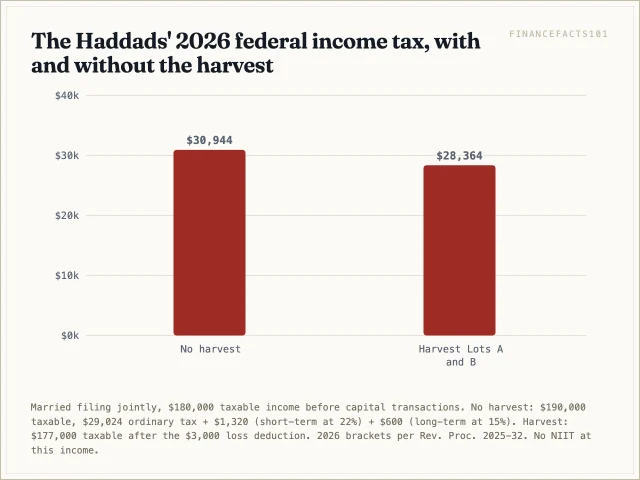
Without the harvest, their taxable income is $190,000 and their federal tax is $30,944: $29,024 on the $180,000, $1,320 on the short-term gain at 22% and $600 on the long-term gain at 15%. With it, taxable income falls to $177,000 and the tax is $28,364. The difference is $2,580, and the $2,300 carryforward is worth another $345 if it later offsets a gain taxed at 15%.
The capital gains tax calculator runs any single sale through the same 2026 brackets. Enter Lot C's $14,000 basis and $20,000 sale, short-term, married filing jointly, with $180,000 of other taxable income, and it shows the $1,320 that gain costs before any harvest; enter a sale below basis and it shows the $3,000 cap and the carryforward.
The Catch: A Lower Basis Means a Larger Gain Later
The $2,580 is not all profit. Sam's replacement funds cost $86,700, against $102,000 for the lots he sold. That $15,300 of lost basis is the harvested loss, and it comes back as extra gain when the replacements are sold. What the harvest is worth depends on the rate at that later sale.
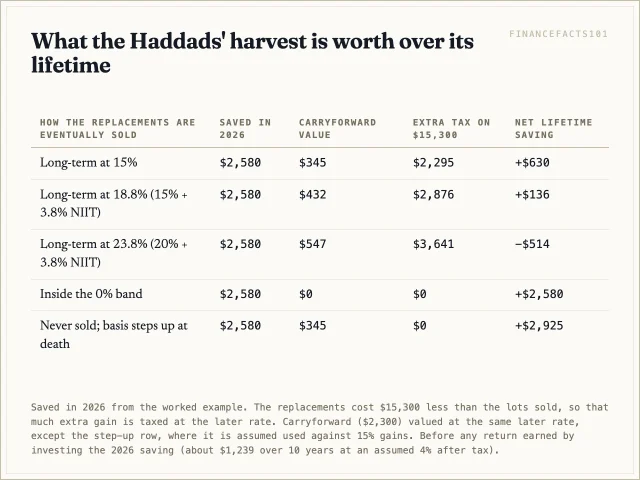
If the Haddads sell the replacements as long-term gains in the 15% band, the extra tax is $2,295 and the lifetime saving shrinks to $630: the 7-point gap on the $6,000 of short-term gain and the $3,000 of ordinary income the losses reached. At 18.8%, the 15% rate plus the 3.8% surtax, the saving is $136. At 23.8% they would owe $514 more than if they had never harvested.
Deferral softens that. At an assumed 4% a year after tax, investing the $2,580 saved in 2026 for 10 years earns about $1,239 before the replacements are sold, more than the $514 shortfall in the 23.8% case and enough to roughly triple the $630 in the 15% case. Counting the carryforward's value, invested from 2027, the gain is about $1,385 at 15% and $1,471 at 23.8%. And the two endings at the bottom of the table erase the later tax entirely: assets held until death generally take a basis equal to fair market value at death under 26 U.S.C. 1014 (the entry on step-up in basis explains the exceptions), and a sale inside the 0% band costs nothing.
When Tax-Loss Harvesting Is Worth Little
The same two lots are worth very different amounts in different households. Run them through a couple with $60,000 of taxable income and a couple with $450,000, keeping every other number identical.
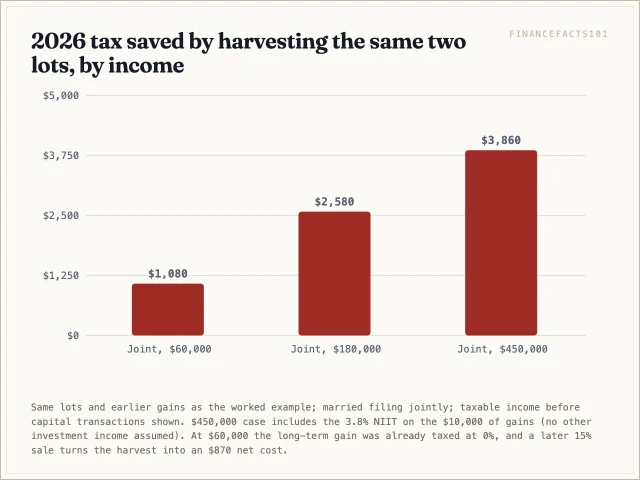
At $60,000 the harvest saves $1,080, but $4,000 of the losses were spent cancelling a long-term gain that the 0% rate already left untaxed. If that couple later sells the replacements at 15%, the harvest ends up costing them $870. At $450,000 the losses reach short-term gains at 32% and remove $380 of surtax, so the harvest saves $3,860 and stays worth $1,416 even after an 18.8% sale later. A low bracket is not the only weak case:
- You are in the 0% long-term band this year. Losses net against those gains automatically. Realizing gains up to the 0% ceiling is usually the better move; see the gain-harvesting section of the capital gains guide.
- Your portfolio is mostly low-basis lots. After a long rise there may be little to harvest, and each harvest ratchets basis lower, so a future need for cash realizes a larger gain.
- The loss is small relative to costs. Bid-ask spreads, fund minimums and a replacement that tracks your target less closely all eat into a three-figure saving.
- You expect a higher rate later. A loss used at 15% now and recovered at 23.8% later loses money before deferral.
Year-End Deadlines: Trade Date and the January Window
The deadline is the trade date, not settlement. Publication 550 gives the example directly: a stock sold "on December 31, 2025," with payment in January 2026, is reported on the 2025 return. For 2026 the last trading day is Thursday, December 31; the NYSE holiday calendar lists Christmas Day, Friday December 25, as a full closure and Thursday December 24 as a 1:00 p.m. early close.
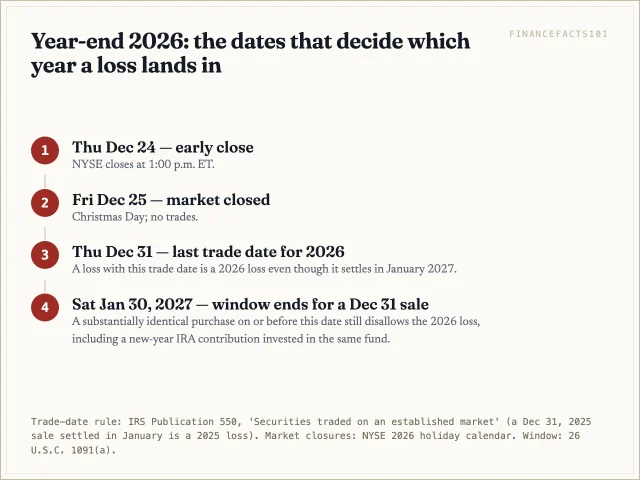
The wash-sale window ignores the calendar year. A loss sold on December 31, 2026 is disallowed by a substantially identical purchase on or before January 30, 2027, even though that purchase falls in a different tax year. Two habits around the turn of the year catch people here: a fund's year-end capital gain or dividend distribution reinvested automatically, which is a purchase, and a new-year IRA contribution invested in the fund you just sold.
A Harvesting Checklist
Put together, the steps in order:
- List lots below cost in taxable accounts, with each lot's holding period. Short-term losses usually reach higher-taxed income.
- Estimate this year's taxable income before the harvest. In the 0% long-term band, harvesting gains is usually the better trade.
- Look back 30 days for any purchase of the same fund in any household account, including reinvested dividends.
- Pause automatic purchases and redirect IRA and 401(k) contributions for the next 30 days.
- Sell by specific lot and choose a replacement that tracks a different index.
- Record the new basis and date, and wait until day 31 if you want the original fund back.
- Trade by December 31, and keep the January window clear.
FAQ
Does reinvesting dividends cause a wash sale?
It can. A reinvested dividend buys new shares, so if it buys the fund you sold within 30 days before or after the loss sale, the loss on that many shares is disallowed and added to their basis. Because only the matched shares are affected, a small reinvestment usually disallows a small slice of the loss, not all of it. Turning off reinvestment for the window avoids it.
Can I buy the same fund back after 31 days?
Yes. A purchase on day 31 is outside the window; for a sale on Friday, November 13, 2026, that is Monday, December 14. Many investors hold a similar but different fund in between rather than sit in cash.
Does my broker catch wash sales for me?
Only partly. Box 1g of Form 1099-B covers covered securities sold at a loss and replaced with the same CUSIP in the same account. Purchases in an IRA, a spouse's account or another brokerage are not reported there, and the loss is still disallowed.
Is harvesting worth it if I have no gains this year?
Often, up to a point. A net loss offsets up to $3,000 of ordinary income ($1,500 married filing separately), worth $660 at 22%, and the rest carries forward until used. The lasting value is the gap between your ordinary rate now and the rate on the replacement's eventual sale.
Sources
- IRS, Publication 550, Investment Income and Expenses: netting, the $3,000 limit, carryovers, wash sales, basis and holding-period adjustment, Form 1099-B box 1g, the trade-date example
- IRS, Topic 409, Capital Gains and Losses: holding period, net capital gain, the $3,000 limit
- IRS, Internal Revenue Bulletin 2025-45 (Rev. Proc. 2025-32): 2026 tax tables, capital gains thresholds and standard deduction
- IRS, Internal Revenue Bulletin 2008-3 (Rev. Rul. 2008-5): IRA and Roth IRA purchases trigger a wash sale with no basis increase
- IRS, Net Investment Income Tax: the 3.8% surtax and its thresholds
- IRS, Instructions for Schedule D (Form 1040): wash-sale reporting and the capital loss carryover worksheet
- US Code via govinfo, 26 U.S.C. 1091: the wash-sale statute and the basis rule in subsection (d)
- US Code via govinfo, 26 U.S.C. 1211: the $3,000 limit on capital losses
- US Code via govinfo, 26 U.S.C. 1014: basis of property acquired from a decedent
- Public Law 119-21 via govinfo, enacted text: checked; it makes no amendment to sections 1091, 1211 or 1212
- NYSE, Holidays and trading hours: 2026 market closures and early closes
 Next entry · No. 5,987Should I Do a Backdoor Roth IRA? How to Avoid the Pro-Rata Tax
See also
-
 No. 5,943
13 Sep 2026
17 min
Capital Gains Tax on Stocks: The One Day That Costs $1,800
Taxation
-
 No. 600
03 May 2024
23 min
Maximizing Tax Savings with Capital Loss Carryover and Tax-Loss Harvesting
Investments
-
 No. 5,301
28 Aug 2025
13 min
Unrecaptured Section 1250 Gain: How the 25% Rate on Real Estate Depreciation Works
Real Estate
-
 No. 4,888
25 Jul 2025
18 min
Maximizing Investment Profits: A Comprehensive Guide to Tax-Loss Harvesting
Business Finance
-
 No. 4,437
18 Jun 2025
19 min
Understanding Return of Capital: What It Is and How It Works
Business Finance
-
 No. 4,307
08 Jun 2025
18 min
Maximizing Your Tax Savings: Understanding Realized Losses in Investing and Business
Business Finance