Capital Gains Tax on Stocks: The One Day That Costs $1,800
Selling a $20,000 gain one day before the one-year line costs $1,800 more. The 2026 brackets, the 0% band, lot selection and wash sales, with the math.
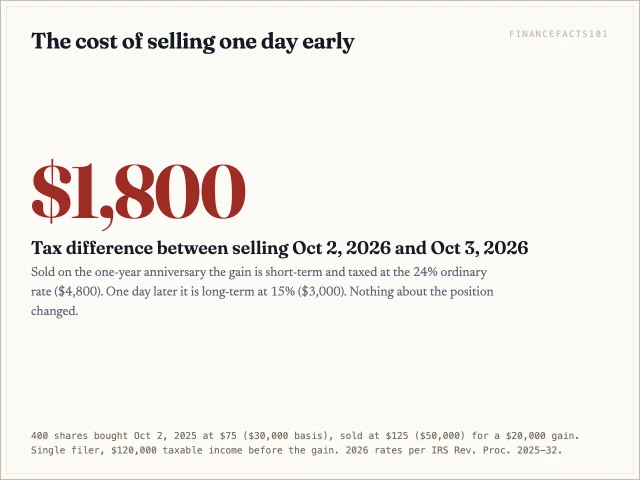
You hold 400 shares in a taxable brokerage account, bought October 2, 2025 for $30,000 and worth $50,000 today. On a single filer's $120,000 of taxable income, sell them October 2, 2026 and the capital gains tax on stocks costs $4,800. Sell October 3, 2026 — one calendar day later, same price, same shares — and it costs $3,000. That $1,800 is the subject of this article, and most sellers never check the date.
The rest of the gap between a good sale and an expensive one comes down to five things: which bracket the gain lands in, whether you use the 0% band, whether the 3.8% surtax reaches you, which tax lot your broker sells, and whether a repurchase quietly voids a loss. All figures use tax year 2026 federal rates from IRS Revenue Procedure 2025-32. General information with the assumptions stated, not personal tax advice.
Capital Gains Tax on Stocks: Two Rate Systems, One Date
A capital gain is the sale price minus your cost basis. Which of two separate rate schedules taxes it turns on one yes-or-no question: did you hold the shares more than one year?
Hold for one year or less and the gain is short-term, taxed as ordinary income — stacked on your salary and run through the same 10/12/22/24/32/35/37% brackets that tax your paycheck. Hold for more than one year and it is long-term, taxed through a separate schedule with three rates: 0%, 15% and 20%. No proration, no partial credit for eleven months.
Who This Is For — and Who It Isn't
This is for someone holding an appreciated stock, ETF or fund in a taxable brokerage account, deciding whether to sell now, wait, or offset the gain against a loss. It assumes a US individual filer with a documented basis.
It is not for holdings inside an IRA, Roth IRA, 401(k) or 403(b). Inside those wrappers there is no capital gains tax at all — no holding period, no lot selection, no wash sales, no 1099-B. Selling every position on one day inside a traditional IRA generates zero tax; what matters is the withdrawal, taxed as ordinary income, which is the subject of Roth vs traditional IRA. It also excludes incentive stock options, section 1202 stock, collectibles at 28%, and the sale of a primary residence.
The One-Year Clock, and Exactly How It Is Counted
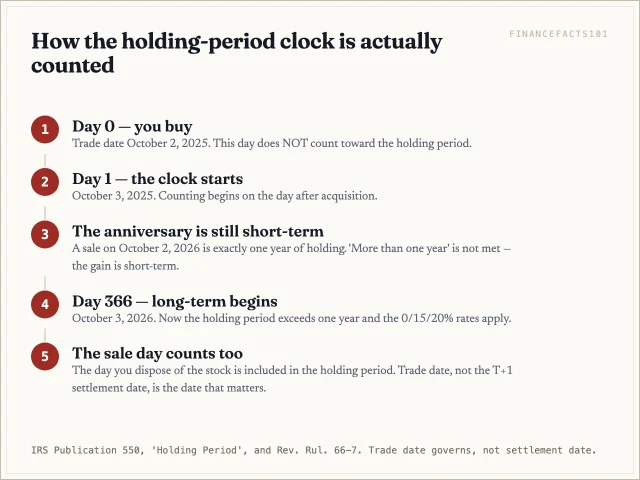
The rule trips people because it is off by one in two places at once. Per IRS Publication 550, you begin counting the day after you acquired the property, and the day you dispose of it counts too.
You bought October 2, 2025, so day one of the holding period is October 3, 2025. A sale on October 2, 2026 gives exactly one year — and the statute says more than one year, so that sale is short-term. October 3, 2026 is the first qualifying day. In plain English, "a year and a day": the anniversary plus one, not the anniversary itself.
Two details decide real dollars. The trade date governs, not settlement, so a trade executed October 3 counts even though cash lands October 4. And each purchase has its own clock — one sell order can produce both a short-term and a long-term line on your Schedule D. See IRS Topic 409 and the entry on holding periods.
Short-Term vs Long-Term Capital Gains: The 2026 Brackets
The short-term vs long-term capital gains gap has no fixed size in points, because the two schedules move independently. Here is the 2026 long-term schedule, verified against Revenue Procedure 2025-32 in Internal Revenue Bulletin 2025-45.
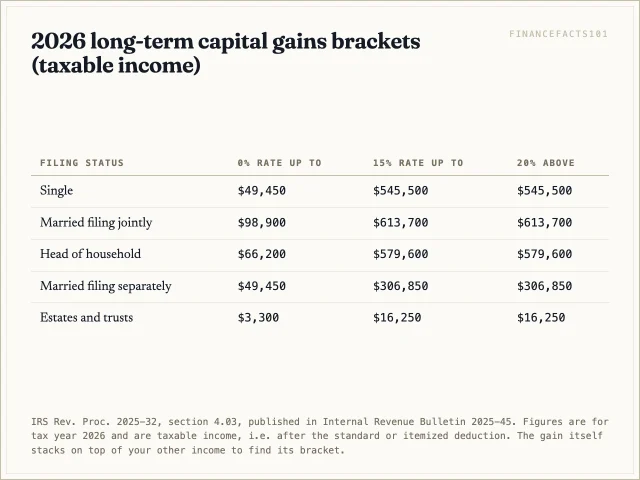
Read those as taxable income — after your standard deduction ($16,100 single, $32,200 joint for 2026) or itemized deductions. And read them as a stack: ordinary income fills the lower part of the schedule first, and the gain sits on top. A single filer with $40,000 of taxable income and a $20,000 gain does not get 0% on all of it; $9,450 fits under the $49,450 ceiling at 0%, and the remaining $10,550 is taxed at 15%.
The 2026 ordinary brackets taxing short-term gains run 10% to $12,400, 12% to $50,400, 22% to $105,700, 24% to $201,775, 32% to $256,225, 35% to $640,600 and 37% above, for a single filer — roughly double for joint filers.
How Much Tax You Pay When You Sell Stock: Three Worked Cases
To see how much tax you pay when you sell stock, run the same $20,000 gain — $30,000 basis, $50,000 sale — through three taxpayers.
Single, $120,000 of taxable income. Short-term, the gain stacks from $120,000 to $140,000, entirely inside the 24% band: $4,800. Long-term, the same slice sits in the 15% band: $3,000. One-day difference: $1,800.
Married joint, $60,000 of taxable income. Short-term, the gain runs from $60,000 to $80,000 in the 12% ordinary band: $2,400. Long-term, all of it sits below the $98,900 zero-rate ceiling — the tax is $0. The long-term bill is not merely lower, it is nothing.
Married joint, $500,000 of taxable income. Short-term, the gain straddles the 32% and 35% bands ($12,450 at 32%, $7,550 at 35%) for $6,627, plus $760 of net investment income tax: $7,387. Long-term, 15% ($3,000) plus the same $760: $3,760. One-day difference: $3,627.
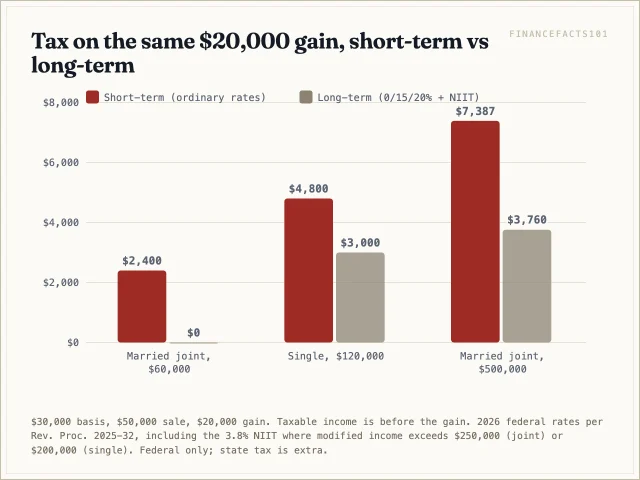
The gap is not a constant. It is the distance between your ordinary marginal rate and your long-term rate at that income, widest where the 35% ordinary rate has kicked in but the 20% long-term rate has not.
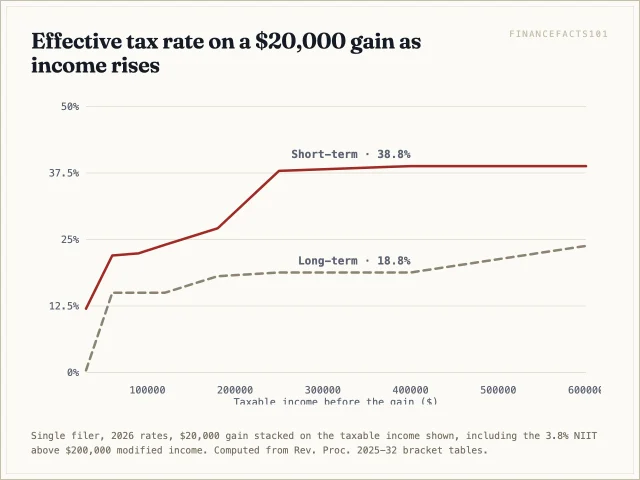
Run your own basis, sale price, income and filing status through the capital gains tax calculator, which applies these brackets and the surtax side by side.
The Crossover: How Far the Price Can Fall While You Wait
Waiting for long-term treatment is not free: you accept market risk on the whole position to save tax on the gain. So how big a drop erases the saving?
For the single filer above, selling short-term today nets $45,200 after $4,800 of tax. Waiting and selling later at price P nets P minus 15% of (P − $30,000). Setting those equal gives a break-even price of $47,882 — a 4.2% decline. Above that, waiting still pays; below it, you should have sold.
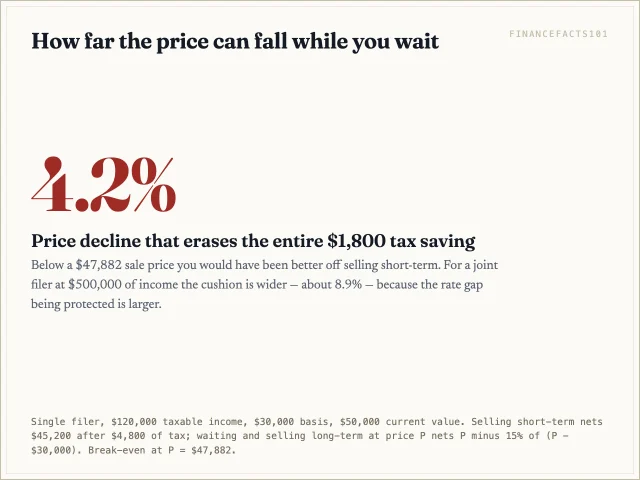
The cushion scales with the rate gap you are protecting: the joint filer at $500,000 can absorb about an 8.9% fall, protecting a 36.9% effective rate rather than a 24% one. Three weeks of single-stock volatility can easily exceed 4.2%; three weeks of broad-index volatility usually does not. Size the risk before the tax — the investment return calculator and CAGR calculator show what the position has done.
The 0% Bracket Is the Most Under-Used Number in Retail Investing
A long-term gain landing under the zero-rate ceiling is taxed at zero. Not deferred, not reduced — zero federal tax, permanently.
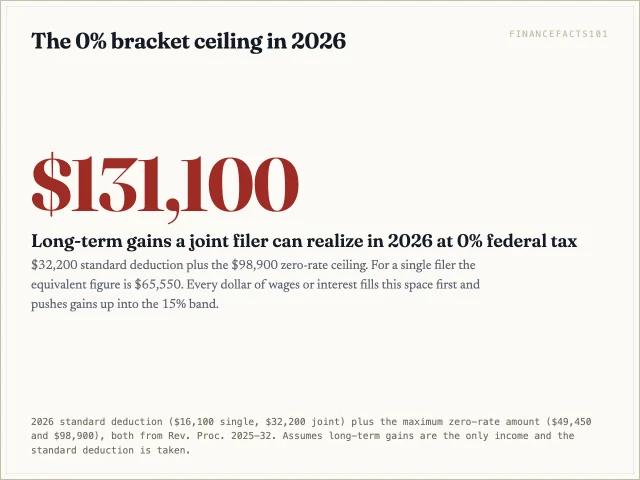
The ceiling is larger than most people assume, because the standard deduction sits underneath it. A married couple whose only 2026 income is long-term gains can realize $131,100 — the $32,200 standard deduction plus the $98,900 zero-rate amount — and owe no federal tax. For a single filer that figure is $65,550.
Who lands there? Early retirees living on cash before Social Security starts, someone between jobs, a couple in the gap year before required minimum distributions, a business owner in a loss year. In each case the 0% band is open, and unless someone deliberately uses it, it expires on December 31.
Gain Harvesting: Resetting Your Basis at Zero Cost
The mirror image of loss harvesting, and far less known. Sell an appreciated position, realize a long-term gain that fits your 0% room, pay no tax, and buy straight back. Your new basis is the higher price, and you have permanently erased that much future gain.
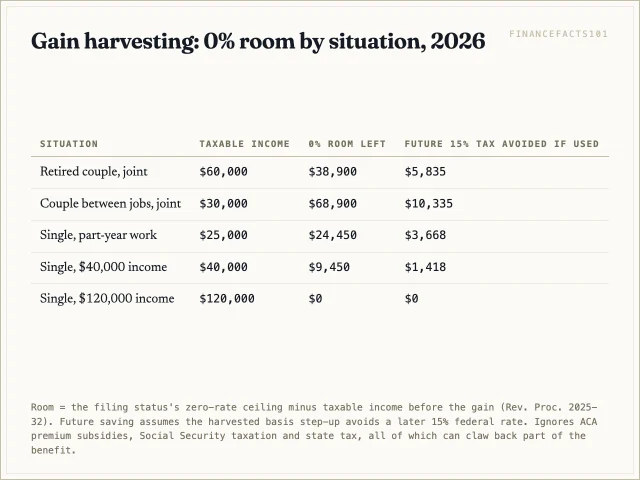
The wash sale rule does not interfere, because it applies only to losses — you may repurchase the identical security the same minute. A retired couple with $60,000 of taxable income has $38,900 of room; harvest it five years running and they reset basis on $194,500 of gains, avoiding roughly $29,175 of tax they would otherwise owe at 15%.
Three cautions. Realized gains raise your AGI, which can shrink an ACA premium credit, push more Social Security into taxable income, or trigger a phase-out — a "free" harvest can cost more sideways than it saves. Your state may tax the gain even where the federal rate is 0%. And harvest against year-end income you actually know, or you overshoot and pay 15% on the overflow.
The 3.8% Surtax Sitting on Top of Both Rates
The 0/15/20% schedule is not the whole federal bill for higher earners. The Net Investment Income Tax adds 3.8% on the lesser of your net investment income and the amount by which your modified AGI exceeds $200,000 (single or head of household), $250,000 (joint) or $125,000 (married filing separately).
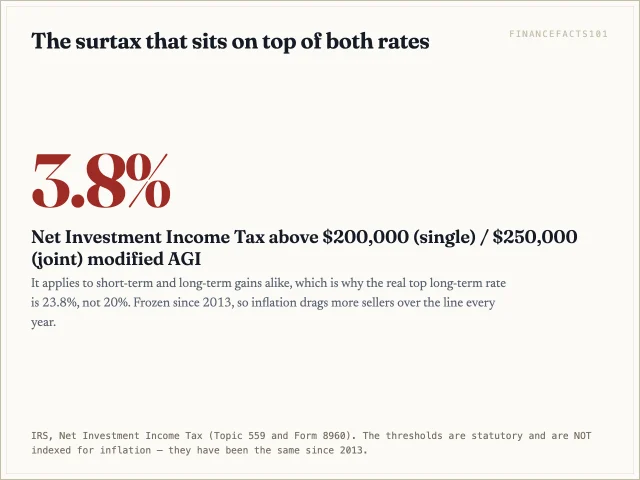
It applies to short-term and long-term gains equally, which is why the real top long-term federal rate is 23.8%, not 20%. The thresholds are statutory and have never been indexed — they are the same numbers as in 2013 — so each year of wage growth pulls more sellers across the line. If you are near a threshold, splitting a large sale across two calendar years can keep part of the gain out of the surtax; the take-home pay calculator shows where your ordinary income leaves you before you add the gain.
Cost Basis: FIFO by Default, Specific ID Only If You Ask
If you bought in pieces, you own several tax lots with different basis and holding periods — and you choose which you sell, but only if you say so.
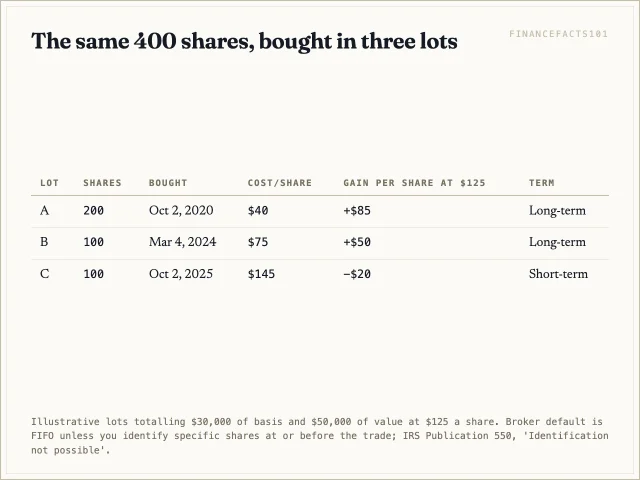
Publication 550 is blunt about the default: if you cannot adequately identify the shares sold, "the basis of the securities you sell is the basis of the securities you acquired first." FIFO sells your oldest, cheapest, largest-gain shares first. To override it, tell your broker which lot to sell at or before the trade and get written confirmation — an instruction after execution does not count.
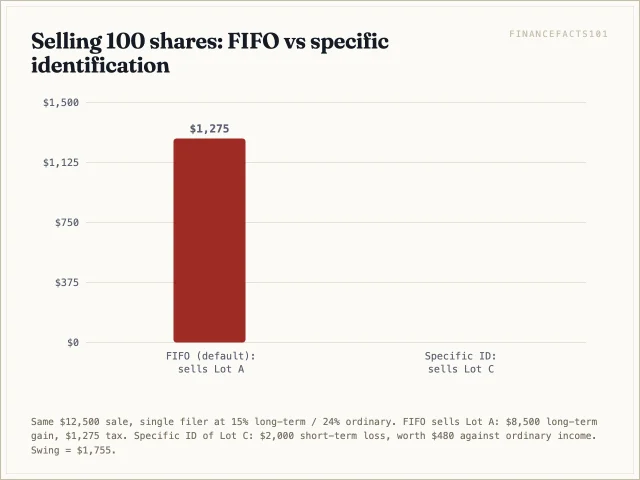
Sell 100 shares for $12,500 under FIFO and you dispose of Lot A: an $8,500 long-term gain, $1,275 of tax. Identify Lot C instead and you realize a $2,000 short-term loss worth $480 against ordinary income at 24%. Same cash, same day, same security — a $1,755 swing decided by a dropdown menu. Most brokers default to FIFO but let you change the account's lot method in settings. The entry on cost basis covers record-keeping.
The Wash Sale Rule Runs 61 Days, Not 30
Harvesting a loss is only useful if the loss survives. Publication 550 defines a wash sale as selling securities at a loss where, "within 30 days before or after the sale," you buy substantially identical securities, acquire an option to buy them, or buy them inside your IRA or Roth IRA.
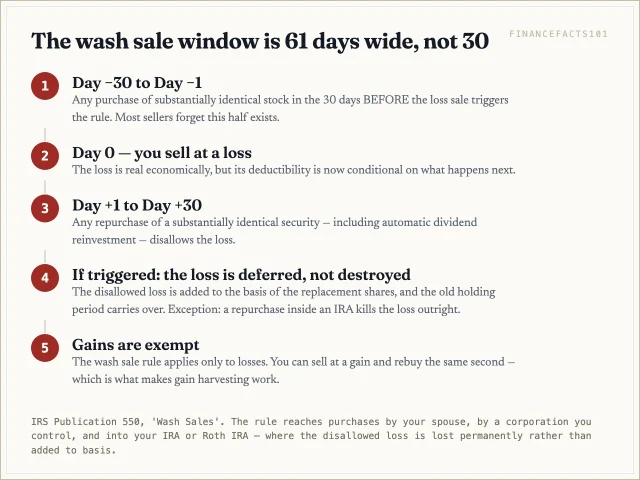
The half people forget is the 30 days before. An automatic monthly purchase three weeks ago is enough to disallow a loss you take today. So is dividend reinvestment, and so is a purchase by your spouse in a separate account or by a corporation you control (investor.gov's summary is the short version).
Trigger it and the loss is deferred, not destroyed: it is added to the replacement shares' basis and the old holding period carries over. One exception matters — repurchase inside an IRA and the disallowed loss is gone permanently, with no basis adjustment to recover it. "Substantially identical" has no bright line for funds; two S&P 500 index funds from different sponsors are widely treated as risky, while swapping a total-market fund for a large-cap fund is the conservative move — see index funds vs ETFs and the wash sale rule.
Losses: Full Offset, Then a $3,000 Ceiling, Then Carryforward
Capital losses net against capital gains without limit — short against short and long against long first, then across. A $20,000 loss cancels a $20,000 gain completely, which is why harvesting a loss in the same year you sell an appreciated position beats harvesting it in isolation.
What is capped is the leftover. If losses exceed gains, you may deduct up to $3,000 a year against ordinary income ($1,500 if married filing separately), and the rest carries forward indefinitely. A $20,000 net loss with no gains to absorb it takes nearly seven years to use:
| Year | Deducted | Remaining | Saved at 24% |
|---|---|---|---|
| 1–6 | $3,000 each | $2,000 after year 6 | $720 each |
| 7 | $2,000 | $0 | $480 |
That is $4,800 of benefit spread over seven years, versus $3,000 cancelled immediately if the loss meets a matching gain. Carryforwards never expire, but they are worth less the longer they sit — and they vanish at death. Tracking them is covered in capital loss carryover and tax-loss harvesting; everything is reported on Form 8949 and summarized on Schedule D.
Fund Distributions Tax You in a Year You Sold Nothing
Here is the bill that arrives unrequested. When a mutual fund sells appreciated holdings inside the portfolio, it must distribute the realized gains — and Publication 550 is explicit that you "report capital gain distributions as long-term capital gains, regardless of how long you owned your shares in the mutual fund."
You did not sell. You may have bought the fund in November. It still lands in box 2a of your 1099-DIV, taxed at your long-term rate. On a $50,000 position, a fund distributing 8% of net asset value hands you a $4,000 long-term gain and a $600 federal bill at 15% with nothing added to your pocket — the share price drops by the distribution on the ex-date.
This is the largest tax difference between fund structures in a taxable account, and why the choice in index funds vs ETFs is not cosmetic: in-kind redemption means most broad-market ETFs distribute no capital gains at all in a typical year, while a high-turnover active fund can distribute 10% or more of NAV. Reinvested distributions buy new shares with their own basis and holding period, and dividends run on a separate track — see qualified dividends and how mutual funds distribute gains.
State Tax: The Second Bill Nobody Budgets For
Every federal figure here is only part of the bill. Most states with an income tax treat capital gains as ordinary income with no preferential rate — California taxes them through brackets topping 13%, so a Californian in the 15% federal band faces a combined rate nearer 24%.
Nine states levy no broad individual income tax: Alaska, Florida, Nevada, New Hampshire, South Dakota, Tennessee, Texas, Washington and Wyoming. Washington is the asterisk — no wage income tax, but a separate 7% excise tax on long-term capital gains above an inflation-indexed standard deduction of $278,000 for 2025, with a higher tier above $1 million of taxable gain, per the Washington Department of Revenue. Check your own state's schedule before assuming the federal number is the number, and note that residency on the sale date generally decides who taxes you.
Putting It Together: A Sequence, Not a Rule
The order of operations for an appreciated taxable position:
- Check the purchase date first. If long-term status is weeks away and the position is not falling, wait — the cushion above was 4.2%.
- Estimate this year's taxable income before the gain. That number decides 0%, 15% or 20%, and whether the surtax reaches you.
- If there is 0% room, use it. Harvest up to the ceiling, rebuy immediately, reset basis.
- Choose the lot before you place the order. Specific identification costs nothing and can be worth four figures.
- Look for losses elsewhere to net against the gain, checking the 30 days before as well as after any repurchase.
- Split large sales across calendar years if that keeps you under a bracket or surtax threshold.
- Add your state's rate, then decide.
Re-run it with your own figures in the capital gains tax calculator before placing the trade. The gap between doing this well and doing it by default is measured in thousands, not basis points.
What Deferral Is Actually Worth
One last argument for holding: unrealized gains compound on money you have not yet handed to the IRS. Take the single filer's choice between selling long-term today for $3,000 of tax and simply keeping the position, both compounding at 7% a year for 20 years.
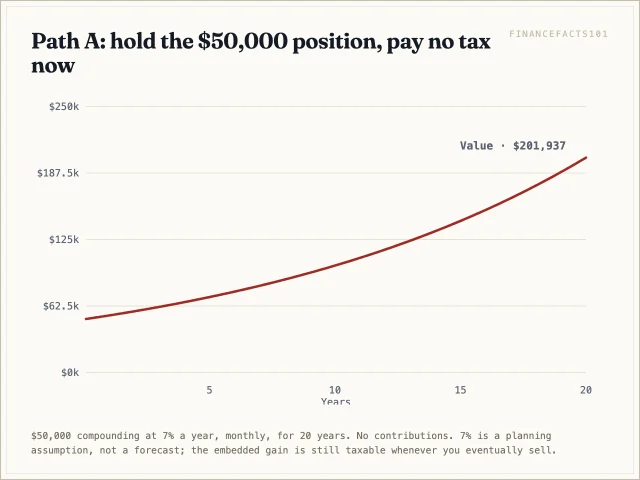
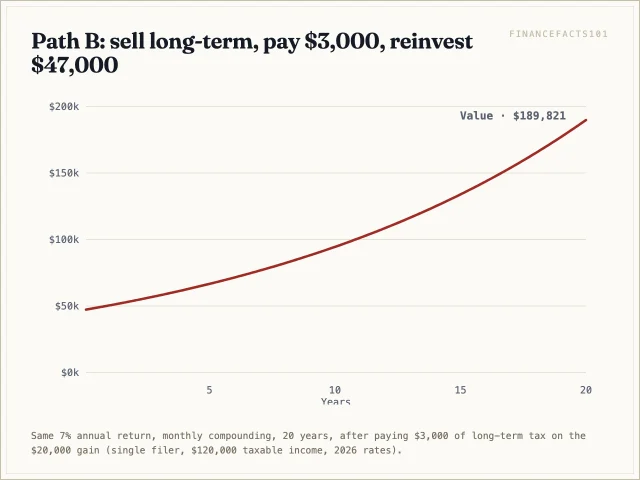
The untaxed $50,000 reaches about $201,937; the $47,000 left after tax reaches about $189,821. Deferral is worth roughly $12,116 over two decades — real, but bounded, because the tax is postponed rather than cancelled. It is a reason not to churn a portfolio for no purpose, not a reason to hold a position you have decided is wrong: a concentrated holding that falls 30% costs far more than the tax it avoided. One exception — assets held until death currently receive a stepped-up basis, which makes the deferral permanent for heirs.
FAQ
Does the one-year clock start on the trade date or the settlement date?
Trade date. The holding period begins the day after your purchase's trade date and includes your sale's trade date. Settlement (currently T+1 for US equities) does not enter the calculation, so a sale executed on the first qualifying day is long-term even though cash arrives the next business day.
If my income is low enough for the 0% rate, do I still report the sale?
Yes. A 0% rate is still a reportable transaction — Form 8949 and Schedule D like any other sale, and your broker files a 1099-B regardless. Reporting it also establishes your new, higher basis if you harvested the gain deliberately.
Can I dodge the wash sale rule by selling in my taxable account and rebuying in my IRA?
No — that is the worst version of the trade. Publication 550 explicitly covers buying substantially identical stock in your IRA or Roth IRA within the window, and unlike an ordinary wash sale the disallowed loss is not added to the replacement shares' basis. It is simply lost.
Do gains inside my 401(k) or IRA get taxed at these rates?
No. Sales inside a tax-deferred or Roth account generate no capital gains tax, no holding period requirement and no wash sale exposure. Traditional accounts tax withdrawals as ordinary income; qualified Roth withdrawals are tax-free. The 0/15/20% schedule applies only to taxable accounts.
What happens to a capital loss carryforward I never use?
It carries forward indefinitely, offsetting future capital gains in full and up to $3,000 of ordinary income a year. It does not transfer to heirs and is extinguished at death — an argument for realizing gains against it rather than draining it $3,000 at a time.
Sources
- IRS, Topic 409, Capital Gains and Losses — the 0/15/20% structure and the more-than-one-year rule
- IRS, Publication 550, Investment Income and Expenses — holding-period counting, FIFO default and specific identification, wash sales, the $3,000 loss limit and carryforward, capital gain distributions
- IRS, Internal Revenue Bulletin 2025-45 (Rev. Proc. 2025-32) — the tax year 2026 capital gains thresholds, ordinary brackets and standard deduction
- IRS, Tax inflation adjustments for tax year 2026 — the plain-language summary of the same figures
- IRS, Net Investment Income Tax — the 3.8% surtax and its unindexed $200,000/$250,000 thresholds
- IRS, About Schedule D (Form 1040) and About Form 8949 — how sales are reported
- SEC, Investor.gov: wash sales — the plain-language definition
- Washington State Department of Revenue, Capital gains tax — the 7% state excise tax and its $278,000 standard deduction
 Next entry · No. 5,944When to Claim Social Security: Break-Even at 62, 67 and 70
See also
-
 No. 5,986
20 Oct 2026
19 min
Is Tax-Loss Harvesting Worth It? The Math and the Wash-Sale Rule
Taxation
-
 No. 6,006
09 Nov 2026
17 min
Capital Gains on Sale of Home: When You Owe Tax in 2026
Taxation
-
 No. 5,301
28 Aug 2025
13 min
Unrecaptured Section 1250 Gain: How the 25% Rate on Real Estate Depreciation Works
Real Estate
-
 No. 600
03 May 2024
23 min
Maximizing Tax Savings with Capital Loss Carryover and Tax-Loss Harvesting
Investments
-
 No. 5,951
17 Sep 2026
18 min
Tax-Deductible Investments: What Actually Cuts Your 2026 Tax Bill
Taxation
-
 No. 4,893
25 Jul 2025
25 min
Understanding Tax Rates: A Comprehensive Guide for Institutional Investors
Taxation