Capital Gains on Sale of Home: When You Owe Tax in 2026
Up to $250,000 of home-sale gain ($500,000 joint) is tax-free if you pass the 2-of-5-year tests. The exceptions, 2026 rates and three sellers worked.
Do you pay capital gains tax when you sell your house? Usually not: as of October 2026, section 121 of the Internal Revenue Code lets you exclude up to $250,000 of gain, or $500,000 on a joint return, if you owned the home and lived in it as your main home for at least two of the five years before the sale and have not used the exclusion on another home in the previous two years. Capital gains on sale of home become taxable in four situations: the gain is larger than your limit, you fail the tests without a qualifying reason, part of the gain comes from depreciation you claimed on a rental or home office, or the house was a rental or second home for years after 2008 before you moved in.
The taxable part pays 0%, 15% or 20% under the 2026 brackets, up to 25% on the depreciation slice, the 3.8% net investment income tax at higher incomes, and then state tax; California taxes it as ordinary income. This guide works each rule from IRS Publication 523 (2025 edition, the latest) and the statute, then runs three sellers through the arithmetic. General information with stated assumptions, rules as of October 9, 2026; not personal tax advice.
Capital Gains on Sale of Home: The Rule in One Paragraph
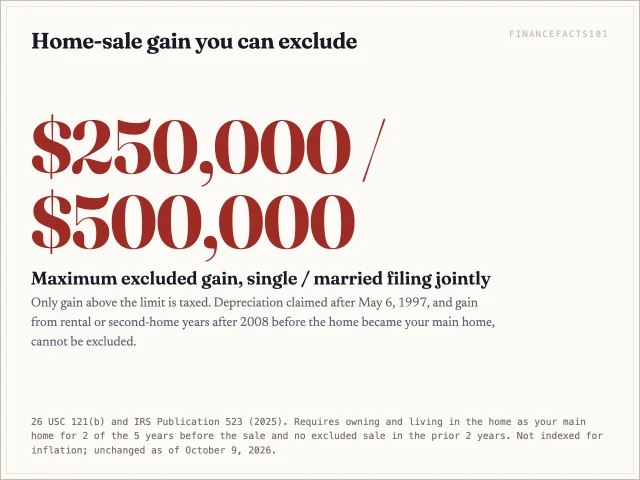
The statute is short. Section 121(a) reads: "Gross income shall not include gain from the sale or exchange of property if, during the 5-year period ending on the date of the sale or exchange, such property has been owned and used by the taxpayer as the taxpayer's principal residence for periods aggregating 2 years or more." Section 121(b) caps the excluded amount at $250,000, or $500,000 for a married couple filing jointly when either spouse meets the ownership test, both meet the use test, and neither used the exclusion in the prior two years.
The exclusion applies to gain, not the sale price, and only gain above the limit is taxed. The limits are not indexed for inflation — the same figures applied to sales after May 6, 1997 — which is why long-time owners in expensive markets are the ones who now owe.
Who This Is For — and Who It Isn't
This is for a US individual selling a house, condo, co-op, mobile home or houseboat that is, or recently was, their main home, including the usual complications: an early move, a divorce, a spouse's death, a home office, a past rental.
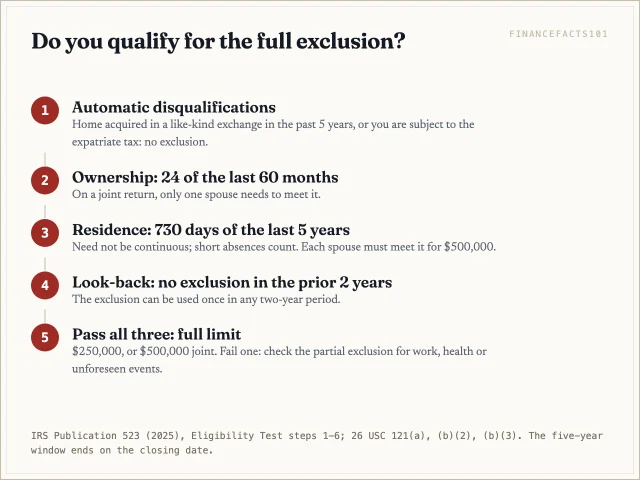
It is not for property you never lived in, which gets no exclusion. A home acquired in a like-kind exchange is shut out for five years (section 121(d)(10)), and anyone subject to the expatriate tax gets no exclusion. Whether to buy or rent next is run in renting vs buying a home; gains on shares are in capital gains tax on stocks.
The Three Tests: Own It, Live in It, Wait Two Years
Ownership. You owned the home for at least 24 months of the five years ending on the closing date. On a joint return only one spouse has to meet this.
Residence. You lived in it as your main home for at least 730 days of the same five years, not necessarily continuous; a vacation or short absence still counts. Each spouse must meet this test for the $500,000 limit. If you become unable to care for yourself, time in a licensed care facility counts once you have lived there 12 months of the five years.
Look-back. You did not exclude gain on another home sold in the two years before this sale; the exclusion works once per two-year period.
Uniformed services, Foreign Service, intelligence-community and Peace Corps personnel on qualified official extended duty can suspend the five-year clock for up to 10 years. With two homes, only one is your main home: chiefly where you spend the most time, then the address on your returns and license.
Married, Divorced or Widowed: Who Gets $500,000
The $500,000 figure is not automatic. When only one spouse meets the residence test, section 121(b)(2)(B) gives the couple the sum of what each would get if single. Treasury Regulation 1.121-3 works a husband who had lived in the house for years and a wife who had lived there one year when her job change forced the sale: $250,000 plus $125,000, or $375,000.
In a divorce, a transfer of the house to a spouse or ex-spouse generally produces no gain or loss. If you receive it, your ex-spouse's ownership counts as yours, though you must meet the residence test yourself; and time your ex-spouse lives there under a divorce or separation instrument counts as your use.
A widow or widower keeps the larger limit for a while. Under section 121(b)(4), an unmarried surviving spouse may exclude up to $500,000 if the sale closes no later than two years after the death and the joint requirements were met immediately before it; the late spouse's ownership and residence count too. Basis also changes: the late spouse's half of a jointly owned home steps up to market value, and in community property states such as California the whole home can, if at least half the community interest is includible in the late spouse's estate (see step-up in basis).
Moved Early? The Partial Exclusion for Work, Health and Unforeseen Events
Fail the two-year tests and you may still exclude part of the gain, if the main reason for the sale was a change in place of employment, health, or unforeseen circumstances (section 121(c)). Treasury Regulation 1.121-3 sets safe harbors that settle the question automatically:
- Work: your new place of employment is at least 50 miles farther from the home than your old one, or at least 50 miles from the home if you had no previous workplace.
- Health: a physician recommends a change of residence for reasons of health.
- Unforeseen: the home is destroyed or condemned or suffers a disaster casualty; or you, your spouse, a co-owner or a household member dies, becomes eligible for unemployment compensation, can no longer pay housing costs and basic living expenses after a change in employment, divorces or legally separates, or has multiple births from the same pregnancy.
Outside the safe harbors, the facts decide. The regulation is explicit that a sale whose primary reason is "a preference for a different residence or an improvement in financial circumstances" does not qualify; its own examples reject a promotion, falling mortgage rates and a lottery win.
The reduced limit is a fraction of the full limit, not of your gain: the shortest of your ownership period, your use period, and the time since your last excluded sale, divided by 730 days (or 24 months), times $250,000. Twelve months gives $125,000.
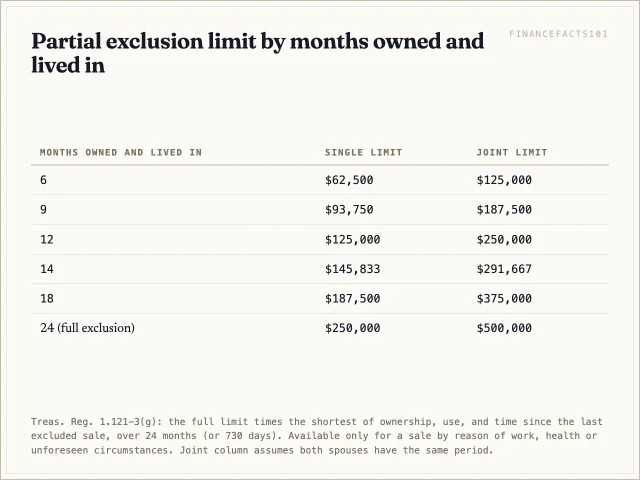
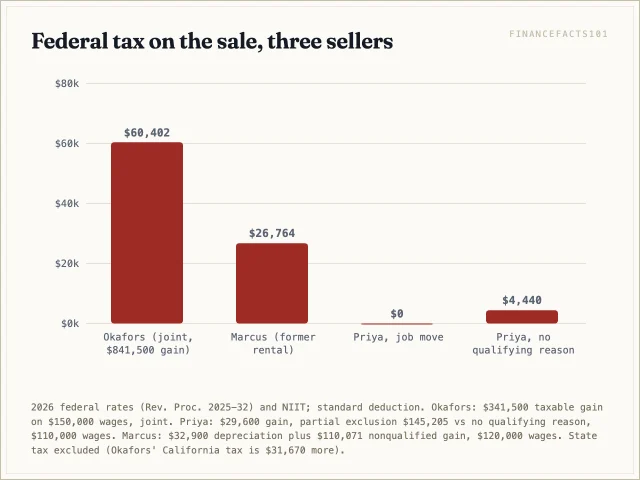
That makes it more generous than people expect. Priya, single, bought her condo on March 3, 2025 for $380,000 plus $4,000 of closing costs that go into basis. She takes a job 140 miles farther away and sells on May 1, 2026 for $440,000, paying $26,400 in selling costs. She owned and lived there 424 days, so her limit is 424 ÷ 730 × $250,000 = $145,205. Her gain is $29,600. She owes nothing.
Had she sold simply to get a bigger place, no exclusion would apply: the $29,600 would be a long-term gain in the 15% band on her $93,900 of taxable income, $4,440. Staying until March 3, 2027 would have made it tax-free with no reason needed.
Your Gain Is Smaller Than You Think: Basis and Selling Costs
Publication 523's Worksheet 2 subtracts in two steps. The amount realized is the sale price minus selling expenses (commissions, advertising, legal fees, other costs of selling). The adjusted basis is what you paid plus purchase closing costs and improvements, minus a few items. Gain is the difference.
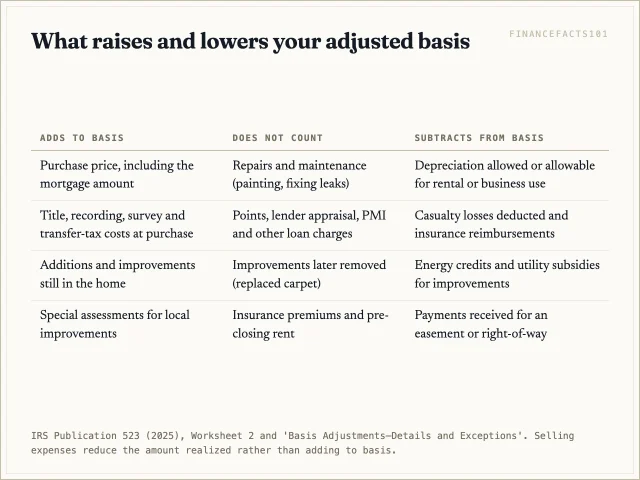
Improvements are where money is left on the table. A roof, a kitchen remodel, central air, a fence, a deck or an addition raises basis; painting and fixing leaks do not, unless part of a larger remodel. Keep the receipts until three years after the due date of the return for the year of sale, as Publication 523 advises.
A loss on your own home is not deductible (IRS Topic 409). Investment losses elsewhere can offset the taxable part of a home gain; the netting rules and wash-sale trap are in is tax-loss harvesting worth it.
Rentals, Home Offices and the Depreciation You Cannot Exclude
Section 121(d)(6) carves out a slice no exclusion covers: depreciation for periods after May 6, 1997. If you rented the house or used part of it for business, gain equal to the depreciation allowed or allowable is taxable — and "allowable" means skipping the deduction does not avoid it.
That slice is unrecaptured section 1250 gain, taxed at a maximum of 25% (Topic 409). Under 26 USC 1(h)(1), the part that fits inside your 10% to 24% ordinary brackets is taxed at those ordinary rates; only the rest pays 25%. See unrecaptured section 1250 gain.
A home office inside the living area needs no allocation; only the depreciation is taxed. Publication 523's example: an attorney with a $13,000 gain and $2,000 of depreciation recognizes $2,000 and excludes $11,000. A separate part — the other unit of a duplex, a farm, a stable — must be allocated, and its gain is not excludable unless you lived in that part two of the five years.
Former Rentals: The Nonqualified-Use Rule After 2008
Since 2009 a second limit hits houses that were rentals or vacation homes before they became your main home. Under section 121(b)(5), gain allocated to "periods of nonqualified use" cannot be excluded, by a simple ratio: days of nonqualified use after December 31, 2008 over total days owned.
Nonqualified use does not include time within the five-year window after you last lived there, up to 10 years of qualified official extended duty, or up to two years of temporary absence for employment, health or unforeseen circumstances. So order decides the bill: renting after you move out does not trigger the ratio if you sell within the window and still meet the two-of-five test; renting before you move in does. Depreciation comes out first and is taxed separately.
Marcus, single, bought a house on July 1, 2019 for $400,000 and rented it out for three years, claiming $32,900 of depreciation. He moved in on July 1, 2022, added a $20,000 bathroom, and sold on July 1, 2026 for $720,000 with $43,200 of selling costs.
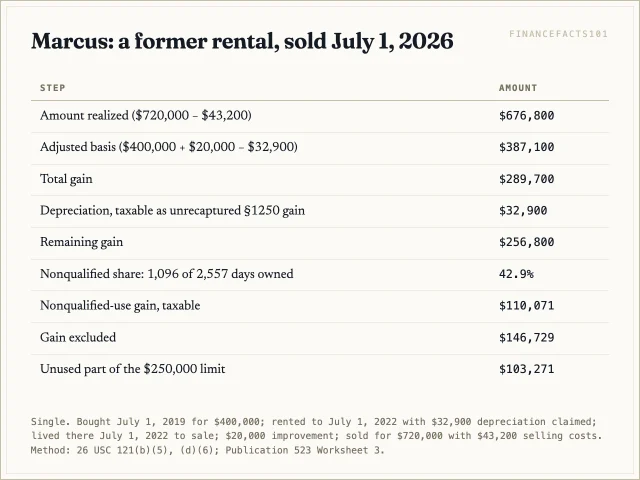
His gain is $289,700. After the $32,900 of depreciation, 1,096 of his 2,557 days of ownership were nonqualified use, so $110,071 of the remaining $256,800 is taxable and $146,729 excluded. The other $103,271 of his limit goes unused; Publication 523 says the balance "can't be used."
On $120,000 of wages, his federal bill is $7,860 on the depreciation (all of it in the 22% and 24% brackets, so the 25% cap never applies), $16,511 on the nonqualified gain at 15%, and $2,393 of net investment income tax: $26,764. Had the three rental years come after his last stretch of living there, and had he still met the two-of-five-year test, only the depreciation would have been taxable: $7,860.
The 2026 Rates That Apply to Any Taxable Gain
A home owned more than a year produces a long-term gain at the 2026 rates in Revenue Procedure 2025-32 (Internal Revenue Bulletin 2025-45). One owned a year or less produces a short-term gain taxed at ordinary rates; any exclusion then can only be partial.
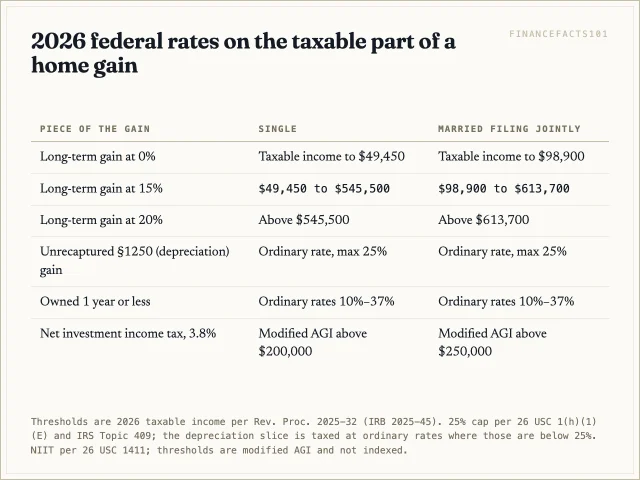
The gain stacks on top of your other taxable income, so a large sale can straddle two rates; capital gains tax on stocks walks through the stacking. The 3.8% surtax applies to the lesser of net investment income and modified AGI above $200,000 single or $250,000 joint. Excluded home gain is not investment income — the tax "does not apply to any amount of gain that is excluded from gross income for regular income tax purposes" (IRS NIIT questions and answers) — but the taxable part is.
Three Sellers, Worked Through
Priya and Marcus are above. The third seller shows what long ownership in an expensive market does. The Okafors, married filing jointly and both under 65, bought their California house in 2004 for $420,000 plus $6,000 of closing costs, then spent $110,000 on a kitchen, a roof and a new heating and cooling system. In 2026 they sell for $1,450,000 and pay $72,500 in commissions, escrow, title and transfer taxes. Wages are $150,000; they take the standard deduction (paying California tax on the gain during 2026, plus property tax, could make itemizing worthwhile and trim the federal figure).
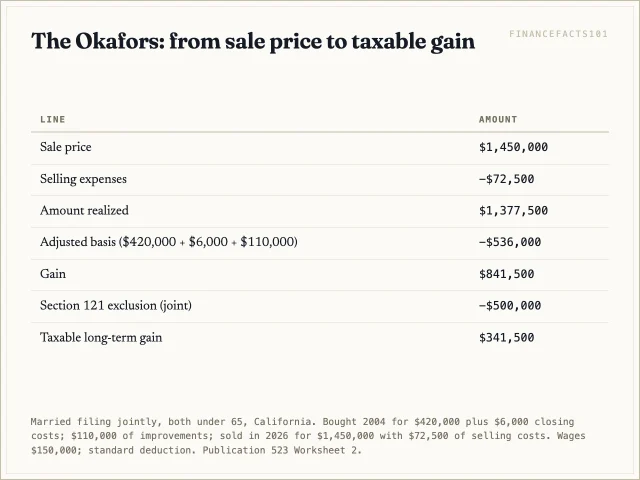
The $500,000 exclusion leaves $341,500 of their $841,500 gain taxable. Their taxable income before the sale is $117,800 ($150,000 minus the $32,200 standard deduction), so the gain stacks from $117,800 to $459,300, all in the 15% band: $51,225. Modified AGI of $491,500 is $241,500 over the threshold, so the surtax is $9,177. Federal total: $60,402.
California adds $31,670 (worked below), for an all-in $92,072, or 10.9% of the gain. Without the exclusion the federal bill alone would be $171,682, so the exclusion is worth $111,280 in federal tax.
The federal bill is zero up to the $500,000 limit, climbs at 15% until modified AGI passes $250,000 (a $600,000 gain), then at 18.8%, and at 23.8% once stacked taxable income passes $613,700, at a gain of about $996,000.
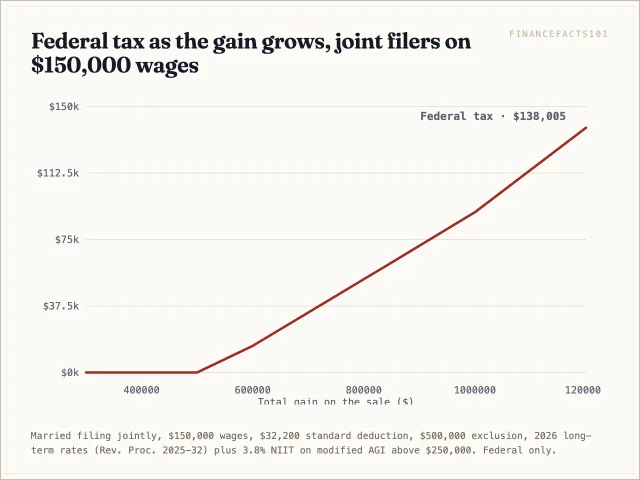
To run your own version in the capital gains tax calculator, enter adjusted basis plus the exclusion ($1,036,000) as the basis and the amount realized as the sale price. The $9,177 surtax above follows the statute's test: 3.8% of the lesser of the taxable gain and modified AGI over $250,000. A former landlord should figure the depreciation slice separately, as in Marcus's case.
Capital Gains on Sale of Home in California
California follows the federal exclusion, then taxes the rest at full rates. The Franchise Tax Board's capital gains page says it plainly: "California does not have a lower rate for capital gains. All capital gains are taxed as ordinary income." FTB Publication 1001 confirms that California conforms to the $250,000 and $500,000 exclusion, and adds a separate state rule: Peace Corps service in the five years before the sale can shorten the two-year requirement by up to 18 months.
Rates run from 1% to 12.3% under the 2025 California tax rate schedules, the latest published as of October 9, 2026, plus a 1% Behavioral Health Services Tax on taxable income over $1 million. With California's 2025 standard deduction of $11,412, the Okafors' state taxable income rises from $138,588 to $480,088: $6,860 of the gain at 8% and the rest at 9.3%, $31,670. Their AGI stays under the 2025 $504,411 line where exemption credits start shrinking. The 2026 schedules, once indexed for inflation, will make the $31,670 slightly lower.
At closing, escrow generally withholds 3 1/3% of the sales price, or an alternative amount based on the gain, unless the seller certifies an exemption on Form 593; the principal residence certification exempts the part of the property that was your main home.
Washington, the other state checked here, exempts real estate from its capital gains excise tax (Washington Department of Revenue). For any other state, check its own rules before treating the federal number as the whole bill.
Will Congress Raise the $250,000 Limit?
Not yet. As of October 9, 2026, no change to the section 121 limits has been enacted; the One Big Beautiful Bill Act (Public Law 119-21) did not amend section 121. Several bills would.
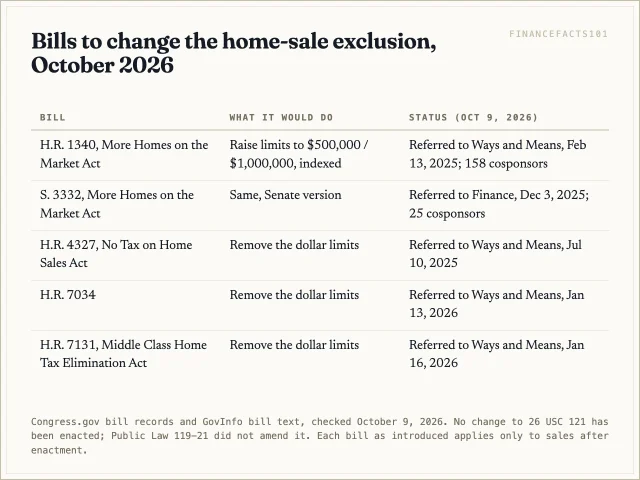
The More Homes on the Market Act (H.R. 1340), with 158 cosponsors, would double the limits to $500,000 and $1,000,000 and index them to inflation; a Senate version, S. 3332, was introduced in December 2025. The No Tax on Home Sales Act (H.R. 4327) and two January 2026 bills with the same text would remove the dollar limits altogether. Each has only been referred to committee, and each, as written, applies only to sales after enactment.
Reporting the Sale: When You Can Skip It
If the whole gain is excluded and you received no Form 1099-S, you report nothing. Otherwise the sale goes on Form 8949 and Schedule D — including when a 1099-S arrives and none of the gain is taxable.
You can choose not to exclude a gain, for instance to save the exclusion for a larger sale expected within two years, and reverse that choice by amended return within three years of the due date.
A taxable gain may call for higher withholding or an estimated payment (IRS Publication 505). And a federally subsidized mortgage can trigger repayment on Form 8828 even when the gain is excluded.
A Decision Sequence Before You List
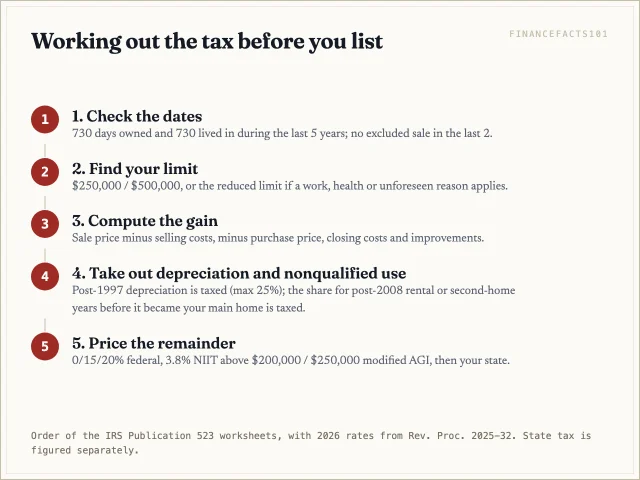
Run it in that order, from closing statements and receipts. If you are a few months short of two years with no qualifying reason, waiting is often worth thousands: Priya's choice was between $4,440 and nothing.
FAQ
Do I have to buy another house to avoid the tax?
No. The old rule that let you postpone the gain by buying a replacement home applied to sales before May 7, 1997; for sales after May 6, 1997, the section 121 exclusion applies instead. Publication 523 still asks for any gain postponed under the old rule, because it reduces your basis. The legacy over-55 home sale exemption entry covers that history.
Is gain on a vacation home or second home excluded?
Not while it is a second home. It qualifies only if it becomes your main home for two of the five years before the sale, and even then the years it was a second home after 2008 count as nonqualified use and reduce the excluded share, as in Marcus's case.
Does receiving Form 1099-S mean I owe tax?
No. It means the closing agent reported the sale, so you must report it on Form 8949. If the exclusion covers the whole gain, the reported gain is offset by the exclusion and the tax is zero.
What if both spouses don't meet the two-year residence test?
You do not get $500,000. Each spouse's limit is figured as if single and the two are added, so one spouse with two years and one with a qualifying partial exclusion can still exclude more than $250,000. A spouse with neither adds nothing.
Sources
- IRS, Publication 523 (2025), Selling Your Home — eligibility tests, partial exclusion, basis, depreciation, nonqualified use, reporting, examples
- US Code, 26 USC 121, Exclusion of gain from sale of principal residence — the limits, surviving spouse, nonqualified use, depreciation and like-kind exchange rules
- eCFR, 26 CFR 1.121-3 — reduced maximum exclusion, safe harbors, the 730-day fraction
- US Code, 26 USC 1 — section 1(h), how unrecaptured section 1250 gain is taxed
- IRS, Internal Revenue Bulletin 2025-45 (Rev. Proc. 2025-32) — 2026 brackets, capital gains thresholds, standard deduction
- IRS, Topic 409, Capital Gains and Losses — 25% maximum rate on unrecaptured section 1250 gain; losses on a home not deductible
- IRS, Questions and Answers on the Net Investment Income Tax — excluded home gain is not net investment income
- GovInfo, Public Law 119-21 — the One Big Beautiful Bill Act, which did not amend section 121
- Congress.gov, H.R. 1340, S. 3332, H.R. 4327, H.R. 7034 and H.R. 7131 — pending bills, status as of October 9, 2026
- California Franchise Tax Board, Capital gains and losses, 2025 California Tax Rate Schedules, 2025 Form 540 booklet, FTB Publication 1001 (2025) and 2025 Form 593 instructions
- Washington State Department of Revenue, Capital gains tax — real estate is exempt
 Next entry · No. 6,005Pension Lump Sum vs Monthly Payments: Which Pays More in 2026
See also
-
 No. 5,986
20 Oct 2026
19 min
Is Tax-Loss Harvesting Worth It? The Math and the Wash-Sale Rule
Taxation
-
 No. 5,943
13 Sep 2026
17 min
Capital Gains Tax on Stocks: The One Day That Costs $1,800
Taxation
-
 No. 5,989
23 Oct 2026
17 min
Brokerage Account vs Roth IRA: Where Should You Invest?
Investments
-
 No. 5,938
10 Sep 2026
16 min
Renting vs Buying a Home: The Real Math
Real Estate
-
 No. 5,301
28 Aug 2025
13 min
Unrecaptured Section 1250 Gain: How the 25% Rate on Real Estate Depreciation Works
Real Estate
-
 No. 4,437
18 Jun 2025
19 min
Understanding Return of Capital: What It Is and How It Works
Business Finance