Pension Lump Sum vs Monthly Payments: Which Pays More in 2026
Pension lump sum vs monthly: on August 2026 IRS rates, $2,000 a month at 65 is worth a $280,100 lump sum. Live past about 82 and the monthly check pays more.
Should you take your pension as a lump sum or monthly payments? If your plan is sound, the monthly payment pays more for most retirees, clearly for women and healthier men; for a man of exactly average health it is close to a fair trade. On the IRS's August 2026 rates, the minimum lump sum for a $2,000-a-month pension starting at 65 is about $280,100, while the same lifetime income would cost a 65-year-old man about $320,000 in an Annuity.org analysis of quotes reported by CBS News on September 17, 2026. The pension lump sum vs monthly decision then comes down to one age: invested at the 5.02% five-year Treasury yield of October 9, 2026, that lump sum pays $2,000 a month only until about 82, so anyone who lives longer comes out ahead with the monthly check.
The lump sum wins in specific cases: poor health, a pension well above the federal guarantee at a weak employer, or a real need for the capital. This guide shows how plans compute the lump sum, how to turn your offer into an implied interest rate and a break-even age, and what the guarantee, spousal rules, inflation and taxes change.
One line of scope honesty: this is general information built on stated assumptions (a hypothetical retiree, IRS segment rates for August 2026, Treasury yields from October 9, 2026 and 2026 tables), not personal advice. Your plan's own numbers and rules govern your offer.
Who this is for — and who it is not for
This is for someone in a private-sector defined benefit plan offered a one-time choice, at retirement, on leaving the employer, or in a lump-sum window, with an election packet showing a monthly amount and a lump sum.
It is not for most government workers. Many public plans offer no lump sum, many carry cost-of-living increases, and the PBGC generally does not insure government plans. It is not for cash balance plans, where the benefit is stated as an account balance, nor for a 401(k), which has no monthly pension to give up; leaving or moving a 401(k) is covered in 401(k) rollover or leave it. How these plans accrue benefits is in our defined benefit plans entry.
How a plan turns a pension into a lump sum
A lump sum is the plan's estimate of what your lifetime payments are worth today, and federal law sets a floor on it. Under 26 USC 417(e)(3), the present value "shall not be less than the present value calculated by using the applicable mortality table and the applicable interest rate." A plan can be more generous; it cannot be stingier.
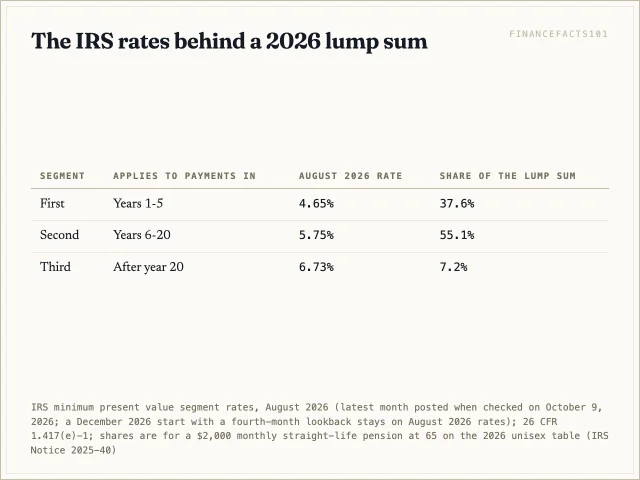
The interest rate is not one number but three. The IRS publishes monthly "segment rates" based on yields of high-grade corporate bonds, as defined in 26 USC 430(h)(2), and its regulation, 26 CFR 1.417(e)-1, applies the first to payments expected in the first five years, the second to the next 15, and the third to everything after year 20. The latest month on the IRS's minimum present value segment rates page, read on October 9, 2026, is August 2026.
The mortality table decides how many payments the plan expects to make. For annuity starting dates in stability periods that begin in 2026, it is the "Unisex" column in the appendix of IRS Notice 2025-40. On that table a 65-year-old has 21.2 years of life expectancy. Because it is unisex, a man and a woman with the same pension get the same lump sum.
Run those inputs for a $2,000 monthly straight-life pension starting at 65, paid monthly with the first check on the starting date, and the minimum lump sum is $280,091. Our worked example rounds it to $280,100. Most of that value, 55%, comes from payments in years six to 20, which is why the second segment rate moves lump sums most.
The lookback month: why rising rates shrink lump sums
Higher interest rates mean a smaller present value: a plan that assumes 5.75% on the money it hands you needs to hand over less than one assuming 4%.
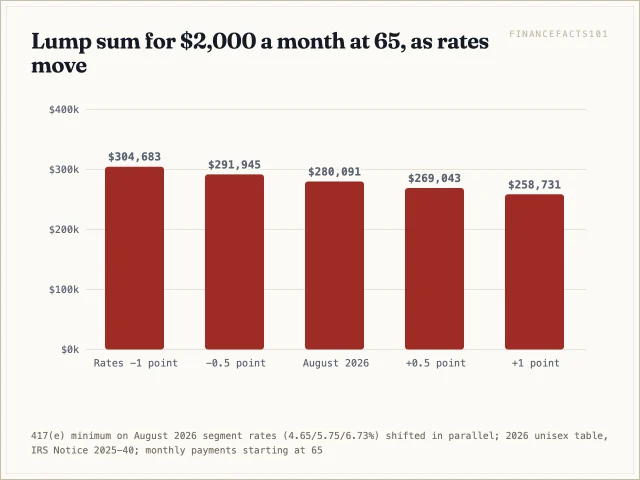
A one-point rise in all three segment rates cuts the lump sum on a $2,000 pension by 7.6%, to $258,731; a one-point fall lifts it 8.8%, to $304,683.
Which month's rates apply is the plan's choice, within limits. The regulation lets a plan fix a "stability period" of one calendar month, one plan quarter, one calendar quarter, one plan year or one calendar year, and a "lookback month" that "may be the first, second, third, fourth, or fifth full calendar month preceding the first day of the stability period." A plan with a calendar-year stability period and an August lookback values every 2026 lump sum on August 2025 rates (4.20%, 5.29%, 6.08%), giving $291,932. A plan with monthly stability periods that looks back to the fourth full month values a December 2026 lump sum on August 2026 rates and pays $280,091, which is $11,841, or 4.1%, less.
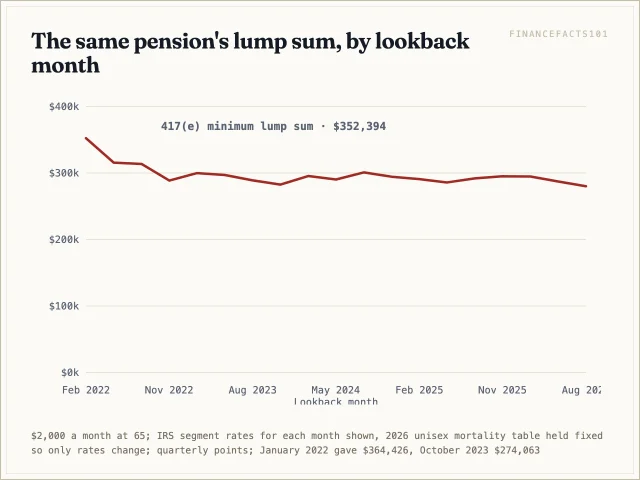
With the 2026 table held fixed, the same pension was worth $364,426 on January 2022 rates and $274,063 on October 2023 rates. If your plan locks rates for a year and they have risen since its lookback month, this year's lump sum may beat next year's. Ask the administrator for the stability period, the lookback month and whether the plan pays more than the 417(e) minimum.
The implied interest rate: what the pension pays for your lump sum
Taking the monthly payment is the same as handing the plan your lump sum and buying an income with it. Its return depends on how long you collect.
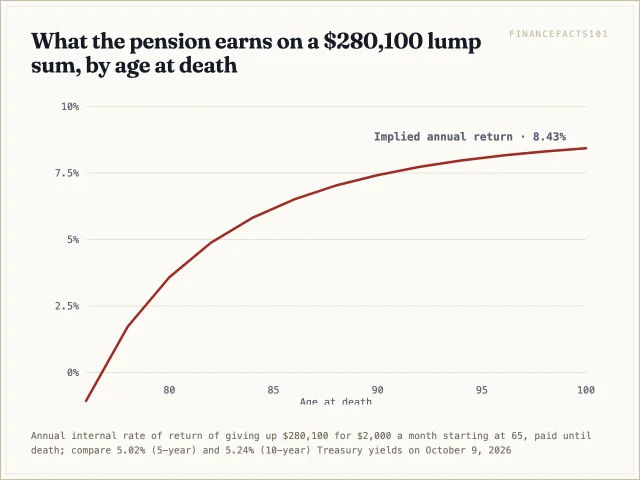
On $280,100, a retiree who dies at 75 has collected $240,000, a return of -3.0% a year. Collect until 80 and the return is 3.6%; until 85, 6.2%; until 90, 7.4%; until 100, 8.4%. The monthly payments return the lump sum in plain dollars after 141 checks, at about 76 and 8 months.
Compare that with a safe return on the lump sum. On October 9, 2026, Treasury's daily par yield curve put the 5-year note at 5.02% and the 10-year at 5.24%. The pension beats the 10-year yield for anyone who collects about 213 checks, to about 82 and 8 months.
The break-even age: how long the lump sum lasts
Turned around: if you took the lump sum and paid yourself $2,000 a month, when would it run out? That depends on the return, here before tax and with no market losses.
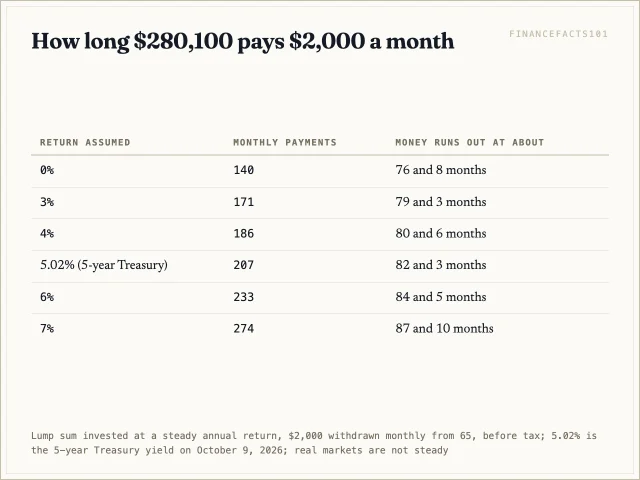
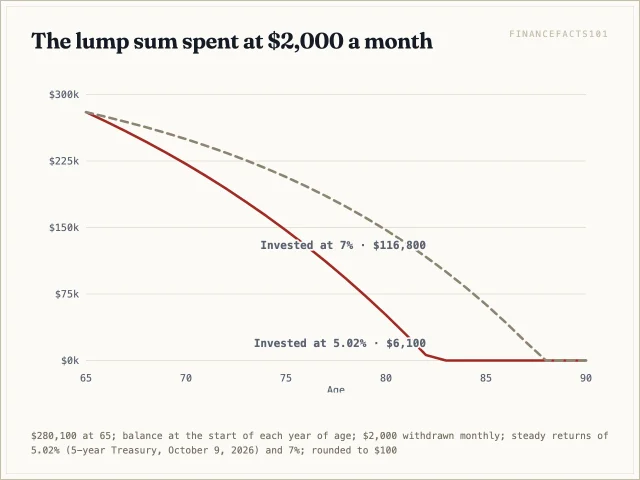
At 0%, the money lasts until about 76 and 8 months. At the 5.02% five-year Treasury yield it lasts until about 82 and 3 months; at 7%, a stock-heavy assumption that carries real risk, until about 87 and 10 months. The pension keeps paying at 95 or 105.
Pension lump sum vs monthly: the worked example
Ray Delgado is 65, single, and retires on December 1, 2026 from a private employer. His plan offers a straight-life pension of $2,000 a month or a lump sum. The plan uses monthly stability periods with a lookback to the fourth full month before each, so his December start uses August 2026 segment rates and the 2026 unisex table. Its quote is the 417(e) minimum, $280,100. He has Social Security, an emergency fund and average health.
Five numbers frame his choice:
- Lump sum per dollar of yearly pension: $280,100 ÷ $24,000 = 11.67.
- Plain-dollar break-even: 141 monthly checks, about 76 and 8 months.
- Break-even against Treasuries: invested at 5.02%, the lump sum runs dry at about 82 and 3 months.
- Implied return at his life expectancy: SSA gives a 65-year-old man 18.1 more years; collecting that long, about 217 checks to 83, earns 5.43% a year, above both Treasury yields.
- Replacement cost: an insurer would want about $319,966 for the same income (see the annuity section), $39,866 more than the plan offers.
Taking the lump sum, Ray gives up an income that out-earns Treasuries if he reaches his life expectancy and that he could not buy back for the money. It is the better choice only if he expects to die before about 82, or values flexibility and an estate more than income.
How life expectancy changes the answer
The implied-rate chart is a bet on your own lifespan, so the honest input is the odds. SSA's period life table for 2023, as used in the 2026 Trustees Report, gives a 65-year-old man 18.12 more years and a woman 20.66, which on Ray's offer means 5.43% for an average man and 6.41% for an average woman.
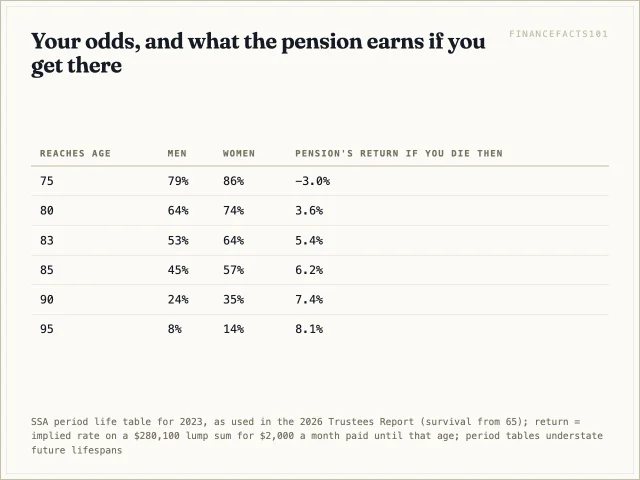
Averages hide the spread. Of 65-year-old men, 79% reach 75 but only 53% reach 83 and 24% reach 90; for women it is 86%, 64% and 35%. Weighting every possible age by those odds, the pension's expected return on $280,100 is 4.56% for a man with population-average mortality, a little below the 5.02% five-year yield, and 5.62% for a woman. On the pension table the plan itself uses, it is 5.85%.
So for a man of exactly average population health, the lump sum is roughly a fair trade, not a bad one. But period tables ignore future gains in longevity, and the pension's value sits in the long-life cases you cannot otherwise insure. A diagnosis that shortens your expected lifespan is the strongest reason to take the lump sum; excellent health and long-lived parents are the strongest reasons not to.
Inflation: most private pensions are fixed in dollars
Social Security rises with prices each year; most private pensions do not. In the Bureau of Labor Statistics' 1993-94 survey of full-time workers at private employers with 100 or more employees (published in 1997, and the latest BLS figure we found, not a current share), only 4% of private defined benefit participants had automatic cost-of-living increases, against 54% of state and local government participants, and its comparison of public and private pensions concluded that "most private sector workers can expect their defined benefit pension benefits to remain unchanged, thus decreasing in real terms during retirement." The PBGC's single-employer FAQ adds that it "does not make cost-of-living adjustments (COLAs) to the benefits it pays."
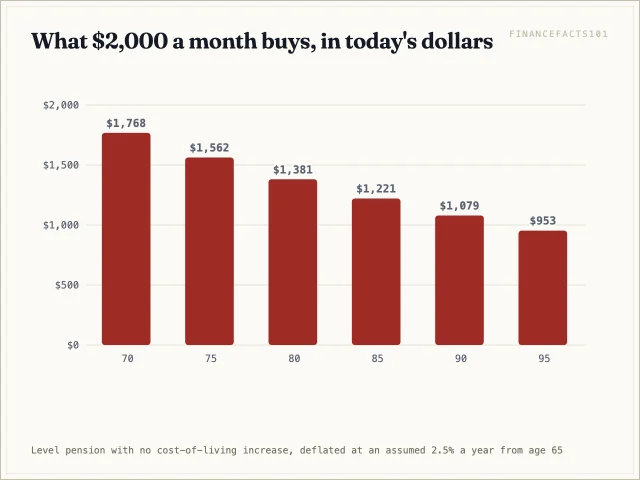
At 2.5% inflation, Ray's $2,000 buys what $1,562 buys today at 75, $1,221 at 85 and $953 at 95. The lump sum already reflects that: the 417(e) formula values a level payment, and the same pension with a 2.5% yearly increase would be worth $347,989, 24% more. Inflation is a reason to keep other savings invested for growth whichever form you choose, not a reason the lump sum is underpriced.
The 4% rule check, with our retirement calculator
A lump sum spent cautiously pays far less than the pension. The classic 4% rule, which our retirement calculator uses, withdraws 4% in year one and raises it with inflation: 4% of $280,100 is $11,204 a year, or $934 a month, against the pension's $2,000.
To see the other side, enter current age 64, retirement age 65, 0% inflation, $24,000 of annual spending and $0 of Social Security. The calculator's "What you'll need" shows 25 × $24,000 = $600,000. That is what the 4% rule wants for $2,000 a month rising with prices, more than twice the lump sum. The pension is level, so the match is not exact, but the gap is too wide for that to close. Why 4%, and its limits, are in how much you need to retire.
Buying it back: the lump sum vs an immediate annuity
If you take the lump sum and later want lifetime income, you buy it at retail. One dated example: an Annuity.org analysis of immediate annuity quotes, reported by CBS News on September 17, 2026, put a $750,000 single-life annuity for a 65-year-old at about $4,688 a month for a man and $4,425 for a woman. These are estimates, not offers.
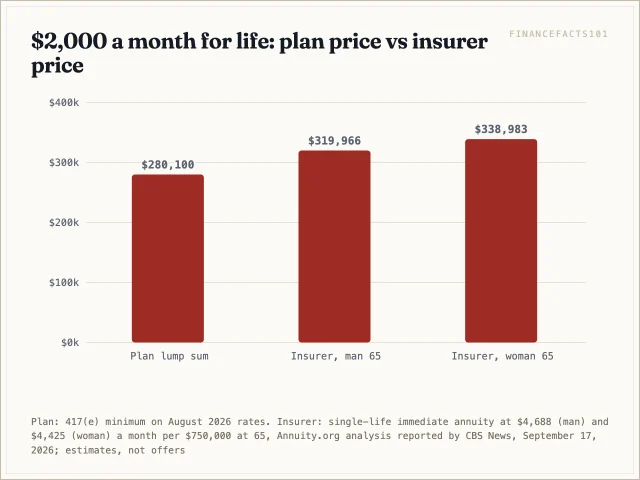
At those prices, $2,000 a month for life would cost a man about $319,966 and a woman about $338,983. Ray's $280,100 would buy a man about $1,751 a month and a woman about $1,653. The plan's minimum is set by law from corporate bond rates and a pension mortality table; an insurer's quote is a retail price. For women the plan's figure is relatively better still, because the unisex column in Notice 2025-40 assumes higher death rates than the same notice's female column (0.729% against 0.610% at 65). Payout rates, guarantee periods and insurer safety are covered in are annuities worth it.
Married? Joint-and-survivor and spousal consent
For a married participant, federal law makes a joint-and-survivor annuity the default. The IRS's qualified joint and survivor annuity page says the survivor's payment "must be no less than 50% and no greater than 100%" of the participant's annuity. The plan pays for that survivor benefit by lowering your own monthly check.
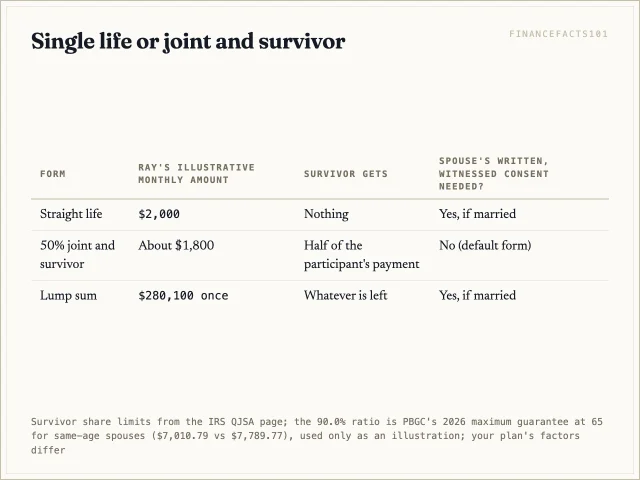
How much lower depends on the plan's factors and both ages. As one illustration, PBGC's 2026 table for same-age spouses at 65 sets the 50% joint-and-survivor limit at $7,010.79 against $7,789.77 for a single life, 90.0%; the same ratio would turn Ray's $2,000 into $1,800. The protection is worth something: SSA's table gives a 50.6% chance that at least one of a 65-year-old man and woman reaches 90, if their lifetimes are independent. Our entry on joint and survivor annuities covers the choices.
Your spouse has a veto. Under 26 USC 417(a)(2), waiving the joint-and-survivor form does not take effect unless "the spouse of the participant consents in writing," the consent "acknowledges the effect of such election," and it "is witnessed by a plan representative or a notary public." Section 417(e)(2) separately requires the written consent of both the participant and the spouse to pay out a lump sum above the plan's small-balance cash-out limit. Treat the lump sum as a decision for two.
If the plan fails: the PBGC guarantee and what sits above it
Private defined benefit plans are insured by the Pension Benefit Guaranty Corporation; plans of governments, churches and some small professional practices usually are not. PBGC's maximum monthly guarantee tables set the 2026 limit at 65 at $7,789.77 a month for a straight-life annuity.
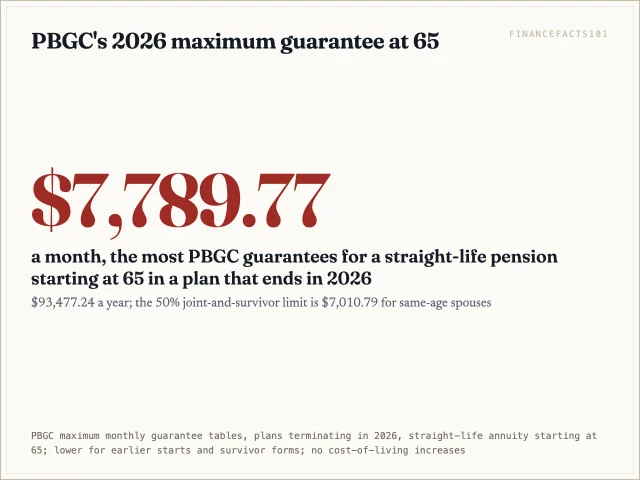
The limit is set as of the plan's termination date, is lower for earlier starts and survivor forms, and covers only benefits earned before termination. Benefits above it are not automatically lost. PBGC's priority categories page says "If plan assets allow PBGC to pay more than a participant's guaranteed benefit, we will do so," and it may add amounts recovered from the employer, but it "can never pay a participant a pension benefit greater than what the plan promised." Among employer-funded benefits, assets go first to people who retired, or could have retired, three or more years before termination.
So plan risk matters mainly when your pension is well above the guarantee and the sponsor is weak; Ray's $2,000 is about a quarter of the limit. Weak funding can also close the lump-sum door. Under 26 USC 436(d), a plan whose adjusted funding target attainment percentage is below 60% may not pay lump sums at all, and PBGC's technical update on section 436(d)(3) explains that between 60% and 80% a lump sum is capped at the lesser of half its value or the present value of the PBGC maximum guarantee. Your plan's annual funding notice shows how well funded it is.
Taking the lump sum: roll it over directly
The monthly pension is taxed as ordinary income as it arrives; per IRS Topic 410, payments are fully taxable if you made no after-tax contributions. A lump sum paid to you is taxable all at once, which on $280,100 could push much of it into a high bracket.
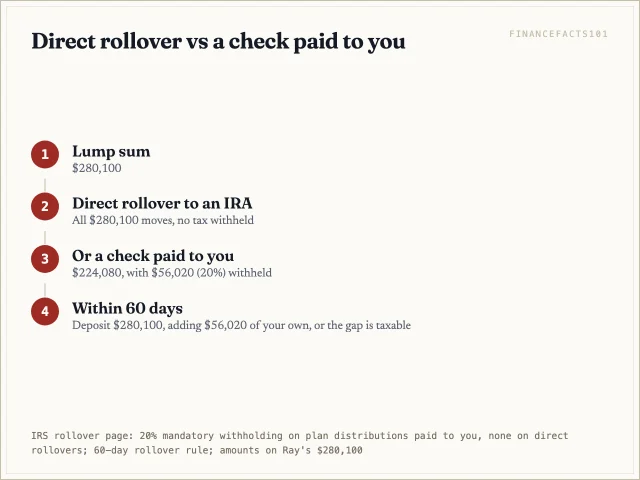
A direct rollover avoids that. The IRS's rollover page says a plan distribution paid to you "is subject to mandatory withholding of 20%, even if you intend to roll it over later," and that "Withholding does not apply if you roll over the amount directly to another retirement plan or to an IRA." Paid to Ray, $280,100 becomes a $224,080 check and $56,020 withheld; to roll over the full amount within 60 days he would have to find the $56,020 elsewhere, or the shortfall becomes taxable income. If you keep the cash, IRS Topic 412 warns that 20% may be too little withholding.
If you leave the employer in or after the year you turn 55, payments from the plan avoid the 10% additional tax on early distributions, but the IRS's exceptions table marks that exception as not available for IRAs; money needed before 59½ may be better taken from the plan. Choosing the IRA and its investments is covered in our 401(k) rollover guide. A lump sum can also fund the years before you claim Social Security, a benefit that rises with prices; when to claim Social Security runs that trade-off.
The decision, step by step
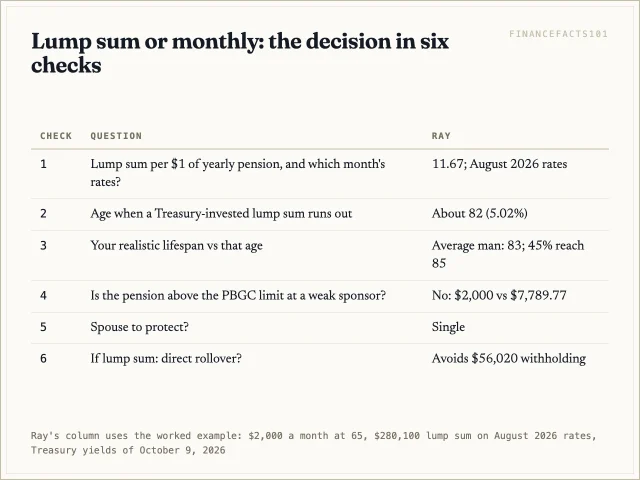
If your implied rate at a realistic lifespan beats Treasury yields, the plan is sound, and your spouse is protected, take the monthly payment. If your health is poor, the pension sits well above the PBGC guarantee at a shaky employer, or you need the capital, take the lump sum and roll it over directly.
FAQ
Is it better to take a lump sum pension or monthly payments?
For most retirees, monthly: clearly for women and healthier men, while for a man of exactly average health it is close to a fair trade. On August 2026 IRS rates a $2,000-a-month pension at 65 converts to about $280,100, which at the 5.02% Treasury yield of October 9, 2026 pays $2,000 a month only until about 82. The lump sum suits a shorter expected life, a weak plan paying above the PBGC guarantee, or a need for the money.
How is a pension lump sum calculated?
The plan discounts each expected monthly payment at IRS segment rates and weights it by the chance, from the IRS unisex mortality table, that you live to receive it. Section 417(e)(3) makes that the minimum; a plan may pay more. Its stability period and lookback month decide which month's rates apply.
Do rising interest rates lower my pension lump sum?
Yes. On a $2,000-a-month pension at 65, a one-point rise in all three segment rates cuts the lump sum by about 7.6%. Moving from August 2025 to August 2026 rates cut it by 4.1%, from $291,932 to $280,091. The monthly payment itself does not change.
Can I roll a pension lump sum into an IRA without paying tax?
Yes, if the plan pays it directly to the IRA: nothing is withheld and no tax is due until you withdraw. If the check is paid to you, the plan withholds 20%, and you have 60 days to deposit the full amount, replacing the withheld part from other funds.
Sources
- IRS, Minimum present value segment rates (page updated September 29, 2026; read October 9, 2026): August 2026 rates 4.65%, 5.75%, 6.73%; August 2025 rates 4.20%, 5.29%, 6.08%; monthly history used for the lookback chart
- IRS, Notice 2025-40, Updated Static Mortality Tables for Defined Benefit Pension Plans for 2026: the "Unisex" column for 417(e)(3) distributions in stability periods beginning in 2026
- eCFR, 26 CFR 1.417(e)-1: segment-rate timing, stability periods and lookback months
- GovInfo, 26 USC 417 (US Code, 2024 edition): minimum present value in 417(e)(3); spousal consent in 417(a)(2) and 417(e)(2)
- GovInfo, 26 USC 436 (US Code, 2024 edition): limits on lump sums in underfunded plans
- GovInfo, 26 USC 430 (US Code, 2024 edition): segment rates from the corporate bond yield curve
- PBGC, Maximum monthly guarantee tables: 2026 straight-life $7,789.77 and 50% joint-and-survivor $7,010.79 at 65
- PBGC, Your guaranteed pension: single-employer plans FAQ (updated February 10, 2026): coverage, no COLAs
- PBGC, Priority categories (updated March 30, 2026): benefits above the guarantee
- PBGC, Present value of the maximum PBGC guaranteed benefit under IRC section 436(d)(3)
- IRS, Retirement topics: qualified joint and survivor annuity (updated July 31, 2026)
- IRS, Rollovers of retirement plan and IRA distributions (updated May 31, 2026): 20% mandatory withholding; direct rollovers
- IRS, Topic 410, Pensions and annuities and Topic 412, Lump-sum distributions (both updated September 24, 2026)
- IRS, Exceptions to tax on early distributions (updated December 11, 2025): separation from service at 55
- SSA, Period Life Table, 2023, as used in the 2026 Trustees Report
- US Treasury, Daily Treasury Par Yield Curve Rates, October 2026: 5-year 5.02% and 10-year 5.24% on October 9, 2026
- Bureau of Labor Statistics, Ann C. Foster, Public and Private Sector Defined Benefit Pensions: A Comparison, Compensation and Working Conditions, Summer 1997 (1993-94 survey of full-time workers; private data cover establishments with 100 or more workers)
- CBS News, How much will a $750,000 annuity pay each month in 2026? (September 17, 2026), citing an Annuity.org analysis
 Next entry · No. 6,006Capital Gains on Sale of Home: When You Owe Tax in 2026
See also
-
 No. 5,984
18 Oct 2026
17 min
Are Annuities Worth It? What They Pay, What They Cost
Retirement
-
 No. 178
07 Apr 2024
21 min
Understanding Annuitization: The Process of Converting an Annuity Investment into Income Payments
Retirement
-
 No. 6,004
07 Nov 2026
21 min
Fixed Annuity vs CD: Which Pays More and Which Is Safer?
Retirement
-
 No. 5,995
29 Oct 2026
21 min
Medicare IRMAA: How It Is Calculated and How to Avoid It
Retirement
-
 No. 5,973
07 Oct 2026
16 min
How Much Do I Need to Retire? Spending, Social Security and the 4% Rule
Retirement
-
 No. 5,970
04 Oct 2026
17 min
Required Minimum Distributions: When to Start, How Much, and How to Cut the Tax
Retirement