Fixed Annuity vs CD: Which Pays More and Which Is Safer?
In October 2026 an A+ insurer's 5-year fixed annuity paid 6.00% vs 4.50% on a 5-year CD. After tax, $100,000 nets $7,556 more, with less protection.
Fixed annuity vs CD: the fixed annuity pays more, and the CD is safer. On October 9, 2026, Protective Life's five-year SecureSaver, a multi-year guaranteed annuity (MYGA) sold through insurance agents from an insurer AM Best rates A+, was listed at 6.00% against 4.50% on Synchrony Bank's five-year CD, while the CD carries FDIC insurance to $250,000 and the annuity rests on the insurer plus a state guaranty association that commonly covers $250,000 and in California only 80% of the value up to that amount.
On $100,000 held five years by a 61-year-old in the 22% bracket, that 1.5-point gap is worth $7,556 after federal tax. Only about $376 of it comes from the annuity's famous tax deferral; the rest is the higher rate. The price is a lock-up with surrender charges, a 10% additional tax on gains taken before 59½ unless an exception applies, and an insurer's promise in place of the federal government's. Fee-based MYGAs sold through investment advisers post similar rates, but the adviser's yearly fee comes off them. This is general information built on stated assumptions and rates read on October 9, 2026, not personal advice.
Fixed Annuity vs CD: Two Fixed Rates, Two Different Promises
A CD is a bank deposit: you lend the bank money for a set term at a set rate, and federal deposit insurance stands behind it. A MYGA, the kind of fixed annuity that competes with CDs, is an insurance contract: the insurer credits a rate guaranteed for a set term, such as three or five years, and you can take the value as a lump sum at the end, renew, or convert it to income. The SEC's annuities overview on Investor.gov describes fixed annuities as the least risky of the deferred annuity types, regulated by state insurance regulators rather than banking agencies.
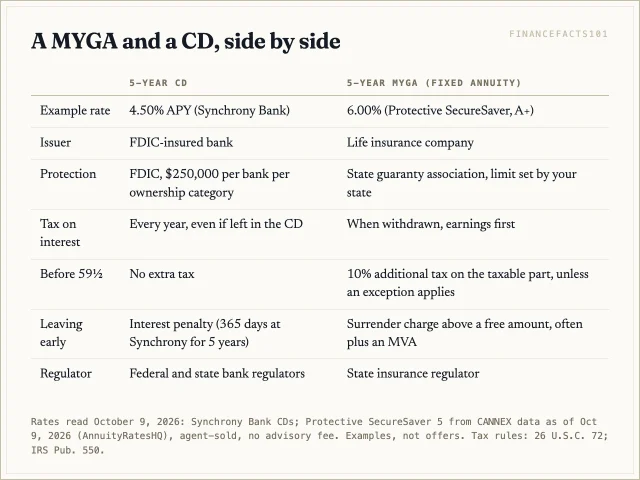
The table is the whole decision in miniature. Everything below prices one row of it: the rate, the protection, the tax, and the exit.
Who This Is For — and Who It Isn't
This guide is for someone holding $25,000 to $500,000 of savings they will not touch for three to five years, who wants a guaranteed rate and no market risk, and who is 59½ or older or will be by the time they withdraw. It also fits anyone handed a MYGA quote by an agent or an adviser who wants to check it against a bank.
It is not for an emergency fund; that belongs in a savings account, compared in high-yield savings vs CDs. It is not for money inside an IRA, where the annuity's tax deferral adds nothing. And if what you want from an annuity is lifetime income rather than a fixed rate, or you are weighing indexed and variable contracts, are annuities worth it? covers that broader question.
MYGA and CD Rates on October 9, 2026
The rates below are examples, not offers, read on October 9, 2026. Synchrony Bank's CD rates come from the rate feed behind its CD page. The MYGA rates come from AnnuityRatesHQ's product pages, which show CANNEX data "as of October 9, 2026": Athene MaxRate at 5.65% for three years and 5.85% for five (the most-states version, compound annual rates, effective September 25, 2026), Protective SecureSaver at 6.00% for five years, and Midland National's Oak ADVantage at 5.80% and 6.00%. Both MYGA rates are for the top premium band: MaxRate's 5.65% applies to $100,000 and up, and SecureSaver's 6.00% to $75,000 and up in MyAnnuityStore's listing ($100,000 to $1,000,000 in Annuity Resources'), so smaller deposits earn less. Neither is sold in New York, and MyAnnuityStore's MaxRate 3 listing shows that version unavailable in 23 states and territories, including California and Texas. SecureSaver had been 5.85% in the site's 5-year ranking of October 2 data, so it rose that week. Mountain Life's 6.10% and 6.45% are from AnnuaLife's 3-year and 5-year boards, updated October 9.
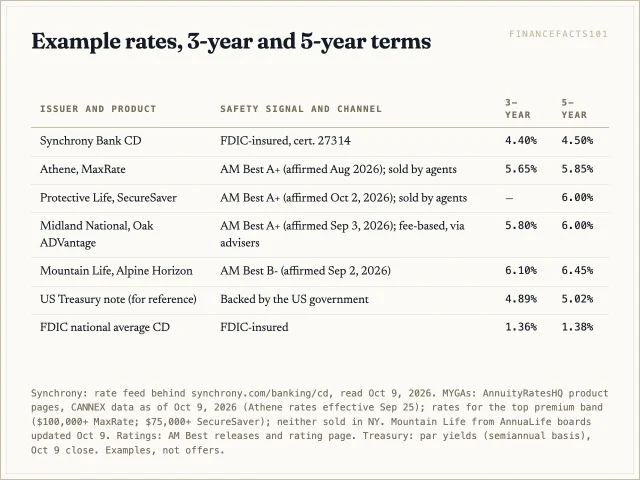
Each name carries its safety signal. Synchrony Bank of Draper, Utah, is FDIC-insured under certificate 27314, per the FDIC's BankFind data. For the insurers, AM Best's rating of the company is the nearest equivalent. AM Best affirmed A+ (Superior) for Protective Life Insurance Company on October 2, 2026, per its release; A+ for the members of Athene Group, which issues MaxRate, in an AM Best release dated August 27, 2026 and reported on August 29; and A+ for Midland National on September 3, 2026, on AM Best's rating page. It affirmed Mountain Life at B- (Fair) on September 2, 2026, citing "marginal operating performance" and "a very high level of financial leverage," per its release.
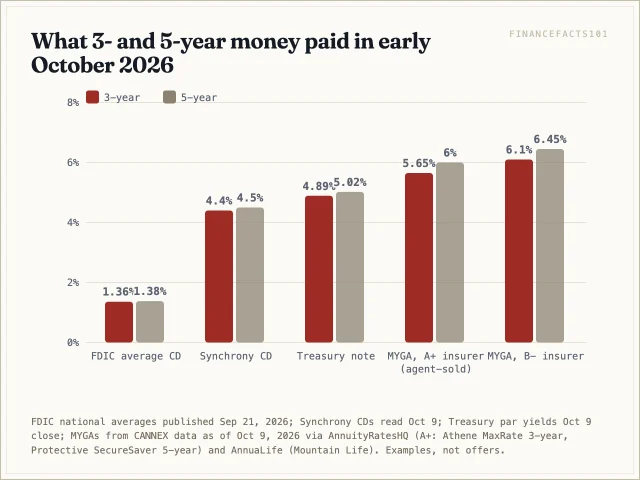
Two patterns stand out. Among these examples, the highest MYGA rate came from the lowest-rated insurer, and the spread between it and the agent-sold A+ contracts was only 0.45 point. And a top CD sits about three points above the national average CD, which the FDIC's national rate table of September 21, 2026 puts at 1.36% for three years and 1.38% for five. Treasury notes sit between the two products: 4.89% for three years and 5.02% for five at the October 9 close, per Treasury's daily par yield curve.
Fee-based MYGAs need one more subtraction. Midland National's Oak ADVantage is sold through Midland Advisory, its unit for investment advisers, and Midland's June 2, 2026 release describes the newest version as a "fee-based multi-year guarantee annuity" designed for registered investment advisors. A no-commission contract can post a higher rate because no agent is paid out of it; Gainbridge's FAQ says the same about its direct sales: "Those savings go straight to your rate." But you reach a fee-based MYGA through an adviser who usually charges a yearly fee on the assets. Take the 6.00% five-year rate and a fee deducted from the contract each year: at 0.5% the net growth is 5.47% a year and the after-tax edge over Synchrony's CD in the worked example below falls from $7,556 to $4,972; at 1.0% it is 4.94% and $2,440. That treats the fee as a straight reduction in growth and leaves out how fee withdrawals are taxed, so read it as an illustration and ask the adviser for the all-in figure.
All of these rates move. The Federal Reserve raised its target range to 3.75%–4.00% on September 16, 2026, and the figures here were read before its October 28 decision, so recheck both sides on the day you buy.
Why Are Fixed Annuity Rates Higher Than CDs?
Three things pay for the extra 1.25 to 1.5 points, and each is a cost to you somewhere else.
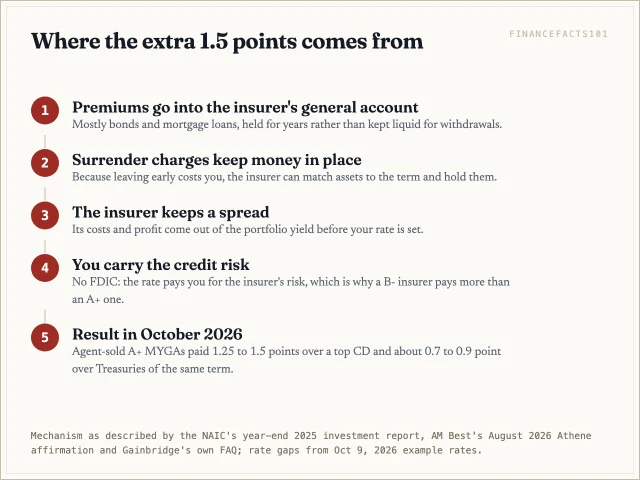
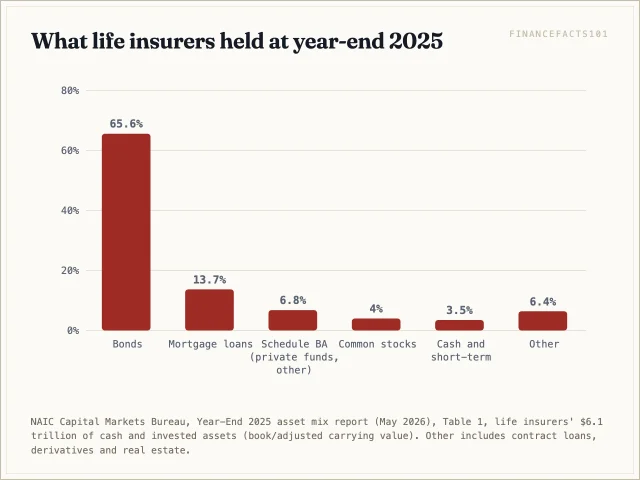
What the insurer invests in. A bank funds loans with deposits it must hand back on demand or at short notice. A life insurer invests premiums in its general account, mostly long-dated and less liquid assets. The NAIC's year-end 2025 report on insurer investments shows life insurers holding $6.1 trillion, of which 65.6% was bonds, 13.7% mortgage loans and 6.8% Schedule BA assets such as private funds, and notes a gradual reallocation across the industry "toward higher-yielding asset classes." Gainbridge, one direct-to-consumer insurer, says on its own site that it invests "in traditional investments like corporate bonds, mortgage-backed securities, and similar securities" and keeps "a small spread to cover our costs." In its August 2026 affirmation of Athene, AM Best noted "elevated allocations to less-liquid investments."
Surrender charges. Because the contract charges you for leaving early, the insurer can buy assets that match the term and hold them, rather than keeping cash for withdrawals. The charge is part of what lets it reach for longer, less liquid assets than a bank keeps against deposits.
No FDIC premium, and credit risk. Banks pay FDIC assessments, and the CD rate reflects that the government stands behind it. The MYGA rate includes pay for the insurer's credit risk, which is why a B- insurer pays more than an A+ one. Even the A+ contract's 6.00% beat the five-year Treasury by about 0.9 point, once the Treasury's semiannual yield of 5.02% is restated as an annual 5.08%: that gap is the compensation for credit risk and illiquidity, not free money.
Safety: FDIC Insurance vs State Guaranty Associations
The FDIC says deposits "are automatically insured to at least $250,000 at each FDIC-insured bank," covering checking, savings, money market deposit accounts and CDs, and lists annuities among the products it does not insure, even when a bank sells them. The CFPB says bank CDs are insured up to $250,000 by the FDIC and credit-union CDs up to $250,000 by the NCUA.
An annuity's backstop is the life and health guaranty association of the state where you live when the insurer is ordered into liquidation, generally regardless of where you bought the policy. Limits are set state by state, apply to the present value of annuity benefits, and generally count per person per insurer, across all of that person's contracts. Three states' associations, read on October 9, 2026:
- Utah: "Annuity Benefits (Present Value): $250,000 per contract owner," and three $250,000 annuities with one failed insurer would get "total guaranty association coverage of only $250,000," per the Utah association's FAQ. NOLHGA's summary table shows $500,000 for Utah; that is the per-life cap across all kinds of coverage in Utah Code 31A-28-103, while the association's own figure for annuities is $250,000.
- California: "80% of the present value up to a maximum of $250,000," with $300,000 the most for any one person across all life and annuity policies, per the California association. Its FAQ adds that annuity benefits "are subject to interest rate adjustments," so an above-benchmark guaranteed rate can be cut.
- New York: $500,000 per life across annuities and other covered benefits, for residents who bought from a New York-licensed insurer, per the New York Guaranty Corporation. New Yorkers can buy only from New York-licensed insurers, and some of the products named here may not be sold there.
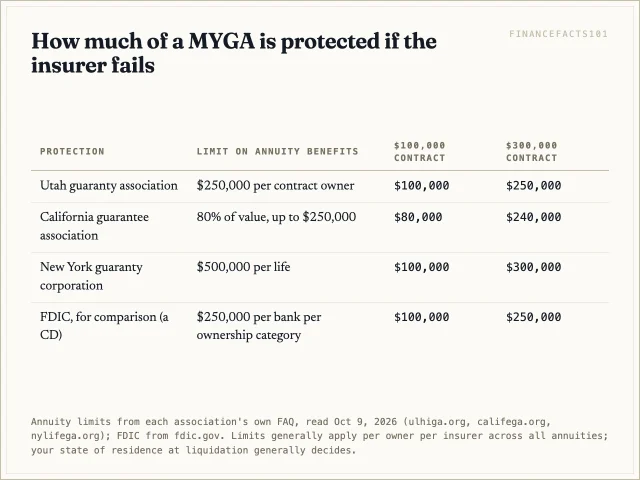
The national association's state table (information as of June 1, 2025) shows $250,000 for 40 of 51 jurisdictions. In practice: $100,000 in a MYGA is fully covered in Utah and New York, but only $80,000 of it in California. Above the limit you become a creditor of the failed insurer's estate. Two habits close most of the gap: keep each insurer's total at or under your state's limit, and favor insurers rated A- or better.
How Each Is Taxed: Every Year vs When You Withdraw
CDs. Interest is taxable in the year you receive it or could take it without a substantial penalty, per IRS Publication 550. Where interest is deferred for more than a year, the publication sends you to the original issue discount rules, which generally tax it as it accrues, so a five-year CD that compounds inside is still taxed every year. An early-withdrawal penalty is deductible on Schedule 1 (Form 1040), line 18. Your bank reports the interest on Form 1099-INT, per IRS Topic 403.
MYGAs. Gains inside a nonqualified annuity owned by a person are not taxed until withdrawn. Under 26 U.S.C. 72(e), a withdrawal before the annuity starting date counts as earnings first, and the earnings are measured on the cash value "determined without regard to any surrender charge." Section 72(q) adds a tax of "10 percent of the portion of such amount which is includible in gross income" unless an exception applies: age 59½, death, disability, substantially equal periodic payments, or an immediate annuity, among others; IRS Publication 575 lists the exceptions for nonqualified contracts. Under 72(u), a contract owned by a corporation or other non-natural person loses the deferral, though a trust holding it as agent for an individual does not.
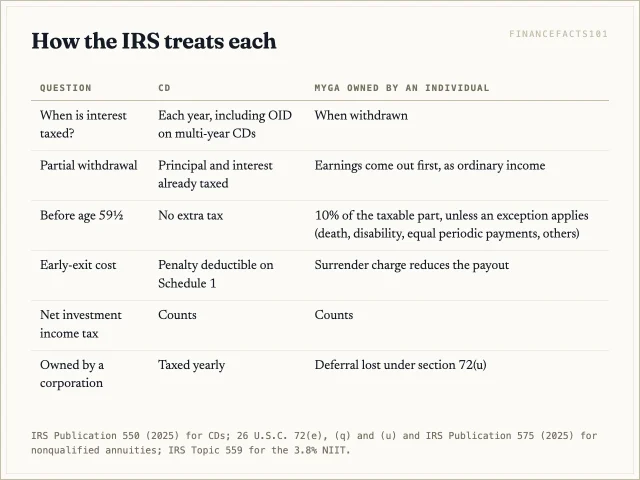
Federal rates on top. Both incomes are ordinary income and both count toward the 3.8% net investment income tax, whose thresholds are $200,000 of modified AGI for single filers and $250,000 for joint. If you are 65 or older, the 2025–2028 $6,000 senior deduction phases out above $75,000 of modified AGI ($150,000 joint), so extra interest inside the phase-out costs more than your bracket rate.
State tax. CD interest shows up on your state return every year; annuity gains show up in the year you withdraw them, taxed by the state you live in then. Neither gets the state exemption Treasury interest has, which is why T-bills vs CDs can favor Treasuries in high-tax states.
Worked Example: $100,000 for 3 and 5 Years, After Tax
Two savers, both single and 61 (past 59½, so no penalty; under 65, so no senior deduction to lose). Saver A has $60,000 of 2026 taxable income before this money, which puts the interest in the 22% bracket. Saver B has $130,000, in the 24% bracket. Each puts $100,000 in either Synchrony's CD (4.40% for three years, 4.50% for five) or an agent-sold MYGA from an A+ insurer with no advisory fee: Athene's MaxRate at 5.65% for three years or Protective's SecureSaver at 6.00% for five. Both rates apply to a $100,000 premium. The CD saver pays tax on each year's interest out of that interest; the MYGA saver withdraws everything at the end and pays tax once. Tax is computed with the 2026 brackets, held level for later years, and the script checked that every slice stays inside one bracket.
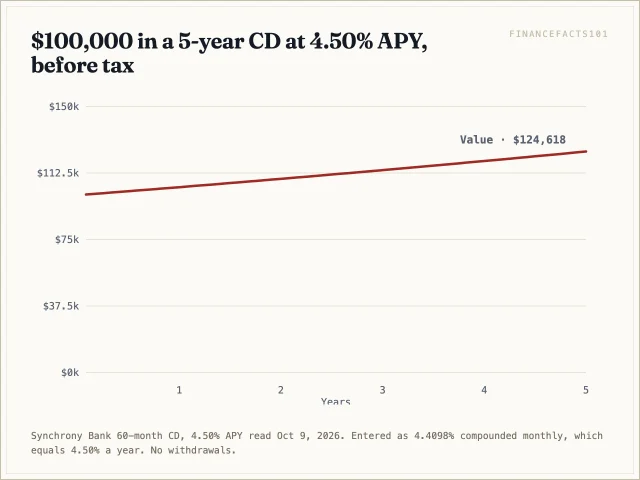
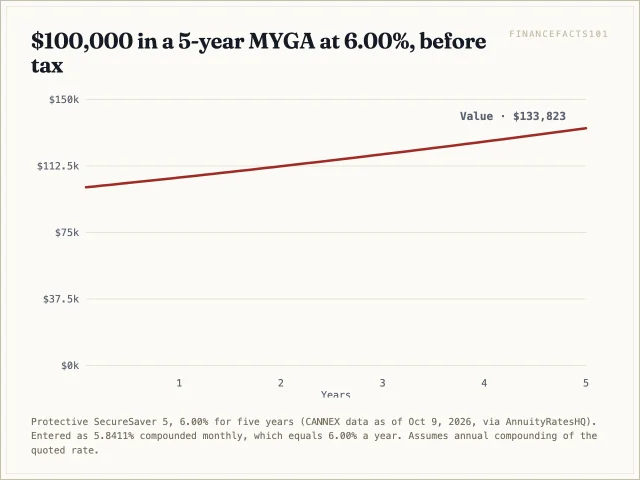
Before tax, $100,000 grows to $124,618 in the five-year CD and $133,823 in the MYGA. You can reproduce both in the compound interest calculator by entering each APY with yearly compounding.
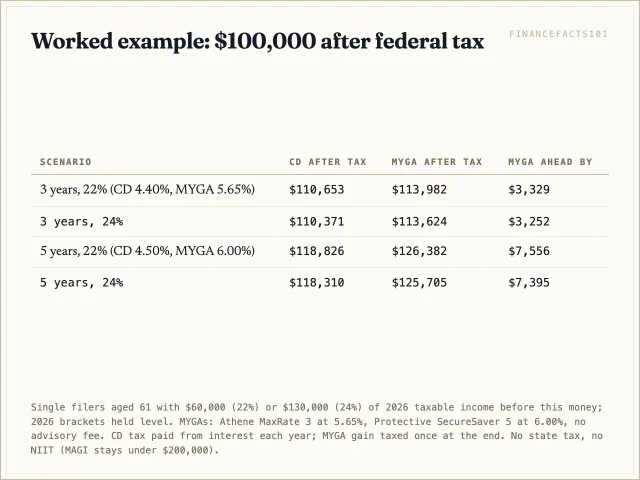
After federal tax, the MYGA wins all four cases: by $3,329 and $3,252 over three years and by $7,556 and $7,395 over five. The after-tax yield is 3.51% for the five-year CD and 4.79% for the MYGA in the 22% bracket.
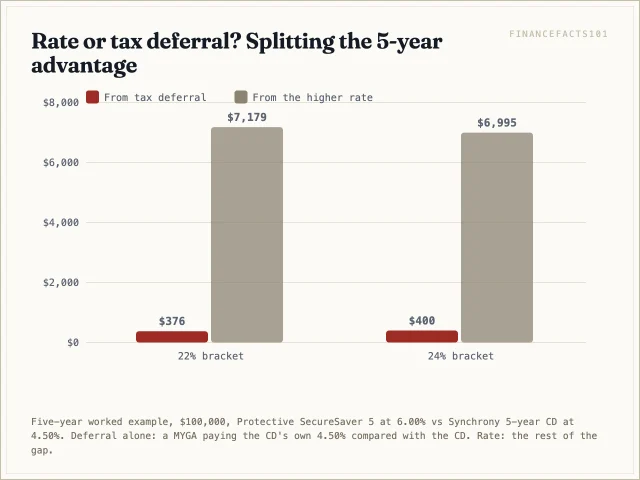
Now split the five-year, 22% gap of $7,556. Had the MYGA paid the CD's own 4.50%, deferral alone would have added just $376. The other $7,179 is the rate. Tax deferral is real but small over five years; a MYGA is worth buying for its rate, not its tax wrapper.
Deferral can also cost you. Saver A's five-year gain of $33,823 lands in one year. With $90,000 of other taxable income instead of $60,000, $18,123 of it would cross the 24% line at $105,700, and the tax would average 23.07% instead of 22%.
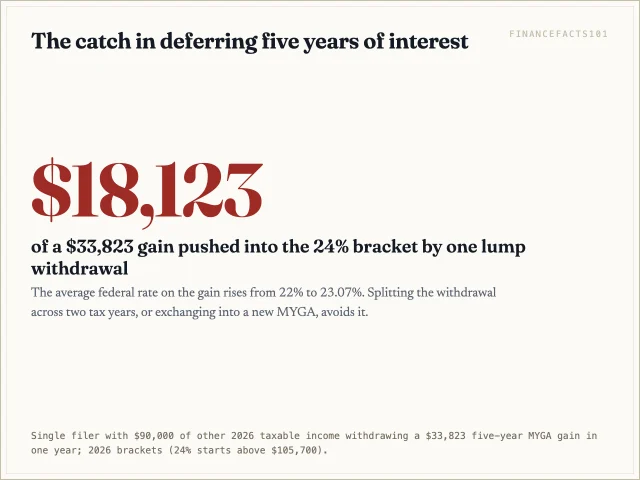
Spreading the withdrawal across two tax years, within the free-withdrawal allowance or once the term has ended, or rolling the contract into a new MYGA through a 1035 exchange, avoids that bunching.
Getting Out Early: Penalties, Surrender Charges and Free Withdrawals
A CD's exit price is a stated amount of interest. Synchrony's published schedule (dated October 2025) charges 180 days of simple interest on terms over 12 months and under 48, and 365 days on terms of 48 months or more. On $100,000, at the 4.30% and 4.40% interest rates in effect on October 9, that is $2,121 for the three-year CD and $4,400 for the five-year.
A MYGA's exit price is a surrender charge, often with a free-withdrawal allowance. The NAIC's buyer's guide, in the 2013 edition hosted by New Jersey's insurance department, says the percentage "usually goes down each year until the surrender charge period ends" and that most contracts let you take "a small amount (usually up to 10%) each year" without the charge. The SEC's guide to variable annuities uses an illustrative schedule of 7% in year one, 6% in year two and 5% in year three. Real MYGAs can charge more. Athene's MaxRate 3 is listed by MyAnnuityStore (updated October 9, 2026, from carrier filings via AnnuityRateWatch) with charges of 9.3%, 8.4% and 7.5% in years one to three and free withdrawals of interest only, not 10%. Protective's SecureSaver 5 is listed by two agencies, MyAnnuityStore and Annuity Resources, with charges of 9%, 8%, 7%, 6% and 5% in years one to five, 10% a year free, and an MVA; confirm the schedule in the contract. Gainbridge, as one example, allows 10% a year penalty-free, figured on the initial deposit in year one and the anniversary value after that, with "withdrawal charges and market value adjustments" above it.
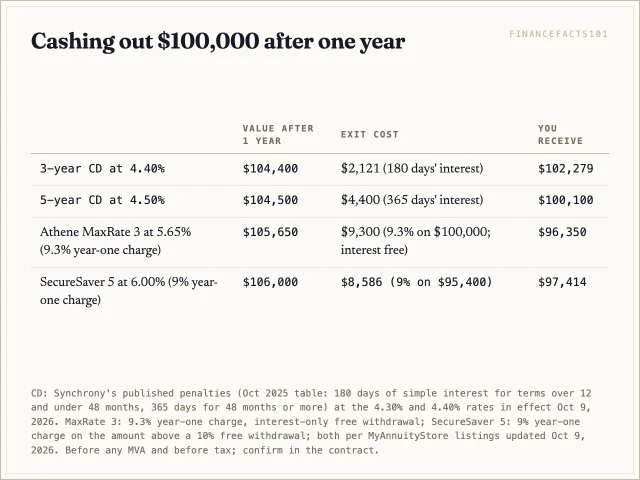
Leave either product after one year and the CD is cheaper to exit: you keep $102,279 or $100,100, against about $96,350 from MaxRate 3 (its first-year interest of $5,650 comes out free, and 9.3% is charged on the other $100,000) and $97,414 from SecureSaver 5 under its listed 9% first-year charge, before any market value adjustment. The SEC's gentler illustrative schedule would leave $98,994 on the three-year contract, which is why the contract's own schedule is the one to read. Your contract's schedule may be shorter or longer. If you might need a slice early, use any free-withdrawal allowance (10% a year at SecureSaver, interest only at MaxRate), or keep that slice in a CD or a CD ladder that matures every year.
Market Value Adjustments
Many MYGAs add a market value adjustment (MVA) to withdrawals above the free amount during the guarantee period. The NAIC guide explains the direction: if interest rates are lower when you withdraw than when you bought, "the MVA could increase the amount you could take"; if they are higher, it "could reduce" it, and "Every MVA calculation is different."
The logic is the bond price. The insurer bought bonds at your purchase date's yields; if rates have risen, those bonds are worth less, and the MVA passes part of the loss to the person leaving. A CD penalty never depends on rates. So a MYGA exit in a rising-rate year can cost the surrender charge plus a negative MVA, which is a reason not to buy a term longer than you can commit to.
3-Year Fixed Annuity vs CD
Shorter terms narrow the trade. On October 9 Athene's three-year MaxRate paid 1.25 points more than Synchrony's three-year CD, and the after-tax edge on $100,000 was $3,329 in the 22% bracket. Deferral alone was worth $102.
Two points argue against the MYGA at three years. Surrender charges are at or near their highest in the first years of a contract (9.3% in year one at MaxRate 3), so a three-year hold leaves little room to outgrow an exit charge if plans change, and the Treasury alternative is close: the three-year note paid 4.89%, and TreasuryDirect notes that Treasury interest is exempt from state and local income tax. For a three-year hold, the MYGA is worth it mainly when you are sure of the date and have checked the insurer's rating.
Fixed Index Annuity vs CD
A fixed index annuity is not a fixed-rate product. Investor.gov's annuities page says the insurer credits interest based on an index "and you do not know the interest rate in advance." The SEC's indexed annuity bulletin lists the limits on that credit: index gains "generally calculated without including dividends," participation rates, caps and spreads. Investor.gov adds that a fixed indexed annuity's credited rate "is guaranteed to never be less than zero, even if the market goes down"; the index-linked contracts whose value can fall with the market are registered index-linked annuities (RILAs). What can still reduce a fixed index annuity's value is what reduces a MYGA's: surrender charges, MVAs and any rider fees.
Against a CD, then, you trade a known 4.50% for a credit you cannot know in advance, limited in good years by caps, participation rates or spreads. That is a different decision; caps, participation rates and fees are worked through in are annuities worth it?, and for a CD-like goal a MYGA is the cleaner comparison.
The Decision
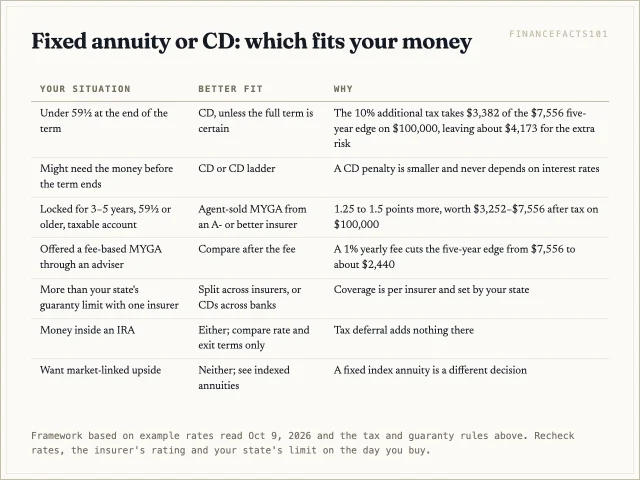
The MYGA earns its place when four things hold: the money is truly locked for the full term, the insurer is rated A- or better, the amount stays inside your state's guaranty limit, and you are 59½ or older by the time you withdraw. The last one is softer than it sounds: under 59½, the 10% additional tax would take $3,382 of the $7,556 five-year edge in the 22% example and $1,793 of the $3,329 three-year edge, leaving the MYGA ahead but by far less. If any of the first three fails, the CD's lower rate buys protection and flexibility worth more than about $1,500 a year per $100,000. Before signing, ask for the contract's surrender schedule, its MVA formula, whether the rate compounds annually (a simple-interest contract at 6.00% earns $30,000 over five years instead of $33,823) and what happens at the end of the term.
FAQ
Why are fixed annuity rates higher than CDs?
Insurers invest premiums in long-dated, less liquid assets such as corporate bonds and mortgage loans, and surrender charges let them hold those assets to term. The rate also pays you for the insurer's credit risk, since there is no FDIC insurance. In October 2026 agent-sold A+ contracts paid 1.25 to 1.5 points over a top CD and about 0.7 to 0.9 point over Treasuries of the same term.
Is a fixed annuity as safe as a CD?
No. A CD at an FDIC-insured bank is covered up to $250,000 by the federal government. A fixed annuity depends on the insurer, backed by a state guaranty association whose limit varies: $250,000 in Utah, 80% up to $250,000 in California, $500,000 in New York. A highly rated insurer within your state's limit is close, but not the same promise.
Is a 3-year fixed annuity better than a 3-year CD?
Before tax it paid more: 5.65% from Athene's MaxRate (A+) against 4.40% at Synchrony Bank on October 9, 2026, about $3,300 more after tax on $100,000 in the 22% bracket. The edge shrinks if you are under 59½, because the 10% additional tax would take $1,793 of it, and it can disappear if you need the money early, when a surrender charge costs more than the CD's penalty.
Do you pay taxes on a fixed annuity every year?
Not on a nonqualified MYGA owned by an individual: gains are taxed when withdrawn, earnings first, as ordinary income. CD interest is taxed every year even when it stays in the CD. Some insurers also sell non-tax-deferred contracts, so check which one you are buying.
Sources
- FDIC, Deposit Insurance: $250,000 per bank; annuities not covered
- FDIC, BankFind institution record for Synchrony Bank: certificate 27314, active
- FDIC, National Rates and Rate Caps, published September 21, 2026
- TreasuryDirect, Treasury notes: no state or local income tax on interest
- CFPB, What is a certificate of deposit?
- US Treasury, Daily Treasury Par Yield Curve Rates, October 2026: 3-year 4.89%, 5-year 5.02% on October 9, 2026
- Federal Reserve, FOMC statement, September 16, 2026
- Cornell LII, 26 U.S.C. 72: subsections (e), (q) and (u)
- IRS, Publication 575 (2025): early-distribution exceptions for nonqualified annuities
- IRS, Publication 550 (2025): CD interest timing, OID, the penalty deduction
- IRS, Topic 403, Interest Received
- IRS, Topic 559, Net Investment Income Tax
- IRS, Tax year 2026 inflation adjustments: 2026 brackets
- IRS, Tax deductions for working Americans and seniors: $6,000 senior deduction and phase-out
- SEC, Variable Annuities: What You Should Know: illustrative surrender schedule
- SEC, Investor.gov, Annuities and Updated Investor Bulletin: Indexed Annuities
- NAIC, U.S. Insurance Industry's Cash and Invested Assets, Year-End 2025 (May 2026)
- NAIC, Buyer's Guide for Deferred Annuities (2013), hosted by the New Jersey Department of Banking and Insurance
- Utah Life & Health Insurance Guaranty Association, FAQ
- California Life & Health Insurance Guarantee Association, FAQ
- Life Insurance Company Guaranty Corporation of New York, FAQ
- NOLHGA, How You're Protected (information as of June 1, 2025): state table, $250,000 in 40 of 51 jurisdictions
- AM Best, Midland National Life Insurance Company rating profile: A+ affirmed September 3, 2026
- AM Best via Business Wire, Mountain Life Insurance Company rating release, September 2, 2026
- AM Best via Business Wire, Protective Life rating release, October 2, 2026: A+ affirmed for Protective Life Insurance Company
- Bernews, AM Best affirms Athene's credit ratings, August 29, 2026
- Midland National via Business Wire, Oak ADVantage Care launch, June 2, 2026: fee-based MYGA for RIAs
- AnnuityRatesHQ product pages, CANNEX data as of October 9, 2026: Athene MaxRate, Protective SecureSaver, Midland National Oak ADVantage; and Best 5-Year MYGA Rates (October 2 data)
- AnnuaLife, 3-year and 5-year MYGA boards, updated October 9, 2026
- MyAnnuityStore, Protective Life Secure Saver 5, and Annuity Resources, Protective Life Secure Saver 5: surrender schedule, free withdrawals, MVA
- Synchrony Bank, CD rates (read October 9, 2026) and CD early withdrawals explained (penalty table dated October 10, 2025)
- Gainbridge, Save annuity and FAQs
 Next entry · No. 6,005Pension Lump Sum vs Monthly Payments: Which Pays More in 2026
See also
-
 No. 5,990
24 Oct 2026
19 min
CD Ladder: Is It Worth It, and How Do You Build One?
Banking
-
 No. 5,953
18 Sep 2026
17 min
Adjustable-Rate CDs: What the Bump-Up Option Really Costs
Banking
-
 No. 5,930
02 Sep 2026
14 min
High-Yield Savings vs CDs: Where Cash Earns More
Personal Finance
-
 No. 658
16 May 2024
22 min
Understanding Certificates of Deposit (CDs) and Their Benefits
Investments
-
 No. 5,984
18 Oct 2026
17 min
Are Annuities Worth It? What They Pay, What They Cost
Retirement
-
 No. 5,968
02 Oct 2026
18 min
T-Bills vs CDs vs High-Yield Savings: Where 3-12 Month Cash Goes
Investments