How Much Disability Insurance Do I Need? The Take-Home Math
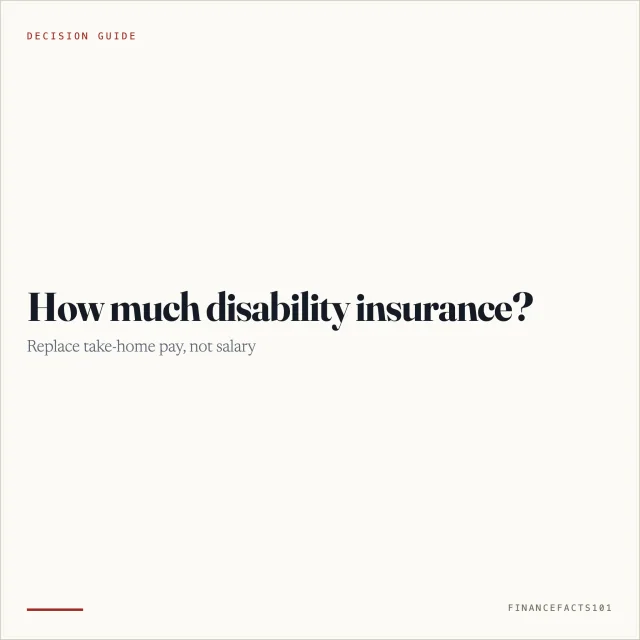
Replace take-home pay, not salary. A 60% employer plan on $90,000 nets $3,917 a month after tax in 2026, $1,392 short of the $5,309 paycheck.
How much disability insurance do I need? Enough to replace your take-home pay rather than your salary: for a single worker earning $90,000 in 2026, that is about $5,309 a month, which is 71 percent of gross pay if the benefit is tax-free and 84 percent if it is taxed. A typical employer plan pays 60 percent, or $4,500 a month, but when the employer pays the premium that check is taxable and nets about $3,917, leaving a gap of $1,392 a month that savings, a voluntary plan or an individual policy has to cover.
Social Security will not close that gap on its own. The estimated average disabled-worker benefit was $1,630 a month in January 2026, per the SSA's 2026 COLA fact sheet, and it starts only after a five-month waiting period, if the claim is approved.
One line of scope honesty: this is general information built on stated assumptions (one worked household, 2026 federal tax rules, a flat 5 percent state tax), not personal advice.
Who this is for, and who it is not for
This guide is for anyone who would be in trouble if their paycheck stopped for a year or more: employees judging the employer plan, people offered a buy-up, and self-employed workers with no group coverage.
It is not for people who live on investment income or a pension that would continue through an illness. It also does not size what your family needs if you die; that is a death-benefit question with its own worksheet, covered in how much life insurance you need. Long-term care insurance, for care costs in old age, is a third product, covered in whether long-term care insurance is worth it.
How likely you are to need it
The Social Security Administration's fact sheet (2025 edition) says about 1 in 4 of today's 20-year-olds will become disabled and entitled to Social Security disabled-worker benefits before reaching age 67. That counts only disabilities that pass Social Security's strict test, so more people than that lose income to a shorter or partial disability.
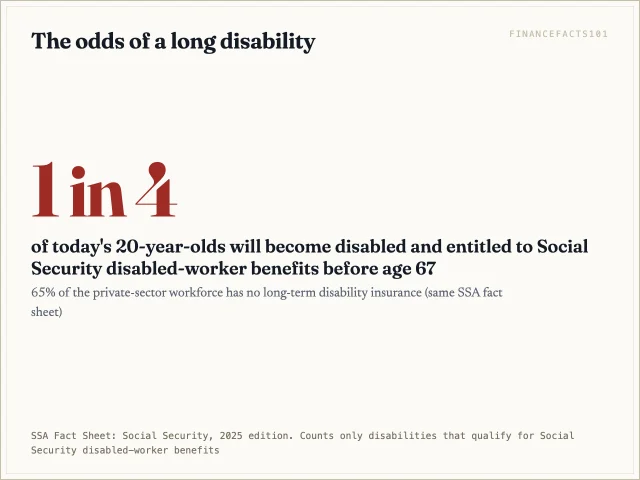
Most workers carry this risk uninsured. The same fact sheet says 65 percent of the private-sector workforce has no long-term disability insurance. The Bureau of Labor Statistics' Employee Benefits in the United States release for March 2026, published September 25, 2026, puts access to long-term disability plans at 37 percent of private-industry workers and access to short-term plans at 44 percent. Access means the plan is offered, not that the worker enrolled.
How much disability insurance do I need: the replacement-ratio method
Insurers state benefits as a percentage of gross pay. The North Carolina Department of Insurance's consumer guide says that percentage "may range from 50 to 75 percent" and that benefits "are not intended to replace 100 percent" of pre-disability income. Sixty percent is a frequent group design. But gross pay is the wrong yardstick, because you never spent it.
The method has four steps:
- Find your monthly take-home pay. The take-home pay calculator does this with 2026 federal figures.
- Adjust it for disability: retirement deferrals stop (already excluded), commuting falls, medical costs often rise.
- Subtract the after-tax value of coverage you already have.
- What is left is the gap, to close with an individual policy, a buy-up, savings or planned spending cuts.
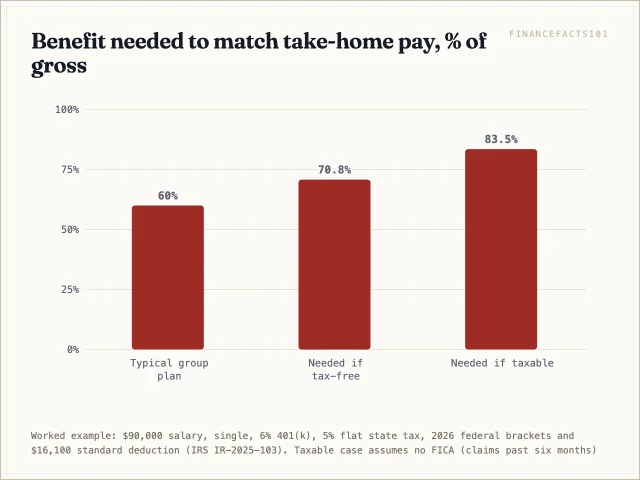
The ratio you need depends on whether the benefit is taxed. For the worked household below, a tax-free benefit must equal 70.8 percent of gross pay to match take-home pay, and a taxable one must reach 83.5 percent. Plans generally pay 50 to 75 percent, well short of 83.5, so an employee who relies only on an employer-paid plan is usually underinsured even when the plan is generous.
Why the tax status of the benefit changes the answer
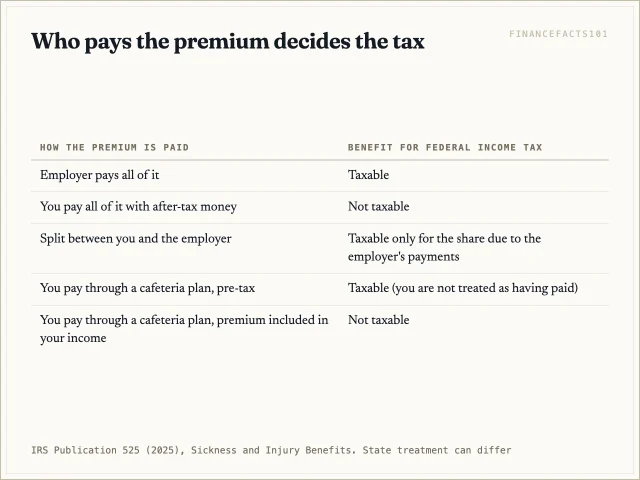
Who pays the premium decides whether the benefit is taxed. IRS Publication 525 says you "must report as income any amount you receive for personal injury or sickness through an accident or health plan that is paid for by your employer," but if you "pay the entire cost of an accident or health plan," the benefits are not income. When both of you pay, only the share due to the employer's payments is taxable.
The cafeteria-plan rule is easy to miss. If premiums went through a cafeteria plan and were not included in your income, "you aren't considered to have paid the premiums," so the benefits are taxable. Paying with pre-tax dollars saves a little tax on the premium and costs far more if you ever claim.
Payroll tax applies for a while too. IRS Publication 15-A says Social Security and Medicare taxes do not apply to sick pay paid more than six calendar months after the last calendar month the employee worked, so the employer-funded part of an early check can lose 7.65 percent to FICA.
The worked example: a $90,000 salary, start to finish
Take a single 38-year-old earning $90,000 who defers 6 percent to a traditional 401(k), lives in a state with a flat 5 percent income tax and no state disability program, and has an employer-paid group plan paying 60 percent of salary after a 90-day elimination period, up to age 67.
Her paycheck, using the 2026 brackets and $16,100 standard deduction from IRS release IR-2025-103: the 401(k) deferral is $5,400; taxable income is $90,000 minus $5,400 minus $16,100, or $68,500; federal tax is $9,782; FICA is $6,885; state tax is $4,230. Take-home is $63,703 a year, or $5,308.58 a month.
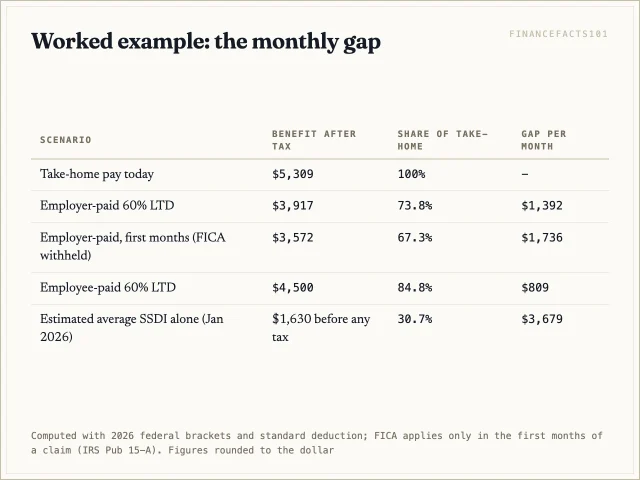
If she becomes disabled, the plan pays 60 percent of $7,500, or $4,500 a month ($54,000 a year), all of it taxable. Federal tax on $54,000 minus the $16,100 standard deduction is $4,300, and state tax is $2,700, so she keeps $47,000 a year, or $3,916.67 a month: 73.8 percent of her old take-home pay, and $1,391.92 a month short.
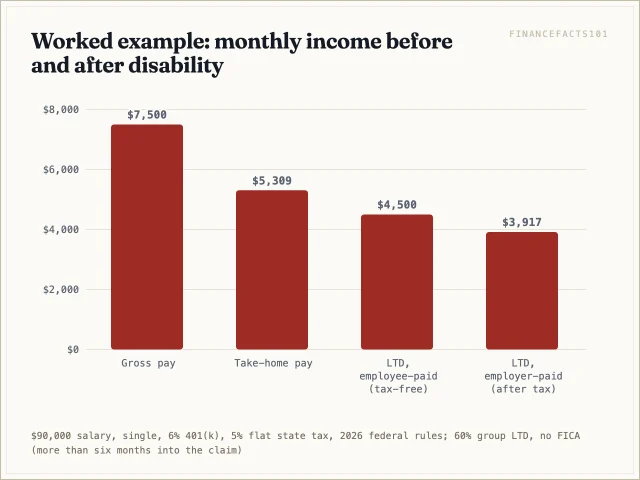
The same $4,500 bought with after-tax premiums would arrive untaxed: 84.8 percent of take-home, $808.58 short. In the first months of the claim, while FICA still applies, the employer-paid check nets about $3,572.
To close the $1,392 gap she needs an individual policy paying about that much, bought with after-tax money so it arrives tax-free. That is 18.6 percent of her gross pay. Insurers limit total coverage relative to income, so part of the gap may not be insurable; the rest must come from savings or spending cuts.
Group long-term disability: the 60 percent, the cap and the offsets
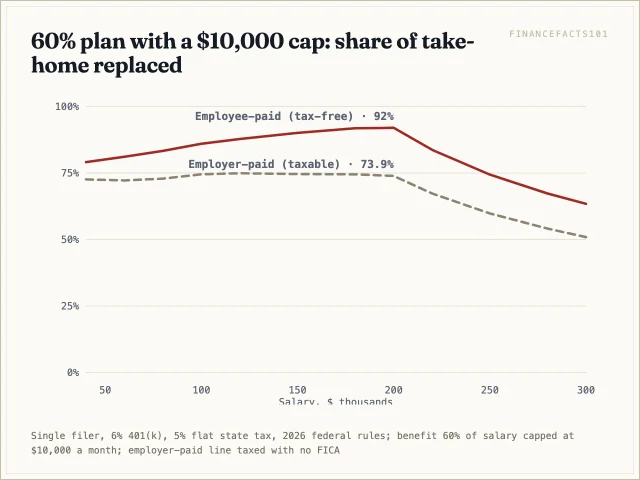
Read three numbers in your plan summary: the percentage, the monthly cap and the offset list. Sixty percent with a $10,000 monthly cap is a frequent design, and three published plans show it. Cobb County, Georgia's plan pays "60% of earnings at the time of disability, to a maximum of $10,000 per month," after a six-month elimination period, and San Bernardino County's pays the same 60 percent up to $10,000 after 180 days. Caps vary: Ohio State University's main staff plan stops at $5,000 a month. Ohio State pays the full premium, and its page says the payments are taxable income. A separate Ohio State plan, based on FGP earnings, pays 60 percent up to $10,000.
Under a $10,000 cap, the benefit stops growing at a $200,000 salary. At $240,000, 60 percent would be $12,000 a month, but the plan pays $10,000, or 50 percent of gross. If the employer pays the premium, she keeps about $8,036 a month after tax, 62 percent of her $12,962 take-home.
Offsets surprise people most. Cobb County's plan subtracts "other income payable for that same disability," including workers' compensation and Social Security, down to a floor of $100 or 10 percent of the benefit, and Ohio State's also offsets Social Security. Under an offset, SSDI reduces the plan's check instead of adding to it; the NC guide warns that SSDI "may reduce the amount of your private disability benefits if your policy contains a social security offset provision."
The employer is also the group policyholder, so renewal rights rest "with the employer," per the NC guide, and the coverage is tied to the job; ask whether you can convert or carry it when you leave. Plans may also exclude pre-existing conditions for a time: Cobb County excludes a condition treated in the 3 months before coverage starts for the first 12 months.
What Social Security disability pays, and how often it says yes
SSDI is the base layer, and it is narrow. SSA's Disability Benefits booklet (July 2026) says it pays only for a condition "expected to last at least one year or result in death," and that while "some programs give money to people with a partial or short-term disability, we do not." Earning more than the 2026 substantial gainful activity limit of $1,690 a month ($2,830 if blind) generally rules you out.
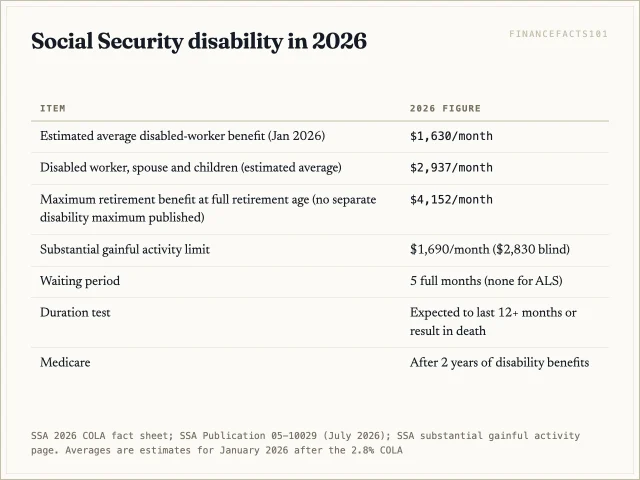
The amounts are modest: an estimated average of $1,630 a month in January 2026, or $2,937 for a disabled worker with a spouse and children. The fact sheet lists no separate disability maximum; its 2026 maximum for a worker at full retirement age is $4,152, from the same earnings formula. For our worked earner, assuming average indexed monthly earnings of $6,000, the 2026 PIA formula (90 percent of the first $1,286, plus 32 percent up to $7,749) gives $2,665.80 a month.
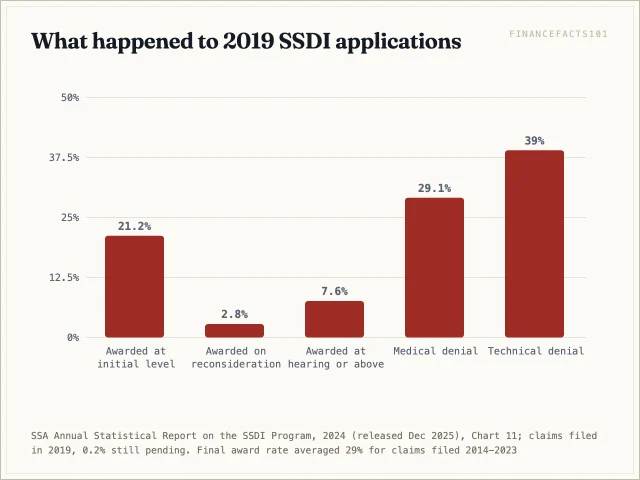
Approval is the bigger uncertainty. SSA's Annual Statistical Report on the SSDI program, 2024, released December 2025, says the final award rate averaged 29 percent for claims filed from 2014 through 2023, with initial-level awards between 18 and 21 percent and denials averaging 68 percent. The most common nonmedical denial is too few recent work credits; the 20/40 rule generally requires 40 credits, 20 of them earned in the last 10 years.
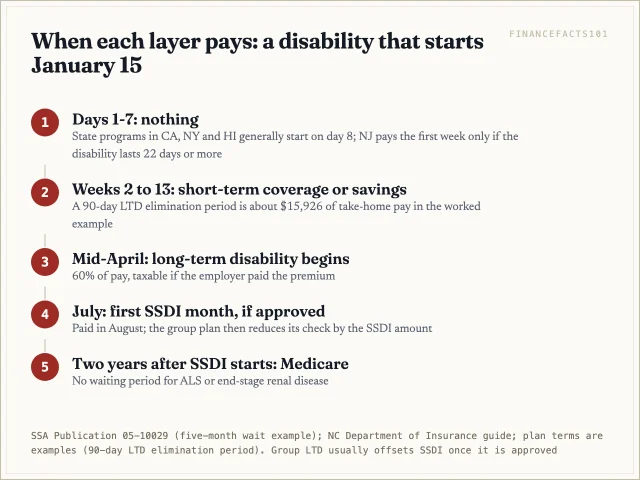
Timing adds a hole. "Generally, there is a five month waiting period," the booklet says: a disability that starts January 15 is first paid for July, with the payment arriving in August. ALS has no waiting period. Medicare starts after two years of disability benefits.
If SSDI is approved, an offset plan rebalances the check without raising it: at $2,665.80 from SSDI, the worked plan pays $1,834.20, still $4,500 in total. Her net rises to about $4,291 a month, because under IRS Publication 915 only $7,904 of her $31,990 of annual SSDI is federally taxable. That assumes her state does not tax Social Security; check yours.
Short-term vs long-term disability
The NC guide says short-term policies "generally provide benefits from six months to two years," while long-term policies "may provide benefits for five to 10 years and may even provide benefits to age 65 or for life." If your employer offers both, check that the short-term plan lasts at least as long as the long-term plan's elimination period; any gap comes out of savings.
Long-term coverage protects most of the money. From the worked earner's age 38 to 67 is 29 years; a short-term plan generally covers two at most, while the long-term plan's $54,000 a year adds up to $1,566,000.
Own-occupation vs any-occupation: the definition decides the claim
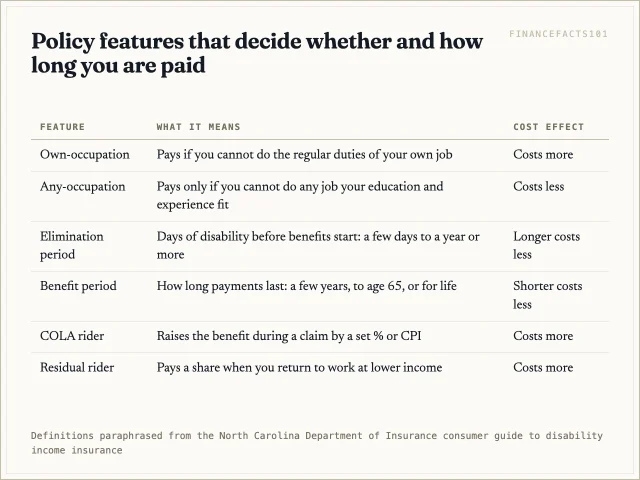
The NC guide defines own-occupation coverage as paying when you cannot "perform the regular and customary duties of" your own occupation, and any-occupation coverage as paying only if you cannot perform "any occupation for which he/she is qualified according to his/her education, training and prior experience."
Long-term policies usually mix the two, the guide says: own-occupation "during the first year or two," then any-occupation for continued benefits. Under that switch, a surgeon with a hand tremor could be paid for two years and then cut off because she could still teach. If your income depends on a specialized skill, a true own-occupation individual policy is what the extra premium buys. Our explainer on own-occupation disability insurance covers the policy wording.
The elimination period: a deductible measured in months
The elimination period is the stretch after you become disabled during which the policy pays nothing. The NC guide says these periods "may range from a few days to a year or longer," and longer ones cost less. For the worked earner, each month is $5,309 of take-home pay that has to come from somewhere else.
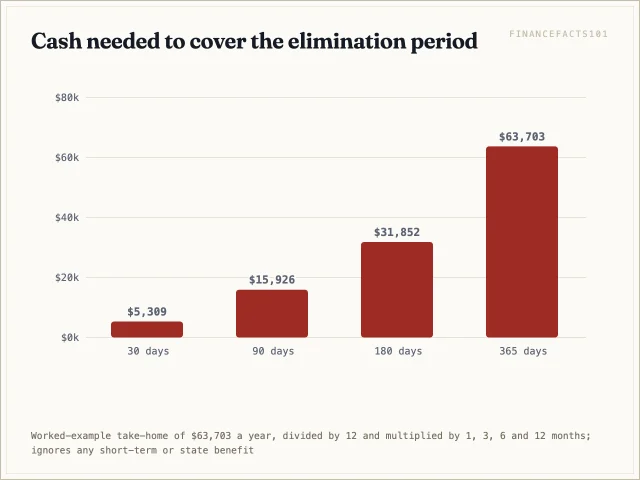
A 90-day period needs about $15,926 of cash; a 180-day period, like Cobb County's, needs $31,852. So the elimination period and the emergency fund are one decision: choose the longest period your savings can cover and spend the premium you save on a higher benefit. Our emergency fund guide covers sizing that cash.
Benefit period, COLA and residual riders
Choose a benefit period that runs to your Social Security full retirement age (67 for anyone born in 1960 or later), not two or five years. Short periods cost less because they end just as a long disability starts to cost the most.
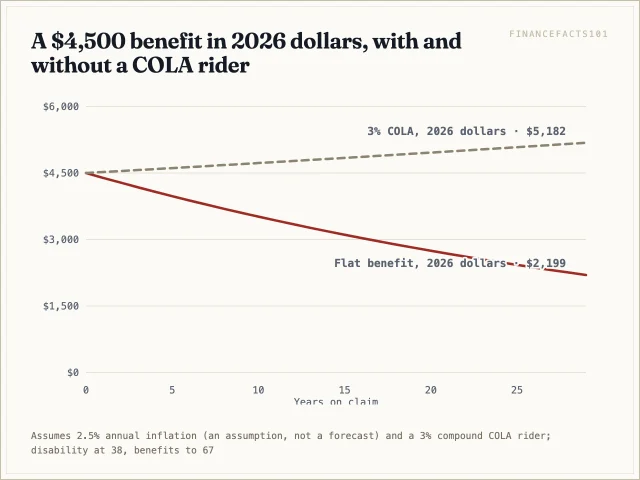
A cost-of-living adjustment (COLA) rider "periodically increases the disability benefit amount" during a claim, per the NC guide, by a stated percentage or with the Consumer Price Index. Without one, at an assumed 2.5 percent inflation, a flat $4,500 is worth about $3,515 in 2026 dollars after 10 years and $2,199 after 29. A 3 percent COLA would raise the payment to about $10,605 by year 29, roughly $5,182 in 2026 dollars.
A residual disability rider "provides a benefit if the insured can return to work full-time but income is not fully restored," using a formula in the policy. For example, a policy that pays the full benefit times the share of income lost would work like this: return at 60 percent of your old pay with a $4,500 benefit and you would collect $1,800 a month. Check your contract's formula; partial-disability riders often pay a flat 50 percent instead.
State disability programs: five states and a newer wave
Five states run long-standing temporary disability programs for illness or injury not caused by work. They pay for weeks, not years, so they are a first layer under long-term coverage, not a substitute.
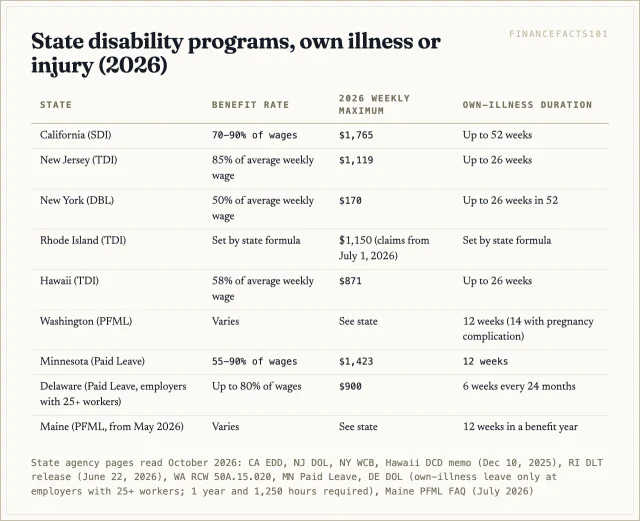
California's SDI is the largest: 70 to 90 percent of wages up to $1,765 a week in 2026, for as long as 52 weeks. New Jersey pays 85 percent of the average weekly wage up to $1,119 (its unpaid first week is paid back if the disability lasts 22 days or more), New York 50 percent but no more than $170 a week, and Hawaii 58 percent up to $871, each for as long as 26 weeks. Rhode Island raised its maximum to $1,150 a week for claims from July 1, 2026.
Newer paid family and medical leave programs also cover your own serious health condition: Washington for 12 weeks a year, Minnesota for 12 weeks at up to $1,423 a week, Delaware for six weeks every 24 months from January 2026 at up to 80 percent of wages ($900 a week), but only at employers with 25 or more workers and after a year and 1,250 hours on the job, and Maine for up to 12 weeks from May 2026. Several other states run similar programs.
How much disability insurance costs
For individual coverage, Guardian, an insurer, repeats a guideline it credits to Britannica Money on its long-term disability page (updated June 2, 2026): "A common guideline: Expect a strong plan to cost between 1–3% of your annual salary." Treat it as a rough published estimate, not a quote. At $90,000 it means $900 to $2,700 a year, or $75 to $225 a month.
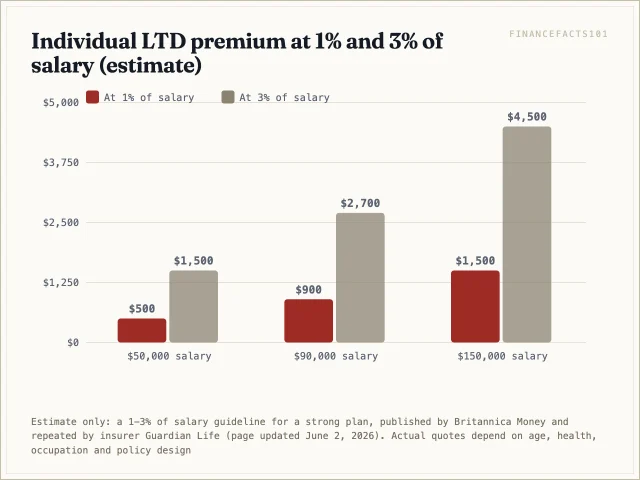
Where a quote lands depends on the levers in the NC guide (definition, elimination period, benefit period, riders, benefit amount) plus age, health and occupation. A supplement covering only the worked earner's $1,392 gap is about 31 percent of a full 60 percent benefit, so expect a smaller premium, though each policy is priced individually. Group coverage can cost the employee nothing; Ohio State pays 100 percent of its plan's premiums.
Mistakes that leave a gap
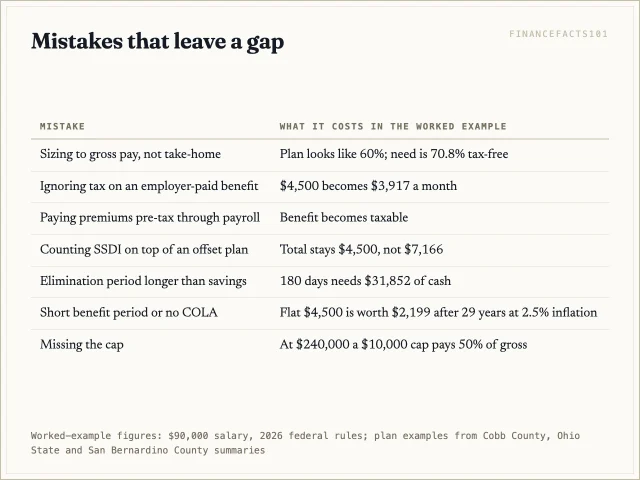
Most come from reading the plan's percentage and stopping there. Our disability insurance overview covers the vocabulary, and the umbrella insurance guide applies the same start-from-what-you-could-lose approach to liability.
The decision, step by step
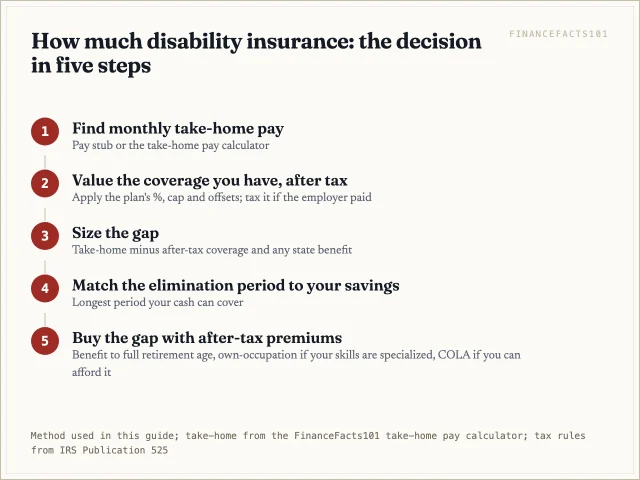
Do it once with real documents: a pay stub, the group plan summary, your SSA statement and one individual quote. Repeat it after a raise, a job change or a move. Coverage is right when the after-tax benefit, plus any state benefit, comes close to your take-home pay and your savings cover the elimination period.
FAQ
How much does disability insurance pay?
Group long-term plans often pay 60 percent of base pay up to a monthly cap: $10,000 at Cobb County, $5,000 in Ohio State's main plan. The NC Department of Insurance puts the usual range at 50 to 75 percent. SSA estimated the average Social Security disability benefit at $1,630 a month in January 2026. Tax matters: an employer-paid 60 percent benefit on a $90,000 salary nets about $3,917 a month, not $4,500.
How much should disability insurance cost?
For an individual long-term policy, a published guideline (Britannica Money's, repeated by the insurer Guardian) is 1 to 3 percent of annual salary, or $900 to $2,700 a year at $90,000. It is a rough estimate, not a quote. Longer elimination periods, shorter benefit periods and any-occupation definitions cost less; own-occupation wording and COLA riders cost more.
Is my employer's disability insurance enough?
Usually not on its own. An employer-paid benefit is taxable, so 60 percent of gross nets about 74 percent of take-home in our example. A cap cuts the percentage for anyone earning more than the cap divided by 0.6 ($200,000 for a $10,000 cap). And the coverage is tied to the job.
Can I get SSDI and private disability benefits at the same time?
Yes, but with a group plan that has an offset clause the total usually stays the same: SSDI reduces the plan's check dollar for dollar, down to a small floor (Cobb County's is $100 or 10 percent). A flat-amount individual policy, which the NC guide says is "typically" paid regardless of other benefits, can stack. Read the offset section of your plan before counting on both.
Sources
- Social Security Administration, 2026 Cost-of-Living Adjustment (COLA) Fact Sheet (average disabled-worker benefit, maximum benefit, SGA)
- Social Security Administration, Fact Sheet: Social Security (2025 edition; 1-in-4 disability odds, 65% without LTD)
- Social Security Administration, Disability Benefits, Publication No. 05-10029 (July 2026)
- Social Security Administration, Annual Statistical Report on the SSDI Program, 2024: Outcomes of Applications (released December 2025)
- Social Security Administration, Substantial Gainful Activity, PIA formula and How you qualify
- IRS, Publication 525 (2025), Taxable and Nontaxable Income
- IRS, Publication 15-A (2026), Employer's Supplemental Tax Guide
- IRS, Publication 915 (2025), Social Security and Equivalent Railroad Retirement Benefits
- IRS, IR-2025-103: tax inflation adjustments for tax year 2026 (October 9, 2025)
- Bureau of Labor Statistics, Employee Benefits in the United States, March 2026 (September 25, 2026)
- North Carolina Department of Insurance, A Consumer's Guide to Disability Income Insurance
- California EDD, Disability Insurance Benefit Payment Amounts and Contribution Rates and Benefit Amounts
- New Jersey Department of Labor, Temporary Disability Insurance and The Waiting Week for Temporary Disability, Explained
- New York Workers' Compensation Board, Disability Benefits: Employee Eligibility and Benefits
- Hawaii DLIR Disability Compensation Division, 2026 Maximum Weekly Wage Base and Maximum Weekly Benefit Amount (December 10, 2025)
- Rhode Island DLT, Maximum weekly benefit amounts to increase in July (June 22, 2026)
- Washington State Legislature, RCW 50A.15.020; Minnesota Paid Leave, How Paid Leave works; Delaware Department of Labor, Delaware Paid Leave and for employees; Maine Department of Labor, PFML employee FAQ (July 2026)
- Plan examples: Cobb County, Georgia long-term disability; Ohio State University long-term disability; San Bernardino County LTD plan summary
- Guardian Life, Long Term Disability Insurance (insurer page, updated June 2, 2026; the 1-3% premium guideline is footnoted there to Britannica Money and is an estimate)
 Next entry · No. 6,004Fixed Annuity vs CD: Which Pays More and Which Is Safer?
See also
-
 No. 5,935
07 Sep 2026
17 min
How Much Life Insurance You Actually Need
Insurance
-
 No. 5,991
25 Oct 2026
16 min
How Much Umbrella Insurance Do I Need? The Exposure Math
Insurance
-
 No. 3,378
23 Mar 2025
17 min
The Needs Approach to Life Insurance Planning: A Comprehensive Guide
Insurance
-
 No. 2,873
10 Feb 2025
21 min
A Comprehensive Guide to Understanding Different Types of Life Insurance: Term vs. Permanent
Insurance
-
 No. 1,040
19 Jul 2024
22 min
Disability Insurance: Protecting Against Loss of Income Due to Disability
Insurance
-
 No. 647
14 May 2024
23 min
Understanding Cash Surrender Value in Whole and Universal Life Insurance Policies
Insurance