Roth 401(k) vs Traditional 401(k): Which Should You Choose?
At the 2026 cap of $24,500, our example saver breaks even at a 19.6% retirement tax rate, not 22.7%. Plus the new Roth rule for catch-ups over $150,000 wages.
Choose the Roth 401(k) when the tax rate on today's contribution is lower than the rate a withdrawal would face in retirement, and the traditional 401(k) when it is higher; under the 2026 limits, a saver who maxes out at $24,500 should lean Roth even at a slightly lower future rate, because in our worked example the break-even retirement rate is about 19.6%, not the 22.7% the saver pays today. For some workers the law now settles part of the Roth 401(k) vs traditional 401(k) question outright: if your 2025 Social Security wages from your employer exceeded $150,000, any catch-up contributions you make in 2026 must go in as Roth.
This guide works the bracket comparison with the 2026 IRS tables, prices a $130,000 earner's choice in dollars this year and at 65, then covers what moves the answer: the employer match, the new catch-up rule, splitting contributions, state taxes and required distributions. It is general information built on stated assumptions, not personal tax advice.
Roth 401(k) vs traditional 401(k): one plan, two tax deals
Both are the same 401(k) plan with the same investment menu and one shared contribution limit. A traditional deferral comes out of your paycheck before federal income tax, grows untaxed, and every dollar withdrawn later is ordinary income. A Roth deferral is taxed in the year you earn it, and a qualified distribution later, earnings included, is tax-free. Social Security and Medicare tax apply to both, so payroll tax never tips the choice.
The core logic is identical to the IRA version: the traditional side wins if your marginal rate falls in retirement, the Roth wins if it rises, and they tie when it holds. That argument is worked in full in Roth vs traditional IRA, so this guide spends its space on what is different inside a 401(k): a limit more than three times larger, catch-up rules, an employer match, and payroll mechanics. One difference helps high earners straight away. The IRS Roth comparison chart lists "no income limitation to participate" for a designated Roth 401(k), while a Roth IRA phases out with income.
Who this is for — and who it is not for
This is for a US employee whose plan offers both options and who has already chosen how much to save. If you have not yet captured the full employer match, settle that first with the 401(k) employer match guide; a 50% or 100% match is worth more than anything in this article.
It is not for three groups. If your plan has no Roth option, there is nothing to choose, though the catch-up rule below may still affect you. If you are self-employed with a solo 401(k), the logic holds but the payroll details differ. And if your question is about moving money you already hold from pre-tax to Roth, that is a conversion, priced slice by slice in the Roth conversion guide.
Tax now or later: the 2026 brackets
"Rate now" means your marginal rate, the rate on your last dollar of taxable income. The difference between marginal and average rates is explained in effective vs marginal tax rate. Here are the 2026 federal brackets from Revenue Procedure 2025-32, with a standard deduction of $16,100 single and $32,200 married filing jointly:
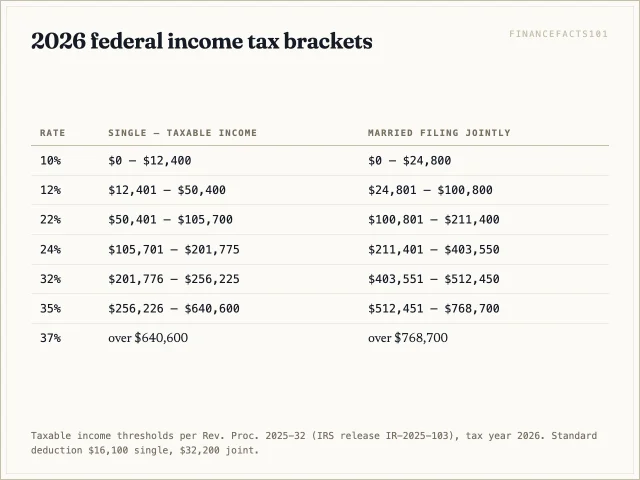
A 401(k) adds a wrinkle the IRA rarely does. A $24,500 deferral is large enough to straddle two brackets, so the rate you save is a blend. Take a single filer earning $130,000 with no other income. With a full traditional deferral, taxable income is $130,000 − $24,500 − $16,100 = $89,400. With a full Roth deferral it is $113,900. The 24% bracket starts above $105,700, so $8,200 of the deferral sits at 24% and the other $16,300 at 22%.
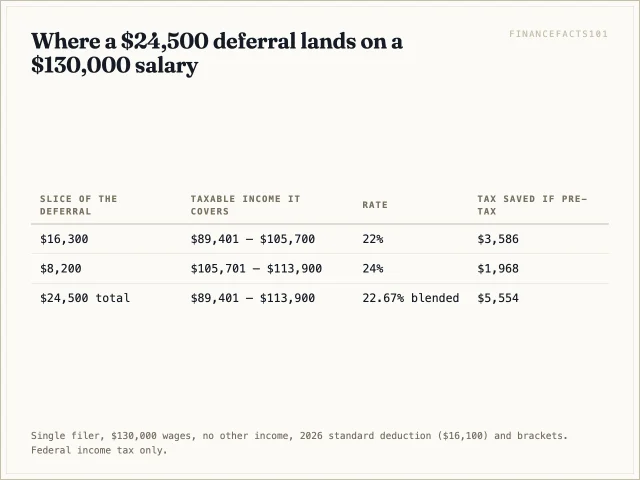
Going traditional saves $1,968 plus $3,586, or $5,554 of federal tax this year. That is 22.67% of the deferral, and that blended rate, not the headline 24%, is the "rate now" to compare against retirement.
The future side is a forecast. Public Law 119-21, section 70101, removed the scheduled 2026 expiry of the current rate schedule, so today's brackets have no end date written into them. Any later Congress can still change them. A Roth contribution fixes the tax on those dollars at the current rate; a traditional one leaves them exposed to whatever rates apply when you withdraw.
The 2026 limits, including the 60–63 catch-up
IRS Notice 2025-67 sets the 2026 numbers. The elective deferral limit is $24,500, shared across Roth and traditional deferrals in all the 401(k) and 403(b) plans you contribute to; a governmental 457 plan has its own separate $24,500 limit. Workers 50 and older may add an $8,000 catch-up. For anyone who reaches age 60, 61, 62 or 63 during 2026, that catch-up is $11,250 instead, if the plan has adopted the higher limit; the final regulations say plans may, but are not required to, include it. The separate section 415(c) cap on additions to your account, employer money included, rises to $72,000.
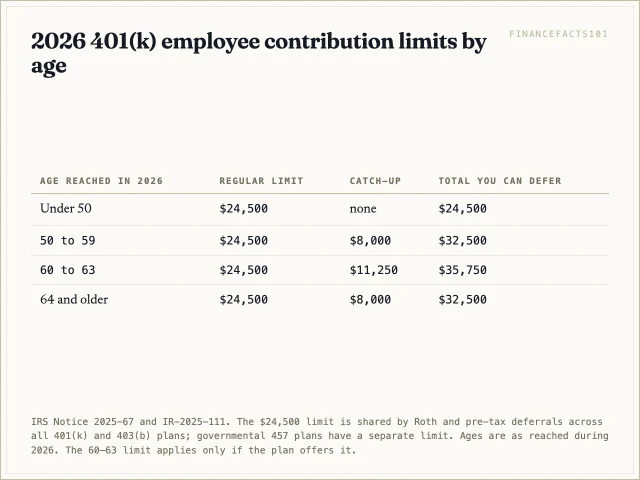
Two consequences follow. A Roth dollar fills the same slot as a traditional dollar, so at the limit the Roth shelters more money: $24,500 of after-tax dollars rather than $24,500 of pre-tax ones. And the super catch-up lasts four years, then drops back to $8,000 at 64, so a 60-year-old weighing Roth against traditional is choosing for a short window of extra room.
The catch-up rule for wages over $150,000
SECURE 2.0 added section 414(v)(7) to the tax code: a participant whose prior-year FICA wages from the employer sponsoring the plan exceeded the threshold may make catch-up contributions only as designated Roth contributions. The threshold started at $145,000 and is indexed. Per Notice 2025-67, the threshold for 2025 wages, which decides how 2026 catch-ups are treated, is $150,000.
The timing has moved twice. The statute applies to tax years beginning after December 31, 2023, but IRS Notice 2023-62 gave plans an administrative transition period, which the IRS says generally ended on December 31, 2025. The final regulations announced September 15, 2025 apply generally to tax years beginning after December 31, 2026. Plans may follow a "reasonable, good faith interpretation" of the statute before then, and the regulations themselves start later for governmental and collectively bargained plans. The statutory rule applies to all plans from 2026, so 2026 is the first year it bites.
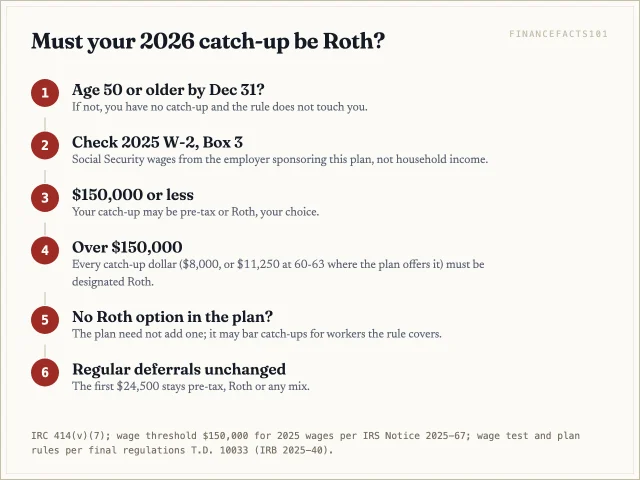
The details in the final regulations (T.D. 10033) matter at the edges. The wage test uses Social Security wages, Box 3 of your prior-year Form W-2, from the employer sponsoring the plan, not your household income. Someone with no FICA wages from that employer is not covered, such as a partner with only self-employment income or a state or local government worker outside Social Security. A plan without a Roth option is not required to add one; it may instead allow catch-ups only for participants the rule does not reach. Your regular $24,500 stays your choice either way.
What it costs: a single 61-year-old earning $180,000 in both 2025 and 2026 who defers $24,500 plus the $11,250 super catch-up, in a plan that offers it, would have taxable income of $128,150 with everything pre-tax. Forcing the $11,250 into Roth raises it to $139,400, all inside the 24% bracket, so federal tax rises by $2,700 this year. That $2,700 buys tax-free withdrawals on those dollars later.
Worked example: $24,500 a year on a $130,000 salary
Name every assumption. Single filer, age 35, $130,000 salary with no other income, standard deduction, 2026 brackets held flat, $24,500 deferred every year to age 65, 7% annual return compounded monthly, no fees, no state tax. Federal income tax only; FICA is the same either way.
This year's paycheck first:
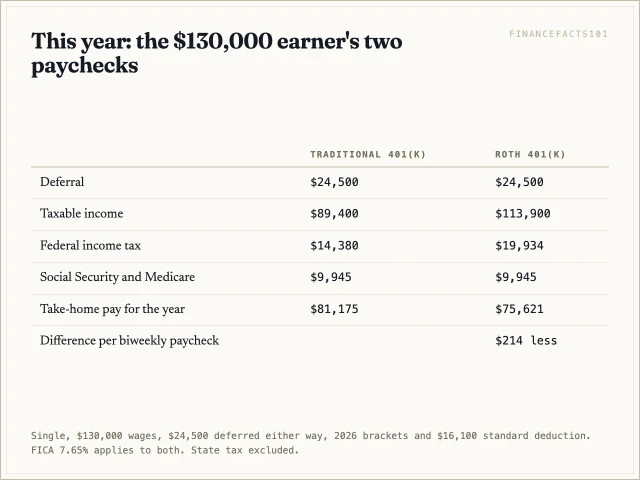
The Roth saver takes home $5,554 less a year, about $214 a biweekly paycheck. The fair comparison gives the traditional saver that $5,554 to invest in a taxable brokerage account each year. That is the "invest the tax savings" setting in the Roth vs traditional calculator. The calculator was built for IRAs, but the arithmetic is the same for any contribution amount.
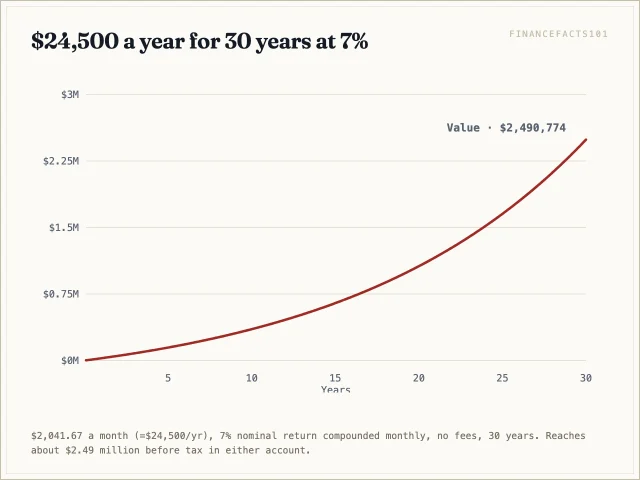
Either account reaches $2,490,774 before tax at 65. The Roth keeps all of it. The traditional account is taxed on withdrawal, and its side account, $166,625 of invested tax savings grown to about $564,658, pays tax on its gains. The calculator taxes those gains once, at the retirement rate. Three futures:
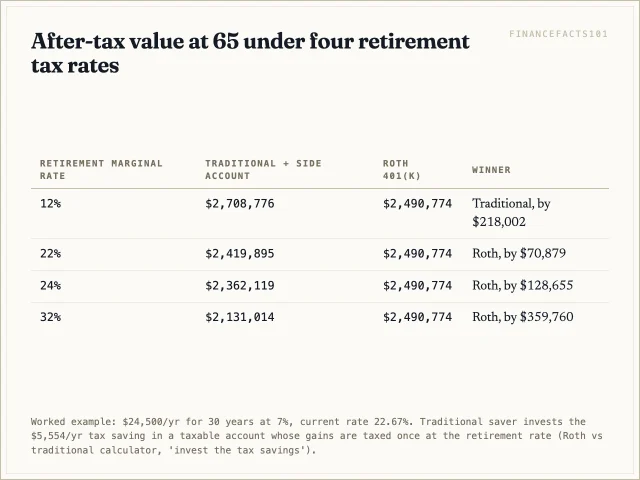
Check one row by hand. At 22% in retirement the 401(k) nets $2,490,774 × 0.78 = $1,942,804. The side account keeps its $166,625 of contributions plus 78% of its $398,034 gain, or $477,091. The total is $2,419,895, which is $70,879 short of the Roth. At 12%, the traditional side wins by $218,002.
For scale, $2.49 million drawn at 4% is about $99,600 a year in 2056 dollars, roughly $47,500 in 2026 dollars if prices rise 2.5% a year. With Social Security added, that plausibly lands in the 12% or 22% bracket at 2026 thresholds, which is exactly the zone where this decision flips.
Why the cap tilts the crossover toward Roth
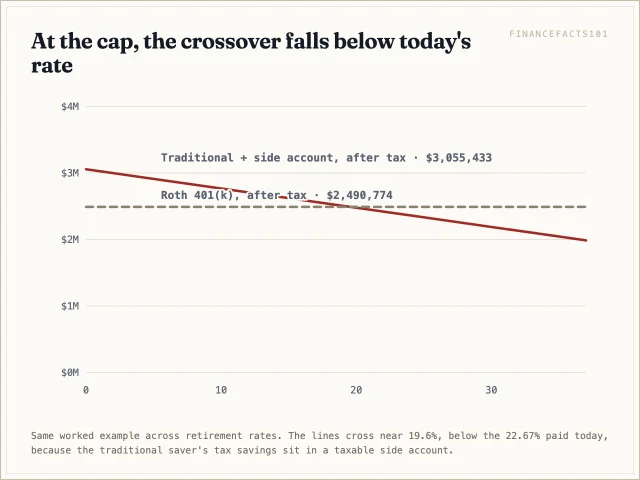
The lines cross at about 19.6%, below the 22.67% the saver pays today. In the IRA guide the crossover sits exactly at today's rate, because a saver below the cap can raise the traditional contribution until take-home pay matches. At 22%, an $8,000 Roth deferral costs the same take-home pay as about $10,256 of traditional deferral. When everything stays sheltered, the two accounts tie at equal rates.
At the $24,500 cap that gross-up is impossible. The traditional saver's extra $5,554 has to sit in a taxable account whose growth is taxed, and that leak moves the break-even down. The calculator taxes the side account's gains once at the retirement rate. A real brokerage account pays tax on dividends every year but often pays lower capital-gains rates on sales, so treat 19.6% as an estimate, not a constant. The direction is reliable: the closer you are to the cap, the more a tie goes to the Roth.
If you are under the cap, use the calculator's "compare rates only" setting. The break-even is then simply your current marginal rate.
The employer match: pre-tax unless you elect Roth
Your deferral choice does not change how the match arrives. Unless your plan permits a Roth match and you elect it, matching contributions go into the pre-tax bucket whatever you choose for your own deferrals. SECURE 2.0 section 604 lets a plan offer Roth matching, and IRS Notice 2024-2 sets the terms. The election is the employee's, made no later than when the match is allocated, and it is irrevocable. You must be fully vested in matching contributions at that moment. The match is included in your gross income for the year it is allocated and reported on Form 1099-R. It is not wages for income tax withholding, so you may need to raise withholding or make estimated payments.
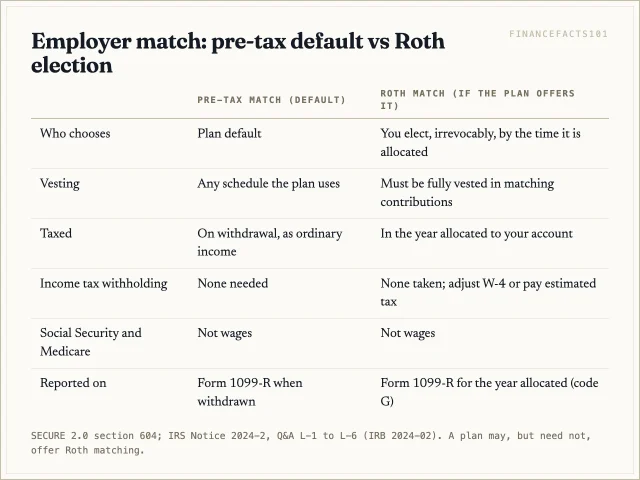
In the example, a 100% match on 4% of pay adds $5,200 a year. Taken as Roth while all-Roth deferrals keep the saver in the 24% bracket, it adds $1,248 of tax with nothing withheld. Left pre-tax, $5,200 a year at this guide's 7% compounded monthly grows to about $529,000 over 30 years; the 401(k) calculator shows the whole plan balance with the match included. That bucket matters for the deferral choice. A saver taking a pre-tax match already holds traditional money, so all-Roth deferrals still leave a mix of taxable and tax-free withdrawals in retirement.
Splitting contributions at the bracket line
Nothing forces one answer, and the IRS FAQ on designated Roth accounts says you may split deferrals "in any proportion you choose." A 50/50 split is a common shortcut, but the bracket table suggests a sharper rule: put pre-tax only the dollars that would otherwise be taxed at the higher rate.
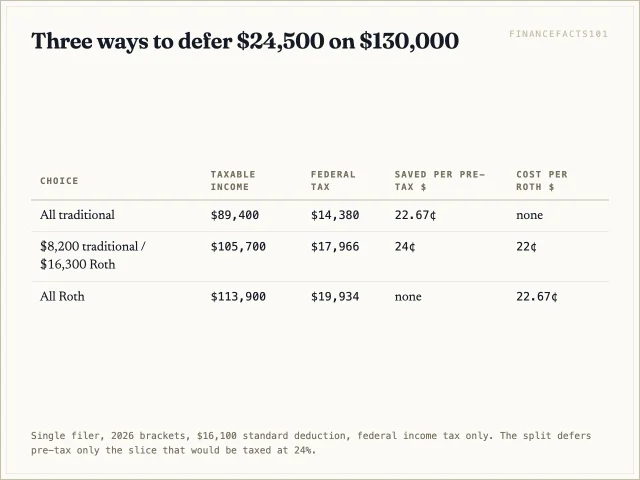
For the $130,000 earner, $8,200 traditional brings taxable income down to exactly $105,700, the top of the 22% bracket, and saves 24 cents per dollar. The remaining $16,300 goes Roth at a cost of 22 cents per dollar. Each bucket now faces its own crossover. The traditional dollars win if retirement withdrawals are taxed well below 24%. The Roth dollars win if withdrawals would be taxed above about 22%, or a little less once the cap effect above is counted. Rerun the split each January, because raises and the indexed bracket edges move the line.
State taxes: where you work and where you retire
State income tax adds to both sides of the comparison: the state rate where you live while contributing, and the state rate where you live while withdrawing. The calculator takes combined rates. Suppose the example saver lives in a state taxing wages at 5% and keeps the federal rates above:
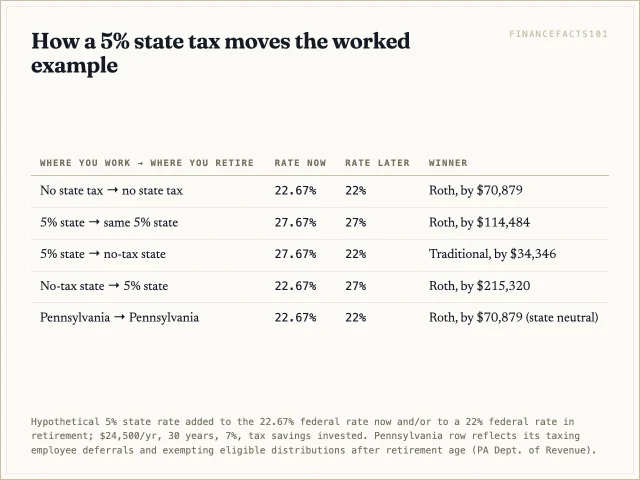
A move is the biggest state lever. Contributing in a 5% state and retiring to a state with no income tax pushes the break-even up to about 23.2% total, and at a 22% retirement rate the traditional side now wins by about $34,000. The reverse move, from a no-tax state to a 5% state, favors the Roth by about $215,000.
Some states break the symmetry outright. The Pennsylvania Department of Revenue states that "employee contributions to any retirement plan are always taxable as compensation" at its 3.07% flat rate, while distributions from eligible Pennsylvania retirement plans after retirement age are not taxed. For a Pennsylvania resident the state side is neutral, and the decision is federal only. Check your own state's treatment of both deferrals and distributions before adding its rate.
What a lower AGI buys this year
Traditional deferrals lower adjusted gross income; Roth deferrals do not. Several 2026 rules key off AGI, so the traditional side can be worth more than its bracket rate.
Roth IRA eligibility. The 2026 Roth IRA phase-out for single filers runs from $153,000 to $168,000 of modified AGI, per Notice 2025-67. A single earner at $165,000 who defers $24,500 pre-tax drops to $140,500 and can make a full Roth IRA contribution directly. In that case the traditional 401(k) and the Roth IRA work together.
The saver's credit. For 2026, single filers with AGI up to $40,250 get a 10% credit, rising to 50% at $24,250 or less, on up to $2,000 of contributions, per the IRS saver's credit page and Notice 2025-67. A single worker earning $42,000 who defers $2,000 pre-tax lands at $40,000 and gets $200 back. The same $2,000 as Roth leaves AGI at $42,000 and earns nothing.
The senior deduction. Workers 65 and older can claim an extra $6,000 deduction for tax years 2025 through 2028. It is reduced by 6% of modified AGI above $75,000 ($150,000 joint), per Public Law 119-21 and the IRS fact sheet. Inside that range, each traditional dollar also restores 6 cents of deduction, so a 22%-bracket deferral saves 23.32 cents rather than 22 (12 cents, or 24.64 cents in all, for a married couple who both qualify).
After you stop working: RMDs, the 5-year clock and rollovers
The old argument for rolling a Roth 401(k) into a Roth IRA at retirement was to escape required minimum distributions. SECURE 2.0 section 325 removed lifetime RMDs from designated Roth accounts for tax years beginning after December 31, 2023, as the final RMD regulations recount. The IRS RMD FAQs now say withdrawals from designated Roth accounts "are not required until after the death of the account owner"; beneficiaries remain subject to RMD rules. Traditional 401(k) money still faces RMDs from 73, or 75 for anyone born in 1960 or later, with a delay while you still work for the sponsor unless you own 5% of the company. Sizing them is covered in the RMD guide.
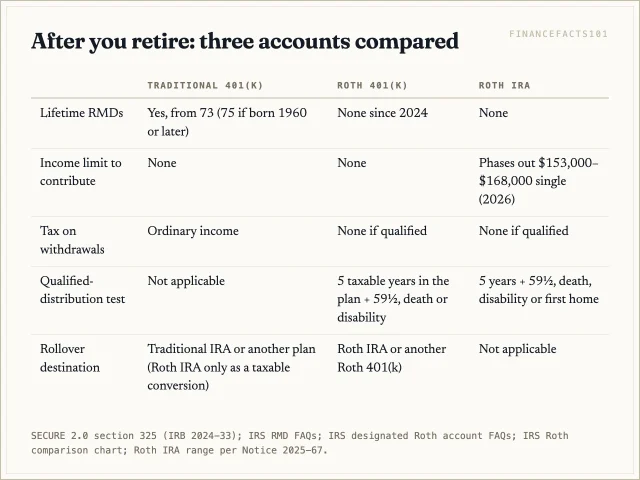
The Roth 401(k) has its own clock. A distribution is qualified only after a "5-taxable-year period of participation" in the plan, starting with the first year you made designated Roth contributions there, and on or after age 59½, death or disability. A designated Roth rollover can go only to another designated Roth account or a Roth IRA. Someone opening a Roth 401(k) at 58 should note the date; contributions made in 2026 start the clock on January 1, 2026.
The decision framework
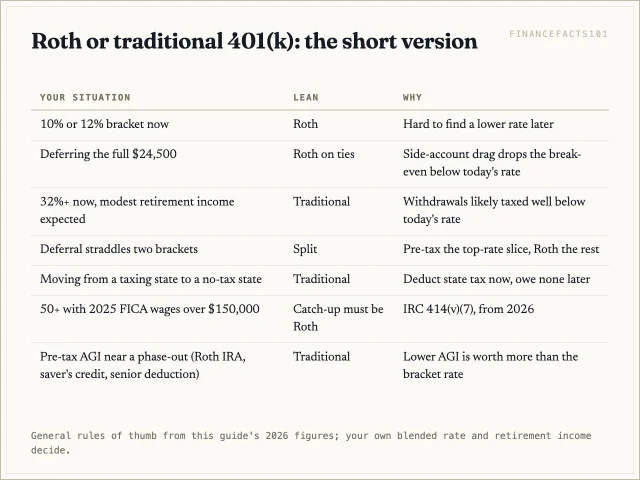
Work through it in order:
- Capture the full match. Its tax treatment is a footnote next to the money itself.
- Find your blended rate now. Take your taxable income with and without the deferral and divide the tax difference by the deferral. For the example, that is 22.67%.
- Guess your retirement rate honestly. If a pre-tax match and existing traditional balances already fill your future 12% bracket, new deferrals would be taxed at 22% or more under today's brackets.
- Adjust for the cap and your state. Near $24,500 a tie goes Roth. A planned move from a taxing state to a no-tax state favors traditional.
- Split at the bracket line when unsure. Defer pre-tax only the dollars taxed at your top rate.
If you earn under about $50,000 single, the Roth is usually the better bet: you pay 10% or 12% now, a rate that is hard to undercut later. If you sit in the 32% bracket or higher and expect a modest retirement income, traditional usually wins. Most people between those points should split.
FAQ
Can I contribute to both a Roth 401(k) and a traditional 401(k) in the same year?
Yes. The two share one limit, $24,500 for 2026 plus any catch-up you qualify for, and you may divide it in any proportion your plan's payroll elections allow. Check whether your plan takes separate percentages for each and how often it lets you change them.
If I choose the Roth 401(k), is my employer match Roth too?
Not unless your plan offers Roth matching and you elect it. By default the match goes into the pre-tax bucket. If you elect Roth matching, under Notice 2024-2 you must be fully vested in the match, and its value is taxable to you in the year it lands, without withholding.
Does the $150,000 Roth rule apply to my regular contributions?
No. It applies only to catch-up contributions by workers 50 and older whose prior-year Social Security wages from the plan sponsor exceeded the threshold, $150,000 of 2025 wages for 2026. The regular $24,500 can still be pre-tax, Roth or any mix.
Can I have a Roth 401(k) and a Roth IRA at the same time?
Yes. They have separate limits: $24,500 for the 401(k) and $7,500 for IRAs in 2026. The Roth 401(k) has no income limit, while direct Roth IRA contributions phase out between $153,000 and $168,000 of modified AGI for single filers.
Sources
- IRS, Notice 2025-67: 2026 amounts relating to retirement plans and IRAs — $24,500, $8,000, $11,250, $72,000, the $150,000 Roth catch-up wage threshold, saver's credit and Roth IRA ranges
- IRS, 401(k) limit increases to $24,500 for 2026 (IR-2025-111)
- IRS, Tax inflation adjustments for tax year 2026 (IR-2025-103, Rev. Proc. 2025-32) — brackets and standard deduction
- IRS, Final regulations on the Roth catch-up rule (IR-2025-91) — applicability dates and the end of the Notice 2023-62 transition
- IRS, Internal Revenue Bulletin 2025-40 (T.D. 10033) — FICA wage test, Box 3, plans without a Roth program
- IRS, Internal Revenue Bulletin 2024-02 (Notice 2024-2) — designated Roth matching contributions
- IRS, Internal Revenue Bulletin 2024-33 — final RMD regulations; SECURE 2.0 section 325
- IRS, Retirement plan and IRA required minimum distributions FAQs
- IRS, Retirement plans FAQs on designated Roth accounts
- IRS, Roth comparison chart
- IRS, Retirement savings contributions credit (saver's credit)
- IRS, Fact sheet FS-2025-03: deductions for working Americans and seniors
- GovInfo, Public Law 119-21 — section 70101 (rate schedule) and the senior deduction's 6% phase-out
- Pennsylvania Department of Revenue, PA personal income tax guide: gross compensation and personal income tax overview — 3.07% rate
 Next entry · No. 5,980Pay Off Debt or Invest? Compare Two After-Tax Rates
See also
-
 No. 5,969
03 Oct 2026
19 min
Should I Do a Roth Conversion in 2026? How Much to Convert
Retirement
No. 5,969
03 Oct 2026
19 min
Should I Do a Roth Conversion in 2026? How Much to Convert
Retirement -
 No. 5,941
12 Sep 2026
16 min
401(k) Employer Match: How Much of Your Salary to Defer
Retirement
No. 5,941
12 Sep 2026
16 min
401(k) Employer Match: How Much of Your Salary to Defer
Retirement -
 No. 948
06 Jul 2024
19 min
Understanding Defined Contribution Plans: Types, Advantages, Limitations and Examples
Personal Finance
No. 948
06 Jul 2024
19 min
Understanding Defined Contribution Plans: Types, Advantages, Limitations and Examples
Personal Finance -
 No. 5,973
07 Oct 2026
16 min
How Much Do I Need to Retire? Spending, Social Security and the 4% Rule
Retirement
No. 5,973
07 Oct 2026
16 min
How Much Do I Need to Retire? Spending, Social Security and the 4% Rule
Retirement -
 No. 5,970
04 Oct 2026
17 min
Required Minimum Distributions: When to Start, How Much, and How to Cut the Tax
Retirement
No. 5,970
04 Oct 2026
17 min
Required Minimum Distributions: When to Start, How Much, and How to Cut the Tax
Retirement -
 No. 5,950
17 Sep 2026
17 min
Thrift Savings Plan: How Much to Contribute, Which Fund, and Whether to Roll It Out
Retirement
No. 5,950
17 Sep 2026
17 min
Thrift Savings Plan: How Much to Contribute, Which Fund, and Whether to Roll It Out
Retirement