Checking Account Fees by Bank (2026): Overdraft, NSF and Monthly Fees at the 30 Largest Banks
27 of the 30 largest US banks still charge an overdraft fee, median $35; one bad day can cost $180. Every bank's overdraft, NSF, monthly and ATM fees.
Capital One charges the least of the 30 largest US branch banks: $0 a month, $0 per overdraft, $0 for a bounced payment and $0 at other banks' ATMs, while 27 of the 30 still charge an overdraft fee on their standard checking account, at a median of $35 per item, according to each bank's own fee documents as we read them in September 2026. What an overdraft costs at your bank depends on three numbers, not one: the per-item fee ($10 to $36), how many fees the bank will charge in a day (one to five), and how small an overdraft the bank forgives without a fee ($1 to $100). Put those together in our table of checking account fees by bank and, among banks that charge, a single bad day runs from $15 at M&T to $180 at SouthState.
This is original data. We collected every fee from each bank's own fee schedule, account agreement or product page, checked each value a second time, and publish the full dataset with the source document and quote behind each value. Scope honesty up front: this is general information about published fee schedules, not advice about your account, and your own account agreement governs what you are charged.
Checking Account Fees by Bank: What the Survey Found
Five findings carry most of the decision.
The overdraft fee has not gone away. Citi, Capital One and Truist charge nothing on their standard accounts, but 16 of the 30 banks charge $35 or $36 per item, and the mean among the 27 that charge is $30.00. Bank of America has the lowest per-item fee among banks that charge, $10 and no more than two a day; M&T's one-fee daily cap gives the lowest worst day, $15.
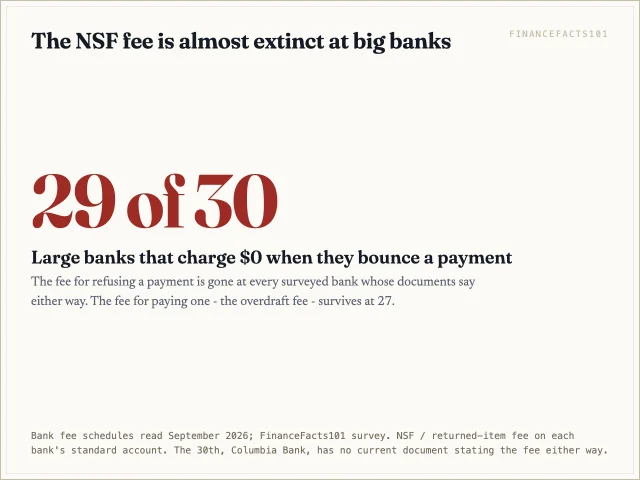
The NSF fee, by contrast, is nearly gone. Twenty-nine of the 30 banks charge $0 when they refuse to pay an item for lack of funds, and the 30th, Columbia Bank, has no current document that states the fee either way.
The daily cap matters more than the headline fee. PNC charges $36, one of the highest per-item fees in the survey, but only once a day. Citizens charges $35 and allows five a day. Those two banks can bill very different amounts for the same morning.
Monthly fees are easy to avoid or absent. Eleven banks charge no monthly fee on their standard account; the median is $8 and the maximum $15, and every fee we recorded has a stated way to waive it.
And 28 of the 30 banks offer an account that cannot run up overdraft fees, usually for $3 to $5 a month.
Who This Is For — and Who It Isn't
This is for someone who banks at one of the largest US banks, or is choosing between them, and wants two answers: which bank's fee rules are cheapest, and what the rules at their own bank will cost on a bad day. It suits anyone who has paid an overdraft fee in the last year or who runs close to zero before payday.
It is not a survey of credit unions, online-only banks or small community banks, whose fee schedules can be better or worse. It covers one account per bank, the standard entry-level checking account, not premium tiers, student accounts or business accounts. And it is not a guide to getting a fee refunded: that is covered in our overdraft fee guide, which walks through the refund call, the Regulation E opt-out and sizing a buffer. In two sentences: ask for a one-time courtesy reversal by phone within days of the charge, then turn off debit-card overdraft coverage and keep a cushion sized to your largest bill-to-payday gap. The rest of this page is about the fees themselves.
How We Built This
The bank list comes from the Federal Reserve's large commercial banks release, now titled U.S. Domestically Chartered Commercial Banks, with data as of March 31, 2026 (posted July 2, 2026). We took the 30 largest banks by consolidated assets that have at least 100 domestic branches. The branch rule keeps the survey to banks a household can walk into, so on the Fed's ranking the 30 run from No. 1, JPMorgan Chase, to No. 44, Frost; the ranks skipped belong to large banks with fewer than 100 branches.
For each bank we identified the standard entry-level personal checking account, the one the bank markets as its basic everyday account, and recorded its fees and overdraft rules. The table shows seven numbers per bank; the dataset adds the monthly-fee waiver, the overdraft-transfer fee and the no-overdraft account. Every value comes from the bank's own documents: its fee schedule, deposit account agreement, account disclosure or product page. Third-party comparison sites were used only to find those documents, never as a source. Each value was then checked a second time by a separate pass that re-opened every document and confirmed, corrected or marked it unknown. The second pass filled six values the first pass had left unknown and found no recorded number that was wrong.
Two labels in the table need precise meanings. $0 means a bank document says the bank charges none. None listed means the bank's documents list no such fee but do not state $0 in so many words. Unknown means no bank document we could open states the value, and we did not fill the gap from anyone else.
The documents' own dates range from March 2024 (Huntington's Asterisk-Free Checking charges form) to September 2026 (Truist's schedule, effective September 28, 2026). Each was the newest version we could reach in September 2026. For four banks whose sites blocked automated reads, some or all of that was an Internet Archive capture of the bank's own page, listed under the table.
What this survey is not: it does not include credit unions, online-only banks or every account tier, and it does not measure how often each bank actually charges these fees. It records the published price, not the bill.
The Full Table: Seven Numbers per Bank
Banks are listed in order of the Fed's asset ranking. A dash means not applicable, because the bank charges no overdraft fee. Download the full dataset: /data/bank-fees-2026.csv. It has one row per bank and, for each field, the value, the source URL and the verbatim quote from the bank's document; values that do not apply, could not be found or are absent from the bank's documents are written as n/a, unknown and none listed, and a caveat column carries the notes on Webster, Pinnacle, Flagstar, First Citizens and Old National.
| Bank | Standard account | Monthly fee | Overdraft fee | Max per day | No-fee cushion | NSF fee | Extended overdraft fee | Out-of-network ATM fee |
|---|---|---|---|---|---|---|---|---|
| Chase | Chase Total Checking | $15 | $34 | 3 | $50 | $0 | none listed | $3 |
| Bank of America | Bank of America Advantage Plus Banking | $12 | $10 | 2 | $1 | $0 | $0 | $2.50 |
| Citi | Citi Regular Checking | $15 | $0 | — | — | $0 | $0 | $2.50 |
| Wells Fargo | Wells Fargo Everyday Checking | $15 | $35 | 3 | $10 | $0 | $0 | $3 |
| U.S. Bank | U.S. Bank Smartly Checking | $12 | $36 | 3 | $50 | $0 | $0 | $3 |
| Capital One | Capital One 360 Checking | $0 | $0 | — | — | $0 | $0 | $0 |
| PNC | PNC Virtual Wallet (Spend account) | $7 | $36 | 1 | $5 | $0 | $0 | $3 |
| Truist | Truist One Checking | $12 | $0 | — | — | $0 | $0 | $3 |
| TD Bank | TD Complete Checking | $15 | $35 | 3 | $50 | $0 | none listed | $3 |
| Fifth Third | Fifth Third Momentum Checking | $0 | $35 | 3 | $5 | $0 | none listed | $3.50 |
| Huntington | Huntington Asterisk-Free Checking | $0 | $15 | 3 | $50 | $0 | none listed | $3.50 |
| BMO | BMO Smart Advantage Checking | $0 | $20 | 3 | $20 | $0 | none listed | $3 |
| First Citizens | Primary Checking | $0 | $25 | 3 | $5 | $0 | none listed | $2.50 |
| Citizens | One Deposit Checking from Citizens | $9.99 | $35 | 5 | $5 | $0 | $0 | $3 |
| M&T Bank | EZChoice Checking | $0 | $15 | 1 | $5 | $0 | none listed | $3 |
| KeyBank | Key Smart Checking | $0 | $20 | 3 | $20 | $0 | $20 after 5 business days over $20 | $3 |
| Regions | LifeGreen Checking | $8 | $36 | 3 | $5 | $0 | $0 | $3 |
| Pinnacle | Basic Checking (Pinnacle banner) | $8 | $30 | 3 | $15 | $0 | none listed | unknown |
| Santander | Simply Right Checking | $10 | $15 | 3 | $100 | $0 | $15 once, on day 6 (5 days, over $100) | $3 |
| Zions Bank | Anytime Checking (Zions Bank division, Utah/Idaho/Wyoming) | $0 | $29 | 5 | $30 | $0 | none listed | $2.50 |
| Flagstar | Flagstar Ready Checking | $10 | $30 (enrolled only) | 3 | $10 | $0 | none listed | $2.50 |
| Webster Bank | Choice Checking | $12 | $35 | 4 | $5 | $0 | unknown | $3 |
| First Horizon | Advantage Checking | $10 | $35 | 3 | $5 | $0 | none listed | $3 |
| Old National | ONB Everyday Checking | $6.95 | $36 | 2 | $25 | $0 | $7/day from day 7, max $35 | $3 |
| UMB | UMB Free Checking | $0 | $36 | 4 | $5 | $0 | none listed | $2 |
| SouthState | SouthState Checking | $5 | $36 | 5 | $10 | $0 | none listed | $3 |
| Columbia Bank | Embark Checking | $0 | $35 | 5 | $10 | unknown | none listed | $2.50 |
| Valley | All Access Checking | $15 | $35 | 4 | unknown | $0 | none listed | $2 |
| BOK Financial | Access Checking (Bank of Oklahoma) | $0 | $36 | 3 | $50 | $0 | none listed | $3 |
| Frost | Frost Personal Account | $8 | $35 | 3 | $100 | $0 | none listed | $2 |
Notes on the table:
- Webster Bank merged into Santander Bank, N.A. on August 20, 2026, after the Federal Reserve approved Santander's acquisition of Webster Financial on August 4; the FDIC's BankFind record shows Webster's charter inactive from that date. It keeps its own row because it still runs its own products and its own fee schedule. On March 31, 2026, the list date, they were two banks.
- Pinnacle's row is the Pinnacle-banner Basic Checking account. Synovus Bank merged into Pinnacle Bank on January 2, 2026, and the bank runs both banners, each on its own fee schedule, until it consolidates under the Pinnacle name in early 2027. Most of its roughly 400 offices carry the Synovus banner, where the everyday account is Plus Checking at $10 a month (waived with a $10,000 relationship balance or $3,500 in monthly deposits), the overdraft fee is $36 ($29 for military accounts) with a maximum of three a day, there is no fee if the account is overdrawn by $5 or less ($50 if enrolled in Overdraft Privilege), and the non-Synovus ATM fee is $2.50.
- Flagstar's $30 overdraft fee applies only to accounts enrolled in its opt-in Overdraft Protection Coverage; an account that is not enrolled pays $0 for overdrafts and $0 NSF, per its disclosure guide.
- First Citizens' out-of-network ATM fee varies by state. The $2.50 shown applies in the NC, SC, VA, CA, MA, OR, WA, WV and WI editions of its fee disclosure; the AZ, CO, FL, GA, KS, MD, MO, NE, NV, NM, OK, TN and TX editions show no charge. The overdraft terms are identical in all 22 editions. Its $5 cushion, like M&T's, applies per item rather than to the end-of-day balance.
- Archived copies: Old National's, Fifth Third's and Huntington's values, and SouthState's account, monthly fee, NSF and transfer-fee values, were read from Internet Archive captures of the banks' own pages, taken between April and September 2026 (SouthState's July 2022 NSF notice from an August 2024 capture). Old National's live site could not be reached at all. Fifth Third's fee chart is an April 2026 capture; a June 2026 welcome kit exists that we could not open. Pinnacle and KeyBank were first read from captures and then confirmed against the live documents.
- Truist's out-of-network ATM fee rises from $3 to $3.50 per transaction on November 9, 2026, per the same schedule.
- Huntington's row is Asterisk-Free Checking, its $0 account; Huntington also calls Perks Checking ($10 a month) ideal for everyday banking. The overdraft terms are the same on both.
- Zions and BOK Financial figures are for the Zions Bank (Utah) and Bank of Oklahoma divisions; the other divisions publish their own schedules.
Overdraft Fees: Where the 30 Banks Land
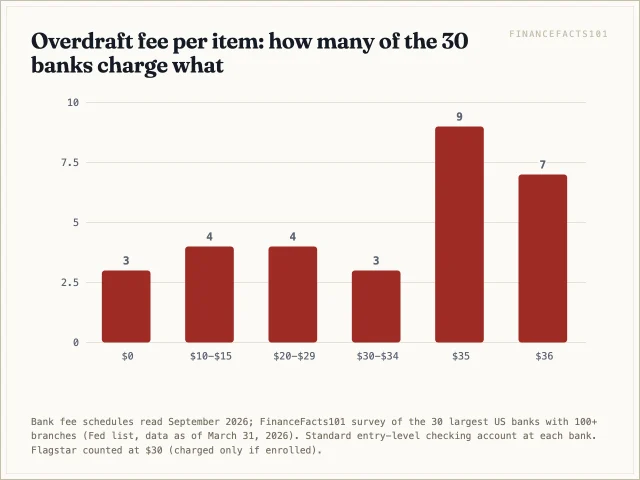
The distribution is lopsided. Three banks charge nothing, eight charge between $10 and $29, three charge $30 to $34, and the remaining 16 cluster at $35 and $36. That cluster is the price at most big banks, and it has barely moved. Valley's own fee page showed $30 per item in 2024 and $35, up to four a day, by May 2026. Fifth Third went the other way, from $37 to $35 for items posting on or after August 26, 2025.
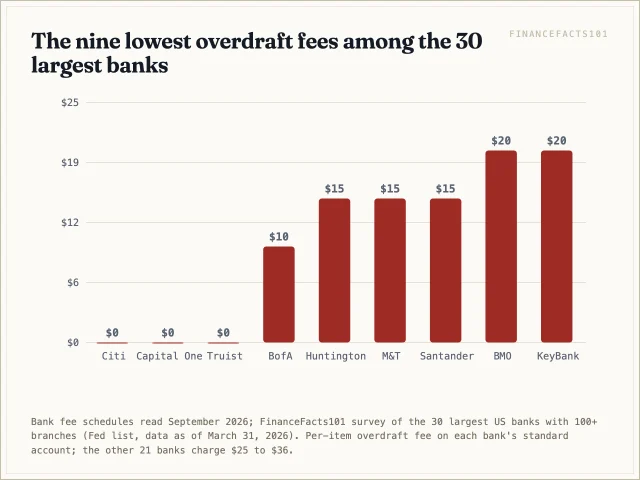
The low end is where the choice gets interesting. Citi's account agreement says plainly that "Citibank does not charge fees for Returned Items and Overdrafts." Truist One carries no overdraft, returned-item or negative-balance fees. Bank of America's fee schedule sets a $10 Overdraft Item Fee and "will not charge this fee for more than 2 overdraft items per day," so its worst day is $20. Huntington, M&T and Santander sit at $15.
The per-item fee is the number banks advertise, but on its own it answers the wrong question. A $36 fee charged once is cheaper than a $15 fee charged three times.
The Daily Cap Decides Your Worst Day
Multiply each bank's per-item fee by the maximum number it will charge in a day and the ranking reshuffles. SouthState's $36 fee with a five-a-day maximum reaches $180, the highest in the survey; its own courtesy overdraft disclosure says the maximum "is five (5) per day." Citizens and Columbia Bank reach $175. At the other end, M&T's overdraft page says it charges "$15 per day (maximum of one fee per day)," so its worst day is $15, and PNC's one-a-day cap holds it to $36 despite the high item fee.
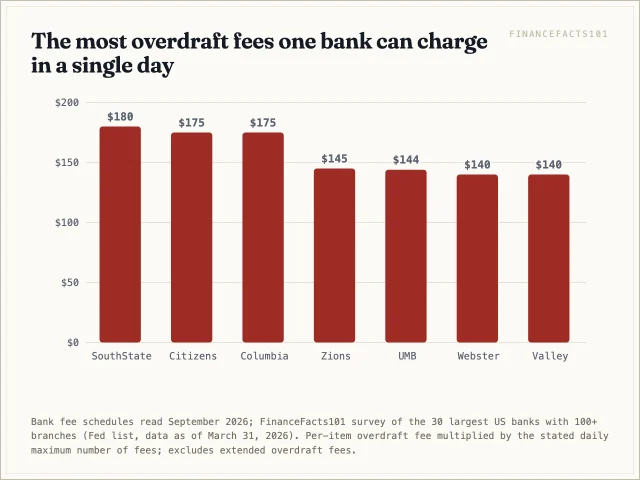
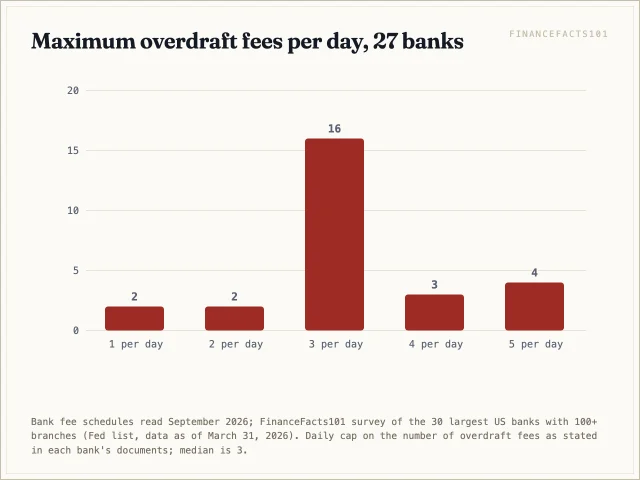
The median cap is three fees a day, which is where 16 of the 27 charging banks sit. Nine banks top out between $102 and $108, the $34-to-$36 fee times three. Seven can charge $140 or more.
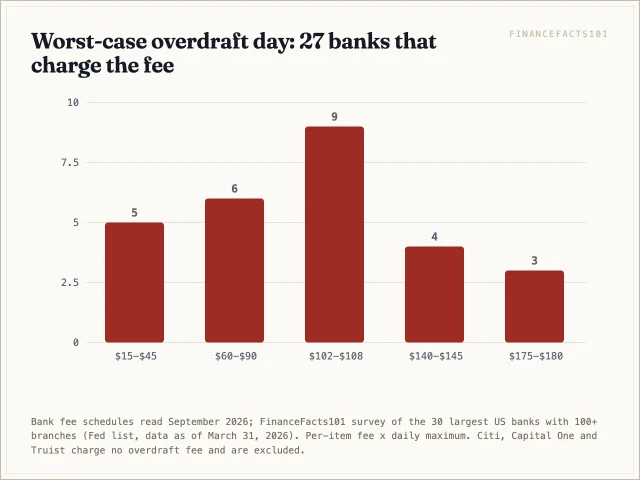
If you routinely have several small payments clearing on the same day, the cap is the number to look up first. A bank with a one-fee daily cap turns a five-payment mistake into a single charge.
The No-Fee Cushion: $1 to $100
Most banks now waive the fee when the overdraft is small, but "small" ranges from $1 to $100. Bank of America forgives an overdraft of $1 or less. Ten banks draw the line at $1 to $5, which forgives almost nothing. Seven forgive $50 or more: Chase, U.S. Bank, TD Bank, Huntington and BOK at $50, and Santander and Frost at $100. The median among the 26 banks that state a cushion is $10.
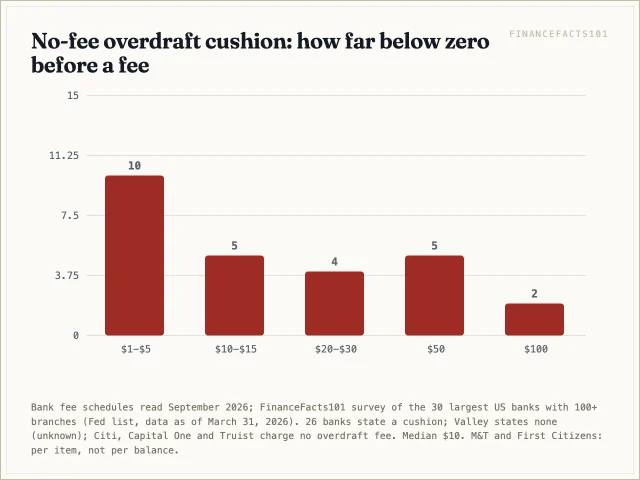
How the cushion is measured matters as much as its size. Chase's fee schedule charges nothing "if you're overdrawn by $50 or less at the end of the business day," and also nothing if you bring the account back to within $50 by the end of the next business day. PNC refunds its fees if the account is overdrawn by $5 or less after all the day's transactions post. At First Citizens and M&T the $5 threshold is per item: a $4 purchase is free, but a $6 purchase that overdraws you by $1 is not. Valley's documents state no cushion at all, which we record as unknown.
A $50 cushion changes behavior in a way a lower fee does not. At a bank that forgives $50, running $30 short the day before payday costs nothing. At a bank that forgives $5, it costs a full fee.
What One Bad Day Costs at Three Banks
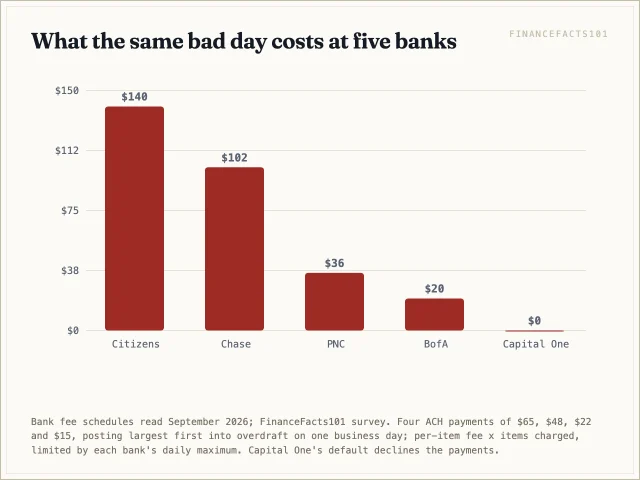
Here is the arithmetic on one ordinary bad day, using the table's numbers. Named assumptions: your balance is $0.00 on a Tuesday morning after rent clears. Four automatic payments post that day, largest first: $65 for car insurance, $48 for electricity, $22 for the phone and $15 for streaming, $150 in all. Each is an ACH autopay, not a debit-card swipe, so the bank can pay it into overdraft whether or not you opted in to debit-card coverage. There is no linked savings account or overdraft line to sweep from. The bank pays all four, your balance ends the day at −$150.00, and your next deposit arrives Friday.
Citizens ($35 per item, maximum five a day, $5 cushion). All four items are over $5 and the day ends $150 short, so each is charged: 4 × $35 = $140. The One Deposit Checking guide caps the day at five fees, "up to a total of $175," which this day does not reach.
Chase ($34 per item, maximum three a day, $50 cushion). Chase's schedule charges "beginning with the first transaction that overdraws your account balance by more than $50." Here that is the first item, the $65 payment, so the fee applies to the first three items before the cap stops it: 3 × $34 = $102. Posting order matters: had the $22 and $15 payments posted first, the balance would still have been within $50 of zero after them, and only the $48 and $65 items would have been charged ($68).
PNC ($36 per item, maximum one a day, $5 cushion). The overdraft is far past $5, so a fee applies, but only one: $36.
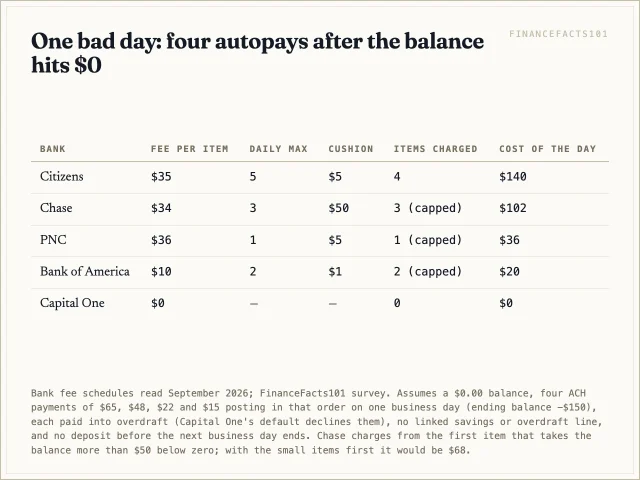
For comparison, Bank of America would charge two $10 fees, $20, and Capital One would charge nothing. Capital One's default setting declines payments that would overdraw the account, so the biller, not the bank, may charge you for the returned payment.
Now change one assumption: a $105 transfer lands on Wednesday. At Chase the account is back to −$45, within $50 by the end of the next business day, so the $102 disappears. At Citizens the $140 stands, because its Peace of Mind reversal requires a positive available balance by 10 p.m. ET the next business day; you would need more than $150 in by Wednesday night. The grace rules differ as much as the fees do: Chase needs you within $50 of zero, Citizens needs you above it.
NSF Fees Are Nearly Gone; Extended Fees Linger
An NSF, or returned-item, fee is what a bank charges for refusing to pay. Twenty-nine of the 30 banks now charge $0 for it, and several say so explicitly: SouthState's own notice says that "as of July 11, 2022, SouthState no longer charges" its $36 NSF fee. Columbia Bank is the exception in the data, not because it lists a fee but because no current document says either way; its overdraft-transfer agreement still refers to "Overdraft or Insufficient Funds Fee(s)."
The fee for staying negative is rarely listed. Nine banks say they charge $0, 17 list no such fee in their documents, and Webster's is unknown. Three still charge one. KeyBank adds a $20 Recurring Overdraft Service Charge if the account is overdrawn by more than $20 for five consecutive business days. Santander charges $15 once, on day six, if the account has been negative five business days and was more than $100 short at the end of the first. Old National charges $7 a day from day seven of a continuous overdraft over $25, for up to five business days, a maximum of $35.
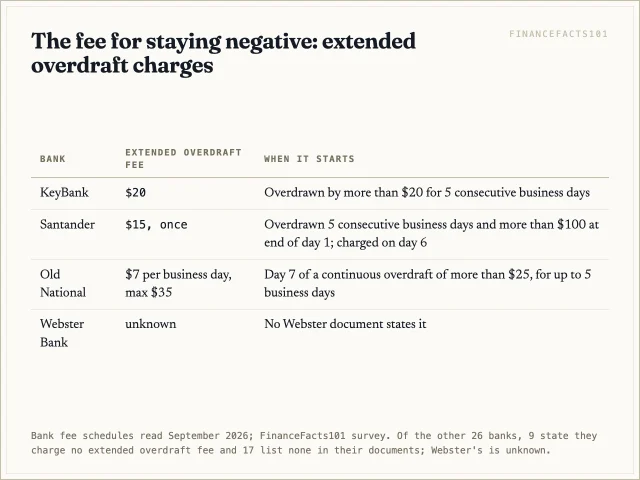
If you bank at one of these three, the trigger day is a deadline. Bringing a KeyBank account back to within $20 of zero before the end of the fifth business day saves $20.
Monthly Fees: Eleven Banks Charge Nothing
Eleven of the 30 standard accounts carry no monthly fee: Capital One, Fifth Third, Huntington, BMO, First Citizens, M&T, KeyBank, Zions, UMB, Columbia and BOK Financial. First Citizens' $0 requires e-statements within 60 days, or the account converts to Select Checking at $12 a month. The median across all 30 is $8, and five banks charge the maximum of $15: Chase, Citi, Wells Fargo, TD Bank and Valley.
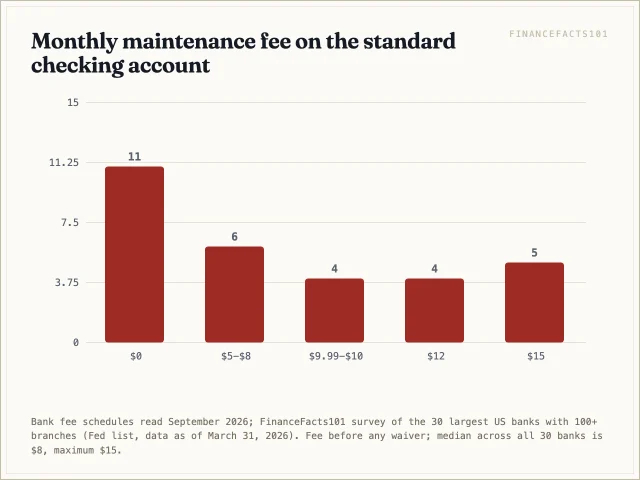
Every fee we recorded has a stated waiver, and most key off direct deposit. Chase waives its $15 with $500 or more in qualifying electronic deposits a statement period; Bank of America waives $12 with one qualifying direct deposit of $250; Citi waives $15 with $250 of direct deposits or other qualifying transactions. Citizens' $9.99 disappears with one deposit of any amount a statement period, and Santander's $10 with any one deposit, withdrawal, transfer or payment in the month. If your paycheck lands in the account, the monthly fee at most of these banks is $0 in practice. For how checking fits beside savings, money market and CD accounts, see our deposit accounts comparison.
Out-of-Network ATM Fees: $3 Is the Norm
The bank's own fee for using another bank's ATM, before the ATM owner's surcharge, is $3 at 17 of the 29 banks where we could find it; the median is $3. Capital One is the only one at $0: "Capital One does not charge additional fees for out of network ATM use." Fifth Third and Huntington charge $3.50, and Truist's schedule discloses a rise from $3 to $3.50 per transaction effective November 9, 2026.
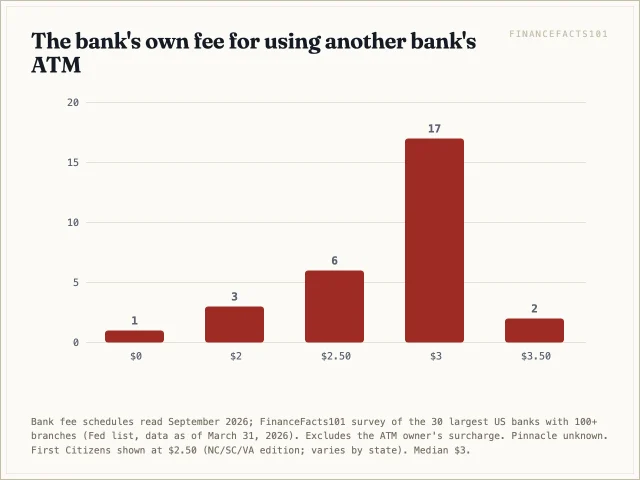
Two wrinkles from the data. First Citizens charges $2.50 in some states and nothing in others. And since the Webster merger, Santander's completion announcement says customers of both banks can use Webster and Santander ATMs in the US without fees, so Santander's $3 out-of-network fee, from a schedule dated September 2025, no longer applies at Webster machines. Pinnacle's is unknown: its fee disclosure lists no ATM fee, but no document says $0.
The No-Overdraft Account at Each Bank
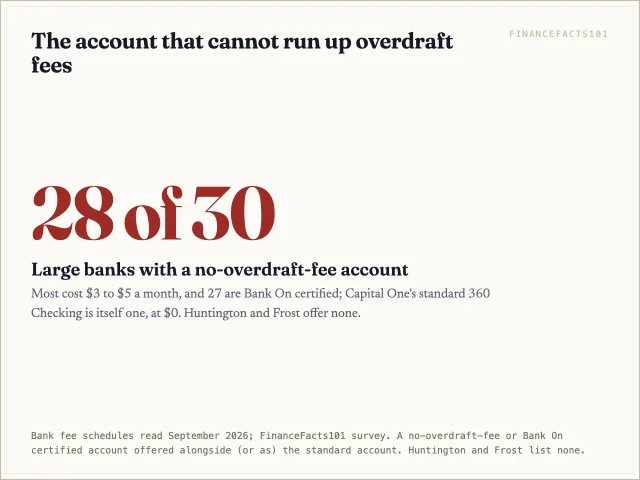
Twenty-eight of the 30 banks offer an account that cannot run up overdraft fees, and 27 of those are certified under the Bank On National Account Standards, which the FDIC points consumers to through its #GetBanked campaign. Most cost $3 to $5 a month, are often checkless, and generally decline transactions rather than pay them into overdraft. SouthState's Direct Checking is the one not certified; Huntington and Frost list no such account. The account names below are as each bank's documents give them.
| Bank | No-overdraft-fee account, as recorded | Bank On certified |
|---|---|---|
| Chase | Chase Secure Checking (marketed as Chase Secure Banking) | Yes |
| Bank of America | Bank of America Advantage SafeBalance Banking | Yes |
| Citi | Citi Access Checking | Yes |
| Wells Fargo | Wells Fargo Clear Access Banking | Yes |
| U.S. Bank | U.S. Bank Safe Debit Account | Yes |
| Capital One | Capital One 360 Checking (the standard account itself has no overdraft fees) | Yes |
| PNC | PNC Simple Checking (Bank On certified, $0 overdraft fees) | Yes |
| Truist | Truist Confidence Account (Bank On certified, no overdraft fees, $5 monthly) | Yes |
| TD Bank | TD Essential Banking (Bank On certified, no overdraft fees, $4.95 monthly) | Yes |
| Fifth Third | Fifth Third Express Banking (Bank On certified, no overdraft fees, $5 monthly) | Yes |
| Huntington | none found | — |
| BMO | BMO Smart Money Checking (Bank On certified, no overdraft fees, $5 monthly) | Yes |
| First Citizens | Sure Advantage | Yes |
| Citizens | Citizens EverValue Checking | Yes |
| M&T Bank | MyWay Banking | Yes |
| KeyBank | KeyBank Hassle-Free Account | Yes |
| Regions | Regions Now Checking | Yes |
| Pinnacle | Budget Checking (Synovus banner) | Yes |
| Santander | Santander Essential Checking (Bank On certified; $4/month; no overdrafts or overdraft fees) | Yes |
| Zions Bank | OnBudget Banking ($5/month, $0 if 25 or younger; checkless; no overdraft fees) | Yes |
| Flagstar | Flagstar One Checking ($5/month; checkless; no overdraft fees; Bank On certified) | Yes |
| Webster Bank | Webster Connect Checking ($4.50/month; no overdraft or return-item fees; Bank On certified) | Yes |
| First Horizon | Essential Checking ($5/month, refunded for ages 18-24; overdrafts typically not paid, $0 overdraft and NSF fees; Bank On certified) | Yes |
| Old National | ONB EZ Access Account ($4.95/month; checkless; no overdraft fees) | Yes |
| UMB | UMB Check-Free Banking | Yes |
| SouthState | Direct Checking (no overdraft fees; not on the Bank On certified list) | No |
| Columbia Bank | Foundation Checking (Bank On certified) | Yes |
| Valley | Valley Journey Checking (Bank On certified) | Yes |
| BOK Financial | Opportunity Banking | Yes |
| Frost | none found | — |
The trade is simple. A $5 account costs $60 a year. If your standard account has cost you two $35 overdraft fees in the last twelve months, the no-overdraft account is already cheaper, before counting the days the $5 fee is waived.
Why the Fees Fell, and Why No Federal Cap Is Coming
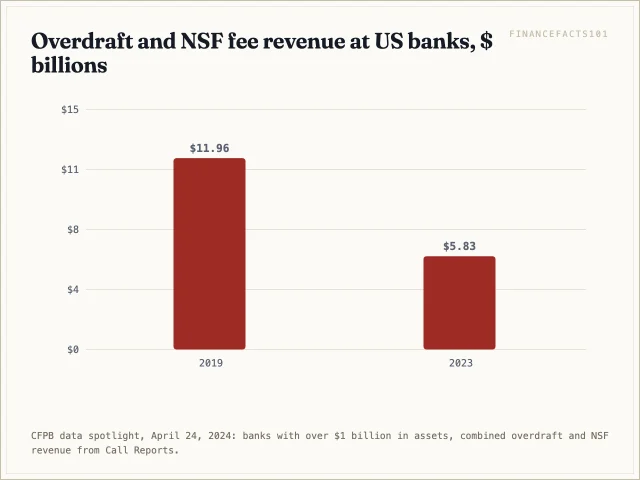
Banks did not cut these fees in a vacuum. The CFPB's April 24, 2024 data spotlight found that reported overdraft and NSF revenue at banks with more than $1 billion in assets fell from $11.96 billion in 2019 to $5.83 billion in 2023, a drop of 51%. Its October 11, 2023 report found that nearly two-thirds of banks with more than $10 billion in assets had eliminated NSF fees, saving consumers almost $2 billion a year. Our survey shows where that ended up at the largest branch banks: the NSF fee all but gone, the overdraft fee intact at 27 of 30.
Regulation was headed further. In December 2024 the CFPB finalized a rule for the largest institutions that would have capped overdraft fees at $5 unless a bank justified a higher fee by its costs or priced overdraft as credit. It never took effect. Congress disapproved it under the Congressional Review Act in S.J. Res. 18, which passed the Senate on March 27, 2025 and the House on April 9, 2025, and became Public Law 119-10 on May 9, 2025: the rule "shall have no force or effect." As of September 2026 there is no federal cap on overdraft fees, which is why the fees in the table are each bank's own choice.
Regulation E: The Opt-In Behind Debit-Card Overdrafts
One federal rule still shapes these fees. Under 12 CFR 1005.17, part of Regulation E, a bank may not charge an overdraft fee on an ATM withdrawal or one-time debit card purchase unless you affirmatively opted in, after a segregated written notice, and received written confirmation of your right to revoke. The bank must also give you the same account terms whether or not you opt in.
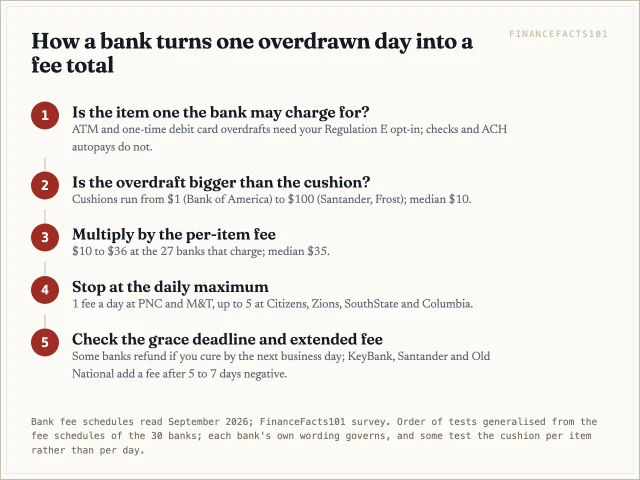
Some banks go further than the rule. Bank of America charges no overdraft fee on everyday non-recurring debit card or ATM transactions at all, UMB's schedule excludes debit card transactions from overdraft charges, and Flagstar requires a separate opt-in for its whole overdraft program, checks and ACH included. The rule's limit is the one the worked example turned on: checks and recurring ACH payments are outside it, so an autopay can still overdraw you and draw a fee at most of these 30 banks.
How to Use This Table
Start with your own row. Find the per-item fee, the daily maximum and the cushion; multiply the first two for your worst day, and keep the cushion in mind as the amount you can safely run short. If your worst day is $100 or more and you have paid an overdraft fee in the last year, you have three options, in rising order of effort.
Turn off debit-card overdraft coverage, which costs nothing under Regulation E and removes one common trigger. Move to your bank's no-overdraft account from the second table, which at $3 to $5 a month costs $36 to $60 a year, about what two overdraft fees cost at most of these banks. Or move your direct deposit to a bank whose rules are kinder: Capital One, Citi and Truist charge no overdraft fee, M&T's worst day is $15 and Bank of America's is $20.
Any of those works better with a cushion of your own. Our emergency fund guide sizes the full reserve, and the part of it you do not need in checking earns more in the accounts compared in high-yield savings vs CDs.
FAQ
Which big bank has the lowest checking account fees?
Among the 30 largest US banks with at least 100 branches, Capital One charges the least on its standard account: 360 Checking has no monthly fee, no overdraft fee, no NSF fee and no fee of its own at out-of-network ATMs, per its own disclosures read in September 2026. Citi and Truist also charge no overdraft fee, but their standard accounts carry monthly fees of $15 and $12 unless waived.
What is the average overdraft fee at big banks in 2026?
Among the 27 of the 30 largest banks that still charge one on their standard account, the median overdraft fee is $35 and the mean is $30.00, as of September 2026. Sixteen banks charge $35 or $36. The lowest charging bank is Bank of America at $10.
Do big banks still charge NSF fees?
Almost none do. Twenty-nine of the 30 banks in our survey charge $0 when they return an item unpaid for insufficient funds. Columbia Bank is the only exception in the data, and only because no current Columbia document states the fee either way.
How many overdraft fees can a bank charge in one day?
It depends on the bank: the caps in our survey run from one fee a day (PNC and M&T) to five (Citizens, Zions, SouthState and Columbia Bank), with a median of three. At current fees that puts the maximum one-day charge between $15 at M&T and $180 at SouthState, before any extended overdraft fee.
Is there a federal limit on overdraft fees?
No. The CFPB's 2024 rule that would have capped overdraft fees at large banks was nullified by Congress under the Congressional Review Act in May 2025 (Public Law 119-10). The Regulation E opt-in for ATM and one-time debit card overdrafts, at 12 CFR 1005.17, remains in force.
Sources
- Federal Reserve, U.S. Domestically Chartered Commercial Banks (large commercial banks release), data as of March 31, 2026 — the bank list and asset ranking
- Federal Reserve, Approval of Banco Santander's application to acquire Webster Financial Corporation, August 4, 2026
- FDIC, BankFind institution record for Webster Bank, N.A. (cert 18221) — inactive from August 20, 2026, successor cert 29950
- FDIC, #GetBanked — Bank On certified accounts
- CFPB, Data spotlight: Overdraft/NSF revenue in 2023 down more than 50% versus pre-pandemic levels, April 24, 2024
- CFPB, Vast majority of NSF fees have been eliminated, October 11, 2023
- eCFR, 12 CFR 1005.17, Requirements for overdraft services (Regulation E)
- Congress.gov, S.J. Res. 18 (119th Congress) — disapproval of the CFPB overdraft rule
- GovInfo, Public Law 119-10, approved May 9, 2025
- Chase, Additional Banking Services and Fees, effective June 14, 2026
- Bank of America, Personal Schedule of Fees, effective August 7, 2026
- Citi, Consumer Deposit Account Agreement
- Capital One, 360 Checking
- PNC, Virtual Wallet fee schedule, effective May 31, 2026
- Citizens, One Deposit Checking account guide
- M&T Bank, Understanding overdrafts
- SouthState, Courtesy Overdraft Privilege personal account disclosure
- Flagstar, Disclosure Guide: Checking Account Summary, rev. 06/2026
- First Citizens, Disclosure of Products and Fees (NC/SC/VA), effective January 24, 2026
- Webster Bank, Fee Schedule for Personal Accounts, effective August 20, 2026
- FinanceFacts101, Checking account fee survey dataset, September 2026 (CSV: every value with its source URL and verbatim quote)
 Next entry · No. 5,979Roth 401(k) vs Traditional 401(k): Which Should You Choose?
See also
-
 No. 5,952
18 Sep 2026
20 min
Overdraft and Insufficient Funds Fees: Get the Refund, Then Stop Paying Them
Banking
No. 5,952
18 Sep 2026
20 min
Overdraft and Insufficient Funds Fees: Get the Refund, Then Stop Paying Them
Banking -
 No. 5,955
19 Sep 2026
20 min
Deposit Accounts: Checking vs Savings vs Money Market vs CD
Banking
No. 5,955
19 Sep 2026
20 min
Deposit Accounts: Checking vs Savings vs Money Market vs CD
Banking -
 No. 3,648
15 Apr 2025
18 min
Offset Mortgages: Understanding and Maximizing Your Savings to Reduce Home Loan Payments
Mortgage
No. 3,648
15 Apr 2025
18 min
Offset Mortgages: Understanding and Maximizing Your Savings to Reduce Home Loan Payments
Mortgage -
 No. 3,590
10 Apr 2025
18 min
Understanding Non-Sufficient Funds (NSF) Fees: Charges, Avoidance, and Criticisms
Business Finance
No. 3,590
10 Apr 2025
18 min
Understanding Non-Sufficient Funds (NSF) Fees: Charges, Avoidance, and Criticisms
Business Finance -
 No. 3,252
13 Mar 2025
21 min
Understanding Money Market Accounts (MMAs): Features, Advantages, Disadvantages, and Comparison with Savings, Checking and Mutual Funds
Business Finance
No. 3,252
13 Mar 2025
21 min
Understanding Money Market Accounts (MMAs): Features, Advantages, Disadvantages, and Comparison with Savings, Checking and Mutual Funds
Business Finance -
 No. 2,811
06 Feb 2025
21 min
Understanding the Legal Rate of Interest: A Comprehensive Guide for Institutional Investors
Business Finance
No. 2,811
06 Feb 2025
21 min
Understanding the Legal Rate of Interest: A Comprehensive Guide for Institutional Investors
Business Finance