HSA vs FSA: Which One to Fund at Open Enrollment
HSA vs FSA for 2026: $4,400 self-only and $8,750 family HSA room against a $3,400 FSA cap. Eligibility usually decides for you. Here is the math.
Your benefits portal wants two answers: which health plan, and how much to put in a tax-advantaged health account. The HSA vs FSA question is the second one, and for most people it is not really a choice — it was already settled on the previous screen. An HSA is only open to you if you enrol in a qualifying high-deductible health plan. A health FSA is only open to you if your employer offers one. For calendar year 2026 the room at stake is $4,400 in an HSA on self-only coverage, $8,750 on family coverage, and $3,400 in a health FSA.
This guide covers eligibility, the 2026 and 2027 limits with their IRS citations, the forfeiture rules that differ more than people expect, the one place FSAs genuinely beat HSAs, and a worked example of a two-earner household saving $2,901 in a single year. One line of scope honesty first: this is general information built on stated assumptions and figures current as of September 2026, not personal advice.
HSA vs FSA: The Choice Is Usually Made Upstream
Two accounts, both funded with pre-tax dollars, both spent on medical care. That is where the similarity ends, and it ends hard.
A Health Savings Account is a bank or brokerage account with your name on it. You own it. It follows you between jobs, between insurers, into retirement, and to your heirs. The balance never expires. A health Flexible Spending Arrangement is an employer-run account that exists only inside a Section 125 cafeteria plan. You do not own it. Leave the job mid-year and, absent COBRA continuation, the unspent balance stays behind.
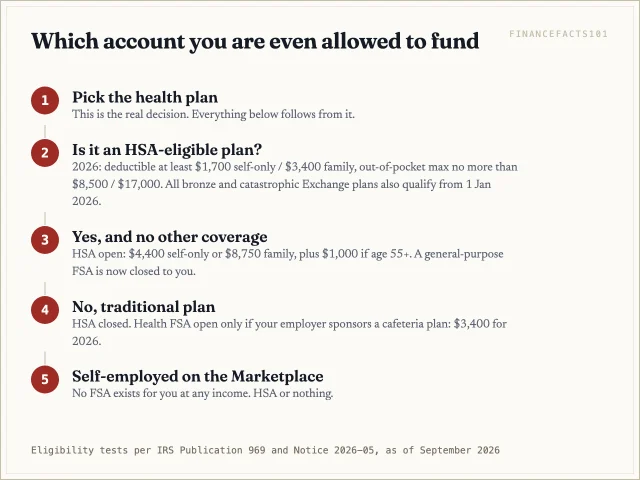
The reason this reads as a choice at all is that the two are mutually exclusive at the margin. You cannot fund an HSA while covered by a general-purpose health FSA — including your spouse's. So the real question is not "which account" but "which health plan", and the account follows.
Who This Is For — and Who It Isn't
This fits a US employee under 65 sitting in open enrollment with a real choice between a high-deductible plan and a traditional one, income high enough that a deduction is worth something, and cash flow stable enough to absorb a deductible. It also fits the self-employed buyer on the Marketplace, who has no FSA available at all and for whom the HSA question is the whole question.
It is not for someone already on Medicare — HSA contributions stop permanently, and the section below covers the six-month trap that catches late filers. It is not for a household whose chronic spending blows past the deductible every year without fail; that reader should run the plan comparison first, not the account comparison. And it is not advice for anyone with a Health Reimbursement Arrangement, TRICARE, VA care in the last three months, or status as someone else's tax dependent — each independently kills HSA eligibility and needs a look at your own plan documents.
Eligibility: What Each Account Actually Requires
To contribute to an HSA in any given month you must, on the first day of that month, be covered by a qualifying high-deductible health plan, have no other disqualifying health coverage, not be enrolled in Medicare, and not be claimable as someone else's dependent. For 2026 a plan qualifies only if its annual deductible is at least $1,700 self-only or $3,400 family, and its out-of-pocket maximum is no more than $8,500 or $17,000 respectively, per healthcare.gov's HSA-eligible plan page.
One 2026 change widens that gate sharply. Under Notice 2026-05, effective January 1, 2026, all bronze and catastrophic Exchange plans count as HSA-compatible whether or not they meet the general deductible test, and they need not be bought on the Exchange. The same guidance made the telehealth safe harbor permanent and allowed qualifying direct primary care fees to be paid from an HSA. If you shopped the Marketplace before 2026 and found no HSA plan in your county, that conclusion is stale.
FSA eligibility is simpler and narrower: your employer must sponsor a cafeteria plan, and you must elect during your window. There is no income test, no plan-type test, and no self-employed route — sole proprietors and more-than-2% S corporation shareholders cannot participate in their own cafeteria plan.
The 2026 and 2027 Numbers
The HSA figures come from Rev. Proc. 2025-19, published in Internal Revenue Bulletin 2025-21; the 2027 set from Rev. Proc. 2026-24 in Bulletin 2026-25. The health FSA limit and its carryover cap come from the IRS tax year 2026 inflation adjustments.
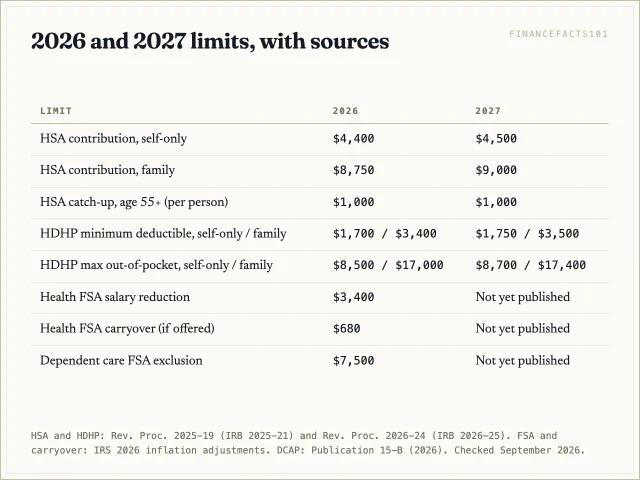
Three notes on that table. The age-55 catch-up is a flat $1,000 that Congress never indexed, and it is per person — a married couple both 55 or older need two separate HSAs to claim $2,000, because an HSA has exactly one owner. The family limit is a household limit, split however you like between two spouses' accounts. And the 2027 health FSA limit is not published as of September 2026; the IRS normally releases it in October, so a fall 2026 enrollment for a calendar-2027 plan year is being made against a number that does not exist yet. Elect against $3,400 and adjust if your employer reopens the window.
Employer contributions count against the HSA limit. A $1,000 employer seed on family coverage leaves you $7,750 of room, not $8,750 — a mistake that shows up as excess contributions on Form 8889 the following April.
The Triple Tax Advantage, Stated Precisely
The HSA is the only account in the US code that is untaxed at all three points. Money goes in deductible, grows untaxed, and comes out untaxed if spent on qualified medical expenses. A traditional 401(k) gets you two of three. A Roth gets you a different two of three. Nothing else gets all three.
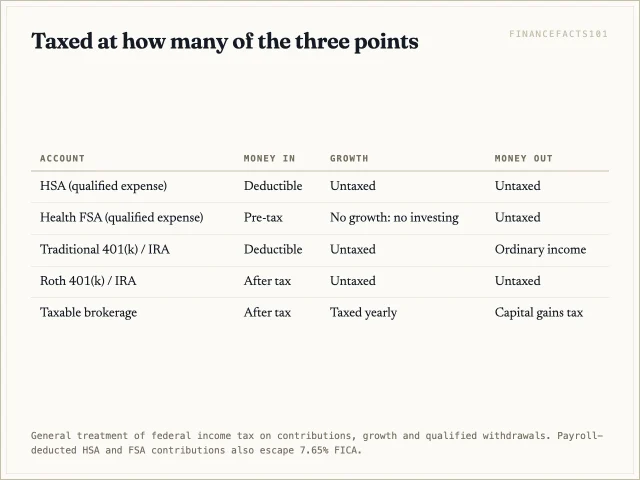
There is a fourth advantage most articles miss. HSA contributions routed through your employer's payroll as salary reductions also escape Social Security and Medicare tax — 7.65% on wages below the wage base. Contributions you make directly to the custodian get the income tax deduction on your return but not the FICA relief. On $8,750 that is a $669 difference for doing the same thing through a different door. If your employer offers payroll deduction, use it; you can see the effect on your own numbers in the take-home pay calculator.
Use It or Lose It: Carryover and Grace Period Are Not the Same
The FSA's defining risk is forfeiture. Money you elect and do not spend by the end of the plan year is gone — returned to the employer, not to you. Employers may soften this two ways, and the rule people miss is that a plan may offer one of them, never both.
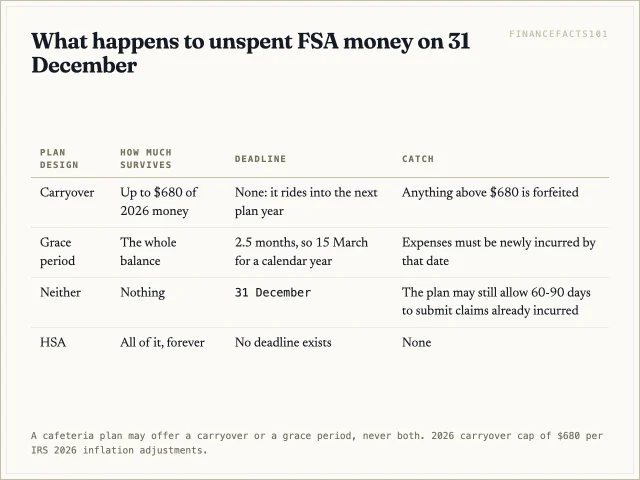
A carryover moves up to $680 of unused 2026 money into the following plan year, where it sits on top of a fresh $3,400 election. A grace period instead gives you 2½ extra months — until March 15 for a calendar plan year — to incur new expenses against the old year's balance, with no dollar cap but a hard date. Some plans offer neither, in which case December 31 is the wall. Find out which of the three your plan is before you decide the number; the FSA rules in detail differ meaningfully by employer.
An HSA has none of this machinery because it needs none. There is no plan year, no deadline, no forfeiture.
The FSA's Real Advantage: All of It on Day One
Here is the fact HSA-boosting articles leave out. Your entire annual FSA election is spendable on the first day of the plan year, before you have contributed a cent. Elect $3,400, have surgery on January 8, and the plan pays $3,400 while you repay it through payroll over the next twelve months. Leave the job in March having spent $3,400 and contributed $567, and the employer eats the difference — the uniform coverage rule, and the price of offering the benefit.
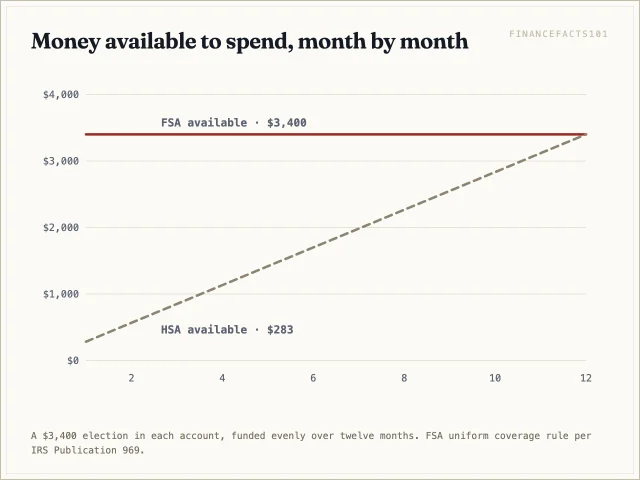
An HSA gives you only what has been deposited. That same January 8 surgery, funded from an HSA on a $3,400-a-year schedule, has $283 available. You pay the rest from savings or a card.
For a household with a known, front-loaded expense — orthodontia starting in January, a scheduled procedure, glasses for four people — that interest-free advance is worth more than the HSA's tax edge on the same dollars. It is the honest case for the FSA, and a good one.
Why the HSA Beats a 401(k) for Money You Can Leave Alone
Now the case in the other direction, which is stronger than most people realise. If you can pay this year's medical bills from ordinary cash flow, an HSA is not a health account at all. It is the best retirement account available to you.
The Ruiz household funds the $8,750 family limit — $729 a month — invests it, and does not touch it for 25 years. At a 7% annual return compounded monthly:
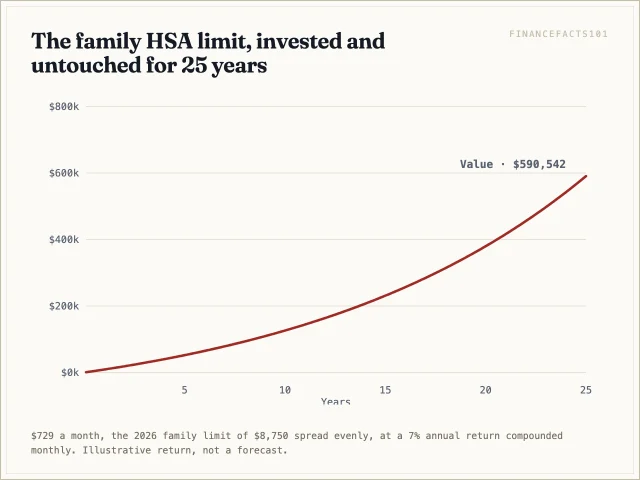
That is $590,542 from $218,700 of contributions. Now compare it with the identical dollars in a traditional 401(k), assuming the same return and a 22% marginal rate in retirement:
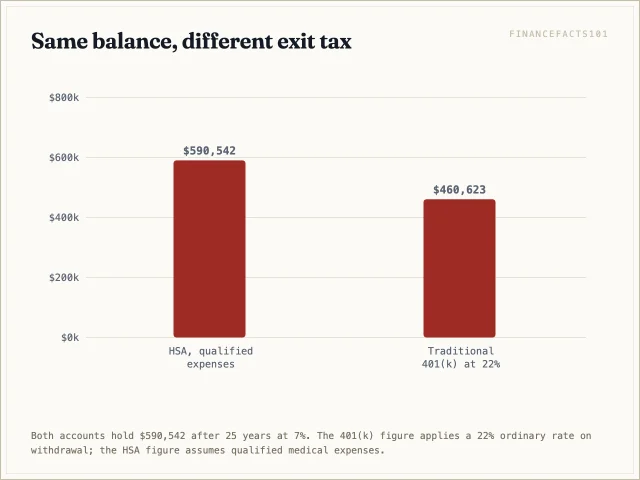
The 401(k) balance is the same $590,542, but withdrawals are ordinary income, leaving $460,623 after tax. The HSA balance comes out whole against qualified medical expenses. That $129,919 gap is what the third tax advantage is worth over 25 years. Spending it is realistic: Fidelity's 2026 retiree health care cost estimate puts a single 65-year-old's retirement medical costs at $185,500 in after-tax savings. Run your own horizon in the compound interest calculator or the retirement calculator, and the HSA vs FSA calculator for the year-one comparison.
The catch is the order of operations. Capture your full 401(k) employer match first — that is an instant 50% or 100% return no tax code can beat — then fill the HSA, then return to the 401(k) or an IRA.
The Receipt Strategy: A Tax-Free Withdrawal With No Deadline
This is the part almost nobody uses, and it is entirely legal.
You may reimburse yourself from an HSA for a qualified medical expense at any time, provided the expense was incurred after the HSA was established. Notice 2004-50, Q&A-39 states it plainly: a distribution in the current year can reimburse an expense from any prior year, and "there is no time limit on when the distribution must occur."
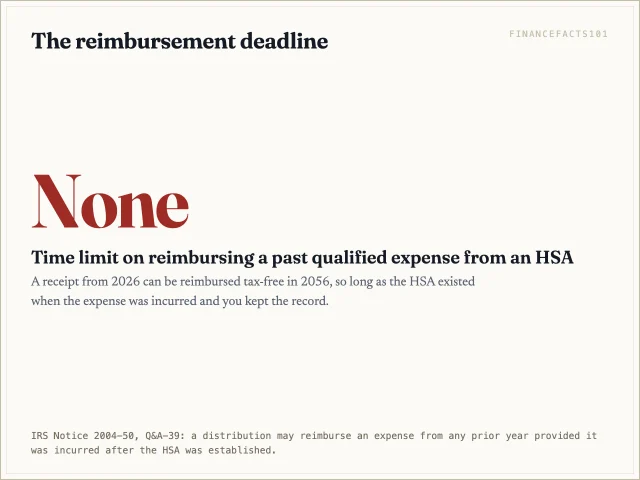
So the strategy is: pay medical bills out of pocket, keep every receipt and explanation of benefits, and let the HSA compound untouched. Each banked receipt is a permanent right to pull that many dollars out tax-free, at any age, for any purpose. Bank $24,000 of receipts across a decade and you hold a $24,000 withdrawal token with no expiry date.
Meanwhile the money you did not withdraw keeps working:
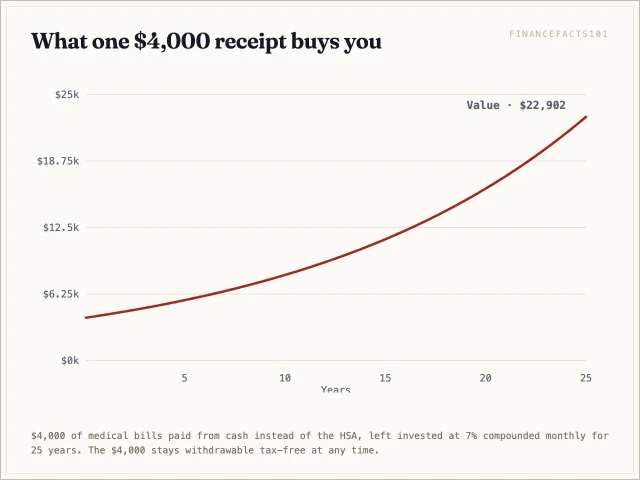
A single $4,000 expense paid from cash instead of the HSA leaves $4,000 invested, worth $22,902 after 25 years at 7%. You still get the $4,000 out tax-free whenever you want it; you simply also kept the $18,902 of growth on it.
Two conditions make this real rather than theoretical. Keep the records: the burden of proof is entirely yours, and a shoebox of faded thermal paper is not a record, so scan everything. And only do it with money you can spare, because paying $4,000 of medical bills on a credit card at 22% to protect a 7% investment is a losing trade.
Investing the Balance, and the Cash Floor in the Way
An HSA that sits in the custodian's default deposit account earns close to nothing, and none of the above happens. Most HSA custodians require a minimum cash balance before they will let you buy funds — commonly $1,000 at HealthEquity or $2,000 at Optum Bank, while Fidelity allows investing from the first dollar. That floor is not investable, so a $2,000 threshold parks $2,000 in near-zero-yield cash indefinitely — 45% of a full self-only year's $4,400.
Two practical moves. If your employer's custodian has a high floor and high fees, contribute through payroll to capture the FICA saving, then transfer the balance annually to a custodian you prefer — trustee-to-trustee transfers are unlimited and not taxable events. And size the cash you hold to your plan's deductible rather than a round number, investing everything above it: on a $3,400 family deductible, keep $3,400 liquid and invest the rest. Your general emergency fund covers everything else.
Worked Example: The Ruiz Household at Open Enrollment
Elena and Marcus Ruiz, both 41, earn $148,000 combined, file jointly, and have two children. Assumptions, stated: a 22% federal marginal bracket, a 3.5% state rate, and 7.65% FICA on both salaries, which sit below the wage base — a combined marginal stack of 33.15%. Both work for employers offering a choice of plans.
If they take the family HDHP and fund the $8,750 HSA limit through payroll, their first-year tax saving is 33.15% of $8,750.
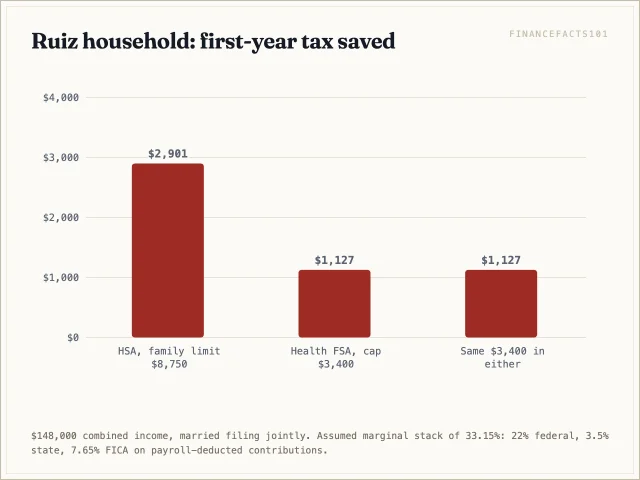
That is $2,901, against $1,127 if they instead take the traditional plan and fund a $3,400 health FSA. The $1,774 difference is not because the HSA has a better rate — the rate is identical — but because it has $5,350 more room. Two people with the same bracket and the same $3,400 to contribute save exactly the same amount either way. The HSA's year-one tax edge exists only if you can actually fund more than the FSA cap. That single sentence resolves most of the confused advice on this topic.
The Plan-Choice Crossover: $21,150 of Claims
Because the account follows the plan, price the plans. Assume the Ruizes' two options, with figures typical of a mid-size employer:
- Traditional PPO: $4,800 employee premium, $1,000 deductible, 20% coinsurance, $5,000 out-of-pocket maximum.
- HDHP: $3,600 employee premium, $3,400 deductible, 20% coinsurance, $7,000 out-of-pocket maximum, plus a $750 employer HSA seed.
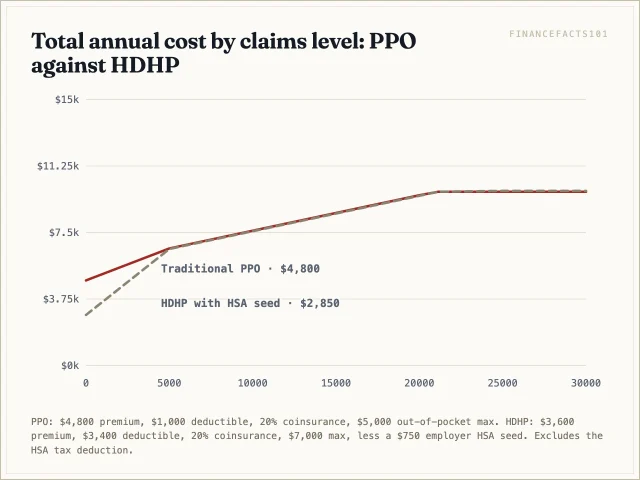
At zero claims the HDHP costs $1,950 less. Through the whole coinsurance range — roughly $3,400 to $21,000 of billed claims — the HDHP still edges it by $30, because the higher deductible is almost exactly offset by the premium gap and the seed. The two lines cross at $21,150 of billed claims. Above that the PPO wins, but by at most $50 a year, since the out-of-pocket maximums are only $2,000 apart.
Add the $1,774 of extra tax saving from the larger HSA and the PPO's best case never catches up. That is the shape of most real comparisons: the HDHP loses on paper only in a narrow band, and the tax treatment closes it. Your own plan documents will produce different numbers — run them through the HSA vs FSA calculator rather than trusting this one.
Medicare Stops HSA Contributions, and the Six-Month Trap
Publication 969 is blunt: "Beginning with the first month you are enrolled in Medicare, your contribution limit is zero." Not reduced. Zero for that month and every month after.
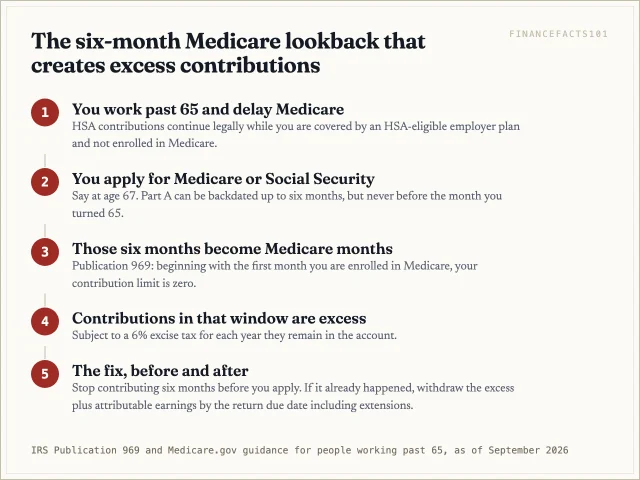
The trap is retroactivity. File for Medicare or Social Security after 65 and Part A can be backdated up to six months. Those retroactive months are Medicare-enrolled months, so any HSA contribution made during them becomes an excess contribution — subject to a 6% excise tax each year it stays in the account. Medicare.gov's guidance for people working past 65 says it directly: "you and your employer should stop contributing to your HSA 6 months before you retire or apply for benefits from Social Security."
The fix if it has already happened: withdraw the excess plus its attributable earnings by your return's due date including extensions, and the 6% penalty does not apply. The prospective fix is a calendar entry six months before you intend to file. Note that only contributions stop — the balance stays yours, keeps growing, and can pay Medicare Part B, Part D and Advantage premiums tax-free, which Medigap premiums cannot.
Qualified Expenses, Penalties, and What Changes at 65
Qualified medical expenses are the ones defined in Publication 502: doctors, dentists, prescriptions, glasses, hearing aids, therapy, most medical equipment. Over-the-counter drugs and menstrual products qualify without a prescription. Health insurance premiums generally do not, with four exceptions — COBRA, coverage while receiving unemployment compensation, most Medicare premiums, and the medical portion of qualified long-term-care insurance.
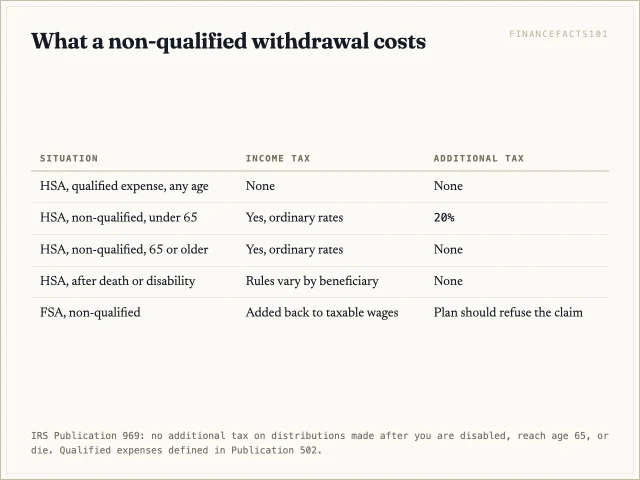
Spend HSA money on something else before 65 and you owe ordinary income tax plus a 20% additional tax. After 65 the 20% disappears and a non-qualified withdrawal is simply ordinary income — the point at which the HSA becomes, at worst, a traditional IRA that also happens to have a tax-free lane. Death and disability lift the penalty too. FSA money spent on a non-qualified expense is a different problem: the plan should not reimburse it, and if it does, the amount is added back to your taxable wages.
Limited-Purpose FSAs and the Dependent Care Account People Confuse
Two accounts sit alongside this decision and cause most of the remaining confusion.
A limited-purpose FSA covers dental and vision only, plus post-deductible medical at some employers. Because it is not general-purpose coverage, it does not disqualify you from an HSA — so you can run both, funding the HSA to $8,750 and a limited-purpose FSA to $3,400 for the braces and the glasses. Publication 969 describes these arrangements as compatible with HSA eligibility. Most employers that offer an HDHP offer one; most employees never notice it on the form.
A dependent care FSA is a wholly separate account with its own limit, for daycare, preschool, before- and after-school care and adult day care — not medical bills. Publication 15-B puts the 2026 exclusion at "up to $7,500 ($3,750 if married filing separately)", raised from $5,000. It has no carryover and no relationship to HSA eligibility, and it interacts with the child and dependent care credit in ways worth checking before you elect; the dependent care benefits guide covers that trade.
How to Size the Election Honestly
For an FSA, elect your floor, not your forecast. Pull last year's explanations of benefits, add up what you actually paid with premiums excluded, subtract the discretionary part you might not schedule, and elect the remainder. Forfeiting $400 at a 33% marginal rate wastes $268 of real money; under-electing by $400 costs only the $132 of tax you did not save. The asymmetry says round down.
For an HSA the logic inverts, because nothing is forfeited. Contribute the maximum you can spare, pay from cash where you can, and let the balance compound. If cash is tight, a sensible floor is what your deductible could actually cost you this year.
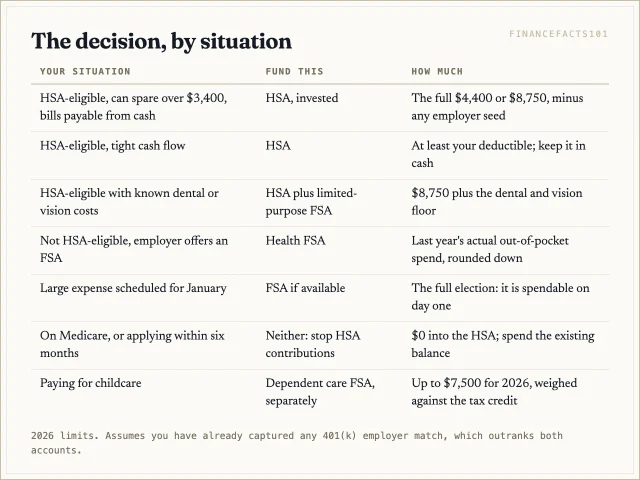
The short version: if you are HSA-eligible and can fund more than $3,400, the HSA wins on every dimension except day-one liquidity. If you are not eligible, elect the FSA at your honest floor and stop reading comparison articles — the choice was made when you picked the plan.
FAQ
Can I have an HSA and an FSA at the same time?
Not a general-purpose health FSA — that counts as disqualifying coverage and zeroes your HSA contribution limit, and your spouse's general-purpose FSA disqualifies you too because it can reimburse your expenses. A limited-purpose FSA covering only dental and vision is compatible, as is a dependent care FSA, which is not health coverage at all.
What happens to my FSA if I quit in June?
Contributions stop with your last paycheck, and you generally can only claim expenses incurred before your coverage ended, though most plans allow a run-out window of 60 to 90 days to submit them. If you have already spent more than you contributed, the employer absorbs the shortfall under the uniform coverage rule. An HSA is unaffected by changing jobs — the balance is yours.
Do I lose my HSA money if I switch off a high-deductible plan?
No. Losing HDHP coverage stops future contributions, effective the first month you are not eligible, but the existing balance stays yours forever, keeps growing, and can still be spent tax-free on qualified expenses. You can also start contributing again in any later month you become eligible.
Is the 2026 HSA limit per person or per household?
Per coverage type. Family HDHP coverage carries one $8,750 household limit for 2026, split between spouses' accounts however you choose. The age-55 catch-up is the exception: it is $1,000 per eligible person, and each spouse must hold their own HSA to claim theirs, since an HSA cannot be jointly owned.
Sources
- IRS, Internal Revenue Bulletin 2025-21 — Rev. Proc. 2025-19, the 2026 HSA contribution limits and HDHP deductible and out-of-pocket thresholds
- IRS, Internal Revenue Bulletin 2026-25 — Rev. Proc. 2026-24, the 2027 HSA and HDHP figures
- IRS, Tax inflation adjustments for tax year 2026 — the $3,400 health FSA limit and $680 carryover
- IRS, Publication 969 — HSA eligibility, the age-55 catch-up, Medicare, the 20% additional tax, limited-purpose FSAs
- IRS, Publication 502 — what counts as a qualified medical expense
- IRS, Publication 15-B — the 2026 dependent care assistance program exclusion of $7,500
- IRS, Notice 2004-50 — Q&A-39, no time limit on reimbursing a prior-year qualified expense
- IRS, Treasury and IRS guidance on new HSA benefits — Notice 2026-05, bronze and catastrophic plans treated as HSA-compatible from January 1, 2026
- IRS, About Form 8889 — reporting HSA contributions and distributions
- HealthCare.gov, HSA-eligible plans and Marketplace plans that work with HSAs
- Medicare.gov, Working past 65 — stop HSA contributions six months before applying
- Fidelity, How to plan for rising health care costs — the 2026 estimate of $185,500 for a single 65-year-old
- Optum Bank, HSA investment options — custodian cash thresholds before investing is allowed
 Next entry · No. 5,948Self-Employment Tax: How Much of Every Payment to Set Aside
See also
-
 No. 5,999
02 Nov 2026
17 min
HDHP vs PPO: Which Health Plan Is Better for You?
Healthcare Finance
-
 No. 5,982
16 Oct 2026
16 min
HSA vs 401(k): Where Should Your Next Dollar Go?
Retirement
-
 No. 2,241
21 Dec 2024
19 min
Understanding Health Savings Accounts (HSAs) for Institutional Investors
Healthcare Finance
-
 No. 2,240
21 Dec 2024
19 min
Understanding HSA Custodians: An Essential Role in Managing Your Health Savings Account
Healthcare Finance
-
 No. 2,239
21 Dec 2024
19 min
Understanding Health Reimbursement Arrangements (HRAs): A Comprehensive Guide for Employers and Employees
Healthcare Finance
-
 No. 5,940
12 Sep 2026
17 min
Take-Home Pay on a $100,000 Salary: What You Actually Keep in 2026
Taxation