401(k) Loan vs Hardship Withdrawal: Which Is Less Costly?
To raise $15,000, a hardship withdrawal costs a 22% saver $7,059 in tax and penalty. A 401(k) loan costs neither and leaves $17,553 more at 65.
In the 401(k) loan vs hardship withdrawal decision, the loan is less costly for almost anyone who will keep the job and can make the payments. Borrowing $15,000 for five years at an assumed 8.00% (prime, 7.00% on the October 2, 2026 H.15, plus one point; your plan sets the rate) costs no tax and no penalty, and the $3,249 of interest goes back into your own account, while withdrawing the same $15,000 in cash costs a saver in the 22% federal bracket under age 59½ another $7,059 in income tax and the 10% additional tax. The withdrawal makes sense only in narrow cases: your plan does not offer loans, you cannot afford the payments, or you expect to leave the job and could not repay or roll over the balance in time.
The gap outlasts tax day. In the worked example below, a 35-year-old who borrows and repays has about $17,553 more at 65, after tax, than if she withdraws and then rebuilds with the same take-home pay.
This is general information built on stated assumptions (federal tax only, a 7% assumed return, rules and rates as of October 2, 2026), not personal advice. Your plan document decides what is available to you, and it can be stricter than the law.
Who this is for — and who it is not for
This guide is for an employee under 59½ with a 401(k), 403(b) or governmental 457(b) balance who needs cash for a real expense (a repair, a medical bill, back rent) and is choosing between borrowing from the plan and taking money out for good. It assumes cheaper money is not available; how big a cash buffer to keep so this never comes up is the emergency fund guide's question.
It is not for IRA owners: the IRS says loans "are not permitted from IRAs" or from SEP and SIMPLE IRA plans (IRS loan FAQs). It is not for federal employees, whose Thrift Savings Plan has its own loan and hardship rules, covered in the TSP guide. And if you cannot already meet minimum debt payments, a loan payment from every paycheck makes that worse; a nonprofit credit counselor is the better first call.
401(k) loan vs hardship withdrawal: the rules side by side
Both options move money out of the plan, but legally they are opposites. A plan loan is not a distribution at all as long as it meets the limits and repayment rules in Internal Revenue Code section 72(p), so nothing is taxed. A hardship withdrawal is a permanent distribution: it is taxed as income, it usually carries the 10% additional tax before 59½, and the IRS says you cannot "repay it to the plan" or roll it over (IRS, hardship distributions).
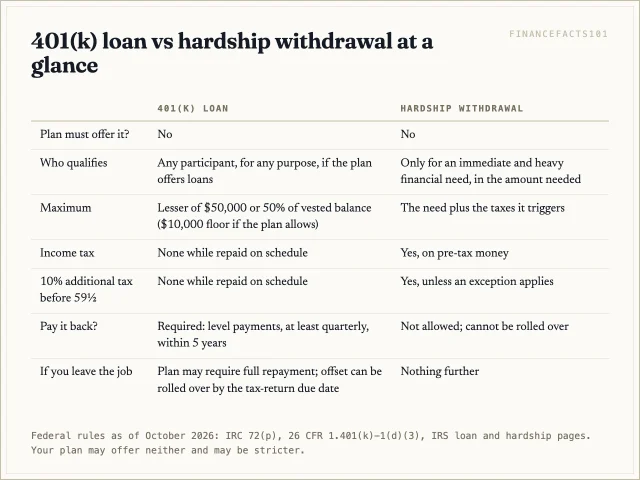
Neither option is guaranteed: the IRS states that a plan "may, but is not required to provide for loans", and hardship distributions are likewise optional. Check your summary plan description first.
How much you can borrow: the 72(p) limits
The statute caps all outstanding loans from the employer's plans at the lesser of $50,000 or the greater of half your vested balance and $10,000. The IRS loans page gives the examples: an $80,000 vested balance supports a $40,000 loan, and $120,000 supports $50,000, not $60,000.
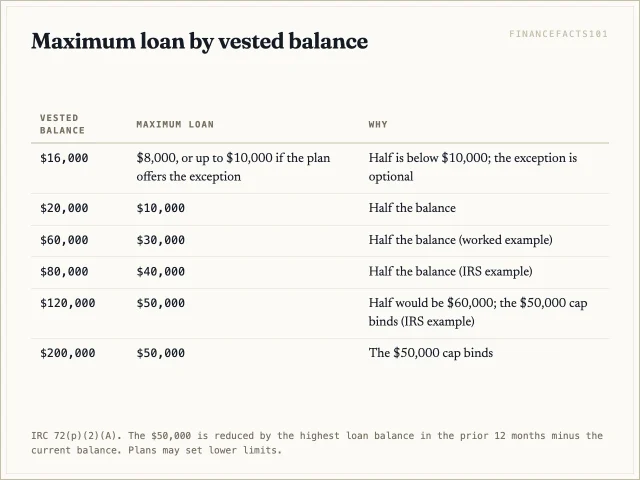
Two refinements matter. The $10,000 floor lets someone with a small balance borrow more than half, but the IRS adds, "Plans are not required to include this exception", and the Labor Department's rule limits a plan to counting no more than 50% of the vested balance as security, so a plan that offers it has to secure the rest some other way. And the $50,000 ceiling is reduced by your highest loan balance during the past 12 months minus your current one. In the IRS's example, someone with $80,000 vested who borrowed $27,000 eight months ago and still owes $18,000 can borrow only $22,000 more, and repaying the first loan would raise that to just $23,000.
Repayment, default and the cure period
A loan must be repaid within five years in "substantially level" payments, made at least quarterly. A loan used to buy your principal residence can run longer. Repayment is often by payroll deduction (the IRS lists it as an example method), in which case the payment shows up as a smaller paycheck rather than a bill.
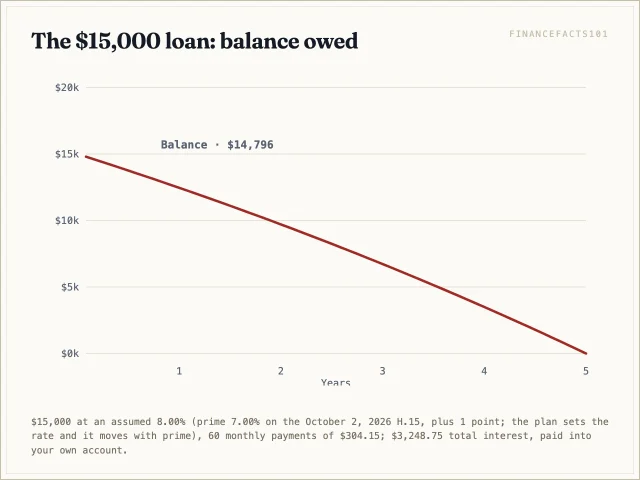
The plan sets the rate. The Labor Department requires only one that gives the plan "a return commensurate with the interest rates charged by persons in the business of lending money" for similar loans (29 CFR 2550.408b-1(e)). This guide assumes 8.00%: the bank prime rate, 7.00% on the Federal Reserve's October 2, 2026 H.15, plus one percentage point. Prime moves with the federal funds rate, so a plan rate set as prime plus a margin moves with it too; your plan's loan policy says whether a loan's rate is fixed once the loan is made.
Missing payments is where a loan turns into a withdrawal. Under 26 CFR 1.72(p)-1, Q&A-10, a missed payment makes the whole outstanding balance, with accrued interest, a "deemed distribution", taxed as income and, before 59½, subject to the 10% additional tax unless an exception applies. The plan may allow a cure period, which "cannot continue beyond the last day of the calendar quarter following the calendar quarter in which the required installment payment was due". A plan may also suspend payments during a leave of absence of up to one year if your pay drops too low to cover them (the term still ends on schedule, so payments rise afterwards), and during military service.
Leaving your job with a loan outstanding
The biggest risk in a 401(k) loan is not the interest but losing the job. The IRS says plans "may require an employee to repay the full outstanding balance of a loan if he or she terminates employment". If you cannot, the plan reduces your account by the unpaid amount, called a plan loan offset, and reports it on Form 1099-R.
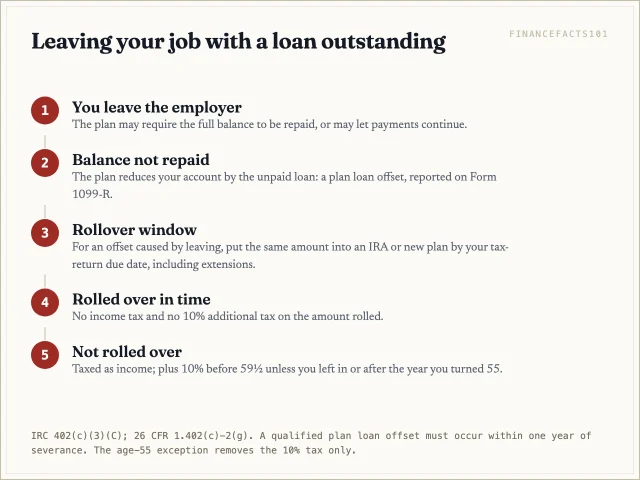
Since 2018 the law gives you more time to fix this. When the offset happens because you left the job (or the plan ended), it is a "qualified plan loan offset", and you have until your tax return's due date, including extensions, for the year of the offset to put the same amount into an IRA or a new employer's plan (IRC 402(c)(3)(C)). Under the regulation, 26 CFR 1.402(c)-2(g), the offset must occur within a year of leaving. For an offset in 2028, that means April 2029, or October 2029 if you extend the return. The catch is that you need the cash from elsewhere, because the offset paid off the loan rather than handing you money; the receiving account is covered in our IRA rollovers explainer.
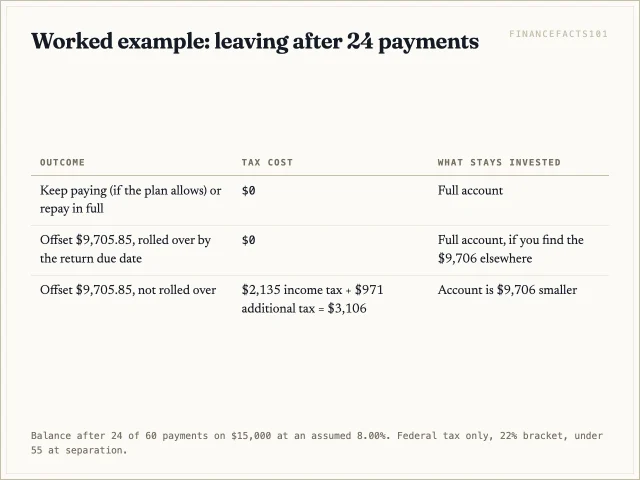
In the worked example, leaving after 24 payments leaves $9,705.85 owed: free to roll over in time, about $3,106 in tax if not. Separating in or after the year you turn 55 removes the 10% part for plan distributions, per the IRS exceptions table, but not the income tax.
Hardship withdrawals: the seven safe-harbor reasons
A plan may make a hardship distribution only for "an immediate and heavy financial need" and only in the amount needed. Plans can rely on the regulation's safe harbor: 26 CFR 1.401(k)-1(d)(3)(ii)(B) lists seven expenses that are deemed to qualify.
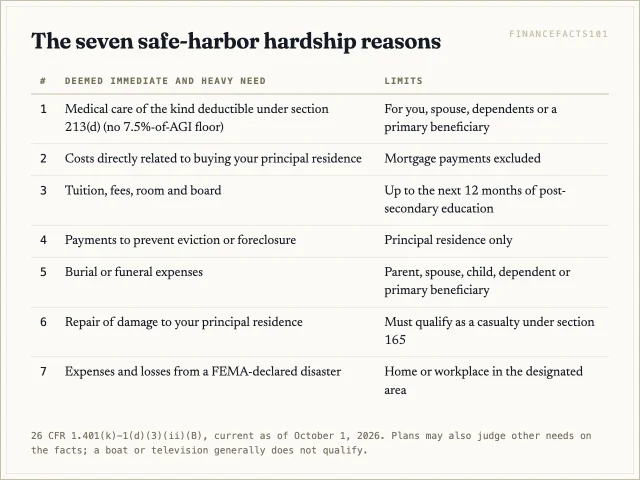
The same regulation says buying "a boat or television" generally would not qualify, and that a need "may be immediate and heavy even if it was reasonably foreseeable or voluntarily incurred". The amount can include "any amounts necessary to pay any federal, state, or local income taxes or penalties reasonably anticipated to result from the distribution", which is why the worked example withdraws more than the bill.
The rules are looser than many people remember. Since 2020 you give the plan a written representation that you lack enough "cash or other liquid assets reasonably available", and the administrator can rely on it unless it knows otherwise. You must also first take any other distributions your employer's plans currently allow (loans excepted); IRC 401(k)(14) now also lets plans rely on your written certification of the need itself, and lets them pay out earnings on your deferrals, not only the contributions. A plan may no longer suspend your contributions afterwards, but it may still require you to take any available plan loan first. Parts of the IRS's hardship web page still describe the old six-month suspension and six-item list; the regulation is the current rule.
What a hardship withdrawal really costs
The cost of a withdrawal is mostly tax. Every pre-tax dollar withdrawn is ordinary income, and before 59½ the 10% additional tax applies to the taxable part unless an exception fits. To end up with $15,000 at a 22% bracket, you need to withdraw $15,000 ÷ (1 − 0.22 − 0.10) = $22,058.82.
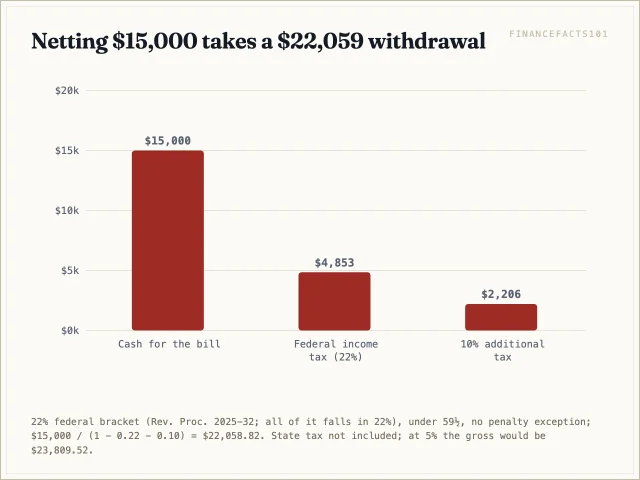
Withholding hides part of this until April. Because a hardship distribution cannot be rolled over, the mandatory 20% withholding does not apply; the plan uses the Form W-4R rule, under which "for nonperiodic payments, the default withholding rate is 10%". On $22,059 that withholds $2,206, which covers only the additional tax. The other $4,853 of income tax is due when you file, unless you elect 32% withholding or set it aside. State income tax adds to all of this: at a 5% state rate the gross needed rises to $23,809.52.
The penalty does not apply to unreimbursed medical expenses above 7.5% of adjusted gross income, to separation in or after the year you turn 55, or to the distributions in the next section. Roth 401(k) contributions come out tax-free, but a non-qualified withdrawal carries a share of taxable earnings.
SECURE 2.0's smaller doors: $1,000 emergencies and domestic abuse
For small needs, two newer options can beat both a loan and a hardship withdrawal. Both took effect for distributions after December 31, 2023, and IRS Notice 2024-55 explains them.
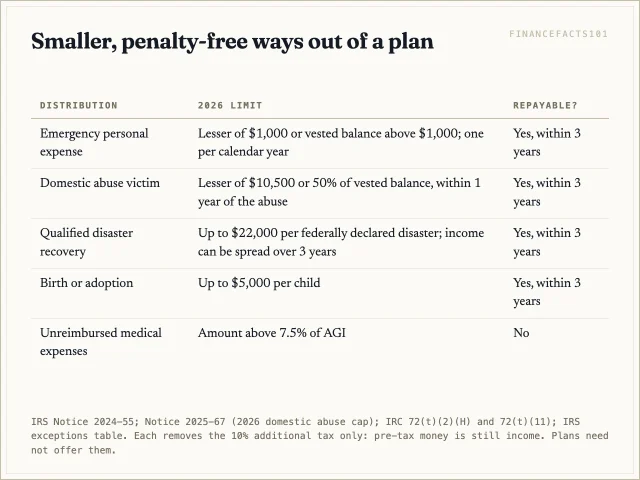
The emergency personal expense distribution allows one withdrawal per calendar year of up to the lesser of $1,000 or your vested balance above $1,000, for "unforeseeable or immediate financial needs relating to necessary personal or family emergency expenses". It is taxed but escapes the 10% additional tax, so at 22% a $1,000 withdrawal nets $780 rather than $680. It can be repaid within three years; until it is (or you have contributed as much again), the same plan allows no other one for the next three calendar years.
The domestic abuse victim distribution allows up to the lesser of 50% of the vested balance or an indexed cap, $10,500 for 2026 under IRS Notice 2025-67, within a year of the abuse. It is self-certified, penalty-free and repayable within three years. Plans need not offer either, but if yours does not, Notice 2024-55 lets you claim a qualifying distribution as one on your tax return and avoid the 10% additional tax.
Worked example: a $15,000 loan vs a $15,000 withdrawal
Dana is 35, single, earns $75,000 and defers 6% into her 401(k), with a 100% match on the first 4%. Her vested balance is $60,000, so she could borrow up to $30,000. A storm damages her house and insurance leaves $15,000 of repairs uncovered, a casualty repair that fits the safe harbor. Her taxable income is about $54,400 ($75,000 less the $4,500 deferral and the $16,100 2026 standard deduction); with the $22,059 withdrawal it would be $76,459, still inside the 22% bracket that runs to $105,700. Federal tax only, and an assumed 7% a year to age 65, compounded as the site's 401(k) calculator does.
The loan costs $304.15 a month for 60 months: $18,248.75 in total, of which $3,248.75 is interest. The withdrawal costs $7,058.82 in tax and penalty up front and nothing after.
To compare them fairly, give both versions of Dana the same take-home pay. The borrower spends $304.15 a month for five years repaying the loan. The withdrawer spends the same $304.15 a month raising her pre-tax deferral to rebuild the account. Using the 2026 brackets in Rev. Proc. 2025-32, held flat, that buys $389.93 a month of extra deferral in the withdrawal year, when all of it saves 22%, and $383.50 a month in years two to five, when her taxable income sits only $4,000 into the 22% bracket and the rest of the deferral saves 12%. Her total deferral stays far below the $24,500 limit for 2026.
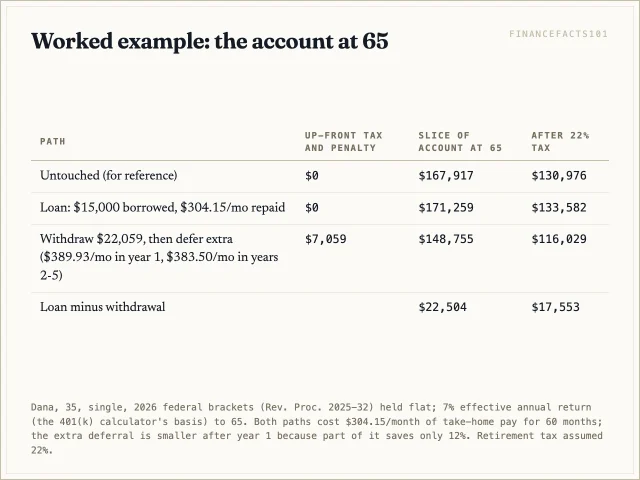
At 65 the borrower's affected slice of the account is worth $171,259 and the withdrawer's $148,755. That $22,504 gap is $17,553 after an assumed 22% tax on withdrawal in retirement. Left alone, the same $22,059 would have grown to $167,917, so the loan path even ends a little ahead of never touching the money: Dana paid $3,249 of her own interest into it, at a rate above the assumed 7% return.
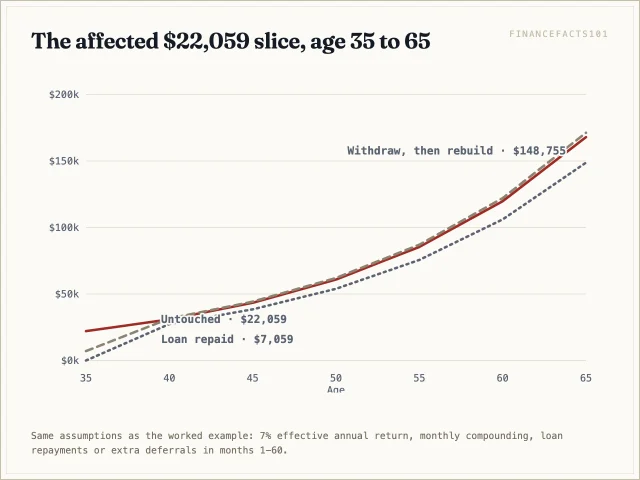
Without the rebuild, the cost is plainer. In the calculator, Dana's projected balance at 65 is $1,187,643 with the $60,000 intact and $1,019,724 after the $22,059 withdrawal, a difference of about $167,900 in future dollars.
When markets run hot: the loan's real opportunity cost
Interest paid to your own account sounds free. The cost sits elsewhere: while the money is lent out, it earns the loan rate, funded from your paycheck, instead of the market return. When the market beats 8%, the loan costs growth.
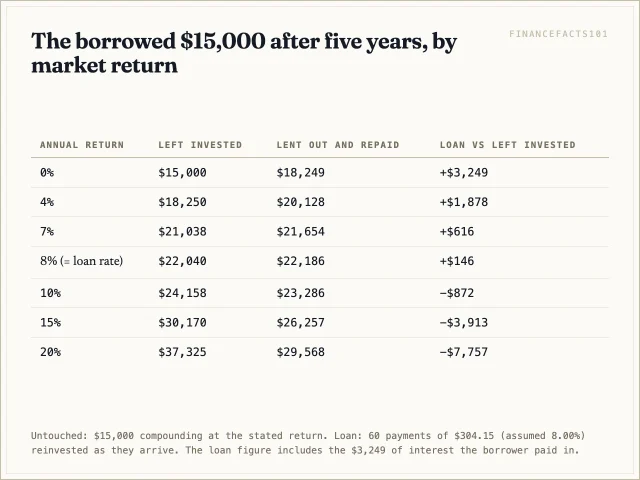
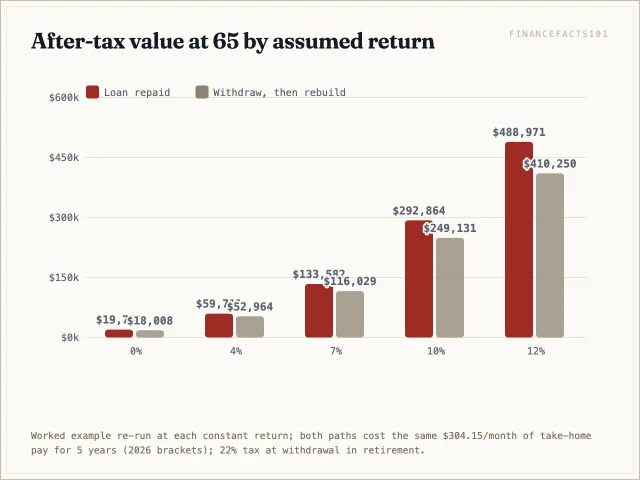
After five years the borrowed $15,000 ends $616 ahead of leaving it invested at 7%, because Dana's interest beats that return. At 10% it ends $872 behind; at 15%, $3,913; at 20%, $7,757. Single years do: Vanguard reports the S&P 500 gained 16% in 2025. Even so, the loan beat withdraw-and-rebuild at every return tested, because the $7,059 lost to tax on day one never compounds.
The double-tax argument, sized
A common objection to plan loans is that you repay with after-tax dollars and pay tax again when you withdraw in retirement. For the principal, this is wrong: you received the $15,000 untaxed, and repaying any loan, from any lender, takes after-tax pay. The objection is right about the interest. Dana's $3,248.75 goes in after tax and is taxed again when it comes out, which at a 22% rate in retirement is about $715. That is real money, and about a tenth of the $7,059 the withdrawal costs.
Plan loan interest is also generally not deductible. Section 72(p)(3) denies the deduction to key employees and on any loan secured by elective deferrals, which covers a typical 401(k) loan.
Plan-specific rules you have to look up
The law sets outer limits; your plan sets the terms. Find these in the summary plan description or loan policy:
- Whether loans, hardship withdrawals and the SECURE 2.0 distributions are offered at all.
- The loan rate formula, any fees, the minimum loan and how many loans you may have at once.
- What happens to a loan when you leave: immediate payoff, or continued payments.
- Whether a hardship withdrawal requires taking available loans first.
- Spousal consent: the IRS notes some plans require it for a loan above $5,000.
Under either option, keep contributing at least enough to get the full match; a plan can no longer suspend contributions after a hardship withdrawal, and the employer match guide shows what each skipped point costs.
Before either: cheaper money and a smaller withdrawal
Both options take money meant to compound for decades, so first ask whether something cheaper exists: insurance, a payment plan with the hospital or contractor, or a 0% card promotion you can clear in time. Once the emergency is past, whether spare cash should go to debt or to investing is the subject of the pay off debt or invest guide; the older explainer on hardship withdrawals covers why they are treated as a last resort.
The need is common. In Vanguard's preview of How America Saves 2026, 13% of participants had a loan outstanding at the end of 2025, and 6% initiated a hardship withdrawal during 2025, up from 5% in 2024. Vanguard attributes part of the rise to hardship withdrawals becoming easier to request.
The decision, step by step
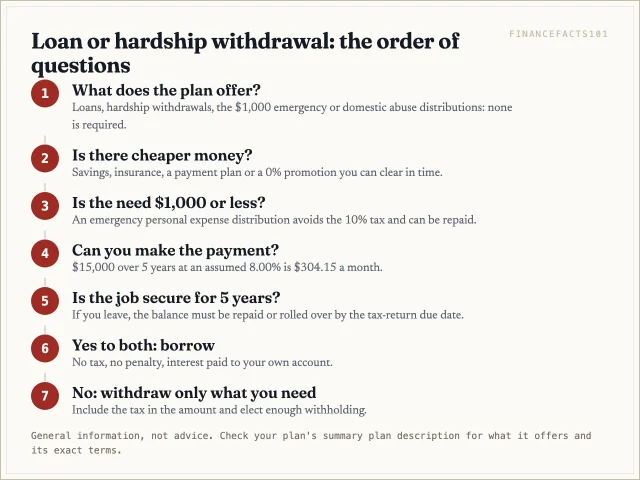
If the job is stable for the loan's term and the payment fits your budget, borrow. If the payment does not fit, or you expect to leave and could not repay the balance, a hardship withdrawal is the safer choice even though it costs more: a defaulted loan is taxed like a withdrawal anyway, and the IRS says a participant who stays in the plan is "still required to make loan repayments" after the default.
FAQ
Can I borrow from my IRA instead?
No. The IRS says loans are not permitted from IRAs, SEPs or SIMPLE IRAs, and if an IRA owner borrows from the account, "the IRA is no longer an IRA" and its entire value is included in income. Nor can an outstanding 401(k) loan be rolled into an IRA; the IRS warns that the IRA "could be disqualified" if that were attempted.
Can I take a hardship withdrawal if I have a 401(k) loan available?
Usually yes. The law says a hardship distribution does not fail "solely because the employee does not take any available loan under the plan", but the regulation still lets a plan require you to borrow first, so check your plan's hardship rules.
Can I pay back a hardship withdrawal?
No. The IRS says you cannot repay a hardship distribution to the plan or roll it over. The distributions that can be put back are different animals: the SECURE 2.0 emergency personal expense and domestic abuse victim distributions, birth or adoption distributions and qualified disaster recovery distributions can each be repaid within three years (IRC 72(t)). If repayment matters to you, a loan or one of those distributions is the route.
What happens to my 401(k) loan if I am laid off?
Your plan decides whether you can keep paying or must repay it in full. If it offsets the balance against your account because you separated, you have until your tax return's due date, including extensions, for that year to roll the same amount into an IRA or another plan and avoid the tax. Miss that deadline and the offset is taxable income, plus the 10% additional tax if you are under 59½, unless you separated in or after the year you turned 55.
Sources
- Internal Revenue Code section 72 (72(p) loan limits, repayment term, level amortization, interest deduction denial), U.S. Code 2024 edition, govinfo
- Internal Revenue Code section 401 (401(k)(14): hardship amounts, no loan requirement, employee certification)
- Internal Revenue Code section 402 (402(c)(3)(C) qualified plan loan offsets; 402(c)(4)(C) hardship not an eligible rollover distribution)
- eCFR, 26 CFR 1.401(k)-1, paragraph (d)(3), hardship distributions (current as of October 1, 2026)
- eCFR, 26 CFR 1.72(p)-1, loans treated as distributions (Q&A-4, -10, -11, -13)
- eCFR, 26 CFR 1.402(c)-2, paragraph (g), plan loan offsets
- eCFR, 29 CFR 2550.408b-1, Labor Department participant loan rules (reasonable rate, 50% security)
- IRS, Retirement topics: loans
- IRS, Retirement plans FAQs regarding loans
- IRS, Retirement topics: hardship distributions
- IRS, Retirement topics: exceptions to tax on early distributions
- IRS, Topic no. 558, Additional tax on early distributions
- IRS, Notice 2024-55, emergency personal expense and domestic abuse victim distributions
- IRS, Notice 2025-67, 2026 retirement plan limits ($10,500 domestic abuse cap)
- IRS, 401(k) limit increases to $24,500 for 2026
- IRS, Tax inflation adjustments for tax year 2026 (brackets, $16,100 standard deduction)
- IRS, Form W-4R (2026) (10% default withholding on nonperiodic payments)
- Federal Reserve, H.15 Selected Interest Rates (bank prime loan rate 7.00%, release of October 2, 2026)
- IRS, Rev. Proc. 2025-32 (2026 tax rate tables)
- Vanguard, Previewing How America Saves 2026 (loan and hardship usage in 2025; secondary source)
 Next entry · No. 5,999HDHP vs PPO: Which Health Plan Is Better for You?
See also
-
 No. 6,002
05 Nov 2026
17 min
Roll Over 401(k) or Leave It in the Plan? How to Decide
Retirement
-
 No. 5,982
16 Oct 2026
16 min
HSA vs 401(k): Where Should Your Next Dollar Go?
Retirement
-
 No. 5,987
21 Oct 2026
19 min
Should I Do a Backdoor Roth IRA? How to Avoid the Pro-Rata Tax
Retirement
-
 No. 5,979
13 Oct 2026
17 min
Roth 401(k) vs Traditional 401(k): Which Should You Choose?
Retirement
-
 No. 5,970
04 Oct 2026
17 min
Required Minimum Distributions: When to Start, How Much, and How to Cut the Tax
Retirement
-
 No. 5,941
12 Sep 2026
16 min
401(k) Employer Match: How Much of Your Salary to Defer
Retirement