Is Renters Insurance Worth It? Cost, Coverage and Break-Even Math
Renters insurance averaged $173 a year in 2023 (NAIC). For $30,000 of belongings, a policy near $211 pays $33,300 after a fire. Here is when it pays.
For most tenants, yes: renters insurance cost an average of $173 a year nationally in 2023, about $14 a month, according to the National Association of Insurance Commissioners' homeowners report published in July 2026. That price covers your belongings, your liability to other people and the extra cost of living elsewhere after a fire. Is renters insurance worth it for you in particular? It is when losing your things, or being sued, would cost more than your savings can absorb. For the worked renter below, a policy costing roughly $211 a year turns a $33,800 loss into a $500 one.
The policy is a bad bet on small losses and a very good one on large ones. Get that point right and the other choices follow: the deductible, the coverage limit, replacement cost versus actual cash value, and how much liability to carry.
A line of scope honesty first: this is general information built on stated assumptions (one specific renter and inventory, NAIC averages for 2023, price indexes through August 2026). It is not personal advice, and your quote and policy wording will differ from the standard form quoted here.
Who this is for — and who it is not for
This guide is for a US tenant in an apartment, a rented house or off-campus housing who is deciding whether to buy a renters policy (the insurance form is called HO-4), how much coverage to carry and which options are worth paying for. The examples assume a one-bedroom renter with about $30,000 of belongings, a common size: the NAIC found that 67.1 percent of renters and condo-owner policies in 2023 insured less than $35,000.
It is not for condo owners, whose HO-6 policy also covers parts of the building. It is not for landlords insuring a rental, or for anyone running a real business from home: the standard renters form caps business property at $2,500 at home and $1,500 away from it. Dependent students should check their parents' policy first. The standard ISO definitions count a full-time student under 24 who is a relative and lived in the household before leaving for school as an insured. The Texas Department of Insurance notes that this coverage is usually limited to 10 percent of the parents' personal property limit.
Is renters insurance worth it? The answer in four numbers
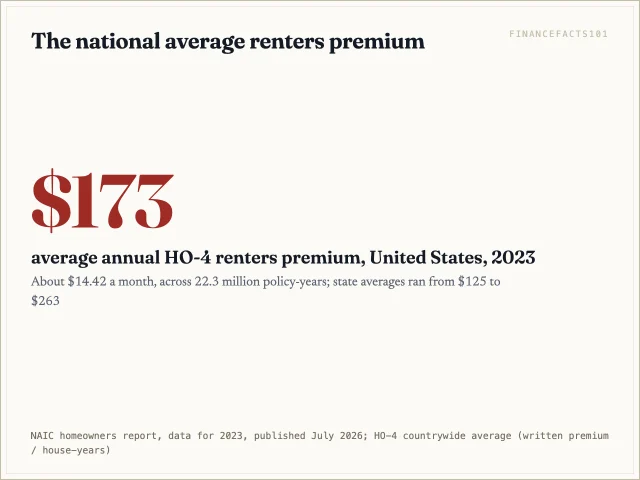
Start with the price. The NAIC's homeowners and renters insurance report, compiled by state regulators from statistical-agent data, put the 2023 countrywide HO-4 average at $173 for a year of coverage, across 22.3 million policy-years. That edition was published in July 2026.
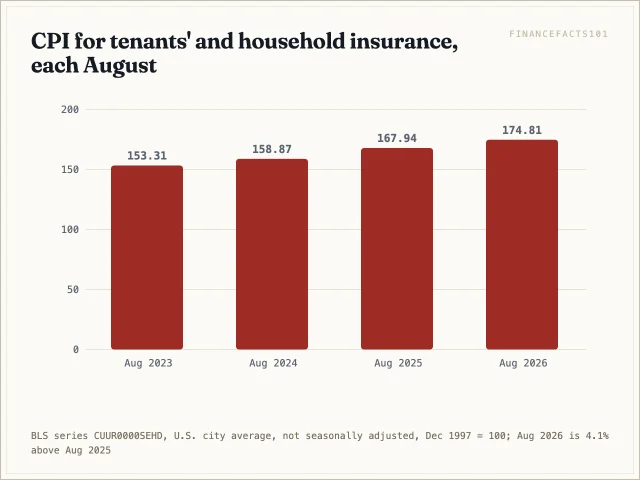
Second, how prices have moved since then. The NAIC data lags by about three years, so the more recent signal is the Bureau of Labor Statistics' consumer price index for tenants' and household insurance. It stood at 174.806 in August 2026, 4.1 percent higher than a year earlier and about 14 percent above its 2023 average. If renters premiums had moved in step, the national average would now be near $197. That is an estimate, not a survey figure: the index also tracks other household insurance.
Third, the spread by state: from $125 in South Dakota to $263 in Mississippi in 2023. Fourth, how many renters buy it. The NAIC counted 22.3 million HO-4 policy-years in 2023, while the Census Bureau's Housing Vacancy Survey counted 44.3 million renter-occupied homes in the second quarter of 2023. A policy-year and a household are not the same unit, so the ratio is rough, but it points to about half of renting households going without.
What a renters policy covers
A standard renters policy bundles four coverages. The wording below comes from the Insurance Services Office's standard HO 00 04 renters form, as posted by Maine's Bureau of Insurance. Many insurers use this form or adapt it, so your own policy may differ.
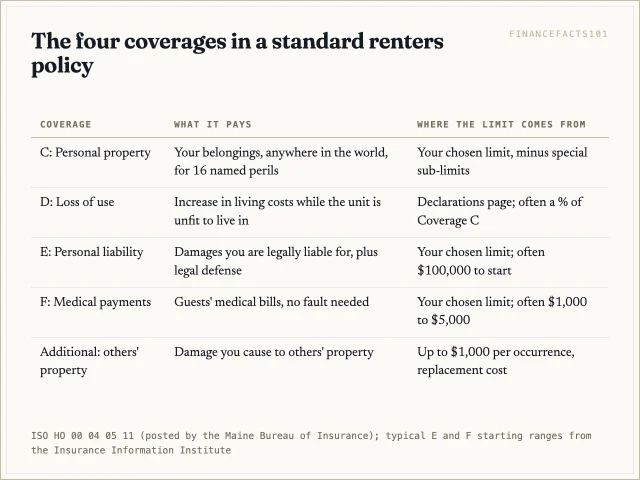
Personal property (Coverage C) covers property "owned or used by an 'insured' while it is anywhere in the world", so a laptop stolen from a car or a suitcase taken from a hotel counts. It pays only for 16 named perils, including fire, lightning, windstorm, theft, smoke, vandalism, burst pipes and sudden electrical damage. Dropping your phone in a lake is not a named peril.
Loss of use (Coverage D) pays the extra cost of living elsewhere while your unit is unfit to live in. Personal liability (Coverage E) pays damages you are legally liable for and, in the form's words, provides "a defense at our expense by counsel of our choice, even if the suit is groundless, false or fraudulent." Medical payments (Coverage F) pays a guest's medical bills without anyone having to prove fault.
What it does not cover: floods, earthquakes, roommates and the fine print
The standard form excludes flood (including storm surge), sewer backup and sump overflow. It also excludes earth movement: earthquake, landslide and sinkhole. One carve-back matters: if an earthquake causes a fire, explosion or theft, that resulting loss is covered. South Carolina's Department of Insurance puts it plainly: "most renter's insurance policies do not cover floods or earthquakes."
Flood cover is a separate purchase. The National Flood Insurance Program, run by FEMA, insures renters' contents, and the NAIC's flood insurance guide puts the contents limit at up to $100,000. FEMA warns of "typically a 30-day waiting period," so buying once a storm is forecast is too late. In California, the California Earthquake Authority sells renters earthquake policies through participating insurers, with deductibles of 5 to 25 percent of the personal property limit.
Roommates are the gap that catches people out. The standard form defines "insured" as you and residents of your household who are your relatives, or people under 21 in your care. An unrelated roommate is neither, and the form's list of property not covered names "property of roomers, boarders and other tenants" unless they are related to an insured. Their belongings and their liability are outside your policy, so each roommate needs one.
Then there are the special limits. These are sub-caps inside your personal property limit, and they apply however high that limit is.
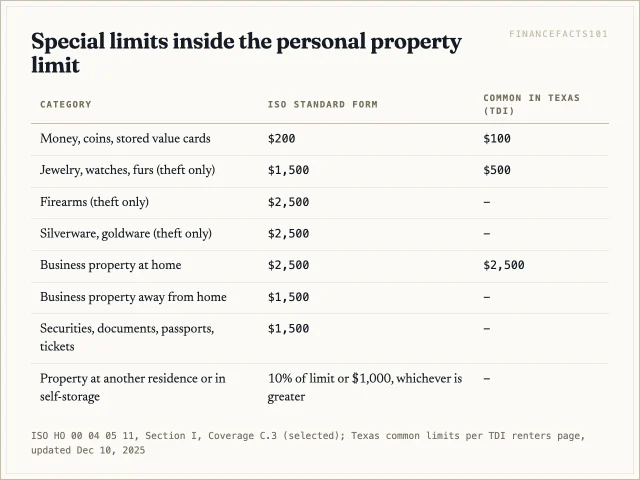
Jewelry and watches are capped at $1,500 for theft (fire is not capped), so a stolen $4,000 ring pays at most $1,500. Cash is capped at $200. State versions vary: the Texas Department of Insurance lists $100 for cash and $500 for jewelry and watches as common limits there. Anything above a cap needs scheduled coverage, such as a jewelry floater.
Your landlord's policy does not cover your things
This is the first point regulators make, and they make it bluntly. The NAIC's renters guide: "Your landlord's insurance doesn't cover the things you own." The DC Department of Insurance, Securities and Banking goes further: the landlord's insurance "does not extend to your personal property, nor does it protect you from being liable for damage you might cause to the building."
That second half is the expensive part. Suppose a pan fire you start spreads to the cabinets and the unit above. The landlord's insurer pays for the repairs and can then, in many states, pursue you to recover what it paid. The standard renters form excludes damage to property you rent, but not damage "caused by fire, smoke or explosion," so your liability coverage answers that claim. Without a policy, you answer it yourself.
The Texas regulator notes that renters insurance "isn't required by law," though "some landlords might require you to have a renters policy." A lease requirement mostly concerns the liability coverage, which is what pays the landlord back for damage you cause. The cover for your belongings is there for you.
What renters insurance costs, by state and by coverage amount
Where you live moves the price a lot. The NAIC's 2023 averages run from $125 in South Dakota to $263 in Mississippi, with Louisiana, Oklahoma and Alabama also above $215. The four states with the most renter policies sit near the national average: California $171, New York $176, Florida $186 and Texas $201.
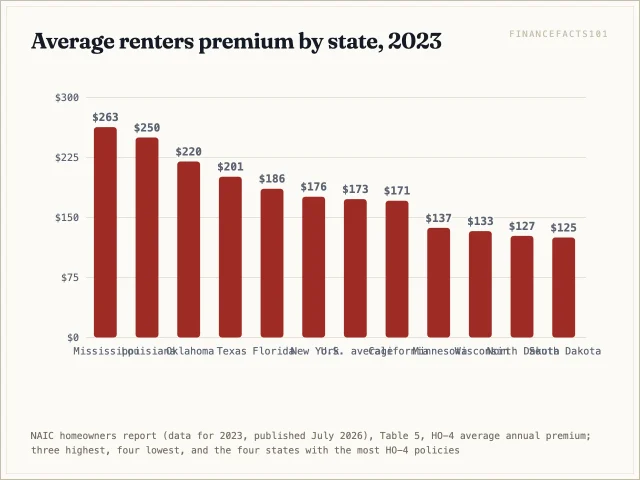
The coverage amount moves it much less. Nationally in 2023, policies insuring $10,000 to $14,999 averaged $140, while those insuring $30,000 to $34,999 averaged $185: $45 a year more for about two and a half times the coverage.
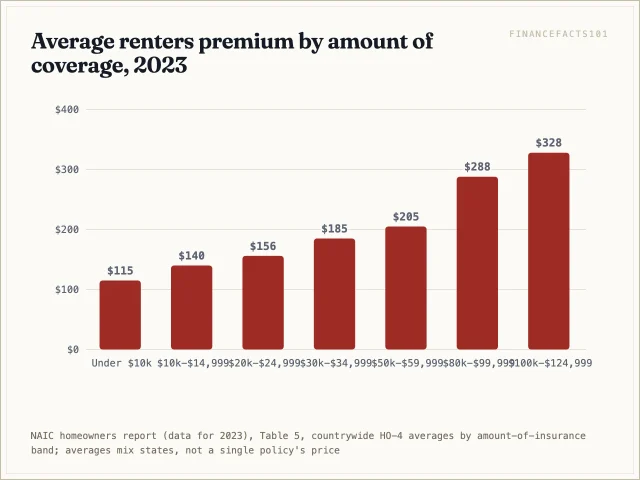
One caveat: each bar averages different people in different states, so it is not the price of adding $10,000 to one policy. The direction still holds, and it is the practical lesson. Underinsuring to save money saves very little.
Replacement cost vs actual cash value: a worked example
The standard form pays actual cash value: "Covered property losses are settled at actual cash value at the time of loss but not more than the amount required to repair or replace." Actual cash value is replacement cost minus depreciation. Replacement cost coverage, added by endorsement for a higher premium, pays what the item costs new today. The Texas regulator's example is a laptop bought for $1,300 two years ago that now sells for $500: a basic policy pays $500.
The worked renter's assumptions:
- One-bedroom apartment; belongings with a replacement cost of $30,000, from a room-by-room inventory
- Policy: $30,000 personal property limit, replacement cost endorsement, loss of use at 20 percent of the personal property limit ($6,000), $500 deductible, $100,000 liability
- Premium: $211 a year, which is the NAIC's 2023 average for policies insuring $30,000 to $34,999 ($185) raised by the CPI index's 14 percent rise to August 2026. That average mixes actual cash value and replacement cost policies, so it is before any replacement-cost surcharge
- Loss: a fire that starts in a neighbour's unit destroys everything, and the renter lives elsewhere for two months
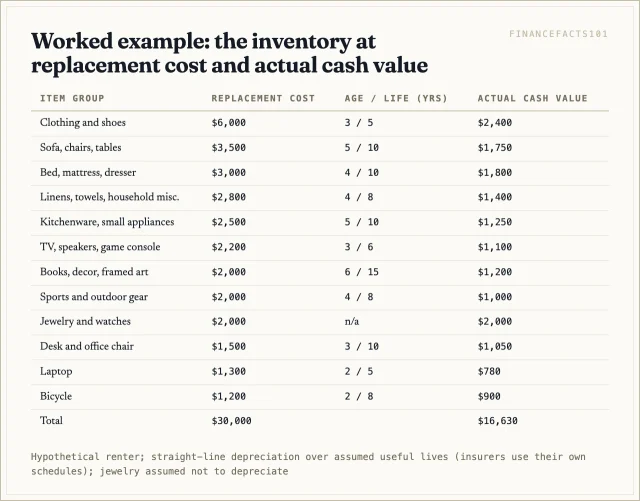
Depreciation is where the two policies part ways. The inventory uses straight-line depreciation over a stated useful life, a simplification of insurers' own schedules. On that basis the $30,000 of belongings has an actual cash value of $16,630, so depreciation takes $13,370. The two months away add $3,800 of extra living costs: $1,500 a month more for a short-term rental than normal rent, plus $400 a month more for meals.
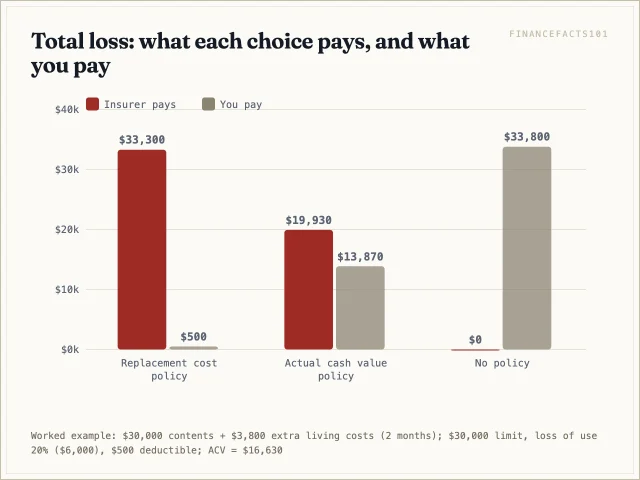
The replacement cost policy pays $30,000 plus $3,800 minus the $500 deductible: $33,300, leaving the renter $500 out. The actual cash value policy pays $16,630 plus $3,800 minus $500: $19,930, leaving a $13,870 gap. With no policy, the gap is the full $33,800.
Two details. The Texas regulator's home insurance guide says replacement cost is paid in two checks, actual cash value first, then: "After you've replaced the item, the company will give you a check for the rest of your claim amount." Anything you never replace stays at actual cash value. And the limit caps everything: had the inventory come to $36,000, the policy would still stop at $30,000. Let the inventory, not a guess, set the limit, as the Insurance Information Institute also advises.
Loss of use: the coverage nobody checks
Loss of use pays "any necessary increase in living expenses" so your household keeps its normal standard of living, for "the shortest time required to repair or replace the damage." It pays the increase, not your whole rent. If your rent stops while the unit is uninhabitable, that saving offsets the claim.
The limit is printed on the declarations page, is often a percentage of the personal property limit, and the percentage varies by insurer. One example: a Florida insurer's HO-4 coverage worksheet, posted by Citizens Property Insurance, sets loss of use at 10 percent and does not allow an increase.
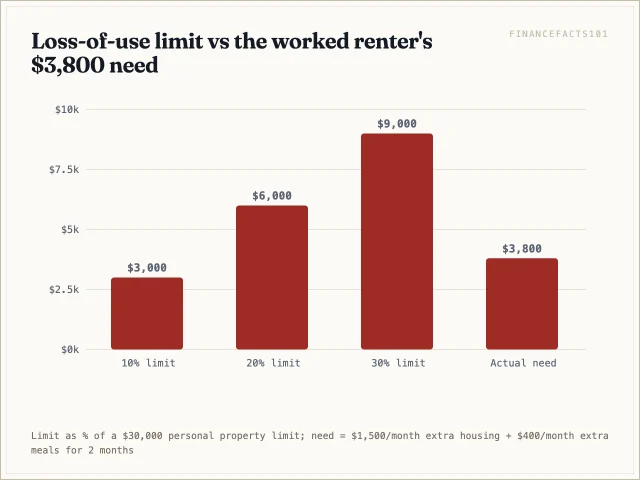
For the worked renter, 10 percent of $30,000 is $3,000, which is $800 short of the $3,800 the two months cost. The worked policy's 20 percent limit ($6,000) covers it, as would 30 percent. A tight short-term rental market or a longer rebuild widens the gap fast, so this is a number worth comparing between quotes.
Deductibles: $500 or $1,000?
The deductible applies per claim, not per year. The Texas Department of Insurance's deductible guide says "the deductible will be applied to each claim," that moving from a $500 to a $1,000 deductible "can save as much as 20 percent," and that "filing small claims may affect how much you have to pay for insurance later."
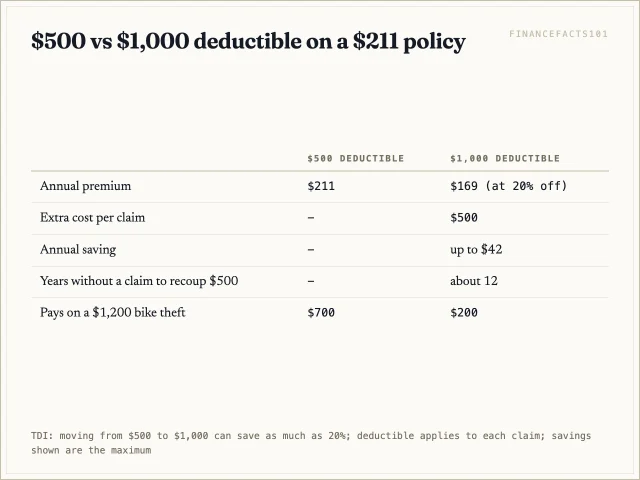
For the worked renter, 20 percent of $211 is at most $42 a year. Taking on $500 more risk to save $42 pays off unless you claim more than about once every 12 years. If you would not expect more than one claim a decade, and you have even a starter emergency fund to cover $1,000, the higher deductible wins.
Liability limits, and where an umbrella fits
The Insurance Information Institute says renters liability limits "generally start at about $100,000," and that "some experts recommend that you buy at least $300,000." Medical payments coverage generally runs from $1,000 to $5,000. In the Florida worksheet above, the standard $100,000 can be raised to $300,000.
Who needs more than the minimum? Anyone a court could see as able to pay: a high earner, someone with significant savings, a dog owner, anyone who hosts often. Read the animal clause as well. The same Florida insurer includes no animal liability unless you buy a $25,000 option, which shows how far one insurer's terms can sit from the standard form.
Above $300,000, the next layer is an umbrella policy, which the III prices at roughly "$200 to $350 a year for an extra $1 million." Umbrella insurers require a minimum liability limit on the policy underneath, so your renters limit is the floor the umbrella stands on. How much umbrella to carry is covered in our guide to how much umbrella insurance you need. In short, raise the renters liability limit to whatever the umbrella insurer requires before you buy the umbrella.
The break-even way to think about it
A policy pays for itself in a given year only if a claim happens. So the useful question is how likely a loss would have to be for the premium to be a fair price. Divide the premium by what the policy would pay:
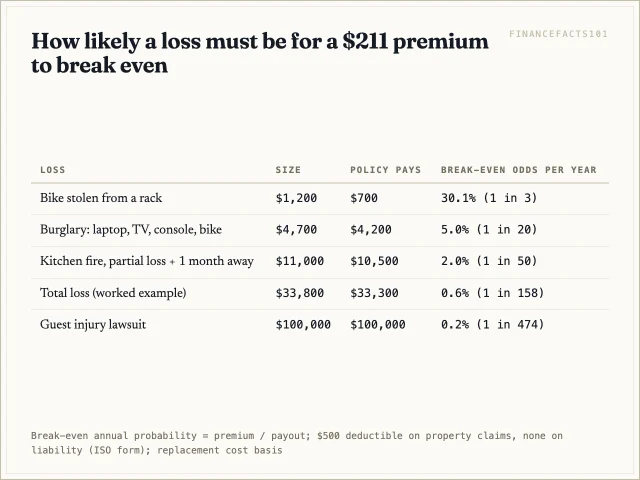
A $211 premium is a terrible price for a $1,200 bike: you would need a 30 percent chance of losing it every year to break even. For a burglary of electronics it is reasonable, at 5 percent. For a total loss it is cheap, at 0.6 percent a year, about 1 in 158. For a $100,000 liability claim, which carries no deductible under the standard form, the break-even odds drop to 0.2 percent.
For scale, the Bureau of Justice Statistics' Criminal Victimization, 2024 found that 0.71 percent of US households suffered a burglary in 2024, and 6.18 percent had some other theft. Those figures cover all households, not just renters, and most burglaries take far less than everything. Insurers' costs and profit come out of premiums, so on average buyers pay in more than they collect; the case for the policy rests on the losses you could not absorb.
So set your worst realistic uninsured loss against your cash buffer. For the worked renter, that is $33,800 of contents and displacement, plus whatever a liability claim adds. Against a three-month emergency fund like the $10,950 in our emergency fund guide's example, it means debt. A renter with $2,000 of belongings and $50,000 in savings could reasonably skip the policy, but would carry the liability risk alone.
Taxes: why an uninsured loss usually stays uninsured
A tax deduction rarely softens an uninsured loss. The IRS's casualty and theft loss page states that since tax year 2018, "a deduction is generally not available for net personal casualty losses... unless the loss is caused by a federally declared disaster."
The One Big Beautiful Bill Act (Public Law 119-21, section 70109) made that limitation permanent. For tax years beginning after December 31, 2025, it also allows losses from a "State declared disaster": a natural catastrophe, or any fire, flood or explosion, that the governor and the Treasury Secretary find severe enough. Even then, the standard rules subtract $100 per event and 10 percent of adjusted gross income (some specially designated disasters have had different rules). An apartment fire or burglary outside a declared disaster generally produces no federal deduction (such losses can still offset any personal casualty gains).
How to buy renters insurance well: the decision, step by step
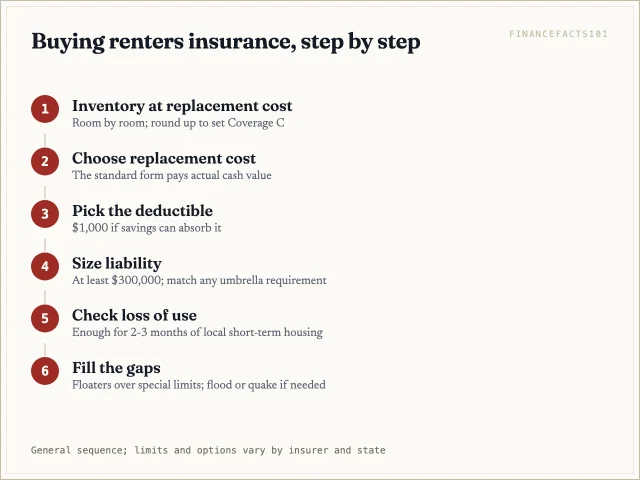
Do the inventory first: an hour with your phone camera, room by room, closets and drawers included. Total it at replacement cost and round up to set the limit. Then choose replacement cost, a $1,000 deductible if you can cover it, liability of at least $300,000, and a loss-of-use limit that would pay for two to three months of local short-term housing. Re-run the inventory after a big purchase or a move. The site's older primer on renters insurance basics explains the vocabulary.
FAQ
How much is renters insurance a month?
The NAIC's latest national figure is $173 a year for 2023, about $14.42 a month, with state averages from $125 a year in South Dakota to $263 in Mississippi. The tenants' and household insurance CPI rose about 14 percent from its 2023 average to August 2026; if premiums tracked it, the average would now be about $197 a year, or $16 a month. That is an estimate: your ZIP code, limits, deductible and claims history set the actual price.
Does renters insurance cover my roommate?
Not under the standard form. An "insured" is you plus resident relatives and people under 21 in your care, and the form excludes "property of roomers, boarders and other tenants" who are not related to you. An unrelated roommate's belongings and liability are outside your policy. The clean answer is two policies; at about $14 a month each on the national average, that is cheaper than the argument after a fire.
Does renters insurance cover theft from my car?
Yes. The standard form covers your belongings "anywhere in the world," and the Texas regulator gives items "stolen out of your car" as an example. The car itself and its parts are a matter for auto insurance. The deductible still applies: a stolen $600 backpack on a $500 deductible pays $100.
Can my landlord require renters insurance?
Yes, through the lease. The Texas Department of Insurance notes it "isn't required by law" but that "some landlords might require you to have a renters policy." A lease may set a minimum liability limit or ask that the landlord be listed as an interested party, so they are told if the policy lapses.
Sources
- National Association of Insurance Commissioners, Dwelling Fire, Homeowners Owner-Occupied, and Homeowners Tenant and Condominium/Cooperative Unit Owner's Insurance Report: Data for 2023 (July 2026; Table 5, HO-4 average premiums)
- NAIC, Renting Your Home? Protect Your Belongings with Renters Insurance (consumer guide)
- NAIC, Flood Insurance (NFIP contents limit, waiting period)
- Bureau of Labor Statistics, CPI-U: Tenants' and household insurance, U.S. city average (CUUR0000SEHD) (August 2026: 174.806)
- U.S. Census Bureau, Quarterly Residential Vacancies and Homeownership, Second Quarter 2023 (renter-occupied housing units)
- Internal Revenue Service, Topic no. 515, Casualty, disaster, and theft losses (reviewed September 24, 2026)
- Public Law 119-21, section 70109 (casualty loss limitation made permanent; State declared disasters, effective 2026)
- FEMA, Flood Insurance (National Flood Insurance Program)
- Bureau of Justice Statistics, Criminal Victimization, 2024 (September 2025; Table 16, households experiencing property crime)
- Insurance Services Office, HO 00 04 05 11 Homeowners 4 – Contents Broad Form (as posted by the Maine Bureau of Insurance)
- Texas Department of Insurance, Renters insurance: What does it cover and how much does it cost? (updated December 10, 2025)
- Texas Department of Insurance, Home insurance guide (updated June 1, 2026; replacement cost paid in two checks)
- Texas Department of Insurance, What to know about deductibles (updated October 14, 2024)
- DC Department of Insurance, Securities and Banking, What You Need to Know About Renters Insurance
- South Carolina Department of Insurance, Understanding Renter's Insurance
- California Earthquake Authority, Renters coverages and deductibles
- Southern Oak Insurance Company, HO-4 Coverage Worksheet (12/25 edition, posted by Citizens Property Insurance Corporation; one insurer's terms)
- Insurance Information Institute, Renters Insurance (industry body; liability and umbrella ranges)
 Next entry · No. 5,998401(k) Loan vs Hardship Withdrawal: Which Is Less Costly?
See also
-
 No. 5,634
25 Sep 2025
17 min
Understanding Water Exclusion Clauses in Homeowners and Renter’s Insurance
Insurance
-
 No. 5,389
04 Sep 2025
19 min
Valuation Clauses in Insurance Policies: Understanding Replacement Cost, Actual Cash Value, and Agreed Value
Insurance
-
 No. 4,380
14 Jun 2025
20 min
Renter’s Insurance 101: Understanding Coverage and Its Importance for Tenants
Insurance
-
 No. 5,991
25 Oct 2026
16 min
How Much Umbrella Insurance Do I Need? The Exposure Math
Insurance
-
 No. 5,804
08 Oct 2025
18 min
Understanding Worldwide Coverage: A Comprehensive Guide for Global Insurance
Insurance
-
 No. 5,707
01 Oct 2025
21 min
Understanding Whole Life Insurance: A Comprehensive Guide for Institutional Investors
Insurance