Inherited IRA Rules: The 10-Year Clock, the Yearly Minimums, and How to Cut the Tax
Most heirs must empty an inherited IRA within 10 years, with yearly RMDs if the owner had begun them. Spreading $500,000 cut the tax rate from 33.9% to 23.5%.
Under the inherited IRA rules in force as of October 2026, most people who inherit an IRA from someone who died after 2019 must empty it by December 31 of the 10th year after the death, and if the owner had already reached the required beginning date for their own RMDs, the heir must also take a minimum withdrawal in each of years one through nine. Spouses, the owner's children under 21, disabled or chronically ill heirs and anyone not more than 10 years younger than the owner can still stretch withdrawals over their life expectancy; for everyone else, spreading the money across the 10 years instead of taking one lump is the main tax cut, lowering the federal rate in our $500,000 example from 33.9 percent to 23.5 percent.
A line of scope honesty first: this is general information built on stated assumptions (a hypothetical heir, 2026 federal tax brackets, a 5 percent assumed return), not personal tax advice. Custodians need not send beneficiaries an RMD statement, as IRS Publication 590-B notes, so getting the number right is on you.
Who this is for, and who it is not for
This guide is for anyone who has inherited, or expects to inherit, a traditional or Roth IRA from someone who died in 2020 or later. Most of it also applies to an inherited 401(k), 403(b) or 457(b), though a plan's own document can be stricter than the law.
It is not for heirs of owners who died in 2019 or earlier. Those accounts keep the older stretch rules, though the life expectancy divisors were reset by the 2022 tables. It is not a guide to the owner's own RMDs, which our required minimum distributions guide covers, and it does not compare estate-planning documents; the will vs trust guide does that. Our older reference entry on inherited IRAs defines the terms without the decision math.
Inherited IRA rules: which of three groups you are in
Beneficiaries fall into three groups, and since the SECURE Act the group decides almost everything else; the IRS page Retirement topics: Beneficiary and Pub. 590-B use the same labels. Eligible designated beneficiaries (the five exceptions) can still stretch. Every other person named on the account is a designated beneficiary on the 10-year rule. An estate, a charity or a trust that fails the look-through tests is not a designated beneficiary and follows the older 5-year or owner's-life-expectancy rules.
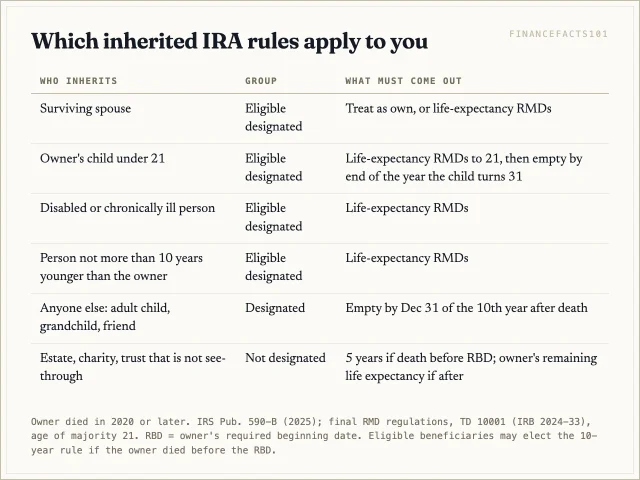
Status is fixed at the date of death. The final RMD regulations, published as TD 10001 in Internal Revenue Bulletin 2024-33, say a person "reaches the age of majority on the individual's 21st birthday", and they define "child" to include a stepchild, an adopted child and an eligible foster child. A grandchild is not an eligible designated beneficiary on age alone.
Heirs sharing one IRA can split it into separate inherited IRAs by December 31 of the year after the death, so each uses his or her own rules, per Pub. 590-B.
The 10-year rule, and when it also needs yearly withdrawals
For a designated beneficiary, Pub. 590-B says the account must be emptied "by December 31 of the year containing the 10th anniversary of the owner's death": a 2025 death sets a deadline of December 31, 2035. Years one through nine depend on one fact about the owner.
If the owner died before the required beginning date, nothing is required until the 10th year. That date is April 1 of the year after the owner reached RMD age: 73 for anyone who turned 72 after 2022, and 72 or 70½ for earlier birth years. Pub. 590-B is explicit: "no distribution is required for any year before the 10th year."
If the owner died on or after the required beginning date, the beneficiary must also take an RMD in each year from the first year after the death. The final regulations kept that reading over commenters' objections: "read together, those provisions generally require annual distributions to continue while also requiring full distribution" by the end of the 10th year.
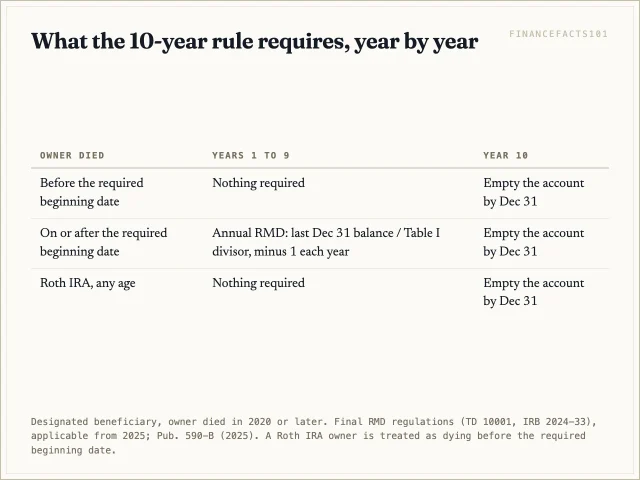
In practice, for deaths so far: an owner who died at 75 or older had passed the date; one who died at 70 had not. Death in the year the owner turned 73, or before April 1 of the next year, is still before the date, so check the exact birth and death dates.
The waived years, 2021 to 2024, and what changed in 2025
The IRS did not enforce the annual RMDs for four years: Notice 2022-53 (IRB 2022-45) waived the excise tax on these missed amounts for 2021 and 2022, Notice 2023-54 (IRB 2023-31) extended that to 2023, and Notice 2024-35 (IRB 2024-19) to 2024.
The relief covered a designated beneficiary whose owner died in 2020 through 2023 on or after the required beginning date, and the heir of an eligible designated beneficiary who died in those years while taking life-expectancy payments. The final regulations apply "for calendar years beginning on or after January 1, 2025", so 2025 was the first enforced year.
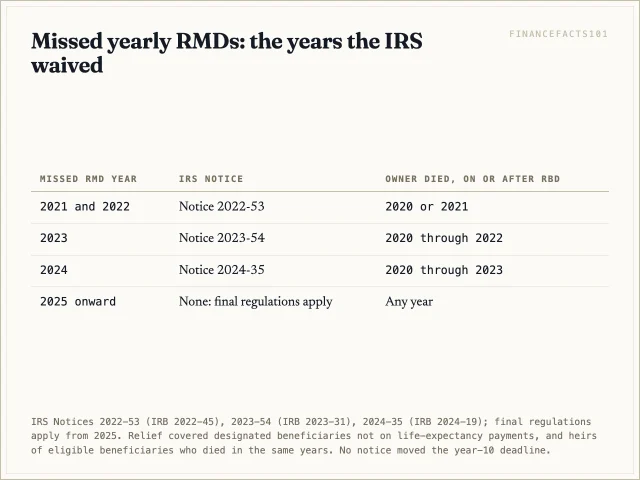
The notices waived only the yearly amounts; none moved the year-10 deadline. An heir of a 2020 death still has to empty the account by December 31, 2030, after five enforced annual RMDs (2025 through 2029).
How a beneficiary's yearly RMD is calculated
Divide last December 31's balance by a divisor from Table I, the Single Life Expectancy table in Pub. 590-B's Appendix B, at the beneficiary's age in the year after the death. A non-spouse beneficiary then subtracts exactly 1 each year.
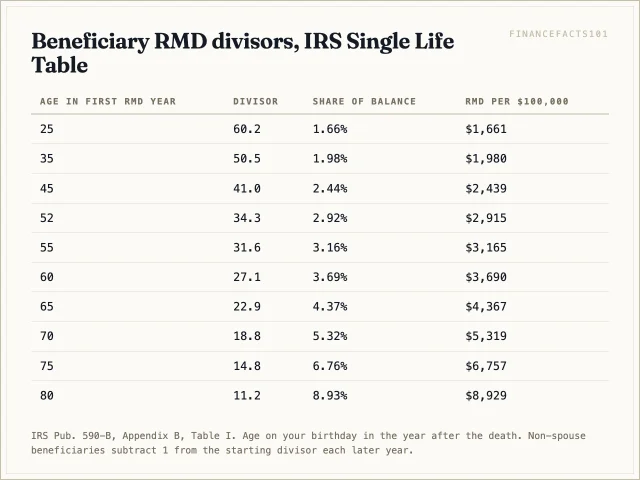
A 52-year-old starting in 2026 uses 34.3 (2.92 percent of the balance), then 33.3 in 2027, and so on. When the owner died after the required beginning date and was younger than the heir, the heir uses the owner's remaining life expectancy instead if that is longer.
Check one more withdrawal first: any untaken RMD for the year of death. Pub. 590-B makes beneficiaries "responsible for figuring and distributing" it, generally on the owner's Uniform Lifetime Table, as if the owner had lived all year. That is the division the RMD calculator performs; for your own later RMDs, do the same division with the Table I divisor instead. Under the final excise tax rules, a missed year-of-death RMD is forgiven automatically if the beneficiary takes it by the later of that year's filing deadline (with extensions) and the end of the next calendar year.
Eligible designated beneficiaries: the stretch that survived
The five exceptions keep most of the pre-2020 "stretch": annual Table I RMDs from the year after the death, for life. When the owner died before the required beginning date, an eligible beneficiary can elect the 10-year rule instead; Pub. 590-B notes most IRA documents default to life-expectancy payments otherwise.
The minor-child exception is temporary. A child on life-expectancy payments switches to the 10-year rule at 21 and must empty the account by the end of the year containing the 10th anniversary of that birthday, which is the year he or she turns 31, while still taking annual RMDs in between. A child who turns 14 in 2026 reaches 21 in 2033 and must empty the account by the end of 2043.
The other three last for life. The most overlooked is the age test: a sibling, partner or friend not more than 10 years younger than the owner qualifies. Disability and chronic illness use the definitions in sections 72(m)(7) and 7702B(c)(2); for IRAs the regulations say the documentation "need not be provided" to the custodian, while plans need it by October 31 of the year after the death.
When an eligible beneficiary dies, the next heir does not restart the stretch: the balance must be paid out within 10 years, with annual RMDs continuing meanwhile.
If you inherited from your spouse: treat it as yours or stay a beneficiary
A surviving spouse has the widest choice. Pub. 590-B lists two routes: treat the IRA as your own (by retitling it or rolling it into your own IRA), or remain a beneficiary. Treating it as your own requires being the sole beneficiary with an unlimited right to withdraw, so a spouse who inherits through a trust cannot.
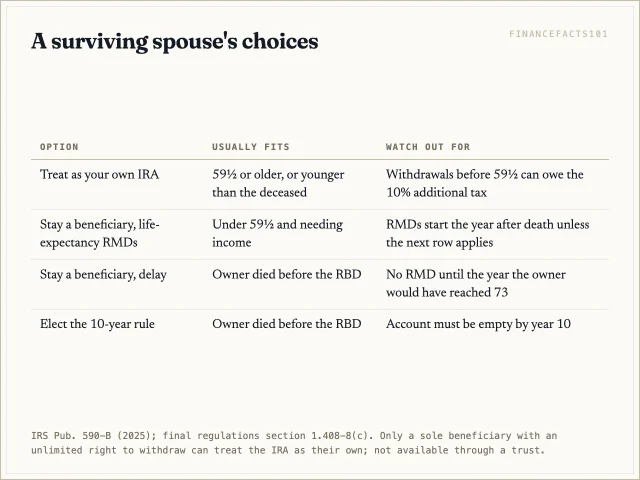
The deciding fact is usually age 59½. Once the account is yours, the regulations make you its owner "for all purposes", and Pub. 590-B warns that distributions before 59½ "may be subject to the 10% additional tax". A beneficiary is exempt under the death exception. So a 50-year-old widow who needs income often stays a beneficiary and makes the election later, which the regulations allow once that year's required amount, if any, is out. The trap runs the other way too: a sole spouse beneficiary who misses a required distribution, or adds money to the inherited IRA, is deemed to have treated it as their own.
Timing is the second factor. If the owner died before the required beginning date, a spouse who stays a beneficiary need not start RMDs until the year the owner would have reached 73. A survivor younger than the deceased can wait longer by treating the account as their own.
Inherited Roth IRAs: wait, then take it tax-free
An inherited Roth IRA follows the same timetable with the tax removed. The final regulations treat every Roth owner as having died before the required beginning date, so a designated beneficiary on the 10-year rule has no yearly withdrawals, only the year-10 deadline.
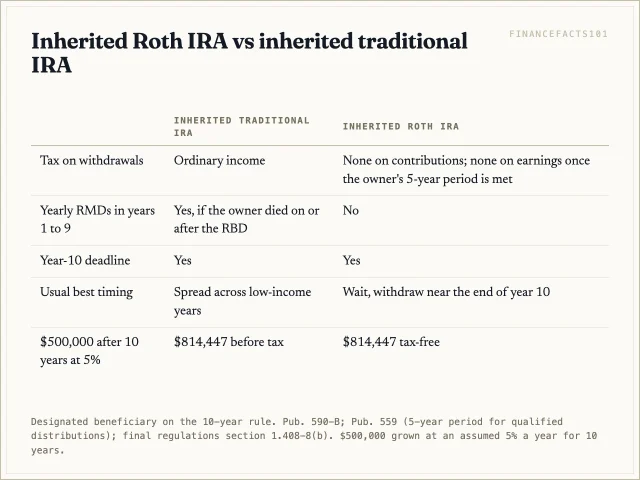
Contributions come out tax-free. Earnings are tax-free once the 5-tax-year period that began with the owner's first contribution to any Roth IRA has passed, per Publication 559. The 10 percent additional tax does not apply to a distribution made to a beneficiary because of the owner's death.
So the strategy is the reverse of a traditional IRA's: let it grow and withdraw near the end of year 10. At 5 percent, $500,000 becomes $814,447, all tax-free.
When a trust or an estate is the beneficiary
A trust cannot itself be a designated beneficiary, but Pub. 590-B treats its beneficiaries as designated beneficiaries if the trust is valid under state law, is irrevocable (or becomes so at death), has identifiable beneficiaries, and the trustee gives the custodian any documentation it asks for (the final regulations no longer require trust documents for IRAs, but custodians may). The regulations split these "see-through" trusts in two.
- A conduit trust must pay every IRA distribution straight out to named beneficiaries. The IRA follows those beneficiaries' rules, so a conduit trust for a spouse or a minor child keeps their stretch.
- An accumulation trust may keep distributions inside. Everyone who could receive the retained money counts as a beneficiary, which usually puts the IRA on the 10-year rule.
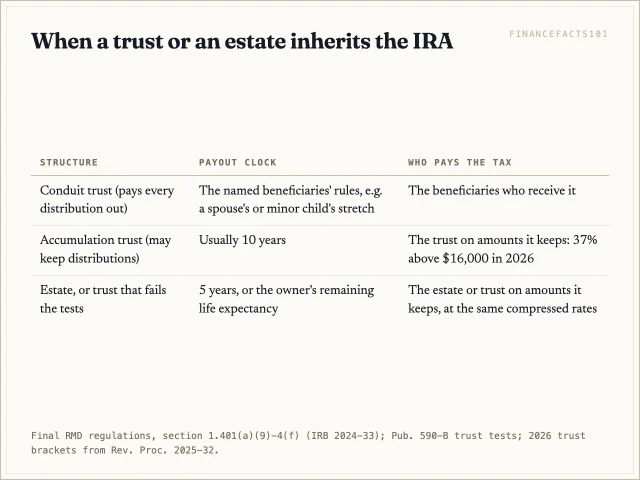
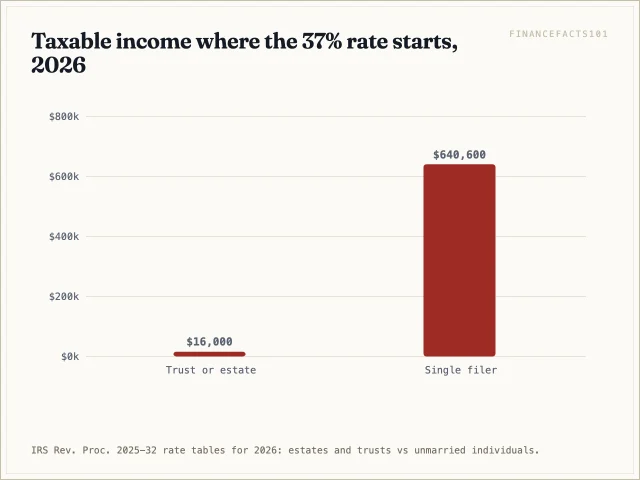
Keeping money in the trust is expensive. Under Revenue Procedure 2025-32, the 2026 trust and estate brackets reach 37 percent above $16,000 of taxable income, against $640,600 for a single filer. If the trustee keeps a $64,752 IRA withdrawal in the trust, the federal tax is about $21,900 before the trust's small exemption; paid out to the heir in our example below, it costs $15,227.
An estate, a charity or a trust that fails the tests has no designated beneficiary: the 5-year rule if the owner died before the required beginning date, the owner's remaining life expectancy if after. Naming individuals, or a trust that passes the tests, is the planning fix.
The excise tax for a missed withdrawal
Pub. 590-B sets an excise tax of 25 percent of the shortfall, cut to 10 percent if you take the missed amount and file a return reflecting the tax within the "correction window", which generally ends on the last day of the second taxable year after the year the tax is imposed. It goes on Form 5329, and a shortfall from reasonable error that you are fixing can be waived with a statement of explanation.
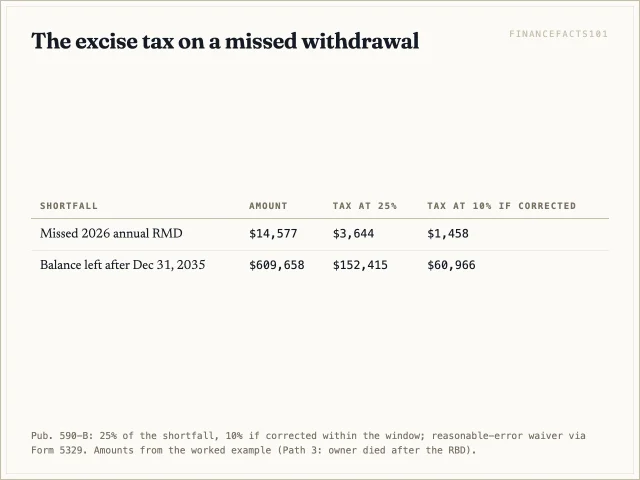
Money left past the year-10 deadline counts too: Pub. 590-B says it "is subject to the excise tax". On the $609,658 our example heir would hold at the end of 2035 if she took only the minimums, 25 percent is $152,415, with income tax still due when the money comes out.
Worked example: $500,000 over 10 years vs a lump in year 10
Take Maya, born in 1974, single, with $90,000 of taxable income from her job after the standard deduction. Her mother, born in 1955, died in 2025 at 70, before her required beginning date, leaving a traditional IRA worth $500,000 on December 31, 2025. Maya is an adult and 19 years younger, so she is a designated beneficiary: nothing is required until 2035, and everything must be out by December 31, 2035.
Assumptions: the IRA earns 5 percent a year; withdrawals are made each December; federal tax only, at the 2026 single brackets from the IRS 2026 inflation adjustments. Everything is in 2026 dollars: brackets are indexed, so holding them at 2026 levels means reading the 5 percent as a return above inflation. Her tax on the $90,000 alone is $14,512.
Path 1: wait and take a lump in 2035. Left alone, the account grows to $500,000 × 1.05^10 = $814,447. Stacked on her $90,000 salary, it fills the rest of the 22 percent bracket ($15,700), then the 24 percent ($96,075), 32 percent ($54,450) and 35 percent ($384,375) bands, and puts the last $263,847 at 37 percent. The extra tax is $276,091, or 33.9 percent of the inheritance, leaving $538,357.
Path 2: level withdrawals for 10 years. The equal December withdrawal that empties a $500,000 account earning 5 percent in exactly 10 years is $64,752. Each one adds $15,700 at 22 percent and $49,052 at 24 percent, so the tax is $15,227 a year, or 23.5 percent. Over 10 years she withdraws $647,523 and pays $152,265.
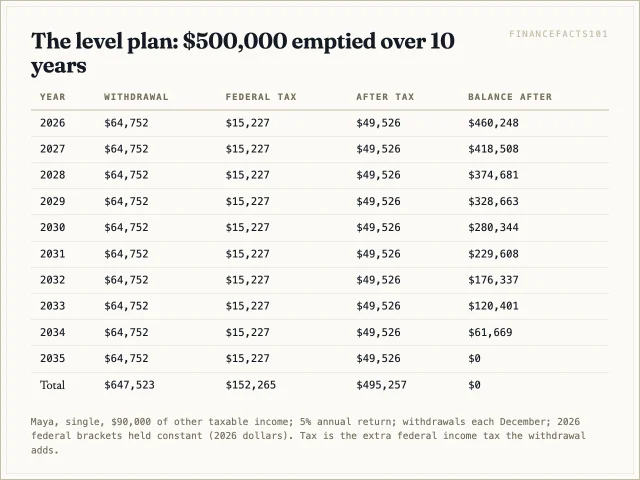
Path 2 withdraws less in total because money leaves earlier, so compare end-of-2035 wealth. Investing each after-tax withdrawal ($49,526) at the same 5 percent leaves her $622,929, or $84,573 more than the lump. Tax on that taxable account narrows the gap: at a 4 percent after-tax return it is $56,255, at 3 percent $29,401.
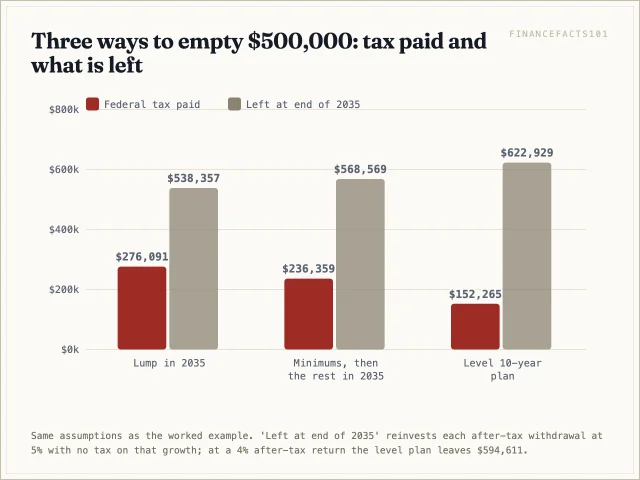
Path 3: if her mother had died after starting RMDs. Change one fact: her mother died at 78, having already taken her 2025 RMD. Now waiting is not allowed. Maya's divisor is 34.3 at 52 in 2026, so her minimums run from $14,577 in 2026 to $21,816 in 2034, and then $609,658 must come out in 2035. That path pays $236,359 of tax and ends with $568,569 at 5 percent, still $54,360 behind the level plan. The level withdrawals exceed the minimum in every year, so the same $64,752 plan works whichever way the owner died.
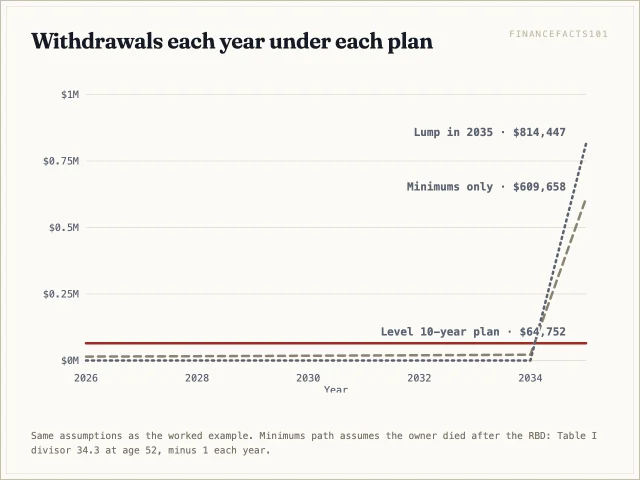
When smoothing pays, and when it does not
A lump is taxed at the top of the rate schedule, level withdrawals at your current marginal rate; the gap depends on your other income.
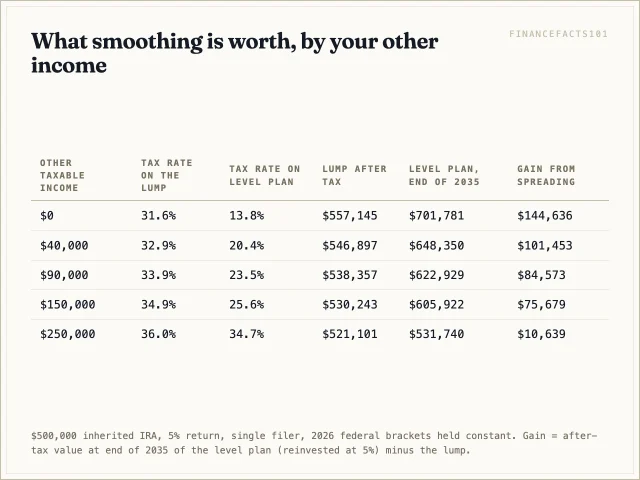
With no other taxable income, level withdrawals are taxed at 13.8 percent and the lump at 31.6 percent, and smoothing is worth about $144,600 by 2035; at Maya's $90,000 it is worth $84,573. At $250,000 of other income the level withdrawals already reach the 35 percent band, the lump costs only 1.3 points more, and the gain falls to about $10,600. There, timing matters more than evenness.
So the better plan is not strictly level: take more in low-income years (a gap between jobs, early retirement before Social Security) and only the minimum, if any, in a year with a bonus or a big capital gain. Decide each December, once you know that year's income.
Other levers on the tax, and what does not work
- No 10 percent penalty. Pub. 590-B lists "you are the beneficiary of a deceased IRA owner" among the exceptions, so a beneficiary of any age can withdraw without it.
- No step-up in basis. Inherited stock usually gets a stepped-up basis; an IRA does not. Pub. 559 treats the distribution as income in respect of a decedent, taxed up to the decedent's balance "including unrealized appreciation".
- Basis and estate tax. The owner's nondeductible contributions come out tax-free (tracked on a separate Form 8606). If the estate paid federal estate tax, Pub. 590-B lets you deduct the part attributable to the IRA income.
- No conversion of an inherited IRA. A non-spouse beneficiary cannot roll money out of an inherited IRA, so it cannot be converted to a Roth. An inherited 401(k) can be: Publication 590-A lets a non-spouse beneficiary move it by direct transfer into an inherited Roth IRA, paying tax on the amount, with the trade-offs of any Roth conversion.
- Watch the income tests. IRA distributions are not net investment income, but Pub. 590-B notes they count toward the modified AGI threshold for the 3.8 percent tax, so a lump year can pull your dividends and gains into it. For an heir on Medicare, a lump can also raise premiums two years later through IRMAA.
The decision, step by step
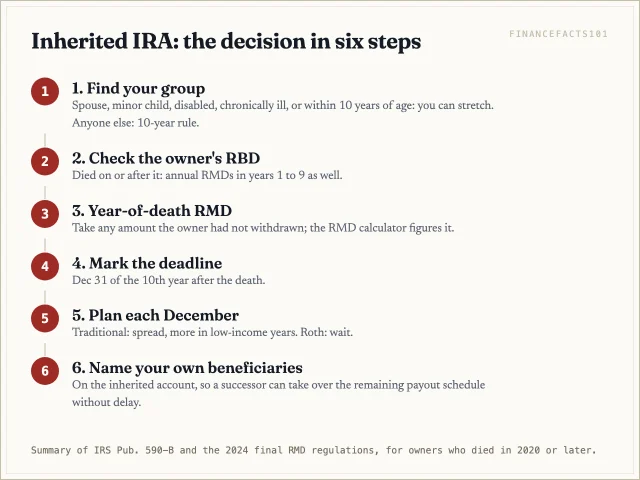
The first four steps take an afternoon; the fifth is a yearly decision. For a traditional IRA it usually means roughly equal amounts with more in low-income years, and for a Roth it means waiting. Name your own beneficiaries on the inherited account too, as our entry on named beneficiaries explains.
FAQ
Do I have to take money out of an inherited IRA every year?
Only in some cases. A designated beneficiary takes annual RMDs from 2025 on if the owner died on or after the required beginning date, and nothing until year 10 if before. Eligible designated beneficiaries on life-expectancy payments take one every year; inherited Roth IRAs on the 10-year rule never need one.
I missed RMDs from an inherited IRA in 2021 to 2024. Do I owe anything?
If you were a designated beneficiary of an owner who died in 2020 through 2023 on or after the required beginning date, IRS Notices 2022-53, 2023-54 and 2024-35 said the excise tax would not be charged on the missed annual amounts, and none of them requires making those amounts up. From 2025 the annual RMDs apply, and the year-10 deadline did not move.
Can I roll an inherited IRA into my own IRA?
Only if you are the surviving spouse. Anyone else keeps it as an inherited IRA in the decedent's name and can move it only by trustee-to-trustee transfer; a check made out to you is a taxable distribution that cannot be put back.
Does the 10-year rule apply to inherited 401(k) accounts too?
Yes, but the plan document decides which options it offers, and a plan can pay out faster than the law requires. If its options are shorter, a non-spouse beneficiary can move the money by direct trustee-to-trustee transfer to an inherited IRA, which Pub. 590-A allows, and follow the IRA rules from there.
Sources
- IRS, Publication 590-B, Distributions from Individual Retirement Arrangements (IRAs) (2025 edition; beneficiary rules, 10-year rule, Table I, excise tax, spouse options, inherited Roth IRAs)
- IRS, Internal Revenue Bulletin 2024-33 (TD 10001, final RMD regulations: annual RMDs after the required beginning date, age of majority 21, see-through trusts, Roth IRAs treated as death before the required beginning date, automatic year-of-death waiver; applicable from 2025)
- IRS, Internal Revenue Bulletin 2022-45 (Notice 2022-53, relief for 2021 and 2022)
- IRS, Internal Revenue Bulletin 2023-31 (Notice 2023-54, relief for 2023)
- IRS, Internal Revenue Bulletin 2024-19 (Notice 2024-35, relief for 2024)
- IRS, Retirement topics: Beneficiary (last reviewed August 1, 2026)
- IRS, Publication 559, Survivors, Executors, and Administrators (income in respect of a decedent; inherited Roth qualified distributions)
- IRS, Publication 590-A, Contributions to Individual Retirement Arrangements (IRAs) (non-spouse transfers and rollovers to an inherited Roth IRA)
- IRS, Revenue Procedure 2025-32 (2026 tax rate tables, including estates and trusts)
- IRS, Tax inflation adjustments for tax year 2026 (2026 brackets, standard deduction)
 Next entry · No. 5,997Is Renters Insurance Worth It? Cost, Coverage and Break-Even Math
See also
-
 No. 2,400
03 Jan 2025
21 min
Inherited IRAs: A Comprehensive Guide for Institutional Investors
Retirement
-
 No. 759
03 Jun 2024
22 min
Understanding Contingent Beneficiaries in Insurance and Retirement Accounts
Insurance
-
 No. 5,995
29 Oct 2026
21 min
Medicare IRMAA: How It Is Calculated and How to Avoid It
Retirement
-
 No. 5,987
21 Oct 2026
19 min
Should I Do a Backdoor Roth IRA? How to Avoid the Pro-Rata Tax
Retirement
-
 No. 5,979
13 Oct 2026
17 min
Roth 401(k) vs Traditional 401(k): Which Should You Choose?
Retirement
-
 No. 5,970
04 Oct 2026
17 min
Required Minimum Distributions: When to Start, How Much, and How to Cut the Tax
Retirement