PMI Removal: When It Ends, and How to End It Sooner
On a $360,000 loan PMI costs $150 a month and ends at month 112 by default. Asking at 80% cuts it to 98; extra principal or an appraisal, to 37–66.
Private mortgage insurance on a $360,000 loan — 10% down on a $400,000 home — costs about $150 a month and, left alone, runs until month 112, for $16,800 in total. You can end it at month 98 by asking, at month 66 by paying $200 a month extra, or as early as month 37 if the home has appreciated and you pay for an appraisal. The difference between doing nothing and doing the cheapest thing is $2,100; between doing nothing and the most aggressive route, more than $11,000. This guide prices each route on the same loan so you can pick the one that fits your cash and your timeline.
The loan throughout is $360,000 at 6.76% over 30 years — the Freddie Mac Primary Mortgage Market Survey average for the week of September 10, 2026 — on a $400,000 purchase with 10% down. PMI is priced at 0.5% of the loan a year, which is the middle of a range that runs from about 0.3% for a strong credit score at 90% loan-to-value to 0.8% or more for a weaker score or a smaller down payment; the tables show all three. The mortgage payment levers guide sets this loan beside its 20%-down twin; this guide is about getting rid of the insurance once you have it.
Scope honesty: this is general information built on the stated assumptions above, not personal advice. Your rate, premium, home value and servicer's rules will differ.
Who this is for — and who it is not for
This guide is for a borrower with a conventional loan who is paying PMI now, or is about to close with less than 20% down and wants to know how long the premium will last. The rules it relies on — the Homeowners Protection Act's cancellation thresholds and Fannie Mae's current-value guidelines — apply to conventional loans on a principal residence.
It is not for FHA borrowers. FHA mortgage insurance is a different product with an upfront premium and an annual premium at rates that do not depend on credit score, as the CFPB's overview of mortgage insurance types describes, and the Homeowners Protection Act's cancellation rights do not apply to it; getting out of FHA insurance usually means refinancing into a conventional loan. It is also not for VA loans, which carry a funding fee and no monthly insurance. And if you have not yet chosen your down payment, the 10% vs 20% guide in this series prices that decision before PMI ever starts.
What PMI is, and what it is not
PMI is insurance the lender requires when a conventional loan exceeds 80% of the home's value. It protects the lender, not you: the CFPB is blunt that "PMI protects the lender — not you — if you stop making payments on your loan," and it does not prevent foreclosure. Most PMI is paid monthly with the mortgage payment, though it can also be paid as a single premium at closing or as a mix of the two. This guide assumes the monthly form, which is the one you can cancel.
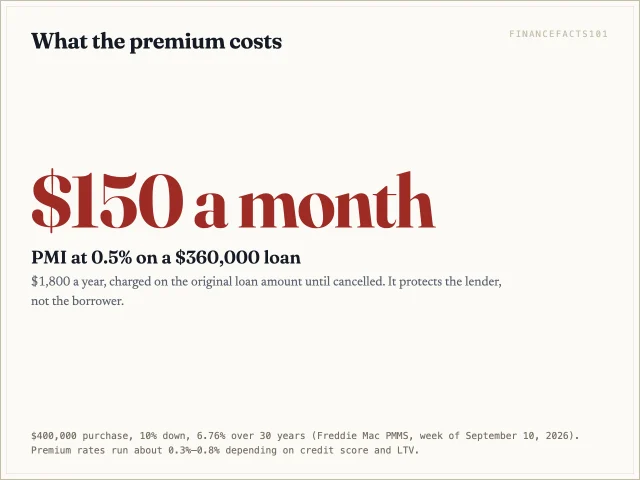
At 0.5% a year on $360,000, the premium is $150 a month, or $1,800 a year. The premium rate is set when the loan closes and does not fall as the balance falls; it is a percentage of the original loan amount, charged until the insurance is cancelled.
Only the monthly form can be cancelled
Two other ways of paying for the same coverage are worth recognising before closing, because neither of them can be ended by the routes in this guide. A single-premium policy is paid in one lump at closing — often rolled into the loan — and there is nothing left to cancel; if you sell in year four, the premium for years five to nine was paid for nothing. Lender-paid insurance is built into a higher interest rate instead of a separate line, and the CFPB's summary of the cancellation rules notes that the Homeowners Protection Act does not cover loans where the lender pays the insurance, so the higher rate runs for the life of the loan regardless of equity. On a loan you expect to hold past the 80% date, the monthly form costs more in total but is the only one that stops.
The premium rate decides the stakes
Three borrowers on the same loan can pay very different amounts for the same coverage, because the premium rate is priced on credit score and loan-to-value. The CFPB's page on loan-to-value notes that a higher LTV brings both a higher rate and, above 80%, the insurance itself.
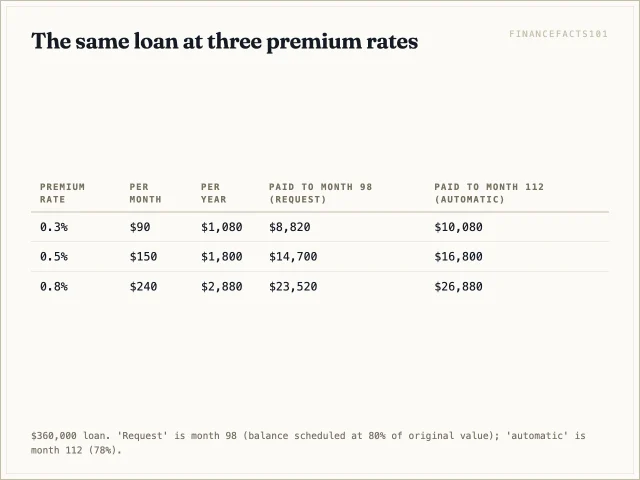
At 0.3% the premium is $90 a month and the default path costs $10,080 in total; at 0.8% it is $240 a month and $26,880. The routes below save the same number of months at every premium rate, so the dollar saving scales with your rate: a borrower at 0.8% has nearly three times as much reason to act as one at 0.3%.
The default path: automatic termination at month 112
Under the Homeowners Protection Act, as summarised by the CFPB, the servicer must cancel PMI automatically on the date the principal balance is scheduled to reach 78% of the home's original value, provided the loan is current. Original value means the purchase price or the appraised value at closing, whichever is lower; on this loan it is $400,000, and 78% of it is $312,000.
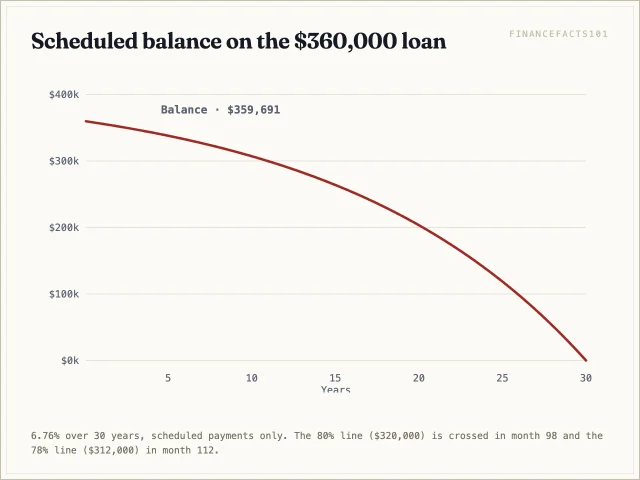
Run the amortization schedule on $360,000 at 6.76% and the balance is scheduled to reach $312,000 in month 112 — nine years and four months in. PMI paid by then at $150 a month: $16,800. Note the word scheduled: automatic termination follows the original amortization schedule, not the actual balance, so extra payments do not bring it forward. They bring forward the request route instead.
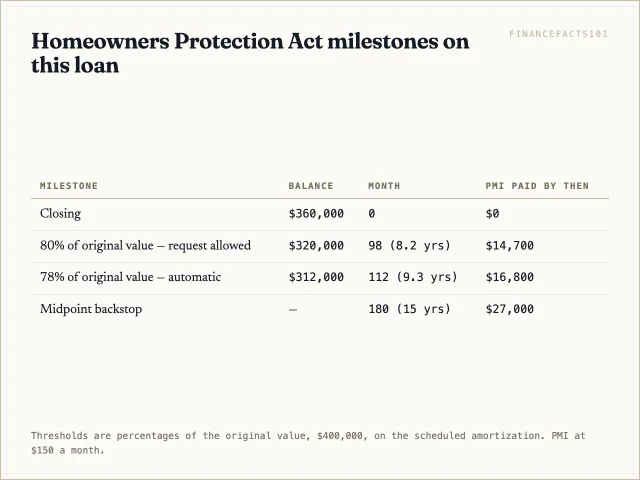
There is also a backstop. If neither threshold has triggered cancellation — which can happen when a loan was current at 78% but later fell behind — PMI must end the month after the midpoint of the amortization schedule, month 180 on a 30-year loan, if the loan is current then.
The cheapest improvement: request it at 80%
The same law lets you request cancellation once the balance is scheduled to reach 80% of original value — $320,000 here — which arrives at month 98, fourteen months earlier than automatic termination. The saving is fourteen premiums, $2,100 at 0.5%, for the cost of a letter.
The conditions, per the CFPB summary, are a written request, a good payment history, being current on the loan, no junior liens such as a second mortgage or a home equity line, and, if the servicer asks, evidence that the property's value has not fallen below its original value. The site's entry on the Homeowners Protection Act goes through those conditions in more detail.
Set a reminder for the month your schedule crosses $320,000. Servicers are required to tell you about the right at closing and in annual notices, but they are not required to act on it until you ask.
The faster route: extra principal moves the 80% date
Because the request threshold is based on the actual balance reaching 80% — or the scheduled balance, whichever comes first — extra principal payments pull it forward. On this loan:
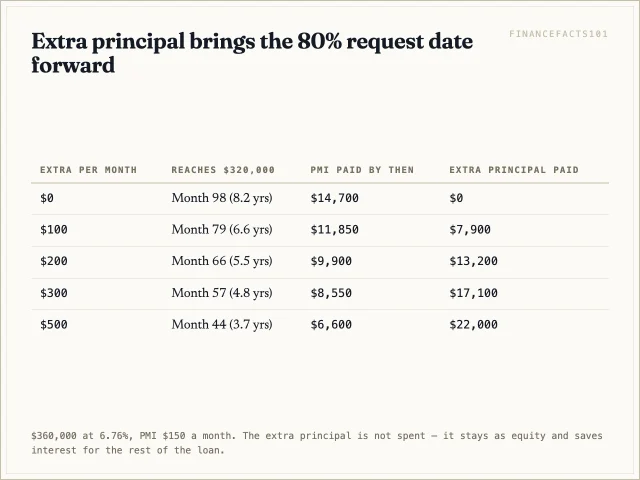
An extra $100 a month reaches $320,000 in month 79 instead of 98, saving nineteen premiums ($2,850) for $7,900 of extra principal — principal you keep as equity. An extra $200 reaches it in month 66 and cuts total PMI to $9,900. An extra $500 reaches it in month 44 and cuts PMI to $6,600.
The trade is favourable at every level, because the extra principal is not spent; it reduces the balance you owe, and on top of ending PMI sooner it saves interest for the rest of the loan, as the mortgage payment levers guide shows for the same $200. The only cost is liquidity: money paid into the loan is hard to get back out.
The fastest route: a new appraisal on the current value
The Homeowners Protection Act sets floors on original value. Investor guidelines go further and allow cancellation on current value, and for loans owned by Fannie Mae the rules are specific. Under the Fannie Mae Servicing Guide, a borrower-initiated request based on current value on a one-unit principal residence needs an LTV of 75% or less if the loan is between two and five years old, or 80% or less if it is more than five years old — with a current payment history, no 30-day late in the last twelve months and no 60-day late in the last twenty-four. The value comes from a new appraisal or broker price opinion ordered by the servicer, and the borrower generally pays for it.
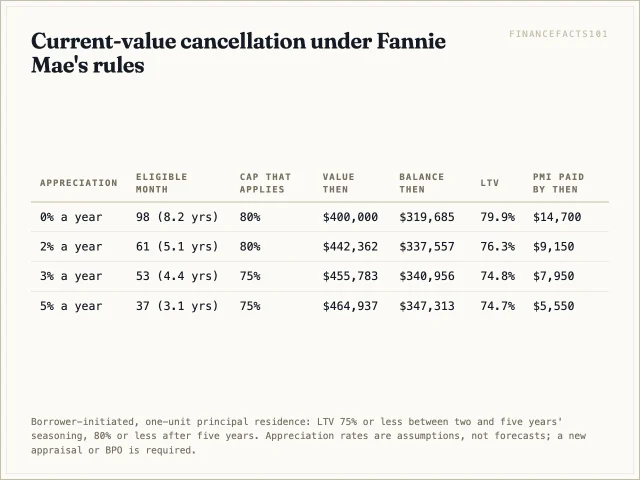
Price appreciation is not something this guide can promise, so the table runs it as an assumption at 0%, 2%, 3% and 5% a year; the FHFA House Price Index, a repeat-sales index of the same properties over time, is where to check what your market has actually done. At 3% a year the home is worth $455,783 in month 53, the balance is $340,956, the LTV is 74.8%, and the 75% cap is met four years and five months in — PMI paid by then $7,950. At 5% a year the cap is met in month 37 with $5,550 paid. At 2% the 75% cap is never met inside the five-year window, and eligibility waits for the 80% cap at month 61. With no appreciation the current-value route is no faster than the original-value one.
Against those savings set the cost of the valuation, typically a few hundred dollars, and the risk that the appraisal comes in low and the request is declined. A borrower who has watched comparable sales in the neighbourhood rise 15% since closing has a strong case; one guessing has a coin flip that costs an appraisal fee.
All the routes on one chart
Here is what PMI costs in total on this loan under each route, at $150 a month:
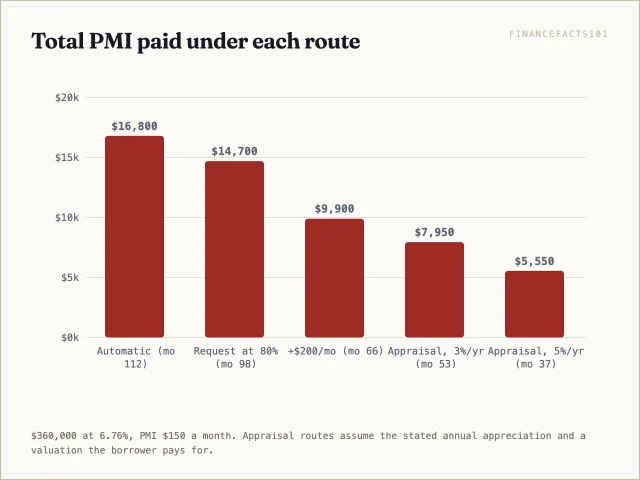
Doing nothing: $16,800. Requesting at 80%: $14,700. Adding $200 a month: $9,900. Appraising at 3% appreciation: $7,950. Appraising at 5%: $5,550. The routes combine — extra principal plus a rising market reach the 75% cap sooner than either alone — and none of them costs more than a stamp and, for the appraisal route, a valuation fee.
The route that avoids PMI entirely
There is one more option for the buyer who has not closed yet: put 20% down. On this purchase that is $40,000 more cash at closing, and it does two things at once — the loan is $320,000 instead of $360,000, so principal and interest fall by $260 a month, and there is no PMI, so another $150 a month never starts.
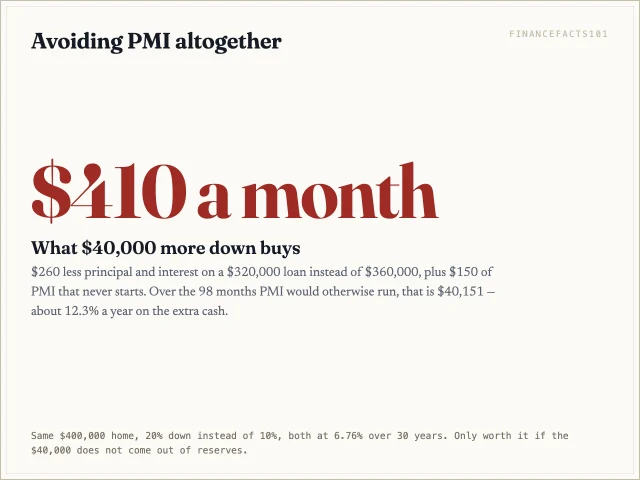
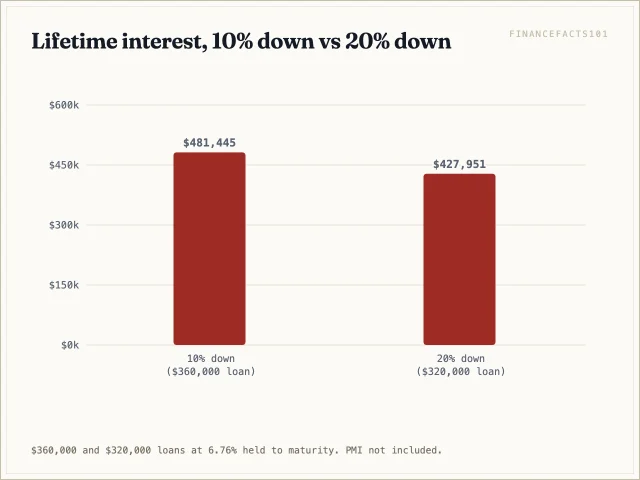
That is $410 a month for as long as PMI would have run, then $260 a month for the rest of the loan. Over the 98 months until a request would have ended PMI anyway, the extra $40,000 returns $40,151 in lower payments — about 12.3% a year on the extra down payment while the insurance is running, which is a return no savings account offers. It also cuts lifetime interest from $481,445 to $427,951, a difference of $53,494.
The catch is the $40,000 itself. A buyer who reaches 20% by emptying the emergency fund has traded a $150 premium for the risk of a forced sale after one bad year, and that trade is worse than PMI. The 10% vs 20% guide in this series prices the two against each other, including what the $40,000 could earn elsewhere and what it is worth as reserves; the how much house can I afford guide sets the down payment inside the whole budget.
A decision sequence
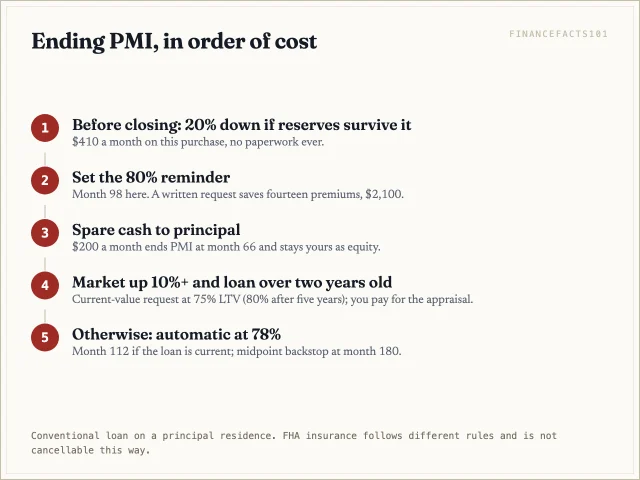
- Before closing, if 20% is within reach without touching reserves: put it down. $410 a month and no cancellation paperwork.
- After closing, in every case: find the month your amortization schedule crosses 80% of original value and set a reminder to request cancellation. Cost: nothing. Saving: $2,100 on this loan.
- If you have spare monthly cash: direct it to principal. $200 a month ends PMI at month 66 and the money stays yours as equity.
- If your market has risen more than about 10% since closing and the loan is over two years old: ask the servicer for a current-value cancellation and be ready to pay for the appraisal. Confirm the 75% or 80% threshold that applies to your loan's age first.
- If none of this applies and the loan is current: automatic termination at 78% of original value, month 112 here, ends it without action.
FAQ
Can I cancel PMI as soon as my balance is below 80% of what I paid?
You can request it once the balance is scheduled to reach 80% of the original value, or has actually reached it through extra payments. The servicer can ask for a good payment history, no second liens, and evidence the value has not dropped. On a $360,000 loan against a $400,000 price at 6.76%, the scheduled date is month 98.
Does the servicer have to cancel it automatically?
Yes, at the point the balance is scheduled to reach 78% of original value, if the loan is current — month 112 on this loan. If that date passes while the loan is delinquent, cancellation happens when it becomes current, and in any case the month after the loan's midpoint if it is current then.
Does a rise in my home's value help?
Not under the federal thresholds, which use original value. It can help under the investor's rules: Fannie Mae allows a current-value request at 75% LTV after two years or 80% after five, with a new appraisal. That route can end PMI three to five years earlier in a rising market.
Is FHA mortgage insurance the same as PMI?
No. FHA insurance has an upfront premium and an annual premium, is priced without regard to credit score, and is not covered by the Homeowners Protection Act's cancellation rights. Ending it generally means refinancing into a conventional loan once you have 20% equity.
Sources
- Freddie Mac Primary Mortgage Market Survey — 30-year fixed average, week of September 10, 2026
- CFPB: when can I remove PMI from my loan — the Homeowners Protection Act's 80%, 78% and midpoint rules and their conditions
- CFPB: what is private mortgage insurance — what PMI covers and how it is paid
- CFPB: what is mortgage insurance and how does it work — conventional PMI against FHA, USDA and VA
- CFPB: what is a loan-to-value ratio — how LTV drives rate and insurance
- FHFA House Price Index — the repeat-sales index for checking local appreciation
- Fannie Mae Servicing Guide B-8.1-04 — current-value cancellation thresholds, seasoning and payment-history conditions
 Next entry · No. 5,96010% vs 20% Down: What the Extra $40,000 Is Actually Worth
See also
-
No. 5,960
24 Sep 2026
12 min
10% vs 20% Down: What the Extra $40,000 Is Actually Worth
Mortgage
-
 No. 5,966
30 Sep 2026
12 min
Assumable Mortgage Value: What a 3% Loan Is Worth in a 6.76% Market
Mortgage
No. 5,966
30 Sep 2026
12 min
Assumable Mortgage Value: What a 3% Loan Is Worth in a 6.76% Market
Mortgage -
 No. 5,957
21 Sep 2026
15 min
Mortgage Payment Levers: What Actually Moves the Number
Mortgage
No. 5,957
21 Sep 2026
15 min
Mortgage Payment Levers: What Actually Moves the Number
Mortgage -
 No. 5,967
01 Oct 2026
12 min
2-1 Buydown: What a Seller-Paid Teaser Rate Is Actually Worth
Mortgage
No. 5,967
01 Oct 2026
12 min
2-1 Buydown: What a Seller-Paid Teaser Rate Is Actually Worth
Mortgage -
 No. 5,964
28 Sep 2026
12 min
Mortgage Recast vs Refinance: What to Do With a $50,000 Lump Sum
Mortgage
No. 5,964
28 Sep 2026
12 min
Mortgage Recast vs Refinance: What to Do With a $50,000 Lump Sum
Mortgage -
 No. 5,963
27 Sep 2026
12 min
ARM vs Fixed-Rate Mortgage: Pricing the Bet on a 5/1 ARM
Mortgage
No. 5,963
27 Sep 2026
12 min
ARM vs Fixed-Rate Mortgage: Pricing the Bet on a 5/1 ARM
Mortgage