Jekyll and Hyde: Understanding the Split Personality of the Stock Market

Discover how the stock market exhibits the 'Jekyll and Hyde' personality. Understand its causes, impact & effective investment strategies in volatile markets.
Introduction to Jekyll and Hyde in Finance
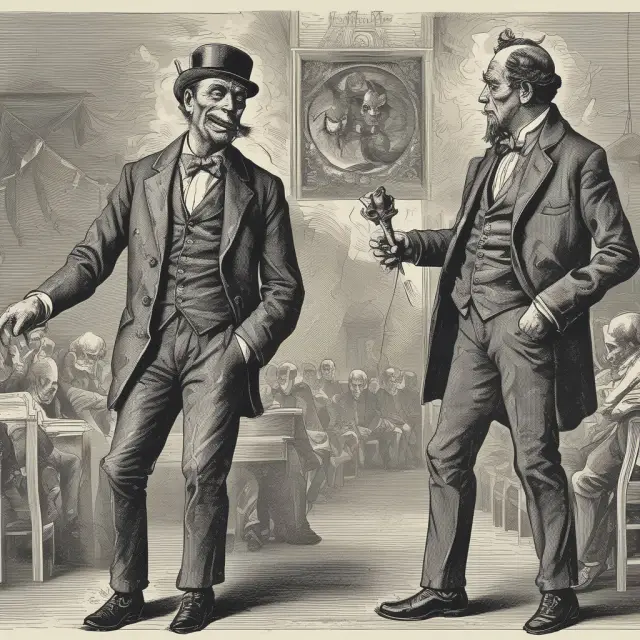
The term ‘Jekyll and Hyde’ is borrowed from Robert Louis Stevenson’s classic novel, ‘The Strange Case of Dr. Jekyll and Mr. Hyde.’ This literary reference has been used to describe a stock market that seemingly embodies contrasting traits – one that is calm, predictable, and beneficial for trading (Jekyll) and another that is volatile, unstable, unpredictable, and dangerous to investors (Hyde). These dual personalities often emerge in the stock market due to its susceptibility to human emotions.
Understanding Jekyll and Hyde: Origins from Literature
In Stevenson’s novel, Dr. Jekyll is a respectable scientist who inadvertently unleashes his dark side, Mr. Hyde, through a series of ill-advised experiments in his laboratory. This embodiment of good and evil within one man bears striking resemblances to the stock market, where calm and predictable behavior can suddenly be overshadowed by frenzied negativity. Like characters in Stevenson’s novel, market participants and observers are often left puzzled about the underlying causes behind this strange market behavior.
The Evolution of Behavioral Finance: A New Perspective on Market Swings
Traditional economic theories, such as the efficient market hypothesis, maintain that stock prices will always remain in line with their fair market value based on all available information. However, a relatively new field of finance called behavioral finance attempts to explain how human emotions and behavior can contribute to unpredictable swings in the market.
Collective emotional responses rooted in fear and greed often lead to the formation of bubbles that eventually burst. The Jekyll and Hyde syndrome is one manifestation of this complex relationship between investor sentiment and market volatility, highlighting an essential aspect of behavioral finance.
As we delve deeper into understanding this phenomenon, let us explore how market volatility arises, the role of human emotions in shaping market behavior, and potential strategies investors can employ to manage risk during Jekyll and Hyde market swings.

The Concept of Behavioral Finance
In the ever-changing world of finance, the term ‘Jekyll and Hyde’ is frequently used to describe a market that exhibits a dual nature – calm and rational at one moment, volatile and irrational at another. This moniker takes inspiration from Robert Louis Stevenson’s classic novel “The Strange Case of Dr. Jekyll and Mr. Hyde.” In the story, Dr. Jekyll is a respectable, upstanding man, while his alter ego, Mr. Hyde, embodies all that is dark and dangerous. Similarly, stock markets can morph from a calm, rational entity to an erratic, volatile one in a blink of an eye. This dichotomy has been the subject of much fascination within the financial community, particularly with the advent of behavioral finance as a theory to explain seemingly irrational market behavior.
Behavioral finance, an emerging field of economic theory, posits that human behavior significantly influences stock markets and asset prices. It challenges the traditional efficient market hypothesis (EMH), which assumes that securities are always priced rationally, based on all available information. Behavioral finance acknowledges that investors can be influenced by emotions, cognitive biases, herd mentality, and other irrational tendencies, leading to market volatility and price discrepancies. The Jekyll and Hyde syndrome is an intriguing illustration of how human behavior manifests in financial markets.
In the context of finance, Jekyll signifies a market that is rational, predictable, and conducive to profitable trading opportunities. Conversely, Mr. Hyde represents volatility, instability, and uncertainty. A sudden shift from Jekyll’s calm demeanor to Hyde’s chaotic nature can leave investors bewildered and at a loss for understanding the underlying causes of such behavior.
Behavioral finance attempts to unravel this mystery by examining collective human emotions and behaviors, which often lead to market bubbles that form and then burst suddenly without warning. The Jekyll and Hyde syndrome is a prime example of how behavioral finance’s perspective can help explain market fluctuations that appear irrational based on traditional economic theories.

Good vs. Bad Market: Jekyll and Hyde Syndrome
The term ‘Jekyll and Hyde’ is borrowed from Robert Louis Stevenson’s classic novel to explain the stock market’s peculiar tendency to exhibit a bifurcated nature, oscillating between calm rationality (Jekyll) and volatile instability (Hyde). This split personality creates an intriguing dynamic for investors, as they must navigate both the appealing aspects of predictable growth and the daunting challenges of erratic market behavior.
In Stevenson’s story, Dr. Jekyll, a respectable man of science, transforms into his alter ego, Mr. Hyde, when he gives in to his darker desires. Similarly, in the financial realm, an initially stable and tranquil market can morph into a volatile, unpredictable beast that leaves investors bewildered and disoriented.
Understanding this paradoxical market behavior is crucial for traders and investors alike. Behavioral finance, an evolving field of study that examines the role of human emotions in financial decision-making, provides valuable insights into the Jekyll and Hyde phenomenon. Human emotion drives collective action in the market, leading to a volatile mix of optimistic exuberance (Jekyll) and pessimistic panic (Hyde).
The efficient market hypothesis, a longstanding economic theory that asserts stock prices reflect all available information, posits a rational market immune to such behavior. However, the Jekyll and Hyde syndrome challenges this view by demonstrating how human emotions can distort market efficiency, leading to significant price swings and inconsistent market behavior.
The presence of Jekyll and Hyde in financial markets is a reminder that markets are not always rational entities driven by pure logic and data analysis. Instead, they are shaped by the collective actions and emotions of investors, making them inherently complex and dynamic. Understanding this duality can help investors navigate the market’s unpredictability and ultimately make more informed decisions.
In the following sections, we will explore the causes of Jekyll and Hyde behavior, its impact on investors, and strategies for managing risk in an ever-changing financial landscape.

The Efficient Market Hypothesis
The term ‘Jekyll and Hyde’ in finance refers to the stock market’s seemingly split personality, which can be both stable and predictable (Jekyll) or volatile and unpredictable (Hyde). The efficient market hypothesis (EMH), a cornerstone of modern financial theory, assumes that all available information is already factored into stock prices. In essence, the EMH dictates that stocks are fairly priced based on their intrinsic value in an ideal world where markets are rational and operate efficiently.
However, the real world does not always follow theoretical ideals. Market behavior often defies this hypothesis, with stock prices fluctuating irrationally due to various factors including human emotions, herd mentality, news events, and other external influences. The ‘Jekyll and Hyde’ market syndrome is a clear demonstration of such inconsistencies.
While the Jekyll aspect symbolizes a calm, predictable market conducive to trading gains, the Hyde personality brings about volatility, instability, and uncertainty. In essence, Jekyll and Hyde represent the contrasting moods that can arise in the financial markets, leaving investors, analysts, and researchers puzzled as to their underlying causes.
The origins of this market phenomenon can be traced back to behavioral finance – a comparatively new field of study which focuses on how human emotions and irrational decision-making influence financial markets. Emotions such as fear and greed lead to market swings, forming bubbles that eventually burst, leaving investors perplexed. The Jekyll and Hyde market personality is an example of this concept in action.
The efficient market hypothesis, which assumes stock prices always reflect all available information, fails to explain the irrational behavior observed during periods of Jekyll and Hyde markets. Instead, behavioral finance offers a more nuanced perspective by incorporating human emotions and collective decision-making into market analysis. This helps provide a better understanding of why stocks exhibit a Jekyll and Hyde personality and why their prices can be affected by external factors beyond just the fundamentals of the underlying companies.
In the next section, we will delve deeper into the causes of this phenomenon and examine its implications for investors.
Causes of Jekyll and Hyde Market Behavior
The ‘Jekyll and Hyde’ term in finance is used to describe a stock market that displays seemingly contradictory personality traits, exhibiting both positive (Jekyll) and negative (Hyde) aspects. Understanding this phenomenon requires looking at its root causes: human emotions, herd mentality, news events, and other factors that influence the market’s mood swings.
Human Emotions: The stock market is not immune to the full range of human emotions. Fear and greed are the primary drivers behind Jekyll and Hyde market behavior. When investors experience fear, they tend to sell off stocks in a panic. Conversely, when they feel greedy, they buy stocks without considering potential risks, leading to market bubbles.
Herd Mentality: Herd mentality, or the tendency for individuals to follow the crowd rather than making their own informed decisions, also significantly contributes to the Jekyll and Hyde personality of markets. When investors see others around them buying or selling a particular stock, they often follow suit without thinking through the implications, further fueling market volatility.
News Events: Sudden, unanticipated news can trigger a switch from Jekyll to Hyde behavior. For example, a seemingly positive announcement like an unexpected interest rate cut could initially send stock prices soaring (Jekyll). However, if the underlying fundamentals are weak or if investors suspect that the announcement is just a ploy to prop up a failing market (Hyde), they may subsequently sell off stocks, causing a sharp decline.
Behavioral Finance: The Jekyll and Hyde phenomenon might also be attributed to the principles of behavioral finance, which posits that market participants’ irrational behaviors significantly impact financial markets. Collective human emotions can lead to bubbles and crashes, as seen in the infamous dot-com bubble of the late 1990s or the housing market crisis in 2008.
It is important for investors to recognize these factors influencing market behavior to better understand the underlying dynamics behind Jekyll and Hyde markets and adjust their investment strategies accordingly.

Impact of Jekyll and Hyde Behavior on Investors
The term ‘Jekyll and Hyde’ in finance refers to a stock market that displays seemingly contradictory traits, exhibiting the good and bad characteristics of its namesakes from Robert Louis Stevenson’s novel. The ‘good’ personality or ‘Jekyll’ is characterized by stability, rationality, and predictability. In contrast, the ‘bad’ or ‘Hyde’ persona is volatile, unstable, and unpredictable. A Jekyll and Hyde stock market can leave investors bewildered and uncertain due to its dramatic shifts from one mood to another.
Behavioral finance, a relatively new field of study, might shed some light on this paradoxical phenomenon. According to this theory, human emotions play a pivotal role in the financial markets’ behavior. The collective psychology of market participants influences both Jekyll and Hyde personalities. While Jekyll offers potential gains for investors, Mr. Hyde poses significant risks that can result in substantial losses.
The efficient market hypothesis (EMH) assumes that stock prices reflect all available information and are always at their fair value. However, the EMH fails to explain the sudden mood swings and irrational behavior often observed in Jekyll and Hyde markets. Behavioral finance provides a framework for understanding these inconsistencies by focusing on the psychological aspects of market participants and their decision-making processes.
The impact of Jekyll and Hyde behavior on investors is multifaceted. On one hand, it presents opportunities to profit from short-term price movements. However, investors must be skilled in identifying trends and timing their trades effectively to capitalize on these fluctuations. Conversely, they may face substantial losses if they are unable to manage the risks associated with Mr. Hyde’s volatile nature.
Understanding the Jekyll and Hyde phenomenon is crucial for investors seeking to navigate an increasingly unpredictable financial landscape. Being aware of potential causes, such as human emotions, herd mentality, news events, and other market influences can help mitigate the risks associated with this split personality. Moreover, employing investment strategies like diversification, hedging, and risk management can provide a safety net against the uncertainties that come with Jekyll and Hyde markets.
Investors are advised to maintain a long-term perspective and avoid making hasty decisions based on short-term market fluctuations. Instead, they should focus on developing a sound investment strategy based on their risk tolerance and financial goals. This will enable them to weather the storms of both Jekyll and Hyde markets while maintaining a stable, rational approach to their investments.
In conclusion, Jekyll and Hyde behavior in the stock market can be a source of both opportunities and risks for investors. By understanding the underlying causes of these sudden shifts in market personality and employing effective risk management strategies, investors can position themselves to capitalize on the opportunities presented by this unpredictable financial landscape while minimizing potential losses.

Investment Strategies to Tackle Market Volatility
The ‘Jekyll and Hyde’ market phenomenon, as described earlier in this article, can be a daunting challenge for investors looking to build wealth. The unpredictable swings between calm, rational markets (represented by Jekyll) and volatile, irrational markets (Hyde), often caught investors off guard and leave them grappling with how to navigate these market conditions effectively. To help investors prepare for such situations, this section will outline key investment strategies that can be employed to tackle market volatility and mitigate the risks associated with Jekyll and Hyde market behavior.
First and foremost, diversification is a crucial strategy when dealing with volatile markets. Diversification refers to spreading investments across various asset classes, sectors, or even geographical regions. This approach reduces overall portfolio risk by ensuring that poor performance in one segment will not significantly impact the entire investment portfolio. By allocating capital among different types of securities, investors can reduce the likelihood of being overly exposed to any particular market swing.
Second, hedging plays a critical role in managing risk and protecting against unexpected market volatility. Hedging is a strategy used to offset potential losses or risks by entering into an opposing transaction or investment that will counteract the adverse impact on the portfolio. For example, investors might consider buying put options or selling short as part of their hedging strategy in anticipation of negative market movements.
Third, risk management strategies are vital for long-term financial success and protecting against potential losses during Jekyll and Hyde market swings. One popular approach to managing risks involves setting clear stop loss limits on investments. This method allows investors to exit a position once the security’s price reaches a predetermined level, minimizing potential losses. Another strategy is setting risk targets for different investments within an overall portfolio, ensuring that the total portfolio risk does not exceed a specific threshold.
Fourth, having a solid understanding of market cycles and trends can help investors anticipate Jekyll and Hyde market behavior and make informed decisions about their investment strategies. By closely monitoring macroeconomic factors, geopolitical events, and market sentiment indicators, investors can better position themselves for the ebbs and flows of the market.
Fifth, being aware of one’s personal financial situation, risk tolerance, and time horizon is essential when navigating Jekyll and Hyde markets. Younger investors with a longer investment horizon might be more willing to accept higher levels of risk in pursuit of potential gains, whereas older or more conservative investors may prefer a more defensive approach. By aligning their investment strategies with their financial goals and personal circumstances, investors can weather the storms of volatile markets and remain focused on achieving their long-term objectives.
Lastly, maintaining a disciplined and patient perspective is crucial when dealing with Jekyll and Hyde market behavior. Volatility can often lead to impulsive decisions that may not be well thought out or aligned with an individual’s investment goals. Instead, investors should resist the urge to react too hastily and instead stay focused on their long-term strategy, remaining committed to their diversified portfolio, and avoiding making hasty decisions based on short-term market movements.
In conclusion, understanding the Jekyll and Hyde nature of the stock market is an essential aspect of successful investing. By employing strategies like diversification, hedging, risk management, trend analysis, personalized investment plans, and maintaining a disciplined perspective, investors can navigate volatile markets more effectively, mitigate risks, and protect their investments during periods of market instability.

Case Studies: Historical Market Events as Illustrations of Jekyll and Hyde Behavior
The ‘Jekyll and Hyde’ market is a financial term that describes the stock market’s seemingly contradictory nature, with its calm and predictable days intermingling with volatile and unstable periods. This phenomenon has historical roots, as shown through several landmark events in finance. One such instance is the infamous 1929 stock market crash.
Before October 1929, the US economy was booming. The Roaring Twenties brought about unprecedented prosperity, marked by rising wages, low unemployment rates, and a growing middle class. In response to this economic growth, the stock market experienced an unparalleled bull run, with prices steadily increasing throughout the decade. This period could easily be compared to the ‘Jekyll’ persona – tranquil, optimistic, and prosperous.
However, come October 1929, the market’s ‘Hyde’ personality emerged without warning. A wave of panic selling swept through the stock markets. Prices began to plummet, as fearful investors sold off their stocks at a rapid pace. This sudden shift from growth to decline, or ‘Jekyll to Hyde,’ resulted in the Great Depression – one of the most catastrophic economic downturns in history.
Another instance that epitomizes the Jekyll and Hyde market is the tech bubble of 1995-2000. During this period, the technology sector experienced an unprecedented bull run, with investors pouring money into Internet companies, many of which lacked any real profitability or business model. This speculative buying led to inflated stock prices and the creation of a new economic paradigm – the ‘new economy.’
But as with all bubbles, this could not last forever. When the bubble burst, the markets experienced a sharp downturn, characterized by a significant loss in value for many tech stocks. The NASDAQ Composite Index plummeted from an all-time high of 5,048 on March 10, 2000, to a low of 1,114 on October 9, 2002 – a loss of over 78% in three years.
These historical events demonstrate the unpredictability inherent in the stock market and serve as stark reminders of the Jekyll and Hyde personality that can emerge without warning, leaving investors both baffled and vulnerable to significant financial losses.

The Role of Central Banks in Regulating Jekyll and Hyde Markets
In the complex world of finance, the stock market’s seemingly contradictory traits – a calm, predictable environment that transforms into a volatile, unstable one seemingly out of nowhere – can be likened to the classic tale “Jekyll and Hyde.” Central banks play an essential role in managing these market swings, balancing interest rates, monetary policy, and communication with the public.
In the financial realm, Jekyll represents a stable, predictable market environment that is conducive to trading gains. On the other hand, Hyde embodies volatility and instability, posing risks and opportunities for investors. The unpredictability of market swings can be attributed to various factors, including human emotions, herd mentality, news events, and more.
To maintain financial stability and mitigate the risks of Jekyll transforming into Hyde, central banks use a combination of interest rates, monetary policy, and communication strategies. When markets exhibit signs of instability or uncertainty, central banks may adjust interest rates to encourage or discourage borrowing and investment activity. By managing interest rates effectively, central banks can help stabilize the market and reduce volatility.
Monetary policy plays another crucial role in regulating Jekyll and Hyde markets. Central banks employ various policies to manage the money supply and control inflation. For instance, quantitative easing involves buying securities from financial institutions to increase the money supply and stimulate economic growth during a downturn. Conversely, tightening monetary policy can help curb inflation by reducing the money supply.
Clear communication with the public is also essential for central banks in managing Jekyll and Hyde markets. Transparent communication about interest rates, monetary policies, and the overall state of the economy instills confidence in investors, reducing market uncertainty. In turn, this leads to more stable market conditions and less frequent transformations from Jekyll into Hyde.
Understanding the importance of central banks in regulating Jekyll and Hyde markets highlights their critical role in maintaining financial stability and fostering an environment conducive to long-term investment growth. By employing a range of tools, including interest rates, monetary policy, and communication strategies, central banks help mitigate market volatility and protect investors from the unpredictable swings between Jekyll and Hyde personalities.

Preparing for Future Market Swings: Risk Management in a Jekyll and Hyde Market
The term “Jekyll and Hyde” is frequently used in finance to describe the stock market’s split personality, characterized by its contrasting ‘good’ and ‘bad’ traits. The ‘good’ side, or Jekyll, represents the calm, predictable nature of the market conducive to profitable trading. Conversely, the ‘bad’ side, Hyde, is volatile, unstable, and risky. Understanding this dichotomy is essential for investors as the market can switch between Jekyll and Hyde modes suddenly, which can lead to significant losses.
Behavioral finance, an economic theory that emerged in response to the limitations of the efficient market hypothesis (EMH), attempts to explain the irrational behavior of markets by examining human emotions and cognitive biases that influence decision-making. The Jekyll and Hyde phenomenon is a prime example of how these behaviors can affect investment strategies and portfolio performance.
The efficient market hypothesis assumes that stock prices are always at their fair value since they reflect all available information. However, the Jekyll and Hyde nature of markets often results in market inefficiencies due to collective fear or greed that influences herd mentality. In a volatile, unpredictable market, investors can be swayed by emotions rather than sound economic fundamentals.
To manage risk effectively in a Jekyll and Hyde market, investors should adopt several strategies:
- Diversification: Spreading investments across various asset classes and sectors reduces exposure to any one security or sector’s volatility. This strategy helps mitigate the risks associated with Jekyll and Hyde markets.
- Hedging: Using financial instruments such as options, futures, or swaps can help offset potential losses in a volatile market by protecting against downside risk. Hedging strategies can be particularly effective during periods of extreme market volatility.
- Risk Management: Implementing a well-thought-out risk management framework helps investors navigate the uncertainty and unpredictability of Jekyll and Hyde markets. This includes setting stop losses, using trailing stops to lock in profits, and regularly reviewing portfolio performance to make adjustments as market conditions change.
- Education and research: Keeping up with market news, understanding economic indicators, and remaining knowledgeable about investment instruments can help investors make more informed decisions when navigating Jekyll and Hyde markets.
- Patience and discipline: Staying calm during times of market turmoil and maintaining a disciplined approach to investing is essential for long-term success. Avoiding the temptation to react impulsively to short-term volatility can help investors avoid costly mistakes.
Historical case studies provide valuable insights into how Jekyll and Hyde markets operate. For example, the stock market crash of 1929 or the dot-com bubble of the late 1990s illustrate the unpredictability of markets and the importance of risk management strategies in volatile conditions.
Investors can learn from these examples to better understand how Jekyll and Hyde markets behave, prepare for future market swings, and manage their investments more effectively. By staying informed, maintaining a disciplined approach, and adopting appropriate risk management strategies, investors can protect their portfolios during periods of volatility and potentially profit from the market’s unpredictability.

FAQs about Jekyll and Hyde Markets
What is the origin of the term “Jekyll and Hyde” in finance?
The term “Jekyll and Hyde” in finance refers to a market that exhibits two contrasting personalities: one calm, rational, and conducive for gains (Jekyll) and another volatile, unstable, and risky (Hyde). This phrase comes from Robert Louis Stevenson’s novel, “The Strange Case of Dr. Jekyll and Mr. Hyde,” where the protagonist Dr. Jekyll transforms into the evil Mr. Hyde.
What is behavioral finance? How does it relate to Jekyll and Hyde markets?
Behavioral finance is a relatively new field that explains how human emotions, such as fear and greed, contribute to market volatility. The ‘Jekyll and Hyde’ phenomenon can be seen as an example of this concept, where the market appears irrational, with sudden swings between calmness (Jekyll) and extreme volatility (Hyde).
What causes Jekyll and Hyde market behavior?
Factors such as human emotions (greed and fear), herd mentality, news events, and other unpredictable factors contribute to the ‘Jekyll and Hyde’ personality of the stock market. These elements can cause market participants to behave irrationally, leading to unexpected market swings.
What is the efficient market hypothesis? How does it fail to explain Jekyll and Hyde markets?
The efficient market hypothesis posits that stock prices always reflect all available information. However, Jekyll and Hyde markets contradict this assumption as they exhibit sudden and unexplained shifts between calmness (Jekyll) and extreme volatility (Hyde), which cannot be solely attributed to new information.
What are some investment strategies for dealing with market volatility in a Jekyll and Hyde market?
Strategies like diversification, hedging, and risk management can help investors manage their exposure to the unpredictability of Jekyll and Hyde markets. These approaches mitigate the impact of unexpected shifts in market conditions.
Can you provide examples of historical events illustrating the Jekyll and Hyde phenomenon?
Yes, several market events, such as the Black Tuesday stock market crash of 1929 or the dot-com bubble, demonstrate how the stock market can display a ‘Jekyll and Hyde’ personality with sudden shifts between calmness and extreme volatility.
 Next entry · No. 2,588Understanding Jensen’s Measure: Calculating Alpha for Investment Performance
See also
-
 No. 3,869
03 May 2025
21 min
Understanding Overreactions in Financial Markets: Causes, Examples, and Strategies for Investors
Business Finance
No. 3,869
03 May 2025
21 min
Understanding Overreactions in Financial Markets: Causes, Examples, and Strategies for Investors
Business Finance -
 No. 2,189
17 Dec 2024
20 min
The Assumption of Homogeneous Expectations in Modern Portfolio Theory: An In-depth Analysis
Finance Policy
No. 2,189
17 Dec 2024
20 min
The Assumption of Homogeneous Expectations in Modern Portfolio Theory: An In-depth Analysis
Finance Policy -
 No. 5,887
16 Oct 2025
22 min
Zero-Bound Interest Rate: Understanding How Central Banks Can Push Rates Below Zero
Business Finance
No. 5,887
16 Oct 2025
22 min
Zero-Bound Interest Rate: Understanding How Central Banks Can Push Rates Below Zero
Business Finance -
 No. 5,643
26 Sep 2025
20 min
Understanding Weak Form Efficiency in Finance: Implications for Investors
Business Finance
No. 5,643
26 Sep 2025
20 min
Understanding Weak Form Efficiency in Finance: Implications for Investors
Business Finance -
 No. 5,448
09 Sep 2025
19 min
Variable Rate Demand Note (VRDN): Understanding This Complex Debt Instrument
Business Finance
No. 5,448
09 Sep 2025
19 min
Variable Rate Demand Note (VRDN): Understanding This Complex Debt Instrument
Business Finance -
 No. 4,675
08 Jul 2025
23 min
Small Cap Stocks: Understanding and Investing in the Smaller Players in the Stock Market
Business Finance
No. 4,675
08 Jul 2025
23 min
Small Cap Stocks: Understanding and Investing in the Smaller Players in the Stock Market
Business Finance