Lockbox Banking: What It Is, How It Works and What It Costs
Lockbox banking sends customer checks to a bank-run P.O. box, which deposits them for you. One bank posts $0.50 a check plus $150 a month. When it pays off.
Lockbox banking is a bank service for collecting payments by mail. Your customers mail their checks to a post office box that your bank controls instead of to your office. The bank collects the mail, opens it, deposits the checks into your account, often the same day, and sends you the payment details and images so you can mark invoices paid. You never touch the paper.
Banks sell lockbox services to businesses of almost every size, and the US government uses them too. Of the more than $5.3 trillion in tax receipts collected for the IRS in fiscal 2025, banks in the Treasury's IRS lockbox network processed about $431.5 billion, according to the Bureau of the Fiscal Service. This page explains what lockbox services mean, how bank lockbox payment processing works step by step, the types, what they cost at banks that publish their prices, a worked example of when a lockbox pays for itself, the options for small businesses, and the security controls that matter. Prices and figures are as of September 2026.
What Lockbox Services Mean
A lockbox, in banking, is a collection arrangement, not a physical safe. The "box" is a P.O. box or unique mailing address assigned to your company that the bank, not your staff, empties. The bank works as your mailroom and deposit clerk. The money lands in your business checking account at that bank.
Don't confuse it with the other lockbox people search for: the key box that real estate agents hang on a door so other agents can show a house. That has nothing to do with payments.
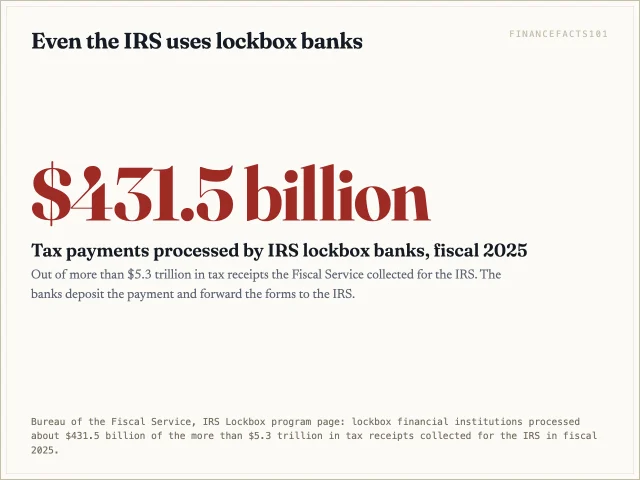
The Treasury's description of its IRS program sums up the job. The participating banks "deposit the taxpayer's payment and forward any tax forms or documentation to the IRS as quickly and efficiently as possible." A separate General Lockbox Network handles non-tax checks mailed to federal agencies, with JPMorgan Chase Bank as the Treasury's financial agent. A business lockbox does the same work for your invoices.
How Lockbox Banking Works
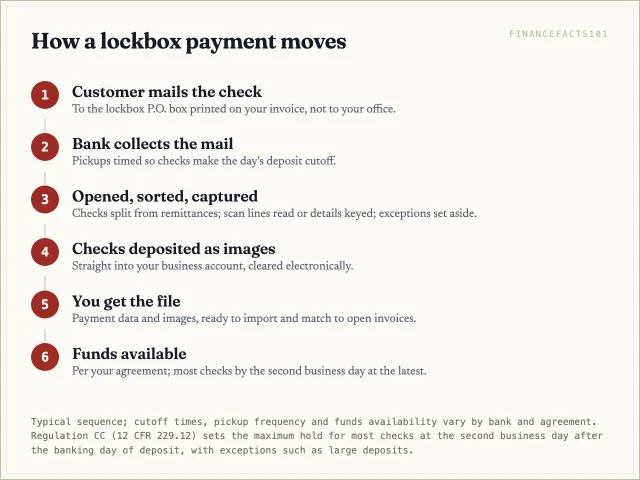
1. You change your remit-to address. Invoices and statements tell customers to mail payments to the lockbox address. Many businesses also print a coupon with a scan line (a machine-readable account number and amount) to speed processing.
2. The bank collects the mail. The processing center picks up from the post office, at larger centers more than once a day, so checks can make that day's deposit.
3. Staff or machines open and sort. Envelopes are opened, and checks are separated from invoices and remittance slips. Anything unusual is set aside, such as cash, a missing check or a note disputing the bill.
4. The bank captures and deposits. Checks are scanned and deposited electronically. Since the Check 21 Act took effect in 2004, banks can collect checks as images instead of shipping paper. The Federal Reserve says the nation's interbank check collection has become "almost entirely electronic" (Federal Reserve).
5. You receive the data. The bank posts a daily file and images: who paid, how much, which invoices. Your accounting or ERP system can import that file to apply cash automatically.
6. Funds become available. A lockbox deposit is still a check deposit. Under Regulation CC, the bank must make funds from most checks available no later than the second business day after the banking day of deposit (12 CFR 229.12), with exceptions such as very large deposits. Banks may give lockbox clients faster availability than the legal maximum. Farmers & Merchants Bank of Long Beach, for example, advertises "same-day credit" on its electronic lockbox (F&M Bank fee schedule, July 2026).
The speed advantage comes from steps 2 to 4. Checks skip the trip to your office, the wait for someone to open the mail, and the separate trip to the bank. The site's entry on electronic checks covers how imaged checks clear.
Types of Lockbox: Retail, Wholesale and Electronic
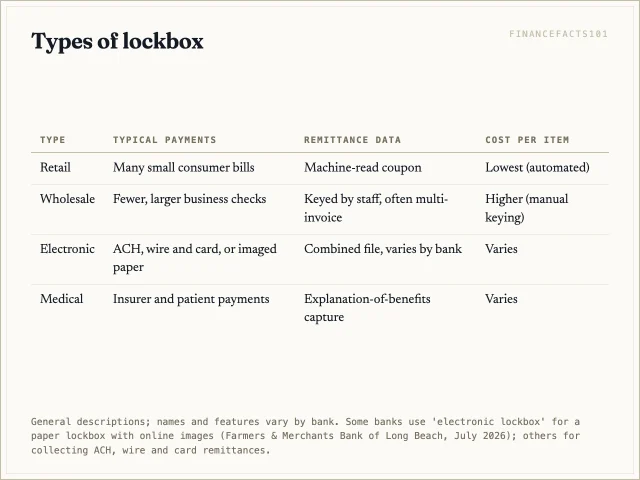
Retail lockbox is built for volume: many small payments from consumers, each with a standard coupon, such as utility bills, insurance premiums and loan payments. Machines read the scan lines, so the per-item cost is low.
Wholesale lockbox is built for business-to-business payments: fewer, larger checks with messy remittance information, such as a check covering eleven invoices with two short-paid. People key in the details, so each item costs more, but the data you get back is richer.
Electronic lockbox means different things at different banks. At some, it is a paper lockbox with online access: Farmers & Merchants Bank of Long Beach's electronic lockbox gives clients a P.O. box, post office pickup, and online viewing of daily deposits and check images. At others, often under the name "virtual lockbox," it applies the same idea to payments that never were paper, collecting ACH, wire and card payments with their remittance details into one file alongside your checks.
Specialized lockboxes exist for industries with their own paperwork. Medical lockboxes, for example, capture insurers' explanation-of-benefits forms; F&M describes its version as HIPAA compliant.
Business-to-business sellers typically need wholesale lockbox; a company with both consumer and business customers may use both. The site's entry on batch processing explains why grouping items into daily runs keeps costs down.
Why Checks Still Matter to Businesses
If checks are dying, why pay for a check-processing service? Because they are declining, not gone, and the ones that remain are big.
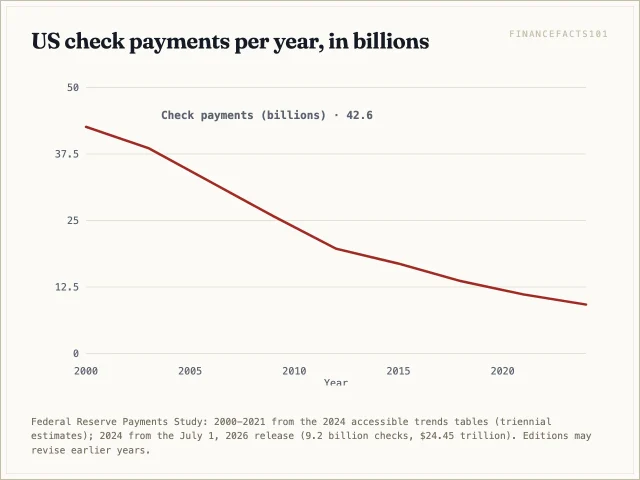
The Federal Reserve's payments study counted 9.2 billion check payments worth $24.45 trillion in 2024, down 1.8 billion checks and $1.92 trillion from 2021 (Federal Reserve Payments Study, July 2026). Checks fell to 4% of US noncash payments by number but still 17% by value. That works out to an average of roughly $2,660 per check, far more than a typical card payment. Some business customers still pay suppliers by check, and a receivables process has to handle them.
What Lockbox Services Cost
Lockbox pricing is often negotiated rather than published, and the fees are often billed through account analysis, the monthly statement that nets service charges against an earnings credit on your balances. Farmers & Merchants Bank of Long Beach's July 2026 schedule lists every lockbox product as "Fees: Per Agreement" and requires an analyzed business checking account.
A few banks publish their prices, and these show how the bill is built. Mechanics Bank's commercial fee schedule, effective October 15, 2024, lists these charges for its Northern California lockboxes (Mechanics Bank):
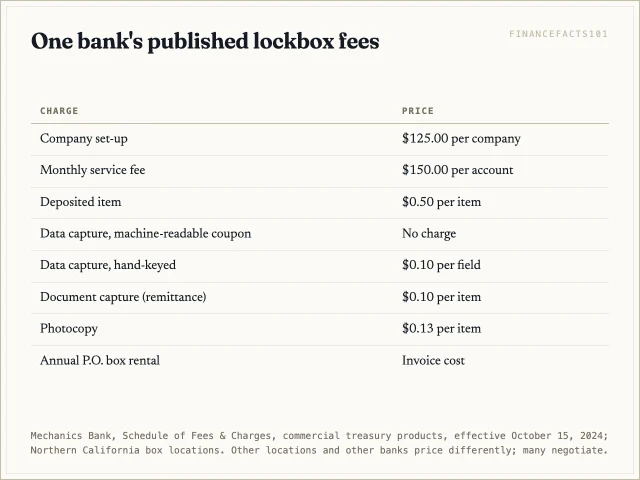
Truist's published price changes use the same structure. You pay a setup fee, a monthly fee, a per-item fee for every check deposited, and extras for anything a person has to handle: keyed data, photocopies, exceptions, cash. The extras are where bills grow. Truist's price changes effective January 1, 2026, for example, raised its retail lockbox charge for processing a cash payment to $8.00 and for a credit card payment item to $1.55 (Truist 2026 price changes).
To estimate the cost of lockbox bank services for your business, multiply your monthly check count by the per-item fee, add the monthly fee, and then add data capture. That last part depends on how clean your remittances are: a check with a scan-line coupon costs pennies to capture, while a check with a handwritten note costs a keyed field or several.
Is a Lockbox Worth It? A Worked Example
A lockbox pays for itself in three ways:
- Float. Money reaches your account sooner.
- Labor. Staff no longer open, key and deposit checks.
- Control. Fewer employees handle checks.
The first can be priced exactly. Value float at a short-term rate, here 3.88%, the effective federal funds rate on September 22, 2026 per the Federal Reserve's H.15 release.
Consider two businesses using Mechanics Bank's published Northern California prices:
- A small contractor receives 150 checks a month averaging $800, so $120,000 a month. Say the lockbox gets money in one day sooner. Fees, before the $125 setup and P.O. box rental: $150 a month plus 150 × $0.50 = $2,700 a year. Float gain: $120,000 × 12 ÷ 365 × 1 day × 3.88% = about $150 a year.
- A mid-size distributor receives 2,500 business checks a month averaging $2,600, so $6.5 million a month. Say it gains two days, and each check needs two hand-keyed fields. Fees: $150 + 2,500 × $0.50 = $1,400 a month, plus 5,000 fields × $0.10 = $500, which is $22,800 a year. Float gain: $6.5 million × 12 ÷ 365 × 2 days × 3.88% = about $16,600 a year.
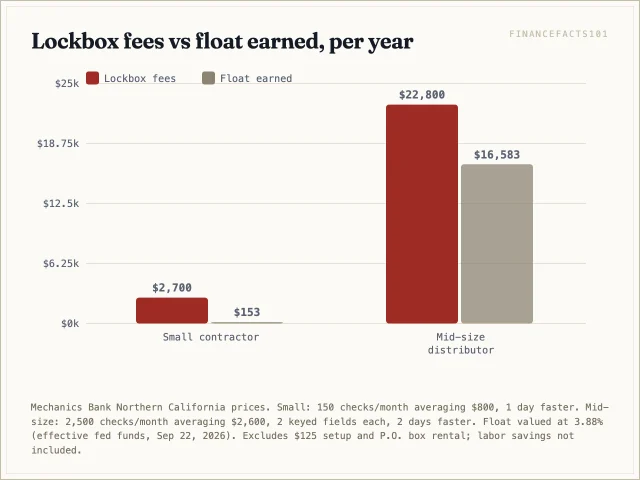
The distributor's lockbox costs about $6,200 a year more than the float it earns. It is worth it if the staff time it replaces is worth more than $6,200 a year. Spread over 30,000 checks a year, that is about 21 cents a check, roughly 30 seconds of staff time at $25 an hour. Opening, matching, keying and depositing a check by hand takes longer than that. For the contractor, the fees exceed the float by about $2,550 a year, and handling 150 checks a month takes little staff time. The lockbox is hard to justify on cost alone.
That is the general rule. Lockbox economics turn on volume and check size. The higher the dollar value that arrives by mail, the more float matters, and the more checks you get, the more labor a lockbox replaces. Your own inputs will differ: your bank's prices, how many days your mail actually saves, and what an hour of your staff's time costs.
Lockbox Banking for Small Businesses
For many small businesses, the right answer is a cheaper tool that does part of the job:
- Mobile or remote deposit capture. You scan checks yourself and deposit them electronically. You still open the mail and key the payments, but you skip the trip to the bank. Business remote deposit usually carries its own monthly fee, so check the bank's fee schedule.
- Electronic payments. ACH transfers and online invoice payments remove the check altogether. Under Regulation CC, a bank must make electronic payments available no later than the business day after the banking day it receives them (12 CFR 229.10).
- A lockbox anyway, for control. A two-person office where one person opens the mail, deposits the checks and keeps the books has a fraud-control problem. A lockbox separates those duties, and that can justify the fee even when the math above does not.
If you do shop for small-business lockbox banking, ask about minimums. Some banks set monthly minimums or require an analyzed account, which a very small business may not otherwise need. The site's guide to deposit accounts covers the account types.
Lockbox Security and Fraud Controls
Mail is a fraud target. In February 2023, FinCEN warned banks of a nationwide surge in mail theft-related check fraud, noting that suspicious activity reports related to check fraud "reached over 680,000" in 2022, "nearly double" the previous year (FinCEN). A lockbox does not stop theft from a blue collection box on a customer's street, but it shortens the time checks spend in the mail and in your building.
Controls worth asking about:
- Physical and access controls at the processing site. Treasury's IRS lockbox banks "must adhere to all IRS and Fiscal Service guidelines and policies for the security of the money and information they collect and pass on." Ask a commercial provider for an independent audit of its controls, such as a SOC 1 report.
- Exception handling rules that you write. Decide what the bank does with checks made out to the wrong name, unsigned checks, cash and correspondence.
- Remit-to address discipline. Tell customers your lockbox address will never change by email alone, so an impostor's "new address" request is easy to spot.
- Daily reconciliation of the bank's deposit file against your receivables.
Positive pay, often mentioned alongside lockbox, protects the other direction: it checks the outgoing checks you write against the list you issued. The two services are often bought together from a bank's treasury management group.
Choosing a Lockbox Provider
When you compare bank lockbox services for your business, get answers in writing on:
- Cutoff and availability. What time must mail be processed to make that day's deposit, and when are funds available?
- Location. Where is the box? Mechanics Bank's schedule, for example, lists separate box locations in Los Angeles, Dallas, Chicago, Pittsburgh and Northern California. A box near where your customers mail from saves mail days.
- Full pricing. Get setup, monthly, per-item, data capture, images, transmission, P.O. box rental and exception fees, priced at your actual volume.
- Data and integration. What file format arrives, how often, and can your ERP or accounting system import it without manual work? Check how long images are kept.
- Exceptions and service. Who calls you about a problem check, and how fast?
- Contract terms. Look at the minimum term, the exit fee, and how long the bank will forward mail if you leave.
Outsourcing a process like this has the usual trade-offs. The site's entry on outsourcing in finance covers the general case.
FAQ
What is a lockbox in banking?
A bank service in which customers mail payments to a P.O. box the bank controls. The bank opens the mail, deposits the checks into your business account and sends you the payment data and images. It speeds up deposits and takes check handling out of your office.
How much does a bank lockbox cost?
It depends on volume and the bank; most negotiate prices. One bank's published schedule, Mechanics Bank's from October 2024, lists a $125 setup fee, $150 a month, $0.50 per deposited check and $0.10 per hand-keyed field. At 2,500 checks a month with two keyed fields each, that comes to about $22,800 a year before setup and box rental.
Is lockbox banking the same as remote deposit capture?
No. With remote deposit capture you receive and scan the checks yourself. With a lockbox, checks go straight to the bank and your staff never handle them. Remote deposit is cheaper, while a lockbox saves more labor and improves control.
Do small businesses need a lockbox?
Usually not for cost reasons. A business receiving a few hundred modest checks a month rarely earns enough float to cover the fees. Mobile deposit or electronic payments cost less. A lockbox can still make sense for fraud control when one person would otherwise handle all the checks.
Sources
- Bureau of the Fiscal Service, IRS Lockbox: about $431.5 billion processed by lockbox banks of more than $5.3 trillion in IRS tax receipts, fiscal 2025; security requirements for financial agents
- Bureau of the Fiscal Service, General Lockbox Network: non-tax collections for federal agencies; JPMorgan Chase Bank, N.A. as financial agent
- Federal Reserve, Regulation CC and Check 21: interbank check collection "almost entirely electronic"
- eCFR, 12 CFR 229.12, availability schedule and 12 CFR 229.10, next-day availability
- Federal Reserve, Federal Reserve Payments Study, national payment volumes 2015–24 (July 1, 2026): 9.2 billion checks worth $24.45 trillion in 2024; 4% and 17% of noncash payments; and 2024 accessible version of trends in noncash payments: check counts 2000–2021
- Federal Reserve, H.15 Selected Interest Rates: effective federal funds rate 3.88%, September 22, 2026
- FinCEN, Alert on nationwide surge in mail theft-related check fraud (February 27, 2023)
- Mechanics Bank, Schedule of Fees & Charges, commercial treasury products (effective October 15, 2024): lockbox fees and box locations
- Truist, 2026 Price Changes (effective January 1, 2026): retail lockbox cash payment processing $8.00, credit card item $1.55
- Farmers & Merchants Bank of Long Beach, Services & Fees (July 2026): lockbox fees per agreement; electronic lockbox same-day credit; HIPAA-compliant medical lockbox
 Next entry · No. 2,968Understanding Locked-In Retirement Accounts in Canada: A Tax-Deferred Option for Former Employer-Sponsored Plan Participants
See also
-
 No. 3,835
30 Apr 2025
20 min
Maximizing Efficiency and Cost Savings: A Comprehensive Guide to Outsourcing in Finance and Investment
Business Finance
No. 3,835
30 Apr 2025
20 min
Maximizing Efficiency and Cost Savings: A Comprehensive Guide to Outsourcing in Finance and Investment
Business Finance -
 No. 3,139
04 Mar 2025
19 min
Understanding Mastercard: An In-Depth Look into the Global Payments Processing Giant
Business Finance
No. 3,139
04 Mar 2025
19 min
Understanding Mastercard: An In-Depth Look into the Global Payments Processing Giant
Business Finance -
 No. 2,727
30 Jan 2025
20 min
Maximizing Value through Knowledge Process Outsourcing: A Comprehensive Guide for Institutional Investors
Business Finance
No. 2,727
30 Jan 2025
20 min
Maximizing Value through Knowledge Process Outsourcing: A Comprehensive Guide for Institutional Investors
Business Finance -
 No. 1,255
19 Aug 2024
16 min
Understanding Electronic Checks: A Secure, Efficient, and Cost-Effective Alternative to Paper Checks
Business Finance
No. 1,255
19 Aug 2024
16 min
Understanding Electronic Checks: A Secure, Efficient, and Cost-Effective Alternative to Paper Checks
Business Finance -
 No. 3,027
23 Feb 2025
16 min
Understanding the Luhn Algorithm: Validating Identification Numbers for Institutional Investors
Finance Policy
No. 3,027
23 Feb 2025
16 min
Understanding the Luhn Algorithm: Validating Identification Numbers for Institutional Investors
Finance Policy -
 No. 2,597
19 Jan 2025
19 min
Understanding Just-in-Time Inventory System: Advantages, Disadvantages, and Examples
Business Strategy
No. 2,597
19 Jan 2025
19 min
Understanding Just-in-Time Inventory System: Advantages, Disadvantages, and Examples
Business Strategy