Organic Reserve Replacement: Understanding the Importance of Organic Reserves for Oil and Gas Companies

Understand Organic Reserve Replacement - a critical metric for evaluating oil companies' financial health and growth.
Introduction to Organic Reserve Replacement
Organic reserve replacement is an essential concept in the oil and gas industry, representing the reserves that a company acquires through its own exploration and production efforts rather than purchasing proven reserves from other sources. Organically sourced reserves are crucial for investors seeking to assess a company’s financial strength, particularly when evaluating its reserve-replacement ratio. In this article, we dive deep into organic reserve replacement, exploring its significance as a metric in the oil industry, how it contributes to a company’s reserve-replacement ratio, and the processes involved in discovering and developing these reserves.
Understanding Organic Reserve Replacement: A Metric for Investors
Organic reserve replacement plays a vital role in evaluating the financial health of an oil or gas company. The reserve-replacement ratio is a widely used metric to assess a company’s long-term profitability and viability. This ratio measures the amount of proved reserves a company adds to its reserve base each year compared to the amount produced. A company with a reserve-replacement ratio below 100% could indicate that it is depleting its reserves, potentially leading to concerns about future production and profits. Organic reserves are an essential component of this calculation, as they represent the new reserves discovered through a company’s exploration and development activities.
The Importance of Organic Reserves for Oil Companies
Oil companies rely on organic reserves to maintain their reserve base, replace depleting reserves, and ensure long-term profitability. For small and medium-sized oil companies, finding and development (F&D) companies specializing in exploration and production can play a crucial role in discovering new organic reserves. In larger integrated corporations, an arm of the business may handle these duties. The term “finding and development” also refers to the process and costs associated with researching and developing or purchasing property to establish commodity reserves.
The Exploration Process: Discovering Organic Reserves
Organic reserve replacement is a lengthy and complex process that begins in areas with high potential for containing resources due to local geology and known nearby petroleum deposits. The first step involves conducting geophysical and geochemical analyses using various techniques like induced polarization (IP) surveys, drilling, assaying, seismologic sounding, and electrical currents. After a promising area is identified, the company will drill an exploratory well to gather more detailed geological data on rock and fluid properties.
Modern oil exploration heavily relies on offshore drilling due to the vast potential reserves located beneath the ocean floor. A single exploratory well can cost upwards of $150 million, and success rates are around one in five. The process from discovering an organic reserve to bringing it into production can take several years.
The Role of Finding and Development Companies
F&D companies play a significant role in helping small and medium-sized oil companies discover new organic reserves through exploration efforts. These specialized firms focus on finding, drilling, and developing resources for their clients, allowing them to maintain their primary focus on production and distribution.
Calculating Organic Reserve Replacement Costs
The costs associated with discovering organic reserves include funds spent during the entire exploration process. To calculate a company’s costs, the total amount spent is divided by the estimated additional quantity discovered. As investors seek to assess a company’s financial strength, understanding organic reserve replacement costs and their impact on a company’s overall reserve-replacement ratio can provide valuable insights into its long-term profitability and viability.
In the next section of this article, we will discuss the accounting methods used to calculate these costs, as well as their implications for investors. Stay tuned to learn more about full cost accounting (FC) vs. successful efforts (SE) accounting methods and their impact on financial health evaluations.
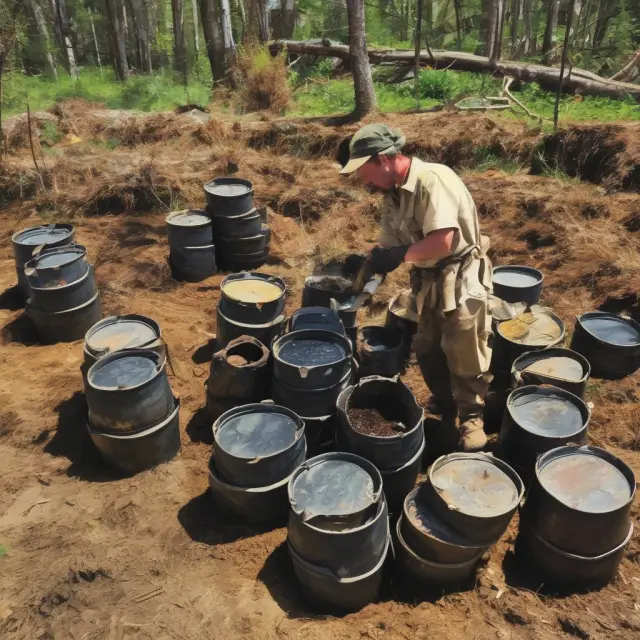
Evaluating Oil Companies: The Need for Organic Reserves
When assessing oil companies, investors rely on several key metrics to evaluate their financial health, potential growth, and long-term viability. One of the most significant indicators is a company’s organic reserve base. Organic reserves are those reserves discovered, extracted, or acquired through exploration, drilling, and development efforts by the oil company itself. Organic reserves play an essential role in determining a company’s financial strength and its ability to replace the oil it produces over time.
Understanding the reserve-replacement ratio is crucial for investors when evaluating oil companies. This metric expresses the amount of proved reserves added to a company’s reserve base during a year compared to the amount produced. Ideally, the reserve-replacement ratio should be at least 100% or more. If a company replaces all the reserves it produces each year, its current reserves will not deplete and can support continuous production. Lower reserve-replacement ratios raise concerns among investors about the long-term viability of the company if they are unable to maintain or exceed this ratio.
Small- to medium-sized oil companies often seek out firms that specialize in exploration and production (E&P) to acquire organic reserves through their efforts. This process, also known as finding and development (F&D), is essential for these companies since they typically lack the resources required for extensive exploratory work. The upstream functions – exploration, finding, and development – refer to these activities in the oil and gas industry. Geophysical and geochemical analyses are conducted using various techniques like induced polarization (IP) surveys, drilling, assaying, seismologic sounding, and electrical currents. Upon locating a promising area, a company drills an exploratory well to gain detailed geological data on the rock and fluid properties. Offshore exploration has become increasingly common due to higher success rates and the potential for massive discoveries. The average cost of an offshore exploratory well is approximately $150 million, with a success rate of around one in five. It may take several years before the results come into production.
Investors need to be aware that some companies use different accounting methods when reporting their reserve replacement costs. One approach, known as the full cost (FC) method, capitalizes all operating expenses, regardless of whether commercially viable reserves are found or not. This method can overstate a company’s profitability by inflating its balance sheet. In contrast, the successful efforts (SE) accounting method only allows those expenses directly associated with discovering new organic oil and gas reserves to be capitalized. This more conservative approach offers a more accurate representation of a company’s financial health when evaluating its organic reserve replacement costs.
Investors should consider a company’s organic reserve replacement as part of their overall evaluation of the company’s financial health, growth potential, and long-term viability. Organic reserves represent a substantial portion of a company’s total reserves and provide insight into the effectiveness of its exploration efforts. By analyzing a company’s organic reserve replacement ratio, investors can gauge the success of a company’s upstream activities and potential future profitability.

What is Organic Reserve Replacement?
Organic reserve replacement, also known as organic reserves or internally generated reserves, refers to the supply of oil and gas reserves that a company acquires through its own exploration and production efforts, rather than purchasing from other companies or governments. This metric holds significant importance for investors looking to evaluate the financial health and long-term viability of oil and gas companies.
By evaluating a company’s organic reserve replacement capacity, investors can assess the efficiency of the company’s exploration and production operations, as well as its ability to replenish its reserves over time. Organic reserves are crucial because they contribute to the company’s overall reserve base, which is used to calculate essential financial ratios such as reserve-replacement ratio.
The reserve-replacement ratio measures the amount of new proved reserves a company finds or acquires during a year compared to the amount it produces and sells. A company must maintain a reserve-replacement ratio of at least 100% to be financially healthy and sustainable in the long term, as a lower ratio indicates that the company is depleting its reserves faster than it can replace them.
To acquire organic reserves, companies undergo exploration processes such as drilling exploratory wells, using geophysical and geochemical analysis techniques to assess potential petroleum deposits. This process is often expensive and time-consuming, with the success rate being around one in five for onshore locations and even lower for offshore projects.
In the oil and gas industry, companies may choose to work with Finding and Development (F&D) firms that specialize in exploration and production to increase their chances of discovering organic reserves. These firms help smaller and medium-sized oil companies locate and develop new hydrocarbon deposits through a collaborative effort. The process of finding and developing organic reserves is known as the upstream function, which involves researching and acquiring land or property for exploration, conducting geological assessments, drilling exploratory wells, and managing production operations.
Calculating the cost of organic reserve replacement can be done by dividing the total funds spent during the exploration process by the estimated quantity of new reserves discovered. This ratio not only helps investors assess a company’s financial health but also provides insights into its future profitability based on its ability to replace depleting reserves.
Investors seeking to evaluate oil and gas companies should consider a company’s organic reserve replacement capacity as a significant metric for understanding the long-term sustainability of their investment. By focusing on a company’s exploration efforts, investors can gain confidence in the company’s ability to continue generating revenue through new discoveries while maintaining its overall financial health.

Impact on Reserve-Replacement Ratio
Organic reserve replacement plays a pivotal role when evaluating an oil company’s financial health through its impact on the reserve-replacement ratio. This ratio expresses the amount of proved reserves added to a company’s reserve base during the year compared to the amount of oil and gas produced. A company with a healthy organic reserve replacement rate ensures a sustainable future, as it indicates that they are not depleting their existing reserves but rather discovering new ones.
To better understand this concept, consider a company with a 90% reserve-replacement ratio, meaning they replaced only 90% of the oil and gas they produced last year. Although it may seem acceptable at first glance, it is essential to recognize that this company is still depleting 10% of their reserves each year. In contrast, an ideal reserve-replacement ratio should be at least 100%, with a goal for excess replenishment.
Investors and analysts closely examine the organic reserve replacement rate when assessing a company’s potential profitability and long-term viability. Lower reserves could indicate that the company is depleting its resources, which may eventually lead to a shortage of supply. Organic reserves help mitigate this issue as they represent new, economically feasible oil reserves discovered through exploration and production processes.
Furthermore, small- to medium-sized oil companies frequently partner with dedicated exploration and development (E&D) firms that specialize in the upstream functions. These companies focus solely on exploration, drilling, and finding organic reserves. Through these collaborations, smaller companies can significantly improve their reserve base and enhance their overall financial health.
Calculating the cost of organic reserve replacement is crucial for investors seeking a thorough evaluation of an oil company’s fiscal strength. The costs incurred during the exploration process, which includes the drilling of exploratory wells and associated geophysical surveys, are totaled. This total is then divided by the estimated quantity discovered to calculate the cost per barrel or cubic feet of new organic reserves. By evaluating this figure, investors can determine the efficiency and profitability of a company’s upstream efforts.
In conclusion, an oil company’s organic reserve replacement rate plays a crucial role in its financial health by significantly impacting the reserve-replacement ratio. Investors should consider this metric when assessing a company’s overall business viability and future profitability. By understanding the importance of organic reserves and their relation to the reserve-replacement ratio, investors can make informed decisions regarding the oil companies they invest in.

How Organic Reserves are Discovered: The Exploration Process
Organic reserve replacement refers to the oil reserves that a company acquires through its exploration and production activities, not purchased from external sources. A strong organic reserve base is crucial for an oil company’s financial health, as it significantly impacts their overall reserve-replacement ratio. In this section, we delve into the process of discovering organic reserves via exploration, finding and development (F&D), and drilling.
The exploration phase marks the initial steps in identifying potentially lucrative areas for oil and gas deposits. Small to medium-sized oil companies often collaborate with F&D firms specializing in exploration and production to locate organic reserves. For larger corporations, an internal department may handle these duties. In both cases, this process is collectively known as upstream functions in the industry.
Exploration typically begins in areas with favorable geological conditions, driven by local geology and nearby petroleum deposits. Geophysical and geochemical analyses are employed using various techniques such as induced polarization (IP) surveys, drilling, assaying, seismologic sounding, and electrical currents. The ultimate goal is to evaluate the subsurface for hydrocarbon potential.
Following a promising area identification, an exploratory well – also known as a wildcat or a dry hole – is drilled to gather more comprehensive geological data about rock and fluid properties. Offshore exploration sites can entail substantial costs, with a single exploratory well potentially costing upwards of $150 million, while success rates remain around one in five. Given the financial commitment, it generally takes several years before an exploratory well comes into production.
The cost associated with discovering a new organic reserve replacement is calculated by totaling all expenditures incurred during the exploration process and dividing it by the estimated additional quantity discovered. The resulting figure provides valuable information for investors looking to assess the financial health of oil and gas companies. A strong organic reserve base, as reflected in a positive reserve-replacement ratio, is indicative of a company’s upstream efforts and future profitability.

The Role of Finding and Development Companies
Organic reserves are essential for smaller to medium-sized oil companies aiming to maintain their financial health and future viability. In this process, finding and development (F&D) companies play a crucial role by assisting these firms in exploring, discovering, and acquiring new organic reserves through various means. F&D companies focus on the upstream functions of exploration and production, employing a range of techniques to research prospective areas, drill exploratory wells, and analyze data to establish oil or gas reserves.
The primary goal for smaller to medium-sized oil companies is to maintain their reserve base and achieve an acceptable reserve-replacement ratio. A company’s reserve-replacement ratio expresses the amount of proved reserves added to its reserve base during the year compared to the amount produced. Investors prefer a company with a reserve-replacement ratio greater than 100%, as this indicates that more reserves are being discovered than extracted.
During the exploratory phase, companies often employ the services of F&D companies to find and develop new organic reserves. These firms specialize in exploration, drilling, and data analysis to determine the potential viability of a given area. They conduct various assessments using techniques such as induced polarization (IP) surveys, geophysical sounding, electrical currents, and seismic analysis to evaluate the subsurface geology. Once an area is deemed promising, F&D companies drill exploratory wells to gather more detailed information on fluid and rock properties.
However, not all exploration efforts lead to successful discoveries. The success rate for discovering commercially viable reserves varies significantly depending on factors such as location, geology, and costs. Typically, it takes several years before an exploratory well comes into production. The costs associated with exploration can be substantial, particularly for offshore projects, where a single well might cost upwards of $150 million.
The accounting method used to calculate the organic reserve replacement cost plays a significant role in evaluating a company’s financial health. Two primary accounting methods exist: full cost (FC) and successful efforts (SE). Under the FC approach, all exploration expenses are capitalized regardless of whether commercially viable reserves are discovered or not. This method inflates the balance sheet and makes the company appear more profitable than it is. In contrast, the SE accounting method only allows expenses associated with successfully locating new oil and natural gas reserves to be capitalized.
The organic reserve replacement cost is a crucial component of a company’s financial analysis. Investors should consider this metric when evaluating a company’s overall financial health and future profitability. The results from the expenditures in drilling, exploration, and evaluation efforts may offer insight into future discoveries and potential revenue growth. By understanding the role of F&D companies, their importance to smaller to medium-sized oil firms, and the significance of organic reserves, investors can make informed decisions based on accurate financial data.

Accounting Methods: Full Cost vs. Successful Efforts
When assessing an oil company’s financial health and potential for profitability, investors and industry analysts closely examine its reserve-replacement ratio – the amount of proved reserves added to a company’s reserve base during the year compared to the quantity produced. A desirable ratio should be 100% or higher, ensuring that the company is replacing its reserves as it extracts them. However, understanding how those reserves are acquired and accounted for can significantly impact investors’ evaluations.
Two primary accounting methods used in the oil industry for reserve replacement costs are Full Cost Accounting (FCA) and Successful Efforts Accounting (SEA). These methods differ significantly in their approach to calculating and reporting costs, ultimately influencing a company’s financial picture.
Full Cost Accounting (FCA): This method requires companies to capitalize all their exploration and development expenses, regardless of whether or not they have found any economically viable reserves. Capitalizing these expenses inflates the balance sheet by treating them as assets. While FCA may make a company appear more profitable on paper due to the increased asset base, it could be misleading as the actual profitability of a company depends on its ability to replace proved reserves through organic growth.
Successful Efforts Accounting (SEA): A more conservative approach, SEA only allows capitalization of those expenses directly related to the discovery and development of commercially viable organic reserves. Under this method, all costs incurred during exploration that do not result in a successful finding are expensed immediately. By accurately reporting the true financial situation, SEA offers investors a clearer picture of a company’s economic health and potential future profitability.
Investors should evaluate a company’s use of accounting methods carefully when examining its organic reserve replacement rate, as this metric plays a crucial role in determining its long-term viability. Companies with strong organic reserves can better withstand market fluctuations and sustain production levels, providing a more stable investment opportunity. By understanding the implications of different accounting methods, investors are equipped to make informed decisions about their investments in the oil industry.

Calculating Organic Reserve Replacement Costs
Understanding how costs for organic reserves are calculated is essential when evaluating oil companies’ financial health. The process of discovering organic reserves through exploration involves several expenses, including drilling, geological analysis, and personnel costs. These costs can significantly impact the viability and profitability of a company. Two primary accounting methods, full cost (FC) and successful efforts (SE), are used to account for these expenses.
First, let us discuss the exploration process and how organic reserve replacement costs are determined:
1. Exploration and Finding New Organic Reserves: Small- and medium-sized oil companies may rely on finding and development (F&D) companies to locate new organic reserves through exploration. These processes involve geological analysis, including techniques like induced polarization (IP) surveys, drilling, and assaying. The upstream functions of exploration, finding, and developing are collectively known as the oil industry’s exploratory efforts.
2. Accounting for Exploration Costs: Two primary accounting methods are used to account for exploration costs – the full cost (FC) and successful efforts (SE) methods. Understanding these differences is crucial in determining a company’s financial health.
Full Cost (FC) Method: This method capitalizes all operating expenses, regardless of whether reserves are found or not. The FC method inflates the balance sheet by treating costs as assets, making the company seem more profitable than it might be.
Successful Efforts (SE) Method: In contrast, the SE method only allows capitalization of costs associated with successfully locating new oil and natural gas reserves. This accounting method offers a more accurate reflection of a company’s financial situation by not overstating assets that may not yet be commercially viable.
Now, let us delve deeper into how these methods impact the calculation of organic reserve replacement costs:
Full Cost (FC) Method: In this method, all exploration costs are capitalized regardless of whether new reserves have been found or not. The total cost is then divided by the estimated quantity discovered to determine the cost per barrel (or cubic feet for natural gas) for new organic reserve replacement. This cost can be used to assess a company’s financial health when evaluating its reserve-replacement ratio and upstream efforts.
Successful Efforts (SE) Method: Under this method, only costs associated with successfully discovering new reserves are capitalized. The total successful cost is then divided by the quantity of new organic reserves discovered to find the cost per barrel for organic reserve replacement. This approach offers a more accurate representation of a company’s financial position by accounting only for the expenses that led to the discovery of commercially viable resources.
Investors and analysts can use this metric to assess a company’s financial strength, profitability, and overall business health. Organic reserve replacement costs are a critical component in determining the success of a company’s upstream efforts and future potential for growth. As such, investors should carefully consider these costs when evaluating oil companies for investment opportunities.

Assessing the Financial Health of Oil Companies: Organic Reserves as a Key Metric
Organic reserves are a crucial metric for investors to evaluate the financial health, viability, and future profitability of oil companies. Understanding organic reserve replacement is essential in determining if an oil company has a healthy and sustainable business model. In this section, we will discuss how organic reserves come into play when assessing the financial strength of oil companies.
Firstly, what is organic reserve replacement? Organic reserve replacement refers to the oil reserves acquired by a company through exploration and production efforts as opposed to purchasing them from other companies. This metric is vital for investors as it helps determine if a company can maintain its production levels while also replacing its reserves.
To evaluate the financial health of an oil company, investors often look at the reserve-replacement ratio (RRR). The RRR measures the amount of proved reserves added to a company’s reserve base during a year compared to the amount produced in that same timeframe. Ideally, a company should have a RRR above 100% for long-term viability and profitability. A lower RRR indicates depletion of reserves and may lead to the eventual exhaustion of resources.
Organic reserve replacement plays a significant role in calculating this ratio. To calculate organic reserve replacement costs, investors look at the funds spent on exploration during the period and divide it by the estimated new quantities discovered. This calculation helps determine how efficiently the company is spending its capital to find and replace its reserves organically.
Now, let’s explore the process of discovering organic reserves. Small- and intermediate-sized oil companies may work with a specialized exploration and production (E&P) firm for finding new reserves. Alternatively, larger integrated corporations have an in-house unit handling these tasks. In either case, this process is known as finding and development (F&D).
The F&D phase includes the costs associated with researching, establishing property, and locating commodity reserves. The oil industry calls exploration and the upstream functions to discover organic reserves. This process generally begins in an area with high potential for resources based on geology and nearby petroleum deposits. To identify a promising area, companies employ various techniques like induced polarization (IP) surveys, drilling, assaying, seismologic sounding, and electrical currents. Once a viable location is found, the company drills an exploratory well to gather detailed geological data on rock and fluid properties. This process can take years as exploratory wells may not come into production for several years.
In terms of accounting methods, companies use either full cost (FC) or successful efforts (SE) approaches when calculating their organic reserve replacement costs. The FC approach capitalizes all operating expenses regardless of whether commercially viable reserves are discovered or not, making the company’s balance sheet appear more profitable than it actually is. On the other hand, the SE method only capitalizes those expenses associated with successfully locating new oil and natural gas reserves, providing a more accurate representation of the financial health of the company.
To sum up, understanding organic reserve replacement and its role in evaluating an oil company’s financial health is essential for investors. The metric helps determine the efficiency of a company’s capital expenditures on finding new reserves, which is crucial for assessing its long-term viability and profitability.

FAQs
What is Organic Reserve Replacement?
Organic reserve replacement is the supply of oil reserves that an oil company acquires through its own exploration and production efforts, rather than purchasing proven reserves. It is a crucial metric for evaluating oil companies, as investors analyze their financial health based on the company’s ability to replace its reserves over time, maintaining a healthy reserve-replacement ratio.
Why is Organic Reserve Replacement essential?
Organic reserve replacement plays a vital role in understanding an oil or gas company’s financial strength and viability. By evaluating a company’s organic reserve replacement rate, investors can assess its ability to sustainably replace the reserves it extracts, ensuring long-term profitability.
How does Organic Reserve Replacement impact the Reserve-Replacement Ratio?
Organic reserve replacement is one part of a company’s overall reserve base expansion, which contributes to its reserve-replacement ratio (RRR). A strong organic reserve replacement rate not only maintains a high RRR but also signals the company’s commitment to upstream efforts and future success.
How does exploration contribute to Organic Reserve Replacement?
The oil industry goes through an exploration process that starts by identifying potential areas based on geological surveys, drilling, or seismic data. The primary goal is to discover new organic reserves, which are economically viable at the current market price and can be sustainably extracted given the existing production methods and government regulations.
What role do Finding and Development (F&D) Companies play in Organic Reserve Replacement?
Finding and Development companies focus on exploration, drilling, and development activities for smaller- to medium-sized oil and gas companies, allowing them to acquire organic reserves without the significant upfront costs and expertise required. This collaboration strengthens the partnership between the two entities and enables both parties to benefit from their unique strengths.
What accounting methods are used for Organic Reserve Replacement?
The oil industry employs different accounting methods to assess the costs related to organic reserve replacement. Some companies follow the Full Cost (FC) approach, where all exploration expenses are capitalized, regardless of whether they lead to discovering any commercially viable reserves or not. This method can overstate profits but provides a more comprehensive view of overall business operations. Alternatively, the Successful Efforts (SE) accounting method only capitalizes costs directly related to finding new reserves, offering a more conservative and accurate representation of profitability.
How is Organic Reserve Replacement calculated?
To determine an oil company’s organic reserve replacement cost, one must calculate the total funds spent on exploration activities during a specific period and divide it by the additional estimated quantity discovered. This number provides valuable insight into the company’s financial health and commitment to exploring for new reserves.
 Next entry · No. 3,790Understanding Organic Sales: Growth Drivers and Benefits
See also
-
 No. 3,657
16 Apr 2025
20 min
Understanding Oil Fields: Discovering and Maximizing the Value of Fossil Fuels
Energy Finance
No. 3,657
16 Apr 2025
20 min
Understanding Oil Fields: Discovering and Maximizing the Value of Fossil Fuels
Energy Finance -
 No. 1,422
13 Sep 2024
20 min
Understanding Exploration & Production (E&P): The Early Stage of Energy Production
Energy Finance
No. 1,422
13 Sep 2024
20 min
Understanding Exploration & Production (E&P): The Early Stage of Energy Production
Energy Finance -
 No. 5,345
01 Sep 2025
20 min
Upstream Oil and Gas Operations: Understanding the Exploration and Production Sector
Business Finance
No. 5,345
01 Sep 2025
20 min
Upstream Oil and Gas Operations: Understanding the Exploration and Production Sector
Business Finance -
 No. 5,343
01 Sep 2025
19 min
Understanding the Upstream Capital Costs Index (UCCI): A Comprehensive Guide for Institutional Investors
Business Finance
No. 5,343
01 Sep 2025
19 min
Understanding the Upstream Capital Costs Index (UCCI): A Comprehensive Guide for Institutional Investors
Business Finance -
 No. 3,408
26 Mar 2025
17 min
Net Cash: Understanding This Essential Measure of a Company’s Financial Health
Business Finance
No. 3,408
26 Mar 2025
17 min
Net Cash: Understanding This Essential Measure of a Company’s Financial Health
Business Finance -
 No. 5,680
29 Sep 2025
17 min
Understanding Wellbores: A Comprehensive Guide for Institutional Investors
Energy Finance
No. 5,680
29 Sep 2025
17 min
Understanding Wellbores: A Comprehensive Guide for Institutional Investors
Energy Finance