Performance Bonds: What They Are, Who Issues Them, and the Bank Alternatives
A performance bond guarantees a contractor finishes the job. Federal construction contracts over $150,000 need one, normally for 100% of the price.
A performance bond is a written guarantee that a contractor will finish the work it signed up for. If the contractor defaults, the company that issued the bond, called the surety, either gets the job completed or pays the project owner up to a fixed amount, the bond's penal sum. In the United States, performance bonds are normally issued by insurance companies acting as sureties, not by banks. When a bank provides the same protection, it does so with a bank guarantee or a standby letter of credit.
Performance bonds are routine in construction. Federal law requires one on every federal construction contract above $150,000, normally for 100% of the contract price, and states and cities impose similar rules on their own projects. This page covers the definition, how a bond works from bid to claim, who issues and accepts them, what banks offer instead, the main types, what a bond costs, and the unrelated futures-market meaning of the same term. It is general information current as of September 2026, not legal advice on any particular contract.
What Is a Performance Bond? The Definition
The Federal Acquisition Regulation gives the shortest accurate definition. In FAR 28.001, a bond is a written instrument signed by a contractor (the "principal") and a surety "to assure fulfillment of the principal's obligations to a third party," the obligee, and "a performance bond secures performance and fulfillment of the contractor's obligations under the contract." The same section defines the penal sum as the most the surety can be made to pay.
So every performance bond has three parties:
- Principal: the contractor or supplier whose work is guaranteed. It buys the bond.
- Obligee: the project owner who is protected. That could be a government agency, a developer, a school district or a business.
- Surety: the company that stands behind the promise, usually an insurance company licensed to write surety bonds.
A performance bond is not insurance for the contractor, even though insurers write it. An insurance policy spreads losses across many policyholders. A surety expects the contractor to repay every dollar it pays out. Smith, Gambrell & Russell, a law firm that advises on construction, explains that before bonding a contractor, "sureties typically require those with a financial interest in the contractor to sign a General Agreement of Indemnity." In practice, that often means the owners personally. The bond protects the owner. The contractor still carries the risk.
A performance bond is also different from a payment bond, its usual companion. The performance bond guarantees that the work gets done. The payment bond guarantees that subcontractors and suppliers get paid. Public projects usually require both, because workers and suppliers generally cannot put a mechanic's lien on public property.
Performance Bonds Explained Simply: From Bid to Claim
If you are new to bonding, the easiest way to understand a performance bond is to follow one through a project. Here is the typical sequence on a public construction job.
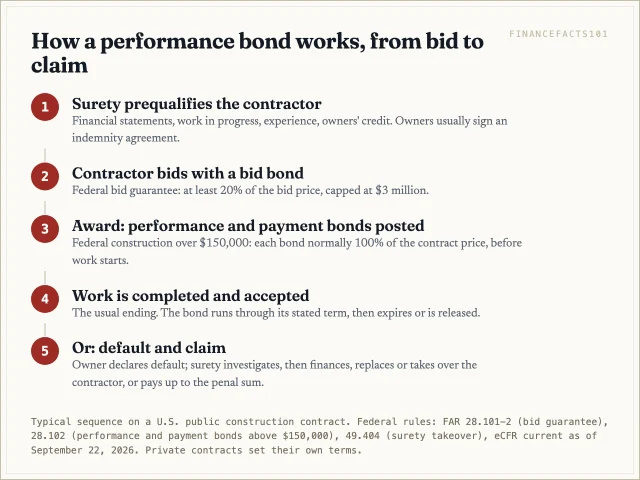
Think of it as a co-signer arrangement with a professional co-signer. The surety investigates the contractor much as a lender would. It looks at financial statements, work in progress, experience and the owners' personal credit. It lends its name only if it thinks the contractor will finish. Most bonded projects end the ordinary way: the job is accepted, the warranty period runs out, and the bond expires without a claim. In the Federal Highway Administration study cited below, the average default rate for five state transportation departments from 2008 to 2010 "never reached 1 percent."
When a contractor does fail, the owner declares a default under the contract, and the surety has to respond. It is not a blank check. The surety investigates whether there really was a default, and it can generally raise the defenses the contractor could have raised against the owner. That investigation is the main practical difference between a surety bond and a bank's on-demand guarantee, covered below.
The surety's options on a valid claim usually include financing the original contractor to finish, bringing in a replacement contractor, taking over and completing the work itself, or paying damages up to the penal sum. On federal jobs, FAR 49.404 tells contracting officers that they "should permit surety offers to complete the contract" unless the proposed completing contractor is not competent and qualified or the offer is not in the government's interest.
Who Issues Performance Bonds?
In the U.S., surety companies, which are insurance companies licensed by state insurance regulators to write surety business, issue most performance bonds. Contractors usually get them through surety agents or brokers who specialize in construction bonds. The broker places the bond, but the insurer issues it and backs it. Federal rules also allow an individual surety who pledges specific assets to back the bond, under FAR 28.203.
For federal work, not every surety qualifies. Under FAR 28.202, corporate sureties on bonds for contracts performed in the U.S. "must appear on the list contained in the Department of the Treasury's Listing of Approved Sureties (Treasury Department Circular 570)." Treasury's Bureau of the Fiscal Service publishes that list on its surety bonds page, where Circular 570 is described as "a complete list of companies that write or reinsure federal bonds." Treasury last updated it on August 1, 2026, and under FAR 28.202(c) it issues supplements when companies are added or removed. Each listed company also has a per-bond underwriting limitation. A bond larger than that limit is acceptable only if the excess is coinsured or reinsured.
Two other players show up often enough to mention:
- The SBA. The Small Business Administration does not issue bonds. It guarantees them, which helps small contractors get bonded by a surety that might otherwise say no. Per the SBA's surety bond program, it guarantees bid, payment, performance and ancillary bonds on contracts up to $9 million, or $14 million for federal contracts. Small businesses pay SBA "a fee of 0.6% of the contract price" on performance and payment bond guarantees.
- Banks. They issue the bank-based equivalents described in the next section, not surety bonds.
Performance Bonds From Banks: Bank Guarantees and Standby Letters of Credit
People who search for "performance bonds from banks" usually want one of two things. Some are contractors hoping their bank can provide the bond. Others are overseas buyers or project owners asking for a "bank performance bond." In both cases the answer is a bank instrument with a different name.
U.S. banks generally issue standby letters of credit, not guarantees. Federal rules sharply limit when a national bank may act as a guarantor or surety. 12 CFR 7.1017 allows national banks to do so only in narrow cases, such as when the bank takes a segregated deposit from the customer covering its full potential liability. What national banks may issue, subject to safety-and-soundness conditions, are "letters of credit and other independent undertakings" under 12 CFR 7.1016. For such an undertaking, the bank's obligation to pay "depends upon the presentation of specified documents and not upon nondocumentary conditions or resolution of questions of fact or law at issue between the applicant and the beneficiary." A standby letter of credit that pays the owner if the contractor defaults is the U.S. bank's version of a performance bond. The entry on standby letters of credit covers them in detail.
Outside the U.S., banks issue performance guarantees. In Europe, the Middle East, Asia and Africa, a "performance bond" in a contract often means a bank's demand guarantee. The site's page on bank guarantees explains how those are issued and called.
The two routes differ in how easily the owner can collect and in how much each one covers. The World Bank's standard bidding documents for smaller works contracts (2004 edition) let the owner pick either form and give a common size for each. A bank guarantee "shall be unconditional (on demand)", and "an amount of 5 to 10 percent of the Contract Price is commonly specified." A performance bond from a surety is an undertaking "to complete the construction in the event of default by the Contractor, or to pay the amount of the Bond," and "an amount of 30 percent of the Contract Price is commonly used internationally." U.S. public bonds are larger still, at 100% of the contract price.
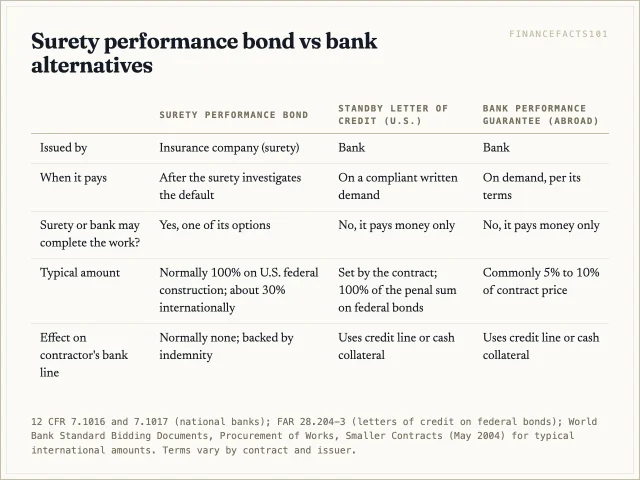
For the contractor, the practical difference is capacity. A standby letter of credit is a credit exposure for the bank. The bank will book it against your credit line or ask for cash collateral, which ties up borrowing power you may need for payroll and materials. A surety bond is backed by the indemnity agreement and the surety's underwriting, so it normally leaves your bank line untouched. That is the main reason U.S. contractors bond through sureties. The entry on letters of credit explains how the documentary side works.
Can a bank letter of credit replace a bond on a federal job? Yes. Under FAR 28.204-3, a contractor may secure a required bond with an irrevocable letter of credit equal to the penal sum. "A separate ILC is required for each bond." The letter must require "no document other than a written demand," and only federally insured institutions rated investment grade may issue or confirm it. A bank that did less than $25 million of letter-of-credit business in the past year needs another qualifying bank to confirm any letter over $5 million.
Types of Performance Bonds
The term "performance bond" is used loosely, so it helps to separate the true performance bonds from their companions and from the bank substitutes.
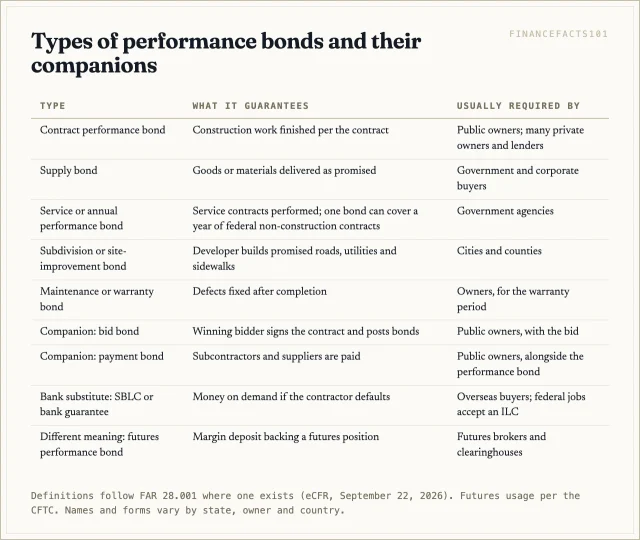
Some notes on the table. Contract performance bonds on construction are the core case. Supply bonds do the same job for delivery of goods. Service performance bonds cover janitorial, maintenance, transport and similar contracts; the FAR even provides for an "annual performance bond" covering all of a contractor's non-construction contracts in a fiscal year. Subdivision or site-improvement bonds are posted by developers to a city or county to guarantee that they will build the roads, sewers and sidewalks promised in a plat approval. Maintenance or warranty bonds cover defects after completion.
Bid bonds and payment bonds sit on either side of the performance bond and are almost always required alongside it on public work. Under FAR 28.101-2, a federal bid guarantee must be at least 20% of the bid price, up to a maximum of $3 million. The site's entry on bid bonds covers them further.
Who Requires and Accepts a Performance Bond?
The obligee (the party that asks for the bond) decides whether it will accept one, and in what form. The main groups:
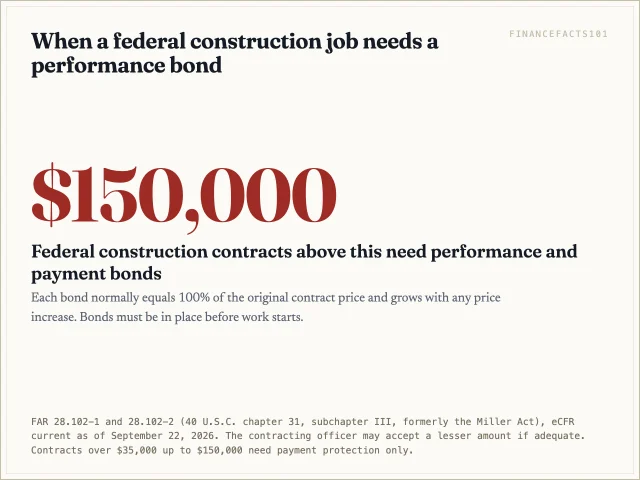
The federal government. The statute once called the Miller Act (now 40 U.S.C. chapter 31, subchapter III) requires performance and payment bonds for any federal construction contract above $150,000, per FAR 28.102-1. That mandate covers construction only. On federal service and supply contracts, a performance bond is optional: under FAR 28.103-2, agencies "may" require one on contracts above the simplified acquisition threshold "when necessary to protect the Government's interest." Under FAR 28.102-2, the performance bond must equal 100% of the original contract price unless the contracting officer decides a smaller amount is enough, and it must grow if the price increases. Federal agencies accept bonds from Treasury-listed corporate sureties or qualifying individual sureties, or the alternatives in FAR 28.204: a deposit of U.S. bonds or notes; a certified or cashier's check, bank draft, money order or currency; or an irrevocable letter of credit.
States and local governments. States have their own bonding statutes for public works, often called "Little Miller Acts," and many cities and counties add their own rules. Thresholds, amounts and acceptable sureties vary by state. Check the solicitation, which states exactly what bond is required.
Private owners and lenders. No law requires a bond on most private projects. Owners ask for one anyway on larger jobs, and construction lenders may require one as a condition of the loan. The contract sets the form, and many private owners specify a standard bond form.
Overseas buyers and international lenders. These obligees often accept either a surety bond or a bank demand guarantee, as the World Bank documents above show, and many prefer the bank version because it pays on demand.
What a Performance Bond Costs: A Worked Example
A performance bond is priced as a one-time premium, a percentage of the bond amount, and the rate falls as the contract gets bigger. No regulator sets the rate. Each surety prices its own risk, and a contractor with weak financials, little track record or poor credit pays more, or cannot get bonded at all.
A 2014 Federal Highway Administration study, Performance-Based Contractor Prequalification as an Alternative to Performance Bonds, reprints a sample tiered schedule from the Surety & Fidelity Association of America for a typical highway or bridge performance bond: $10.80 per $1,000 on the first $500,000, $6.70 per $1,000 from $500,000 to $2.5 million, $5.30 to $5 million, $4.90 to $7.5 million, and $4.40 above that.
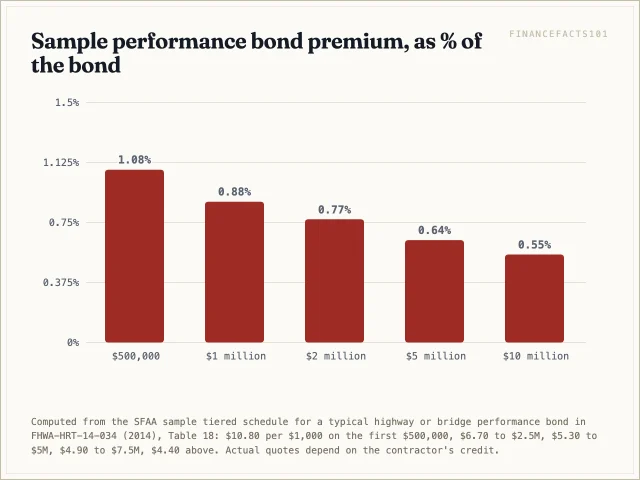
Worked example: a $2,000,000 federal building contract. The contractor needs a performance bond and a payment bond, each for $2,000,000.
- Surety premium. On the sample schedule, the performance bond costs $5,400 on the first $500,000 plus $10,050 on the next $1.5 million: $15,450, or about 0.77% of the contract. Your own surety's quote will differ. Most sureties quote one premium covering the performance and payment bonds together, according to James Moore & Co., an accounting firm that advises contractors, so do not simply double the figure. Confirm with your surety.
- SBA fee, if used. A small business bonded through the SBA program also pays SBA 0.6% of the contract price, or $12,000.
- Bank route instead. Two irrevocable letters of credit of $2,000,000 each would tie up $4,000,000 of bank credit until at least a year after final payment, plus the bank's commission.
Contractors usually build the bond premium into the bid price, so the owner ends up paying for the protection it asked for.
How to Get a Performance Bond
Bonding is a relationship, not a one-off purchase. A contractor who first calls a surety the week a bid is due can be too late, because underwriting a new account takes time and paperwork. The usual path:
- Find a surety agent or broker who writes construction bonds. For federal work, confirm that the surety is on Circular 570 with an underwriting limit large enough for the bond, or that reinsurance is arranged.
- Prequalify before you bid. Sureties typically ask for company and personal financial statements (CPA-prepared for larger programs), a schedule of work in progress, resumes of key people, bank references and the owners' credit.
- Sign the indemnity agreement. Expect the company and its owners to sign.
- Get a bonding line. The surety sets a single-job limit and an aggregate limit for all bonded work at once. Those two numbers cap how much work you can bid.
- Submit a bid bond with the bid, then deliver the performance and payment bonds on award. On federal jobs, bonds are due before the notice to proceed.
Contractors below the standard market's appetite should ask about the SBA program. Lenders and owners evaluating a contractor's surety relationship are, in effect, relying on the surety's underwriting risk judgment.
The Other "Performance Bond": Futures Margin
In futures trading, "performance bond" means something unrelated: the deposit a trader must post with a broker to hold a position. The Commodity Futures Trading Commission describes it this way: "Margins in the futures markets are not down payments like stock margins, but are performance bonds designed to ensure that traders can meet their financial obligations," typically "between two and 10 percent of the total value of the contract." If you arrived here from a futures context, the entry on initial margin is the one you want.
FAQ
Do banks issue performance bonds?
Not in the surety sense. U.S. banks generally issue standby letters of credit, which do the same job, because federal rules limit national banks acting as guarantors. Banks outside the U.S. issue performance guarantees. Both pay on demand and use up the contractor's credit line. Surety bonds come from insurance companies.
What is the difference between a performance bond and a bank guarantee?
A surety performance bond is usually conditional. The surety investigates the claimed default and can complete the work instead of paying. A bank guarantee or standby letter of credit usually pays against a compliant written demand, with no inquiry into the dispute. Bank guarantees are commonly smaller (5% to 10% of contract value on World Bank-financed works) but quicker to collect.
How much of the contract does a performance bond cover?
It depends on the contract. U.S. federal construction bonds are normally 100% of the contract price, though the contracting officer may accept less. Internationally, surety performance bonds are commonly around 30% and bank performance guarantees 5% to 10%, per World Bank bidding documents. Private contracts set their own amount.
What happens to a performance bond when the project is finished?
It stays in force for whatever period the bond and contract specify, often through final acceptance and sometimes the warranty period. Then it expires or is released. A separate maintenance bond may replace it for the warranty period.
Sources
- Federal Acquisition Regulation, 48 CFR 28.001, Definitions: bond, performance bond, payment bond, penal sum, annual performance bond (eCFR, current as of September 22, 2026)
- Federal Acquisition Regulation, 48 CFR 28.102-1, General: bonds required on construction contracts exceeding $150,000
- Federal Acquisition Regulation, 48 CFR 28.102-2, Amount required: performance bonds equal to 100% of the original contract price
- Federal Acquisition Regulation, 48 CFR 28.103-2, Performance bonds: optional performance bonds on non-construction contracts
- Federal Acquisition Regulation, 48 CFR 28.101-2: bid guarantee at least 20% of bid price, maximum $3 million
- Federal Acquisition Regulation, 48 CFR 28.202, Acceptability of corporate sureties: Treasury Circular 570 and underwriting limits
- Federal Acquisition Regulation, 48 CFR 28.204-3, Irrevocable letter of credit: letters of credit in place of sureties
- Federal Acquisition Regulation, 48 CFR 49.404, Surety-takeover agreements
- U.S. Department of the Treasury, Bureau of the Fiscal Service, Surety Bonds and Circular 570: list of companies that write or reinsure federal bonds; updated August 1, 2026
- U.S. Small Business Administration, Surety bonds: bond types guaranteed, $9 million and $14 million contract limits, 0.6% fee
- OCC regulations, 12 CFR 7.1017, National bank as guarantor or surety and 12 CFR 7.1016, Independent undertakings
- The World Bank, Standard Bidding Documents: Procurement of Works, Smaller Contracts (May 2004): performance bank guarantee 5-10% and performance bond 30% of contract price
- Federal Highway Administration, Performance-Based Contractor Prequalification as an Alternative to Performance Bonds, Chapter 4 (FHWA-HRT-14-034, August 2014): SFAA sample tiered premium schedule, Table 18
- James Moore & Co., How Much Does a Surety Bond Cost? The James Moore Guide (January 13, 2026): performance and payment bonds usually share one premium
- Smith, Gambrell & Russell LLP, Understanding Your Surety's Indemnity Agreement (August 2016)
- Commodity Futures Trading Commission, Economic Purpose of Futures Markets and How They Work: futures margins as performance bonds
 Next entry · No. 3,953Understanding Periodic Interest Rates: Compound Frequency Matters for Investors
See also
-
 No. 5,917
18 Oct 2025
20 min
Identifying Zombie ETFs: Spotting the Signs Before It’s Too Late
Business Finance
No. 5,917
18 Oct 2025
20 min
Identifying Zombie ETFs: Spotting the Signs Before It’s Too Late
Business Finance -
 No. 5,908
17 Oct 2025
26 min
Understanding Zero Plus Ticks in Finance and Investment: An Essential Guide for Institutional Investors
Business Finance
No. 5,908
17 Oct 2025
26 min
Understanding Zero Plus Ticks in Finance and Investment: An Essential Guide for Institutional Investors
Business Finance -
 No. 5,863
14 Oct 2025
21 min
Understanding Yield Maintenance: A Prepayment Penalty for Institutional Investors
Business Finance
No. 5,863
14 Oct 2025
21 min
Understanding Yield Maintenance: A Prepayment Penalty for Institutional Investors
Business Finance -
 No. 5,747
04 Oct 2025
22 min
Window Dressing in Finance: Unveiling Deceptive Practices in Mutual Funds and Accounting
Business Finance
No. 5,747
04 Oct 2025
22 min
Window Dressing in Finance: Unveiling Deceptive Practices in Mutual Funds and Accounting
Business Finance -
 No. 5,713
01 Oct 2025
19 min
Understanding Wholesale Banking: Services, Benefits, and Examples
Business Finance
No. 5,713
01 Oct 2025
19 min
Understanding Wholesale Banking: Services, Benefits, and Examples
Business Finance -
 No. 5,675
28 Sep 2025
18 min
Understanding the Welfare and Pension Plans Disclosure Act (WPPDA) and its Impact on ERISA
Business Finance
No. 5,675
28 Sep 2025
18 min
Understanding the Welfare and Pension Plans Disclosure Act (WPPDA) and its Impact on ERISA
Business Finance