Bank Guarantees: Types, Uses, and Key Considerations
A bank guarantee is a bank's promise to pay a named party up to a fixed sum if its client defaults. The 9 main types, how one is issued, and terms to check.
A bank guarantee is a bank's written promise to pay a named beneficiary, up to a fixed amount, if the bank's customer fails to pay or perform under a contract. The customer (the applicant) asks its own bank to issue it, the bank charges a fee and takes a counter-indemnity or collateral, and the beneficiary — a buyer, a project owner, a landlord, a customs authority — gets a claim against a bank instead of a claim against a company it may not know. That is the whole idea: bank guarantees swap the applicant's credit for the bank's.
This page covers what a bank guarantee is and how it works, how one is issued step by step, the full list of types, how it differs from a standby letter of credit, the terms and conditions worth reading line by line, and what it costs. It is general information current as of September 2026, not legal advice on a specific contract; guarantee wording is negotiated, and the text you sign governs.
What a Bank Guarantee Is: A Bank-Based Commercial Guarantee
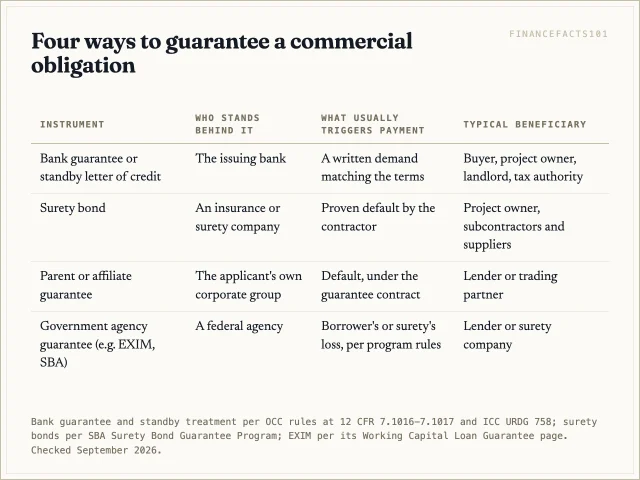
When a contract says a party must provide "security," there are four broad ways to do it, and a bank guarantee is the one where a bank stands behind the promise. That is what people mean by a bank-based commercial guarantee: a commercial obligation — deliver the goods, finish the building, repay the advance, pay the rent — backed by a bank's own undertaking rather than by an insurer, a parent company or a government agency.
Three parties are always involved:
- Applicant (also called the principal or instructing party) — the company or person whose performance is being guaranteed. It asks for the guarantee and ultimately pays for any claim.
- Guarantor — the issuing bank. It pays the beneficiary on a valid claim, then recovers from the applicant.
- Beneficiary — the party protected by the guarantee, who can make a claim if the applicant defaults.
In cross-border deals a fourth party often appears: a bank in the beneficiary's own country that issues a local guarantee, backed by a counter-guarantee from the applicant's bank. Governments and state-owned buyers frequently insist on this so that any claim is against a bank they can sue at home.
The other families of commercial guarantee sit next to this one. A surety bond is issued by an insurance company rather than a bank, and in the United States the Small Business Administration guarantees bid, payment, performance and ancillary surety bonds for small contractors on contracts up to $9 million (non-federal) or $14 million (federal). A parent or affiliate guarantee — including upstream guarantees and softer keepwell agreements — is backed only by the group's own balance sheet. And export credit agencies guarantee loans to exporters or buyers. What sets the bank version apart is speed: most bank guarantees pay on demand.
How Does a Bank Guarantee Work?
The feature that decides how a guarantee behaves is whether it is a demand guarantee or a conditional (accessory) guarantee.
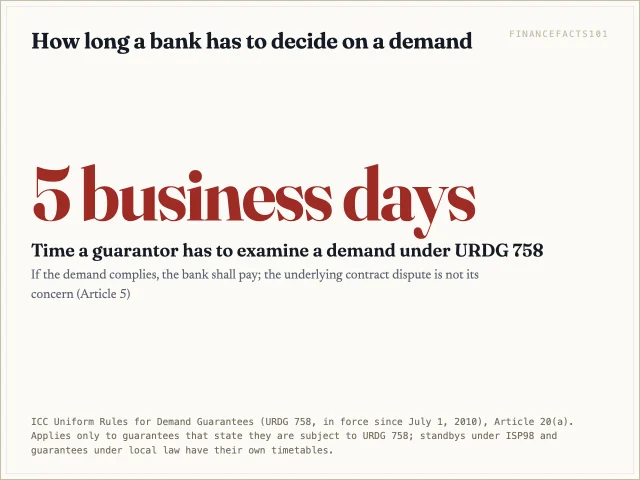
A demand guarantee pays against a written demand that matches the guarantee's terms, without the bank investigating whether the applicant really defaulted. The International Chamber of Commerce's Uniform Rules for Demand Guarantees (URDG 758, in force since July 1, 2010) put it bluntly in Article 5: a guarantee "is by its nature independent of the underlying relationship," and the bank "is in no way concerned with or bound by" the underlying contract. Most international bank guarantees are demand guarantees, and many say so by stating they are "subject to URDG 758." Under its Article 1, URDG 758 applies only to a guarantee that expressly says it is subject to the rules; a guarantee that does not is governed by the applicable national law alone.
A conditional guarantee is closer to a classic suretyship: the beneficiary must prove the default — sometimes with an arbitration award or court judgment — before the guarantor pays. Surety bonds from insurers usually work this way, which is why beneficiaries tend to prefer bank paper.
Under URDG 758, a demand is not quite a blank check. Article 15 requires the demand to be supported by a statement "indicating in what respect the applicant is in breach," unless the guarantee expressly excludes that requirement. Article 20 then gives the bank five business days after presentation to decide whether the demand complies, and if it does, the bank "shall pay."
After paying, the bank turns to its customer. The applicant signed a counter-indemnity when it applied, so the bank debits the applicant's account, draws on collateral, or books the amount as a loan under the applicant's credit facility. The applicant's remedy, if the call was unfair, is against the beneficiary under the underlying contract — not against the bank. That order of events — pay first, argue later — is what makes a demand guarantee valuable to the beneficiary and risky for the applicant.
How a Bank Guarantee Is Issued, Step by Step
Issuance is a credit decision, not a form-filling exercise. The bank is taking on a contingent liability equal to the guarantee amount, so it underwrites the applicant much as it would for a loan.
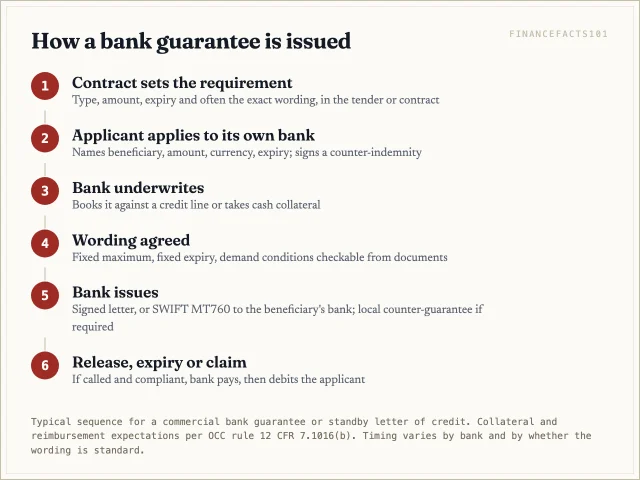
- The contract sets the requirement. A tender, supply contract, construction contract or lease specifies the type of guarantee, its amount (often a percentage of contract value), its expiry, and frequently the exact wording, supplied as an annex.
- The applicant applies to its bank. The application names the beneficiary, amount, currency, expiry and underlying contract, and attaches the required wording.
- The bank underwrites. It reviews financial statements and the underlying deal, then either books the guarantee against an existing trade or credit line or requires cash collateral. For national banks, U.S. regulation sets the bar: an issuer of an independent undertaking should limit it in amount; should also limit it in duration, keep the right to terminate it periodically or at will, or be entitled to cash collateral from the applicant on demand; and "either should be fully collateralized or have a post-honor right of reimbursement," per the OCC's rule at 12 CFR 7.1016.
- The wording is settled. The bank checks that the text is workable: a clear maximum amount, a fixed expiry, and demand conditions it can examine from documents alone.
- The bank issues. Domestically, that can be a signed letter. Internationally, it is usually an authenticated SWIFT message (the MT760 format) sent to the beneficiary's bank, which either advises it or issues its own local guarantee against the counter-guarantee.
- The guarantee runs until release or expiry. The beneficiary holds it, may reduce it as milestones are met, and returns it or lets it lapse at the end. If it is called, the bank pays and recovers from the applicant.
Timing depends on the bank and on whether the wording is standard: a guarantee on the bank's own template under an existing line can be same-week; a bespoke cross-border guarantee needing a counter-guarantee can take weeks.
Types of Bank Guarantees: The Full List
Every type below is the same instrument — a bank's promise to pay up to a sum — aimed at a different risk. The names vary by country and industry, which is why lists of "various types of bank guarantees" never quite match.
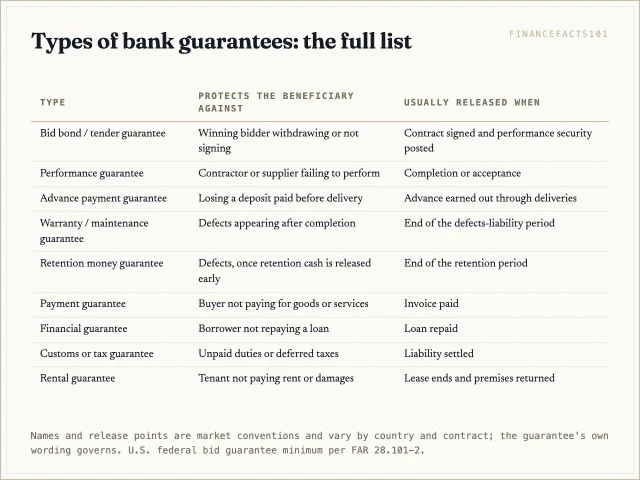
Bid bond or tender guarantee. Submitted with a bid, it protects the buyer if the winning bidder withdraws or refuses to sign the contract and post the performance security. U.S. federal procurement is a useful benchmark: under FAR 28.101-2 the bid guarantee must be at least 20% of the bid price, capped at $3 million. Private and international tenders often ask for less; the tender documents set the number.
Performance guarantee. The core construction and supply guarantee: if the contractor fails to perform, the owner can claim up to the guaranteed sum to cover the cost of finishing or replacing the work. It typically replaces the bid bond at contract signing and runs until completion or acceptance.
Advance payment guarantee. When a buyer pays a deposit up front, this guarantee lets it recover the unearned part of that advance payment if the seller never delivers. Well-drafted versions reduce automatically as deliveries are made.
Warranty or maintenance guarantee. Covers the defects-liability period after completion, often replacing the performance guarantee at a lower amount.
Retention money guarantee. Lets a contractor collect the retention a project owner would otherwise hold back from each payment, with the bank promising to repay it if defects are not fixed.
Payment guarantee. Protects a seller if the buyer does not pay for goods or services delivered on credit — the mirror image of a performance guarantee.
Financial guarantee. Backs a loan or other money obligation, for example a subsidiary's borrowing from another bank.
Customs or tax guarantee. Secures duties, taxes or deferred-payment privileges owed to a government authority.
Rental guarantee. Replaces a cash security deposit on a lease. It is common in parts of Europe and the Middle East and rare in U.S. residential leasing, where cash deposits dominate.
Shipping guarantees (letting a buyer collect goods before the original bill of lading arrives) and court or appeal guarantees are narrower relatives.
Bank Guarantee vs. Standby Letter of Credit
In practice the two do the same job. The difference is mostly legal packaging and geography, and it explains why U.S. banks rarely use the word "guarantee."
For a national bank, a true guarantee is restricted. Under 12 CFR 7.1017, a national bank may become a guarantor for a customer only if it has a substantial interest in the transaction, holds a segregated deposit covering its full potential liability, or is guaranteeing a financial obligation whose amount is reasonably ascertainable. Independent undertakings to pay against documents — letters of credit, including standbys — are expressly permitted under 12 CFR 7.1016 and are "not subject to" the guarantee rule. So U.S. banks issue standby letters of credit governed by UCC Article 5 and the ICC's International Standby Practices (ISP98), while banks in Europe, the Middle East, Asia and Africa issue demand guarantees under URDG 758 or local law.
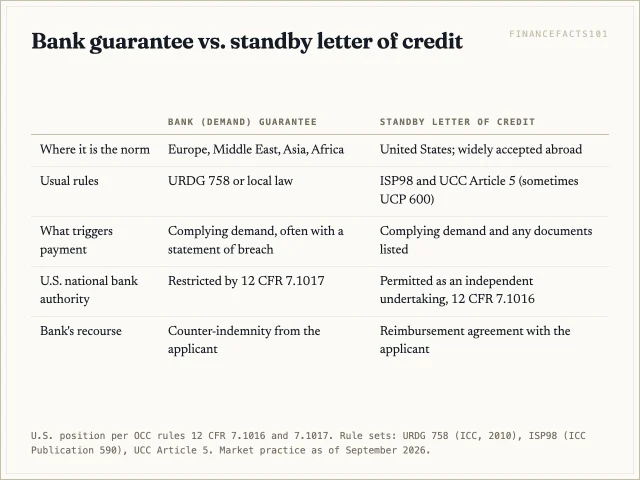
If you are a U.S. company asked for a "bank guarantee" by a foreign buyer, the usual answer is a standby letter of credit from your U.S. bank, or a local guarantee issued by the buyer's bank against your bank's standby as a counter-undertaking. Ask the beneficiary which it will accept before you apply.
Bank Guarantee Terms and Conditions: What to Read in the Wording
The guarantee text decides who carries the risk, and the applicant is often handed the beneficiary's wording as a take-it-or-leave-it annex. These are the clauses to read before signing the contract that requires it.
- Maximum amount and reductions. One fixed ceiling, in one currency. For advance payment and performance guarantees, look for automatic reduction as deliveries or milestones are completed.
- Expiry. A calendar date, an event (such as a completion certificate), or the earlier of the two. Open-ended wording is dangerous for the applicant; under URDG Article 25, a guarantee that states no expiry at all terminates three years after issue.
- Demand conditions. On-demand, demand plus a statement of breach, or demand plus a third-party document such as an engineer's certificate. Each extra document is protection against an unfair call.
- "Extend or pay." A beneficiary may demand payment unless the guarantee is extended. Your bank will need your instructions quickly.
- Governing law and jurisdiction. Unless stated otherwise, URDG Article 34 applies the law of the place where the issuing branch is located.
- Assignment and transfer. Whether the beneficiary can pass the guarantee or its proceeds to someone else, such as a lender.
- Automatic renewal. "Evergreen" clauses that roll the guarantee forward unless the bank gives notice; the OCC expects renewal terms to leave room for a fresh credit review.
- Your side of the deal. The counter-indemnity, the collateral or credit line the guarantee consumes, the commission, and the bank's right to debit your account the moment it pays.
The practical test: could a beneficiary acting in bad faith call this guarantee with a one-line letter? If yes, price that risk into the contract.
What a Bank Guarantee Costs — and a Worked Example
Banks price guarantees as a commission, usually quoted as an annual percentage of the face amount, plus issuance, amendment and claim-handling fees. There is no published standard rate. Pricing depends on the applicant's credit, the tenor, the type (financial guarantees tend to cost more than performance guarantees), the country risk, and whether the bank holds cash collateral. The less visible cost is capacity: a guarantee uses up credit line the business could otherwise borrow against.
Worked example: a $2 million federal construction contract. A contractor bids $2,000,000 on a U.S. federal construction job, as of September 2026:
- Bid guarantee. At least 20% of the bid price under the FAR: $400,000.
- Performance and payment security. Contracts above $150,000 require both a performance bond and a payment bond, each normally 100% of the original contract price, under FAR 28.102-2: $2,000,000 each.
- Bank route. Instead of surety bonds, the contractor may post an irrevocable letter of credit, which may require "no document other than a written demand" to draw. A separate one is needed for each bond, so this route ties up $4,000,000 of bank credit. At an illustrative 1% annual commission, that is $40,000 a year before fees — the actual rate is whatever the bank quotes.
- Surety route. A small contractor using an SBA-guaranteed surety bond pays SBA a guarantee fee of 0.6% of the contract price on performance and payment bonds — $12,000 here — plus the surety's own premium, and ties up no bank line.
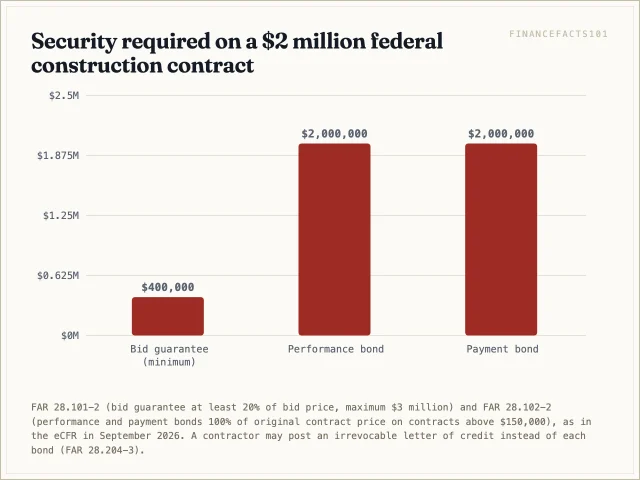
That comparison is why U.S. contractors usually bond through sureties and why exporters facing foreign buyers usually end up with bank paper: the beneficiary chooses the instrument, and the applicant's job is to price whichever one it gets.
U.S. Export-Import Bank Loan Guarantees
The Export-Import Bank of the United States (EXIM) is often mentioned alongside bank guarantees, but it guarantees something different: loans. Under its Working Capital Loan Guarantee, EXIM gives a commercial lender a 90% guarantee on its working capital loan to a U.S. exporter, which lets the lender advance more against export receivables and inventory. The beneficiary is the lender, the risk covered is the exporter's non-repayment, and the backer is the federal government rather than a bank. If a foreign buyer asks your company for a performance or advance payment guarantee, EXIM is not the issuer — your bank is, though EXIM says exporters can use a guaranteed working capital line to "post standby letters of credit serving as bid bonds, performance bonds, or payment guarantees."
Banker's Acceptance: A Bank Promise, but Not a Guarantee
Older explanations, including the earlier version of this page, list the banker's acceptance as a kind of bank guarantee. It is better understood as a short-term credit instrument. A banker's acceptance is a time draft — an order to pay a sum on a future date — that a bank has "accepted," making the bank itself liable to pay the holder at maturity. The customer then owes the bank. As the Richmond Fed's money-market reference describes it, the bank is "in effect substituting its credit for that of the importer."
That substitution of credit is the family resemblance. The difference is that an acceptance is the payment itself, due on a set date regardless of performance, while a guarantee pays only if something goes wrong. Acceptances financed just under half of U.S. imports and exports at their 1931 peak; the Federal Reserve stopped outright purchases of them in March 1977, and they are now a niche instrument.
Red Flags: "Bank Guarantees" That Are Scams
Real bank guarantees are issued to support a specific contract, for a specific beneficiary, and are not investments. The SEC's investor education office warns that "Prime Bank" investment programs — pitched as trading in debentures, standby letters of credit or bank guarantees — "do not exist. They are all scams." Offers to lease a bank guarantee, "monetize" one, or buy a trade slot in a guarantee trading platform fit that pattern. So do promises of high, risk-free returns and claimed backing from the World Bank, the IMF, the Federal Reserve or the ICC.
The test is simple. A genuine guarantee is requested by the applicant from its own bank, costs the applicant a fee, and pays out only to the named beneficiary. Anything sold to you as a way to earn money from a guarantee is not one.
FAQ
What is the difference between a bank guarantee and a letter of credit?
A commercial (documentary) letter of credit is the normal way to pay: the bank pays the seller when shipping documents are presented. A bank guarantee, like a standby letter of credit, is a backstop: it pays only if the applicant fails to pay or perform. A standby letter of credit and a demand guarantee are functionally close; U.S. banks issue standbys because federal rules restrict national banks from acting as guarantors, while banks elsewhere issue guarantees under URDG 758.
Can a bank refuse to pay a bank guarantee?
Yes, but only on the guarantee's own terms. The bank refuses if the demand arrives after expiry, exceeds the maximum amount, or lacks a required document or statement. It will not refuse because the applicant says the underlying dispute is unfair; demand guarantees are independent of the contract. The narrow exception is clear fraud, where courts in many jurisdictions can block payment.
Who pays for a bank guarantee?
The applicant pays the bank's fees and commission and, if the guarantee is called, reimburses the bank for the full amount paid under the counter-indemnity. The beneficiary pays nothing to the bank, though the cost is usually built into the contract price.
How long does a bank guarantee last?
As long as its expiry date or expiry event says. Bid guarantees usually run a few months beyond the bid validity period; performance guarantees run to completion; warranty guarantees cover the defects period. Under URDG 758, a guarantee with no stated expiry terminates three years after issue.
Do U.S. banks issue bank guarantees?
Mostly in the form of standby letters of credit. The instrument does the same job, and many U.S. banks with international desks can also arrange a local guarantee in the beneficiary's country through a correspondent bank, backed by their standby.
Sources
- SBA, Surety bonds — bid, payment, performance and ancillary bonds; $9 million and $14 million contract limits; 0.6% guarantee fee
- OCC regulation, 12 CFR 7.1016, Independent undertakings to pay against documents — letters of credit and standbys; collateral and reimbursement expectations
- OCC regulation, 12 CFR 7.1017, National bank as guarantor or surety — limits on national banks issuing guarantees
- Federal Acquisition Regulation, 48 CFR 28.101-2, Bid guarantee — at least 20% of bid price, maximum $3 million
- Federal Acquisition Regulation, 48 CFR 28.102-2, Amount required — 100% performance and payment bonds above $150,000
- Federal Acquisition Regulation, 48 CFR 28.204-3, Irrevocable letter of credit — demand-only ILCs in place of bonds
- SEC Office of Investor Education and Advocacy, "Prime Bank" investments
- Export-Import Bank of the United States, Working Capital Loan Guarantee — 90% guarantee to lenders
- Federal Reserve Bank of Richmond, Instruments of the Money Market, Chapter 10: Bankers Acceptances
- International Chamber of Commerce, Uniform Rules for Demand Guarantees, URDG 758 (2010 revision) — Articles 1, 5, 15, 20, 25 and 34
 Next entry · No. 345Understanding Bank Reconciliation Statements: A Powerful Financial Control Tool
See also
-
 No. 4,552
28 Jun 2025
18 min
Understanding the Complexities of a Sale: Types, Elements, and Implications
Business Strategy
No. 4,552
28 Jun 2025
18 min
Understanding the Complexities of a Sale: Types, Elements, and Implications
Business Strategy -
 No. 95
07 Apr 2024
20 min
Understanding Advance Payments: Types, Importance, and Examples
Business Strategy
No. 95
07 Apr 2024
20 min
Understanding Advance Payments: Types, Importance, and Examples
Business Strategy -
 No. 5,344
01 Sep 2025
22 min
Understanding Upstream Guarantees: A Key Financing Strategy in Corporate Finance and Investment
Business Finance
No. 5,344
01 Sep 2025
22 min
Understanding Upstream Guarantees: A Key Financing Strategy in Corporate Finance and Investment
Business Finance -
 No. 2,681
26 Jan 2025
18 min
Understanding Keepwell Agreements: A Contract for Parent Companies to Maintain Solvency and Financial Backing
Business Finance
No. 2,681
26 Jan 2025
18 min
Understanding Keepwell Agreements: A Contract for Parent Companies to Maintain Solvency and Financial Backing
Business Finance -
 No. 1,424
13 Sep 2024
19 min
Export Credit Agencies: Facilitating International Trade and Investment
International Trade
No. 1,424
13 Sep 2024
19 min
Export Credit Agencies: Facilitating International Trade and Investment
International Trade -
 No. 349
10 Apr 2024
22 min
Understanding Bank Drafts: A Secure Payment Option for Institutional Investors
Business Strategy
No. 349
10 Apr 2024
22 min
Understanding Bank Drafts: A Secure Payment Option for Institutional Investors
Business Strategy