Bond Quotes: Last Prices, Bid and Ask, Spreads and Yield to Maturity

Bonds are quoted as a percent of par (face value): 95.50 means $955 per $1,000 bond. How to read last price, bid and ask, bid vs ask yield, and spreads.
A bond quote is a price stated as a percentage of the bond's par value, which is the same thing as its face value. A quote of 100 means the bond trades at exactly its face value. A quote of 95.50 means 95.5% of face, or $955 for a bond with a $1,000 face value, and a quote of 105 means $1,050. A full quote usually shows four numbers: the last price (the most recent reported trade), the bid (what a dealer will pay you), the ask (what a dealer will charge you) and a yield, usually the yield to maturity at one of those prices.
Two details catch most readers out. The quoted price leaves out accrued interest, which the buyer pays on top. And because bond prices and yields move in opposite directions, the lower bid price comes with the higher yield: the bid yield sits above the ask yield. This page explains each part of a bond quote, how Treasury and corporate bonds are quoted differently, and what you actually pay, with a worked example. It is general information, not advice about any particular bond.
How Bonds Are Quoted: Percent of Par
FINRA's investor guide to buying and selling bonds puts the convention in one line: "Bond quotes are typically expressed as a percentage of their par value with the percentage converted to a point scale." One point is 1% of face value. On a $1,000 bond, one point is $10, half a point is $5 and a hundredth of a point is 10 cents.
To turn any quote into dollars, multiply the quote by the face amount and divide by 100:
- 95.50 on a $1,000 bond: 95.50 × $1,000 ÷ 100 = $955.00
- 101.375 on a $1,000 bond: $1,013.75
- 95.50 on $10,000 of face value (ten bonds): $9,550
A quote below 100 means the bond trades at a discount; above 100, at a premium. Neither is good or bad in itself. A bond trades below par when its coupon is lower than the yield investors now demand for that maturity and credit, and above par when its coupon is higher. The SEC's investor bulletin What Are Corporate Bonds? notes that "bond prices may be quoted in dollars or as a percentage of its face value," and walks through three 4% bonds priced at 100, 90 and 110.
Different markets write the number differently:
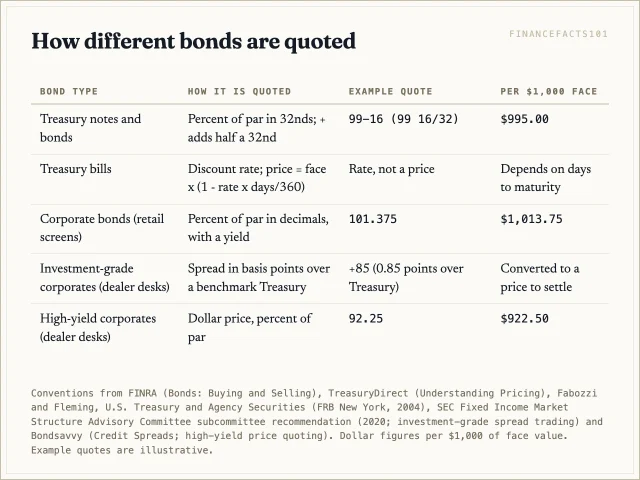
Treasury notes and bonds are quoted in 32nds. A Federal Reserve Bank of New York economist and Frank Fabozzi describe the convention in U.S. Treasury and Agency Securities: prices are quoted "in points where one point equals one percent of par," and "the points are split into units of 32nds, so that a price of 97-14, for example, refers to a price of 97 and 14/32 or 97.4375." A plus sign adds half a 32nd, so 97-14+ is 97.453125. One 32nd is worth $0.3125 on a $1,000 bond. The dash is not a decimal point: 99-16 is 99.5, not 99.16.
Treasury bills are quoted as a discount rate, not a price. TreasuryDirect's page on understanding pricing gives the formula: price = face value × (1 − discount rate × days ÷ 360). Because the quote is a rate, a bill's bid number is higher than its ask number, the reverse of a price quote.
Par Value vs Face Value: The Same Number
Par value and face value mean the same thing for a bond: the principal amount the issuer promises to repay at maturity, and the amount the coupon is calculated on. TreasuryDirect uses the phrase "face value (also called par value)," and the SEC's Investor.gov glossary describes the principal as "also known as face value or par value of the bond." Quotes are usually explained per $1,000 of face value, the amount FINRA and the SEC use in their own examples.
The two words are used a little differently in conversation:
- Face value is the dollar amount printed on the bond: $1,000, or $10,000 if you own ten bonds.
- Par is also the name of the price level 100. "Trading at par," "above par" and "below par" describe the price relative to face value.
What never changes is the face value itself. A 5% bond with a $1,000 face pays $50 a year in interest whether it trades at 90 or 110, and it repays $1,000 at maturity either way. Only the price moves. (Stocks also have a "par value," but that is an unrelated legal figure, often a penny or less per share, with no link to market price.)
Last Price, Bid and Ask: The Three Prices in a Quote
The last price is the most recent trade that was reported. Most bonds do not trade on an exchange; they trade over the counter between dealers and customers. FINRA member firms must report their trades in corporate bonds, agency debt, Treasuries and several other types of debt to TRACE, FINRA's Trade Reporting and Compliance Engine. Under FINRA Rule 6730, corporate bond trades must be reported "as soon as practicable but no later than within 15 minutes of the time of execution"; FINRA confirmed in Regulatory Notice 25-17 that it is keeping that 15-minute standard rather than moving to one minute. You can look up a corporate bond by CUSIP on FINRA's fixed income data pages and see its recent trade history.
A last price can be misleading. Many bonds trade infrequently, so the last print may be days or weeks old, and a trade of $5,000 and a trade of $5 million can happen at very different prices. As the SEC bulletin puts it, "the bond market does not have the same pricing transparency as the equity market."
The bid is the price a dealer is willing to pay if you sell. The ask, also called the offer, is the price a dealer wants if you buy. The ask is above the bid; the gap is the dealer's compensation for holding the bond and taking the risk. For a deeper look at the mechanics, see the entry on bid and ask prices.
So which number is "the price at which a bond is quoted in the secondary market"? It is the price as a percentage of par, stated as a clean price, meaning without accrued interest. If you are buying, the ask is the price that applies to you; if you are selling, the bid.
Bid Yield vs Ask Yield
A yield in a quote is the yield to maturity calculated at one particular price. FINRA's guide to bond yield and return defines yield to maturity as "the overall interest rate earned by an investor who buys a bond at the market price and holds it until maturity."
- Bid yield is the yield to maturity at the bid price. It is the yield the next buyer would earn if you sold to the dealer at the bid.
- Ask yield is the yield to maturity at the ask price. It is the yield you lock in if you buy at the ask and hold to maturity.
Because "price and yield are inversely related," in FINRA's words, the lower bid price produces the higher yield. Bid yield is above ask yield, and the gap between them is the bid-ask spread expressed in yield instead of dollars.
The yields you see in the news are usually bid-side. The Treasury's yield curve methodology says its inputs are "indicative, bid-side market price quotations (not actual transactions)" collected by the New York Fed near 3:30 p.m. each trading day. Those yields feed the Federal Reserve's H.15 release, which put the 10-year Treasury at 4.96% on September 22, 2026.
Worked example: one corporate bond, four numbers
Take a hypothetical corporate bond with a 5.00% coupon paid twice a year and exactly 10 years left to maturity. To keep the arithmetic clean, assume the trade settles on a coupon date, so there is no accrued interest yet. A dealer screen shows:
| Last | Bid | Ask | Ask yield |
|---|---|---|---|
| 95.400 | 95.000 | 95.500 | 5.59% |
Working each price through the yield-to-maturity formula:
- At the ask of 95.50 ($955 per bond), the yield is 5.59%. That is your yield if you buy.
- At the last price of 95.40, the yield is 5.61%.
- At the bid of 95.00 ($950 per bond), the yield is 5.66%. That is the yield the dealer's next customer gets if you sell.
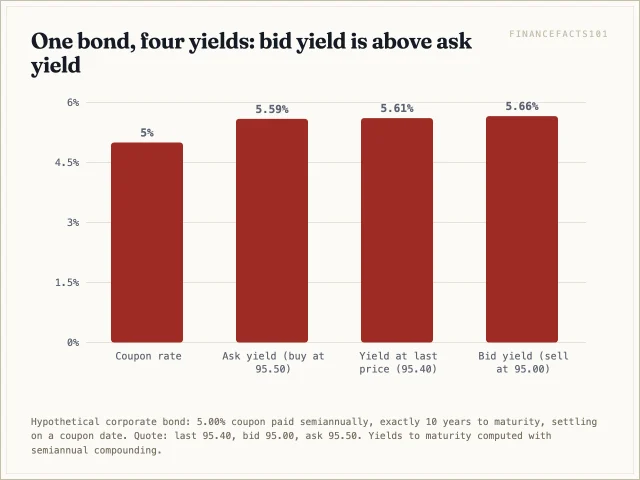
The spread is 0.50 point, or $5 per $1,000 bond, which in yield terms is about 6.8 basis points (5.66% minus 5.59%, before rounding). If you bought at 95.50 and sold straight back at 95.00, you would lose $50 on ten bonds before the market moved at all. The bond yield calculator lets you run the same numbers for your own bond.
Compare a 10-year Treasury note with a 4.25% coupon quoted 94-16 bid, 94-17 ask. That is 94.5 bid and 94.53125 ask, yields of 4.954% and 4.950%. The spread is one 32nd, $0.3125 per $1,000, or under half a basis point of yield. Liquidity is the whole difference.
The Bid-Ask Spread and What It Costs You
The spread is the simplest cost of trading a bond, and it varies far more than in stocks. The New York Fed chapter cited above put typical interdealer spreads for on-the-run Treasury bills at 0.5 basis points in its 2004 data, and adds that "bid-ask spreads are typically wider outside of the interdealer market and for less active issues." Four things tend to widen the spread you see:
- Trade size. Small retail orders usually get wider spreads than large blocks.
- How often the bond trades. A bond that trades daily is easier for a dealer to resell than one that trades monthly.
- Credit quality. Lower-rated bonds carry more risk for a dealer holding them.
- Market stress. Spreads widen across the board when volatility rises.
When a firm sells you a bond from its own inventory, the spread arrives as a markup: in FINRA's words, the firm "may increase or mark up the price you pay over the price the firm paid to acquire the bond." There is often no separate commission line. FINRA Rule 2232 requires the confirmation for a retail customer's corporate or agency bond trade to show the markup "as a total dollar amount and as a percentage of the prevailing market price" when the firm made an offsetting trade the same day, with some exceptions. Every retail confirmation for a corporate or agency bond trade must also include the execution time "expressed to the second" and a reference (and hyperlink, if electronic) to that bond's TRACE data. Check those TRACE prints against your price. The broader idea of spreads across markets is covered in the entry on spreads in finance.
Clean Price, Accrued Interest and What You Actually Pay
Bond prices are quoted clean, meaning without the interest that has built up since the last coupon payment. The buyer pays that accrued interest to the seller on top of the quoted price. FINRA puts it from the seller's side: "you're entitled to the price of the bond, plus accrued interest—the interest that adds up each day between coupon payments." The buyer gets it back in full with the next coupon, which pays six months of interest regardless of when the bond was bought.
Back to the example bond. Suppose you buy $10,000 of face value at the 95.50 ask, 60 days after the last coupon date. Corporate bonds usually count interest on a 30/360 basis, the convention in FINRA's Rule 11620: "every calendar month shall be considered to be 1/12 of 360 days."
- Clean price: 95.50% × $10,000 = $9,550.00
- Accrued interest: $10,000 × 5.00% × 60 ÷ 360 = $83.33
- Amount due at settlement: $9,633.33
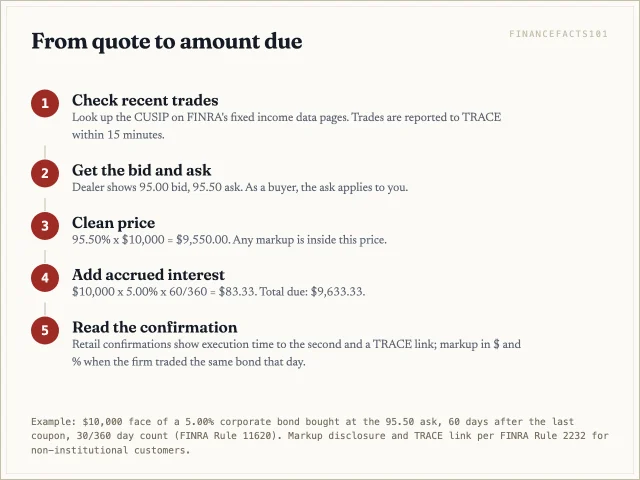
The quoted price does not jump when a coupon is paid, because accrued interest is handled separately. That is why markets quote clean prices; a price with interest included would rise every day and then drop on each payment date. FINRA offers an accrued interest calculator for checking a confirmation.
Yield to Maturity: What the Yield in a Quote Means
Yield to maturity is the single discount rate at which the present value of every remaining coupon plus the face value equals the price you pay. It assumes you hold to maturity, the issuer makes every payment, and coupons are reinvested at that same yield. It is found by trial and error, not by a shortcut formula, which is why quotes show it pre-calculated.
The SEC bulletin gives a clean illustration with three 10-year bonds, each with a 4.00% coupon: priced at 100 the yield to maturity is 4.00%; at 90, 5.31%; at 110, 2.84%. The coupon is identical in all three; the price decides the yield.
A few related yields appear on some quote screens:
- Current yield is the annual coupon divided by the price. For the example bond, $50 ÷ $955 = 5.24%. It ignores the $45 gain from buying at $955 and receiving $1,000 at maturity, so it understates the return on a discount bond.
- Yield to call applies to bonds the issuer can redeem early. It assumes the bond is called on a given date at the call price.
- Yield to worst is the lowest of the yield to maturity and the yields to each possible call date. Quotes for callable bonds often show this figure, because it is the most conservative.
Yield to maturity is also the number that moves when rates change. The entry on the inverted yield curve shows what happens when short-term yields rise above long-term ones.
How Corporate Bonds Are Quoted, and on What Basis
Corporate bonds are quoted on a price basis: a percentage of par in decimals, such as 101.375, usually with a yield beside it. That is what an individual investor sees on a brokerage screen, and it is the price reported to TRACE.
Among professionals, the basis differs by credit quality. "Most investment grade bonds trade on the basis of a spread to the applicable benchmark government bond yield," and those trades "are then converted to a dollar price by 'spotting' the benchmark Treasury security," according to a 2020 preliminary recommendation by a subcommittee of the SEC's Fixed Income Market Structure Advisory Committee (an advisory body, not an SEC rule). Bondsavvy, a bond research publisher, notes that high-yield bonds are quoted on a dollar-price basis. A spread quote of "+85" means 0.85 percentage points above the Treasury yield. Because a spread trade is converted to a price for settlement, both ways of quoting arrive at the same dollars.
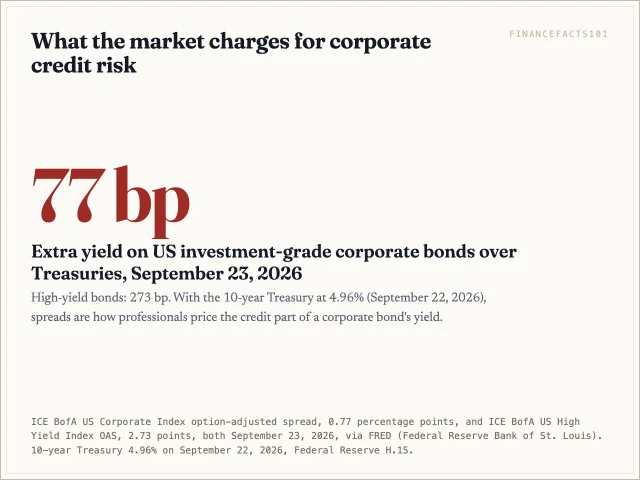
The spread is the market's price for credit risk. The ICE BofA option-adjusted spread for US investment-grade corporate bonds, published on the St. Louis Fed's FRED, was 0.77 percentage points on September 23, 2026. The same measure for high-yield bonds was 2.73 points. Add a spread to the matching Treasury yield and you have a rough yield for that type of bond.
FAQ
Is par value the same as face value?
Yes. For a bond, par value and face value both mean the principal the issuer repays at maturity, usually $1,000 per corporate bond. TreasuryDirect uses the phrase "face value (also called par value)." "Par" is also shorthand for a price of 100, so a bond "trading at par" sells for exactly its face value.
Which price represents the price at which a bond is quoted in the secondary market?
A bond's secondary-market quote is a clean price stated as a percentage of par value, where 100 equals face value. It excludes accrued interest, which the buyer pays separately. A buyer pays the ask; a seller receives the bid.
Why is the bid yield higher than the ask yield?
Because the bid price is lower than the ask price, and a lower price means a higher yield for the same coupons and face value. In the example above, a bid of 95.00 gives 5.66% and an ask of 95.50 gives 5.59%. Ask yield is the yield you get when buying.
How are corporate bonds quoted?
As a percentage of par in decimals, such as 95.50 for $955 per $1,000 bond, usually shown with a yield to maturity or yield to worst. Between professionals, investment-grade corporates are often quoted as a spread in basis points over a benchmark Treasury and then converted into a price.
Sources
- FINRA, Bonds: Buying and Selling — quotes as a percentage of par on a point scale; accrued interest to the seller; markups and markdowns
- FINRA, Understanding Bond Yield and Return — yield to maturity definition; price and yield inversely related
- SEC Office of Investor Education and Advocacy, What Are Corporate Bonds? (June 4, 2013) — face value also called par value; three 4% bonds at 100, 90 and 110 with yields of 4.00%, 5.31% and 2.84%; pricing transparency
- Investor.gov, Bonds (glossary) — principal "also known as face value or par value"
- TreasuryDirect, Understanding Pricing and Interest Rates — "face value (also called par value)"; bill price formula
- Frank J. Fabozzi and Michael J. Fleming (Federal Reserve Bank of New York), U.S. Treasury and Agency Securities (April 2004) — 32nds and plus-sign conventions; bills quoted on a discount-rate basis; interdealer bid-ask spreads
- U.S. Department of the Treasury, Treasury Yield Curve Methodology — yield curve inputs are bid-side quotations
- Federal Reserve, H.15 Selected Interest Rates — 10-year Treasury constant maturity 4.96% on September 22, 2026
- FINRA, TRACE and Regulatory Notice 25-17 — mandatory trade reporting; 15-minute reporting standard retained
- FINRA, Fixed Income Data — bond search by CUSIP with trade history
- FINRA, Rule 2232 — markup disclosure, execution time and TRACE link on retail confirmations
- FINRA, Rule 11620 — interest computed on a 360-day year; accrued interest calculator
- Federal Reserve Bank of St. Louis, FRED, ICE BofA US Corporate Index OAS (0.77, September 23, 2026) and ICE BofA US High Yield Index OAS (2.73, September 23, 2026)
- SEC Fixed Income Market Structure Advisory Committee, Technology and Electronic Trading Subcommittee, Preliminary Recommendation Regarding Additional TRACE Reporting Indicators for Corporate Bond Trades (2020) — most investment-grade bonds trade on a spread to the benchmark government bond yield, then are converted to a dollar price by spotting the Treasury
- Bondsavvy, Credit Spreads — high-yield corporates quoted on a dollar-price basis
 Next entry · No. 475Understanding Bond Ratings: An Essential Measure for Institutional Investors
See also
-
 No. 4,648
05 Jul 2025
20 min
Mastering Short Positions: Understanding Risks, Strategies, and Techniques
Business Finance
No. 4,648
05 Jul 2025
20 min
Mastering Short Positions: Understanding Risks, Strategies, and Techniques
Business Finance -
 No. 4,265
04 Jun 2025
19 min
Understanding Quoted Prices: The Basics for Institutional Investors
Business Finance
No. 4,265
04 Jun 2025
19 min
Understanding Quoted Prices: The Basics for Institutional Investors
Business Finance -
 No. 4,261
04 Jun 2025
22 min
Understanding Quotations: The Role of Asking Prices and Bid Prices in Financial Markets
Finance Policy
No. 4,261
04 Jun 2025
22 min
Understanding Quotations: The Role of Asking Prices and Bid Prices in Financial Markets
Finance Policy -
 No. 3,486
02 Apr 2025
17 min
Understanding Nominal Rate of Return: The Key Metric for Institutional Investors
Business Finance
No. 3,486
02 Apr 2025
17 min
Understanding Nominal Rate of Return: The Key Metric for Institutional Investors
Business Finance -
 No. 3,003
21 Feb 2025
22 min
Understanding Lookback Options: Minimizing Regret in Finance and Investment
Business Finance
No. 3,003
21 Feb 2025
22 min
Understanding Lookback Options: Minimizing Regret in Finance and Investment
Business Finance -
 No. 2,997
20 Feb 2025
23 min
Long-Term Growth (LTG) Investment Strategy: Understanding the Long Game for Institutional and Professional Investors
Business Finance
No. 2,997
20 Feb 2025
23 min
Long-Term Growth (LTG) Investment Strategy: Understanding the Long Game for Institutional and Professional Investors
Business Finance