Bridge Financing: What It Is, How Bank Bridge Loans Work, and the Main Types
Bridge financing is short-term money repaid by a later bond, equity round or sale. How bank bridges work, using Amgen's $28.5 billion loan as the example.
Bridge financing is short-term money that covers a gap until a planned, longer-term source of cash arrives: a bond issue, an equity round, an IPO, or the sale of a property. It can be a loan (a debt bridge) or an investment that converts into shares (an equity bridge). What defines it is the exit, not the lender. Every bridge is priced and documented on the assumption that something else will repay it, usually within a year.
The largest bridges come from banks. When Amgen agreed to buy Horizon Therapeutics in December 2022, it signed a $28.5 billion bridge credit agreement the same day, with Citibank as administrative agent, then replaced almost all of it with a term loan and bonds within three months, per its SEC filings. This page explains how that kind of institutional bank bridging finance works and how companies get it. It also covers the other forms: equity bridges, IPO bridges and property bridging loans, with their benefits, costs and the rules that apply. It is general information, not advice on any particular deal.
What Is Bridge Financing?
A bridge has three parts: a gap, a loan or investment that covers it, and a takeout, the later financing that repays it. Lenders care most about the third part. A bank will lend billions for a few months when the takeout is a bond sale by an investment-grade company. It will not lend for long against a takeout that might never happen.
That is also why bridge money is expensive or restrictive in ways ordinary loans are not. Its terms are built to push the borrower toward the takeout quickly. The main tools are interest margins that rise the longer the loan is outstanding, fees on commitments that sit unused, and mandatory repayment from any new debt or equity the borrower raises. A company that uses a bridge exactly as planned pays relatively little. The cost comes when the takeout is late.
Most bridges run 12 months or less. Amgen's facility was set to mature 364 days after the first advance. Facebook's pre-IPO bridge, covered below, was due one year after any draw. The short tenor tells everyone involved that this is not permanent capital, and it gives the lender a firm date by which the takeout has to happen. If you want the broader trade-offs between borrowing and issuing shares, the entry on debt financing costs and advantages covers them.
Types of Bridge Financing: Debt, Equity and Property
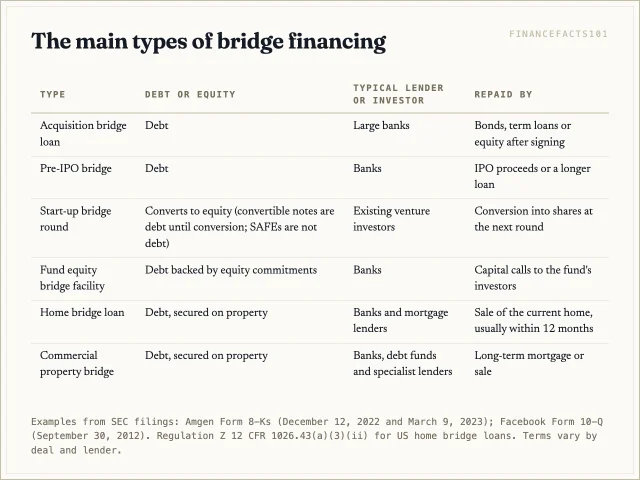
The split that matters most is debt versus equity.
A debt bridge is a loan. It carries interest, has a maturity date, and must be repaid whatever happens to the company's plans. Existing shareholders are not diluted, which is its main attraction. Acquisition bridges, pre-IPO bridges and property bridging loans are all debt.
An equity bridge puts money in now in exchange for shares later, or is secured by commitments from equity investors. In start-up finance it usually means a small round between two priced rounds, often structured as convertible notes. In private equity and infrastructure it means a short-term bank facility backed by the fund investors' promises to contribute capital. Either way, dilution replaces some or all of the interest cost.
Institutional Bank Bridging Finance: How Large Bridge Loans Work
When a public company agrees to buy another for cash, the seller wants certainty that the money will be there at closing. A bond sale takes time to arrange and depends on market conditions on the day, so the buyer's banks sign a committed bridge facility before the deal is announced. The bridge exists so the deal can be signed; often the plan is never to draw it.

Amgen's December 2022 filing shows the standard mechanics in the borrower's own words:
- Size and purpose. $28.5 billion, available to pay the purchase price for Horizon, to repay certain existing Horizon debt, and to pay deal fees and expenses.
- Price that climbs with time. Interest at term SOFR plus 0.10%, plus a margin "between 0.875% and 2.125%, depending on the rating of our senior long-term unsecured debt and the number of days elapsed between the initial funding day and the day of determination."
- A fee for waiting. Starting on the 90th day after the agreement took effect, a ticking fee of 0.125% a year on commitments not yet drawn.
- Automatic shrinkage. Commitments would be reduced by "the net cash proceeds received by Amgen or its subsidiaries in connection with debt and equity issuances and non-ordinary course asset dispositions," with certain exceptions.
These four features are what the parties negotiate hardest. The borrower wants low margins, slow step-ups, broad flexibility over when to issue bonds, and as few conditions to funding as possible. The banks want fees for the commitment, higher margins if the loan is actually drawn, and the right to shrink their exposure the moment the company raises permanent money.
Banks take real risk here. If markets seize up after the commitment is signed, the bank may have to fund a loan it cannot syndicate or refinance. The Federal Reserve's supervisory letter on leveraged lending, SR 13-3, describes the problem this way: "Market disruptions can substantially impede the ability of a loan underwriter to consummate syndications or otherwise sell down exposures, which may result in material losses to the underwriter." That guidance covers leveraged loans, so it describes the syndication risk rather than governing an investment-grade bridge like Amgen's. The OCC and FDIC have since withdrawn from the interagency version; see the rules section below.
A Real Bridge From Signing to Termination: Amgen and Horizon
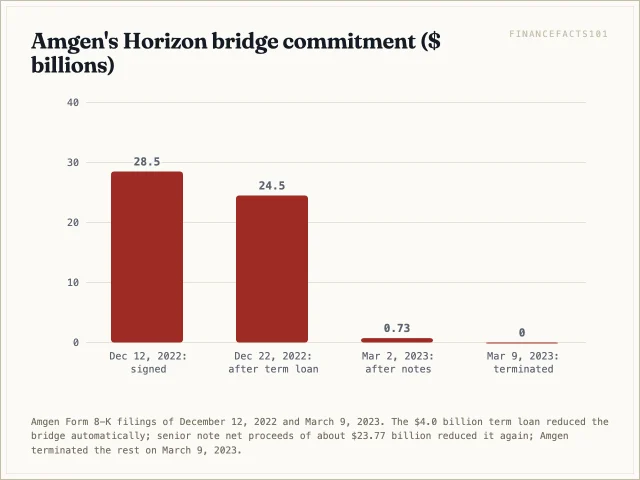
Amgen announced its agreement to buy Horizon for $116.50 a share in cash, about $27.8 billion of equity value, on December 12, 2022. The bridge was signed that day with Citibank, N.A. as administrative agent, Bank of America, N.A. as syndication agent, and the two banks as lead arrangers.
Ten days later, on December 22, 2022, Amgen signed a $4.0 billion term loan in two $2.0 billion tranches, one of 18 months and one of three years. That automatically cut the bridge to $24.5 billion. On March 2, 2023, it sold senior notes, and the net proceeds of about $23.77 billion cut the bridge again, leaving roughly $0.73 billion. On March 9, 2023, Amgen terminated the rest of the facility. Its filing says that with cash on hand, the note proceeds and the term loan it had enough to complete the deal, so "the remaining commitments under the Bridge Credit Facility are not needed," and that "all accrued and unpaid fees thereunder were paid in full."
The acquisition itself did not close until October 6, 2023, per Amgen's announcement. So the bridge had done its job seven months before the deal closed. It gave the seller certainty on day one, then was replaced by cheaper, longer-term debt as soon as the bond market allowed. The fees were the price of that certainty.
A quick worked example shows why borrowers move so fast. Take a hypothetical $5 billion bridge on Amgen-style terms. Overnight SOFR was 3.87% on September 23, 2026, per the New York Fed; use it as a stand-in for the term SOFR rate a real agreement would reference. Assume a starting margin of 1.25%, inside Amgen's 0.875% to 2.125% range. Undrawn, the 0.125% ticking fee costs about $6.25 million a year, or roughly $520,000 a month. Drawn, at 3.87% + 0.10% + 1.25% = 5.22%, the loan costs about $65 million of interest per 90 days (actual/360). And the margin rises the longer it stays out. Holding the commitment is cheap insurance; using it is expensive.
How to Get Institutional Bank Bridging Finance
Large bank bridges are not applied for like a consumer loan. They are negotiated, usually by the company's treasurer and its financial and legal advisers, with the banks already in the company's lending group. The typical sequence:
- Line up the takeout first. Banks lend against the exit. A credible plan to repay, most often a bond issue sized to the bridge, is the core of the pitch. An investment-grade credit rating makes that plan believable.
- Approach relationship banks. Lead arrangers are often banks that already lend to the company, for example through its revolving credit facility. They sign a commitment letter and fee letter before the deal is announced, often for the full amount, and syndicate portions to other banks afterwards.
- Negotiate the terms that matter. Margin grid and step-ups, ticking fee start date, conditions to funding, mandatory prepayment triggers, and how any term loan or bond issue reduces the commitment.
- Disclose it. A public company generally files a Form 8-K when it enters into a material agreement such as a bridge, which is why these terms are visible at all.
- Execute the takeout. Replace the bridge with term loans, bonds or equity as soon as markets allow, then terminate the unused commitment.
Smaller companies and non-rated borrowers go through the same logic with different lenders. Banks now provide a shrinking share of corporate credit. In a May 8, 2026 speech, Federal Reserve Vice Chair for Supervision Michelle Bowman said: "Since 2015, the bank share of corporate lending decreased from 48 percent to 29 percent in 2025." She added that the US private credit market "currently accounts for about $1.4 trillion."
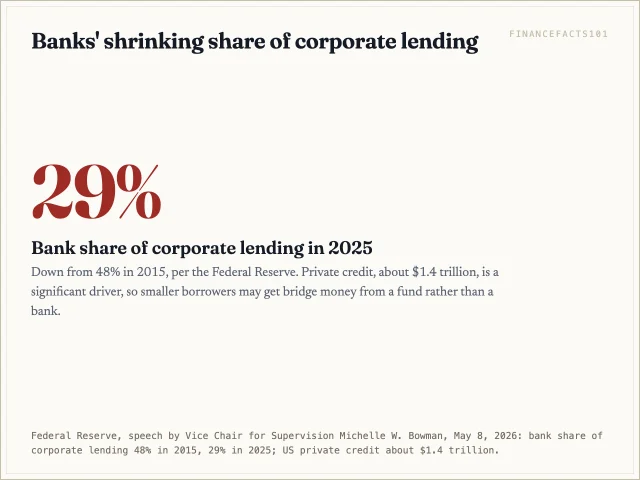
For a mid-sized company, that means the bridge may come from a private credit fund rather than a bank.
Equity Bridge Financing
"Equity bridge financing" has two common meanings, and they barely overlap.
In start-ups, it is a bridge round. A company between two priced venture rounds raises a smaller amount from existing investors to extend its runway, usually through convertible notes or SAFEs. The SEC's guide to common start-up securities defines a convertible note as "a loan made by an investor to a company that can be converted into a different security," typically converting into preferred stock at the next funding round. A SAFE is not debt at all; it promises future shares if a triggering event occurs.
A simplified worked example with illustrative terms: investors put $500,000 into convertible notes with a 20% discount and a $10 million valuation cap. The next round is priced at $2.00 a share on a $15 million pre-money valuation. The discount price is $1.60. The cap price is $2.00 × (10 ÷ 15), or about $1.33. Noteholders typically get whichever is lower, so the notes convert at about $1.33, into roughly 375,000 shares before any accrued interest. That extra dilution is the real cost of an equity bridge.
These notes are securities, commonly sold privately under Rule 506(b), which allows an unlimited raise from an unlimited number of accredited investors and up to 35 non-accredited investors in any 90-day period, bars general solicitation, and requires a Form D notice "within 15 days after the first sale of securities in the offering."
In private equity and infrastructure funds, it is a short-term bank facility. A fund borrows against its investors' uncalled capital commitments so it can close an investment before collecting the cash. Lawyers at King & Wood Mallesons described these in Financier Worldwide as short-term loans "leveraged on the limited partners' commitments" and usually structured as revolving facilities, repaid when the fund issues capital calls to its investors.
Bridge Financing Around an IPO
A company preparing to go public can face large cash needs before the offering proceeds arrive. Facebook's 2012 IPO offers a well-documented example. In February 2012, three months before its IPO, it entered into a bridge credit facility with JPMorgan Chase Bank, N.A. as administrative agent. The facility allowed it to borrow up to $3 billion "to fund tax withholding and remittance obligations related to the settlement of RSUs in connection with our IPO," according to its quarterly report for September 30, 2012.
The price structure was classic bridge: LIBOR plus 1.0%, plus "an additional 0.25% payable on drawn balances outstanding from and after the 180th day of borrowing," and a commitment fee of 0.10% a year on the undrawn balance starting 90 days after signing. Any borrowing was due one year after the draw, and no later than June 30, 2014. Facebook reported that it had drawn nothing on the bridge as of September 30, 2012. In October 2012 it converted the facility into an unsecured term loan of up to $1.5 billion for the same purpose.
As with Amgen, the bridge bought certainty at a known cost. For how the offering itself is run, see going public through an IPO and the entry on the book-building process.
Bridging Finance for Property: Home and Commercial Options
Outside corporate finance, most bridge loans are secured on real estate. The main bridging finance options are:
- Buy-before-you-sell home loans. You borrow against your current home to fund the down payment or purchase of the next one, then repay when the first home sells.
- Commercial and investor bridges. Short-term loans to buy, renovate or stabilise a property before refinancing it with a long-term mortgage.
- Auction and construction bridges. Money to meet a fixed completion deadline, such as an auction purchase, or to fund building work before permanent financing is in place.
In the US, the federal ability-to-repay rule treats short home bridges differently. Regulation Z's mortgage underwriting requirements in 12 CFR 1026.43 do not apply to "a temporary or 'bridge' loan with a term of 12 months or less," such as a loan to buy a new home "where the consumer plans to sell a current dwelling within 12 months." The exemption covers only those underwriting requirements; the loan is still subject to the rest of Regulation Z. The exemption is a reason to read the terms closely, because the lender is not required to verify your ability to repay under those rules.
In the UK, where "bridging finance" is the everyday term, the FCA's Handbook defines a bridging loan as, in part, a regulated mortgage contract with a term of twelve months or less. Under the FCA's perimeter guidance, a loan to an individual secured on UK land, at least 40% of which is used or intended to be used as a dwelling, is generally a regulated mortgage contract, with specific exclusions for some bridging loans. Loans on purely commercial property fall outside that test.
Before taking a home bridge, compare it with a home equity line of credit on your current home; the comparison of cash-out refinancing and HELOCs sets out those costs.
Benefits of Bridging Finance, and the Risks
The benefits of bridging finance are real but narrow:
- Speed and certainty. A committed bridge lets a buyer sign a deal, or a homeowner make a non-contingent offer, before long-term money is available.
- Timing control. The borrower can wait for better bond or equity markets instead of raising permanent capital on a deadline.
- No immediate dilution in a debt bridge.
- Low cost if unused. Amgen's ticking fee of 0.125% a year is small next to the value of a signed deal.
The risks all come from the takeout failing:
- Rising cost. Margins step up with time, as both the Amgen and Facebook terms show.
- Refinancing risk. If bond markets close or the company's credit weakens, the borrower may have to refinance at a much higher rate or sell assets.
- Lump-sum repayment. Most bridges are repaid in one payment at or before maturity, with the same exposure as balloon loans.
- Dilution in an equity bridge, often at a discount to the next round's price.
- Double carrying costs for property owners holding two homes until one sells.
Rules and Regulators That Apply to Bridge Financing
There is no single "bridge financing law." The rules depend on the form:
- Bank bridge loans fall under ordinary bank supervision. On December 5, 2025, the OCC and FDIC withdrew from the 2013 interagency guidance on leveraged lending and its 2014 FAQs, per OCC Bulletin 2025-44 and the FDIC's joint statement. The Federal Reserve has not withdrawn its version, SR 13-3. As of September 24, 2026 it had announced no rescission, so the guidance still applies to banks and bank holding companies the Fed supervises.
- Convertible notes and other equity bridges are securities, usually sold under Regulation D with a Form D filing.
- Public-company bridges are disclosed on Form 8-K, which is why their terms are public.
- Home bridge loans are covered by Regulation Z disclosures in the US and by FCA mortgage rules in the UK, as above.
FAQ
What is bridge financing in simple terms?
It is temporary money that covers a gap until a planned, longer-term source of cash arrives, such as a bond issue, an equity round, an IPO or a property sale. It can be a loan or an investment that converts into shares, and it is usually meant to last 12 months or less.
How do companies get institutional bank bridging finance?
They negotiate it with their relationship banks, usually before announcing an acquisition. The banks sign a commitment letter for a short-term facility, often for the full purchase price, and the company replaces it with term loans or bonds soon after. Amgen's $28.5 billion bridge was signed on December 12, 2022 and terminated on March 9, 2023.
Is equity bridge financing debt or equity?
It depends on the form. A start-up bridge round is often convertible notes, which are debt until they convert into shares, or SAFEs, which are not debt. A fund-level equity bridge facility is a bank loan secured by investors' capital commitments.
Is deBridge the same as bridge financing?
No. deBridge is a cryptocurrency service for cross-chain swaps and transfers, moving digital assets between blockchains. It has nothing to do with bridge loans or bridging finance.
Sources
- Amgen Inc., Form 8-K, December 12, 2022 — $28.5 billion Bridge Credit Agreement: parties, purpose, 364-day maturity, SOFR margins, ticking fee, mandatory commitment reductions
- Amgen Inc., Form 8-K, March 9, 2023 — $4.0 billion term loan of December 22, 2022, senior notes net proceeds of about $23.77 billion, termination of the bridge
- Amgen, Amgen Completes Acquisition of Horizon Therapeutics plc (October 6, 2023) — closing date, $116.50 per share, about $27.8 billion equity value
- Facebook, Inc., Form 10-Q for the quarter ended September 30, 2012 — $3 billion bridge facility for RSU tax obligations, pricing, no draws, October 2012 conversion to a $1.5 billion term loan
- Facebook, Inc., Bridge Loan Agreement, February 28, 2012 — JPMorgan Chase Bank, N.A. as administrative agent; maturity 364 days after funding
- Federal Reserve, SR 13-3, Interagency Guidance on Leveraged Lending — pipeline and syndication risk for loan underwriters; no Federal Reserve rescission notice as of September 24, 2026
- Federal Reserve, Speech by Vice Chair for Supervision Bowman, May 8, 2026 — bank share of corporate lending 48% (2015) to 29% (2025); private credit about $1.4 trillion
- OCC, Bulletin 2025-44: rescission of interagency leveraged lending guidance — OCC and FDIC withdrawal, December 5, 2025
- FDIC, Interagency Statement on OCC and FDIC Withdrawal from the Interagency Leveraged Lending Guidance Issuances (December 5, 2025) — rescission of the 2013 guidance and 2014 FAQs
- SEC, Common Startup Securities — definitions of convertible notes and SAFEs
- SEC, Private placements under Rule 506(b) — offering limits and the 15-day Form D deadline
- CFPB, Regulation Z § 1026.43 — exemption for temporary or bridge loans of 12 months or less
- Financial Conduct Authority, FCA Handbook glossary: bridging loan and PERG 4.4, regulated mortgage contracts — UK definition and the 40% dwelling test
- Federal Reserve Bank of New York, Secured Overnight Financing Rate — SOFR 3.87% on September 23, 2026
- Financier Worldwide, Equity bridge financings: an overview (King & Wood Mallesons, March 2015) — fund-level equity bridge facilities
- deBridge, debridge.com — cross-chain swaps and transfers
 Next entry · No. 522Understanding Bridge Loans: A Short-Term Financing Solution
See also
-
 No. 952
07 Jul 2024
18 min
Understanding Delayed Draw Term Loans: Flexibility and Cash Management for Institutional Investors
Corporate Finance
No. 952
07 Jul 2024
18 min
Understanding Delayed Draw Term Loans: Flexibility and Cash Management for Institutional Investors
Corporate Finance -
 No. 943
05 Jul 2024
19 min
Understanding Deferred Tax Liability: An Essential Concept for Institutional Investors
Corporate Finance
No. 943
05 Jul 2024
19 min
Understanding Deferred Tax Liability: An Essential Concept for Institutional Investors
Corporate Finance -
 No. 942
05 Jul 2024
21 min
Understanding Deferred Tax Assets: An In-depth Guide for Institutional Investors
Corporate Finance
No. 942
05 Jul 2024
21 min
Understanding Deferred Tax Assets: An In-depth Guide for Institutional Investors
Corporate Finance -
 No. 941
05 Jul 2024
21 min
Deferred Revenue: Understanding This Key Financial Concept for Institutional Investors
Corporate Finance
No. 941
05 Jul 2024
21 min
Deferred Revenue: Understanding This Key Financial Concept for Institutional Investors
Corporate Finance -
 No. 907
29 Jun 2024
23 min
Understanding Debt Instruments: A Comprehensive Guide for Institutional Investors
Corporate Finance
No. 907
29 Jun 2024
23 min
Understanding Debt Instruments: A Comprehensive Guide for Institutional Investors
Corporate Finance -
 No. 904
28 Jun 2024
21 min
Understanding Debt Financing: Costs, Advantages, Disadvantages, and FAQs
Corporate Finance
No. 904
28 Jun 2024
21 min
Understanding Debt Financing: Costs, Advantages, Disadvantages, and FAQs
Corporate Finance