Understanding Helicopter Money: The Metaphorical Monetary Policy That Stimulates Economy

Explore the theory behind helicopter money - an unconventional monetary policy to stimulate economies during deflationary periods. Discover origins…
What is a Helicopter Drop (Helicopter Money)?
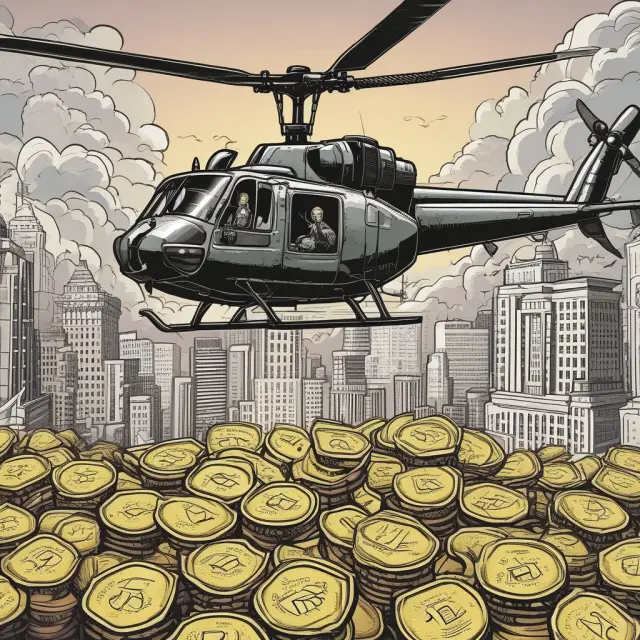
In the world of economics, Milton Friedman introduced an intriguing concept in the form of helicopter drop or helicopter money as a metaphorical monetary policy tool to stimulate economies during periods of deflation. The term ‘helicopter drop’ was coined as an abstract thought experiment where cash is distributed to all citizens as if it were dropped from a helicopter overnight. In essence, this idea represents an expansionary fiscal or monetary policy that increases the money supply through various means such as spending or tax cuts, with the primary goal of sparking inflation and economic growth in economies grappling with falling prices.
The roots of helicopter drop can be traced back to Milton Friedman’s theories on monetary policy during his speech to the American Economic Association in 1968. He argued that if a government were committed to maintaining the price level, then it could achieve this goal by increasing the supply of money whenever prices started falling.
Fast forward to present day, helicopter drop policies have gained popularity as a response to significant economic shocks. The term “helicopter Ben” emerged after former Federal Reserve Chair Ben Bernanke made a casual reference to helicopter money during a speech in 2002. Bernanke’s suggestion of broad-based tax cuts and quantitative easing was seen as a potential solution for combating deflation, a severe drop in consumer spending leading producers to cut prices continually.
The idea of helicopter drop has garnered significant attention in the context of Japan’s economy which faced stagnant growth throughout the 21st century. In 2016, Bernanke and Japanese Prime Minister Shinzo Abe met with Bank of Japan’s Haruhiko Kuroda to discuss potential monetary policy options, one of which was the issuance of long-term, interest-bearing bonds known as helicopter money. While Japan did not formally adopt this strategy, they instead opted for large scale asset purchases and yield curve control.
A notable example of a helicopter drop policy occurred in response to the economic crisis caused by various government lockdowns during the COVID-19 pandemic. The U.S. government implemented direct stimulus payments to taxpayers, combined with quantitative easing from the Federal Reserve. These actions resulted in an injection of trillions of dollars into the U.S. economy through programs such as the Paycheck Protection Program, Main Street Lending Program, and corporate bond purchases.
However, helicopter drop policies have not been without controversy. Critics argue that this strategy could result in inflationary pressures and moral hazard, with potential long-term implications on economic stability and debt levels. In the following sections, we will delve deeper into these issues and explore the pros and cons of using helicopter money as an economic policy tool.

Background: Origins and History of Helicopter Money
The term “helicopter money” originated from Milton Friedman’s thought experiment in which he proposed adding cash to the economy as if it was dropped from a helicopter—a metaphorical representation of unconventional monetary policies. The idea gained widespread attention when then-Federal Reserve Chairman Ben Bernanke made a reference to it during a speech in 2002, referring to it as a ‘broad-based tax cut.’
Milton Friedman, a renowned economist at the University of Chicago, proposed helicopter money as an unconventional monetary policy tool to combat deflationary periods characterized by falling prices. In such situations, traditional monetary policies might fail to stimulate demand, making it necessary to increase the quantity of money in circulation directly and distribute it among citizens as a means to boost aggregate demand and inflation.
Bernanke’s reference to helicopter money came during his tenure as a new governor at the Federal Reserve, where he discussed potential measures to combat deflation. In his speech, Bernanke emphasized that deflation was not merely a monetary problem but an economic one—arising from insufficient aggregate demand. He believed cooperation between fiscal and monetary authorities would enhance the effectiveness of anti-deflation policies.
The term ‘helicopter drop’ became synonymous with unconventional monetary policy during Bernanke’s speech, earning him the nickname ‘Helicopter Ben.’ Despite controversy surrounding Bernanke’s economic policies, some argue they were effective in addressing the economic downturn following the Great Recession of 2008-2009.
In more recent times, Japan has explored helicopter money as a potential solution to its ongoing economic stagnation. In 2016, Milton Friedman’s protégé and former Fed Chair, Ben Bernanke, met with Japanese Prime Minister Shinzo Abe and Bank of Japan Governor Haruhiko Kuroda to discuss monetary policy options, including helicopter money in the form of issuing long-term perpetual bonds.
While Japan did not officially adopt a helicopter drop approach, it opted for additional large-scale asset purchases instead. However, recent events such as the COVID-19 pandemic and its economic aftermath have seen some semblance of helicopter drop policies being implemented through various stimulus measures. In response to the crisis, the Fed injected trillions of dollars into the US economy via a combination of loans, bond purchases, and direct payments to taxpayers—further expanding its balance sheet from $4.7 trillion in March 2020 to over $7.3 trillion by January 5, 2021.
Understanding Helicopter Money: A Modern Perspective
In the context of modern economics, helicopter money can be described as an expansionary fiscal or monetary policy that is financed through an increase in a country’s money supply—be it through tax cuts, spending increases, or more direct methods such as cash transfers to the population. The primary objective is to stimulate economic growth and inflation during deflationary periods by increasing demand for goods and services.
The metaphorical ‘helicopter’ in this term represents the seemingly unconventional manner of introducing additional money into an economy, emphasizing the innovative nature of such policies. In essence, helicopter drop is a bold response to economic downturns that requires cooperation between fiscal and monetary authorities and significant trust in their ability to manage inflationary pressures effectively.
In the following sections, we will explore the implications, mechanics, and criticisms surrounding helicopter money in greater detail.

The Economic Rationale Behind Helicopter Money
Helicopter money, a monetary policy tool first mentioned in a thought experiment by economist Milton Friedman, refers to a strategy aimed at stimulating an economy during deflationary periods through the injection of cash into the financial system. The term was popularized after Ben Bernanke, then a Federal Reserve governor, made a passing reference to it in a speech in 2002. Helicopter money serves as a metaphorical device to abstract away monetary policy transmission mechanisms and focuses on the direct effects of increasing the overall quantity of money.
In essence, helicopter money is an expansionary fiscal or monetary policy financed by an increase in an economy’s money supply. This can be achieved through various means such as spending increases, tax cuts, or even printing new money. The ultimate goal is to promote inflation and economic growth when conventional stimulus measures are insufficient or ineffective during periods of falling prices (deflation).
Understanding the Context: Deflation vs. Inflation
Deflation occurs when there is a persistent decline in the overall price level, while inflation refers to an ongoing increase in the general price level. During deflationary periods, consumers may delay spending as they anticipate falling prices, resulting in weak aggregate demand and reduced consumer confidence. Producers, in turn, may cut prices or wages to maintain market share, intensifying the deflationary process. As a result, there is an increased risk of a downward spiral in prices and economic activity—a situation commonly referred to as a deflationary trap.
Rationale for Helicopter Money during Deflation:
The primary goal of helicopter money is to counteract the negative effects of deflation by boosting aggregate demand, preventing the potential damage associated with falling prices. Injecting cash into an economy through helicopter money can help break the deflationary cycle and stimulate spending, investment, and employment growth. A growing body of evidence supports the use of unconventional monetary policy tools like helicopter money during periods of prolonged deflation and weak economic conditions.
Milton Friedman’s Thought Experiment:
Friedman first introduced the helicopter drop analogy to illustrate how central banks could effectively control inflation, but it has since been adapted as a tool for stimulating economies in deflationary conditions. In his thought experiment, Friedman proposed that the government could distribute money directly to households by dropping it from helicopters, bypassing traditional channels such as financial intermediaries and fiscal authorities. This direct infusion of cash would lead to increased spending, which would generate economic activity and inflation.
The Modern Application:
Modern applications of helicopter money have involved indirect methods like tax cuts or government spending to stimulate demand in the economy. However, some central banks and governments have discussed more unconventional approaches such as printing money directly and distributing it to citizens or issuing long-term bonds to finance deficits.
In conclusion, helicopter money represents an innovative monetary policy tool for combating the adverse effects of deflationary periods and stimulating economic growth. By increasing a nation’s overall money supply through various methods, policymakers can inject demand into the economy, spurring inflation and reversing the negative impacts of falling prices. Understanding helicopter money is crucial in today’s economic landscape, particularly as central banks continue to explore unconventional monetary policies to respond to changing market conditions.

Implementing Helicopter Drop: How it Works
The concept of helicopter money was introduced as a metaphorical monetary policy strategy by Milton Friedman in his academic work and speeches. This idea gained popularity when former Federal Reserve Chair Ben Bernanke made reference to it during a speech in 2002, likening it to a tax cut that would effectively increase the money supply through fiscal expansion. Helicopter drop can be described as a monetary intervention aimed at stimulating an economy experiencing deflationary conditions by directly distributing cash to its citizens.
The fundamental idea behind helicopter money is to inject new currency into an economy without expecting it to be paid back, thereby increasing the overall supply of money. This increase in the money supply can lead to price inflation as demand for goods and services rises. Helicopter drop can take various forms such as tax cuts or spending increases by the government, with the intention of directly impacting consumers and businesses within an economy.
Let’s delve deeper into how helicopter money is implemented through these methods:
1) Tax Cuts: By reducing taxes for citizens, governments provide them with more disposable income to spend on goods and services, thereby driving up demand and increasing the overall level of economic activity.
2) Spending Increases: Governments can directly increase spending on public goods or transfer payments like unemployment benefits or social security payments. This infusion of cash into the economy can lead to a surge in demand for various goods and services, stimulating economic growth.
3) Money Printing: Although less common due to its potentially inflationary consequences, governments can print money as part of an expansionary monetary policy. The newly-printed money is then distributed among the population or used for public spending to stimulate demand and economic activity.
A notable example of helicopter money implementation occurred in Japan during the 21st century when it faced stagnant growth. Despite not formally implementing a helicopter drop, they opted for large scale asset purchases instead. The U.S. government’s response to the economic crisis caused by the COVID-19 pandemic also resembled helicopter money through direct stimulus payments and quantitative easing efforts.
In conclusion, helicopter money represents an intriguing concept within the realm of monetary and fiscal policy aimed at reviving economies in deflationary periods. While it holds the potential to generate significant economic growth, its implications for inflation, moral hazard, and ethical concerns remain subjects of ongoing debate among scholars and policymakers alike. Stay tuned for further insights on the advantages, disadvantages, criticisms, and future possibilities surrounding helicopter money in our upcoming sections.

Japan’s Approach to Helicopter Money
Since Japan faced stagnant growth throughout the 21st century, helicopter money emerged as a potential solution for revitalizing its economy. Milton Friedman’s metaphorical concept gained popularity after Ben Bernanke, former Federal Reserve (Fed) Chair, made a passing reference to it in a November 2002 speech when discussing measures against deflation. In this context, helicopter money refers to an increase in a nation’s money supply through spending, tax cuts, or boosting money supply, which is financed by the central bank printing new money and distributing it directly to the public.
In 2016, Japan toyed with the idea of helicopter drop when Prime Minister Shinzo Abe and Bank of Japan’s Haruhiko Kuroda met with Bernanke to discuss further monetary policy options. One suggested method was issuing large-scale, long-dated perpetual bonds to provide financial relief and stimulate economic growth. However, Japan opted for larger asset purchases instead, which amounted to almost ¥80 trillion ($765 billion) in March 2013.
Despite not formally implementing helicopter drop, Bernanke’s reference continued to influence economic discussions. A significant example of a helicopter drop policy was the direct-to-taxpayer stimulus payments made by the U.S. government in response to the economic crisis caused by the COVID-19 pandemic. The CARES Act authorized these payments, and subsequent legislation increased the amounts to $1,200 per taxpayer and later to $600 during the holiday season. These payments, combined with quantitative easing (QE) measures by the Fed, injected trillions of dollars into the US economy.
In Japan’s response to the pandemic, the Bank of Japan took actions that resembled helicopter money through its yield curve control and other monetary tools. However, critics argue that these policies did not go far enough in addressing Japan’s persistent deflationary pressures and stagnant growth.
The ongoing debate surrounding helicopter money highlights its potential role as a tool to combat deflation and spur economic growth, especially during times of economic uncertainty or crises.
The Fed’s Role in Helicopter Money: The COVID-19 Pandemic Response
In the face of an economic crisis as monumental as the COVID-19 pandemic, governments and central banks worldwide have turned to unprecedented measures to stabilize their economies. One of these responses resembles the concept of helicopter money, which refers to a significant expansion in a nation’s money supply through increased spending, tax cuts, or direct cash transfers to citizens. Helicopter drop policies were first introduced as a thought experiment by Milton Friedman and later adopted by Ben Bernanke in 2002 when he was a new Fed Governor. These unconventional monetary tools gained notoriety during Bernanke’s tenure as Chair of the Federal Reserve, where they were utilized to stimulate the economy following the Great Recession of 2008-09.
Amidst the economic turmoil caused by the COVID-19 pandemic, the Federal Reserve and the U.S. Treasury Department took several steps that can be likened to helicopter drop policies. In March 2020, under the CARES Act, the Trump administration authorized direct stimulus payments of $1,200 per taxpayer, followed by another round of stimulus checks containing $600 in December 2020. This direct-to-taxpayer stimulus was paired with the Fed’s quantitative easing (QE) measures aimed at injecting trillions of dollars into the economy through various facilities designed to stabilize financial markets and support small businesses, such as the Paycheck Protection Program Liquidity Facility (PPPLF), Main Street Lending Program, and corporate bond purchases.
The PPPLF provided liquidity to participating banks so they could extend loans to small businesses to maintain their payrolls. Although these loans need to be repaid, it might not be the purest example of helicopter money as complete repayment has yet to occur. The Main Street Lending Program, which ended on January 8, 2021, was created to support and provide loans to small- and mid-sized companies that were financially sound before the COVID-19 pandemic.
In addition to these initiatives, the Fed implemented a facility to directly purchase existing investment-grade corporate bonds of U.S. companies through the Secondary Market Corporate Credit Facility (SMCCF). This was the first time in the Fed’s history that they bought corporate bonds and exchange-traded funds containing bonds, reducing the outstanding supply of bonds, enabling companies to issue new ones or raise capital.
These stimulative actions led to a swell in the Fed’s balance sheet from $4.7 trillion on March 17, 2020, to over $7.3 trillion by January 5, 2021. While it’s essential to note that these policies are not identical to helicopter drop money since they involved some repayment or loans, they share the common goal of injecting significant amounts of cash into the economy to stabilize it during a period of severe economic distress.

Helicopter Money Criticism
Throughout the history of helicopter money as a monetary policy tool, it has faced several criticisms from various perspectives. These concerns range from potential inflation risks to moral hazard and ethical implications.
Inflation Concerns: The primary concern with helicopter drop is that increased spending or money supply could potentially lead to hyperinflation due to an oversupply of currency. Critics argue that the potential for rising prices can destabilize an economy, leading to uncertainty and reduced consumer confidence. Milton Friedman himself acknowledged this risk when discussing his concept in a 1968 letter to The Economist, stating “the monetary expansion necessary to produce such an effect would be so great that there is no reason to believe it could ever occur.”
Moral Hazard: Another criticism of helicopter money involves the moral hazard problem. Moral hazard refers to a situation where one party incurs less risk because another party bears some or all of the risk involved. In the context of helicopter drop, critics argue that the government may be tempted to use this tool excessively, leading to an erosion of trust from taxpayers and investors alike. This could ultimately undermine the credibility of monetary policy and result in a loss of confidence in the central bank.
Ethical Implications: A more philosophical criticism concerns the ethical implications of helicopter drop money. Critics argue that, by distributing cash to the public, governments are essentially picking winners and losers and may be creating an unfair distribution of wealth. Furthermore, some argue that the government should not intervene in economic matters and let the market decide its course instead.
In conclusion, while helicopter drop is a valuable tool in the arsenal of monetary policy, it is essential to consider potential criticisms and their implications. Policymakers must balance the benefits of increased spending and economic stimulation against the risks of inflation, moral hazard, and ethical concerns. Understanding these trade-offs will enable a more informed decision-making process when implementing helicopter drop policies in response to economic downturns or crises.

Helicopter Money: Pros and Cons
The concept of helicopter money, first introduced by Milton Friedman as a theoretical monetary policy tool, has gained significant attention in the realm of economics due to its potential to stimulate economies facing deflation or economic stagnation. As we have seen, helicopter drop policies involve an increase in a nation’s money supply through various methods such as spending increases, tax cuts, and even money printing, with the cash then being distributed directly to citizens. Although helicopter money has proven effective during times of economic turmoil, it is essential to understand both its advantages and disadvantages.
Advantages:
1. Effective Stimulus in Deflationary Periods: Helicopter money acts as a powerful tool for combating deflation by increasing aggregate demand through direct monetary transfers to the public. As prices fall, an increase in demand can help spur inflation and prevent a sustained period of falling prices.
2. Fiscal and Monetary Cooperation: In a helicopter drop scenario, fiscal and monetary authorities can collaborate to provide significant economic stimulus through both tax cuts and increased spending while also expanding the money supply. This coordinated effort can help ensure the effectiveness of their respective policies.
3. Countercyclical Fiscal Policy: Helicopter money allows governments to implement countercyclical fiscal policy, which automatically responds to an economic downturn by distributing cash directly to individuals, who in turn spend it and stimulate economic activity.
4. Reduction of Unemployment and Inflation Hysteresis: A helicopter drop can help reduce unemployment during economic slowdowns by increasing demand for goods and services, potentially reducing hysteresis effects—the idea that a prolonged period of high unemployment can make it more difficult to restore full employment in the future.
Disadvantages:
1. Moral Hazard and Inflation Concerns: Critics argue that helicopter money could create moral hazard by encouraging excessive government spending, potentially leading to long-term inflation risks due to an overabundance of cash within the economy.
2. Ethical Concerns: Some may view helicopter drop policies as an ethical concern if they perceive the wealthiest individuals or those who do not need the money to receive a disproportionate amount of funds, while those who are most in need may be overlooked.
3. Economic Uncertainty and Disruption: The implementation of helicopter money can create significant economic uncertainty and market instability, potentially leading to increased volatility and disruptions within financial markets.
4. Potential for Inflationary Spiral: Depending on the size of the helicopter drop and the speed at which the money is injected into the economy, there is a risk of creating an inflationary spiral where prices rise rapidly due to increased demand outpacing supply.
In conclusion, the helicopter drop policy, first introduced as a thought experiment by Milton Friedman, has proven to be a powerful monetary policy tool for stimulating economies facing deflation or economic stagnation. While there are advantages such as effective countercyclical fiscal policy and collaboration between fiscal and monetary authorities, there are also potential disadvantages like moral hazard, inflation concerns, ethical issues, and market disruptions. Understanding these pros and cons is crucial for assessing the efficacy of helicopter money in addressing ongoing economic challenges.

FAQs About Helicopter Money
What is helicopter money, and how does it work?
Helicopter money refers to a type of expansionary monetary or fiscal policy where the government directly increases the quantity of money in an economy by issuing cash to its citizens or making large-scale spending or tax cuts without increasing taxes or debt. Milton Friedman famously described helicopter drops as “a large quantity of money dropped in a previously quiet community” through a metaphorical helicopter, symbolizing unconventional monetary actions.
Who coined the term ‘helicopter money’?
The term was originally introduced by economist Milton Friedman to describe a hypothetical scenario where a central bank would drop cash from a helicopter over an economy. It gained popularity when former Federal Reserve Chair Ben Bernanke made a reference to it in 2002, likening a large-scale tax cut as “essentially equivalent” to Friedman’s helicopter money.
What are some examples of helicopter drop policies?
One example is Japan’s attempts to combat deflation by issuing perpetual bonds, although they did not formally implement a helicopter drop policy. Another instance is the U.S. government’s direct-to-taxpayer stimulus payments in response to the COVID-19 pandemic, combined with simultaneous quantitative easing (QE) measures by the Fed.
How does helicopter money differ from regular monetary policy?
Helicopter money differs from traditional monetary policy as it is a more direct method of injecting cash into an economy, whereas conventional monetary policy relies on interest rates or bond purchases to influence borrowing costs and overall economic activity.
What are the potential advantages of helicopter money?
The primary advantage is that helicopter money can help jump-start an economy in deflationary periods where traditional monetary policy may be ineffective, as it increases spending power directly and boosts aggregate demand. Moreover, it could potentially lead to a reduction in inequality and poverty by providing cash to lower income households.
What are the potential downsides of helicopter money?
One primary concern is the risk of inflationary pressures and the potential for an overheating economy if excessive amounts of money are injected into the economy. Another concern is moral hazard, as citizens may come to expect such measures in the future instead of relying on sustainable economic growth. Lastly, helicopter money could have ethical implications regarding who would be targeted and how the cash would be distributed fairly.
How has helicopter money been implemented during the COVID-19 pandemic?
In response to the economic hardship caused by various government lockdowns during the COVID-19 pandemic, the Fed took unprecedented steps to stabilize financial markets and provide support to small businesses through various facilities like Paycheck Protection Programs, Main Street Lending Program, and corporate bond purchases. These actions represented an injection of trillions of dollars into the U.S. economy, making it one of the most recent and significant examples of helicopter money policy implementation.

Conclusion: A Look at the Future of Helicopter Money
The use of helicopter money as a monetary policy tool has gained significant attention in recent years due to its role in providing stimulus during times of economic hardship. Milton Friedman’s metaphorical concept was popularized by Ben Bernanke, who has since implemented such policies as Federal Reserve chair. As we’ve seen throughout this article, Japan attempted to employ helicopter money in response to economic stagnation, and the COVID-19 pandemic led to unprecedented stimulus measures from the Fed that share similarities with helicopter drop policies.
However, as with any monetary policy tool, helicopter money comes with its fair share of criticisms and debates. Some argue that such large-scale fiscal and monetary interventions may result in inflationary pressures or potential moral hazards. Furthermore, ethical implications come into play as some question the long-term sustainability of financing these measures through additional debt.
Despite these concerns, helicopter money remains a viable option for policymakers seeking to combat severe economic downturns and deflationary periods. With ongoing discussions surrounding central banks’ roles in managing their economies during periods of uncertainty, it is important to continue exploring the implications of helicopter money as a potential monetary policy tool for the future.
FAQs About Helicopter Money:
What is helicopter drop money?
Helicopter drop money refers to an increase in a nation’s money supply through more spending, tax cuts, or boosting the money supply as if it were dropped from a helicopter.
When was helicopter money first introduced?
Milton Friedman coined the term helicopter drop metaphorically in a thought experiment about monetary policy during deflationary periods.
What are some criticisms of helicopter money?
Critics argue that helicopter drop policies may lead to inflation, moral hazard, and ethical concerns due to the potential long-term debt financing required for such measures.
Has helicopter money been used in response to any major economic events?
Yes, helicopter drop policies were used in Japan’s attempt to combat economic stagnation and during the global financial crisis in 2008-09 by the Federal Reserve.
How does helicopter money differ from quantitative easing (QE)?
Helicopter money directly injects cash into the economy, whereas QE focuses on purchasing securities to increase the monetary base and expand the money supply. However, both methods aim to boost inflation and stimulate economic growth.
 Next entry · No. 2,087The Help-Wanted Index: A Leading Indicator of the Labor Market’s Health
See also
-
 No. 5,882
15 Oct 2025
19 min
Zero-Based Budgeting: Understanding the Advantages, Disadvantages, and Process
Business Finance
No. 5,882
15 Oct 2025
19 min
Zero-Based Budgeting: Understanding the Advantages, Disadvantages, and Process
Business Finance -
 No. 5,069
09 Aug 2025
23 min
Treasury STRIPS: Understanding Zero-Coupon Bonds Backed by US Treasuries
Business Finance
No. 5,069
09 Aug 2025
23 min
Treasury STRIPS: Understanding Zero-Coupon Bonds Backed by US Treasuries
Business Finance -
 No. 4,290
06 Jun 2025
16 min
Understanding the Role and Functioning of the Reserve Bank of India (RBI)
Business Finance
No. 4,290
06 Jun 2025
16 min
Understanding the Role and Functioning of the Reserve Bank of India (RBI)
Business Finance -
 No. 3,564
08 Apr 2025
18 min
Understanding the Normal Yield Curve: An Essential Tool for Institutional Investors
Business Finance
No. 3,564
08 Apr 2025
18 min
Understanding the Normal Yield Curve: An Essential Tool for Institutional Investors
Business Finance -
 No. 3,129
03 Mar 2025
23 min
Mark to Market (MTM): Understanding This Valuation Method in Accounting, Financial Services, Personal Finance, and Investing
Business Finance
No. 3,129
03 Mar 2025
23 min
Mark to Market (MTM): Understanding This Valuation Method in Accounting, Financial Services, Personal Finance, and Investing
Business Finance -
 No. 3,018
22 Feb 2025
19 min
Low Interest Rate Environment: Opportunities and Challenges for Investors
Business Finance
No. 3,018
22 Feb 2025
19 min
Low Interest Rate Environment: Opportunities and Challenges for Investors
Business Finance