Loan Locks: How a Mortgage Rate Lock Works, What It Costs, and When to Lock
A loan lock holds your mortgage rate for 30 to 60 days or longer. In two weeks of September 2026, rates rose 0.24 points: $64 a month on a $400,000 loan.
A loan lock, usually called a mortgage rate lock, is a lender's promise to hold a specific interest rate for you from the offer until closing, as long as you close within the lock period and nothing material in your application changes. Locks typically run 30, 45 or 60 days, sometimes longer, and a longer lock usually costs more. If closing slips past the expiry date, you either pay to extend, relock at whatever the market rate is that day, or let the rate float.
Why it matters, in one number: Freddie Mac's weekly average for a 30-year fixed mortgage rose from 6.71% on September 3, 2026 to 6.95% on September 17. On a $400,000 loan that two-week move adds $64 a month to principal and interest, or about $23,000 over 30 years. A lock is what stands between you and that kind of move while your loan is processed. This page covers how locks work, what they cost, extensions, float-downs, and the risk of locking too early. It is general information with stated assumptions, not advice about your loan.
What a Loan Lock Is, and What It Is Not
The Consumer Financial Protection Bureau defines it plainly: a rate lock "means that your interest rate won't change between the offer and closing, as long as you close within the specified time frame and there are no changes to your application." Both conditions matter. The lock protects you from the market. It does not protect you from yourself: the CFPB notes the rate can still change if your loan amount, credit score or verified income changes.
A lock normally covers more than the rate. It fixes the pairing of rate and price, meaning any discount points you pay to buy the rate down or lender credits you receive for taking a higher one. Points and lock fees are different things. Points buy a lower rate for the life of the loan, and the entry on discount points and their break-even shows how to judge them. A lock fee, where one exists, buys time.
A lock is also not a loan commitment. A commitment is the lender's conditional promise to make the loan; it may or may not include a locked rate. You can be approved and still floating, or locked and not yet approved. Ask for both in writing and check which one you actually have.
For an adjustable-rate mortgage, the lock holds the initial rate; it does not fix what the rate will do after the first reset. The trade-offs there are covered in ARM vs fixed.
How Locking In a Mortgage Rate Works, Step by Step
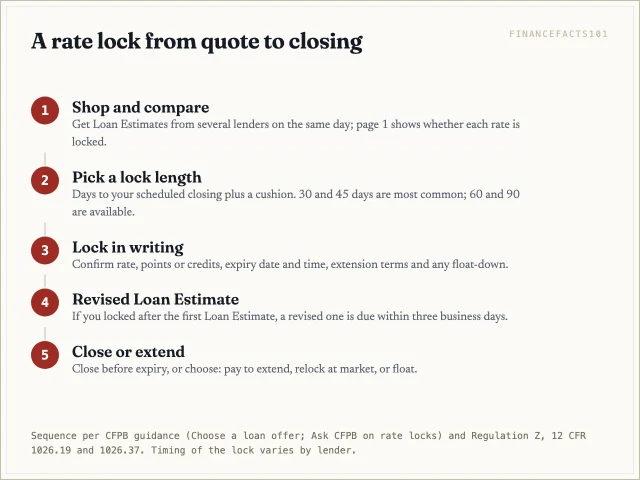
Timing varies by lender. The CFPB's guidance on choosing a loan offer says some lenders lock at the Loan Estimate stage, while others require you to state your intent to proceed first. A lock attaches to a specific application, so for a purchase loan lenders generally want a property address, which in practice usually means a signed purchase contract.
Behind the scenes, your lock is a promise the lender has to fund in the secondary market, where most mortgages are sold. Lenders hedge their pipeline of locked loans, and every borrower who locks but walks away ("fallout") costs them money. That hedging cost is why longer locks are priced higher and why extensions are rarely free. The entry on mortgage originators explains how loans move from lender to investor.
Mortgage Interest Rate Lock Periods: 30, 45, 60 Days and Longer
Freddie Mac's consumer guide to rate lock-ins (last reviewed May 21, 2026) says standard locks are offered for 30, 45, 60 or 90 days, with 30 or 45 days the most common, and that "usually, a longer lock period will have a higher fee."
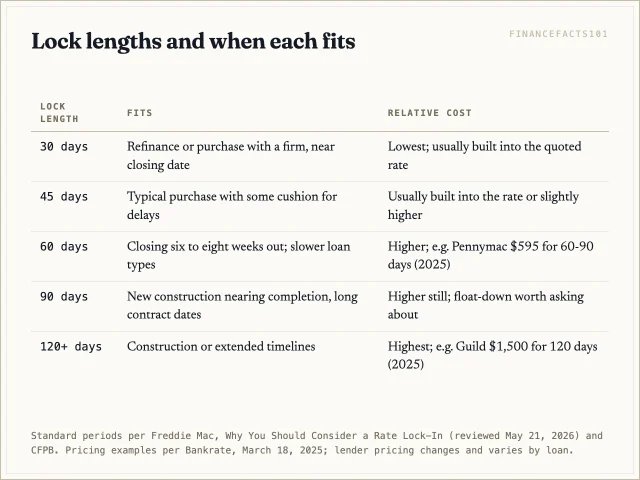
The right length is the number of days to your scheduled closing plus a cushion for delays, not the longest lock on offer. A 60-day mortgage rate lock makes sense when the closing date is already six to eight weeks out: a new-construction purchase that is almost finished, a contract with a long closing date, or a loan type that routinely takes longer (government-backed loans, condos needing project approval, self-employed income documentation). If you are closing in 30 days, paying for 60 buys protection you will not use.
How the extra length is priced depends on the lender. Common structures are: a slightly higher rate for the same points; a fraction of a point added at closing; or a flat fee. Bankrate's guide to lock-extension fees (March 18, 2025) gave two lender examples of long-lock pricing at the time: Pennymac at $595 for a 60-, 75- or 90-day lock, and Guild Mortgage at $1,500 for a 120-day lock. Those are one snapshot, not a market rate. Ask each lender you are comparing for the same lock length so the quotes are comparable.
What Two Weeks of Rate Movement Costs: A Worked Example
Assumptions: a $400,000 loan, 30-year fixed, principal and interest only (no taxes, insurance or mortgage insurance). Rates are Freddie Mac's Primary Mortgage Market Survey weekly averages. That survey reflects conventional, conforming purchase loans for borrowers with 20% down and excellent credit, so your quote will differ, but the size of the moves is what matters here.
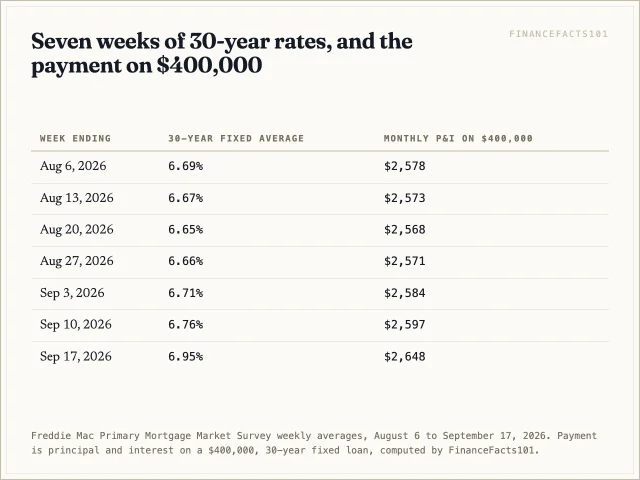
Through August 2026 the average barely moved, staying between 6.65% and 6.69%. From its August 20 low it then rose four weeks running, finishing with a 0.19-point jump in the single week to September 17.
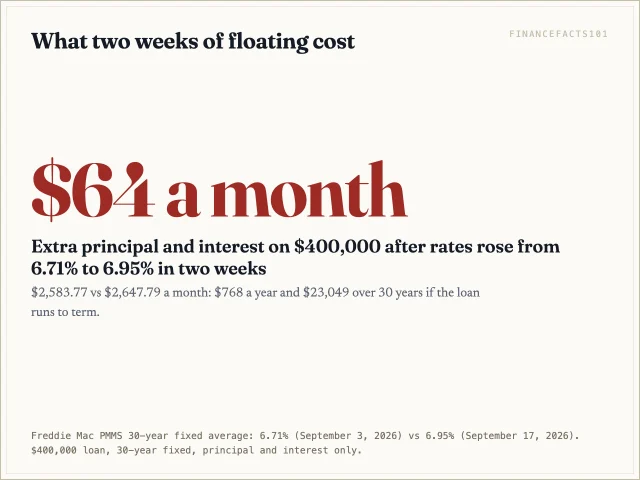
A borrower who locked on September 3 at the average would pay $2,583.77 a month. A borrower who floated and locked on September 17 would pay $2,647.79, which is $64.02 a month, $768 a year and $23,049 over the full 30 years if the loan is never refinanced or paid off early. Your own payment at any rate is one entry away in the mortgage payment calculator.
Now put a price on the insurance. Suppose your lender charged 0.125% of the loan, $500, for a longer lock (an illustrative figure; lenders set their own pricing). The $64 difference would repay that $500 in about eight months. The reverse is also true: if rates had fallen 0.24 points, the lock would have cost you the same $64 a month, unless you had a float-down option.
Rate Lock Extensions: Who Pays When Closing Slips
Closings slip for ordinary reasons: appraisals come in late, title issues surface, the seller's side is not ready, underwriting asks for one more document. When the lock runs out first, the CFPB's loan offer guidance is blunt: "If you don't close before your rate lock expires, even if it's because of the lender's processing time, you might have to pay a fee to extend your rate lock."
Your choices when a lock is about to expire are usually these three:
- Extend the lock. Pay a fee for more days at the same rate. Bankrate reports extension fees ranging from 0.25% to 1% of the loan amount, though many lenders charge a flat fee instead; on $400,000 the percentage range is $1,000 to $4,000.
- Relock. Let the lock lapse and take the market rate on the day you relock. Some lenders' relock policies price you at the worse of your old rate and the current one, so ask before assuming a relock helps if rates fell.
- Float. Leave the rate unlocked and take whatever it is when you lock again.
Extension policies at banks are written into the lock agreement, and they vary. Wells Fargo's rate lock page, for example, says "the maximum number of customer-paid rate lock extensions is two (2) per loan and fees apply." Separately, it says it will refund the upfront fee for choosing an extended lock period if the application is denied, but that fee may not be refunded if you withdraw or cancel the application (VA loans excepted). Other lenders' terms differ; read your own lock agreement.
Who caused the delay matters. Some lenders' written policies say the lender absorbs the extension cost when its own processing caused the slip, and regulators have enforced such a policy. In 2018 the OCC and the CFPB fined Wells Fargo a combined $1 billion over two issues, one of which was rate-lock extension fees: per the OCC's announcement, the CFPB's enforcement action and the CFPB's consent order, the bank's policy from September 16, 2013 through February 28, 2017 (the period the CFPB order covers) was to bear the fee when it was responsible for a missed closing, yet it charged customers anyway in a number of those cases. If you are asked to pay for an extension, ask in writing what caused the delay and whose policy covers it.
Float-Downs and Relocking When Rates Fall
A standard lock is one-way insurance for the lender as much as for you: rates go up, you are protected; rates go down, you are, in the CFPB's words, potentially locked "out of a lower interest rate."
A float-down option is the fix. Freddie Mac describes it as letting "you take advantage of a lower rate if one becomes available during your lock period." Terms vary widely. As lender Lower's float-down explainer (updated June 1, 2026) lays out, the option can be paid for as a separate upfront fee, a higher locked rate, or extra points; some lenders require rates to fall by a minimum amount before you can use it; and many allow only one float-down per loan. Ask for the trigger, the price and the window in writing. Wells Fargo calls the related option "repricing": if rates fall, you can pay a fee and relock lower.
Whether a float-down is worth paying for depends on how volatile rates are and how long your lock runs. On a 30-day lock in a quiet market, rarely. On a 90-day or longer lock for new construction, the option has more time to pay off.
Locking Mortgage Rates Too Early, or Too Late
There is no right day to lock, and nobody can reliably forecast the next week of mortgage rates. Freddie Mac frames the decision around three things: the current market, how close you are to closing, and how comfortable you are with risk. What you can control is the mismatch between lock length and your timeline.
Locking too early has two costs. You pay for more days than you need, and you raise the chance of an expiry and an extension fee if the closing date is not firm. A buyer who locks for 60 days before the appraisal is ordered on a 30-day closing has usually paid for protection twice. It also means that if rates fall during a long lock without a float-down, you are stuck at the higher rate.
Locking too late is the September example: floating for two weeks cost $64 a month for the life of the loan. Floating is a bet that rates will fall before you close. It can pay, but the downside is permanent and the upside is usually a fraction of a point.
A reasonable middle path: lock once you have a signed purchase contract, a firm closing date and a lender you intend to use, for a period that covers that date plus about a week or two of cushion. Rate shopping across lenders, which you should do before locking, is the bigger lever; see how much house you can afford for the budget side.
Checking Your Lock on the Loan Estimate
The federal Loan Estimate form tells you whether you are locked. Under Regulation Z, 12 CFR 1026.37(a)(13), if your rate is locked the lender must show the date and time (including the time zone) when the lock ends. If it is not, the form must say that the rate, points and lender credits can change until you lock. The CFPB tells borrowers to look at the top of page 1 to see "whether your rate is locked, and until when."
If you lock after receiving the Loan Estimate, the lender must send a revised one reflecting the locked rate, points and lender credits no later than three business days after the lock, under 12 CFR 1026.19(e)(3)(iv)(D). What the Loan Estimate will not tell you is what an extension costs. The CFPB suggests asking directly: what the lock period is, whether a shorter or longer lock is available and at what cost, what happens if closing is delayed, and what happens if rates fall. The wider set of closing disclosure rules sits under RESPA and Regulation Z.
FAQ
Is a 60-day mortgage rate lock worth it?
It is worth it when your closing is genuinely 45 to 60 days away, for example on new construction or a contract with a long closing date, because the added cost is usually small compared with the risk of an extension fee or a higher rate. If you expect to close within 30 days, a 30- or 45-day lock is typically cheaper. Ask each lender for the price of both lengths on the same day.
Does it cost money to lock a mortgage rate?
For standard lock lengths, many lenders do not charge a separate fee; the cost is built into the rate and points you are quoted. Longer locks usually cost more, per Freddie Mac, either as a slightly higher rate, a fraction of a point, or a flat fee. Extensions after a lock expires almost always carry a charge unless the lender caused the delay and its policy covers it.
Can my rate change after I lock it?
Yes, in two cases: if your application changes (a different loan amount, a lower credit score, income that verifies lower than stated) or if you do not close before the lock expires. A market move alone does not change a locked rate.
What happens if my rate lock expires before closing?
You can pay to extend it, relock at the current market rate (some lenders use the worse of your old rate and the new one), or let the rate float. If you relock, the lender must send a revised Loan Estimate within three business days (or a corrected Closing Disclosure if you already have one). Ask early: if the delay is the lender's fault, some lenders' policies say the lender pays the extension.
Sources
- CFPB, What's a lock-in or a rate lock on a mortgage? — definition, typical 30/45/60-day periods, questions to ask the lender
- CFPB, Choose a loan offer — when to lock, extension fees even for lender processing delays
- CFPB, 12 CFR 1026.37, Loan Estimate content — the rate-lock disclosure in paragraph (a)(13)
- CFPB, 12 CFR 1026.19, Certain mortgage and variable-rate transactions — revised Loan Estimate within three business days after a rate lock, paragraph (e)(3)(iv)(D)
- CFPB, Enforcement action: Wells Fargo Bank, N.A. (2018)
- CFPB, Consent Order, In the Matter of Wells Fargo Bank, N.A., File No. 2018-BCFP-0001, April 20, 2018 — rate-lock extension fee findings for September 16, 2013 through February 28, 2017
- OCC, OCC Assesses $500 Million Penalty Against Wells Fargo, Orders Restitution for Unsafe or Unsound Practices, April 20, 2018 — rate-lock extension fee findings
- Freddie Mac, Primary Mortgage Market Survey — weekly 30-year fixed averages, August 6 to September 17, 2026
- Freddie Mac, Why You Should Consider a Rate Lock-In — standard 30/45/60/90-day locks, longer locks cost more, float-downs
- Wells Fargo, What is an interest rate lock for mortgages? — two customer-paid extensions, extended-lock fee refund terms, repricing
- Lower, Mortgage rate lock float-down option cost, updated June 1, 2026 — how float-downs are priced and limited
- Bankrate, How to avoid mortgage rate lock extension fees, March 18, 2025 — extension fee range and lender long-lock examples
 Next entry · No. 2,950Understanding Loan Notes: A Comprehensive Guide for Institutional Investors
See also
-
 No. 5,869
14 Oct 2025
18 min
Understanding Yield Spread Premium: What It Is, How it Works, and its Historical Context
Mortgage
No. 5,869
14 Oct 2025
18 min
Understanding Yield Spread Premium: What It Is, How it Works, and its Historical Context
Mortgage -
 No. 3,281
16 Mar 2025
21 min
Understanding Mortgage Originators: Bridging Primary and Secondary Markets
Mortgage
No. 3,281
16 Mar 2025
21 min
Understanding Mortgage Originators: Bridging Primary and Secondary Markets
Mortgage -
 No. 3,275
15 Mar 2025
20 min
Understanding Mortgages: A Comprehensive Guide for Institutional Investors
Mortgage
No. 3,275
15 Mar 2025
20 min
Understanding Mortgages: A Comprehensive Guide for Institutional Investors
Mortgage -
 No. 2,440
06 Jan 2025
19 min
Understanding Interest-Only Mortgages: Advantages, Disadvantages, and How They Work
Mortgage
No. 2,440
06 Jan 2025
19 min
Understanding Interest-Only Mortgages: Advantages, Disadvantages, and How They Work
Mortgage -
 No. 2,261
23 Dec 2024
22 min
Understanding Hybrid Adjustable Rate Mortgages (ARMs): A Comprehensive Guide for Institutional Investors
Mortgage
No. 2,261
23 Dec 2024
22 min
Understanding Hybrid Adjustable Rate Mortgages (ARMs): A Comprehensive Guide for Institutional Investors
Mortgage -
 No. 2,167
15 Dec 2024
18 min
Understanding the Home Affordable Refinance Program (HARP): Providing Relief to Underwater Homeowners
Mortgage
No. 2,167
15 Dec 2024
18 min
Understanding the Home Affordable Refinance Program (HARP): Providing Relief to Underwater Homeowners
Mortgage