Loan Syndication: How It Works, the Process, and the Parties
A loan syndication splits one large loan among a group of lenders under a single agreement. Large US syndicated commitments reached $6.9 trillion in 2025.
Loan syndication is a way for a group of lenders to make one large loan together. A lead bank, called the arranger, structures the deal and finds the other lenders. Every lender signs the same credit agreement and funds its own share. An agent bank then runs the loan day to day: it collects payments and passes them on to the whole group. The borrower gets one loan and one set of terms, sized larger than any single lender would take on alone.
It is how most large corporate loans get made. In the 2025 Shared National Credit review, US bank regulators counted $6.9 trillion of commitments on loans of $100 million or more shared by several supervised lenders. This page explains the structure, walks through the loan syndication process step by step, sets out the parties and their roles, and works through a real 2026 credit agreement with numbers. It is general information, not advice on any particular financing.
What Is Loan Syndication? The Meaning in Finance
In finance, a syndicate is a temporary group of firms that join together on one deal, sharing the work, the money and the risk. Investment banks form underwriting syndicates to sell a company's new bonds or shares. Real estate sponsors syndicate a property purchase among investors. Loan syndication applies the same idea to lending: several lenders provide one loan.
A syndicated loan has three defining features:
- One agreement, many lenders. The borrower signs a single credit agreement with all the lenders, not a separate contract with each one.
- Separate shares. Each lender commits a specific amount. In most syndicated credit agreements, each lender is responsible only for its own share and does not cover another lender that fails to fund.
- One agent. An administrative agent handles the paperwork, payments and communication for the group, so the borrower deals with one bank rather than twenty.
That is what separates a syndicated loan from a bilateral loan (one borrower, one lender) and from a loan participation. The OCC describes a participation as "a sharing or selling of interests in a loan." In a participation, one bank usually makes the loan in its own name and then sells pieces of it, and the buyers normally have no direct contract with the borrower. In a syndication, every lender is a party to the loan from the start.
Why Big Loans Get Syndicated
The Office of the Comptroller of the Currency, which supervises national banks, sums up the case in its Comptroller's Handbook on leveraged lending. Syndicated loans "allow borrowers to access a larger pool of capital than any one single lender may be prepared to make available." They are also "simpler for borrowers and lenders to arrange and less costly than borrowing the same amount from a number of lenders through traditional bilateral loan underwritings."
Lenders get something too. Few banks want $1 billion of exposure to a single company, but many will hold a slice of it. The handbook notes that syndication lets smaller lenders "lend to larger borrowers than their smaller balance sheets would allow." The arranging banks earn fees, and they often win the borrower's cash management and other business.
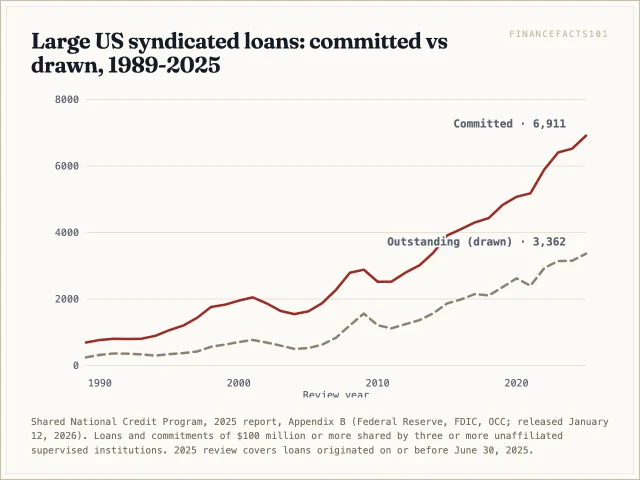
The market has grown steadily. The federal banking agencies' 2025 Shared National Credit report counted 6,857 borrowers with $6.91 trillion of commitments, up 6% on 2024. The review covers loans originated on or before June 30, 2025. A Shared National Credit is a loan or commitment of $100 million or more shared by three or more unaffiliated supervised institutions. The full report shows commitments of $692 billion in 1989, so the market has grown about tenfold since then. Only about half of what is committed is actually borrowed at any time: $3.36 trillion was outstanding in 2025.
The Parties to a Syndicated Loan
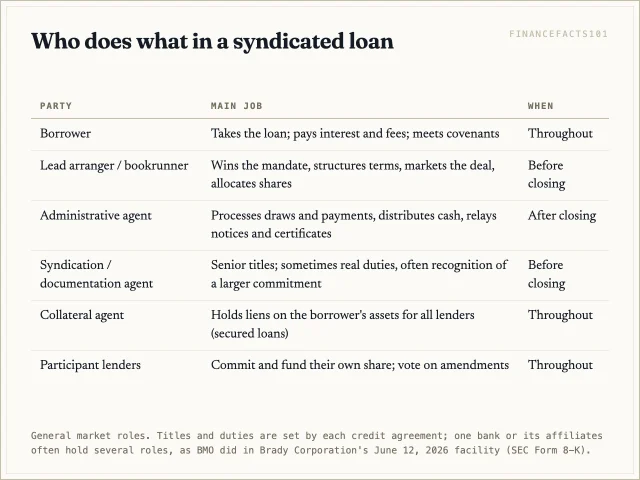
The same institution often plays several roles, and titles like "co-documentation agent" can be more about league-table credit than work. These are the parties that matter:
- Borrower. The company taking the loan, often with its subsidiaries as guarantors.
- Lead arranger and bookrunner. The bank or banks that win the mandate, structure the terms, prepare the marketing materials, bring in lenders and decide allocations. Big deals have several joint lead arrangers.
- Administrative agent. Usually one of the arrangers. After closing, it processes draws and repayments, calculates interest, distributes payments to the lenders, collects compliance certificates and passes notices between the borrower and the group. It works for the lenders, not the borrower. This is the role most people mean by the "lead bank"; our lead bank explainer covers it in more depth.
- Syndication agent and documentation agents. These titles go to senior banks in the group. They sometimes carry real duties, but often they mainly recognize a larger commitment.
- Collateral agent. In a secured loan, this party holds the liens on the borrower's assets for the benefit of all the lenders.
- Participant lenders. The banks and, for some tranches, the institutional investors that fund the rest of the loan.
Decisions are made by vote. Most credit agreements let lenders holding more than half the commitments approve routine amendments and waivers. Changes to a lender's own money, such as the interest rate, the principal or the maturity date, usually need that lender's consent.
The Loan Syndication Process, Step by Step
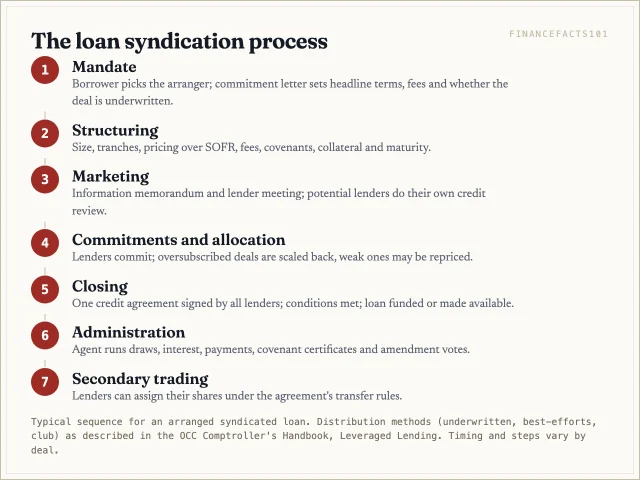
A syndication runs through the same stages whether it is a $200 million club loan or a multi-billion-dollar acquisition financing:
- Mandate. The borrower picks one or more arrangers and signs a mandate or commitment letter. The letter sets out the headline terms, the fees and whether the loan is underwritten.
- Structuring. The arranger sets the loan's size, tranches, pricing over a benchmark such as SOFR, fees, covenants, collateral and maturity. The borrower's credit, the purpose of the loan and market conditions all shape the result.
- Marketing. The arranger sends potential lenders an information memorandum with the borrower's financials, projections and draft terms. Larger deals often start with a bank meeting or lender presentation.
- Commitments and allocation. Lenders commit amounts. If a deal is oversubscribed, the arranger scales allocations back. If demand is weak, the arranger may have to adjust pricing or terms.
- Documentation and closing. The final credit agreement is signed, conditions such as legal opinions and lien filings are met, and the loan is funded or made available to draw.
- Administration. The agent runs the loan until maturity: draws, interest periods, payments, covenant certificates and amendments.
- Secondary trading. Lenders can sell their shares to other lenders, within the transfer rules in the credit agreement.
Types of Syndication: Underwritten, Best-Efforts, and Club Deals
The OCC handbook describes three main ways a loan is distributed. They differ in who carries the risk that lenders don't show up:
- Underwritten deal. The arranger "commits to the borrower the entire loan amount before syndication." If it cannot sell the whole loan, "it must hold the unsold portion," which exposes it to price risk. Borrowers pay more for this certainty, and it is common in acquisition financing where the money must be there on the closing date.
- Best-efforts syndication. The arranger "agrees to use all efforts to sell as much of the loan as possible." It is not responsible for funding any unsold part. These deals may include flex language, which lets the arranger change pricing if the credit markets or the borrower's position change.
- Club deal. A smaller loan marketed to "a small group of relationship lenders," often without one bank taking a large arranger role.
Loan Structuring and Syndication: Tranches and Who Holds Them
A single syndicated financing often contains several tranches. Each tranche has its own terms and appeals to different lenders:
- Revolving credit facility. A line the borrower can draw, repay and redraw. Banks hold almost all of these, because revolvers support other banking business and need a lender that can fund on short notice.
- Term loan A. An amortizing term loan, usually held by banks alongside the revolver. Together these are called the "pro rata" tranches.
- Term loan B. A longer, mostly bullet-repayment term loan sold to institutional investors, such as collateralized loan obligations (CLOs), loan mutual funds and insurers. The SEC's investor education office calls these leveraged loans: loans "made to borrowers who already have high levels of debt and/or a low credit rating," which "typically pay a variable interest rate."
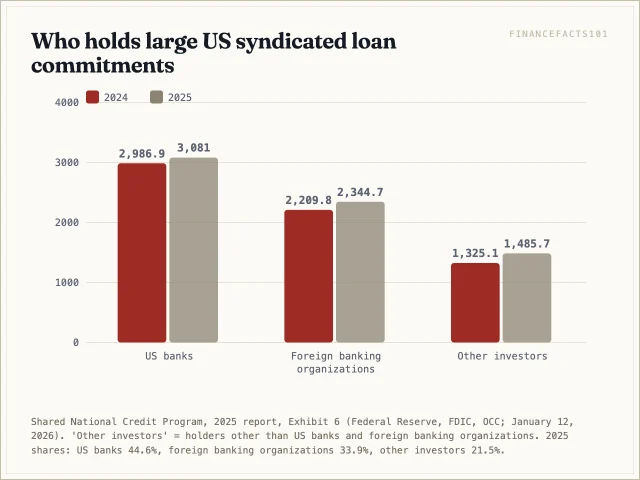
The Shared National Credit data show how the split works. Among leveraged commitments in the 2025 review, banks held $819.9 billion of investment-grade revolvers and $633.0 billion of non-investment-grade revolvers. Other investors held only $17.8 billion and $32.1 billion of those. Non-investment-grade term loans went the other way: $1,093.7 billion sat with other investors and $259.0 billion with banks. Across all commitments, US banks held 44.6%, foreign banking organizations 33.9% and the report's "other investors" category, holders outside those two bank groups, 21.5%.
Where a loan sits in the borrower's capital structure also matters. Syndicated bank loans are usually senior and often secured, which puts them ahead of bonds and far ahead of equity if the borrower fails. Our explainer on junior equity covers the bottom of that ladder.
A Real Example: Brady Corporation's 2026 Credit Agreement
On June 12, 2026, Brady Corporation signed a $1.0 billion syndicated credit agreement, filed with the SEC on Form 8-K. It consists of a $500 million term loan and a $500 million revolving credit facility, both maturing June 12, 2031. The parties show the roles in practice:
- BMO Bank N.A. is administrative agent, swing line lender and letter-of-credit issuer.
- Bank of America, N.A. is syndication agent and a letter-of-credit issuer.
- BMO Capital Markets, BofA Securities, CIBC Bank USA, PNC Capital Markets and Wells Fargo are joint lead arrangers and joint bookrunners.
The agreement also lets Brady add up to $550 million of commitments, plus an unlimited further amount as long as its pro forma net leverage stays at or below 2.50 to 1.00. Its covenants cap consolidated net leverage at 3.50 to 1.00, which can rise temporarily to up to 4.00 to 1.00 for the four quarterly test periods after Brady's planned PSS acquisition closes. They also set a minimum interest coverage ratio of 3.00 to 1.00. Pricing moves with Brady's leverage. The credit agreement (Exhibit 10.1) sets a margin of 1.00% to 2.25% over Term SOFR and a commitment fee of 0.10% to 0.30% a year on the unused amount.
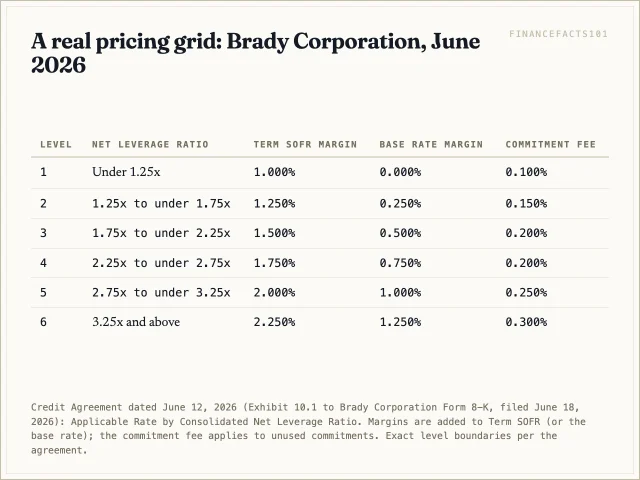
Here is how the money moves, using the middle of that grid: level 3, Term SOFR plus 1.50% and a 0.20% commitment fee. Until its first quarterly compliance certificate, Brady pays at least the level 4 rate, so the example assumes its leverage has since fallen into the level 3 band. Overnight SOFR was 3.88% on September 24, 2026, according to the New York Fed. Term SOFR is published separately and differs slightly, so treat this as an approximation. Suppose Brady borrowed $200 million of the revolver for a full year:
- Interest: $200 million × (3.88% + 1.50%) = $10.76 million.
- Commitment fee: $300 million undrawn × 0.20% = $0.60 million.
- Total: $11.36 million, paid to the agent and split among the lenders by their share of the revolver.
A bank with a $50 million commitment, 10% of the revolver, would have funded $20 million of the draw. It would receive $1.076 million of interest and $60,000 of fees. That pro rata sharing is the core of syndication: the borrower writes one check, and each lender gets its fraction. For how the benchmark itself moves when the Fed acts, see our guide to prime rate changes. Credit agreements usually offer a prime-linked "base rate" alongside SOFR.
What Syndication Means for the Borrower: Advantages and Disadvantages
Advantages:
- Size. One agreement can raise more than any single lender would provide.
- Speed and simplicity. The borrower negotiates one set of terms and then deals with one agent, instead of running separate bilateral loans with separate covenants.
- Flexibility. Revolvers, term loans and letters of credit can sit in one package, with an accordion or incremental feature for later growth.
- Relationships. A syndicate gives the borrower a group of banks that know its credit, which helps with future financings.
Disadvantages:
- Cost. Arrangement fees, agency fees, legal costs and commitment fees add up. Underwritten deals cost more than best-efforts deals.
- Covenants and reporting. Financial covenants, quarterly compliance certificates and restrictions on further borrowing come with most syndicated loans.
- Harder amendments. Changing the terms means winning a vote, and some changes need every affected lender to agree.
- Unknown lenders. Loans trade, so the lenders you work out a problem with may not be the banks you started with. The OCC notes that syndicates can include "private equity groups, hedge funds, and investment conduits." Their "workout motivations" can "differ significantly from bank members, complicating the workout process."
The LSTA and the Secondary Loan Market
Once a loan closes, lenders can sell their shares by assignment. The buyer becomes a lender of record, usually with the agent's consent and, outside a default, the borrower's. The Loan Syndications and Trading Association (LSTA) is the US trade group for this market. On its own site, it says it has worked "since 1995" to "bring order, equity and standardization to every aspect of corporate lending." It publishes standard documentation, trading and settlement practices, and market data.
Loan trading is slower than bond trading. The SEC's investor bulletin warns that leveraged loans "typically have a long settlement period," a real risk for funds that may need to sell quickly. Lenders that want to hedge instead of sell can use credit derivatives; see our explainer on loan credit default swaps.
FAQ
What is loan syndication in simple terms?
Several lenders jointly make one loan to a single borrower under one agreement. An arranger puts the group together, an agent bank administers the loan, and each lender funds and earns interest on its own share.
Who is the lead bank in a loan syndication?
The lead arranger structures and markets the deal, and the administrative agent runs it after closing. The same banking group often does both. In Brady Corporation's June 2026 facility, BMO Bank was administrative agent and its affiliate BMO Capital Markets was one of five joint lead arrangers.
What is the difference between a syndicated loan and a loan participation?
In a syndicated loan, every lender signs the credit agreement and has a direct relationship with the borrower. In a participation, one lender makes the loan and sells interests in it to others, who usually deal only with that lender.
Can a syndicated loan be sold?
Yes. Lenders can assign their shares to other lenders or institutional investors, subject to the transfer rules in the credit agreement. Leveraged term loans trade actively, though settlement takes longer than for bonds.
Sources
- Board of Governors of the Federal Reserve System, FDIC and OCC, Agencies release 2025 Shared National Credit report (January 12, 2026) and 2025 SNC Program Report (PDF): Appendix A definitions, Appendix B committed and outstanding balances 1989-2025, Exhibits 5 and 6
- Office of the Comptroller of the Currency, Comptroller's Handbook: Leveraged Lending and Loan Sales and Participations
- U.S. Securities and Exchange Commission (EDGAR), Brady Corporation Form 8-K (filed June 18, 2026) and Credit Agreement dated June 12, 2026 (Exhibit 10.1)
- Investor.gov (SEC Office of Investor Education and Advocacy), Leveraged Loan Funds: Investor Bulletin
- Federal Reserve Bank of New York, Secured Overnight Financing Rate (SOFR)
- Loan Syndications and Trading Association, LSTA home page and About the LSTA
 Next entry · No. 2,961Understanding Loan-to-Value (LTV) Ratios: The Key to Securing Mortgages
See also
-
 No. 2,785
04 Feb 2025
18 min
Understanding Lead Banks: Role, Functions, and Significance in Finance and Investment
Business Finance
No. 2,785
04 Feb 2025
18 min
Understanding Lead Banks: Role, Functions, and Significance in Finance and Investment
Business Finance -
 No. 2,870
10 Feb 2025
25 min
Understanding Life Annuities: A Comprehensive Guide for Institutional Investors
Business Finance
No. 2,870
10 Feb 2025
25 min
Understanding Life Annuities: A Comprehensive Guide for Institutional Investors
Business Finance -
 No. 2,831
07 Feb 2025
18 min
Understanding Letters of Guarantee: What They Are and How They Work in Finance
Business Finance
No. 2,831
07 Feb 2025
18 min
Understanding Letters of Guarantee: What They Are and How They Work in Finance
Business Finance -
 No. 2,798
05 Feb 2025
20 min
Understanding Lease Payments: An In-Depth Guide for Institutional Investors
Business Finance
No. 2,798
05 Feb 2025
20 min
Understanding Lease Payments: An In-Depth Guide for Institutional Investors
Business Finance -
 No. 2,657
24 Jan 2025
19 min
Understanding Junior Equity: The Last Priority in Corporate Capital Structure
Business Finance
No. 2,657
24 Jan 2025
19 min
Understanding Junior Equity: The Last Priority in Corporate Capital Structure
Business Finance -
 No. 2,589
19 Jan 2025
18 min
The Unauthorized Trades of Jérôme Kerviel: A Rogue Trader Case Study
Business Finance
No. 2,589
19 Jan 2025
18 min
The Unauthorized Trades of Jérôme Kerviel: A Rogue Trader Case Study
Business Finance