Understanding Probability Density Functions (PDF) in Finance: Meaning, Calculation, and Significance

Understand the role of Probability Density Functions in Finance through this comprehensive guide: Meaning, calculation, differences, and applications.
Introduction to Probability Density Functions (PDF)
Probability density functions, commonly denoted as PDFs, are an essential component of statistical analysis used extensively in finance to gauge the risk and expected return potential for discrete variables such as individual stocks or exchange-traded funds (ETFs). They represent the probability distribution of a random variable by defining the likelihood of obtaining a specific outcome. A key feature distinguishing PDFs from continuous functions is their application to discrete data, where outcomes can be identified with exact values.
A popular example of a PDF in finance is the normal distribution, which generates the renowned bell curve shape. Understanding probability density functions is vital for financial professionals to evaluate risk profiles and construct well-diversified portfolios. In this section, we’ll discuss what probability density functions are, their importance in finance, and the differences between discrete and continuous data.
Probability density functions can be defined as a statistical measure used to gauge the likelihood of a discrete value occurring. They are typically visualized on a graph that resembles a bell curve, with the probability of outcomes lying below the curve. For instance, a PDF for a stock’s price return might illustrate how often an investor could expect a certain percentage increase or decrease in share value.
When dealing with continuous data, a distribution skewed to the right side of the curve indicates greater upside potential while a skew to the left signals increased downside risk. Probability distributions can also be employed to generate cumulative distribution functions (CDFs), which add up the likelihood of occurrences and start at zero, ultimately ending at 100%.
It’s essential to recognize that probability density functions are not limited to discrete data. They can also describe continuous variables, such as temperature or time, where every point on the curve represents an infinite number of values. The main difference between discrete and continuous PDFs lies in their respective data types and the way they represent outcomes.
Discrete variables only take on specific values, like integers or yes/no answers. For example, a coin flip can result in either heads (H) or tails (T), making it a discrete variable. Continuous variables, such as temperature or height, have an infinite number of possibilities and are often depicted using graphs with a continuous curve.
In finance, probability density functions play a significant role in determining the overall risk/reward profile of investments. By understanding the distribution of potential outcomes for a given asset, investors can make informed decisions about portfolio construction and risk management strategies. In the following sections, we will dive deeper into the properties, calculations, applications, and various types of probability density functions commonly utilized in finance.
Stay tuned! In our subsequent sections, we’ll discuss the key characteristics of PDFs, methods for computing and calculating these essential statistical measures, and their applications within the context of finance. We will also explore some popular distributions, such as normal, binomial, lognormal, Poisson, and beta distributions. Additionally, we’ll highlight the differences between probability density functions (PDFs) and cumulative distribution functions (CDFs) and discuss how the central limit theorem (CLT) plays a role in shaping our understanding of these essential statistical tools.

Properties of PDFs
Probability density functions (PDFs) are crucial in finance as they help investors and traders evaluate risk and reward potential. These functions can define both discrete and continuous variables, which have distinct differences. Discrete variables can be identified by exact values, whereas continuous variables are characterized by infinite possibilities. One key characteristic of PDFs is their ability to provide several essential measures: mean, standard deviation, kurtosis, and skewness. In this section, we will discuss these properties, how they are calculated, and their significance in the context of probability density functions.
Mean: The Mean represents the average value of a random variable. It is calculated as the sum of all possible outcomes multiplied by their respective probabilities:
Mean = (∑ xi * Pi) / N
where:
– xi is the ith outcome’s value
– Pi is the probability of observing the ith outcome
– N is the total number of outcomes
Standard deviation: The standard deviation measures the dispersion, or spread, of a distribution. It is calculated as the square root of the variance:
Variance = (∑ [(xi – Mean)²] * Pi) / N
Standard deviation = sqrt(Variance)
Kurtosis: Kurtosis quantifies the “tailedness” or peakedness of a distribution. A distribution with a high kurtosis value indicates heavy tails, meaning there is a higher likelihood for extreme values, whereas a low kurtosis implies lighter tails and fewer extreme values. Kurtosis can be measured as a standardized score:
Kurtosis = (Moment of Order 4 / Moment of Order 2)³ – 1
Skewness: Skewness measures the symmetry of a distribution. It is calculated as the standardized measure of asymmetry:
Skewness = (Moment of Order 3 / Standard Deviation³)
Calculating PDFs can be complex, requiring differential equations or integral calculus to determine the function’s shape. Modern statistical software packages enable investors and traders to compute and visualize probability distribution functions, aiding in risk assessment and portfolio management decisions.
Next, we will explore how these properties of PDFs apply to normal distributions and other important distributions in finance.

Computing PDFs: Methods and Complexities
Understanding probability density functions (PDFs) in finance is crucial for gauging risk, evaluating investments, and managing portfolios effectively. One essential aspect of working with PDFs is calculating them using appropriate methods. In this section, we explore various ways to compute and plot PDFs using differential equations, integral calculus, and statistical software packages.
Differential Equations
A differential equation is a mathematical expression that describes how a function changes as an independent variable changes. For instance, the famous Black-Scholes differential equation models the price of a European call option under the assumptions of continuous trading, no transaction costs, and zero interest rates. To find the solution to this differential equation, we can use techniques like separation of variables or numerical methods.
Integral Calculus
An alternative method for computing PDFs involves integral calculus, which deals with finding the area under a curve, called the definite integral. Integration formulas, such as the fundamental theorem of calculus and change of variable techniques, can be utilized to calculate PDFs from probability mass or density functions. For example, the normal distribution’s cumulative distribution function (CDF) can be integrated to obtain its corresponding PDF.
Statistical Software Packages
For practical applications in finance, it is often more convenient to use statistical software packages like R, MATLAB, SAS, or Python to calculate and visualize probability density functions. These tools can handle complex computations with ease and provide a wide range of built-in distributions and functions, including the normal distribution, uniform distribution, binomial distribution, Poisson distribution, and lognormal distribution.
Calculating the PDF of a Normal Distribution
A common example of calculating a probability density function is finding the PDF for a standard normal distribution using integral calculus. The formula is given as follows:
f(x)= 1 √ (2π) e − x²/2
where x = value of the variable and π = a constant (approximately 3.14159265).
To calculate this PDF, we need to find the area under the curve for a specific range of values using integration techniques or statistical software packages.
In conclusion, understanding how to compute probability density functions is crucial for making informed investment decisions and managing risk in finance. While there are various methods, such as differential equations, integral calculus, and statistical software packages, it’s often more practical and efficient to rely on the latter for most applications.

Normal Distribution: The Bell Curve
The normal distribution, also known as Gaussian distribution or the bell curve, is one of the most popular probability density functions (PDFs) used in finance. It describes the continuous distribution of a variable around its mean value. This section delves into the significance and applications of the normal distribution in finance.
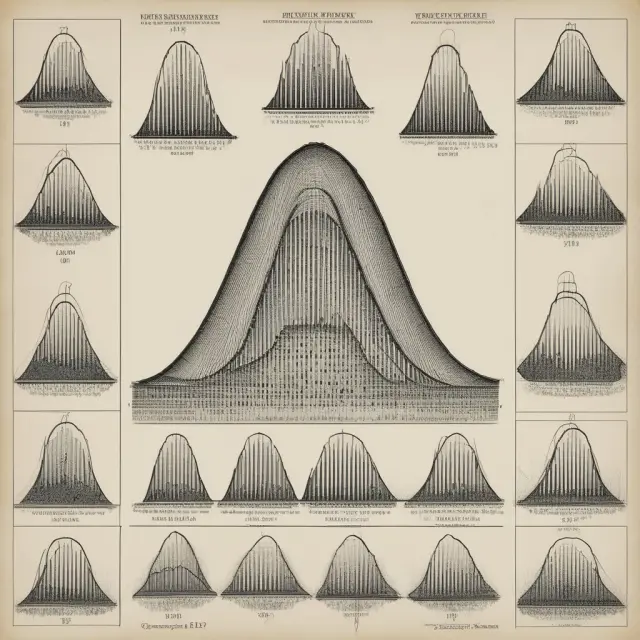
The normal distribution is characterized by a symmetrical bell-shaped curve with mean μ and standard deviation σ (sigma). The shape of this curve indicates that most outcomes will fall within a certain range close to the mean, while fewer occurrences will be found at greater distances from it (Figure 1).
Figure 1: Normal Distribution
The normal distribution’s importance stems from its versatility in modeling various financial scenarios. One common application involves assessing returns and risk levels for investment portfolios. The curve can help investors gauge the probability of specific returns, estimate potential losses or gains, and identify areas with higher volatility.
For instance, assume an investor is considering two mutual funds, A and B. Using historical data, they calculate the mean (expected value) and standard deviation for each fund. If Fund A has a higher standard deviation compared to Fund B but similar mean values, the normal distribution can help illustrate the potential risk-reward tradeoff.
Let’s assume the following statistics:
Fund A: Mean = 10%, Standard Deviation = 4%
Fund B: Mean = 8%, Standard Deviation = 2%
The investor can plot both funds on a normal distribution curve, revealing that Fund A has a wider spread and higher volatility. This indicates the potential for larger returns (upside risk) or losses (downside risk) compared to Fund B. By understanding this risk-reward profile, investors can make more informed decisions when constructing their portfolios.
Additionally, the normal distribution plays a vital role in option pricing and risk management. Black-Scholes model, a popular method for pricing options, relies on the assumption of a lognormal distribution of stock prices. This model utilizes the properties of the normal distribution to determine option premiums based on various factors such as volatility, time, strike price, and underlying asset price (Figure 2).
Figure 2: Black-Scholes Model
Moreover, risk management professionals can employ the normal distribution to assess potential losses and calculate the Value at Risk (VaR) for portfolios. VaR is a risk metric that quantifies the maximum potential loss within a specified time frame under normal market conditions. By calculating VaR for various scenarios using normal distribution curves, investors can effectively manage their exposure to risks and monitor portfolio performance closely.
In conclusion, probability density functions (PDFs) like the normal distribution significantly contribute to understanding financial concepts and making informed investment decisions. The bell curve’s symmetry, mean, standard deviation, and its wide application in various areas of finance make it an essential tool for financial professionals.

Discrete vs. Continuous PDFs: Key Differences
Probability density functions (PDFs) are essential tools in finance, enabling investors and traders to analyze risk and potential returns. However, it’s crucial to understand that there are two distinct types of data – discrete and continuous – which necessitate different approaches when dealing with probability density functions.
Discrete Random Variables
A discrete random variable can only assume specific values within a limited range or set. For instance, the number of heads obtained in a series of coin flips is a discrete random variable because it can only take on integer values ranging from 0 to n (the total number of trials). The probability mass function (PMF) describes how likely each discrete outcome is, while the cumulative distribution function (CDF) summarizes the probabilities for all possible outcomes up to and including that value.
Continuous Random Variables
In contrast, continuous random variables can take on infinitely many values within a range. For example, stock prices are considered continuous variables as they can assume any price between certain intervals. Probability density functions (PDFs) are used for continuous random variables and provide information about the likelihood of an outcome occurring within a given range or interval. The total area under the curve of a PDF represents the integral probability of all possible values, equaling 1.
Calculating Probabilities with PDFs
In finance, calculating probabilities using PDFs can involve complex mathematical calculations using differential equations and integral calculus. However, statistical software packages like R, Python’s NumPy or Matlab simplify these processes. For instance, to calculate the probability of a continuous random variable X falling within an interval [a,b], you can use the following formula:
P(a Probability density functions (PDFs) play an essential role in finance, providing valuable insights into investment analysis, risk assessment, and portfolio management. By understanding the behavior and properties of various probability distributions, investors can evaluate their risk-reward profiles for securities or funds in their portfolios. Probability density functions are crucial tools for assessing potential investments by calculating their expected returns and associated risks. For example, option pricing models like the Black-Scholes model rely on the normal distribution to estimate the underlying stock price dynamics and determine the optimal price of an option contract. In addition, portfolio optimization techniques such as Modern Portfolio Theory (MPT) utilize probability distributions to identify the most efficient allocation of assets in a diversified portfolio. When evaluating potential risks for investments or financial instruments, probability density functions help investors determine the likelihood and consequences of specific outcomes. For instance, Value-at-Risk (VaR) and Conditional Value-at-Risk (CVaR), two popular risk measurement metrics, both utilize probability distributions to assess the downside potential of an investment over a given time horizon. Probability density functions enable investors to manage risk by diversifying their portfolios effectively. By understanding the properties and relationships between various probability distributions, investors can create well-balanced portfolios that minimize overall risk while maximizing potential returns. For instance, when constructing a portfolio of assets, an investor might use PDFs to determine the likelihood of specific outcomes based on the historical performance data of each asset. Probability density functions also offer insights into the behavior of financial markets and the underlying distribution of returns. The normal distribution, for example, is often used as a benchmark for modeling financial risks due to its symmetry and ease of calculation. However, in real-world situations, financial returns often display non-normal distributions characterized by skewness or heavy tails. Understanding these differences can help investors make more informed decisions when managing their portfolios. Moreover, probability density functions are used extensively in other areas of finance, such as insurance risk modeling, credit risk analysis, and derivative pricing, among others. By leveraging the power of probability distributions, financial professionals can assess risks more effectively and develop strategies to mitigate potential losses. In conclusion, probability density functions play a crucial role in financial analysis by providing insights into investment behavior, risk assessment, and portfolio management. By understanding various probability distributions and their properties, investors and financial analysts can make more informed decisions and create robust investment strategies tailored to their specific needs. While the normal distribution is widely known and used as an essential tool in finance, several other probability density functions (PDFs) hold significance for various applications. This section will discuss key differences, characteristics, and applications of binomial, lognormal, Poisson, and beta distributions compared to the normal distribution. 1. Binomial Distribution: f(x) = C(n, x) * p^x * (1-p)^(n-x) where n represents the number of trials, x represents the number of successes, and p is the probability of success in each trial. The histogram of a binomial distribution appears as a bell shape when n is large enough and p remains constant. In finance, this distribution can be applied to assess probabilities for binary events like stock price movements above or below a specific threshold. 2. Lognormal Distribution: 3. Poisson Distribution: 4. Beta Distribution: Probability density functions are powerful tools for understanding and evaluating various aspects of financial investments. By comparing different PDFs like normal, binomial, lognormal, Poisson, and beta distributions, investors and traders can gain valuable insights into asset risk and return characteristics. Understanding Probability Density Functions’ (PDFs) Significance in Finance with Central Limit Theorem (CLT) Probability density functions (PDFs) are vital tools for investors, traders, and financial analysts to evaluate risk and expected returns. These functions describe a probability distribution, indicating the likelihood of an outcome based on historical data. One crucial theorem that helps explain the significance of PDFs is the Central Limit Theorem (CLT). The CLT states that as the sample size grows larger, the distribution of a random variable in a population approaches a normal distribution, regardless of the underlying data’s shape. In finance, this concept plays an essential role in understanding risk/reward potential and portfolio analysis. The normal distribution’s familiar bell-shaped curve is commonly used to model stock returns and other financial variables. Properties of PDFs: Meaning, Calculation, and Key Characteristics Probability density functions are defined as a measure of the likelihood that a discrete or continuous random variable will fall within a particular range of values. They can be characterized by their mean (the average value), standard deviation (a measure of dispersion around the mean), kurtosis ( describing the “fatness” of the distribution’s tails), and skewness (deviations from symmetry). Understanding the Mean, Standard Deviation, Kurtosis, and Skewness of a PDF is crucial in finance for assessing risk/reward potential, portfolio diversification, and investment strategy. For instance, higher kurtosis indicates greater volatility and potential downside risk, while positive skewness implies a left tail bias. Calculating Probability Density Functions: Methods and Complexities To calculate probability density functions, mathematical techniques such as differential equations or integral calculus are employed. However, due to their complexity, statistical software packages like R, Python, and MATLAB are often required for accurate results. These tools allow the computation of various distributions, such as normal, uniform, binomial, lognormal, Poisson, and beta distributions, providing valuable insights into financial data. Probability Density Functions: Use Cases in Finance PDFs serve a variety of purposes within finance, including risk assessment, investment analysis, and portfolio management. For instance, calculating the PDF for stock returns can help determine the likelihood of specific outcomes, such as finding the probability of losing 5% or gaining 10% within a given time frame. Additionally, understanding the underlying distribution shapes allows for more effective asset allocation, risk mitigation strategies, and performance benchmarking. In summary, probability density functions are crucial tools in finance, offering valuable insights into understanding risk and potential reward. With the help of the Central Limit Theorem, the significance of PDFs can be further emphasized by recognizing their role in approximating distribution shapes as sample sizes grow larger. In finance, understanding probability distributions is crucial for assessing risk and potential reward in investments. Two essential concepts that investors should know are probability density functions (PDFs) and cumulative distribution functions (CDFs). In this section, we will discuss the differences between these two functions and their applications in finance. Probability density functions (PDFs) represent the likelihood of a random variable falling within a specific range of values. They are often plotted on graphs depicting the probability distribution. PDFs describe how probable it is for a particular value to occur, given the data-generating process. For example, in the context of stock prices, a PDF might indicate that a certain price range has a higher probability of occurring than others. Cumulative distribution functions (CDFs), on the other hand, determine the cumulative probability of an event happening up to a certain point. The CDF represents the percentage of observations below or equal to a specific value. In financial terms, the CDF of stock prices could be used to find the probability that a stock’s price will fall below or be equal to a specific level at a given time. One key difference between PDFs and CDFs is their graphical representation. PDFs are typically shown as continuous curves, while CDFs appear as step functions, with steps corresponding to the increments in the underlying variable. The area under a PDF curve represents the total probability of occurrence for all values within that range. In contrast, a CDF shows the cumulative probability as a percentage, summing up the probabilities from the lowest value to the current value. In finance, investors can use both PDFs and CDFs together to gain a more comprehensive understanding of the risk and return potential of various investments. For instance, an investor might analyze the PDF of historical returns for a particular stock or asset class to determine the likelihood of specific return ranges. Then they could consult the corresponding CDF to calculate the probability that the stock’s price will fall below a certain threshold at a given time. Understanding how PDFs and CDFs relate can be particularly valuable when assessing risk in portfolios or evaluating potential investment opportunities. By considering both the distribution of returns and their cumulative probabilities, investors can make informed decisions based on the likelihood of various outcomes. This knowledge can help them build more robust and diversified portfolios that are better prepared for market volatility. In conclusion, probability density functions (PDFs) and cumulative distribution functions (CDFs) serve different purposes in finance but provide essential insights when analyzing risk and potential returns in investments. PDFs represent the likelihood of a random variable falling within a range of values, while CDFs determine the cumulative probability of an event occurring up to a certain point. By utilizing both PDFs and CDFs, investors can gain a more complete understanding of their investment landscape and make more informed decisions based on the probabilities of various outcomes. Probability density functions (PDFs) play an indispensable role in finance as valuable tools for investors, traders, and financial analysts. By helping to understand the risk/reward potential of securities or funds within a portfolio, probability distributions offer insights into both expected values and the likelihood of specific outcomes. One common example of a PDF is the normal distribution, which forms the well-known bell curve in finance, indicating neutral market risk for traders and investors alike. However, distributions skewed to either side (left or right) provide valuable information on potential upside reward versus downside risk. Probability density functions can be calculated using complex methods, such as differential equations and integral calculus, but are more frequently determined through statistical software packages. These tools enable the calculation of various characteristics like mean, standard deviation, kurtosis, and skewness to better assess potential outcomes. While the normal distribution is a widely used PDF in finance, there are other important distributions that provide valuable context for different situations. Understanding the differences between discrete and continuous data, as well as specific distributions such as uniform, binomial, lognormal, Poisson, and beta, can greatly enhance financial analysis capabilities. In conclusion, probability density functions serve as essential instruments for investors, traders, and financial analysts in assessing risk/reward potential, creating robust investment strategies, and constructing diversified portfolios that accommodate various market conditions. By gaining a solid understanding of probability distributions, you will be better equipped to navigate the complex world of finance with confidence. FAQ: Probability Density Functions (PDF) A PDF is a statistical measure used in finance to describe the likelihood of a random variable falling within a specific range of values, often depicted as a bell curve on a graph. Probability distributions offer valuable insights into risk/reward potential by describing how likely it is for a security or fund to achieve certain outcomes based on historical data. The normal distribution, uniform distribution, binomial distribution, lognormal distribution, Poisson distribution, and beta distribution are among the most frequently employed PDFs in finance. Discrete probability distributions describe random variables that can only take on specific values, while continuous probability distributions describe those with infinite values between any two points. A PDF describes how likely it is for a variable to fall within a given range, while a CDF shows the cumulative probability of occurrences up to a certain point. What is a probability density function (PDF)? A probability density function (PDF) is a statistical measure used to gauge the likelihood of an outcome for both discrete and continuous random variables. It defines the distribution of the probability that the value of a variable falls within a specific range. PDFs are typically depicted on graphs resembling bell curves, with the area under each curve representing the total probability of occurrences. Why is the normal distribution a common example of a PDF? The normal distribution represents a continuous probability distribution where data points are symmetrically distributed around the mean (average value), forming the familiar “bell curve.” Its simplicity and ubiquity make it a fundamental concept in finance, particularly when assessing risk/reward potential for individual securities or entire portfolios. What are the primary differences between discrete and continuous PDFs? Discrete random variables can only take on specific values, such as integers, whereas continuous variables span an infinite range of possibilities. As a result, calculating their probability density functions (PDFs) may involve distinct methods, including differential equations or integral calculus. What are the properties of a PDF? A probability density function is characterized by its mean, standard deviation, skewness, and kurtosis: Mean: The average value representing the central tendency of the data set. How can one calculate and plot PDFs? Probability density functions are typically calculated using differential equations, integral calculus, or statistical software packages to generate visual representations of their shape and characteristics. For example, the normal distribution has a well-known formula for its PDF calculation. What is a cumulative distribution function (CDF)? A cumulative distribution function (CDF) represents the probability that a continuous random variable is below a given threshold value. It adds up all probabilities of occurrences below the threshold and provides a comprehensive view of how the data is distributed. How can PDFs be used in finance? Probability density functions play a crucial role in various aspects of finance, such as understanding risk/reward potential for securities or entire portfolios, calculating expected values, and determining optimal investment strategies. They help investors and traders to make more informed decisions by quantifying the likelihood of different outcomes. What are common alternative probability distribution functions to the normal distribution? Other important probability distributions include the uniform, binomial, lognormal, Poisson, and beta distributions. Each has its unique applications in finance, such as modeling asset price returns or calculating risk exposure for different investment instruments.
PDF Applications in Finance
Investment Analysis
Risk Assessment
Portfolio Management

Other Probability Distribution Functions
Binomial distribution is a discrete PDF that describes outcomes with only two possible results—success or failure. It is commonly used for events with definite outcomes, such as coin tosses. The binomial distribution can be calculated using the following formula:
Lognormal distribution differs from the normal distribution in that it models continuous data where variables are not normally distributed but have symmetric tails and skewness. It is often used in finance to model stock prices due to their non-Gaussian properties. The logarithm of the data follows a normal distribution. This PDF is useful for understanding risk, volatility, and return distributions.
Poisson distribution is another discrete probability density function that describes the number of occurrences within a fixed interval for certain events with a known average rate of arrival. It can be used to model events like traffic accidents or insurance claims. For example, an investor might use this distribution to estimate the frequency of losing a certain percentage of portfolio value in a specific time frame.
Beta distribution is a continuous PDF with two parameters, α and β, which determine its shape. It represents an extension of the binomial distribution when the number of trials (n) approaches infinity. The beta distribution can be applied to various fields, including finance for modeling probability distributions for asset returns and insurance risks. In portfolio analysis, it is used to determine risk and reward profiles while considering the correlation between assets.
Central Limit Theorem (CLT) and PDFs

PDF vs. CDF: Key Differences
Conclusion: The Importance of Probability Density Functions in Finance
What is a probability density function (PDF)?
How can probability distributions help investors and traders?
What are the most common types of probability density functions used in finance?
How do discrete and continuous probability distributions differ?
What is the difference between a probability density function (PDF) and a cumulative distribution function (CDF)?

FAQ: Probability Density Functions (PDF)
Standard Deviation: Measures dispersion from the mean (average spread).
Skewness: Indicates asymmetry in the distribution.
Kurtosis: Describes the “tailedness” or peakedness of a distribution.
 Next entry · No. 3,934Understanding the P/E 10 Ratio: A Valuation Measure for Professional and Institutional Investors
See also
-
 No. 4,557
28 Jun 2025
19 min
Understanding Sampling Distribution: What It Is and Its Significance in Statistics
Financial Data Analysis
No. 4,557
28 Jun 2025
19 min
Understanding Sampling Distribution: What It Is and Its Significance in Statistics
Financial Data Analysis -
 No. 4,095
21 May 2025
23 min
Understanding Probability Distributions: Types, Uses, and Applications in Finance and Investing
Business Finance
No. 4,095
21 May 2025
23 min
Understanding Probability Distributions: Types, Uses, and Applications in Finance and Investing
Business Finance -
 No. 3,562
08 Apr 2025
21 min
Understanding the Normal Distribution in Finance and Investment
Business Finance
No. 3,562
08 Apr 2025
21 min
Understanding the Normal Distribution in Finance and Investment
Business Finance -
 No. 5,451
10 Sep 2025
20 min
Variance and Standard Deviation: Measuring Volatility in Finance
Financial Data Analysis
No. 5,451
10 Sep 2025
20 min
Variance and Standard Deviation: Measuring Volatility in Finance
Financial Data Analysis -
 No. 5,165
16 Aug 2025
19 min
Understanding Unconditional Probability: A Key Concept in Finance and Investment
Financial Data Analysis
No. 5,165
16 Aug 2025
19 min
Understanding Unconditional Probability: A Key Concept in Finance and Investment
Financial Data Analysis -
 No. 4,025
16 May 2025
19 min
Understanding Posterior Probability in Finance: Calculation, Applications, and Importance
Financial Data Analysis
No. 4,025
16 May 2025
19 min
Understanding Posterior Probability in Finance: Calculation, Applications, and Importance
Financial Data Analysis