Rehypothecation: What It Means, How Brokers Use Client Assets, and the Risks

Rehypothecation is when a broker re-pledges collateral you posted. US brokers can use up to 140% of your margin loan. How it works, the rules, and the risks.
Rehypothecation is when a lender or broker takes collateral you pledged to it and pledges it again, or lends it out, to raise money for itself. The most common case: you borrow on margin, your broker holds your shares as collateral, and the broker uses some of those shares to back its own bank loans or lends them to short sellers. In the US, Rule 15c3-3 caps how much a broker-dealer can use at 140% of what you owe it, and everything above that must stay in the broker's control for you.
The practice is legal, routine and usually invisible. It becomes a problem only when the firm holding your collateral fails, because a claim on assets that have been passed along to someone else is weaker than owning them outright. This page explains what rehypothecation means, how it works with securities and other collateral, the rules that protect client assets, the risks (including token re-hypothecation in crypto), and how to limit your exposure. It is general information, not advice about any particular account.
Rehypothecation Meaning: Your Collateral, Pledged a Second Time
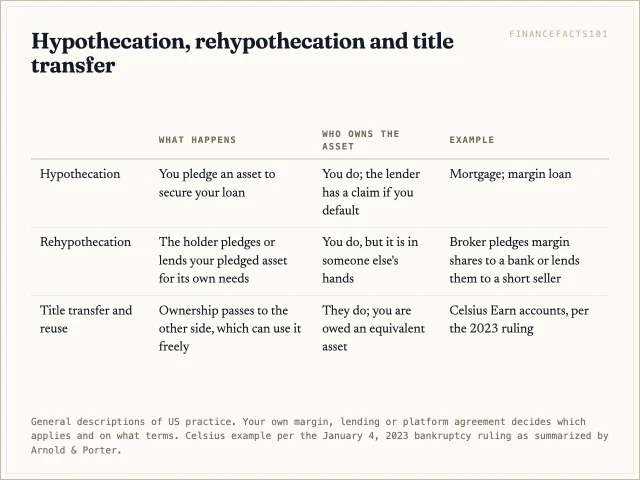
The word is built on hypothecation, which means pledging an asset as security for a loan while you keep ownership. A mortgage is hypothecation: you own the house, and the lender has a claim on it if you stop paying. A margin loan is hypothecation too: you own the shares, and your broker can sell them if you fail a margin call.
Rehypothecation is the next step. The party holding your collateral uses it as collateral for its own borrowing. Your shares, already pledged to your broker, get pledged again by the broker to a bank, or lent to another firm that needs to borrow them. The same securities now support two debts: yours to the broker, and the broker's to someone else.
A related but stronger version is reuse under title transfer. Here you do not just pledge the asset; the agreement transfers ownership to the other side, which can do anything with it and owes you only an equivalent asset back. Many crypto lending platforms worked this way, with results covered below.
How Rehypothecation of Securities Works at a Broker-Dealer
Most people who search for "what is rehypothecation of securities" have a margin account, whether they know it or not. The SEC's investor bulletin on margin accounts warns, in capital letters, that some account applications make margin accounts the default account type. Here is the chain once you have one:
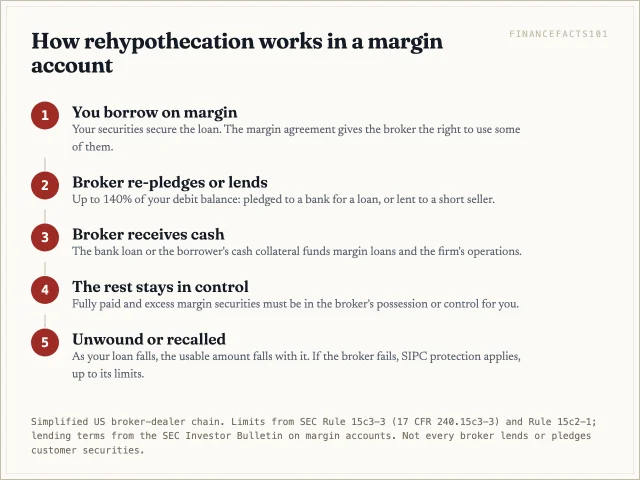
A broker-dealer finances its customers' margin loans partly with its own money and partly by borrowing, often from banks, against customer collateral. Bank loans secured by stock fall under the Federal Reserve's Regulation U. The broker can also lend customer securities to other firms, typically to short sellers who need shares to deliver, and collect cash collateral and a fee in return.
The margin agreement you signed is what permits this. The SEC's bulletin puts it plainly: some margin accounts allow the brokerage firm "to lend out securities in the account to a third-party, at any time without notice or compensation to the account holder, if the investor has any outstanding margin loan in the account." While your shares are out on loan, you may lose the right to vote them. You still receive a payment equal to any dividend, but, as the bulletin notes, it "may be taxed differently."
That tax point is real money for some investors. IRS Publication 550 says payments in lieu of dividends are not to be counted as qualified dividends if you know or have reason to know they are not qualified dividends. They are then taxed at ordinary income rates rather than the lower qualified-dividend rates.
The 140% Rule: How Much of Your Account a Broker Can Use
The cap comes from SEC Rule 15c3-3, the customer protection rule. It sorts your securities into three groups:
- Fully paid securities: everything in a cash account, and securities in a margin account that are paid for in full.
- Margin securities: securities in a margin account bought partly with borrowed money.
- Excess margin securities: margin securities with a market value above 140% of your debit balance, meaning what you owe the broker.
The rule's core requirement, in paragraph (b)(1), is that a broker "shall promptly obtain and shall thereafter maintain the physical possession or control of all fully-paid securities and excess margin securities carried by a broker or dealer for the account of customers." Anything the broker must keep in its control, it cannot pledge or lend. What is left over, margin securities worth up to 140% of your debit balance, is the part it may rehypothecate.
A worked example with round numbers. You buy $100,000 of stock, paying $50,000 yourself and borrowing $50,000 from your broker, the most Regulation T allows on a new purchase (50%):
- 140% of your $50,000 debit balance is $70,000. The broker may use up to $70,000 of your securities.
- The remaining $30,000 are excess margin securities and must stay in the broker's possession or control for you.
- If the stock rises to $150,000 and your loan is unchanged, the usable amount stays $70,000 and the locked-up part grows to $80,000.
- If you pay the loan down to $20,000, the usable amount falls to $28,000 (140% of $20,000), and $72,000 is locked up.
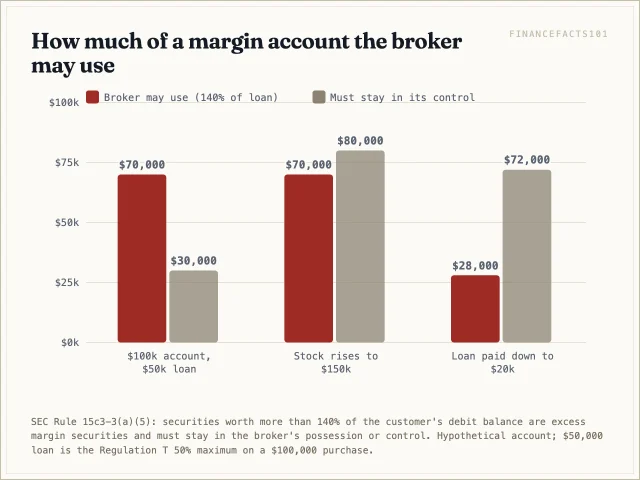
The cap is tied to your loan, not your account size, so the surest way to shrink rehypothecation is to owe less. A cash account with no loan at all leaves nothing the broker may use under this rule without separate permission.
Rules That Protect Client Assets in the US
Several rules work together, and it helps to know which one does what when you search "rehypothecation client assets."
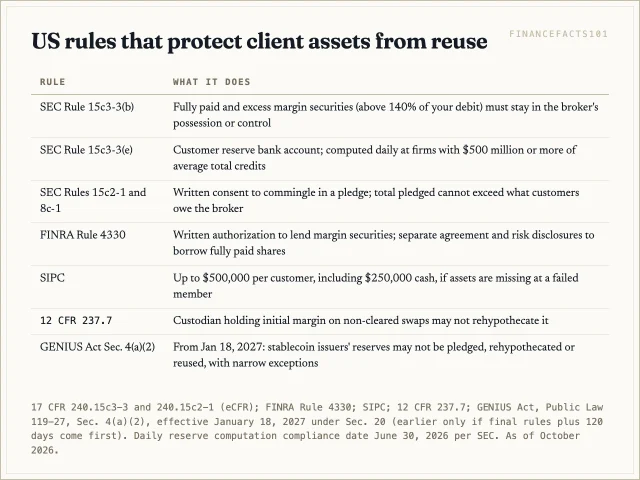
Possession or control (Rule 15c3-3(b)). As above: fully paid and excess margin securities must be held for customers, not used.
The reserve account (Rule 15c3-3(e)). Brokers must keep cash or qualified securities in a "Special Reserve Bank Account for the Exclusive Benefit of Customers," sized by a formula that compares what the firm owes customers with what customers owe it. Historically the computation was weekly. Amendments the SEC adopted on December 20, 2024 require firms with average total credits of $500 million or more to compute it daily; the compliance date was extended to June 30, 2026, and FINRA reminded firms that daily computations start with that day's close of business.
Consent and aggregate limits (Rules 15c2-1 and 8c-1). Under Rule 15c2-1, a broker may not pledge customer securities in a way that commingles one customer's securities with another's without first obtaining each customer's written consent. It may not let them be commingled with securities of anyone who is not a bona fide customer, including the firm's own, under a lien for a loan to the broker. And it may not pledge customer securities for more than the total that all customers owe it.
Borrowing your fully paid shares (FINRA Rule 4330). A broker may borrow fully paid or excess margin securities from you only under a separate written agreement. FINRA Rule 4330 requires the firm to have "reasonable grounds for believing" the loan is appropriate for you and to disclose in writing, among other things, that SIPC protection may not cover the loan, that you lose voting rights, how your compensation is set, and the tax implications, including cash payments in lieu of dividends. The same rule says a firm may not lend your margin securities at all without your written authorization. Rule 15c3-3 adds that the agreement must carry "a prominent notice that the provisions of the SIPA may not protect the lender."
SIPC. If a member broker fails and assets are missing, the Securities Investor Protection Corporation protects up to $500,000 per customer, including a $250,000 limit for cash. It does not protect commodity futures (unless held in a special portfolio margining account), foreign exchange trades, or crypto assets that are not registered securities.
Rehypothecation Risk: What Can Go Wrong
The rules above make rehypothecation at a US broker-dealer fairly contained for ordinary investors. The risks grow as you move to places where the rules are thinner: prime brokerage for hedge funds, derivatives collateral, and crypto platforms.
The holder fails and your claim changes shape. If your collateral has been re-pledged and the firm collapses, getting the specific asset back depends on the firm's records, the insolvency regime, and whether someone further down the chain has a better claim. Where your assets were transferred outright, you may be only an unsecured creditor, standing in line with everyone else the firm owes.
Chains of reuse. The same collateral can back several obligations as it passes from firm to firm. A 2010 IMF working paper by Manmohan Singh and James Aitken, The (Sizable) Role of Rehypothecation in the Shadow Banking System, estimated that at end-2007 collateral was being re-used, or "churned," around four times. When confidence breaks, everyone in the chain demands collateral back at once, and the funding disappears.
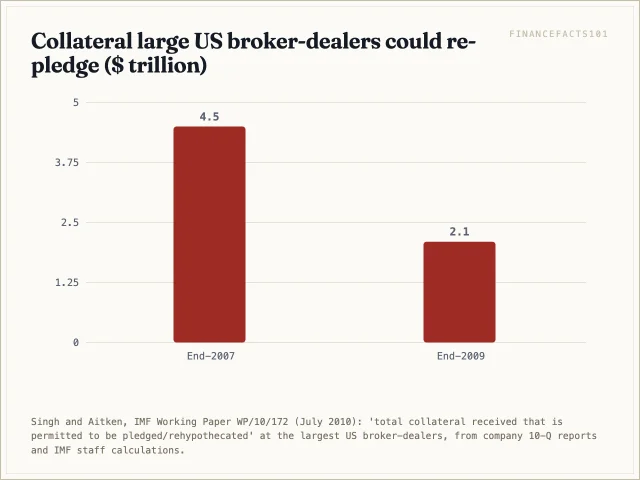
The paper found that collateral the largest US broker-dealers had received and were permitted to re-pledge fell from about $4.5 trillion at end-2007 to $2.1 trillion at end-2009. More than half of it disappeared in two years that included Lehman's failure. That is what "rehypothecation risk" means at the level of the financial system: the leverage it enables unwinds all at once.
Smaller costs to you even when nothing fails. Lost voting rights while shares are on loan, substitute payments that may not qualify for lower dividend tax rates, and little visibility into whether your shares are out at all.
Lehman and MF Global: What the Failures Showed
Lehman Brothers, 2008. The IMF paper, written in 2010, describes UK rules at the time as allowing an unlimited amount of a client's assets to be rehypothecated, with no cap like the US 140% rule. When Lehman's main European arm, Lehman Brothers International (Europe), was placed into administration in September 2008, the paper notes there was little statutory protection for customers who had allowed re-use of their collateral. Afterward, it reports, some investors began holding assets in custody accounts and many large hedge funds used the 140% figure as a benchmark when negotiating new agreements.
UK rules have changed since. From 2011, the client-asset rules of the Financial Services Authority, now the FCA's, require a prime broker to give each client a statement by the close of the next business day showing, among other things, collateral held "including where the firm has exercised a right of use" of the client's assets (CASS 9.2), and every prime brokerage agreement that lets the firm use client assets must carry a disclosure annex summarising those rights and the main risks, including the firm's failure (CASS 9.3). Article 15 of the UK Securities Financing Transactions Regulation allows reuse of collateral only after the client has been "duly informed in writing" of the risks and has given "prior express consent, as evidenced by a signature, in writing or in a legally equivalent manner." And the Investment Bank Special Administration Regulations 2011 created a special insolvency procedure for investment firms, one of whose objectives is returning client assets. There is still no percentage cap like the US 140% rule, so the limit is whatever the agreement says.
MF Global, 2011. MF Global is often cited as a rehypothecation story, and it is worth getting right. According to the CFTC's complaint, the firm had built large positions in European sovereign bonds through "repurchase-to-maturity" transactions arranged by its UK affiliate, and rising margin calls on those trades drained its cash. In the last week of October 2011 it unlawfully used nearly $1 billion of segregated customer funds for its own needs, and the firm failed on October 31, 2011, when its parent filed for bankruptcy. That was misuse of money the law required it to keep separate, not rehypothecation permitted by a margin agreement. The lesson overlaps: when a firm is short of cash, anything of yours it can reach is at risk. Under a court order the CFTC obtained, the trustee began final restitution payments in April 2014 to cover $1.212 billion of customer losses in full, two and a half years after the collapse.
Token Re-hypothecation Risk in Crypto
Crypto collateral can be re-used just like securities, often with fewer protections. Three patterns matter.
Lenders that took title. The clearest case is Celsius Network. Its terms of use, as quoted in an Arnold & Porter analysis of the court's ruling, gave Celsius the right "to pledge, re-pledge, hypothecate, rehypothecate, sell, lend, or otherwise transfer or use any amount of such Digital Assets" without keeping a like amount in reserve. Celsius filed for bankruptcy in July 2022. On January 4, 2023, Judge Martin Glenn ruled that the terms transferred ownership of coins in its Earn accounts to Celsius, so roughly 600,000 Earn account holders became unsecured creditors rather than owners of their coins. The FTC's complaint said Celsius took title to and misappropriated more than $4 billion of deposits and made unsecured loans totaling $1.2 billion as of April 2022.
Exchanges that moved customer assets. In its December 2022 complaint, the SEC alleged that FTX customer funds were diverted to Alameda Research, a trading firm controlled by FTX's founder. That was not disclosed reuse at all, but the effect for customers was similar: assets they thought were held for them were not there.
On-chain reuse. In decentralized finance, you can deposit a token as collateral, receive a receipt token, and post that receipt token as collateral somewhere else, sometimes several times. Each layer adds smart-contract risk and ties your position to the price and liquidity of every token in the chain. A sharp price drop can set off liquidations at several layers at once.
The protections are thin. SIPC does not cover crypto assets that are not registered securities, even at a SIPC-member firm. US law will ban reuse in one corner: the GENIUS Act (Public Law 119-27, signed July 18, 2025) says a permitted payment stablecoin issuer's required reserves "may not be pledged, rehypothecated, or reused" except for narrow purposes, such as margin on certain reserve investments, standard custody arrangements, and Treasury bills in repurchase agreements of 93 days or less. The ban is enacted but not yet in force. Under Section 20, the Act takes effect on January 18, 2027, 18 months after enactment, or 120 days after regulators issue final implementing rules if that comes first; only proposed rules had been published as of September 2026. It covers the issuer's reserves, not a platform that holds your tokens, so read the platform's own terms for the words "rehypothecate," "lend" or "title."
Why Firms Rehypothecate: The Advantages
Rehypothecation persists because it does useful work, and the benefits are not only the firm's.
- Cheaper margin loans. Borrowing against customer collateral lets a broker fund margin loans without using only its own capital.
- Securities lending. Short sellers must borrow shares to sell them, and margin accounts are one source of supply.
- Liquidity. Collateral that circulates supports more lending and trading, the flip side of the chain risk above.
- Income for lenders who opt in. In fully paid lending programs under FINRA Rule 4330, the investor is paid for the loan, and the firm must disclose how that payment is set and whether it can change.
For the firm, those benefits come with capital and liquidity requirements; the entry on risk-based capital requirements explains that side.
How to Limit Rehypothecation of Your Assets
For individual investors, most of the control sits in a few choices:
- Use a cash account unless you need margin. If you never borrow, there is no debit balance for the 140% rule to apply to.
- Keep margin balances small. The usable amount is 140% of what you owe, so paying the loan down shrinks it directly.
- Read before opting into securities lending. A fully paid lending program is a separate agreement; the FINRA 4330 disclosures tell you what you give up.
- Ask your broker. The SEC's bulletin suggests asking whether your margin account permits securities lending and how it works.
Institutions have more levers. Hedge funds negotiate caps on reuse in prime brokerage agreements, split assets across several prime brokers, or hold them in custody accounts. For collateral on derivatives traded over the counter, US bank regulators already require segregation: initial margin that a bank-regulated swap dealer collects on non-cleared swaps must sit with an independent custodian whose agreement prohibits it from "rehypothecating, repledging, reusing, or otherwise transferring" the collateral, with a narrow exception for cash awaiting reinvestment in eligible collateral.
For crypto, the safest arrangements keep assets in your name at a custodian that is barred from using them, or in self-custody, which trades counterparty risk for the risk of losing your own keys.
FAQ
What is rehypothecation in simple terms?
It is when someone holding your collateral uses it as collateral for their own borrowing or lends it out. In a margin account, your broker can pledge or lend some of your securities, up to 140% of your margin loan under SEC Rule 15c3-3.
Is rehypothecation legal?
Yes, within limits. US broker-dealers need your written consent in a margin agreement, cannot use more than 140% of your debit balance, and must keep fully paid and excess margin securities in their control. Lending your fully paid shares requires a separate agreement with disclosures under FINRA Rule 4330.
Can a broker rehypothecate securities in a cash account?
Not under the customer protection rule. Securities in a cash account are fully paid, so the broker must keep them in its possession or control. The only way they can be lent is if you sign a separate securities lending agreement.
Does SIPC protect rehypothecated securities?
SIPC protects up to $500,000 per customer, including $250,000 in cash, when assets are missing at a failed member broker. Securities you lend under a fully paid lending agreement may not be covered, which is why FINRA requires that warning, and crypto assets that are not registered securities are not covered.
What is token re-hypothecation risk?
The risk that a crypto platform, lender or protocol re-uses the tokens you deposited, so that if it fails or a price falls sharply, your tokens are not there or are liquidated. In the Celsius bankruptcy, Earn account holders became unsecured creditors.
Sources
- U.S. SEC / Investor.gov, Investor Bulletin: Understanding Margin Accounts — securities lending in margin accounts, voting rights, substitute payments, margin as default account type, Regulation T 50% initial margin
- eCFR, 17 CFR 240.15c3-3, Customer protection: reserves and custody of securities — definitions of fully paid, margin and excess margin securities (140%), possession or control, reserve bank account, $500 million daily-computation threshold, SIPA notice on securities loans
- U.S. SEC, Daily Computation of Customer and Broker-Dealer Reserve Requirements — adopted December 20, 2024; compliance date extended to June 30, 2026
- FINRA, Information Notice, June 29, 2026 — daily customer and PAB reserve computations beginning with the June 30, 2026 close of business
- eCFR, 17 CFR 240.15c2-1, Hypothecation of customers' securities — written consent, commingling, aggregate indebtedness limit
- FINRA, Rule 4330, Customer Protection: Permissible Use of Customers' Securities
- SIPC, What SIPC Protects — $500,000 limit including $250,000 cash; exclusions for futures and unregistered digital assets (futures covered only in a special portfolio margining account)
- IRS, Publication 550, Investment Income and Expenses — payments in lieu of dividends and qualified dividends
- Manmohan Singh and James Aitken, IMF Working Paper WP/10/172, The (Sizable) Role of Rehypothecation in the Shadow Banking System (July 2010) — US vs UK rules as of 2010, $4.5 trillion to $2.1 trillion, churning factor of about 4
- CFTC, Charges against MF Global Inc., MF Global Holdings, Jon S. Corzine and Edith O'Brien (June 27, 2013) and complaint — repurchase-to-maturity trades, nearly $1 billion of customer funds, October 31, 2011 bankruptcy
- CFTC, MF Global customers to begin receiving final restitution payments — full restitution of $1.212 billion
- Arnold & Porter, Judge Glenn Rules That Earn Account Crypto Assets are Property of Celsius' Bankruptcy Estates (January 2023) — Terms of Use text, January 4, 2023 ruling, about 600,000 Earn account holders
- FTC, FTC Reaches Settlement with Crypto Platform Celsius Network (July 13, 2023)
- U.S. SEC, SEC Charges Samuel Bankman-Fried with Defrauding Investors in Crypto Asset Trading Platform FTX (December 13, 2022)
- GovInfo, Public Law 119-27, the GENIUS Act — Section 4(a)(2) prohibition on rehypothecation of reserves; Section 20 effective date (January 18, 2027, or 120 days after final rules if earlier)
- Financial Conduct Authority Handbook, CASS 9.2 Prime brokerage agreements and reporting and CASS 9.3 Prime brokerage agreement disclosure annex
- legislation.gov.uk, Regulation (EU) 2015/2365 (UK SFTR), Article 15, Reuse of financial instruments received under a collateral arrangement
- legislation.gov.uk, The Investment Bank Special Administration Regulations 2011 (SI 2011/245)
- Lehman Brothers Holdings Inc., Form 8-K, September 2008 — UK affiliates including Lehman Brothers International (Europe) placed into administration
- eCFR, 12 CFR 237.7, Segregation of collateral — custodians barred from rehypothecating initial margin on non-cleared swaps
 Next entry · No. 4,357Real Estate Investment Groups (REIGs): A Comprehensive Guide to Real Estate Pooled Capital for Institutional and Professional Investors
See also
-
 No. 5,755
05 Oct 2025
20 min
Understanding Wire Transfers: A Comprehensive Guide for Institutional Investors
Business Finance
No. 5,755
05 Oct 2025
20 min
Understanding Wire Transfers: A Comprehensive Guide for Institutional Investors
Business Finance -
 No. 5,344
01 Sep 2025
22 min
Understanding Upstream Guarantees: A Key Financing Strategy in Corporate Finance and Investment
Business Finance
No. 5,344
01 Sep 2025
22 min
Understanding Upstream Guarantees: A Key Financing Strategy in Corporate Finance and Investment
Business Finance -
 No. 5,170
17 Aug 2025
20 min
Understanding Uncovered Interest Arbitrage: Seizing Opportunities Amid Currency Fluctuations and Interest Rate Differentials
Business Finance
No. 5,170
17 Aug 2025
20 min
Understanding Uncovered Interest Arbitrage: Seizing Opportunities Amid Currency Fluctuations and Interest Rate Differentials
Business Finance -
 No. 4,142
25 May 2025
20 min
Understanding Contract Provisions: From Sunset to Call and Beyond
Business Finance
No. 4,142
25 May 2025
20 min
Understanding Contract Provisions: From Sunset to Call and Beyond
Business Finance -
 No. 3,767
25 Apr 2025
19 min
Understanding the Role and Impact of the Options Industry Council (OIC) in Finance and Investment
Business Finance
No. 3,767
25 Apr 2025
19 min
Understanding the Role and Impact of the Options Industry Council (OIC) in Finance and Investment
Business Finance -
 No. 4,353
11 Jun 2025
18 min
Understanding Regulation U: Key Requirements for Securities Loans and Margin Trading
Finance Policy
No. 4,353
11 Jun 2025
18 min
Understanding Regulation U: Key Requirements for Securities Loans and Margin Trading
Finance Policy