Shareholders: Rights, Responsibilities and Their Role in Corporate Governance
A shareholder owns part of a corporation: a vote, a share of declared dividends and a last-in-line claim on assets. 56% of US families held stock in 2025.
A shareholder, also called a stockholder, is a person or organization that owns at least one share of a corporation. Owning shares makes you a part-owner: you usually get a vote on who sits on the board and on major deals, a proportional share of any dividends the board declares, some rights to information and to sue, and a claim on whatever is left if the company is wound up, after everyone else is paid.
What shareholders mostly do not have is responsibility for the company's debts or its day-to-day running. Your loss is normally capped at what you paid for the shares; the board of directors, not the owners, manages the business. The main exceptions apply to large and controlling holders, who pick up disclosure duties and, in some cases, fiduciary duties to the other owners.
This page explains who counts as a shareholder, the types, the rights and responsibilities that come with the shares, and how shareholders influence a company through corporate governance. US corporate rights come mostly from state law, so the examples below use Delaware, where many large US companies are incorporated; your company's state and its charter can differ. Rules are as of September 2026.
What Is a Shareholder?
Investor.gov, the SEC's investor site, describes a share of stock as "an instrument that signifies an ownership position (called equity) in a corporation, and a claim on its proportional share in the corporation's assets and profits. Most stocks also provide voting rights, which give shareholders a proportional vote in certain corporate decisions, such as the election of corporate directors."
Shareholders can be individuals, other companies, pension funds, mutual funds, governments or trusts. How you hold the shares affects how you exercise your rights:
- A registered owner or record holder "holds shares directly with the company," per Investor.gov.
- A beneficial owner "holds shares indirectly, through a bank or broker-dealer," which is called holding in "street name." Investor.gov notes that "the majority of U.S investors own their securities this way." Your broker passes along proxy materials and votes as you instruct.
- If you own a mutual fund or ETF, the fund is the shareholder of the underlying companies. You are a shareholder of the fund, and the fund generally votes the portfolio shares.
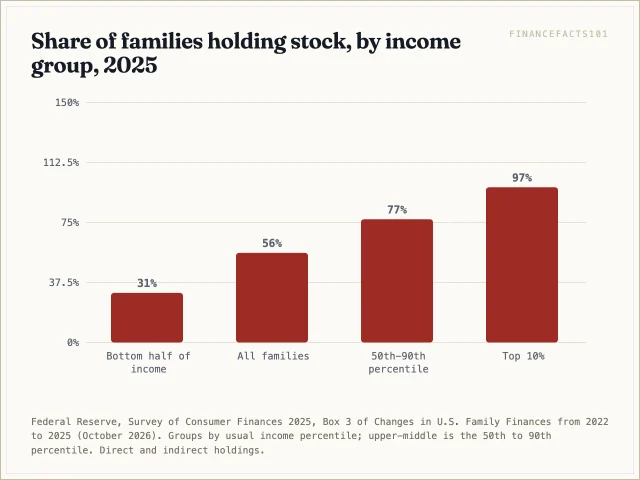
Share ownership is widespread. In the Federal Reserve's 2025 Survey of Consumer Finances, published October 9, 2026 and the latest available, 19% of families owned stock directly, down from 21% in 2022. Counting indirect holdings such as retirement accounts and funds, the survey "showed a slight decline in stock ownership to 56 percent from 58 percent in 2022, though still larger than the 53 percent in 2019."

Ownership rises steeply with income. In the same survey, 31% of families in the bottom half of the income distribution held stock, against 77% in the upper-middle group and 97% of the top tenth.
Types of Shareholders: Common, Preferred, Majority and Minority
Shareholders are usually sorted two ways: by the class of stock they hold and by how much of it.
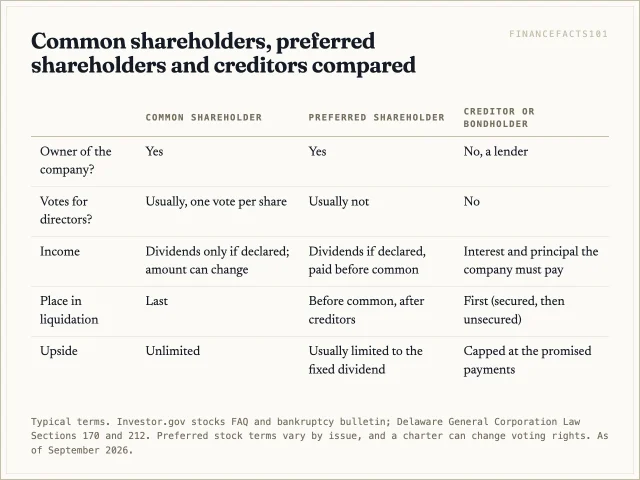
Common shareholders hold the standard ownership stake. Investor.gov's stocks FAQ says common stock "entitles owners to vote at shareholder meetings and receive dividends."
Preferred shareholders trade the vote for priority. The same page explains that preferred stockholders "usually don't have voting rights but they receive dividend payments before common stockholders do, and have priority over common stockholders if the company goes bankrupt and its assets are liquidated." Preferred terms are set in each issue's documents, so voting, dividend rate and conversion features vary.
Majority and minority shareholders. A holder with more than half the voting power can normally elect the whole board, unless the charter gives minority holders a route to seats such as cumulative voting (Delaware Section 214), which is why a majority stake is called control. Everyone else is a minority holder. In practice a holder with far less than 50% can steer a company whose other shares are widely scattered; the site's entry on working control covers how.
Many companies also issue more than one class of common stock with different voting power. Delaware's default is "1 vote for each share," but the charter can provide "for more or less than 1 vote for any share," per Section 212 of the Delaware General Corporation Law. Before buying, check which class you are getting.
Shareholder Rights
The rights below are the usual core set. They come from state corporate law, the company's certificate of incorporation (charter) and bylaws, and federal securities rules.
1. The right to vote. Shareholders elect the board of directors and vote on fundamental changes: mergers, amendments to the charter, and the sale of all or substantially all of the company's assets. In Delaware, an asset sale of that size needs approval by "the holders of a majority of the outstanding stock of the corporation entitled to vote thereon" (Section 271). An annual meeting to elect directors is the default, and if none is held within 30 days of the designated date, the Court of Chancery "may summarily order a meeting to be held upon the application of any stockholder or director" (Section 211).
2. The right to dividends, once declared. You have no right to a dividend until the board declares one. Delaware law gives that power to "the directors of every corporation" (Section 170). Once declared, every share of the same class is paid the same amount, and preferred dividends come first.
3. The right to inspect books and records. A Delaware stockholder can make a written demand under oath to inspect "for any proper purpose" the stock ledger, the list of stockholders and certain books and records, under Section 220. A proper purpose is "a purpose reasonably related to a stockholder's interest as a stockholder." Amendments signed on March 25, 2025 limited the records covered to listed categories, such as the charter and bylaws, board minutes and three years of annual financial statements, as Alston & Bird's summary of the law explains.
4. The right to sue. If directors harm the company, a shareholder can bring a derivative suit on the company's behalf. Delaware's Section 327 requires that the plaintiff "was a stockholder of the corporation at the time of the transaction" complained of. Shareholders can also sue directly for harm to themselves, including under federal securities laws for misleading disclosures.
5. Appraisal rights. If you do not vote for certain mergers, you may be able to have a court set the fair value of your shares instead of taking the deal price (Section 262). The site's entry on dissenters' rights covers how that works.
6. The right to sell. Public company shares can usually be sold at any time on an exchange. Shares in private companies often carry transfer limits in a shareholders' agreement.
7. Preemptive rights, only if granted. A right to buy new shares before outsiders, to avoid dilution, exists in Delaware only if the charter expressly grants it: "No stockholder shall have any preemptive right ... unless ... such right is expressly granted" (Section 102). Companies sometimes offer existing holders first refusal anyway through a rights issue.
8. A residual claim. Shareholders get what is left after every creditor is paid, which is covered in the liquidation section below.
The Role of Shareholders in Corporate Governance
Corporate governance is the system of who decides what inside a company. Shareholders sit at the top of it but do not run the business. Delaware's Section 141(a) says "the business and affairs of every corporation ... shall be managed by or under the direction of a board of directors." The board hires the CEO, sets strategy and declares dividends. The shareholders' job is to choose the board and approve the biggest decisions.
So how do shareholders influence a company? Five main ways:
- Voting. Most votes are cast by proxy rather than in person. Investor.gov explains that when you vote by proxy "you are authorizing someone (often members of the company's management) to vote according to your wishes as reflected on the proxy card at the meeting." If you hold in street name and do not instruct your broker, the broker may vote on certain routine matters at its discretion, a broker vote; stock exchange rules decide which matters count as routine.
- Say on pay. Under SEC rules adopted in January 2011, public companies must hold a non-binding advisory vote on executive pay "at least once every three years," and a vote on how often to hold it "at least once every six years."
- Shareholder proposals. Under SEC Rule 14a-8, a holder who has "continuously held at least $2,000, $15,000, or $25,000 in market value of the company's securities ... for at least three years, two years, or one year, respectively" can ask to have one proposal of up to 500 words included in the company's proxy statement (17 CFR 240.14a-8). This may change: on September 16, 2026 the SEC proposed rescinding Rule 14a-8, which "would leave determinations about the role of shareholder proposals to state law and company governing documents." Comments are due November 20, 2026, and the rule remains in force until the SEC acts.
- Engagement and activism. Large holders meet with management and directors, and activist investors can run their own candidates in a proxy contest. The site's entry on shareholder activism covers the methods.
- Selling. When enough holders sell, the share price falls, raising the company's cost of capital and making it a takeover target. It is the bluntest form of influence, but it is always available.
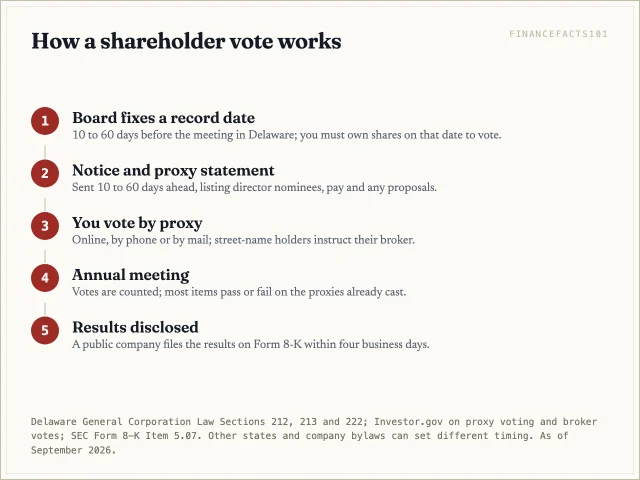
Delaware sets the timing: the record date that fixes who may vote "shall not be more than 60 nor less than 10 days before the date of such meeting" (Section 213), and notice goes out 10 to 60 days before the meeting (Section 222). After the vote, the company reports the results on SEC Form 8-K within four business days of the meeting under Item 5.07.
Shareholder Responsibilities
Search for "shareholder responsibilities" and you may expect a long list. For an ordinary investor it is short, and most of it is optional.
You are not liable for the company's debts. This is the defining feature of a corporation. Delaware's Section 102(b)(6) provides that "the stockholders of a corporation shall not be personally liable for the payment of the corporation's debts except as they may be liable by reason of their own conduct or acts," unless the charter says otherwise. Compare a sole proprietor, who, per the SBA, "can be held personally liable for the debts and obligations of the business," or a general partner with unlimited liability. Courts can occasionally disregard the corporate form, usually in closely held companies that ignore it, but that is the exception.
Voting is a right, not a duty. No law requires an individual to vote their shares. Voting is still the main way to protect your interests, and it costs a few minutes.
Large holders must disclose. Anyone who acquires "beneficial ownership of more than five percent of a voting class" of a registered company's equity must file a Schedule 13D with the SEC, or in some cases the shorter 13G, per Investor.gov. Since 2024, an initial 13D is due within five business days, down from 10 days.
Controlling holders owe loyalty. A controlling stockholder is not a passive investor. Delaware's rewritten Section 144 defines one as a person holding a majority of the voting power, the right to elect a board majority, or at least one-third of the voting power plus managerial authority, and it keeps such a holder liable for "a breach of the duty of loyalty to the corporation or the other stockholders." Section 144 also sets out approval procedures, such as independent committees and votes of disinterested holders, that shield qualifying deals with a controller.
Pay tax on what you receive. Dividends and gains on sale are taxable (more below).
Majority Shareholders vs Minority Shareholders
A majority holder can elect the board, approve most charter changes and asset sales that need a majority of outstanding stock, and in practice choose management. That power is why minority protections exist: appraisal rights, fiduciary duties owed by controllers, and deal protections such as tag-along and drag-along rights in shareholders' agreements.
Majority holders are still shareholders, so they keep limited liability. What changes is scrutiny. A deal between a company and its controller, such as a buyout of the minority, is where most disputes arise, and Section 144's safe-harbor steps exist for exactly those deals.
Shareholders vs Creditors: Who Gets Paid First
Shareholders stand at the back of the line. Investor.gov's bankruptcy bulletin is blunt: "any common stock in a bankrupt company is likely to be worthless. That is because the common stock (that is, "equity") is the last in line to receive what's available to be distributed in a bankruptcy proceeding. Creditors, including bondholders, suppliers and employees, all come before holders of the company's common stock."
The usual order is secured creditors, then unsecured creditors including bondholders, then preferred shareholders, then common shareholders. The stocks FAQ puts the end of the line plainly: "If you are a common stockholder, you get whatever is left, which may be nothing."
In return for that risk, shareholders get the upside. A bondholder's return is capped at the interest and principal promised; a shareholder's is not.
Tax Implications for Shareholders
Shareholders in a regular C corporation face two layers of tax. The SBA notes that corporate profits can be "taxed twice — first, when the company makes a profit, and again when dividends are paid to shareholders on their personal tax returns."
For you, that second layer works like this, per IRS Topic 404:
- You should receive a Form 1099-DIV from each payer "for distributions of at least $10."
- Ordinary dividends are taxed as ordinary income. Qualified dividends are taxed at the lower long-term capital gains rates of 0%, 15% or 20%, depending on your taxable income (IRS Topic 409).
- A return of capital is not a dividend. It reduces your cost basis instead.
When you sell shares, the gain or loss is a capital gain or loss, long-term if you held the shares for more than a year. The site's guide to capital gains tax on stocks works through the rates and brackets. Shares held in an IRA or 401(k) follow that account's rules instead.
FAQ
What rights do shareholders have?
Common shareholders usually have the right to vote for directors and on major changes, to receive dividends the board declares, to inspect certain books and records for a proper purpose, to sue on the company's behalf when directors harm it, to sell their shares, and to a share of whatever is left after creditors in a liquidation. Preferred shareholders usually give up most voting rights in exchange for dividend and liquidation priority.
What are the responsibilities of a shareholder?
For an ordinary investor they are light: you are not liable for the company's debts, and voting is optional. Responsibilities grow with size. Owners of more than 5% of a public company must file a Schedule 13D or 13G, and a controlling stockholder owes a duty of loyalty to the company and the other stockholders.
Do shareholders run the company?
No. The board of directors manages the business or directs its management, and the board appoints the executives. Shareholders elect the board, vote on major changes such as mergers, and can press for change through proposals, engagement or selling their shares.
What is the difference between a shareholder and a stakeholder?
A shareholder owns shares. A stakeholder is anyone affected by the company, including employees, customers, suppliers, lenders and the local community. Every shareholder is a stakeholder, but most stakeholders own no shares and have no vote.
Sources
- Investor.gov (SEC), Stock — definition and voting rights
- Investor.gov (SEC), Stocks FAQs — common vs preferred stock; liquidation order
- Investor.gov (SEC), What is a registered owner? What is a beneficial owner? — street name
- Investor.gov (SEC), How do I vote at a corporate election? and Broker vote
- Investor.gov (SEC), Schedules 13D and 13G — more-than-5% beneficial ownership
- Investor.gov (SEC), Investor Bulletin: Bankruptcy for a Public Company
- SEC, Press release 2023-219 — Schedule 13D deadline shortened to five business days
- SEC, Press release 2011-25 — say-on-pay and frequency votes
- SEC, Press release 2026-89, September 16, 2026 and rulemaking page S7-2026-32 — proposal to rescind Rule 14a-8; comments due November 20, 2026
- SEC, Form 8-K — Item 5.07 voting results within four business days
- Cornell LII, 17 CFR 240.14a-8 — ownership thresholds, one proposal, 500 words
- Federal Reserve, Changes in U.S. Family Finances from 2022 to 2025 (October 2026), Box 3 and the assets section — direct and indirect stock ownership, by income group
- Delaware Code, Title 8: subchapter I (Section 102), IV (Sections 141, 144), V (Section 170), VII (Sections 211-222), IX (Section 262), X (Section 271), XIII (Section 327)
- Alston & Bird, Delaware Legislators Swiftly Enact Proposed Changes to Corporate Code (April 2025) — SB 21 signed March 25, 2025
- SBA, Choose a business structure — sole proprietor liability; double taxation of corporations
- IRS, Topic 404, Dividends and Topic 409, Capital gains and losses
 Next entry · No. 4,633Understanding Shareholder Activism: The Role, Methods, and Impact on Corporations
See also
-
No. 4,633
04 Jul 2025
19 min
Understanding Shareholder Activism: The Role, Methods, and Impact on Corporations
Business Strategy
-
 No. 4,144
25 May 2025
17 min
Understanding Proxy Statements and How They Impact Shareholder Decision Making
Business Finance
No. 4,144
25 May 2025
17 min
Understanding Proxy Statements and How They Impact Shareholder Decision Making
Business Finance -
 No. 4,094
21 May 2025
20 min
Pro Rata: Understanding Proportional Allocation and Its Use Cases
Business Finance
No. 4,094
21 May 2025
20 min
Pro Rata: Understanding Proportional Allocation and Its Use Cases
Business Finance -
 No. 3,480
01 Apr 2025
19 min
Understanding Non-Objecting Beneficial Owners (NOBOs) in Securities: Definition, Importance, and Arguments
Business Finance
No. 3,480
01 Apr 2025
19 min
Understanding Non-Objecting Beneficial Owners (NOBOs) in Securities: Definition, Importance, and Arguments
Business Finance -
 No. 2,915
14 Feb 2025
18 min
Understanding Company Liquidation: Definition, Process, and Prioritization of Claimants
Business Finance
No. 2,915
14 Feb 2025
18 min
Understanding Company Liquidation: Definition, Process, and Prioritization of Claimants
Business Finance -
 No. 1,335
01 Sep 2024
22 min
Understanding Employee Stock Options (ESOs): A Comprehensive Guide for Institutional Investors
Business Finance
No. 1,335
01 Sep 2024
22 min
Understanding Employee Stock Options (ESOs): A Comprehensive Guide for Institutional Investors
Business Finance