Socially Responsible Investing (SRI): Meaning, Strategies and Rules

SRI picks investments on values as well as returns. US SIF counts $6.6 trillion of US assets marketed as sustainable. The strategies, rules and trade-offs.
Socially responsible investing (SRI) means choosing investments on your values as well as on expected risk and return. In practice, that means leaving out businesses you object to, favoring companies you think are better run, or putting money into projects built to do some social good. In finance, SRI stands for socially responsible investing. You will also see "sustainable and responsible investing" or simply ESG investing, and the terms overlap heavily.
It is a large market. US SIF, the US industry association for sustainable investing, counts $6.6 trillion of US assets identified or marketed as sustainable or ESG, about 11% of the $61.7 trillion it measures under professional management. That figure comes from its US Sustainable Investing Trends 2025/2026 report, released December 9, 2025. This page explains what SRI means, the main strategies, how bank-based SRI works through community banks and credit unions, the US rules that apply, and what the evidence says about returns. It is general information as of September 2026, not advice about any particular fund.
What SRI Means in Finance
No federal law defines socially responsible investing. The SEC's investor education office says ESG investing "may be referred to in many different ways, such as sustainable investing, socially responsible investing, and impact investing," and warns that some of these factors "are not defined in federal securities laws, may be subjective, and may be defined in different ways by different funds or sponsors" (SEC Investor Bulletin on ESG funds).
In everyday use, the three labels differ mainly in emphasis:
- SRI is the oldest label. It starts from values and often excludes whole industries such as weapons, tobacco or gambling.
- ESG investing starts from risk. Environmental, social and governance factors are treated as information that may affect a company's value, such as climate exposure, labor practices or board quality.
- Impact investing aims for a specific, measurable social or environmental result alongside a financial return, such as affordable housing units financed or small-business loans made.
One investor can use all three, and many funds do. The label on a fund tells you little on its own, which is why the SEC's bulletin points investors to a fund's disclosure documents, starting with the prospectus. The site's entry on ESG investing covers the E, S and G factors in more depth.
Socially Responsible Investing Strategies
If you are asking which strategy an SRI investor uses, the answer is usually several at once. US SIF's December 2024 Trends report found that more than 65% of respondents use three or more strategies. The main ones:

Negative (exclusionary) screening is the classic SRI tool: leave out companies whose products or conduct you object to. It remains one of the two most common strategies. In the 2024 report, 75% of respondents used it, and partial or full fossil-fuel exclusion (68%) had overtaken tobacco exclusion (66%) as the most common screen.
Positive and best-in-class screening picks the companies that score best on chosen criteria, often within every industry. That is why an ESG fund can still own an oil company. The SEC bulletin notes that some ESG funds invest in "best in class" companies within commonly excluded industries.
ESG integration adds ESG data to ordinary financial analysis without necessarily excluding anything. US SIF's 2025/2026 report calls it "the mainstream default," used by 77% of respondents.
Shareholder engagement means owning a company and pushing it to change through proxy votes, shareholder proposals and direct talks with management. US SIF reports that 69% of US market assets, $42.7 trillion, were covered by an active stewardship policy. The site's entry on corporate governance explains the board and voting mechanics that engagement works through.
Impact and community investing puts capital where it is scarce: loans to small businesses, affordable housing and underserved neighborhoods, often through the institutions described in the next section.
Bank-Based SRI: Community Investing Through Banks and Credit Unions
Bank-based SRI is the simplest form of socially responsible investing, and the one most people overlook. Instead of buying a fund, you keep deposits at a bank or credit union whose lending serves communities that mainstream lenders underserve. Your money funds that lending, and at an insured institution it keeps the same federal deposit insurance as any other account.
Two federal designations identify these institutions:
- Community Development Financial Institutions (CDFIs) are certified by the Treasury's CDFI Fund. The Fund describes certification as a designation for "specialized organizations that provide financial services in low-income communities and to people who lack access to financing" (CDFI Fund).
- Minority Depository Institutions (MDIs) are banks at least 51% owned by minority individuals, or with a mostly minority board that serve a predominantly minority community (FDIC definition). The FDIC counted 157 FDIC-insured MDIs as of June 30, 2026 (FDIC MDI list). An institution can be both a CDFI and an MDI.
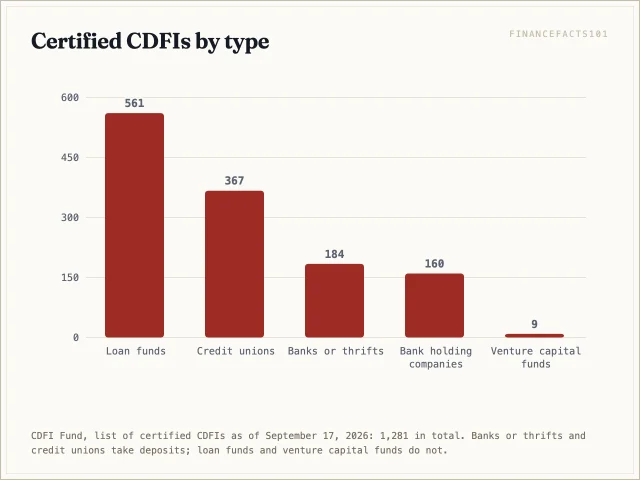
The CDFI Fund's list counted 1,281 certified CDFIs as of September 17, 2026. The largest group is loan funds (561), which do not take deposits; you would reach them through notes or other investments that carry more risk. The bank-based part of the sector is 184 banks or thrifts and 367 credit unions, plus 160 bank holding companies.
For a deposit at one of these institutions, the protection is the same as at any bank. The FDIC states that "your deposits are automatically insured to at least $250,000 at each FDIC-insured bank" (FDIC). At a federally insured credit union, the NCUA's Share Insurance Fund covers individual accounts "up to $250,000" (NCUA). Check the insurance before you deposit, and keep each institution's total under the limit for each ownership category.
Here is how that works in practice. Say you hold a $30,000 emergency fund and a $20,000 CD. You can move the savings to a CDFI bank or credit union now, and the CD when it matures (to avoid an early-withdrawal penalty), without adding investment risk, provided each account is insured and the combined $50,000 stays well under the limit. What you give up, if anything, is yield. Each community lender sets its own deposit rates, like any bank, so compare the APY against the best rate you could get elsewhere. The site's guide to high-yield savings vs CDs shows how to compare. If the rate is close, bank-based SRI costs you almost nothing.
Other bank-based options carry more risk and deserve more scrutiny. Examples include the ESG funds and managed accounts that banks' wealth divisions sell, and community-investment notes issued by loan funds. None of those is a deposit, and none is FDIC- or NCUA-insured.
How Big Is Socially Responsible Investing?
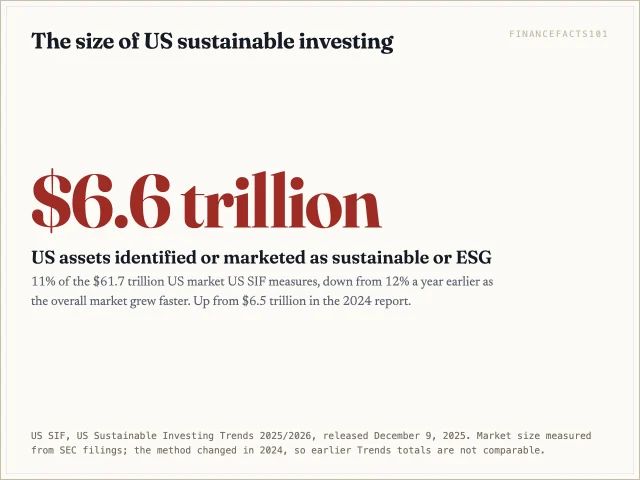
US SIF's 2025/2026 report puts US assets identified or marketed as sustainable or ESG at $6.6 trillion, up from $6.5 trillion a year earlier. Their share of the whole market slipped to 11% from 12%, which US SIF attributes to the overall market growing faster. Its December 2024 report called that $6.5 trillion figure "a new baseline," because it switched to measuring from SEC filings. Older and much larger totals from earlier Trends reports are not comparable.
The political mood has shifted too. In the same report, 46% of respondents said political pushback had not changed how their organization approached sustainability. Another 29% said they now focus explicitly on demonstrable financial materiality, and one in four had stopped using the ESG acronym. For individual investors, the practical point is that fund names and marketing may change even where the strategy does not.
Benefits of Socially Responsible Investing, and the Trade-Offs
People choose SRI for three kinds of reasons.
- Values alignment. You do not want your savings financing businesses you object to. This is the original reason, and it needs no performance argument.
- Risk management. ESG data can flag problems that financial statements miss, such as pending environmental liabilities or weak governance. This is the argument used by pension funds and other institutions.
- Influence. Shareholders can vote and engage, and community deposits fund lending that would not otherwise happen.
The cost side is real but often smaller than people expect. Returns can differ from the market because the portfolio differs. The SEC bulletin says an ESG fund's performance "may differ (either higher or lower) from the overall market." One long-running example is the MSCI KLD 400 Social Index. It is the successor to the Domini 400 Social Index, which was launched in May 1990 as one of the first SRI indexes. It holds about 400 US stocks against 2,159 in its parent index:
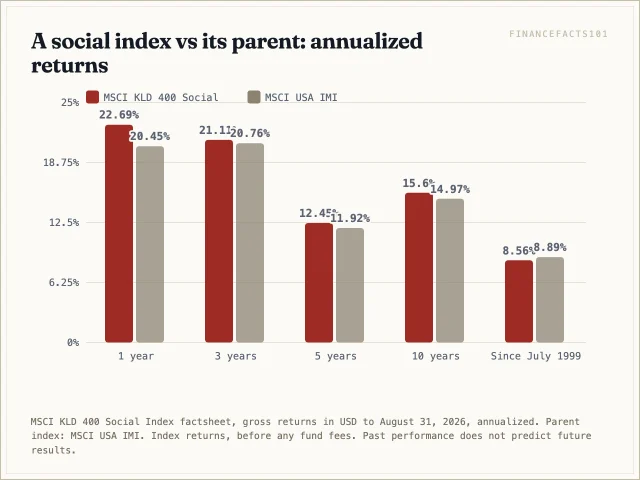
To August 31, 2026, the social index was ahead over 1, 3, 5 and 10 years and slightly behind since mid-1999: 8.56% a year against 8.89%, per MSCI's factsheet. Those are gross index returns, before any fund's fees, and past results do not predict future ones. Individual years swing more. In 2022 the social index lost 21.48% against 19.22% for the parent.
Fund-level data tell a similar story of swings rather than a steady penalty or bonus. The Morgan Stanley Institute for Sustainable Investing, using Morningstar data, found a global median return of 12.5% for sustainable funds against 9.2% for traditional funds in the first half of 2025. It attributed much of that gap to sustainable funds' greater exposure to European and global markets. In the second half, sustainable funds returned 5.3% against 5.5%.
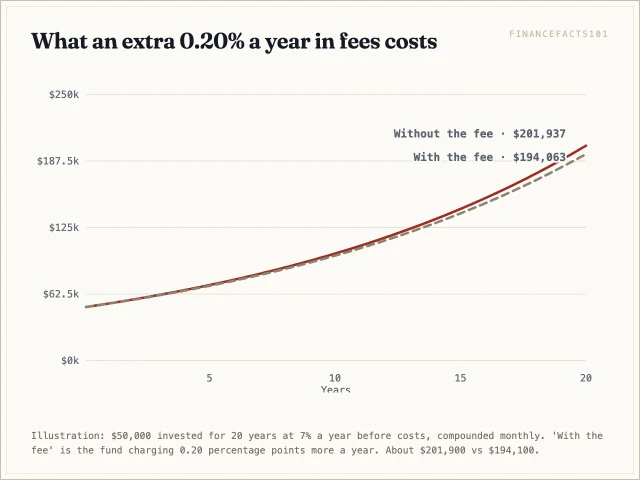
The trade-off you can control is cost. The SEC notes that some ESG funds "may have different expense ratios" and that "paying more in expenses will reduce the value of your investment over time." Take two funds that earn the same 7% a year before costs, where one charges 0.20 percentage points more. On $50,000 over 20 years, the cheaper fund grows to about $201,900 and the dearer one to about $194,100, a gap of roughly $7,900:
So if you choose an SRI fund, compare its expense ratio with a plain index fund covering the same market. The site's comparison of index funds vs ETFs covers the cost differences between fund types.
Socially Responsible Investing Guidelines: The US Rules
No single rulebook governs SRI, but four sets of rules matter.
Fund names. Under the SEC's Names Rule, amended in 2023, a fund whose name suggests a focus must adopt a policy to invest at least 80% of its assets accordingly. The SEC's 2023 announcement says the amendments extend that requirement to names with "certain terms that reference a thematic investment focus, such as the incorporation of one or more Environmental, Social, or Governance factors." The SEC later extended the compliance dates to June 11, 2026 for larger fund groups and December 11, 2026 for smaller ones. So by the time you read this, many "ESG" or "sustainable" fund names carry an 80% commitment. The name still does not tell you which criteria the fund uses.
Marketing claims. Misleading ESG claims are securities violations. In May 2022 the SEC charged BNY Mellon Investment Adviser with representing or implying that all investments in certain funds had undergone an ESG quality review when numerous holdings had not; the firm paid a $1.5 million penalty. In September 2023, Deutsche Bank's asset manager DWS agreed to pay $19 million over misstatements about its ESG integration, part of a $25 million settlement that also covered anti-money-laundering violations.
Retirement plans (ERISA). Fiduciaries of employer plans such as 401(k)s must put participants' financial interests first. The Labor Department's current regulation, 29 CFR 2550.404a-1, says risk and return factors "may include the economic effects of climate change and other environmental, social, or governance factors." It also says a fiduciary may not "sacrifice investment return or take on additional investment risk to promote benefits or goals unrelated to" participants' interests. Only when competing options "equally serve the financial interests of the plan" may a fiduciary break the tie on other benefits. That rule has been in effect since early 2023. On June 30, 2026 the department sent a replacement proposal to White House review that would restrict fiduciaries from prioritizing ESG factors. As of October 9, 2026 it had not been published in the Federal Register for public comment, so the 2022 rule still applies.
Private foundations. Charities face a looser standard than retirement plans. The IRS's Notice 2015-62 says foundation managers "are not required to select only investments that offer the highest rates of return, the lowest risks, or the greatest liquidity," provided they exercise ordinary business care and prudence. A foundation may therefore accept a lower expected return on an investment that furthers its mission. That is exactly what an ERISA plan may not do. Separately, program-related investments are those where "production of income or appreciation of property is not a significant purpose."
Those last two rules are why institutional investors approach SRI so differently. A pension fund must justify ESG factors as financially relevant. A foundation can invest partly for mission.
A Short History of SRI
Investing by conscience long predates the acronym. Religious investors have long avoided businesses that conflict with their beliefs, and the first publicly available US mutual fund to use social as well as financial criteria came from that tradition: the Pax World Fund, launched in August 1971. Its founders were two United Methodist ministers who opposed the Vietnam War and did not want their churches' assets invested in companies involved in it, according to Impax Asset Management, which now runs the fund.
In the 1970s and 1980s, campaigns to divest from companies doing business in apartheid-era South Africa brought SRI to universities and public pension funds. In May 1990 the Domini 400 Social Index launched, giving SRI a benchmark. On April 27, 2006, the UN-backed Principles for Responsible Investment were launched at the New York Stock Exchange, signed by institutions from 16 countries owning more than $2 trillion, and the focus shifted from exclusion toward ESG integration by large institutions.
The 2020s brought both a peak and a pullback: rapid growth in ESG funds, then enforcement against greenwashing, political opposition, and the rule changes described above.
How to Check Whether an SRI Fund Does What It Says
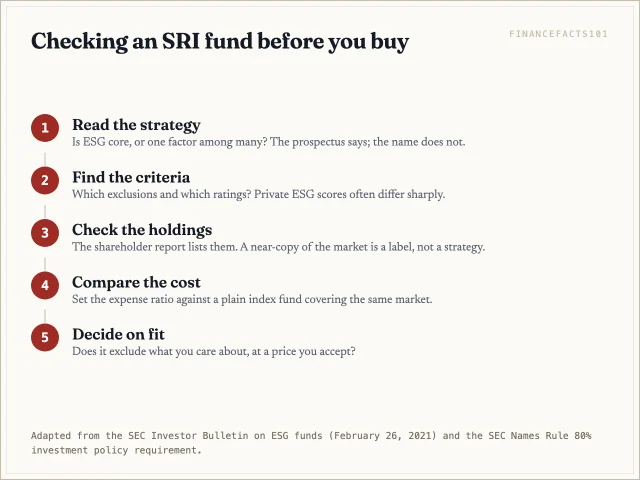
The SEC's bulletin gives a checklist. The questions that matter most:
- Is ESG core or one factor among many? Ask whether the fund excludes holdings or only "considers" ESG data. The prospectus should say which.
- Which criteria, weighted how? One fund's "governance" means shareholder rights; another's means board diversity. There is no SEC ESG rating. Private ratings "often differ significantly from each other," the SEC notes.
- What does it actually hold? Look at the full holdings list in the shareholder report. If it looks like the broad market, you may be paying extra for a label.
- What does it cost? Compare the expense ratio with a plain index fund covering the same market. Paying for advice on top of that is a separate decision; the site's guide to advisory fees shows how a 1% fee compounds.
For bank-based SRI the check is shorter. Confirm the institution's CDFI or MDI status on the CDFI Fund or FDIC list, confirm the deposit insurance, and compare the rate.
FAQ
What does SRI stand for in finance?
Socially responsible investing: choosing investments on values as well as risk and return. It overlaps with ESG investing and impact investing, and no federal law defines any of the three. US SIF, the industry body, uses the broader phrase "sustainable investing."
What is bank-based SRI?
Keeping your deposits at a bank or credit union whose lending serves underserved communities, usually a certified CDFI or a Minority Depository Institution. There were 184 CDFI banks or thrifts and 367 CDFI credit unions as of September 17, 2026. Insured deposits keep their FDIC or NCUA coverage up to $250,000.
Does socially responsible investing mean lower returns?
Not necessarily. The MSCI KLD 400 Social Index returned 8.56% a year from mid-1999 to August 2026, against 8.89% for its parent index. It was ahead over the past 1, 3, 5 and 10 years. Fund fees matter more than the label, so compare expense ratios.
Can I use SRI in my 401(k)?
Only through the funds your plan offers. Under the current Labor Department rule, plan fiduciaries may consider ESG factors that affect risk and return, but may not give up return for other goals. A replacement proposal that would restrict ESG considerations was under White House review in September 2026. If your plan has no ESG option, you can still do SRI in an IRA or taxable account, or through bank deposits.
Sources
- US SIF, US Sustainable Investing Trends 2025/2026 press release (December 9, 2025): $6.6 trillion of $61.7 trillion (11%); ESG integration 77%; stewardship coverage $42.7 trillion (69%); 46%, 29% and one-in-four findings on political pushback
- US SIF, Trends Report press release (December 2024): $6.5 trillion "new baseline"; integration 81%, exclusionary screening 75%, fossil-fuel exclusion 68%, tobacco 66%; over 65% use three or more strategies
- SEC Office of Investor Education and Advocacy, Environmental, Social and Governance (ESG) Funds – Investor Bulletin (February 26, 2021)
- SEC, Names Rule amendments press release 2023-188 and compliance date extension 2025-54
- SEC, BNY Mellon Investment Adviser, press release 2022-86 (May 23, 2022) and DWS, press release 2023-194 (September 25, 2023)
- eCFR, 29 CFR 2550.404a-1, Investment duties
- Ballotpedia News, Labor Department submits revised ESG rule to White House (July 18, 2026): proposal sent to OIRA June 30, 2026
- IRS, Notice 2015-62, Investments Made for Charitable Purposes and Program-related investments
- CDFI Fund, CDFI Certification and its list of certified CDFIs as of September 17, 2026: 1,281 total by institution type
- FDIC, Minority Depository Institutions List, second quarter 2026: 157 MDIs as of June 30, 2026; deposit insurance
- NCUA, Share insurance coverage
- MSCI, MSCI KLD 400 Social Index factsheet (August 31, 2026): launch history, annualized gross returns, 2022 annual returns, constituent counts
- Morgan Stanley Institute for Sustainable Investing, Sustainable Reality: first half 2025 (September 8, 2025) and second half 2025 (March 11, 2026), Morningstar data
- GreenMoney, 50 Years of Sustainable Investing at Pax World, by Joe Keefe, president of Impax Asset Management LLC: August 1971 launch and founders
- United Nations, Secretary-General launches Principles for Responsible Investment, press release SG/2111 (April 27, 2006)
 Next entry · No. 4,728Understanding Self-Regulatory Organizations (SROs) in Finance: Role, Functions, and Key Players
See also
-
 No. 1,299
26 Aug 2024
20 min
ESG Investing: Understanding Environmental, Social, and Governance Factors in Modern Finance
Business Finance
No. 1,299
26 Aug 2024
20 min
ESG Investing: Understanding Environmental, Social, and Governance Factors in Modern Finance
Business Finance -
 No. 781
07 Jun 2024
22 min
Understanding Corporate Governance: Principles, Models, and Best Practices for Institutional Investors
Business Strategy
No. 781
07 Jun 2024
22 min
Understanding Corporate Governance: Principles, Models, and Best Practices for Institutional Investors
Business Strategy -
 No. 5,802
08 Oct 2025
16 min
WorldCom: The Largest Telecom Accounting Scandal in US History
Business Finance
No. 5,802
08 Oct 2025
16 min
WorldCom: The Largest Telecom Accounting Scandal in US History
Business Finance -
 No. 5,550
18 Sep 2025
15 min
Understanding Voting Trust Agreements: A Powerful Tool for Corporate Control
Business Finance
No. 5,550
18 Sep 2025
15 min
Understanding Voting Trust Agreements: A Powerful Tool for Corporate Control
Business Finance -
 No. 5,548
18 Sep 2025
19 min
Understanding Voting Shares: Types, Mechanics, and Companies with Multiple Classes
Business Finance
No. 5,548
18 Sep 2025
19 min
Understanding Voting Shares: Types, Mechanics, and Companies with Multiple Classes
Business Finance -
 No. 5,471
11 Sep 2025
23 min
Understanding Venture Capital: History, Structure, and Compensation
Business Finance
No. 5,471
11 Sep 2025
23 min
Understanding Venture Capital: History, Structure, and Compensation
Business Finance