Subordinated Debt: What It Is, How Banks Use It, and How It Shows Up on the Balance Sheet
Subordinated debt is repaid only after senior debt if a borrower fails, so it pays more. Types, 2026 bank Tier 2 notes at 6.2-6.5%, and balance sheet rules.
Subordinated debt is a loan or bond that, by contract, ranks behind the borrower's senior debt. If the borrower fails and its assets are sold, senior lenders are paid in full before subordinated holders receive anything; subordinated holders, in turn, are paid before shareholders. Because they stand further back in line, subordinated lenders charge more. In August 2026, for example, Provident Financial Services sold $175 million of 6.50% subordinated notes due 2036, and said it would use most of the money to repay $150 million of 2.875% subordinated notes that Lakeland Bancorp issued in 2021 and Provident assumed in their 2024 merger.
Below: the repayment waterfall with real arithmetic, why banks issue so much of it, the main types, what a term sheet contains, and where the debt sits on a balance sheet. Deal terms are quoted from SEC filings and are current as of September 2026. This is general information, not investment advice.
What Is Subordinated Debt?
The SEC's investor bulletin on corporate bonds describes the ladder in one line: unsecured bonds, or debentures, "may be classified as either senior or junior (subordinated) debentures," and if the company defaults, senior holders "will have a higher priority claim on the company's assets and cash flows than holders of junior debentures." Subordinated debt is the junior rung. It is also called junior debt, sub debt, or subordinated notes or debentures.
Three kinds of subordination are worth separating, because they behave differently:
- Contractual subordination. The debt's own documents say it ranks behind a defined class of senior debt. The Bankruptcy Code enforces that promise: under 11 U.S.C. 510(a), a subordination agreement is enforceable in bankruptcy "to the same extent that such agreement is enforceable under applicable nonbankruptcy law." This is what people usually mean by subordinated debt.
- Structural subordination. Debt issued by a holding company sits behind every creditor of its operating subsidiaries, because the holding company only gets paid from what is left after a subsidiary settles its own debts. No contract clause is needed; the corporate structure does it.
- Equitable subordination. A bankruptcy court can push a creditor's claim down the line as a remedy for misconduct, under 510(c). That is a penalty imposed after the fact, not a feature anyone buys.
Subordination is only as broad as the contract says. Many indentures subordinate the notes to "Senior Indebtedness" as defined, which may leave suppliers and other trade creditors ranking alongside the subordinated holders rather than ahead of them. Reading that definition is the first job in any credit review.
How Subordinated Debt Works: The Repayment Waterfall
While the borrower is healthy, subordinated debt behaves like any other bond: it pays its coupon and matures. The subordination matters only when there is not enough money to go around. Then claims are paid in strict order, each class in full before the next gets a dollar. In a Chapter 11 reorganization the plan sorts claims into classes — secured creditors, unsecured creditors entitled to priority, general unsecured creditors and equity holders, as the U.S. Courts' Chapter 11 guide lists them — and subordinated holders sit at the bottom of the unsecured group.

A worked example shows how quickly the junior class loses. Take a company with a $40 million secured bank loan, $30 million of senior unsecured notes and $20 million of subordinated notes — $90 million of debt — and ignore bankruptcy costs and priority claims such as taxes and wages for simplicity.
If the assets are sold for $80 million, the secured lender takes $40 million, senior noteholders take their full $30 million, and $10 million is left for the subordinated holders: 50 cents on the dollar. Shareholders get nothing.
If the assets fetch $60 million instead — 25% less — the secured lender still recovers in full, senior holders split the remaining $20 million for about 67 cents on the dollar, and the subordinated holders recover zero.
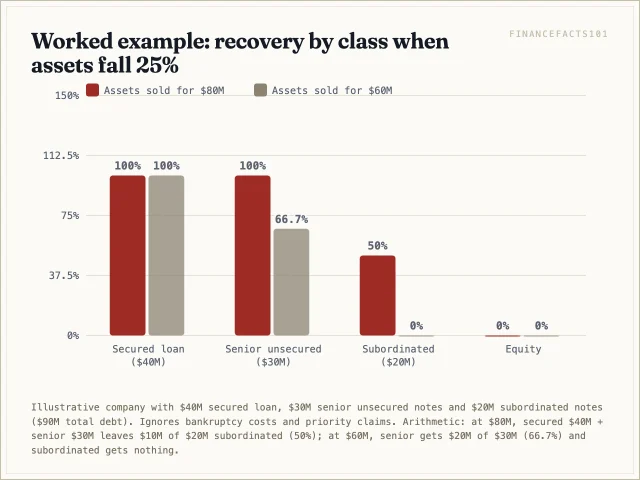
That asymmetry is the whole economics of the product. A 25% fall in asset value cost the senior unsecured holders a third of their money and the subordinated holders all of it. Subordinated debt sits just above equity in the loss sequence, so its price behaves more like equity as a borrower weakens. That is why it carries a higher coupon than the same issuer's senior debt, and why credit analysts judge it on the size of the cushion beneath the senior debt rather than on the borrower's ability to pay interest in good years.
Understanding Bank Subordinated Debt
Banks and bank holding companies are among the most regular issuers of subordinated debt in the US, and the reason is regulatory capital. Subordinated notes that meet the Federal Reserve's criteria count as Tier 2 capital, the loss-absorbing layer that sits below common equity and additional Tier 1 capital in a bank's capital stack.
The criteria in the Fed's capital rule, 12 CFR 217.20(d), shape almost every bank sub debt deal. The instrument must be subordinated to depositors and general creditors. It must have an original maturity of at least five years. It may be callable only after at least five years, and only with the Fed's prior approval. Holders may have no contractual right to accelerate payment except in a receivership, insolvency or liquidation. The rate cannot reset based on the bank's own credit standing. And the amount that counts as capital shrinks as maturity approaches:
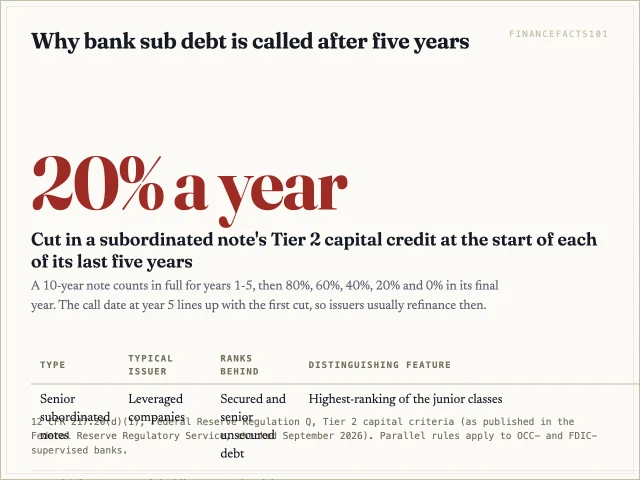
Put those rules together and you get the standard US bank deal: a 10-year note, callable after year 5, paying a fixed rate for five years and then a floating rate. The call date lines up with the point when capital credit begins to amortize, which is also when the issuer is most likely to refinance. That is exactly what happened across 2026. Valley National Bancorp said it would use its May 2026 $500 million issue to retire its 3.00% subordinated notes due 2031 — notes now inside their final five years, when their Tier 2 value falls 20% a year. Provident announced the same plan for the 2.875% notes it assumed from Lakeland Bancorp in their 2024 merger. Notes sold at roughly 3% when rates were low are being refinanced at 6.2% to 6.5%.
Most of this debt is issued by the holding company, not the bank. That adds structural subordination to the contractual kind. FB Financial's September 2026 prospectus supplement spells it out: the notes "will be obligations of FB Financial Corporation only," are not guaranteed by any of its subsidiaries, are "not insured or guaranteed by the FDIC," and "will be structurally subordinated to all of the existing and future liabilities and obligations of our subsidiaries, including the deposit liabilities and claims of other creditors" of its bank, FirstBank.
Where a bank itself issues subordinated debt and then fails, federal law fixes the order. Section 11(d)(11) of the Federal Deposit Insurance Act pays the receiver's administrative expenses first, then all deposits, then other general or senior liabilities, then "any obligation subordinated to depositors or general creditors," and shareholders last. In practice the deposit class is large enough that general creditors are often wiped out; the FDIC publishes insufficient-assets determinations for failed banks that could not pay general unsecured creditors anything. A subordinated holder ranks below even them.
Government has also been a buyer. Treasury's Emergency Capital Investment Program invested more than $8.57 billion in 175 community development and minority depository institutions, taking either preferred stock or subordinated debt, with a rate that falls as the institution increases lending in low- and moderate-income communities. For how Tier 2 fits with the equity layers above it, see the entry on common equity Tier 1.
Types of Subordinated Debt
"Subordinated" describes a ranking, not a single product. The same position in the waterfall appears in very different wrappers depending on who issues it and why.

Two distinctions sort most of them. The first is how far down it sits: senior subordinated notes rank ahead of junior subordinated debentures from the same issuer. Trust preferred securities share that bottom rung rather than sitting below it: as the Federal Reserve described them in its 2005 capital rule, the issuing trust's sole asset is a junior subordinated note of the holding company whose terms mirror the trust preferred securities, so the investor's claim is effectively that note's claim — senior only to the holding company's preferred and common stock, with interest deferrable for up to 20 consecutive quarters, or five years. The second is what the lender gets for the risk: a public bank note pays only a higher coupon, while a private mezzanine loan to a mid-sized company often adds warrants or payment-in-kind interest so the lender shares in the upside.
Structured finance uses the same idea without separate issuers. In an asset-backed security, the junior or "mezzanine" tranches absorb pool losses before the senior tranche does, which is a form of credit enhancement for the senior buyers. The subordination there is written into the payment waterfall of a single trust.
Subordinated Debt Examples: Three 2026 Bank Issues
The clearest subordinated debt examples are public bank deals, because their full terms are filed with the SEC. Three from 2026 show how uniform the market is.
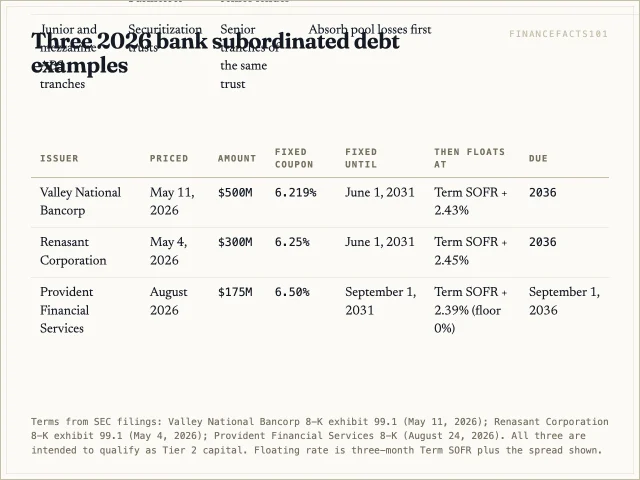
All three are fixed-to-floating notes due in 2036, all switch to three-month Term SOFR plus about 2.4 percentage points in 2031, and all are intended to count as Tier 2 capital. Renasant's filing states it may redeem the notes on or after June 1, 2031 at 100% of principal plus accrued interest.
The cash flows are simple to check. A $1,000 Provident note pays $65.00 a year for its first five years, in two $32.50 installments each March 1 and September 1. From September 1, 2031 it pays quarterly at Term SOFR plus 2.39%, with a floor of zero: if three-month Term SOFR were 3.50% at a reset, the note would pay 5.89% for that quarter. To compare a note like this against other bonds you might buy at a premium or discount, run the price through the bond yield calculator.
Subordinated Debt Term Sheet: The Clauses That Matter
A subordinated debt term sheet is the short summary of terms agreed before the full indenture or note purchase agreement is drafted. For a public bank deal, the terms end up in the prospectus supplement; for a private placement or a corporate mezzanine loan, the term sheet is often the only document the investment committee reads. These are the lines that carry the risk.
- Issuer and ranking. Who owes the money (holding company or operating company) and exactly which debt ranks ahead. FB Financial's notes are "junior in right of payment and upon our liquidation to any of our existing and all of our future Senior Indebtedness."
- Principal, denomination and maturity. Public bank notes typically trade in $1,000 minimums. Bank Tier 2 notes need at least five years to maturity; ten is standard.
- Coupon. Fixed, floating, or fixed-to-floating, with the index (now Term SOFR), the spread and any floor.
- Optional redemption. The first call date, the call price (usually par) and, for banks, the requirement of Federal Reserve approval.
- Special redemption events. Most bank notes let the issuer redeem early, at par, after a Tax Event, a Tier 2 Capital Event (the notes stop counting as capital) or an Investment Company Event. These shift risk to you: if the rules change, you can be paid off at par when the notes are worth more.
- Events of default and acceleration. FB Financial's notes, like most bank Tier 2 notes, state that principal "may be accelerated only in the case of certain events of bankruptcy or insolvency." A missed interest payment lets you sue for that payment but not demand the whole principal.
- Covenants. Bank notes carry almost none. Corporate mezzanine loans usually include financial covenants set looser than the senior lender's, so the senior lender trips first.
- Subordination and intercreditor terms. In private corporate deals, a separate intercreditor agreement typically lets the senior lender block payments to the junior lender during a default, bars the junior lender from suing or enforcing for a standstill period, and requires the junior lender to hand over anything it receives in breach.
- Use of proceeds. Often refinancing: Provident and Valley both said in 2026 that they planned to use the proceeds to repay older subordinated notes.
If you are reviewing a subordinated debt term sheet, the senior debt definition, the acceleration clause and the payment blockage terms decide more of your outcome in a default than the coupon does.
Subordinated Debt on the Balance Sheet
On the issuer's balance sheet, subordinated debt is a liability, not equity, however junior it is. It sits with long-term debt, with any portion due within twelve months moved to current liabilities. Under US GAAP it is carried net of unamortized issuance costs, and the interest, including amortization of those costs, runs through interest expense on the income statement.
Disclosure makes the ranking visible. The SEC's Regulation S-X, Rule 5-02, requires a public company to state each issue or type of long-term debt separately, in the balance sheet or the notes, with its interest rate, maturity and "a brief indication of priority." So the debt footnote is where you find which notes are subordinated and to what. Banks report subordinated debt on a dedicated line of the quarterly Call Report — Schedule RC, item 19, "Subordinated notes and debentures" — and the qualifying portion again in the regulatory capital schedule as Tier 2.
Lenders and analysts treat it in two ways at once. For senior lenders, subordinated debt behaves like a cushion, and their covenants are often written on senior leverage: a company with $50 million of EBITDA, $150 million of senior debt and $100 million of subordinated debt has senior leverage of 3.0 times but total leverage of 5.0 times. The senior lender watches the 3.0; the subordinated lender has to live with the 5.0. Rating agencies may also give partial equity credit to deeply subordinated instruments with long maturities and interest deferral, such as junior subordinated debentures, though accounting still books them as debt.
Risks of Subordinated Debt
The yield premium pays for risks that are concentrated in bad outcomes.
Loss severity. As the worked example showed, a modest fall in asset value can take subordinated recoveries from partial to zero. For a bank holding company, structural subordination to deposits makes a meaningful recovery unlikely if the bank itself fails.
No early exit. Limited acceleration rights mean you cannot force repayment when the credit starts to slide; you wait for maturity, a restructuring or a bankruptcy.
Call and extension risk. If rates fall, the issuer calls the notes at par on the first call date and you reinvest at lower rates. If the issuer's credit weakens, it may not call, and you hold a floating-rate note of a weaker credit for five more years — a skipped call is often read as a warning sign.
Liquidity. Many smaller bank issues are private placements that trade rarely, so exiting before maturity can mean a wide discount.
Interest deferral. Junior subordinated debentures and trust preferreds typically let the issuer defer interest for years without a default.
None of this makes subordinated debt a bad holding. It makes it a credit bet on the issuer staying well clear of the point where ranking starts to matter, priced accordingly.
FAQ
What is subordinated debt in simple terms?
It is debt that agrees to be repaid after other debt. While the borrower is healthy it pays interest like any bond or loan. If the borrower fails, senior creditors are paid first in full, subordinated creditors get whatever is left, and shareholders come last. Because of that higher risk, it pays a higher interest rate than the same borrower's senior debt.
Why do banks issue subordinated debt?
Mainly to raise Tier 2 regulatory capital without issuing new shares. Under the Federal Reserve's capital rule, qualifying subordinated notes must be subordinated to depositors and general creditors, have at least a five-year maturity, and be callable only after five years with Fed approval. That is why bank sub debt is typically a 10-year note callable after year 5, and why banks refinanced older, cheaper notes across 2026 at rates around 6.2% to 6.5%.
Is subordinated debt the same as mezzanine debt?
Mezzanine debt is one type of subordinated debt. The term usually means a private loan to a mid-sized company that ranks behind the senior bank loan, often with warrants or payment-in-kind interest added for extra return. All mezzanine debt is subordinated; not all subordinated debt is mezzanine — a public bank Tier 2 note is subordinated but is not called mezzanine.
Is subordinated debt debt or equity on the balance sheet?
Debt. It is a liability, carried with long-term debt net of issuance costs, and its interest is an expense. Public companies must disclose each issue's rate, maturity and priority in the balance sheet or notes under SEC Regulation S-X. Lenders may treat it as equity-like when setting senior leverage covenants, and rating agencies may give partial equity credit to deeply subordinated hybrids, but the accounting classification stays debt.
Is bank subordinated debt FDIC insured?
No. Subordinated notes are not deposits and are not insured or guaranteed by the FDIC or any other agency; bank offering documents state this expressly. If the bank fails, deposits are paid before general creditors, and subordinated obligations rank below both.
Sources
- SEC Office of Investor Education and Advocacy, Investor Bulletin: What Are Corporate Bonds? — senior versus junior (subordinated) debentures and bankruptcy priority
- Federal Reserve, 12 CFR 217.20, Capital components and eligibility criteria for regulatory capital instruments — Tier 2 criteria, five-year minimum, 20% annual amortization
- FDIC, Federal Deposit Insurance Act, Section 11 — depositor preference order, (d)(11)(A)
- FDIC, FAQs regarding determination of insufficient assets
- U.S. Treasury, Emergency Capital Investment Program — $8.57 billion in 175 institutions via preferred stock or subordinated debt
- Provident Financial Services, Form 8-K, August 24, 2026 — 6.50% fixed-to-floating subordinated notes due September 1, 2036; intended repayment of $150 million of 2.875% notes due 2031 and $20 million of junior subordinated notes due 2033, both originally issued by Lakeland Bancorp
- Valley National Bancorp, pricing release, Form 8-K exhibit 99.1, May 11, 2026 — $500 million 6.219% subordinated notes due 2036
- Renasant Corporation, pricing release, Form 8-K exhibit 99.1, May 4, 2026 — $300 million 6.25% subordinated notes due 2036
- Lakeland Bancorp, pricing release, Form 8-K exhibit 99.1, September 8, 2021 — $150 million 2.875% fixed-to-floating subordinated notes due 2031
- Provident Financial Services, Form 8-K, May 2024 — merger with Lakeland Bancorp completed May 15, 2024; Provident assumed Lakeland's 2.875% notes due September 15, 2031 and its junior subordinated debt
- FB Financial Corporation, preliminary prospectus supplement, September 2026 — ranking, acceleration, structural subordination and FDIC disclaimer language (quoted verbatim)
- Federal Reserve, Risk-Based Capital Standards: Trust Preferred Securities and the Definition of Capital, final rule, March 2005 — trust structure, sole-asset junior subordinated note, 20-quarter deferral
- U.S. Courts, Chapter 11 - Bankruptcy Basics — classes of claims in a reorganization plan
- 11 U.S.C. 510, Subordination — enforceability of subordination agreements and equitable subordination
- 17 CFR 210.5-02, Regulation S-X balance sheet requirements — item 22, long-term debt disclosure including priority
 Next entry · No. 4,791Understanding Subordination Agreements: Prioritizing Debts in Finance and Investment
See also
-
 No. 3,178
07 Mar 2025
18 min
Understanding Mezzanine Debt: Bridging the Gap Between Debt and Equity Financing
Business Finance
No. 3,178
07 Mar 2025
18 min
Understanding Mezzanine Debt: Bridging the Gap Between Debt and Equity Financing
Business Finance -
 No. 822
14 Jun 2024
14 min
Credit Facilities: Types, Advantages, Disadvantages, and What They Cost
Corporate Finance
No. 822
14 Jun 2024
14 min
Credit Facilities: Types, Advantages, Disadvantages, and What They Cost
Corporate Finance -
 No. 5,287
27 Aug 2025
21 min
Understanding Unlevered Beta: Measuring Market Risk Exclusively from Company Assets
Business Finance
No. 5,287
27 Aug 2025
21 min
Understanding Unlevered Beta: Measuring Market Risk Exclusively from Company Assets
Business Finance -
 No. 5,281
26 Aug 2025
20 min
Understanding Universal Banking: A Modern Approach to Comprehensive Financial Services
Business Finance
No. 5,281
26 Aug 2025
20 min
Understanding Universal Banking: A Modern Approach to Comprehensive Financial Services
Business Finance -
 No. 5,186
18 Aug 2025
20 min
The Underinvestment Problem: Conflicts Between Debtholders and Equity Shareholders
Business Finance
No. 5,186
18 Aug 2025
20 min
The Underinvestment Problem: Conflicts Between Debtholders and Equity Shareholders
Business Finance -
 No. 4,972
01 Aug 2025
21 min
Understanding the Tier 1 Leverage Ratio: A Key Measuring Stick for Bank Capitalization
Business Finance
No. 4,972
01 Aug 2025
21 min
Understanding the Tier 1 Leverage Ratio: A Key Measuring Stick for Bank Capitalization
Business Finance