Understanding Williams %R – A Powerful Momentum Indicator for Technical Analysis

Explore the powerful momentum indicator Williams %R for technical analysis. Learn its components, calculation, interpretation, and real-life applications.
Introduction to Williams %R
Williams %R, developed by Larry Williams, is a popular momentum indicator that helps traders identify overbought and oversold conditions based on a stock’s closing price in relation to its high-low range over a specific period, typically 14 days or periods. This powerful technical analysis tool plays an essential role in determining entry and exit points for both long and short positions. The Williams %R functions similarly to the Stochastic Oscillator, and they share some similarities in their calculation methods. However, there are significant differences between these two indicators that set them apart (as we will discuss later).
To fully grasp the essence of Williams %R, it is crucial to delve deeper into its components, calculation process, interpretations, advantages, limitations, and real-life applications. In this comprehensive section, we aim to provide an in-depth understanding of Williams %R and how it can be harnessed for effective trading strategies.
Components of Williams %R
The foundation of the Williams %R lies in its three primary components – highest high, lowest low, and close price. Let’s explore each component in detail:
- Highest High: The highest high is determined by identifying the highest price within a specific lookback period (usually 14 days or periods). This value helps set the upper boundary for the Williams %R calculation.
- Lowest Low: Similarly, the lowest low represents the lowest price recorded during the same lookback period. It forms the lower boundary of the indicator’s calculation.
- Close Price: The close price signifies the most recent closing price. This value is compared with the highest high and lowest low to calculate the Williams %R.
Calculating Williams %R
To determine the actual Williams %R value, you will need to follow these steps:
- Record the highest high and lowest low for each period over 14 periods.
- Note the current period’s close price, highest high, and lowest low.
- Fill in all variables in the formula: Wiliams %R = (Highest High – Lowest Low) / (Highest High – Close Price).
- Repeat this process for each new period. As the period ends, compute the new Williams %R value using only the last 14 periods of data.
In the next section, we will discuss how to interpret the results obtained from calculating the Williams %R and what they signify in various market conditions. Stay tuned!

Components of Williams %R
The Williams %R indicator, a valuable tool for momentum traders and technical analysts alike, is designed to measure a financial asset’s overbought or oversold conditions based on its price action within a given timeframe. Developed by Larry Williams in the late 1970s, this oscillator helps identify potential entry and exit points when used effectively. Understanding the components of the Williams %R is crucial to utilizing this indicator successfully in your trading strategy.
The primary components required for calculating Williams %R include:
- Highest High – This value signifies the highest price recorded within a specified period, typically 14 periods. In other words, it represents the highest peak achieved during that time frame.
- Lowest Low – This value represents the lowest price seen within the same 14-period window. The lowest low indicates the trough or valley of the asset’s price action.
- Close Price – The closing price for each period is the last recorded price before the new trading day begins.
With these variables at hand, we can now delve into the calculation process of Williams %R:
The formula for calculating Williams %R is as follows:
Williams %R = (Highest High – Lowest Low) / (Highest High – Lowest Low + Close Price – Highest High)
This equation allows us to determine the current position of the closing price in relation to the highest high and lowest low for a given period. A few important things to note about this formula:
– The denominator is adjusted slightly by subtracting the highest high before dividing, which helps ensure that Williams %R always falls between 0 and -100.
– The result obtained from the formula represents the position of the closing price relative to the highest high and lowest low for the defined period. This value can then be interpreted based on overbought and oversold levels, as discussed below.

Calculating Williams %R
The calculation of Williams %R is an essential aspect that allows traders to assess the market’s momentum by comparing a security’s closing price with its highest high and lowest low over a specific period, typically 14 periods. To calculate this indicator, you need three components: the current close, the highest high within the lookback period, and the lowest low within the same time frame.
First, note the highest high and lowest low for every period in the 14-period window. For instance, if we examine a security’s price data for the past 20 days, the highest high and lowest low will correspond to the highest and lowest prices within that 14-day period. Next, record the current price as the closing price for each bar in the time frame.
The Williams %R formula is calculated by subtracting the lowest low from the highest high, and then dividing the closing price by this value. To make the indicator more readable, multiply the result by -100. This calculation results in a value between 0 and -100.
For example, consider the following hypothetical data:
– Period 1: Highest High = 45, Lowest Low = 38, Close = 42
– Period 2: Highest High = 49, Lowest Low = 43, Close = 46
To calculate the Williams %R for period 1, use these values in the formula:
Williams %R = ((Highest High – Lowest Low) x (-1)) / (Current Close – Lowest Low)
Williams %R = ((45 – 38) x (-1)) / (42 – 38)
Williams %R = -78.57
For period 2, repeat the calculation:
Williams %R = ((Highest High – Lowest Low) x (-1)) / (Current Close – Lowest Low)
Williams %R = ((49 – 43) x (-1)) / (46 – 43)
Williams %R = -52.38
The value of Williams %R gives insight into the current market momentum, allowing traders to determine whether a security is overbought or oversold. An overbought reading indicates that a security’s closing price is near the high end of its recent range, while an oversold reading suggests it’s near the lower end. In the next section, we will explore the significance and implications of overbought and oversold readings in the context of trending markets.
Interpreting Williams %R
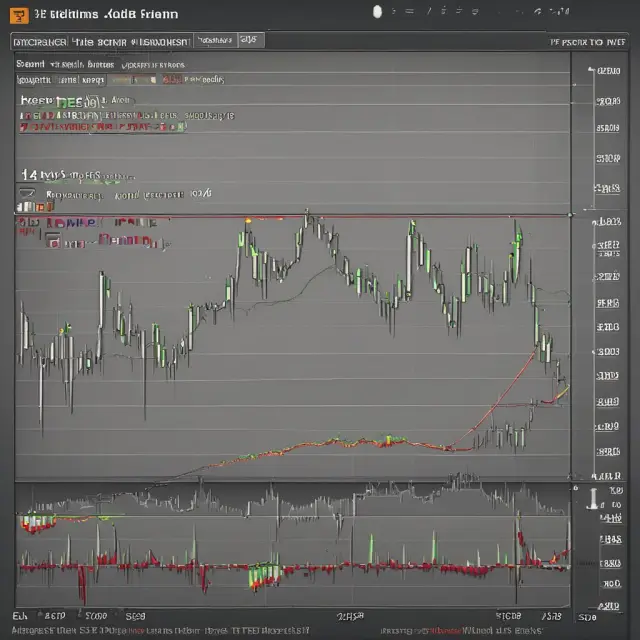
The Williams %R is a momentum indicator used primarily for identifying overbought and oversold conditions of an asset. It moves between 0 and -100 and helps traders determine potential entry or exit points based on the current price position in relation to its recent range. Interpreting the Williams %R requires understanding its key concepts: overbought and oversold levels, their significance in a trending market, and potential limitations.
Overbought and Oversold Levels
An asset is considered overbought when the price is near the highs of its recent range, while an oversold asset is near the lower end. The Williams %R indicator is crucial in identifying these conditions. Overbought or oversold levels are not guaranteed to result in a price reversal. However, they do provide important information on the market’s current state and potential future direction.
Implications for Trending Markets
In an uptrend, traders may look for the Williams %R indicator to fall below -80. When the price starts rising again, while the indicator moves back above -80, it can be seen as a potential confirmation of the continuation of the uptrend. Conversely, in a downtrend, the trader may observe the indicator moving above -20 and wait for the price to start falling along with the Williams %R moving below -20. This could potentially signal a continuation of the downtrend.
Momentum Failures
During a strong trend, it’s not uncommon for the indicator to reach overbought or oversold levels. However, traders should be aware of momentum failures, which occur when an asset reaches a certain level and fails to sustain it before moving in the opposite direction. For instance, if an uptrend is marked by frequent overbought conditions, but the Williams %R fails to remain above -20, it may indicate that the upward trend might be weakening, leading to a potential reversal or correction.
Limitations and False Signals
It’s essential to acknowledge that Williams %R readings do not ensure price reversals. Overbought conditions can actually support an uptrend as a strong trend will regularly push prices close to prior highs. Additionally, the indicator may generate false signals due to its responsiveness. For example, the indicator might be in oversold territory but fail to recover as expected, leading traders to miss potential entry points or exit too early.
Understanding these aspects of Williams %R is crucial for interpreting this momentum indicator effectively and making informed trading decisions based on its readings.

Understanding Momentum Failures
One of the most powerful features of Williams %R as a momentum indicator lies in its ability to identify potential momentum failures – instances where market trends might be weaker than they appear. By examining how price moves relative to its highest and lowest levels over a specific period, the indicator can serve as an early warning system for possible shifts in market direction.
A momentum failure occurs when a strong trend fails to continue in the anticipated direction, either due to a reversal or a prolonged consolidation. In an uptrend, a momentum failure may manifest as a pullback that lasts longer than usual or a sharp decline followed by a weak recovery. Conversely, a downtrend might experience a relief rally or a short-lived correction before resuming its downward trajectory.
To identify momentum failures with Williams %R, you should look for instances where the indicator’s readings do not align with the price action. For example:
- In an uptrend, if the price reaches overbought levels (above -20), but the Williams %R fails to confirm this by remaining below that threshold, it may signal a potential momentum failure and a forthcoming correction or consolidation.
- Conversely, in a downtrend, if the price dips into oversold territory (below -80) but the Williams %R does not follow suit, it might indicate that the downtrend has lost momentum and could potentially reverse.
These discrepancies can be attributed to the fact that Williams %R measures price momentum based on a specific lookback period. When a market trend becomes overextended or weakened, there may be a delay in the indicator’s response due to its lagging nature. This delay creates an opportunity for traders to anticipate potential price movements and adjust their positions accordingly.
Real-life examples of momentum failures can be found across various financial markets. For instance, consider an equity market with a prolonged uptrend, where the price consistently rises above the -20 Williams %R threshold. If, however, the indicator fails to confirm this overbought condition and remains below it, a potential momentum failure might be underway. This situation could provide valuable insight for traders looking to enter short positions or lock in profits from long positions.
In summary, understanding momentum failures is an essential aspect of using Williams %R as a technical analysis tool. By closely monitoring the relationship between price and the indicator’s readings, investors and traders can capitalize on market trends while minimizing risk exposure. Remember that no indicator is perfect, and false signals are inevitable; however, being aware of momentum failures can help improve your overall trading strategy and lead to more informed decisions.

Difference between Williams %R and Stochastic Oscillator
The Williams %R and Stochastic Oscillator are two popular momentum indicators used extensively by traders to identify overbought and oversold levels in a financial instrument’s price action. Although these indicators share several similarities, it is essential to understand their key differences, as each indicator offers unique insights that can contribute to successful trading strategies.
Both Williams %R and Stochastic Oscillator aim to provide traders with an understanding of the current price’s position relative to its recent price range. However, they approach this objective differently, leading to distinct interpretations and applications for each indicator.
Williams %R: The Williams Percent Range (Williams %R) is a momentum indicator that moves between 0 and -100, measuring overbought and oversold levels based on the closing price in relation to the highest high and lowest low over a specified period, usually 14 days. It was introduced by Larry Williams in the late 1980s as an alternative to Stochastic Oscillator.
Stochastic Oscillator: The Stochastic Oscillator is a momentum indicator that oscillates between 0 and 100, measuring the market’s closing price relative to its lowest low over a specific period, typically 14 periods. It was developed by George Lane in the 1950s.
Calculation methods:
Williams %R: Williams %R is calculated using the following formula:
W%R = (Most Recent High – Current Close) / (Highest High – Lowest Low) *-100
Stochastic Oscillator: Stochastic Oscillator uses the following calculation method:
%K = [(Closing Price for the current period – Lowest Low for a specific period, usually 14 periods) / (Highest High for a specific period, usually 14 periods – Lowest Low for a specific period)] * 100
%D = Three-day moving average of %K.
Comparison:
The primary difference between the two indicators lies in their calculation methods and scaling. The Williams %R is scaled between -100 and 0, while Stochastic Oscillator is scaled between 0 and 100. This scaling affects how traders interpret overbought and oversold conditions for each indicator.
Traders using Williams %R consider a reading above -20 as overbought and below -80 as oversold, while Stochastic Oscillator users view readings above 70 as overbought and below 30 as oversold. Both indicators can provide valuable insights into market momentum, but their differences in scaling make them suitable for different trading styles and conditions.
In conclusion, understanding the distinctions between Williams %R and Stochastic Oscillator can help traders make informed decisions when implementing momentum-based strategies. By recognizing each indicator’s strengths and limitations, as well as their unique approaches to measuring market momentum, traders can effectively optimize their analysis and capitalize on opportunities that may not be apparent using just one indicator alone.

Using Williams %R in Trading Strategies
Williams %R is a powerful momentum indicator that can provide valuable insights into market trends by highlighting potential overbought and oversold levels. This section will discuss how traders use the Williams %R to identify entry and exit points for both long and short positions, as well as the importance of confirming signals with other indicators or price action.
Long Positions
In an uptrend, the Williams %R may be used to identify potential buying opportunities when it moves below its oversold threshold, typically -80. The indicator’s ability to indicate potential reversals can be improved by combining it with other technical tools such as moving averages or trend lines. For example, a trader might look for a bullish crossover between the Williams %R and a 50-day moving average, which could signify an emerging uptrend.
Short Positions
Conversely, traders seeking to profit from downtrends can use the Williams %R by looking for potential selling opportunities when it moves above its overbought threshold, typically -20. Similar to long positions, confirmation signals from other indicators like moving averages or trend lines can increase the validity of the trading signal. For instance, a bearish crossover between the Williams %R and a 50-day moving average could indicate an emerging downtrend.
Confirming Signals
It’s important to note that while the Williams %R can provide valuable insights, it should not be used in isolation. Instead, traders often combine its signals with those from other technical indicators or price action analysis to increase confidence in their trading decisions. For example, a bullish divergence between price and the Williams %R may suggest that the indicator is providing a false signal, which could be confirmed by studying price charts for potential reversal patterns such as double bottoms or triple tops.
In summary, the Williams %R can be a powerful tool for identifying entry and exit points in various market conditions when combined with other indicators or price analysis methods. By understanding how to interpret its readings and confirm signals, traders can potentially maximize their profits and minimize risk.

Advantages and Disadvantages
Williams %R has gained significant popularity among traders due to its effectiveness in identifying overbought and oversold conditions. However, it comes with unique advantages and disadvantages that traders should be aware of before incorporating this momentum indicator into their trading strategies.
Advantages:
- Dual Overbought/Oversold Thresholds: Williams %R provides two threshold levels (-20 for overbought and -80 for oversold) that help traders quickly assess the current price’s position within its recent range.
- Smoother Signals: In comparison to other momentum indicators like Stochastic Oscillator, RSI (Relative Strength Index), or Moving Average Convergence Divergence (MACD), Williams %R offers more consistent buy and sell signals due to its smoothed calculation method.
- Easy Visualization: The Williams %R indicator’s straightforward oscillation between zero and -100 makes it simpler to visualize potential buying and selling opportunities.
Disadvantages:
- Lack of Absolute Reversal Signals: Unlike other momentum indicators, Williams %R doesn’t provide definitive signals regarding price reversals, as overbought or oversold conditions don’t necessarily result in a trend change. Instead, it acts as a confirmatory tool to strengthen existing trends.
- Delayed Reactions: The 14-period lookback window of Williams %R can lead to delayed entry and exit signals, making it less suitable for short-term trading strategies.
- False Signals: Similar to other momentum indicators, Williams %R can produce false signals due to its sensitivity to market volatility. These misleading readings may cause traders to enter or exit positions prematurely.
- Lack of Adjustability: The default 14-period lookback window for Williams %R doesn’t offer flexibility for customizing settings according to market conditions and individual trading styles.
In summary, the Williams %R indicator offers valuable insights into a security’s momentum, particularly when used in conjunction with other technical indicators or price action analysis. Its ability to confirm trends and identify potential entry/exit points makes it an essential tool for traders seeking to enhance their overall market awareness and profitability. However, its limitations should also be carefully considered before incorporating this indicator into a trading strategy.

Case Studies and Real-life Applications
One of the most compelling aspects of Williams %R lies in its real-world applications and the success stories it has produced for traders. In this section, we’ll delve into some fascinating examples from various markets where traders have effectively utilized this momentum indicator to generate substantial returns.
Let us first explore a case study involving Apple Inc. (AAPL), one of the most widely-traded stocks in the tech sector. In late 2019, AAPL’s stock price underwent a significant correction as investors grew concerned about the company’s slowing growth rate and increasing competition.
During this period, a diligent trader closely monitored the Williams %R indicator for potential opportunities within the market volatility. As the stock price declined, the Williams %R oscillator moved into oversold territory, suggesting that the selling pressure was exhausting and an uptrend may be imminent.
In this particular instance, the trader identified a buy signal once the Williams %R line crossed back above the -20 level. Shortly after the entry, AAPL’s price experienced a robust rally, resulting in substantial profits for the investor.
Another intriguing application of Williams %R can be found in the forex market. In 2016, the British Pound underwent considerable volatility following the Brexit referendum. The GBP/USD exchange rate saw dramatic price swings as uncertainty surrounding Britain’s departure from the European Union kept markets on edge.
A skilled trader closely tracking the Williams %R indicator for the GBP/USD pair observed a momentum failure during this period of heightened volatility. After an extended downtrend, the Williams %R line failed to reach oversold territory before reversing course and moving back into positive territory. This discrepancy in momentum was a clear warning sign that the currency pair’s downtrend may be coming to an end.
Acting on this insight, the trader entered a long position when the GBP/USD price began to recover, ultimately generating impressive returns as the currency pair rallied over the following weeks.
Finally, let us examine how Williams %R has been used in commodity markets, specifically in crude oil (WTI). In 2014, the global oil market experienced a dramatic downturn as oversupply and weak demand pushed prices to their lowest levels in several years. During this period, a shrewd trader carefully analyzed the Williams %R indicator for potential opportunities within the depressed market.
As WTI’s price continued its decline, the Williams %R oscillator reached deeply oversold territory. However, instead of recovering as expected, the indicator failed to maintain gains and slipped back below -80. This false signal was a red flag for the trader, who took it as a warning that the downtrend may persist despite the oversold conditions.
The trader, therefore, chose to remain patient and waited for a confirmed reversal before entering the market. After several weeks of monitoring, the Williams %R line eventually crossed back above -20, providing a clear buy signal. Shortly afterward, crude oil prices began an impressive rebound, enabling the trader to secure substantial profits from their entry position.
In summary, the Williams %R indicator has proven to be an invaluable tool for traders across various markets. By closely examining its real-life applications and success stories, it becomes apparent that this momentum indicator can generate significant returns when utilized effectively. Whether you’re a stock trader, forex investor, or commodity speculator, incorporating Williams %R into your technical analysis strategy could yield impressive rewards in the ever-changing financial markets.
FAQ
**What is Williams %R?**
Williams %R (also known as Larry Williams Percent Range or simply %R) is a technical analysis indicator that measures overbought and oversold levels based on the price’s relationship to its high-low range within a specified period, usually 14 periods. It’s used by traders to identify potential entry and exit points in the market.
**How does Williams %R work?**
Williams %R compares the most recent closing price with the highest high (highest price within a lookback period) and lowest low (lowest price within a lookback period) for each period over the specified duration to determine whether the current price is overbought or oversold.
**What are the components of Williams %R?**
The components required to calculate Williams %R are:
– The highest high (Highest High): The highest price in a given lookback period.
– The lowest low (Lowest Low): The lowest price within a specific lookback period.
– The close price: The most recent closing price.
**How is Williams %R calculated?**
To calculate the indicator, take the difference between the highest high and the lowest low, subtract the current close from it, and divide by the range (highest high minus lowest low). Multiply the result by -100 to obtain a value that lies between 0 and -100.
**What does Williams %R tell you?**
Williams %R can be used for various purposes, including identifying potential entry and exit points, trend reversals, momentum failures, or even confirming other technical indicators’ signals. A reading above -20 indicates an overbought condition (price is near the high of its recent range), while a reading below -80 signifies an oversold condition (price is in the lower end of its recent range).
**What is the difference between Williams %R and Stochastic Oscillator?**
Both indicators are closely related, as they both aim to measure momentum. The primary difference lies in their scaling: Williams %R represents a market’s closing level versus the highest high for the lookback period (and is scaled from 0 to -100), while Stochastic Oscillator illustrates a market’s close in relation to the lowest low (scaled between 0 and 100).
**What are some advantages of using Williams %R?**
Williams %R is known for providing clear overbought and oversold levels, being responsive to trends, and providing buy/sell signals. Additionally, it can be used alongside other indicators or price action analysis.
**Are there any limitations to using Williams %R?**
Some traders argue that Williams %R can sometimes provide false signals due to its sensitivity. It’s also important to note that overbought and oversold readings do not guarantee a reversal will occur, but rather help confirm an existing trend or potential trend change.
 Next entry · No. 5,739The Willie Sutton Rule: Choosing Obvious Routes for Maximum Financial Gain
See also
-
 No. 5,774
06 Oct 2025
20 min
A Comprehensive Guide to Understanding and Utilizing Worden Stochastics in Finance and Investment
Business Finance
No. 5,774
06 Oct 2025
20 min
A Comprehensive Guide to Understanding and Utilizing Worden Stochastics in Finance and Investment
Business Finance -
 No. 5,336
31 Aug 2025
22 min
Understanding the Upside Gap Two Crows Pattern: A Bearish Reversal Signal
Markets
No. 5,336
31 Aug 2025
22 min
Understanding the Upside Gap Two Crows Pattern: A Bearish Reversal Signal
Markets -
 No. 5,112
12 Aug 2025
18 min
Understanding Tweezer Patterns in Technical Analysis
Markets
No. 5,112
12 Aug 2025
18 min
Understanding Tweezer Patterns in Technical Analysis
Markets -
 No. 5,076
10 Aug 2025
18 min
Triangle Patterns: Understanding Ascending, Descending and Symmetrical Triangles
Markets
No. 5,076
10 Aug 2025
18 min
Triangle Patterns: Understanding Ascending, Descending and Symmetrical Triangles
Markets -
 No. 5,913
18 Oct 2025
21 min
Mastering the Zig Zag Indicator for Trend Identification and Filtering Noise in Finance
Financial Tools
No. 5,913
18 Oct 2025
21 min
Mastering the Zig Zag Indicator for Trend Identification and Filtering Noise in Finance
Financial Tools -
 No. 5,731
03 Oct 2025
19 min
Mastering Wilder’s DMI (ADX) Indicator: A Powerful Tool for Trend Analysis in Finance and Investment
Business Finance
No. 5,731
03 Oct 2025
19 min
Mastering Wilder’s DMI (ADX) Indicator: A Powerful Tool for Trend Analysis in Finance and Investment
Business Finance