John Stuart Mill: His Economic Beliefs, Personal Life, Notable Accomplishments and Most Important Works

Explore the life of influential philosopher and economist John Stuart Mill, including his education, career, relationships, and groundbreaking works in…
Early Life and Education
John Stuart Mill (1806-1873) was a trailblazing figure in British intellectual history, leaving an indelible mark on philosophy, politics, ethics, metaphysics, and economics. Born into a distinguished family, Mill’s education and upbringing significantly shaped his influential thoughts and ideas that would later captivate audiences worldwide.
John Stuart Mill was the eldest son of the renowned historian, economist, and philosopher James Mill (1773-1836). His early years were marked by a rigorous education that began under his father’s watchful eye in London. From a young age, he was exposed to an intensive regimen that included Greek, Latin, mathematics, history, and economic theory.
James Mill was well-acquainted with the leading political theorist Jeremy Bentham (1745-1832), who became a formative influence on the family’s intellectual sphere. Together, they embarked on a political movement advocating philosophical radicalism and utilitarianism – the belief that actions should produce ‘the greatest good for the greatest number’. Mill’s father, keen to instill these beliefs in his son from an early age, ensured that John Stuart would be immersed in this philosophical environment.
Mill’s strict upbringing, however, had its dark side. The rigorous education and unyielding expectations placed upon him led Mill to experience periods of mental instability, which he later attributed to the overbearing nature of his father and the radical system in which he was raised. During this time, Mill began questioning the theories he had previously accepted as truth, leading him on a path towards intellectual and philosophical growth.
Despite these challenges, Mill’s formative years laid the groundwork for an extraordinary intellectual career that would span over half a century. In later life, his beliefs would be reflected in his best-known works, including Principles of Political Economy (1848), Utilitarianism (1863), On Liberty (1859), and The Subjection of Women (1869).
As Mill’s mental breakdown forced him to reconsider the theories he had previously accepted as unquestionable truth, a turning point in his life occurred. This introspection led him to revise Bentham’s utilitarian ideology, making it more positive and adopting it as his own system of belief. Mill would spend most of his working life with the East India Company, joining at age 16 and remaining there for 38 years. During 1865-68, he served as a Member of Parliament (MP), representing the City of Westminster.
It was this unique background that gave Mill a solid foundation upon which to build his influential thoughts on economics, ethics, political philosophy, and social awareness. His upbringing not only shaped his beliefs but also influenced his personal life, as he would later find love in Harriet Hardy Taylor. This section provides an in-depth exploration of John Stuart Mill’s formative years, which played a crucial role in shaping the man who would become one of the most influential figures in British intellectual history.

Influential Beliefs and Ideology
John Stuart Mill, the influential philosopher and economist from the 19th century, was not only known for his contributions to economic theory but also for his advocacy of individual rights, progressive social policies, and utilitarianism. Utilitarianism, a moral theory that promotes actions leading to “the greatest good for the greatest number,” significantly shaped Mill’s political discourse in economics, ethics, metaphysics, and other fields (Mill, 1863).
Utilitarianism was a controversial yet powerful belief system Mill adopted from his early mentor, Jeremy Bentham. This theory posits that the morality of an action is determined by its ability to promote overall happiness and well-being for all involved. Mill built upon Bentham’s ideas, developing a more positive, humanistic interpretation of utilitarianism that emphasized individual freedom and personal growth (Mill, 1859).
Mill’s advocacy for individual rights is an extension of his utilitarian beliefs. He believed in the importance of respecting each person’s autonomy and allowing them the freedom to pursue their own happiness as long as it didn’t harm others. This perspective led Mill to challenge societal norms, especially regarding the legal status of women and slavery (Mill, 1869).
Moreover, Mill’s utilitarian principles influenced his thoughts on economics, particularly in regards to the role of government intervention and the importance of addressing issues like poverty and education. He did not advocate for a laissez-faire economic system but instead believed in taxes and regulations that aimed to promote the greatest good for the greatest number (Mill, 1848).
Although Mill was an economist by trade, his belief in individual rights and utilitarianism extended beyond economics. His works on logic and ethics—such as A System of Logic (1843) and Utilitarianism (1863)—showcased the interconnected nature of these various disciplines, further solidifying Mill’s place as a groundbreaking thinker who brought philosophical thought to bear on economic theory.
In summary, John Stuart Mill’s influential beliefs in individual rights, utilitarianism, and a nuanced understanding of economics contributed significantly to his political discourse across multiple fields. His unique perspective helped shape debates on topics like women’s rights, slavery, and government intervention and laid the groundwork for further exploration of these issues.
References:
Mill, J. S. (1843). A system of logic. London: John W. Parker and Son.
Mill, J. S. (1848). Principles of political economy with some applications to social philosophy. London: John Stuart Mill.
Mill, J. S. (1859). On liberty. London: John W. Parker and Son.
Mill, J. S. (1861). Utilitarianism. In Examiner, 1 September 1863, pp. 2-3.
Mill, J. S. (1863). Utilitarianism. London: John W. Parker and Son.
Mill, J. S. (1869). The subjection of women. London: John Stuart Mill.
Career with the East India Company
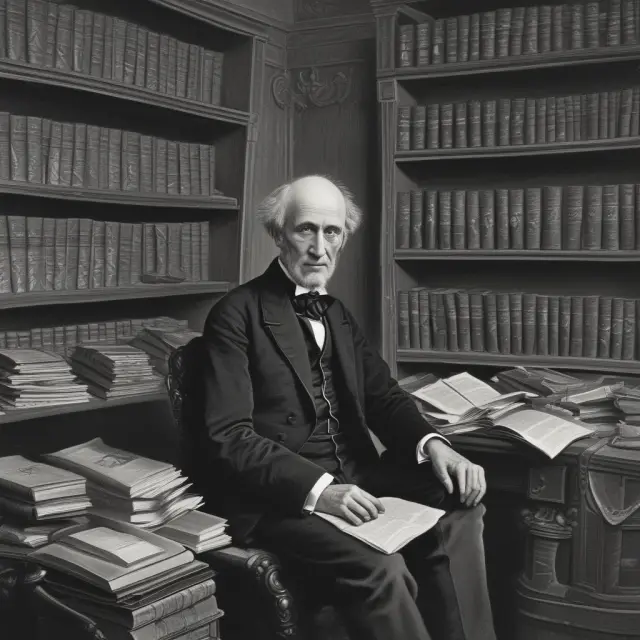
John Stuart Mill’s professional life was marked by his lengthy tenure at the East India Company, a position that significantly influenced both his political and economic thought. Joining the company at the tender age of 16, Mill spent nearly four decades with the organization, serving from 1826 to 1867.
During this time, he was exposed to a diverse range of experiences and insights that shaped his perspectives on political economy, social issues, and the role of government in society. Mill’s employment with the East India Company began under the auspices of his father James Mill, who held a prominent position within the organization.
This experience provided Mill with an in-depth understanding of the inner workings of colonial administration, as well as the economic realities that shaped the British Empire’s expansion and trade during the 19th century. In fact, many of the ideas he later presented in his influential works, such as Principles of Political Economy (1848), were informed by the practical knowledge he gained from his time at the East India Company.
One significant impact the organization had on Mill was its emphasis on free trade and economic liberalization. The East India Company’s commercial operations relied on the principles of laissez-faire economics, allowing him to observe firsthand how markets functioned in practice. While he would eventually question the absolute value of a completely unregulated market system, his initial exposure to the benefits of free trade left an indelible mark on his economic beliefs.
In addition to gaining valuable knowledge about political economy and trade, Mill’s career with the East India Company also provided him with insights into the complex interplay between governmental power and individual rights. He became acutely aware of how the company wielded significant influence over Indian populations, raising questions regarding the ethical implications of colonial rule and the role that a more just and equitable society could play in fostering economic prosperity.
Mill’s time at the East India Company ultimately shaped his views on both economics and politics, pushing him to question prevailing ideologies and advocate for greater individual liberties, social progress, and the ethical use of governmental power. As he later reflected, “The East India House was my university.”
In 1865-1868, Mill served as a Member of Parliament (MP) representing the City of Westminster, marking an important milestone in his public life and enabling him to apply his extensive knowledge and beliefs to political decision-making. Throughout his career, Mill’s experiences with the East India Company informed his philosophical and economic thought, contributing significantly to his groundbreaking work as a philosopher, economist, and advocate for social reform.

Notable Accomplishments: Philosophical Writings
John Stuart Mill’s philosophical works profoundly impacted the intellectual landscape of his time, shaping debates around ethics, logic, and individual rights. Amongst his most well-known publications in this field, four stand out for their enduring influence: A System of Logic, Utilitarianism, On Liberty, and The Subjection of Women.
In A System of Logic (1843), Mill introduced readers to the logical methods used in the sciences and proposed their application to social mechanics. This work became a foundational text for formal logic studies, setting the stage for advancements in both philosophy and economics.
Mill’s 1848 publication, Principles of Political Economy, signaled his transition from philosophy into economics. While this work adhered to classical economic theory, it also incorporated philosophical perspectives and social awareness, making it a groundbreaking text for its time. Mill’s contributions included the development of concepts like opportunity cost, economies of scale, and comparative advantage in trade.
On Liberty (1859) tackled issues concerning individual rights and the role of government in shaping society. Introducing the harm principle, Mill argued that political power should only be wielded over a member of an organization when used to prevent harm to that member. His defense of free speech laid the groundwork for modern discussions on freedom of expression and privacy.
In his 1861 essay Utilitarianism, Mill expanded upon Jeremy Bentham’s original philosophy by advocating for the betterment of society as a whole rather than merely focusing on narrow self-interest. His interpretation of utilitarianism remains influential today in both moral philosophy and economic theory.
The Subjection of Women (1869), published just before his death, was an impassioned plea for women’s suffrage and gender equality. This work continued Mill’s advocacy for individual rights, extending it to the most marginalized segment of society at the time: women. The Subjection of Women marked a significant shift in social discourse, paving the way for future feminist thought.

Notable Accomplishments: Economic Writings
John Stuart Mill’s contributions to economics are significant and far-reaching, with his work on principles of political economy shaping economic thought for decades after its publication. In his book, he developed influential concepts like opportunity cost, economies of scale, and comparative advantage in trade. These theories were important as they built upon the foundational ideas of early economists David Ricardo and Adam Smith.
Opportunity Cost is the concept that when a choice is made between two or more options, there’s an inherent cost associated with giving up one for the other. This idea helped Mill expand on the principles laid out by both Ricardo and Smith, focusing on how individuals allocate their resources based on what they value most in the short term. Mill believed that understanding this concept was essential for making informed economic decisions.
Another significant contribution is the theory of Economies of Scale, which suggests that as a business expands its operations, there are cost savings and efficiency improvements to be gained. Mill recognized that these economies could lead to increased production, lower prices, and, ultimately, better living standards for consumers. In this way, his economic theories helped bridge the gap between production and consumption, recognizing the interconnectedness of both concepts.
Lastly, Comparative Advantage in trade refers to a country’s ability to produce goods more efficiently than another, making it advantageous for countries to specialize in producing certain goods and trading them with other nations. This theory, which is essential to understanding international trade and the division of labor, was first presented by David Ricardo but expanded upon by Mill through his work on principles of political economy.
These economic theories, along with Mill’s advocacy for the role of human laws and institutions in distributing wealth, set the stage for further economic exploration and development. By recognizing the importance of production, distribution, and consumption in a holistic manner, Mill paved the way for future economists to build upon his ideas and create new frameworks for understanding economic systems.
By exploring Mill’s work on principles of political economy and these specific concepts—opportunity cost, economies of scale, and comparative advantage—we gain a deeper appreciation for his lasting impact on economic thought. Mill’s contributions to economics were not only influential during his time but continue to shape modern economic theory today.

Personal Life and Love: Harriet Hardy Taylor
John Stuart Mill’s romantic relationship with Harriet Hardy Taylor (neé Helena Maria Stanhope; 1810-1873) was a significant aspect of his life that influenced not only his personal happiness but also his work. Although they met in the late 1820s, Harriet was married to John’s senior colleague and mentor, John Edward Taylor, until her husband’s passing in 1854. Mill and Harriet finally wed in 1851. Their marriage brought newfound happiness to both individuals and further fueled Mill’s work, as she became a constant source of inspiration, encouragement, and collaboration.
Harriet, like Mill, possessed an insatiable intellectual curiosity and an interest in social issues that challenged the status quo—an ideal match for Mill’s progressive views on individual rights and gender equality. She supported his ideas on women’s rights and was likely a significant influence on Mill’s most influential work, The Subjection of Women (1869).
As a dedicated editor, Harriet played an essential role in the editing and publication process of many of her husband’s works, including Utilitarianism (1863) and On Liberty (1859), which solidified Mill’s reputation as a leading philosopher. Moreover, she may have contributed to these works herself, although this remains a subject of debate among scholars.
In the late 1850s, Harriet introduced Mill to the progressive ideas of socialism and the cooperative movement. These ideologies resonated with Mill, who saw them as potential solutions for addressing economic inequality and providing greater opportunities for working individuals.
As a result, Mill’s later works began to reflect his shifting economic beliefs—a departure from classical economics and its emphasis on free markets and individual enterprise. He increasingly advocated for government intervention to prevent monopolies and protect the welfare of workers. His final work, Autobiography (1873), published posthumously, showed Mill’s full commitment to socialism and his belief that it was a necessary step towards a more equitable society.
In essence, Harriet Hardy Taylor played a pivotal role in Mill’s intellectual development and personal life, providing him with companionship, love, and inspiration that significantly impacted the course of his work. Their relationship not only strengthened Mill’s commitment to individual rights and gender equality but also broadened his economic perspective, leading him towards socialist ideologies.

Mill’s Shift from Classical Economics to Socialism
John Stuart Mill’s later works began to reveal a departure from classical economics, indicating a shift towards socialist or mixed economy ideologies. Despite his early adherence to laissez-faire policies and the free marketplace, he later questioned their efficacy in addressing societal issues and distributing wealth fairly.
In Principles of Political Economy (1848), Mill eloquently outlined his thoughts on wealth creation and distribution. He believed that labor is the natural source of wealth, but the manner in which it is distributed is influenced by human laws and institutions. Mill’s perspective introduced a new dimension to classical economics, as he recognized the role governments could play in shaping economic policies for the greater good.
One of his most significant departures from traditional economic thought was his belief that wealth should not only be allowed but actively encouraged to be redistributed through taxes and workplace regulations. This progressive stance contrasted with the laissez-faire views he once held. In Principles of Political Economy, Mill stated, “The proper function of government is to secure equal justice and impartial protection of persons and property to all citizens.”
As Mill’s political career progressed, his economic beliefs continued to evolve. By the end of his life, he expressed support for socialist ideas, such as worker-owned cooperatives, which would shift the power from private ownership to collective management of economic production. However, it is important to note that Mill did not fully embrace socialism but rather saw it as a complementary approach to classical economics.
Mill’s changing economic beliefs are evident in his later works, including “Chapters on Socialism” (1879), written by his wife Harriet Taylor Mill after his death. Although this piece was published posthumously, it showcases the couple’s shared vision for a more equitable distribution of wealth and resources.
The shift from classical economics to socialist or mixed economy ideologies marked a significant turning point in John Stuart Mill’s thought. His later works challenged the traditional economic theories he had previously endorsed, paving the way for a more nuanced understanding of economic policies and their implications for society as a whole.
Key Economic Theories: Wealth and Distribution
John Stuart Mill’s economic theories have long been a subject of interest for scholars, policymakers, and economists. A central figure in the history of thought on political economy, he contributed significantly to the development of concepts like opportunity cost, economies of scale, and comparative advantage. Mill’s ideas on wealth distribution and its connection with labor were essential to his economic philosophy.
The idea that people create wealth through their labor is a fundamental concept in classical economics. Mill extended this notion by arguing that the fair distribution of wealth is influenced not only by natural laws but also by human laws and institutions. In other words, he believed that it was within the power of society to determine how wealth should be distributed.
This view contrasted with the prevailing laissez-faire ideology that held that markets would naturally distribute resources efficiently without any intervention. Mill, however, did not reject the free market entirely; instead, he advocated for a mixed economy in which governments played a role in maintaining competition, preventing monopolies, and ensuring that the poor had access to essential services like education.
In his work on wealth distribution, Mill also acknowledged the importance of social factors in creating and redistributing wealth. He believed that social institutions and the actions of the elite class could significantly impact wealth distribution. In this regard, he argued for a more equitable society where everyone had equal opportunities to contribute to and benefit from economic production.
One of the most controversial aspects of Mill’s economic thought was his shift towards socialism. Although he did not fully embrace socialist ideology, his writings suggest a growing appreciation for its potential benefits. In particular, he saw socialism as offering an alternative to the exploitative nature of capitalism and the vast income inequality it produced.
Despite these shifts in Mill’s economic thought, he remained committed to the principles of utilitarianism that guided his philosophical work. The greatest good for the greatest number remained his primary concern. As such, his ideas on wealth distribution were not just theoretical; they carried significant implications for public policy and social welfare.
For example, his advocacy for progressive taxation aimed to ensure that the benefits of economic growth were shared more equitably among all members of society. By redistributing wealth through taxes, governments could invest in essential services like education and healthcare, making society as a whole better off.
Another way Mill sought to address issues of wealth distribution was by advocating for a living wage and regulated labor markets. He believed that fair wages were necessary for workers to contribute to the economy effectively, and he saw regulation as a means to prevent exploitation in labor markets.
In conclusion, John Stuart Mill’s economic theories on wealth distribution and its connection with labor set the stage for debates that continue to be relevant today. His ideas challenged conventional wisdom and offered new perspectives on the role of government in managing economic resources, ensuring fairness, and promoting social welfare. Through his work, Mill made a significant contribution to our understanding of political economy and its implications for society.

Most Important Works
John Stuart Mill’s (1806-1873) lasting impact on political theory, ethics, economics, and social thought is largely attributed to his influential writings. Some of his most prominent publications delve into logic, economics, individual rights, utilitarianism, and women’s rights.
Principles of Political Economy (1848), Mill’s magnum opus on economics, was an essential textbook for over 50 years. Here, Mill integrated economic principles with social awareness, advocating a mixed economy that balanced free markets with government intervention and social welfare policies. He believed in the power of human laws and institutions to influence wealth distribution and uphold a moral framework.
Utilitarianism (1863) is another milestone work by Mill, in which he expanded upon Jeremy Bentham’s original utilitarian philosophy. This philosophy posits that actions are right when they promote the greatest amount of happiness for the most people and wrong if they contribute to unhappiness or suffering. Mill’s version introduced a more positive and less self-interested interpretation of utilitarianism, which resonated with many readers and scholars in the late 19th century and beyond.
A System of Logic (1843) is an essential contribution by Mill to logical thought and philosophical inquiry. In this book, he outlined various methods for analyzing arguments and making valid deductions—an influential work that continues to inspire scholars today. Mill’s logic also helped form the foundation for John Dewey’s instrumentalist philosophy of logic and education, which emphasizes practical applications over abstract theories.
On Liberty (1859) is Mill’s seminal text on individual rights, privacy, and freedom. In it, he argued that limiting an individual’s personal freedoms only when necessary to protect others from harm was essential for a just and fair society. The ‘harm principle,’ as it came to be known, laid the groundwork for modern discussions on liberty, autonomy, and government intervention in personal matters.
The Subjection of Women (1869) is an influential work by Mill addressing women’s rights and gender equality. In this publication, he advocated for equal legal, political, and social status between men and women. The ideas presented in The Subjection of Women sparked widespread debate on the role of women in society and set the stage for future feminist movements.
These are only a few of Mill’s most significant works. His influence extends beyond these titles, as his writings continue to inspire critical thought and progress in various fields.

FAQ: Frequently Asked Questions
Who was John Stuart Mill?
John Stuart Mill (1806–1873) was a renowned British philosopher, economist, politician, and civil servant who championed individual liberties, utilitarianism, and classical economic theories during the Victorian era. Born to a strict household under his father James Mill, he developed an affinity for liberal ideologies and became a prominent figure in intellectual circles.
What is utilitarianism, and how did it influence John Stuart Mill?
Utilitarianism is a moral philosophy that advocates actions are right based on their ability to promote happiness or pleasure, and wrong if they result in suffering or pain. Mill adopted this theory from his mentor, Jeremy Bentham, and applied it to various aspects of his work, including economics, politics, and social issues.
What was John Stuart Mill’s career with the East India Company?
Mill began working for the East India Company at 16 and served there for 38 years until 1865. During this time, he rose to become an Examiner and later a Senior Examiner in the Examinations Department. He was later elected as a Member of Parliament (MP) representing the City of Westminster from 1865 to 1868.
What are Mill’s most significant works?
John Stuart Mill is best known for his influential books, including A System of Logic (1843), Principles of Political Economy (1848), Utilitarianism (1861), and The Subjection of Women (1869). His works expanded upon classical economic theories, advocated individual liberties, and promoted social progress.
What was Mill’s philosophy on wealth distribution?
Mill believed that the distribution of wealth is influenced by human laws and institutions and can be improved through proper legislation and regulation. He did not strictly adhere to laissez-faire economics but believed in a mixed economy with some government intervention for public welfare and the protection of worker rights.
How was Mill’s personal life significant to his work?
Mill had a close friendship with Harriet Hardy Taylor, whom he later married in 1851. Their relationship deeply influenced his thoughts on gender equality, individual liberties, and social progress. The experiences from their marriage informed several of Mill’s works, such as The Subjection of Women.
What led to the shift in Mill’s economic beliefs towards socialism?
Mill’s later works suggest a shift away from classical economics and capitalist belief systems towards socialist principles. This change may have been influenced by his experiences in the East India Company, personal observations of social inequalities, and the evolution of societal norms during the Victorian era.
 Next entry · No. 2,612The Cornell Johnson Graduate School of Management: An Elite Ivy League MBA Program
See also
-
 No. 4,005
14 May 2025
19 min
Understanding Political Economy: A Comprehensive Guide for Institutional Investors
Economics
No. 4,005
14 May 2025
19 min
Understanding Political Economy: A Comprehensive Guide for Institutional Investors
Economics -
 No. 5,375
03 Sep 2025
20 min
Understanding Utilitarianism: A Modern Approach to Morality, Ethics, and Decision Making
Business Strategy
No. 5,375
03 Sep 2025
20 min
Understanding Utilitarianism: A Modern Approach to Morality, Ethics, and Decision Making
Business Strategy -
 No. 4,692
09 Jul 2025
22 min
Understanding Socialism: A Comprehensive Guide for Institutional Investors
Economics
No. 4,692
09 Jul 2025
22 min
Understanding Socialism: A Comprehensive Guide for Institutional Investors
Economics -
 No. 3,406
26 Mar 2025
20 min
Neoclassical Economics: Theory and Implications
Economics
No. 3,406
26 Mar 2025
20 min
Neoclassical Economics: Theory and Implications
Economics -
 No. 3,134
03 Mar 2025
21 min
Marxism: Understanding the Economic and Political Philosophy Behind Class Conflict, Socialism, and Communism
Economics
No. 3,134
03 Mar 2025
21 min
Marxism: Understanding the Economic and Political Philosophy Behind Class Conflict, Socialism, and Communism
Economics -
 No. 3,133
03 Mar 2025
20 min
Marxian Economics: Understanding Karl Marx’s Theory of Capitalism and Labor Exploitation
Economics
No. 3,133
03 Mar 2025
20 min
Marxian Economics: Understanding Karl Marx’s Theory of Capitalism and Labor Exploitation
Economics