Pork Barrel Politics: What It Is and Its Impact on Modern Budgeting

Explore pork barrel politics and its impact on modern budgeting, including identifying features, historical context, and alternatives. Understand projects'…
Understanding Pork Barrel Politics
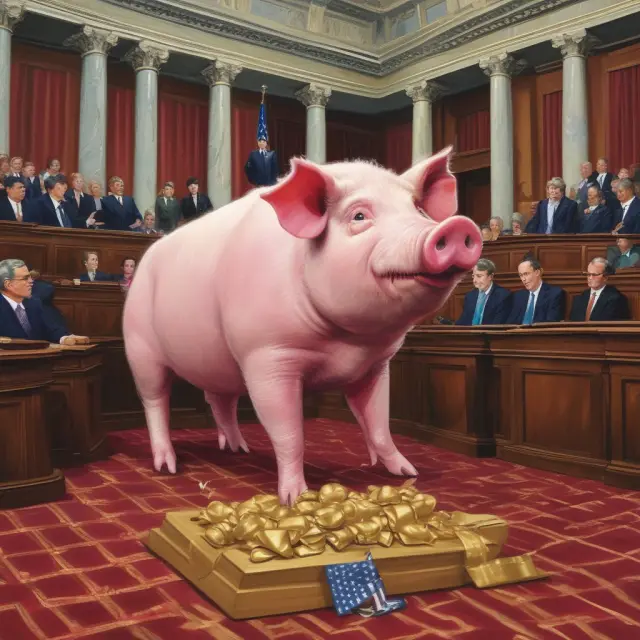
Pork barrel politics, also known as earmarking, refers to a legislative practice where funds for local projects are inserted into larger budgets without undergoing the typical congressional scrutiny or oversight. The term ‘pork barrel’ originated from the belief that politicians would stuff pork – in the form of unnecessary spending items – into these bills for their own benefit and that of their constituents, much like farmers filling a barrel with pork.
This practice can result in inflated budgets as numerous legislators add their pet projects, often under the guise of providing valuable services to their communities or special interest groups. While some politicians view pork barrel politics as an effective means of securing constituent support and political clout, critics argue that it leads to mismanagement of taxpayer dollars and a lack of transparency in government spending.
Citizens Against Government Waste (CAGW) is a nonprofit organization that annually publishes the Congressional Pig Book, which documents pork-barrel projects in the federal budget. According to CAGW, a pork-barrel project is identified if it satisfies at least two of seven criteria:
- Limited Population or Special Interest
- Lack of Competitive Bidding Process
- Requisitioned by Only One Chamber of Congress
- Not Authorized by an Individual
- Not Proposed by the President
- Funding Beyond Prior Year or Budget Request
- No Congressional Hearing
The number and cost of pork-barrel projects reached record levels in 2019 after the Bipartisan Budget Act removed all constraints on such spending, as reported by CAGW.
The practice of pork barrel politics has its origins deep in American history, though it was not formally named until much later. In essence, it represents a legislative loophole where taxpayer dollars can be diverted to specific projects that may or may not provide real value, but instead serve the interests of individual politicians and their constituents.
Attempts have been made to curb pork barrel politics through various measures, most notably the Bipartisan Control Act, which imposed a moratorium on earmarks from 2011 until 2018 when all restrictions were lifted. Another approach was the line-item veto, a power granted to presidents to strike individual budget items, which was ultimately ruled unconstitutional by the Supreme Court in 1998. However, many states have adopted this provision, enabling governors to remove earmarks from state spending bills.
By recognizing the origins and evolution of pork barrel politics, understanding its potential implications, and considering alternative methods for more efficient funding distribution, readers can make informed decisions about the role of pork barrel projects in modern budgeting.
Criteria for Identifying Pork Barrel Projects
In the realm of politics and budgeting, pork barrel projects refer to local or special interest initiatives that receive funding through a larger bill, often bypassing the usual congressional scrutiny and oversight mechanisms. Citizens Against Government Waste (CAGW), a nonprofit organization dedicated to advocating for fiscal responsibility, maintains the annual Congressional Pig Book to document such projects within federal budgets. According to CAGW, a pork barrel project is identified by meeting at least two of the following criteria:
- It benefits a limited population or special interest.
- The project did not undergo a competitive bidding process.
- It was requisitioned by only one chamber of Congress.
- It was not authorized by an individual.
- It was not proposed by the president.
- It required funding that significantly exceeded the president’s official budget request or the prior year’s funding.
- It was not subject to any congressional hearings.
The Congressional Pig Book also includes projects or programs that have appeared in prior years as earmarks. In 2018, the Bipartisan Budget Act lifted all constraints on pork-barrel projects, leading to a record-breaking number and cost for such initiatives in 2019.
It’s essential to note that while local projects can be considered pork barrel, earmarks may also extend beyond strictly local initiatives. For instance, a legislator with a strong base of support among educators or technology companies might add an earmark to the budget funding a pet project of one of those constituencies.
Pork-barrel politics is not a new concept, but it continues to shape modern budgeting in various ways. In the following sections, we’ll explore historical perspectives on pork barrel projects and examine their prevalence and significance during the 21st century. We will also discuss alternatives to this approach, such as merit-based funding and transparency measures, and delve into real-life examples of pork barrel projects and their implications.
Understanding Pork Barrel Politics
Pork-barrel politics refers to a legislator’s practice of adding funding for a local project into the federal budget as a line item, often bypassing established congressional scrutiny or oversight procedures. The term “pork barrel” originated from the belief that legislators were filling their constituents’ districts with ‘pork,’ or unnecessary expenses, to ensure reelection.
Although pork-barreling is sometimes seen as a form of constituent service, critics argue that it distorts the budgeting process and undermines fiscal responsibility by directing resources based on political influence rather than merit.
In recent years, efforts have been made to curb pork barrel projects. For instance, the Bipartisan Control Act placed a moratorium on earmarks from 2011 until it was lifted in 2018. Despite these attempts, numerous pork-barrel projects still slipped through the cracks. The line-item veto, another tool used to remove individual budget items, was granted to presidents but ultimately proved unconstitutional in 1998.
In the following sections, we will examine historical perspectives on pork barrel politics, its prevalence and significance during the 21st century, and alternative methods for distributing funds more efficiently while reducing political influence on budget decisions. We will also provide real-life examples of pork barrel projects and discuss their implications for taxpayers.
Stay tuned for further insights into this fascinating topic!

The Impact of Pork-Barrel Politics on the Federal Budget
Pork barrel politics significantly affects the US federal budget, with taxpayers bearing the brunt of its financial implications. The practice involves securing funding for local projects within larger bills, often bypassing established budgetary procedures and congressional oversight. Let’s examine how pork barrel projects impact the federal budget and taxpayers.
1. Inflated Budgets and Unchecked Spending: Pork barrel politics causes federal spending to soar through the addition of various legislators’ pet projects. The more pork barrel projects there are, the larger the overall budget becomes. This constant inflation in budget size can lead to long-term fiscal issues.
2. Misallocation of Resources: When funds are allocated based on political considerations rather than merit, resources are misdirected from where they could be most effective towards less valuable projects. In turn, taxpayers receive fewer services and infrastructure improvements relative to the amount of money spent.
3. Opacity in Government Spending: Pork barrel politics contributes to a lack of transparency in government spending by making it difficult for taxpayers to understand how their money is being used. The absence of clear justifications and competitive bidding processes further reduces public confidence in the fairness and efficiency of the budgeting process.
4. Consequences for Future Generations: Inflating the federal budget with pork barrel projects means future generations will bear the burden of paying off these debts. As a result, younger generations inherit an increased tax liability and may not have access to essential services or investments that would be more beneficial to their socio-economic development.
5. Wasted Taxpayer Dollars: Pork barrel projects often lack merit, resulting in wasted public funds. An analysis of federal budgets indicates that many of these projects either duplicate existing programs, fail to produce meaningful outcomes, or provide little to no benefit to the taxpayers.
6. Political Repercussions: The prevalence of pork barrel politics can lead to political instability and discontent among the electorate. Voters may become disillusioned with their representatives if they feel that their taxes are being used inefficiently or for projects that do not serve their interests.
To summarize, pork barrel politics has significant implications for the federal budget and taxpayers. By adding pet projects to larger bills without proper oversight, legislators contribute to inflated budgets, misallocation of resources, lack of transparency, and wasted taxpayer dollars. Ultimately, it is crucial that policymakers find a way to address these concerns and move towards a more responsible and transparent budgeting process.

Two Failed Strategies to Address Pork Barrel Politics: The Line-Item Veto and Bipartisan Control Act
The battle against pork barrel politics has seen several attempts to curb the practice, resulting in two significant strategies that, unfortunately, didn’t bear the desired fruits. These efforts include the line-item veto and the Bipartisan Budget Act of 2011 and its successor, the Bipartisan Control Act.
The Line-Item Veto: A Powerful Weapon in the War on Pork Barrel Politics
In 1995, President Bill Clinton was granted the line-item veto by Congress as a tool to strike individual budget items that were deemed pork barrel projects. This power allowed the president to eliminate specific earmarks without vetoing an entire bill. However, during its brief existence, it proved to be a double-edged sword.
Clinton used the line-item veto extensively, eliminating hundreds of millions of dollars’ worth of pork barrel projects. However, this power was short-lived as it was challenged in the U.S. Supreme Court in 1998 and ultimately ruled unconstitutional. Nevertheless, the line-item veto lives on at the state level, where governors can remove earmarks from their respective budgets.
Bipartisan Control Act: A Moratorium with Unintended Consequences
In response to public outrage over rampant pork barrel politics, Congress passed the Bipartisan Budget Act of 2011, which placed a moratorium on earmarks in the federal budget. During this period, the number of earmarks declined significantly, but they didn’t completely disappear. According to Citizens Against Government Waste (CAGW), many projects still managed to slip through despite the moratorium.
In 2018, the Bipartisan Budget Act removed all constraints on pork barrel projects, resulting in a surge in their numbers and costs. The 2019 budget set a new record with a significant increase in the number and price tag of earmarks added to the federal budget.
In conclusion, while the line-item veto and the Bipartisan Budget Act have made some headway in addressing pork barrel politics, their impact has been limited. The practice continues to be a contentious issue, with both proponents and detractors arguing for or against its merits. Despite these setbacks, ongoing efforts are being made to increase transparency and eliminate earmarks from the federal budget, ensuring that taxpayer dollars are used effectively and efficiently.

Congressional Pig Book and Documenting Pork Barrel Projects
One of the most notable nonprofit organizations that have been tracking pork barrel projects in federal budgets is Citizens Against Government Waste (CAGW). Established in 1984, CAGW plays a crucial role in keeping the public informed about their tax dollars being used efficiently by publishing an annual Congressional Pig Book.
According to CAGW, a pork-barrel project refers to a line item in an appropriations bill that designates taxpayers’ money for a specific purpose while circumventing established budgetary procedures. To be classified as a pork barrel project, an entry must satisfy at least two of the following seven criteria:
- The project serves a limited population or special interest.
- It did not undergo a competitive bidding process.
- It was requisitioned by only one chamber of Congress.
- It was not authorized by an individual.
- It was not proposed by the president.
- It required funding that went well beyond the president’s official budget request or the prior year’s funding.
- It was not subjected to any congressional hearings.
Moreover, a project or program must have appeared in prior years as an earmark to qualify for inclusion in the Congressional Pig Book. CAGW reported that the Bipartisan Budget Act of 2018 removed all constraints on pork-barrel projects, leading to an unprecedented number and cost of such projects added to the federal budget in 2019.
Historically, two strategies have been attempted to address the issue of pork barrel politics: the line-item veto and the Bipartisan Control Act. The line-item veto, which is every president’s favorite tool for eliminating earmarks from federal budgets, was granted by Congress in 1995. President Bill Clinton used it extensively to strike individual budget items, but its use was ultimately ruled unconstitutional by the U.S. Supreme Court in 1998. The line-item veto has since been adopted in 44 states, allowing governors to remove earmarks from state spending bills.
The Bipartisan Control Act of 2011 imposed a moratorium on earmarks, which lasted until it was lifted by the Bipartisan Budget Act of 2018. Although some earmarks still managed to slip through during the moratorium years, their numbers increased more than 13% after it was lifted. Despite these efforts, pork barrel politics continues to be a prevalent issue in modern politics.
The Congressional Pig Book serves as an essential resource for the public to monitor and understand the use of taxpayers’ money at all levels of government. By providing detailed information on specific projects that meet CAGW’s criteria, the organization raises awareness about how budgetary decisions impact citizens. In this way, it empowers voters to engage in informed discussions with their elected representatives and encourages transparency within the political process.

Historical Perspective: Origins and Early Development
The origins of pork barrel politics can be traced back to the very foundation of American democracy. In essence, a legislator’s pork barrel could be likened to bringing home the bacon for their district or state. This practice gained significant momentum during the era of the New Deal (1933-1939), as President Franklin D. Roosevelt implemented numerous public works projects across the nation to help alleviate the effects of the Great Depression. With the influx of federal dollars for infrastructure improvements and social services, opportunities arose for lawmakers to attach pet projects to larger spending bills, thereby ensuring the support of their constituents.
As Congress continued its role in distributing funds during World War II and beyond, pork barrel politics persisted as a means for members to secure resources for their districts and states while garnering political favor. However, these practices did not go unchallenged. In the late 1940s, President Harry S. Truman called for an end to what he termed “pork chop” legislation, which referred to unmerited or wasteful projects inserted into appropriations bills. The battle against pork barrel politics continued through subsequent decades, with various attempts made in Congress to limit its influence and promote more efficient budgeting methods.
Fast forward to the late 20th century, when the practice of earmarking became a focal point for public scrutiny. The term “earmark” emerged as a synonym for pork barrel projects that might not strictly benefit a legislator’s district but rather catered to special interests or favored industries. Amid growing concern over government waste and the increasing number of earmarks, nonprofit organizations such as Citizens Against Government Waste (CAGW) took it upon themselves to document these spending items and bring public attention to their impact on the federal budget.
In 1994, CAGW published its first Congressional Pig Book, which highlighted pork barrel projects added to the federal budget without proper oversight or merit-based consideration. This annual publication would serve as a valuable resource for taxpayers and media outlets interested in understanding how their tax dollars were being allocated.
In conclusion, pork barrel politics has been a persistent presence within American politics since its early days. Though it began as an attempt to bring benefits home to constituents and secure political support, it has evolved into a practice that often results in wasteful spending and the circumvention of proper budgeting procedures. With public awareness and advocacy groups like CAGW taking on the issue, it remains to be seen how pork barrel politics will continue to shape federal funding decisions in the future.
For more information on pork barrel projects and their impact on the federal budget, stay tuned for subsequent sections of this article exploring criteria for identifying these spending items, their implications for taxpayers, and historical case studies.

Pork Barrel Politics in the 21st Century
In contemporary politics, pork barrel projects continue to be a contentious issue due to their potential impact on the federal budget and taxpayers’ pockets. The practice of adding local projects into larger bills to bypass congressional scrutiny or oversight has persisted since the early days of American democracy. In the 21st century, pork barrel politics has grown in both prevalence and controversy.
Pork Barrel Politics: A Modern Perspective
Since the term “pork barrel” came into common usage, it has been a subject of debate among policymakers, economists, and taxpayers. The practice gained momentum during the 1970s when President Gerald Ford vetoed hundreds of earmarks in an attempt to control government spending (Citizens Against Government Waste, 2018). However, as political pressures mounted, Congress passed legislation to allow the president to propose earmarks instead of voting them down individually.
The Bipartisan Budget Act of 2018 marked a significant turning point in the history of pork barrel politics. This act removed all constraints on earmarks, leading to a record-breaking number and cost of projects added to the federal budget (Citizens Against Government Waste, 2019). According to Citizens Against Government Waste’s Congressional Pig Book, there were 3,688 earmarks in 2019, totaling approximately $3.5 billion.
The Impact on the Federal Budget and Taxpayers
The prevalence of pork barrel projects in the federal budget has significant financial implications for taxpayers. By adding local projects to larger bills without proper oversight or competition, legislators may allocate funds towards less essential or inefficient initiatives while neglecting more pressing needs. Moreover, these projects often lack transparency and accountability, making it difficult for taxpayers to know exactly how their money is being spent.
Two Unsuccessful Attempts at Change: The Line-Item Veto and Bipartisan Control Act
In response to the growing issue of pork barrel politics, there have been two major attempts to curb or eliminate earmarks in federal budgeting. The first was the Line-Item Veto, which allowed presidents to strike individual items from spending bills. Presidents Bill Clinton and George H.W. Bush both used this power to great effect, but it was ultimately ruled unconstitutional by the U.S. Supreme Court in 1998 (National Conference of State Legislatures, n.d.).
The second attempt came in 2011 with the Bipartisan Control Act, which placed a moratorium on earmarks. Despite this moratorium, many projects still found their way into budgets under various guises. However, its lifting in 2018 led to an increase in both the number and cost of earmarks (Citizens Against Government Waste, 2019).
The Role of Transparency and Merit-Based Funding
To address the issue of pork barrel politics, alternative methods for distributing funds have been suggested. These include increased transparency in the budgeting process and merit-based funding programs that evaluate projects based on their potential benefits rather than political connections or constituent pressure. By shifting away from earmarks and toward more efficient and unbiased allocation of resources, policymakers could save taxpayer dollars and improve overall government effectiveness.

Alternatives to Pork Barrel Politics: Merit-Based Funding and Transparency
In the ongoing debate over the merits of pork barrel politics, alternative methods for distributing funds have emerged as potential solutions to increase efficiency and unbiased allocation. Among these alternatives are merit-based funding and transparency.
Merit-based Funding
The concept of merit-based funding involves allocating resources based on a project’s intrinsic value or its capacity to deliver the desired outcomes effectively. Merit-based systems aim to ensure that projects receive funding based on their demonstrated worth, rather than political connections or influence. In this context, projects are subjected to rigorous evaluation and competition for grants, which ultimately leads to better use of public funds.
Transparency
The importance of transparency in the budgeting process cannot be overstated as it plays a crucial role in reducing opportunities for pork barrel politics. By ensuring that all funding decisions are publicly documented and easily accessible, stakeholders can monitor their implementation and assess their impact on taxpayers. Greater transparency leads to increased accountability and, ultimately, helps minimize the potential for misappropriation of funds.
Impact on Federal Budgeting
Adopting merit-based funding and increasing transparency in federal budgeting processes can help reduce the influence of pork barrel politics on the allocation of public funds. By focusing resources on projects that demonstrate value and results, the government can maximize its impact while maintaining accountability to taxpayers. Moreover, increased transparency enables better oversight of funding decisions and fosters a more informed dialogue among stakeholders.
Case Studies
Several countries have embraced merit-based funding in their public sector. For instance, Finland’s funding model for research and development is based on competitive grant applications. The system ensures that only projects with high potential receive funding, leading to more productive investments and a stronger innovation ecosystem. In the United States, organizations like the National Institutes of Health (NIH) and the National Science Foundation (NSF) employ merit-based systems for research grants. These agencies fund projects based on peer review, which significantly reduces the influence of pork barrel politics in scientific research funding.
Pros and Cons
Merit-based funding and transparency offer numerous benefits, such as allocating funds more efficiently and effectively, minimizing opportunities for political manipulation, and promoting accountability to taxpayers. However, there are also potential downsides. For example, the implementation of a merit-based system may require additional resources and expertise to manage grant applications and assess project proposals. Moreover, it may lead to some worthy but underrepresented projects being overlooked in favor of higher-scoring competitors.
The Future of Pork Barrel Politics: A Balanced Approach
While pork barrel politics has persisted as a part of the political landscape for centuries, there are signs that the tide is turning towards more efficient and unbiased allocation methods. By adopting merit-based funding and increasing transparency in budgeting processes, governments can minimize opportunities for pork barrel projects while maximizing the impact of public investments. However, it is essential to remember that a balanced approach is necessary. Political representatives must maintain the ability to respond to their constituents’ needs and ensure that they continue to represent their interests effectively. In conclusion, the future of pork barrel politics lies in striking the right balance between responsiveness to local concerns and efficient allocation of resources through merit-based funding and transparency.

Case Studies: Notable Examples of Pork Barrel Projects
Pork barrel politics is not just a theoretical construct; it’s an essential part of the legislative process with numerous real-life examples. In 2019, the Congressional Pig Book documented over 5,000 earmarks worth more than $7.8 billion. Here are some notable instances that illustrate the concept and its consequences.
Bridges to Nowhere: The infamous “bridges to nowhere” were a set of three proposed bridges in Alaska intended to connect remote islands with no significant population. Despite lacking any substantial transportation benefits, these bridges garnered $223 million in appropriations between 2001 and 2005.
The Teapot Dome Scandal: A prime example of early pork barrel politics occurred during the Harding Administration (1921-1923). The Teapot Dome scandal involved Secretary of the Interior Albert B. Fall leasing naval oil reserves in California and Wyoming to private companies without bidding, generating a profit of $400,000 for himself. This event is often cited as one of the earliest instances of large-scale political corruption in American history.
Bridge to Nowhere Revisited: In 2015, Sen. Lisa Murkowski (R-AK) attempted to revive a previous failed earmark to build a bridge connecting Kake, Alaska, with Gravina Island. The proposal was met with criticism and eventually failed due to lack of support from her fellow senators.
The Bridge to Nowhere: A More Recent Example: In 2016, Sen. Mitch McConnell (R-KY) included a $32 million earmark to replace the Brent Spence Bridge in his home state during an unrelated transportation bill. Critics argued that the project was not a true necessity and lacked transparency regarding its costs and benefits.
These examples demonstrate how pork barrel projects can lead to wasteful spending, corruption, and inefficiencies in government budgeting. However, they also highlight the power of constituents and legislators to influence budgetary decisions.
Pros and Cons of Pork Barrel Politics
Pork barrel politics is a double-edged sword, with both advantages and disadvantages. While it can lead to improved infrastructure and local economic development, it also opens the door to corruption and inefficient spending. The debate continues as to whether these benefits outweigh the potential drawbacks.
The FAQ Section
FAQ: Commonly Asked Questions About Pork Barrel Politics
What is pork barrel politics?
Pork barrel politics refers to a legislator’s practice of inserting funding for a local project into a larger budget, often bypassing typical congressional scrutiny and oversight.
How does the Congressional Pig Book define pork-barrel projects?
The Congressional Pig Book defines pork-barrel projects as line items in an appropriations bill that designate tax dollars for a specific purpose while circumventing established budgetary procedures.
Is earmarking the same thing as pork barrel politics?
Earmarking is similar to but not exactly the same as pork barrel politics, as it may include projects not strictly local in scope.
Why are earmarks controversial?
Critics argue that earmarks can lead to wasteful spending, corruption, and a lack of transparency. Proponents contend that they enable legislators to deliver critical infrastructure projects and support for their constituents.
What attempts have been made to reduce pork barrel politics in the US?
The Bipartisan Control Act placed a moratorium on earmarks from 2011-2018, but this was lifted in 2018 when the Bipartisan Budget Act removed all restraints. The line-item veto, which allowed presidents to strike individual budget items, was ruled unconstitutional by the Supreme Court in 1998.

Pros and Cons of Pork Barrel Politics
Pork barrel politics, a practice where legislators add funding for local projects into larger budget bills, can be viewed as both beneficial and detrimental, depending on one’s perspective. This section will provide a balanced analysis of its advantages and disadvantages.
On the positive side, pork barrel politics enables legislators to secure funds for essential projects in their districts that may not receive sufficient attention or resources otherwise (Congressional Research Service, 2014). By securing funding for local infrastructure, education, and research initiatives, politicians can demonstrate their commitment and responsiveness to their constituents. This can help build trust and strengthen support in the community.
Moreover, pork barrel projects can spur economic growth by attracting businesses, creating jobs, and stimulating investment (Morris & Shapiro, 2013). Additionally, these projects may contribute to addressing pressing issues such as transportation challenges or public health concerns, ultimately benefiting the broader population.
However, pork barrel politics can also lead to misallocation of resources and exacerbate fiscal deficits. When legislators earmark funds for local projects, they divert resources away from other critical national needs and potentially less effective programs (Congressional Research Service, 2014). Furthermore, the absence of proper oversight and competitive bidding processes can result in higher costs and inefficient project execution.
The lack of transparency surrounding pork barrel projects can also fuel public skepticism and distrust in government. These concerns intensified with the annual Congressional Pig Book documenting pork-barrel projects in the federal budget, published by Citizens Against Government Waste (CAGW). The publication highlighted numerous instances of questionable projects, further fueling calls for increased accountability and transparency.
One potential solution to mitigate the negative impacts of pork barrel politics is merit-based funding and a more transparent allocation process. Implementing such measures can ensure that resources are directed towards projects with proven benefits and outcomes while minimizing political considerations (Congressional Research Service, 2014). Additionally, increasing transparency and competition in the budgeting process can lead to more efficient use of taxpayer dollars and a better balance between local and national priorities.
In conclusion, pork barrel politics represents both an opportunity for legislators to address pressing local needs and potential drawbacks that can misallocate resources and undermine public trust. While it is essential to acknowledge the positive aspects of this practice, it is equally important to strive for increased transparency, accountability, and merit-based funding in order to make the most effective use of taxpayer dollars.

FAQ: Commonly Asked Questions About Pork Barrel Politics
What is pork barrel politics?
Pork barrel politics refers to the legislative practice of slipping funding for a local project into a budget, with the project having nothing to do with the bill and benefiting only the legislator’s home district or special interest. A budget can be significantly inflated through such additions, often called earmarks, which may bypass usual congressional scrutiny or oversight.
How does pork barrel politics impact the federal budget?
Pork barrel projects increase the overall costs of a bill and may divert funds from other priorities. The lack of competition in funding decisions can lead to inefficiencies, waste, and unequal distribution of resources. This phenomenon became particularly evident following the Bipartisan Budget Act of 2018, which removed all constraints on pork barrel projects.
What are some criteria for identifying pork barrel projects?
As defined by Citizens Against Government Waste (CAGW), a pork-barrel project is a line item in an appropriations bill that designates tax dollars for a specific purpose while circumventing established budgetary procedures. Projects satisfying at least two of the following criteria are considered pork barrel: They serve a limited population or special interest; they did not undergo a competitive bidding process; they were requisitioned by only one chamber of Congress; they were not authorized by an individual; they were not proposed by the president; they required funding that went well beyond the president’s official budget request or the prior year’s funding; and they were not subjected to any congressional hearings.
What are some historical perspectives on pork barrel politics?
Pork barrel politics can be traced back to ancient Rome, but the practice gained significant momentum in the United States during the 19th century. The term “pork barrel” is believed to have originated from the practice of distributing pork barrels filled with pork to soldiers and sailors during the Civil War.
How has pork barrel politics evolved in modern times?
In the 20th century, the power to add earmarks was largely concentrated among congressional committee chairs, making it difficult for outsiders to challenge these projects. However, with increased scrutiny and public pressure, efforts have been made to reduce the influence of pork barrel politics on federal budgeting. The Bipartisan Control Act imposed a moratorium on earmarks from 2011 to 2018, but their numbers and costs skyrocketed after the restraints were lifted in 2018.
Are there alternatives to pork barrel politics?
Alternatives to pork barrel politics include merit-based funding, where projects are awarded based on objective criteria and a competitive bidding process, as well as greater transparency in budgeting and a more active role for the executive branch in vetting proposed projects. These methods can help ensure that taxpayer dollars are allocated efficiently and fairly.
What is the impact of pork barrel politics on the federal deficit?
Pork barrel projects contribute to increasing federal spending, which can lead to a larger federal deficit. The lack of competition in funding decisions and unequal distribution of resources can result in wasted taxpayer dollars, diverting funds from more pressing priorities.
 Next entry · No. 4,011Understanding Porter’s Diamond Model: The Path to a Nation’s Economic Competitive Advantage
See also
-
 No. 1,167
06 Aug 2024
25 min
Earmarking: Understanding the Practice of Setting Money Aside for Specific Purposes
Finance Policy
No. 1,167
06 Aug 2024
25 min
Earmarking: Understanding the Practice of Setting Money Aside for Specific Purposes
Finance Policy -
 No. 4,467
21 Jun 2025
18 min
Revolving Door: Understanding the Phenomenon and Its Implications
Government
No. 4,467
21 Jun 2025
18 min
Revolving Door: Understanding the Phenomenon and Its Implications
Government -
 No. 5,883
15 Oct 2025
17 min
Understanding ZCash (ZEC): A Decentralized Cryptocurrency with Enhanced Security and Anonymity
Crypto
No. 5,883
15 Oct 2025
17 min
Understanding ZCash (ZEC): A Decentralized Cryptocurrency with Enhanced Security and Anonymity
Crypto -
 No. 5,789
07 Oct 2025
19 min
Understanding Working Capital Loans: A Comprehensive Guide for Institutional Investors
Business Finance
No. 5,789
07 Oct 2025
19 min
Understanding Working Capital Loans: A Comprehensive Guide for Institutional Investors
Business Finance -
 No. 5,773
06 Oct 2025
21 min
Word-of-Mouth Marketing: Understanding the Power of Shared Experiences in Finance and Investment
Business Strategy
No. 5,773
06 Oct 2025
21 min
Word-of-Mouth Marketing: Understanding the Power of Shared Experiences in Finance and Investment
Business Strategy -
 No. 5,747
04 Oct 2025
22 min
Window Dressing in Finance: Unveiling Deceptive Practices in Mutual Funds and Accounting
Business Finance
No. 5,747
04 Oct 2025
22 min
Window Dressing in Finance: Unveiling Deceptive Practices in Mutual Funds and Accounting
Business Finance