Stop Payment on a Check: The Request Procedure, Rules and Fees
To stop payment on a check, tell your bank before it pays the check. A written order lasts 6 months in most states; big banks charge about $30.
To stop payment on a check, contact your bank or credit union as soon as possible and give it the check number, the exact amount, the payee's name and the date. Do this by app, online banking, phone or branch, then confirm it in writing if you placed it by phone. The order works only if it reaches the bank before the bank pays the check. Once the check has cleared your account, a stop payment is too late.
Under Article 4 of the Uniform Commercial Code, which states have adopted as their law on checks, a written stop payment order lasts six months and can be renewed. An oral order lapses after 14 calendar days unless you confirm it in writing. As of September 2026, Chase, Bank of America and Wells Fargo each charge up to $30 per stop payment request, with waivers on some accounts. This page walks through the stop payment request procedure step by step and the rules that decide whether it works. It also covers what it costs, why official bank checks are different, and what to do when a check is lost or stolen. It is general information; your deposit account agreement governs your own account.
What a Stop Payment Order on a Check Is
A stop payment order is your instruction to your own bank not to pay a specific check you wrote. The check is still out in the world, but when the payee's bank presents it for payment, your bank returns it unpaid instead of taking the money from your account.
The right comes from state law. Section 4-403 of the Uniform Commercial Code says a customer "may stop payment of any item drawn on the customer's account" by an order "describing the item or account with reasonable certainty," received in time for the bank to act on it. On a joint account, anyone authorized to write checks can stop one. If an account needs two signatures, either signer can stop payment alone.
Three limits follow from that wording:
- It applies only to checks drawn on your account. You cannot stop payment on a check someone wrote to you, and generally not on a cashier's check you bought (see below).
- Your description has to be accurate. The OCC's HelpWithMyBank site says a bank is not liable for paying a stopped check if you fail to give enough information to identify the check or fail to give enough notice.
- Timing is everything. The order must arrive before the bank has paid the check.
A stop payment is not the same as voiding a check. Writing "VOID" across a blank or unsent check makes it unusable; for card and electronic transactions, the entry on void transactions covers that process. A stop payment deals with a check that has already left your hands.
Reasons to Request a Stop Payment on a Check
People ask their bank to stop payment for a handful of recurring reasons. If you are asked to list at least two reasons why an individual might request a stop payment, any two of these will do:
- The check was lost or stolen. It went missing in the mail, fell out of a bag, or was taken from a mailbox. The Consumer Financial Protection Bureau's advice when a store loses your check is that you "can stop payment on the lost check and then write a new one," and you may ask the store to reimburse the stop payment fee.
- You wrote the wrong amount or the wrong payee and want to replace the check before it is cashed.
- You paid twice, for example mailing a check and then paying the same bill online.
- The goods or services never arrived or were defective, and you want to hold the money while you resolve the dispute with the seller.
- You suspect fraud, such as a check that was altered, a stolen checkbook, or a scam where you were pressured to pay quickly.
Stopping payment does not cancel what you owe. If you have a genuine debt to the payee, you will still need to pay it another way.
Stop Payment Request Procedure: Steps to Issue a Stop Payment Order
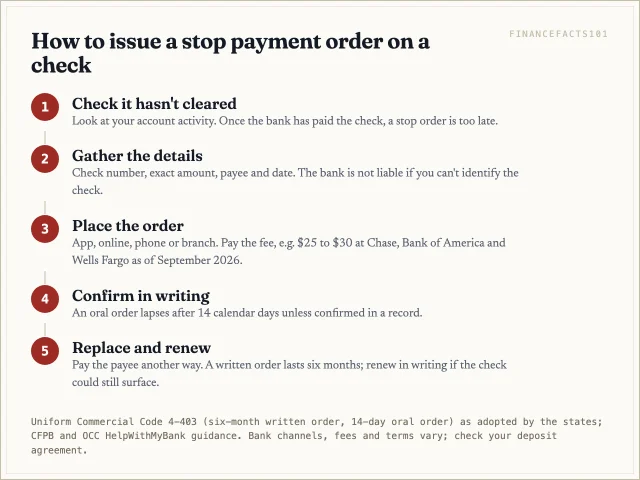
The steps you should take to issue a stop payment order are the same at almost every bank:
- Check whether the check has already cleared. Look at your account activity online or in the app. If the check has already been paid, a stop payment cannot help, and you need to deal with the payee directly.
- Gather the details. Check number, exact amount, payee name and date. The bank matches its order against the check when it is presented, so an error can let the check through.
- Place the order through your bank's channels. Most large banks take stop payments in their app or online banking, by phone and at a branch. Wells Fargo, for example, lists all four on its stop payment help page.
- Confirm it in writing if you called. An oral order lapses after 14 calendar days under UCC 4-403(b) unless it is confirmed "in a record." A record can be electronic, so a request made online is already in writing; if you called, ask the bank how it wants the confirmation.
- Pay the fee and keep the confirmation. Note the date, the confirmation number and the expiry date.
- Tell the payee and replace the check if needed. Let the payee know the original will be returned unpaid if it is deposited, then send a replacement or pay another way.
- Diary the expiry date. Renew the order before it lapses if the original check could still surface.
Stop Payment Rules on Checks: Timing, Duration and Liability
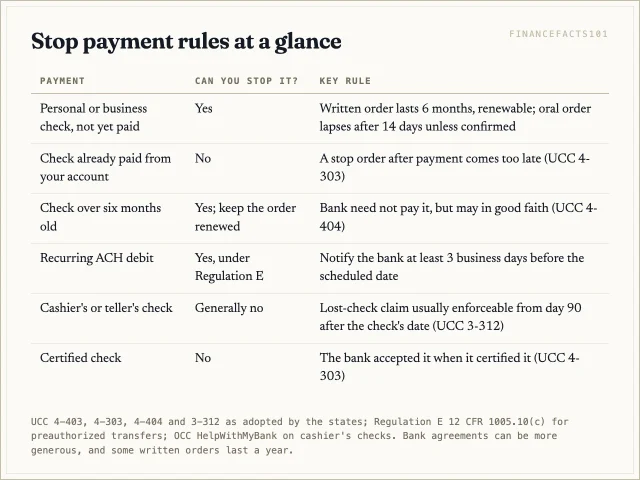
The core stop payment rules on checks come from UCC Article 4, as adopted in each state. Banks can add their own terms in the deposit agreement, and some are more generous.
When it is too late. UCC 4-303 lists the points after which a stop order "comes too late," including when the bank has certified the check, paid it in cash, or settled for it without a right to revoke. For checks it also sets a cutoff no later than the close of the next banking day after the bank received the check. In practice, if the check has posted to your account, assume you have missed the window.
How long it lasts. Six months for a written order, renewable in writing for further six-month periods while the order is still in effect; 14 calendar days for an oral order not confirmed in writing. The CFPB notes that most states follow the six-month rule for written orders, and that "in some cases, the stop payment expires after one year," per its answer on how to stop payment on a check. Your bank's terms tell you which applies.
Old checks. Under UCC 4-404, a bank "is under no obligation" to pay a check, other than a certified check, presented more than six months after its date, but "it may charge its customer's account for a payment made thereafter in good faith." A stale check can still be paid, which is why renewing a stop order matters.
If the bank pays anyway. The bank may be liable to you, but UCC 4-403(c) puts "the burden of establishing the fact and amount of loss" on you, the customer. If you owed the payee the money anyway, you may have no loss to recover. Under UCC 4-407, a bank that pays over a stop order can step into the payee's or a later holder's rights against you to prevent unjust enrichment.
The check may still be enforceable against you. If the payee cashed or sold the check to someone who took it in good faith, such as a check-cashing store, that holder may still be able to pursue you for the amount even though your bank refused it. Under UCC 3-305(b), a holder in due course is not subject to ordinary disputes such as goods that never arrived, only to narrower defenses such as fraud about the nature of what you signed, duress or illegality.
What a Stop Payment Costs
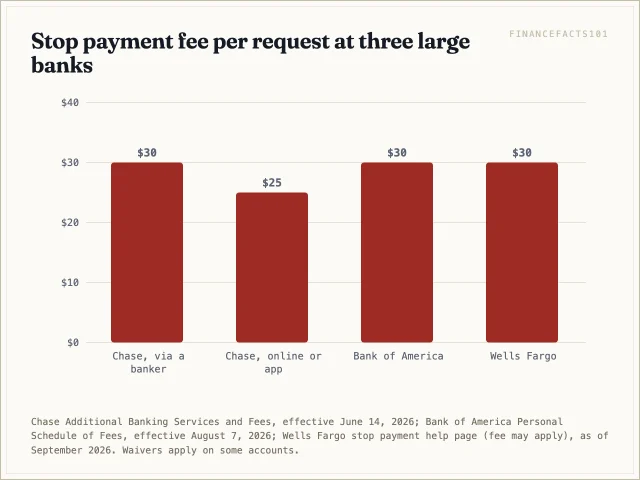
Fees are set by each bank, and the CFPB notes only that your institution "may charge you a fee." At three of the largest US banks the price is similar as of September 2026:
- Chase: $30 per request when a banker places it, or $25 when you use chase.com, the Chase Mobile app or the automated phone line, per its fee schedule effective June 14, 2026. Some premium accounts include free stop payments.
- Bank of America: $30 per request, per its personal schedule of fees effective August 7, 2026. The fee is waived on Advantage Relationship Banking, Advantage with Tiered Interest Checking and Advantage Regular Checking accounts, and for account owners in the Preferred Plus, Preferred Honors or Premier tiers of BofA Rewards. There is no charge to stop debit card or Bill Pay transactions.
- Wells Fargo: "A fee of $30 per item may apply," with waivers on some accounts, per its stop payment help page.
Credit unions and smaller banks set their own prices. Check your fee schedule before you call; a $30 fee on a $40 check may not be worth paying. The same schedules list overdraft and returned-item charges, which the guide to overdraft fees compares.
A Worked Example: Stopping a $1,250 Check
Suppose you mailed a $1,250 check to a contractor on September 2, 2026, and on September 24 the contractor tells you it never arrived. Your online banking shows the check has not been paid.
- You place the order online on September 24. At Chase that costs $25; at Bank of America, $30 unless your account waives it. That is 2% to 2.4% of the check.
- The order is in writing, so under the UCC it lasts six months, to about March 24, 2027. If you had called instead and never confirmed in writing, the order would lapse after 14 calendar days, around October 8, 2026.
- You write a new check, marking the memo line as a replacement for check number 1043, and ask the contractor to destroy the original if it turns up.
- In March 2027, if there is any chance the original is still out there, you renew the order in writing. Because a bank may still pay a stale check in good faith, the six-month mark is not a guarantee.
If the replacement is urgent and the amount is large, some people close the account instead. The CFPB suggests that option if you need a check never to clear.
Official Bank Check Stop Payment: Cashier's, Certified and Teller's Checks
An official bank check is one the bank itself is responsible for, not you. That changes the rules.
Cashier's checks. You generally cannot stop payment on a cashier's check. The OCC's HelpWithMyBank explains that it "is drawn directly on the bank that issues the check, not on your account," and the bank must honor it when it is presented for payment. If the check is lost, stolen or destroyed, contact the issuing bank right away. The OCC says the bank will require an indemnity bond before replacing a lost cashier's check, so that you rather than the bank are liable if the original is later presented, and that even after you present one, a bank may require you to wait 30 to 90 days before it issues a replacement.
The 90-day rule. UCC 3-312 lets the remitter or payee of a lost cashier's or teller's check file a declaration of loss. The claim becomes enforceable on the later of the day it is made or "the 90th day following the date of the check." Until then the bank may still pay anyone entitled to the check. Wells Fargo's own terms apply a 90-day waiting period before it will stop and reissue an outstanding cashier's check over $1,000, with 30 days in Wisconsin and 91 in New York, and require an indemnity agreement. It says the wait can be avoided by buying an acceptable surety bond.
Certified checks. Once your bank certifies a check, it has accepted it, and under UCC 4-303 a stop order after certification comes too late.
Teller's checks. A bank that wrongfully stops payment on its own teller's check can owe the holder expenses, lost interest and sometimes consequential damages under UCC 3-411.
If you receive an official check from a stranger, treat it with care. The FTC warns that "even if you see the funds in your account, that doesn't mean it's a good check," and if a fake check bounces, you are the one repaying the bank.
Stopping Automatic Payments Is a Different Process
A recurring debit from your account, such as a gym or loan payment pulled by ACH, is not a check. On a personal account, federal law rather than the UCC governs it; business accounts fall outside Regulation E and depend on the bank's terms and payment-network rules. Under Regulation E, 12 CFR 1005.10(c), you can stop a preauthorized electronic transfer "by notifying the financial institution orally or in writing at least three business days before the scheduled date of the transfer." The bank may require written confirmation within 14 days of an oral request.
The CFPB recommends telling both the company and your bank that you have revoked authorization, and keeping a record of the dates. Wells Fargo says its stop payments on ACH items remain in effect indefinitely, unlike the six-month limit on checks. As with checks, canceling the payment does not cancel the debt. Wire transfers follow different rules again; the entry on wire transfers covers how they work.
When a Stop Payment Is Not Enough: Lost Checks, Theft and Fraud
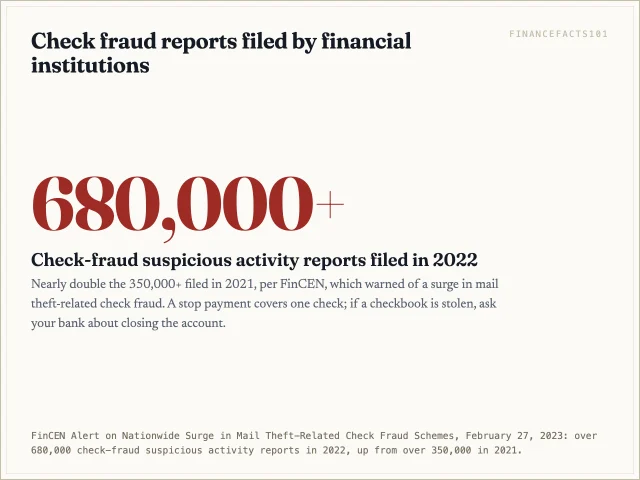
Checks are used less every year but are still a large target for fraud. The Federal Reserve's payments study counted 9.2 billion check payments in 2024, down from 17.0 billion in 2015, with an average value of $2,653.
The Treasury's Financial Crimes Enforcement Network warned in February 2023 of a nationwide surge in check fraud linked to mail theft. Financial institutions filed more than 680,000 suspicious activity reports on check fraud in 2022, nearly double the year before.
A stop payment covers one check. If a checkbook is stolen or a check was altered or counterfeited, ask your bank about closing the account and opening a new one; the CFPB suggests closing the account when you need to be sure a check never clears. Review statements promptly, since state law and your deposit agreement set deadlines for reporting unauthorized or altered checks, and a late report can shift the loss to you.
FAQ
How long does a stop payment on a check last?
Under the Uniform Commercial Code, which most states follow, a written stop payment lasts six months and can be renewed in writing for further six-month periods. An oral order lapses after 14 calendar days unless confirmed in writing. Some banks' terms run longer, up to a year, so check your account agreement.
Can I stop payment on a check that has already cleared?
No. Once your bank has paid the check, a stop payment order comes too late. You would need to ask the payee to refund the money or pursue the dispute directly. If the check was forged or altered, report it to your bank as unauthorized instead.
Can I put a stop payment on a cashier's check or other official bank check?
Generally no. A cashier's check is the bank's own obligation, so the bank must honor it. If one is lost, stolen or destroyed, the bank can usually replace it, but it will generally require an indemnity bond or agreement, and according to the OCC it may require you to wait 30 to 90 days before issuing the replacement.
Does a stop payment cancel the debt I owe?
No. It only stops that check. If you owe the money, you still have to pay it another way, and someone who took the check in good faith may still be able to pursue you for it.
Sources
- Uniform Commercial Code via Cornell Law School LII: § 4-403 (right to stop payment; six-month and 14-day rules; burden of proof), § 4-303 (when a stop order comes too late), § 4-404 (checks over six months old), § 4-407 (bank's subrogation rights), § 3-312 (lost cashier's, teller's and certified checks), § 3-411 (refusal to pay official checks), § 3-305 (defenses against a holder in due course)
- CFPB, How do I stop payment on a check? — fees, six-month rule, one-year expiry in some cases, closing the account
- CFPB, I wrote a check to a merchant and they lost it — stop payment and reimbursement of the fee
- CFPB, How do I stop automatic payments from my bank account?
- CFPB, Regulation E § 1005.10 — stop payment of preauthorized transfers, three business days
- OCC HelpWithMyBank, Can the bank pay a check after I place a stop payment on it?, Can I put a stop payment order on a cashier's check? and Why do I need an indemnity bond to replace a lost cashier's check? — indemnity bond and a possible 30-to-90-day wait
- FinCEN, Alert on Nationwide Surge in Mail Theft-Related Check Fraud Schemes (February 27, 2023) — 680,000+ check fraud SARs in 2022
- Federal Reserve, Federal Reserve Payments Study: national payment volumes, CY 2015–24 — 9.2 billion check payments in 2024, average value $2,653
- FTC, How to spot, avoid, and report fake check scams
- Chase, Additional Banking Services and Fees for Personal Accounts, effective June 14, 2026 — stop payment $30 by banker, $25 online or automated phone
- Bank of America, Personal Schedule of Fees, effective August 7, 2026 — stop payment $30 and waivers
- Wells Fargo, Order checks, stop payment on a check, and other requests — $30 fee, channels, six months for checks and indefinitely for ACH, cashier's check waiting periods, indemnity agreement and surety bond
 Next entry · No. 4,771Understanding Stop Orders: A Comprehensive Guide for Institutional and Professional Investors
See also
-
 No. 4,469
21 Jun 2025
22 min
Revolving Credit: Understanding the Flexible Financial Tool for Institutional and Professional Investors
Business Finance
No. 4,469
21 Jun 2025
22 min
Revolving Credit: Understanding the Flexible Financial Tool for Institutional and Professional Investors
Business Finance -
 No. 5,794
08 Oct 2025
16 min
Workout Agreements: A Mutual Solution for Borrowers and Lenders
Business Finance
No. 5,794
08 Oct 2025
16 min
Workout Agreements: A Mutual Solution for Borrowers and Lenders
Business Finance -
 No. 5,755
05 Oct 2025
20 min
Understanding Wire Transfers: A Comprehensive Guide for Institutional Investors
Business Finance
No. 5,755
05 Oct 2025
20 min
Understanding Wire Transfers: A Comprehensive Guide for Institutional Investors
Business Finance -
 No. 5,587
21 Sep 2025
20 min
Understanding Walk-Away Leases: Pros, Cons, and Alternatives for Professional Investors
Business Finance
No. 5,587
21 Sep 2025
20 min
Understanding Walk-Away Leases: Pros, Cons, and Alternatives for Professional Investors
Business Finance -
 No. 5,515
15 Sep 2025
17 min
Understanding Void Transactions: A Comprehensive Guide
Business Finance
No. 5,515
15 Sep 2025
17 min
Understanding Void Transactions: A Comprehensive Guide
Business Finance -
 No. 1,499
24 Sep 2024
17 min
Understanding Finance Charges: Definition, Types, Regulations, and Impact on Investors
Business Finance
No. 1,499
24 Sep 2024
17 min
Understanding Finance Charges: Definition, Types, Regulations, and Impact on Investors
Business Finance