Understanding Descriptive Statistics: Measures of Central Tendency, Variability, and Frequency
Understanding Descriptive Statistics: Key concepts include measures of central tendency, variability, frequency, visualization techniques, and their roles…
Introduction to Descriptive Statistics
Descriptive statistics are crucial tools for understanding and interpreting data sets, offering valuable insights into their central tendencies and variability. These measures condense complex data sets into easily digestible summaries, enabling us to identify trends, patterns, and relationships in our data. In this section, we delve deeper into descriptive statistics, discussing its significance, types, and functions.
Descriptive statistics serve as an introduction or preliminary analysis of a dataset, providing essential insights before applying advanced statistical techniques. By summarizing key features of the data, such as average, range, and frequency distribution, we can develop a solid foundation for further exploration.
The significance of descriptive statistics lies in its ability to succinctly represent complex information, making it accessible to a wide audience. Its primary functions include:
- Summarizing large datasets
- Identifying trends and patterns
- Facilitating comparisons between datasets
- Providing insights for further statistical analysis
Descriptive statistics are categorized into three main types: measures of central tendency, measures of variability (spread), and frequency distribution. Let’s explore each type in more detail:
Understanding Central Tendency Measures
Central tendency measures provide insight into the typical or most frequently occurring value within a dataset. The most common measures include the mean, median, and mode.
The Mean: Calculated by summing all values in the data set and then dividing by the total number of observations, the mean represents an average value that may be affected by outliers.
The Median: Represents the middle value when data is arranged in order from least to greatest or greatest to least. It is not influenced by extreme values (outliers) and serves as a robust measure for identifying central tendencies.
The Mode: Refers to the value that appears most frequently within the dataset, offering another way to identify central tendencies.
Exploring Measures of Variability
Measures of variability provide insight into the spread or dispersion of data points in a dataset. By understanding the distribution and degree of variability, we can make more informed decisions and draw meaningful conclusions.
Key measures of variability include:
- Range: The difference between the largest and smallest values within the dataset
- Variance: Calculated by subtracting each data point from the mean and then averaging the deviations
- Standard Deviation: A more refined measure of spread, taking into account the degree of dispersion from the mean
- Quartiles: Divide data into four equal parts based on order to identify quartile ranges and interquartile range (IQR)
- Absolute deviation: The absolute difference between each data point and the median
In the next section, we will delve deeper into how descriptive statistics are applied in finance and investment analysis. Stay tuned!

Understanding Central Tendency Measures
Central tendency measures are a vital aspect of descriptive statistics, which help determine the middle or average values in a data set. These measures provide valuable insights into the distribution of data by identifying the most common occurrences and locations around which other values cluster. In this section, we will explore three essential central tendency measures: mean, median, and mode.
1. Mean: Mean, also known as the arithmetic mean or average, is a commonly used measure to identify the center of a data set by adding all the data points and then dividing the sum by the total number of data points. For example, if we have a set of numbers {2, 5, 7, 8}, calculating the mean would be (2 + 5 + 7 + 8)/4 = 6. Mean is useful for understanding the typical value in a symmetrically distributed dataset but can be misleading when dealing with skewed distributions.
2. Median: The median represents the middle value in an ordered data set; it separates the higher and lower halves of the data. For instance, if we have the following data set {1, 5, 7, 8, 9}, the median is 7, as there are two equal values at this position when ordering the data from least to greatest. The median is particularly useful when dealing with skewed distributions or extreme outliers since it provides a more robust representation of the central tendency compared to the mean.
3. Mode: The mode refers to the value that appears most frequently in a dataset. For example, in the data set {1, 2, 2, 5, 5, 5}, the mode is 5 since it occurs three times more often than any other value. This measure is helpful for understanding the most common occurrences within a dataset and can be useful when dealing with categorical data.
In conclusion, understanding central tendency measures is crucial in descriptive statistics as they help identify the middle or average values of a dataset. Mean, median, and mode are three essential central tendency measures that provide valuable insights into the distribution of data and can be used to understand the typical value, most common occurrence, and robust representation of the center, respectively.
Descriptive statistics play an important role in finance and investment by providing insights into financial statements, stocks, and other investment-related data. For example, calculating the mean return on investment (ROI) can help investors determine the typical performance of their investments over a given time frame. Similarly, identifying the median price of a stock can give investors a more robust understanding of its value compared to the mean price, especially when dealing with extreme outliers or skewed distributions.
In summary, central tendency measures are integral components of descriptive statistics and play an essential role in understanding the middle values and typical occurrences within a dataset. Mean, median, and mode provide valuable insights into symmetrically and skewed distributed data, making them indispensable tools for financial analysis and investment decision-making.
Exploring Measures of Variability
Descriptive statistics, a crucial tool in data analysis, condenses complex data sets into succinct, valuable summaries. Among these, measures of central tendency (mean, median, mode) and measures of variability (range, variance, standard deviation, quartiles, absolute deviation) play essential roles in comprehending the nature of a data set.
Measures of variability address how dispersed or spread out the data points are within a specific data set. By examining these measures, analysts gain insights into the shape and distribution of the dataset. Let us delve deeper into various measures of variability:
- Range: The range is the simplest measure of variability that involves calculating the difference between the highest and lowest values in a dataset. For example, if we have the data set {3, 5, 7, 8, 10}, the range would be 7 (10 – 3).
- Variance: Variance is another essential measure of variability that calculates how far each data point deviates from the mean value. To calculate variance, first, find the difference between each data point and the mean; square these differences, and then average those squared differences. For instance, using our previous example with a dataset {3, 5, 7, 8, 10} and a mean of 6:
– Difference from mean: {-3, 1, 2, 2, 4}
– Squared differences: {9, 1, 4, 4, 16}
– Average squared difference (variance): 7.2
3. Standard Deviation: Standard deviation is the square root of variance, which makes it easier to interpret since it’s in the same scale as the data itself. In our example:
– Variance: 7.2
– Standard deviation: 2.685 (the square root of 7.2)
4. Quartiles: Quartiles divide a dataset into four equal parts, allowing analysts to understand how data is distributed throughout the range. The first quartile (Q1) represents the 25th percentile, while the third quartile (Q3) represents the 75th percentile. To calculate Q1 and Q3, find the median of each half of the dataset:
– For our data set {3, 5, 7, 8, 10}, the median is 6.5. Since there are five values in this dataset, the lower quartile (Q1) represents the value below the median, and the higher quartile (Q3) is above it. So, Q1 is 5 and Q3 is 8.
5. Absolute Deviation: The absolute deviation measures how far each data point is from the mean by calculating the simple difference between every data point and the mean value, regardless of whether they are above or below the mean. For example, using our dataset {3, 5, 7, 8, 10} with a mean of 6:
– Absolute deviations for each data point: {-3, 1, 2, 2, 4}
In finance and investment analysis, measures of variability are essential when assessing risk and volatility. For instance, investors can analyze the standard deviation of stock prices to evaluate potential risks and returns. Additionally, portfolio managers use measures of variability like range and standard deviation to allocate assets efficiently based on risk tolerance.

Analyzing Univariate and Bivariate Data
Descriptive statistics play an integral role in understanding and analyzing data sets. It’s essential to know the difference between univariate and bivariate data when dealing with descriptive statistics, as each has unique applications and methods of analysis.
Univariate Data: Single Variable Analysis
Univariate data refers to data that involves only one variable or dimension. It is used primarily to identify patterns or trends within a single dataset. For instance, analyzing the frequency distribution of student test scores in a class is an example of univariate analysis. Univariate statistics provide a comprehensive understanding of the central tendency and variability of a single data set.
Central Tendency Measures: Mean, Median, Mode
Measures of central tendency are used to determine the center or typical value within a dataset. The three most common measures for univariate analysis include mean, median, and mode.
Mean: Mean is the most commonly used measure of central tendency that represents the sum total of all values divided by the number of values in a dataset. For example, if we calculate the mean of five numbers 2, 4, 5, 6, and 8, the result would be (2+4+5+6+8)/5 = 5.6.
Median: Median is the middle value of an ordered dataset when arranged in ascending or descending order. In a dataset with odd numbers, the median represents the exact middle value. For example, if we have an ordered dataset (2, 4, 5, 6, 8), the median would be 5 since it is the middle value.
Mode: Mode represents the value that occurs most frequently in a given dataset. In a dataset with multiple modes, each mode refers to the values that occur most often. For example, if we have a dataset consisting of numbers {1, 2, 3, 3, 4, 4}, the two modes are 3 and 4, since both appear more frequently than any other value.
Variability Measures: Range, Variance, Standard Deviation, Quartiles, Absolute Deviation
Measures of variability help determine how spread out or dispersed the data is from its central tendency. Some common measures include range, variance, standard deviation, quartiles, and absolute deviation.
Range: Range refers to the difference between the minimum value and maximum value in a dataset. For instance, given the dataset {1, 4, 5, 6, 8}, the range would be 7 (maximum value – minimum value).
Variance: Variance measures how much data points deviate from the mean. It is calculated by summing up the squared differences of each data point from the mean and then dividing it by the dataset size. For example, if a dataset consists of numbers 2, 4, 5, 6, and 8, with a mean of 5.6, the variance would be ((2-5.6)² + (4-5.6)² + (5-5.6)² + (6-5.6)² + (8-5.6)²)/5 = 10.4
Standard Deviation: Standard deviation is the square root of variance and provides a measure of how spread out the data is from the mean in units of the standard deviation itself. For instance, given a variance of 10.4 for the previous dataset, the standard deviation would be 3.23 (√10.4).
Quartiles: Quartiles divide a dataset into four equal parts when arranged in order. The first quartile represents the value below which 25% of data points fall, the second quartile is the median, while the third quartile represents the value below which 75% of data points fall.
Absolute Deviation: Absolute deviation refers to the absolute difference between each data point and the mean. For instance, given a dataset with numbers {2, 4, 5, 6, 8} and a mean of 5.6, the absolute deviations would be |2-5.6| = 3.6, |4-5.6| = 1.6, |5-5.6| = 0.4, |6-5.6| = 0.8, and |8-5.6| = 2.4.
Bivariate Data: Two Variable Analysis
Bivariate data analysis is used to determine the relationship between two variables in a dataset. This type of analysis provides insights into correlation, causation, or association between the variables. For instance, analyzing the relationship between students’ test scores and their grade point averages (GPAs) would be an example of bivariate data analysis.
In conclusion, understanding univariate and bivariate data is crucial when working with descriptive statistics. Univariate data helps identify trends and patterns within a single dataset, while bivariate data sheds light on relationships between two variables. By utilizing the appropriate measures of central tendency and variability for each type of data, you can effectively analyze and interpret data to draw meaningful conclusions.
In finance and investment, descriptive statistics are used extensively in analyzing financial statements, stocks, and other investment-related data. For example, calculating the mean, median, mode, variance, and standard deviation of stock prices, returns, or dividends help investors understand trends and make informed decisions. Additionally, bivariate analysis can be employed to study relationships between factors such as market volatility and interest rates.
In summary, descriptive statistics provide a comprehensive understanding of the nature and properties of data by summarizing important information from large datasets using measures of central tendency and variability. The ability to effectively analyze univariate and bivariate data is essential for gaining valuable insights in various fields such as finance, economics, science, and engineering, among others.

The Role of Descriptive Statistics in Finance and Investment
Descriptive statistics serve an essential role in finance and investment by allowing us to analyze and summarize large datasets, enabling informed decision-making. These statistical measures can be categorized into measures of central tendency and measures of variability.
Measures of Central Tendency
Measures of central tendency describe the typical value or location within a data set. Three primary measures are commonly used – mean, median, and mode.
The Mean (Average) is calculated by summing all values in a dataset and dividing by the total count of observations. For example, consider a stock portfolio containing stocks with the following returns: 6%, 8%, 4%, 12%, and 9%. The average return for this portfolio would be calculated as (6% + 8% + 4% + 12% + 9%) / 5 = 8.2%.
The Median is the middle value in a dataset when arranged in ascending order. For example, if we arrange the returns mentioned above from lowest to highest (4%, 6%, 8%, 9%, 12%), the median return would be 8%. This measure is useful when dealing with outliers or extreme values that may skew the average.
The Mode represents the most frequent value in a dataset. For instance, if two stocks have an equal number of occurrences as the highest frequency within the dataset, then both are considered modes. However, in our example, no stock return occurs more than once; thus, there’s no mode for this dataset.
Measures of Variability
Measures of variability help assess how spread out or dispersed a dataset is from its central tendency. Two common measures include variance and standard deviation.
Variance measures the average difference between each value in a dataset and the mean. It can be calculated using the following formula: [Sum of (Value_i – Mean)] / Count of observations. In our example, the variance would be calculated as follows: ([6% – 8.2%]² + [8% – 8.2%]² + [4% – 8.2%]² + [12% – 8.2%]² + [9% – 8.2%]²) / 5 = 8.4%.
Standard deviation is the square root of variance and represents the average difference between each value in a dataset and its mean, providing a more intuitive measure of spread. For our example, the standard deviation would be approximately 3%, making it easier to understand the dispersion within the portfolio compared to the percentage-based variance calculation.
In finance, descriptive statistics are essential for analyzing financial statements, stocks, and investment data by providing a clear understanding of their central tendencies and variabilities. For example, investors can use descriptive statistics to evaluate stock performance, assess risk levels, and make informed investment decisions based on historical data. Additionally, financial analysts and portfolio managers employ descriptive statistics to analyze trends, identify outliers, and monitor the overall health of their portfolios.
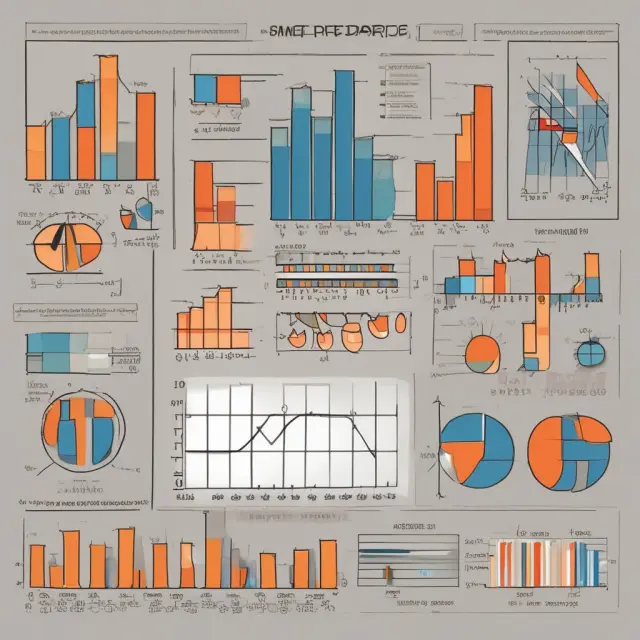
Visualizing Data Using Charts and Graphs
Descriptive statistics often rely on visual representation to help understand complex data sets. Visualization using charts and graphs is an effective means of interpreting trends and patterns in data, allowing for easier comprehension and communication. This section delves into the five major types of descriptive statistical graphics: histograms, bar charts, line graphs, pie charts, and scatterplots.
1) Histograms – A histogram is a continuous frequency distribution graph that represents the distribution shape and central tendency using rectangular bars stacked vertically. The x-axis displays data values, while the y-axis depicts the frequency counts (Heights of the bars). Histograms are useful in analyzing skewness or symmetry, identifying outliers, and discovering underlying distributions.
2) Bar Charts – Bar charts visually display categorical data using rectangular bars. Each bar represents a category, with height indicating the frequency or magnitude. These graphs help in comparing values of different categories and understanding the distribution of a specific variable.
3) Line Graphs – Line graphs illustrate trends over time by connecting consecutive data points with lines, enabling an easy comparison between variables and visualization of patterns and trends. Line graphs can represent continuous data and are often used to analyze stock price movements or other time-series data.
4) Pie Charts – A pie chart is a circular graph divided into sections representing proportions (slices) of a whole. Each section’s size represents the percentage of the total, making it an effective tool for visualizing distributions and comparing parts to the entirety. Pie charts are particularly useful when analyzing categorical data with distinct categories.
5) Scatterplots – A scatterplot displays relationships between two continuous variables by plotting individual data points on a Cartesian plane. The position of each point corresponds to the value of both variables, enabling an analysis of correlation and trend lines that can predict future outcomes based on existing data.
In conclusion, these charts and graphs play a crucial role in communicating descriptive statistical insights and trends through visual representations, making it easier for readers to understand and make informed decisions based on the analyzed data.
Advanced Descriptive Statistical Techniques
Descriptive statistics offer valuable insights into a data set by summarizing its essential features. In addition to measures of central tendency (mean, median, mode) and variability (range, variance, standard deviation), other advanced descriptive statistical techniques include skewness, kurtosis, percentiles, quartiles, and data transformations.
Skewness, often denoted as g1 or Sk, measures the degree of asymmetry in a probability distribution. A positively skewed distribution has its tail extending toward the right while negatively skewed distributions have their tails pointing left. For instance, income distribution is usually positively skewed due to the presence of extreme high earners. In finance and investment, skewness can provide insights into risk and return characteristics.
Kurtosis, denoted as g2 or Ko, measures the ‘peakedness’ or flatness of a probability distribution relative to a normal (Gaussian) distribution. High kurtosis indicates heavy tails and frequent extreme values, while low kurtosis implies light tails and fewer outliers. Kurtosis is essential in finance for understanding risk levels and portfolio diversification.
Percentiles are points that divide a data set into 100 equal parts. For example, the 50th percentile represents the median value. In finance, percentiles help identify performance milestones such as deciles (splitting a distribution into ten equal parts) or quartiles (four equal parts).
Quartiles are essential subdivisions of a data set that divide it into quarters. The first quartile (Q1) represents the 25th percentile, while the third quartile (Q3) stands for the 75th percentile. In finance and investment, quartiles help identify extreme values by determining the interquartile range – the difference between Q1 and Q3.
Data transformations are techniques used to convert data into forms more suitable for analysis. For example, logarithmic, square root, and inverse transformations can make skewed or heavy-tailed distributions more normal. These techniques help ensure that statistical assumptions (like homoscedasticity) hold true when applying inferential statistical methods.
In conclusion, understanding advanced descriptive statistics provides valuable insights into various aspects of a data set. Skewness, kurtosis, percentiles, quartiles, and data transformations can offer critical information for investment decision-making and risk management. By mastering these techniques, investors and analysts can gain a deeper understanding of financial markets and portfolio performance characteristics.

Descriptive Statistics vs. Inferential Statistics
Descriptive statistics and inferential statistics are two essential types of statistical analysis methods used to interpret and understand data. While both deal with numerical data, they differ significantly in their functions, applications, and goals. In this section, we’ll dive deeper into the differences, similarities, and uses of descriptive and inferential statistics.
Descriptive Statistics: Understanding the Basics
Descriptive statistics, as the name implies, describe or summarize a dataset by providing information about its main characteristics. They help in understanding the distribution and spread of data within a dataset. Descriptive statistics are further divided into measures of central tendency and measures of variability. Measures of central tendency focus on identifying the center position of a distribution, whereas measures of variability determine the spread or dispersion of data.
Measures of Central Tendency: Mean, Median, Mode
The most common types of descriptive statistics are measures of central tendency, including the mean, median, and mode. The mean represents the average value of a dataset, which is calculated by summing up all the values in a dataset and then dividing the total sum by the number of data points. For example, if we have a dataset containing the following numbers: 5, 10, 12, 15, 17, the mean would be (5 + 10 + 12 + 15 + 17) / 5 = 12.6
The median is another measure of central tendency that represents the middle value in a dataset when arranged in ascending or descending order. For our example above, the median would be the third number (10). The mode is the most frequently occurring value within a dataset. In our example, there isn’t a single mode as none of the numbers appear more than once.
Measures of Variability: Range, Variance, Standard Deviation
Measures of variability are used to understand the spread or dispersion of data in a dataset. The range is the difference between the smallest and largest values within a dataset. For our example above, the range would be 17 – 5 = 12. The variance is a measure of how much each data point deviates from the mean, calculated by summing up the squared differences of each value from the mean and then dividing that total by the number of data points. For example, for our dataset: (12.6 – 5)^2 + (12.6 – 10)^2 + (12.6 – 12)^2 + (12.6 – 15)^2 + (12.6 – 17)^2 / 5 = 92.84. The standard deviation is the square root of variance and represents how spread out the data points are from the mean. In our example, the standard deviation would be sqrt(92.84) = 9.65
Understanding Descriptive Statistics: Univariate vs Bivariate Analysis
Descriptive statistics are used for both univariate and bivariate analysis. Univariate analysis focuses on a single variable within a dataset, whereas bivariate analysis examines the relationship between two variables. For instance, a company might use univariate analysis to determine the average sales of its products in different regions or during various time periods. Bivariate analysis, on the other hand, would be used to explore the correlation between two variables, such as the relationship between sales and advertising budgets.
Descriptive Statistics in Finance: A Practical Application
Descriptive statistics are extensively used in finance for data analysis. Financial reports, balance sheets, income statements, and statements of cash flow provide a wealth of information about a company’s financial health that can be analyzed using descriptive statistics to gain valuable insights. For example, descriptive statistics can help investors understand key financial ratios, such as the price-to-earnings ratio (P/E), return on investment (ROI), and debt-to-equity ratio (D/E).
Descriptive Statistics vs Inferential Statistics: A Comparison
While descriptive statistics focus on summarizing and describing a dataset, inferential statistics are used to make predictions or draw conclusions about an entire population based on the information gathered from a sample. Descriptive statistics provide insights into what has occurred within a dataset, whereas inferential statistics help in understanding why it has happened and how it relates to the larger population.
Descriptive statistics and inferential statistics are powerful tools for analyzing data, each with their unique strengths and applications. Understanding when to use which method is crucial for effectively interpreting data and making informed decisions based on that information.

Case Study: Applying Descriptive Statistics in Finance
Descriptive statistics play a pivotal role in finance, particularly when analyzing data from financial statements or stock market trends. Let’s dive deeper into some real-life examples of descriptive statistics applications in finance.
1. Stock Analysis: Investors employ descriptive statistics to understand a company’s financial health and performance. Key Performance Indicators (KPIs) like the average monthly returns, standard deviation, moving averages, or volatility indices help gauge investment risk and potential profitability. For instance, the mean return on investment (ROI) represents the average gain or loss over a given period. Standard deviation reveals the degree of dispersion around the mean, giving investors a sense of the stock’s volatility.
2. Financial Reporting: Descriptive statistics enable clear, concise communication of financial information in annual reports and statements. Companies report revenue growth rates using percentages or comparative figures, while average daily trading volumes, sales revenue, and net income are presented in absolute terms to provide a snapshot of their financial standing.
3. Market Analysis: Financial analysts frequently use descriptive statistics to analyze historical stock market trends. They compute statistical measures like mean, median, mode, standard deviation, variance, and quartiles to understand patterns and identify potential risks or opportunities. For example, the mean price-earnings ratio (P/E ratio) indicates how much investors are willing to pay per dollar of earnings for a given stock on average.
4. Risk Management: Insurance companies use descriptive statistics extensively for risk management purposes. They analyze claims data using measures like mean, median, mode, and standard deviation to calculate the likelihood and potential cost impact of different types of risks. For example, the mean loss ratio illustrates the average claim payout across all policies issued during a specific time frame.
5. Performance Evaluation: Descriptive statistics help evaluate the effectiveness and efficiency of various financial strategies. Institutional investors analyze portfolio performance using metrics like Sharpe ratio, beta, and Alpha, which represent risk-adjusted returns and benchmark comparison respectively. Additionally, statistical measures like standard deviation, downside volatility, and value at risk (VaR) help assess portfolio risk and potential losses in specific scenarios.
In conclusion, descriptive statistics are essential tools for financial professionals to gain insights into complex data sets, make informed decisions, and communicate results effectively. By understanding measures of central tendency, variability, and frequency, investors can analyze stock market trends, evaluate investment performance, manage risk, and much more.

FAQs about Descriptive Statistics
Descriptive statistics, a vital tool in data analysis, help to provide valuable insights by summarizing the essential characteristics of a given data set. In this section, we will discuss some frequently asked questions (FAQs) regarding descriptive statistics, its types, and their functions.
What is Descriptive Statistics?
Descriptive statistics are numerical values or statistical measures that help to summarize and describe the essential features of a data set. They include measures of central tendency (mean, median, mode), measures of variability (range, variance, standard deviation), and frequency distribution (count).
What Are Measures of Central Tendency?
Measures of central tendency are statistical values that represent the ‘average’ or ‘center’ of a data set. The most common measures include the mean, median, and mode.
– Mean: It is calculated by adding all the figures within the data set and then dividing by the number of figures in the set.
– Median: This value lies in the middle of the sorted data set, separating higher values from lower values.
– Mode: The mode is the value that occurs most frequently within a data set.
What Are Measures of Variability?
Measures of variability describe the spread or dispersion of a data set. They help to understand the range and distribution of data points around the measures of central tendency. Common measures include:
– Range: It is calculated by subtracting the lowest value from the highest value in a data set.
– Variance: This statistical measure shows how spread out or dispersed the values are from the mean in a given dataset.
– Standard Deviation: A more commonly used measure of variability, it describes the average difference between each data point and the mean.
What Is the Role of Descriptive Statistics in Finance and Investment?
Descriptive statistics play a crucial role in analyzing financial statements, stocks, bonds, and other investment-related data. They help investors to evaluate performance, identify trends, and make informed decisions by providing a comprehensive understanding of the underlying data. In finance, descriptive statistics are used to analyze various aspects, including:
– Risk assessment: Measuring volatility (standard deviation) and identifying the distribution of returns.
– Performance evaluation: Analyzing key performance indicators like mean return, median return, and mode return for a given investment.
– Portfolio management: Understanding the risk and return characteristics of a portfolio to optimize asset allocation.
How Are Descriptive Statistics Visualized?
Descriptive statistics can be visually represented using charts, graphs, or histograms. These visual aids make it easier for analysts to interpret complex data by providing clear insights into patterns, distributions, and relationships within the data set. Commonly used charts include:
– Histograms: Showing the distribution of continuous numerical data in the form of bars.
– Bar charts: Representing categorical data as rectangular bars with lengths proportional to the values they represent.
– Line graphs: Displaying trends and patterns over time using a continuous line connecting various data points.
In conclusion, descriptive statistics serve an essential role in data analysis by summarizing, describing, and interpreting key features of a given dataset. Understanding their types and functions enables analysts to derive valuable insights for informed decision-making.
 Next entry · No. 1,017Understanding Devaluation: A Monetary Policy Tool Used for Combating Trade Imbalances and Currency Wars
See also
-
 No. 3,960
10 May 2025
18 min
Understanding Personal Financial Statements: A Comprehensive Guide for Institutional Investors
Personal Finance
No. 3,960
10 May 2025
18 min
Understanding Personal Financial Statements: A Comprehensive Guide for Institutional Investors
Personal Finance -
 No. 2,132
12 Dec 2024
18 min
Understanding Histograms: A Comprehensive Guide for Finance and Investment Professionals
Finance History
No. 2,132
12 Dec 2024
18 min
Understanding Histograms: A Comprehensive Guide for Finance and Investment Professionals
Finance History -
 No. 5,468
11 Sep 2025
18 min
Understanding the Power and Application of Venn Diagrams in Finance and Investment
Financial Data Analysis
No. 5,468
11 Sep 2025
18 min
Understanding the Power and Application of Venn Diagrams in Finance and Investment
Financial Data Analysis -
 No. 4,968
01 Aug 2025
20 min
Understanding Tick Size in Finance: Incremental Changes for Stocks, Futures and Forex
Financial Data Analysis
No. 4,968
01 Aug 2025
20 min
Understanding Tick Size in Finance: Incremental Changes for Stocks, Futures and Forex
Financial Data Analysis -
 No. 2,974
18 Feb 2025
21 min
Understanding Logarithmic Price Scales in Finance: A Powerful Tool for Institutional Investors
Financial Data Analysis
No. 2,974
18 Feb 2025
21 min
Understanding Logarithmic Price Scales in Finance: A Powerful Tool for Institutional Investors
Financial Data Analysis -
 No. 2,901
13 Feb 2025
20 min
Understanding Line Charts: A Visual Representation of Asset’s Historical Price Action
Financial Data Analysis
No. 2,901
13 Feb 2025
20 min
Understanding Line Charts: A Visual Representation of Asset’s Historical Price Action
Financial Data Analysis