Funds Transfer Pricing (FTP) in Banking: What It Is and How the FTP Rate Works
FTP in banking is the internal rate a bank's treasury charges lenders and credits deposit takers. How the FTP rate is set, with a worked $1M loan example.
Funds transfer pricing (FTP) in banking is the internal system a bank uses to put a price on money moving between its own departments. A central treasury "buys" the money that branches raise as deposits and "sells" money to the units that make loans, at an internal interest rate called the FTP rate. Each unit's profit is measured against that rate, and the interest rate and liquidity risk move to the treasury, which manages them for the whole bank.
So the FTP rate is a transfer price, not a rate any customer pays. A lending desk that makes a five-year loan at 7.25% might be charged 5.49% for the money, keeping 1.76 points as its margin. A branch that gathers deposits paying 2.00% might be credited 4.64% for them, earning 2.64 points for bringing in funding. Those figures come from the worked example below, built on the Treasury yield curve as of September 23, 2026. This page explains what FTP means in banking, how the FTP rate is set and charted, the main methods, and the supervisory guidance behind it. It is general information about how banks manage themselves, not advice.
What FTP Means in Banking
In a bank, "FTP" nearly always means funds transfer pricing, not the file transfer protocol that IT departments use. It is also distinct from transfer pricing in the tax sense, which sets prices for goods and services sold between related companies in different countries. Bank FTP never leaves the building: every charge to one unit is a credit to another, and the internal entries net to zero for the bank as a whole.
US bank supervisors define it precisely. In their 2016 interagency guidance, the Federal Reserve, FDIC and OCC describe FTP as "a process performed by a firm's central management function that allocates costs and benefits associated with funding and contingent liquidity risks (FTP costs and benefits), as measured at transaction or trade inception, to a firm's business lines, products, and activities" (Federal Reserve SR 16-3 and attachment).
In plain terms, three parties are involved:
- Asset units (commercial lending, mortgages, cards) use funds and pay an FTP charge.
- Liability units (branches, online deposits) provide funds and receive an FTP credit.
- The central treasury, often run under the asset-liability committee (ALCO), sits in the middle, owns the mismatch between what it charges and what it credits, and hedges it.
Why bother? A bank's income statement shows one number for net interest income, the gap between interest earned on loans and securities and interest paid on deposits and debt. Without FTP, nobody can say how much of that income came from good lending, how much from cheap deposits, and how much from a bet that rates would move a certain way. FTP answers that question for each branch, product and loan.
What Is the FTP Rate?
The FTP rate is the internal interest rate attached to a specific loan, deposit or pool of them. For a loan, it is the cost of the funds the loan ties up. For a deposit, it is the value of the funding the deposit supplies. Most banks build it from a few parts:
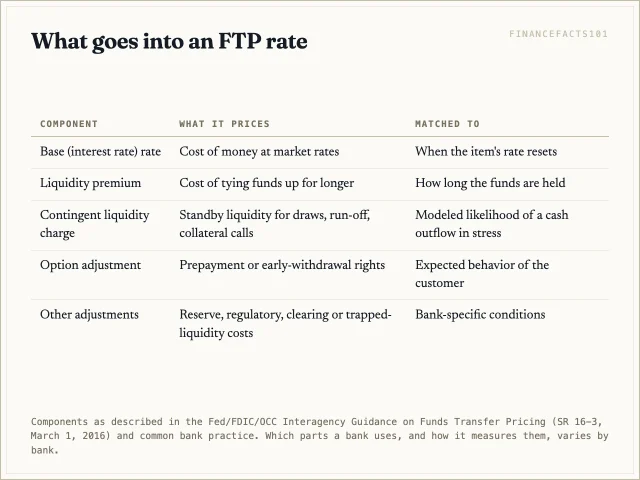
The base rate usually comes from a market curve the bank could actually fund or hedge at: the SOFR swap curve, Treasury yields, Federal Home Loan Bank advance rates or the bank's own wholesale borrowing curve. The interagency guidance gives the example of a "wholesale long-term debt curve adjusted based on the composition of the firm's alternate sources of funding such as Federal Home Loan Bank advances and customer deposits." There is no industry-wide FTP rate and no published FTP rate index. Each bank builds its own curve, and it treats that curve as internal information.
Two rules keep the rate honest. First, it is matched to the characteristics of the item being priced: its term, how often its rate resets, and how likely it is to be prepaid or withdrawn. Second, it is set when the loan or deposit is booked and normally stays fixed for that item's life. A fixed-rate loan made at today's rates keeps today's FTP charge even if market rates jump next year, so the lender's margin is protected and the rate risk sits with the treasury.
The guidance's own example shows how the parts combine. For "a five-year commercial loan that has a rate that resets every three months," the interest rate component can be based on a three-month horizon and the liquidity component on a five-year horizon. On the curve used on this page, that is 4.19% (the three-month Treasury yield) plus a 0.50-point five-year liquidity premium, an FTP rate of about 4.69%.
How Funds Transfer Pricing Works, Step by Step

The flow runs the same way whether a bank has $5 billion or $3 trillion of assets. Treasury sets the curve and updates it as market rates move. Business units see the FTP rate before they quote a customer, which is the point: a relationship manager pricing a five-year loan knows the internal cost of five-year money before naming a rate. Once the deal closes, the transfer rate is locked. Each month the bank's profitability system calculates each unit's spread against its FTP rates. Treasury's result is whatever is left: the difference between what it charged asset units and what it credited liability units, plus any hedging gains or losses.
For deposits with no maturity date, such as checking, savings and money market accounts, there is no contract term to match. Banks estimate a behavioral maturity from how long balances actually stay, often splitting a deposit book into a volatile slice credited at short rates and a stable core credited at longer ones. The guidance allows credits to deposits "based on volatility and modeled behavioral maturity," and says the assumptions should be documented, with any mismatch against the bank's own stress-test assumptions written into its report on FTP.
Charting FTP: The Transfer Pricing Curve
Charting is how the FTP rate becomes visible. The standard FTP chart plots yield on the vertical axis against time to maturity on the horizontal axis. It is a yield curve with the bank's own adjustments layered on top. A business unit reads its rate straight off the chart at the term that matches its loan or deposit.
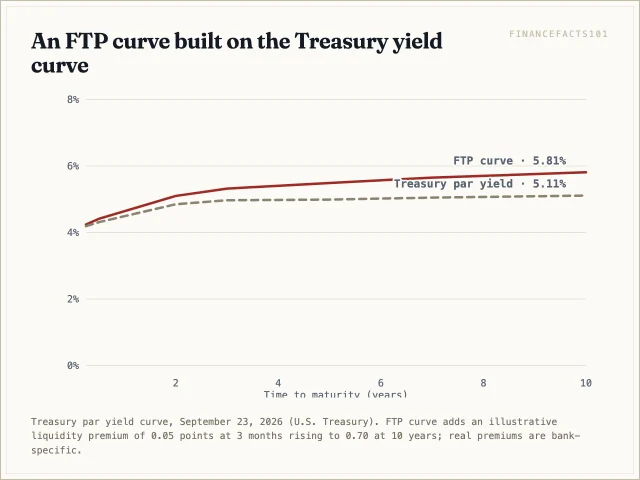
The lower line is the US Treasury par yield curve for September 23, 2026: 4.19% at three months, 4.49% at one year, 4.99% at five years and 5.11% at ten years, per the Treasury's daily yield curve data. The upper line adds an illustrative liquidity premium that grows with term, from 0.05 points at three months to 0.70 points at ten years. A real bank would derive that premium from its own borrowing spreads, and it would differ from bank to bank.
Two features of the chart matter. The slope tells lenders what longer commitments cost: on this curve, five-year money is charged 0.85 points more than one-year money. And the gap between the lines is the price of liquidity. When a bank's own funding gets more expensive, that gap widens and every new long-dated loan becomes more expensive internally before a single customer rate changes.
A Worked Example: Splitting One Loan's Margin
Take a hypothetical bank with one fixed-rate five-year commercial loan of $1,000,000 at 7.25%, funded by $1,000,000 of branch deposits costing 2.00%. The bank's net interest margin on this pair is 5.25 points, or $52,500 a year. The FTP curve above charges the loan the five-year rate of 5.49%. The treasury credits the deposits at the one-year point, 4.64%, because it models them as staying about a year. The split:
- Lending unit: 7.25% − 5.49% = 1.76 points, $17,600 a year. That margin still has to cover credit losses, operating costs and capital.
- Deposit unit: 4.64% − 2.00% = 2.64 points, $26,400 a year for gathering the funding.
- Treasury: 5.49% − 4.64% = 0.85 points, $8,500 a year for funding a five-year asset with one-year money, and for carrying the risk that creates.
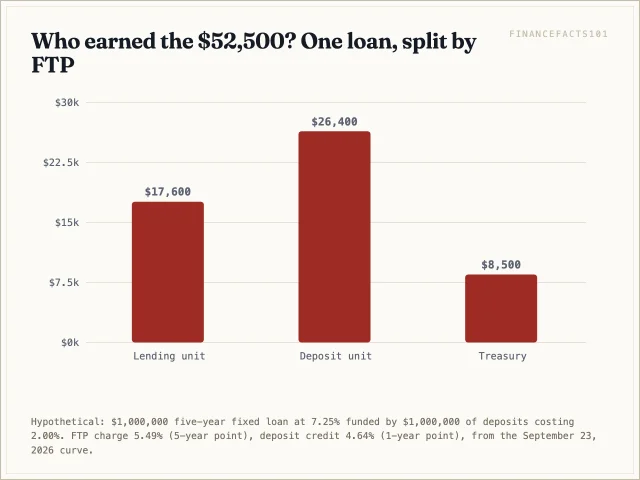
The three pieces add back to $52,500, which is the point of FTP. No income is created or lost; it is assigned to whoever earned it.
Now run the same book through a single-rate method that charges and credits everything at one pooled rate of 4.64%. The lender's margin jumps to 2.61 points, $26,100, and treasury shows zero. The loan looks $8,500 a year more profitable than it is, because nobody is charged for the five-year commitment. That is how single-rate systems nudge lenders toward long, fixed-rate loans. If short-term rates then rise a point, deposit costs follow while the loan's 7.25% stays put. Under matched-maturity FTP, that squeeze shows up in treasury, which can hedge it with swaps or interest rate futures. Under a single pool rate, it shows up years later as a mysterious decline in the lending unit's results.
FTP Methods: Single Rate, Pooled and Matched Maturity
FTP is often described as either "single-rate" or "multi-rate." That split is a useful start, but banks describe their methods in more detail:
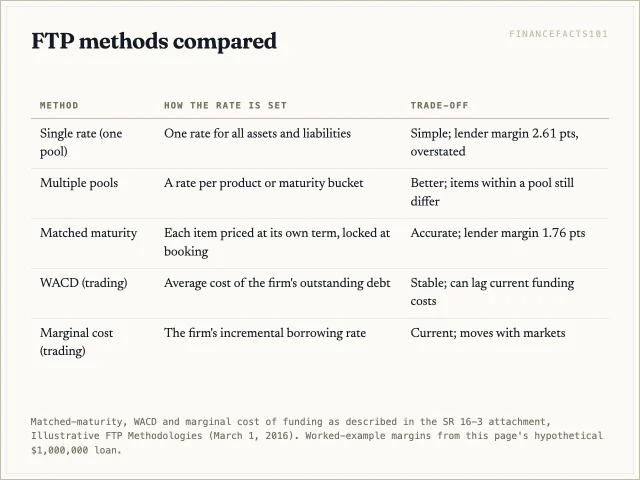
Single-rate (one pool). One rate for every asset and liability, often the bank's average cost of funds. Cheap to run, but blind to term and liquidity, as the worked example shows.
Multiple pools. Assets and liabilities are grouped, for example by product or broad maturity bucket, and each pool gets its own rate. Better, but items inside a pool can still differ widely.
Matched-maturity (matched-term). Each item gets the rate for its own term and repricing profile, fixed at inception. The interagency guidance calls matched-maturity marginal cost of funding "a commonly used methodology for non-trading exposures." It notes that the method "incentivizes business lines to generate stable funding (for example, core deposits)" and charges lenders "the cost of funding for the life of longer-dated assets."
Trading book methods. For securities inventories the guidance describes two observed approaches. Weighted average cost of debt (WACD) is "the weighted average cost of outstanding firm debt, usually expressed as a spread over an index." Marginal cost of funding sets the charge at the bank's incremental borrowing rate. The guidance notes that some firms using either method split a position into a secured part and an unsecured part, using repo haircuts.
Large banks commonly run matched-maturity FTP for loans and deposits, add behavioral models for items without fixed terms, and add a contingent liquidity charge for undrawn credit lines and other commitments that could drain cash in a stress. Smaller banks often use simpler pooled methods. The guidance itself covers only the largest firms, and even for them it says a framework should be "commensurate with its size, complexity, business activities, and overall risk profile."
Regulatory Guidance: SR 16-3 and the Interagency Principles
The main US supervisory text on FTP is the Interagency Guidance on Funds Transfer Pricing Related to Funding and Contingent Liquidity Risks, dated March 1, 2016. The Federal Reserve issued it as SR 16-3, the OCC as Bulletin 2016-7 and the FDIC as FIL-12-2016.
Its scope is narrow. It applies to large institutions: banks and holding companies with consolidated assets of $250 billion or more, holding companies with foreign exposure of $10 billion or more, and foreign banks with combined US assets of $250 billion or more. The OCC's bulletin is blunt: "This interagency guidance does not apply to community banks."
The guidance sets four principles. A firm should:
- Allocate FTP costs and benefits based on funding risk and contingent liquidity risk.
- Run a consistent, transparent framework that allocates them on a timely basis and at a sufficiently granular level.
- Have a robust governance structure, including a report on FTP and oversight from a senior management group and a central management function. Senior management should review that report "no less frequently than quarterly."
- Build FTP costs and benefits into product pricing, business metrics and new product approval.
The motivation was 2008. The guidance quotes a 2009 Senior Supervisors Group report in which several firms "acknowledged that if robust FTP practices had been in place earlier, and if the systems had charged not just for funding but for liquidity risks, they would not have carried the significant levels of illiquid assets" that led to large losses. It builds on the 2010 Interagency Policy Statement on Funding and Liquidity Risk Management (Fed SR 10-6) and on the Basel Committee's 2008 liquidity principles, which stressed "the necessity of allocating liquidity costs, benefits and risks to all significant business activities" (Basel Committee, BCBS 144).
Two corrections to common claims. SR 16-3 is supervisory guidance about FTP practices. It does not set capital or liquid-asset requirements, and it does not require banks to publish FTP results. Those results stay internal, which is why outsiders cannot compare one bank's FTP rates with another's.
FTP vs Net Interest Margin and Net Income
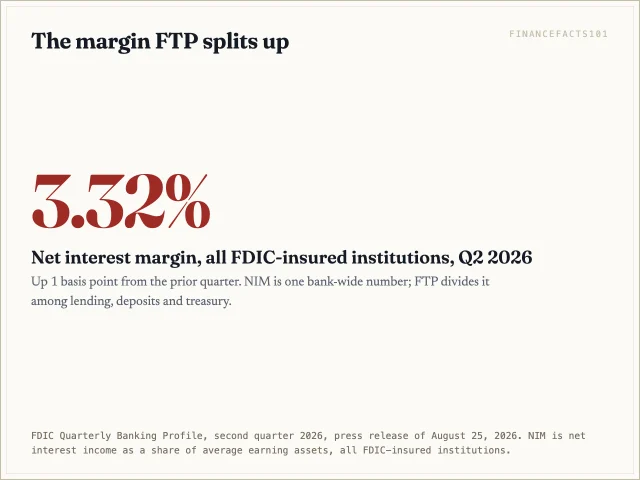
Net interest margin (NIM) is net interest income divided by average earning assets, a single bank-wide number. For all FDIC-insured institutions it was 3.32% in the second quarter of 2026, per the FDIC's Quarterly Banking Profile release of August 25, 2026. NIM tells you how wide the bank's spread is. FTP tells you who produced it: in the worked example, the 5.25-point margin splits into 1.76 for lending, 2.64 for deposits and 0.85 for treasury.
Net income is broader still. It adds fee income and subtracts loan-loss provisions, operating expenses and taxes. FTP feeds into it at the unit level: a branch's full profit-and-loss statement starts with its FTP-based net interest income, then adds its fees and subtracts its costs.
Because FTP entries net to zero, changing the method moves income between units without changing the bank's total. JPMorgan Chase gave a public example in its fourth-quarter 2024 earnings release: "During the fourth quarter of 2024, the Firm made a change to its funds transfer pricing with respect to consumer deposits, resulting in an increase in the funding benefit reflected within CCB net interest income which is fully offset within Corporate net interest income" (JPMorgan Chase 4Q24 earnings release, filed with the SEC). CCB is its consumer and community bank. The consumer bank's reported interest income went up, the corporate segment's went down, and the firm's total did not move.
Real-World Uses, Advantages and Limits
FTP drives decisions a customer eventually feels.
- Loan pricing. The FTP rate is the floor under a quoted loan rate. When long-term funding costs rise, the FTP curve rises and new fixed-rate loan quotes follow, whether or not the prime rate has changed.
- Deposit pricing. A high FTP credit for stable deposits is why banks compete hard for checking and savings balances when rates are high, and why they pay up for CDs of the terms they need.
- Branch profitability. Branches that gather cheap, stable deposits can look highly profitable even if they make few loans. Without FTP, a deposit-heavy branch could look like a cost center and be closed by mistake.
- New products and commitments. Principle 4 asks banks to build FTP into new product approval, so an undrawn credit line carries a liquidity charge from the day it is signed, not from the day it is drawn.
The advantages are clearer incentives, risk moved to the one team equipped to hedge it, and management reports that explain where the margin comes from. The limits are real too. Behavioral maturities for deposits are estimates, and a bank that assumes its deposits are stickier than they are will over-credit its branches. Choices about the curve and the liquidity premium can shift millions of dollars between units, which makes FTP a frequent source of internal argument. And because every bank's method is different, FTP results say little when comparing banks; for outside analysis, year-over-year trends in reported NIM and net interest income remain the tools that work.
FAQ
What does FTP stand for in banking?
Funds transfer pricing. It is a bank's internal pricing of money moving between units: lending units are charged an FTP rate for the funds they use, and deposit-gathering units are credited an FTP rate for the funds they bring in. In banking contexts it does not mean file transfer protocol.
How is the FTP rate calculated?
Most large banks start from a market curve such as SOFR swaps, Treasuries or their own wholesale borrowing costs. They pick the point that matches the item's repricing term, add a liquidity premium for how long the money is tied up, and adjust for things like prepayment options or undrawn commitments. The rate is fixed when the loan or deposit is booked. On the Treasury curve of September 23, 2026, with an illustrative premium, a five-year fixed loan would be charged about 5.49%.
Is funds transfer pricing required by regulators?
Not as a reporting requirement. The 2016 interagency guidance (Fed SR 16-3, OCC Bulletin 2016-7, FDIC FIL-12-2016) sets supervisory expectations for institutions with $250 billion or more in assets, and the OCC states it does not apply to community banks. Smaller banks use FTP by choice, usually in simpler form.
Does FTP affect the rates customers pay?
Indirectly, yes. The FTP rate is the internal cost a loan officer prices on top of, and the internal value a deposit is worth to the bank. When the FTP curve rises, new loan quotes rise, and deposits of the terms the bank needs become worth paying more for.
Sources
- Federal Reserve, SR 16-3: Interagency Guidance on Funds Transfer Pricing Related to Funding and Contingent Liquidity Risks, March 1, 2016, with the guidance and illustrative methodologies attachment: definition of FTP, applicability at $250 billion, the four principles, matched-maturity, WACD and marginal cost methods, and the Senior Supervisors Group quotation
- OCC, Bulletin 2016-7, Funds Transfer Pricing: Interagency Guidance: "does not apply to community banks"
- FDIC, FIL-12-2016, Funds Transfer Pricing Related to Funding and Contingent Liquidity Risks
- Federal Reserve, SR 10-6: Interagency Policy Statement on Funding and Liquidity Risk Management, March 17, 2010
- Basel Committee on Banking Supervision, Principles for Sound Liquidity Risk Management and Supervision, September 2008
- U.S. Department of the Treasury, Daily Treasury Par Yield Curve Rates, 2026: September 23, 2026 curve (3-month 4.19%, 1-year 4.49%, 5-year 4.99%, 10-year 5.11%)
- FDIC, Quarterly Banking Profile, second quarter 2026 press release, August 25, 2026: industry net interest margin 3.32%
- JPMorgan Chase & Co., fourth-quarter 2024 earnings release, Exhibit 99.1 (SEC EDGAR): change to FTP for consumer deposits, offset in Corporate
 Next entry · No. 1,695Understanding the Financial Times Stock Exchange Group (FTSE) and Its Popular Indexes
See also
-
 No. 5,845
12 Oct 2025
18 min
Understanding and Utilizing Year-Over-Year (YOY) Analysis in Finance and Investment
Business Finance
No. 5,845
12 Oct 2025
18 min
Understanding and Utilizing Year-Over-Year (YOY) Analysis in Finance and Investment
Business Finance -
 No. 5,327
30 Aug 2025
18 min
Understanding Up-Market Capture Ratio: A Key Metric for Evaluating Investment Managers
Business Finance
No. 5,327
30 Aug 2025
18 min
Understanding Up-Market Capture Ratio: A Key Metric for Evaluating Investment Managers
Business Finance -
 No. 4,399
15 Jun 2025
20 min
Understanding the Role of a Research Analyst in Finance and Investment
Business Finance
No. 4,399
15 Jun 2025
20 min
Understanding the Role of a Research Analyst in Finance and Investment
Business Finance -
 No. 3,521
04 Apr 2025
20 min
Understanding Non-Cash Items in Accounting and Banking
Business Finance
No. 3,521
04 Apr 2025
20 min
Understanding Non-Cash Items in Accounting and Banking
Business Finance -
 No. 3,415
27 Mar 2025
13 min
Net Interest Income: The Key Financial Metric for Banks
Business Finance
No. 3,415
27 Mar 2025
13 min
Net Interest Income: The Key Financial Metric for Banks
Business Finance -
 No. 3,400
25 Mar 2025
19 min
Negotiable Instruments: Understanding the Function, Types, and Significance of Transferable Financial Documents
Business Finance
No. 3,400
25 Mar 2025
19 min
Negotiable Instruments: Understanding the Function, Types, and Significance of Transferable Financial Documents
Business Finance