Understanding International Finance: Key Concepts, Institutions, and Challenges

Explore key concepts, institutions, and challenges in International Finance, including the Mundell-Fleming Model, Bretton Woods System, and more.
Introduction to International Finance
International finance is a vital and intriguing area of economics that explores monetary transactions between different countries. This field encompasses subjects like foreign direct investment, currency exchanges, and international trade. As the world becomes increasingly globalized, the significance of international finance has grown substantially. In this section, we will delve into the fundamentals of international finance, including key theories and institutions.
Understanding International Finance
International finance focuses on understanding monetary interactions between two or more countries rather than analyzing individual markets. Institutions such as the International Finance Corporation (IFC), the National Bureau of Economic Research (NBER,) and the U.S. Federal Reserve engage in extensive research to explore policies regarding international capital flows, external trade, and the evolution of global financial markets.
Areas of Study in International Finance
International finance encompasses several essential concepts, such as:
- The Mundell-Fleming Model examines the interplay between a country’s goods market and its money market, based on the assumption that the prices of goods remain constant.
- International Fisher Effect is a theory proposing that nominal interest rates mirror fluctuations in spot exchange rates between countries.
- The Optimum Currency Area Theory posits that specific geographical regions would maximize economic efficiency if they adopted a single currency.
- Purchasing power parity measures the relative purchasing power of currencies using a consistent set of goods or services.
- Interest rate parity describes the equilibrium state where investors are indifferent to interest rates on bank deposits in two distinct countries.
Bretton Woods System and its Impact on International Finance
The Bretton Woods system was established at a 1944 conference attended by 40 nations, with the goal of standardizing international monetary exchanges and policies post World War II. This initiative birthed the International Monetary Fund (IMF) and the International Bank for Reconstruction and Development, which later became known as the World Bank, playing a crucial role in shaping the global economy.
Key Players in International Finance Research
Three prominent institutions carry out extensive research in international finance:
- The International Finance Corporation (IFC), an arm of the World Bank Group, invests in private sector projects in emerging markets to promote sustainable economic growth and reduce poverty.
- The National Bureau of Economic Research (NBER) is a nonprofit research organization that aims to promote high-quality economic research and disseminate its findings.
- The U.S. Federal Reserve, through its Division of International Finance, examines and analyzes policies pertinent to U.S. capital flows, external trade, and the development of global financial markets.
The Role of Interest Rates in International Finance
Interest rates impact international finance in various ways:
- Interest rate parity describes the equilibrium state where investors are indifferent to interest rates on bank deposits in two separate countries.
- Changes in interest rates affect exchange rates and capital flows, as higher interest rates often attract foreign capital, leading to currency appreciation.
Impact of Globalization on International Finance
The increasing globalization of markets and economies has amplified the importance of international finance. This interconnectedness facilitates international trade, investment, and economic cooperation between countries. However, it also introduces new challenges, such as managing exchange rate risk and political instability in various regions.
International Trade and Its Influence on Prosperity
Global trade plays a pivotal role in driving prosperity and growth in the global economy. While there are concerns regarding the shift from being an international creditor to becoming a significant international debtor, absorbing excess funding from organizations and countries, further developments and challenges continue to shape the landscape of international finance.
Challenges in International Finance: Past, Present, and Future
Throughout history, international finance has faced numerous challenges. Understanding these hurdles is essential for navigating future complexities. Some of the historical and contemporary issues include:
- Balance of payments deficits/surpluses
- Currency devaluations and revaluations
- Geopolitical instability
- Regulatory changes, such as new capital adequacy ratios or tax reforms.
FAQs on International Finance
Question 1: What is international finance, and why is it important?
Answer: International finance is the study of monetary transactions between two or more countries. It’s vital due to increased globalization and its influence on areas such as foreign direct investment, currency exchange rates, and international trade.
Question 2: How does interest rate parity impact international finance?
Answer: Interest rate parity is the equilibrium state where investors are indifferent to interest rates in different countries. This concept impacts capital flows and exchange rates, leading to potential appreciation or depreciation of currencies depending on interest rate differentials.

Areas of Study in International Finance
International finance is an intriguing field that delves into the economic interactions between multiple countries, focusing on critical aspects like exchange rates and foreign direct investment. In this section, we’ll discuss five essential concepts that are key to understanding international finance: The Mundell-Fleming Model, International Fisher Effect, Optimum Currency Area Theory, Purchasing Power Parity, and Interest Rate Parity.
1. The Mundell-Fleming Model
The Mundell-Fleming model is a seminal framework in international finance that explores the interplay between the goods market and money market, with an underlying assumption that price levels of goods are fixed. This model offers valuable insights into how changes in monetary policy and exchange rates impact interest rates, inflation, and economic growth in open economies.
2. International Fisher Effect
The International Fisher Effect is a theory based on the notion that nominal interest rates mirror fluctuations in the spot exchange rate between nations. Simply put, it proposes an inverse relationship between real interest rates and expected changes in the exchange rate. This effect plays a significant role in shaping expectations about returns from foreign investments and has important implications for investors operating in international markets.
3. Optimum Currency Area Theory
The optimum currency area theory is another vital concept that postulates that certain geographical regions would maximize economic efficiency if the entire area adopted a single currency. This theory suggests that countries with high levels of interconnectedness, similar economic structures, and flexibility in labor markets are more likely to benefit from using a common currency.
4. Purchasing Power Parity
Purchasing power parity (PPP) is an essential principle in international finance used to compare the purchasing power of different currencies by evaluating their relative ability to buy an identical basket of goods and services across various countries. Understanding PPP can help investors assess the fair value of exchange rates and forecast potential movements based on changes in inflation rates and exchange rates between countries.
5. Interest Rate Parity
Interest rate parity describes an equilibrium state where investors are indifferent to interest rates attached to bank deposits in two separate countries. It asserts that differences in interest rates across currencies should equal the expected difference in returns from holding the respective currencies, which can have a significant impact on foreign exchange markets and capital flows between countries.
In conclusion, the areas of study in international finance provide valuable insights into how economies interact with one another. These concepts include the Mundell-Fleming Model, International Fisher Effect, Optimum Currency Area Theory, Purchasing Power Parity, and Interest Rate Parity. Understanding these theories helps investors navigate the complex world of international finance, enabling them to make informed decisions about capital flows, exchange rates, and economic policies in a globalized world.

Bretton Woods System and its Impact on International Finance
The historical context of international finance is deeply rooted in the Bretton Woods system, which emerged following a 1944 conference attended by 730 delegates from allied nations. This conference aimed to restore global economic cooperation in the aftermath of World War II. The resulting agreements would establish the International Monetary Fund (IMF) and the World Bank – two institutions that have shaped international finance ever since.
The Bretton Woods system was designed to regulate exchange rates between countries, ensuring monetary stability through a fixed exchange rate regime. This meant that each country’s currency would be pegged to the U.S. dollar, with the dollar itself being backed by gold. The aim of this arrangement was to foster post-war economic recovery and promote international trade.
Under the Bretton Woods system, countries could maintain a fixed exchange rate, but they were permitted to adjust it within a band of plus or minus 1% around an agreed parity if their economies showed signs of instability. Countries that faced temporary balance-of-payments deficits could borrow from the IMF in order to restore monetary stability. This arrangement proved successful for several decades, with exchange rates remaining largely fixed until the early 1970s when a combination of factors – including the U.S. dollar’s growing role as a global reserve currency, European economic integration, and U.S. inflation pressures – led to its demise.
The Bretton Woods system brought significant changes to international finance, allowing countries to address balance-of-payments issues through multilateral cooperation rather than resorting to protectionist measures or competitive devaluations. The IMF played an essential role in facilitating these adjustments and maintaining international financial stability during the post-war era.
To this day, the Bretton Woods institutions continue to shape international finance. The IMF has evolved into a leading forum for international economic cooperation, providing policy advice and financial assistance to member countries facing economic challenges. Similarly, the World Bank focuses on reducing poverty and promoting sustainable development, particularly in low-income countries.
In conclusion, the Bretton Woods system is a cornerstone of modern international finance. Its creation brought about significant changes in how nations manage their currencies and collaborate to maintain financial stability. The legacy of this historical agreement continues to influence the global economy and serves as an example of the importance of cooperation and coordination among countries when navigating economic challenges.

Key Players in International Finance Research
International finance is a vast field that requires extensive research to provide insights into the complex monetary interactions between countries. Institutions such as the International Finance Corporation (IFC), the National Bureau of Economic Research (NBER), and the U.S. Federal Reserve play a significant role in driving understanding, analysis, and policymaking within international finance.
The IFC, established in 1956, is a member of the World Bank Group and an international financial institution that offers long-term loans, equity financing, risk management products, and advisory services to support sustainable private sector development in its client countries. As of 2021, the IFC operates in more than 100 developing countries. Their efforts span across various sectors such as manufacturing, agriculture, energy, financial markets, infrastructure, and healthcare.
The NBER, founded in 1920, is a non-profit research organization located in Cambridge, Massachusetts. Its mission is to promote a deeper understanding of how the economy functions through independent research and data analysis. The NBER hosts multiple programs focused on various aspects of economics, including international trade, monetary economics, and macroeconomics. Researchers from the NBER have produced influential studies and papers that have helped shape the academic discourse on international finance.
Lastly, the U.S. Federal Reserve System, often simply referred to as the Federal Reserve, is an independent central banking system of the United States created in 1913. It sets monetary policy, regulates banks, maintains the stability of the financial system, and provides certain financial services to the U.S. government and other domestic and foreign official institutions. Its Division of International Finance and Exchange, based in Washington D.C., focuses on analyzing policies related to international capital flows, external trade, and the development of global markets. This division contributes significantly to the research, analysis, and policy recommendations related to international finance.
With the help of these prominent institutions, researchers delve deeper into essential concepts of international finance, such as the Mundell-Fleming Model, International Fisher Effect, Optimum Currency Area Theory, Purchasing Power Parity, Interest Rate Parity, and more. Their efforts contribute to a better understanding of this critical area and provide guidance for policy decisions in an increasingly interconnected global economy.

Impact of Globalization on International Finance
The advent of globalization has significantly magnified the importance of international finance, as it now plays a pivotal role in enabling international economic interactions. In this context, it’s crucial to understand how these two interconnected phenomena have evolved and influenced each other over time.
International finance, which deals with monetary transactions between multiple countries, has gained increasing importance due to the globalization trend that began in the late 20th century. This shift can be attributed to several factors:
- Increased Cross-Border Trade: As trade between nations expanded, the need for currency exchange and international financial transactions grew exponentially.
- Global Supply Chains: Multinational corporations established complex global supply chains that relied on international finance to manage various financial transactions and risks.
- Emergence of New Economic Powerhouses: The rise of emerging markets like China, India, and other countries necessitated a greater understanding of their currencies, economic systems, and regulatory frameworks.
- Advancements in Technology: Technological advancements allowed for faster and more efficient cross-border transactions, making international finance increasingly essential.
- Geopolitical Instability and Regulatory Changes: Political instability and regulatory changes have led to a heightened need for financial instruments, such as derivatives and hedging tools, that can help mitigate associated risks.
One of the most significant outcomes of globalization’s influence on international finance is the proliferation of international institutions dedicated to fostering economic cooperation and stability. The Bretton Woods system, established in 1944, was one such initiative designed to create a fixed exchange rate system that would help bring about post World War II economic stability.
The Bretton Woods conference resulted in the creation of two crucial international organizations: the International Monetary Fund (IMF) and the World Bank. The IMF’s mandate is to ensure monetary cooperation between its member countries, while the World Bank aims to provide loans for development projects in low-income countries. Both institutions have significantly contributed to the global economy by promoting economic growth, financial stability, and international cooperation.
The role of these institutions has become more vital as they grapple with the challenges arising from geopolitical instability and regulatory changes. For example, the 2008 financial crisis highlighted the need for stronger regulations and oversight to prevent future crises. As globalization continues to evolve, international finance will remain a critical element that influences various aspects of our interconnected world economy.
In conclusion, globalization’s impact on international finance has been profound, with the former giving rise to the need for more efficient financial transactions, risk management tools, and international cooperation. As we move forward, it is essential to stay informed about emerging trends in international finance and their potential implications on the global economy.

The Role of Interest Rates in International Finance
Interest rate parity is one crucial concept that plays a significant role in international finance. It describes an equilibrium state where investors are indifferent to interest rates attached to bank deposits in two separate countries when considering the associated risk and the expected future spot exchange rates. This equilibrium holds true due to arbitrage opportunities that arise when the interest rate differentials and exchange rate fluctuations do not balance.
For instance, suppose an investor has the option of investing $10,000 in either country A or country B at a given moment. If the interest rate is 5% in country A and 6% in country B, but the expected future spot exchange rate between the two countries’ currencies is such that it is anticipated that country A’s currency will appreciate by 4%, then the net return for both investments would be equal:
– In country A: $10,000 * 1.05 (annual interest) = $10,500
– In country B: $10,000 * 1.06 (annual interest) = $10,600
– Expected future value of country A’s currency: $10,500 / (1 + expected appreciation rate) = $9,827.45
– Anticipated exchange rate between countries A and B: 1.04
Now the investor has an arbitrage opportunity to buy $10,600 in country B and sell it for approximately $10,500 in country A, earning a riskless profit of $100 without taking any currency or interest rate risk. As the market adjusts, the interest rates will change, or exchange rates will shift until equilibrium is re-established, ensuring that investors are indifferent to holding funds in either country.
Another important aspect of international finance is the impact of interest rates on exchange rates. When a central bank raises interest rates, it makes its currency more attractive for investors as they can earn higher yields from holding deposits denominated in that currency. This can lead to an appreciation of the currency. Conversely, if a central bank lowers interest rates, the currency may depreciate as it becomes less attractive to foreign investors.
Overall, understanding the role of interest rates in international finance is crucial for investors and policymakers alike. By evaluating interest rate parity and the relationship between interest rates and exchange rates, one can gain insight into how various countries’ economies interact with each other on a global scale.

Exchange Rate Risk and Political Instability in International Finance
Understanding the Risks of Managing Multinational Corporations
The study of international finance extends beyond examining economic interactions between countries; it also includes the analysis of political risks associated with managing multinational corporations. These risks can significantly impact a company’s profitability and value, as they affect the exchange rates that determine the revenue streams and cost structures of their international operations.
Exchange Rate Risks
One critical risk faced by multinationals is exchange rate risk—the possibility of currency depreciation or appreciation causing changes in cash flows. For example, if a U.S.-based firm has revenues in euros but expenses in dollars, it faces the risk that a stronger euro against the dollar would reduce its profitability. Conversely, if the U.S. dollar strengthens relative to the euro, the multinational company would experience enhanced profitability due to the exchange rate appreciation.
Political Instability Risks
Another significant challenge for international finance is political instability. This risk refers to the uncertainty that arises from events like currency devaluations, expropriation, or government instability, which can affect a firm’s operations and profitability in foreign markets. For example, if a country undergoes a sudden change of leadership or experiences political unrest, it may lead to policy changes that negatively impact a multinational company’s investments in that region.
Managing Exchange Rate Risk
Multinationals often employ various strategies to manage exchange rate risk:
1. Hedge Strategies: Firms can use financial instruments such as forward contracts, options, or swaps to hedge against currency fluctuations and lock-in future exchange rates. These strategies help mitigate risks associated with revenue streams and costs in foreign currencies.
2. Operational Strategies: Companies may adopt operational strategies like maintaining cash reserves in local currencies or implementing internal hedging systems, which can help reduce the need for currency conversions and lessen the impact of exchange rate fluctuations on their business.
Managing Political Instability Risks
Managing political instability risks requires a multifaceted approach:
1. Political Risk Analysis: Firms should conduct thorough analysis of countries’ political environments, including assessing the potential for policy changes and monitoring geopolitical developments that may impact their investments.
2. Diversification: By spreading investments across various regions and industries, multinationals can minimize their exposure to political instability risks in a single country or sector.
3. Insurance and Risk Mitigation Contracts: Companies can purchase political risk insurance or enter into contracts with governments or multilateral organizations to cover losses resulting from certain types of political events.
In conclusion, international finance involves more than just analyzing economic interactions between countries; it also requires understanding the risks associated with managing multinational corporations and their exposure to exchange rate and political instability risks. By implementing effective risk management strategies, multinationals can navigate these challenges and minimize their impact on profitability and long-term growth.
International Trade and Its Influence on Prosperity
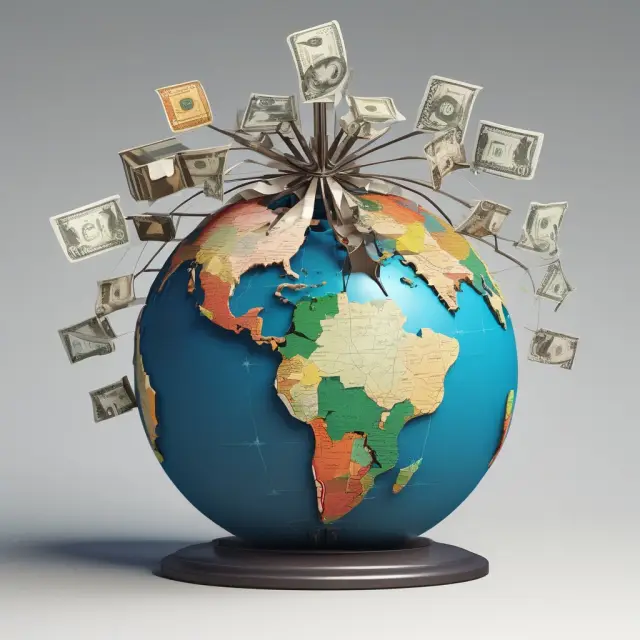
One of the most significant areas within international finance is the study of international trade and its influence on global prosperity and growth. International trade plays a vital role in driving economic development, as it enables countries to specialize in production based on their comparative advantages and exchange goods and services with other nations. This leads to increased productivity, lower prices, and higher standards of living for consumers around the world.
However, there is growing concern that the United States’ increasing international debt could impact international finance significantly. The U.S. has shifted from being the largest international creditor nation in 1985 to the world’s largest international debtor, with its total public and private sector foreign debts surpassing $10 trillion as of 2021. This poses risks for various reasons:
1) Geopolitical Instability: As a leading global power, the U.S. has long been seen as a stable economy that investors rely on for safe investments. However, mounting debt can potentially lead to geopolitical instability, which could negatively impact investor confidence and increase borrowing costs for the U.S. government.
2) Debt Sustainability: If the U.S. is unable to maintain its debt servicing obligations, it could default on its loans or restructure its debt, leading to significant economic consequences for both the U.S. and global markets.
3) Currency Depreciation: Should foreign investors lose confidence in the U.S. dollar due to growing concerns about the country’s debt, they may begin selling their U.S. Treasury securities, resulting in a depreciation of the U.S. dollar and potentially triggering a currency war.
4) Inflationary Pressure: Rapidly increasing debt can lead to inflationary pressures that impact interest rates, which could result in higher borrowing costs for businesses and consumers.
5) Trade Deficits: The U.S. has consistently run large trade deficits, meaning it imports more goods than it exports. This results in a net outflow of capital from the country, making it increasingly reliant on foreign investment to fund its deficits. If these investments were to dry up, it could negatively impact growth and economic stability in the U.S.
The management of multinational corporations also involves understanding political risk and foreign exchange risk, as the business environment can vary greatly from one country to another. These risks can be mitigated through a variety of strategies such as diversification, hedging instruments like futures contracts or options, and comprehensive risk assessment frameworks like the Political Risk Group’s (PRG) Risk Assessment Framework.
Understanding these challenges and the role international trade plays in shaping the global economy is crucial for investors, businesses, policymakers, and anyone interested in staying informed about current events in international finance.

Challenges in International Finance: Past, Present, and Future
International finance has undergone several challenges throughout history. These trials stem from a variety of sources including geopolitical instability, regulatory changes, and the evolving role of multinational corporations (MNCs) in the global economy.
One of the earliest challenges to international finance can be traced back to the Bretton Woods system. The Bretton Woods system, established in 1944, aimed to foster post World War II economic stability by standardizing international monetary exchanges and policies. This initiative led to the creation of two essential institutions: The International Monetary Fund (IMF) and the World Bank. However, this system faced challenges as well; most notably, the inability of the United States to maintain a fixed exchange rate due to its massive post-war debt accumulation.
In present times, international finance faces challenges stemming from geopolitical instability and regulatory changes. For instance, political upheaval and uncertainty can impact currency values and trade flows between countries. Additionally, regulatory shifts – such as stricter capital controls and the increasing prevalence of cryptocurrencies – could disrupt traditional financial systems and require adaptation.
Another concern is the role of MNCs in international finance. Managing multinational corporations in various countries involves significant risk, particularly with respect to political instability and fluctuating exchange rates. For instance, a change in government policy or an economic downturn can result in financial losses for these corporations. This can ripple through the global economy, potentially impacting other businesses and even leading to systemic risks.
Historically, international finance has experienced numerous challenges. The Bretton Woods system, initially established to stabilize the international monetary system following World War II, faced difficulties as the United States struggled to maintain a fixed exchange rate due to its mounting debt obligations. Presently, geopolitical instability and regulatory changes pose significant hurdles for international finance. Political upheaval can cause volatility in currency values and trade flows between nations, while shifting regulations – such as stricter capital controls and the increasing use of cryptocurrencies – could potentially disrupt traditional financial systems.
The role of multinational corporations (MNCs) in international finance adds another layer of complexity. Managing these corporations in various countries involves significant risk, particularly with respect to political instability and fluctuating exchange rates. For instance, a change in government policy or an economic downturn can result in financial losses for MNCs, potentially impacting other businesses and even leading to systemic risks within the global economy.
Understanding these challenges is crucial for investors and policymakers alike. By analyzing historical examples and present trends, we can develop strategies to minimize risk and capitalize on opportunities within international finance. The importance of this field will only grow as the world becomes increasingly interconnected.
FAQs on International Finance
**What is international finance?**
International finance, also known as international macroeconomics, is the study of monetary interactions between two or more countries, primarily focusing on areas such as foreign direct investment and currency exchange rates. By understanding these concepts, we can analyze the impact of globalization on economies and the interconnectedness between countries’ financial systems.
**Who conducts research in international finance?**
Various institutions contribute to international finance research, including the International Finance Corporation (IFC), National Bureau of Economic Research (NBER), and the U.S. Federal Reserve. Each organization plays a critical role in analyzing international economic policies, understanding global capital flows, and promoting sustainable development.
**What is the Mundell-Fleming Model?**
The Mundell-Fleming Model examines the interaction between a country’s goods market and money market under the assumption that price levels remain fixed. This theory allows us to understand how exchange rate policies, interest rates, and fiscal policy impact one another in an open economy setting.
**What is the International Fisher Effect?**
The International Fisher Effect posits that nominal interest rates mirror fluctuations in the spot exchange rate between nations. This concept can help investors make informed decisions regarding cross-border asset allocation.
**What is the optimum currency area theory?**
According to the optimum currency area theory, certain geographical regions would maximize economic efficiency if they adopted a single currency. This idea underpins the need for careful consideration when determining whether countries should adopt a common currency or maintain their individual currencies.
**What is purchasing power parity?**
Purchasing Power Parity (PPP) measures the relative value of different currencies by comparing prices of a specific good or set of goods between countries. By understanding PPP, we can evaluate the buying power of various currencies and assess exchange rate fluctuations more effectively.
**What is interest rate parity?**
Interest rate parity describes the equilibrium state in which investors are indifferent to interest rates attached to bank deposits in two separate countries. This concept ensures that the expected return on investment remains equal across borders.
**How has the Bretton Woods System impacted international finance?**
The Bretton Woods system, established after World War II, aimed to create a stable monetary order by standardizing international exchange rates and policies. Its creation led to the establishment of major international organizations such as the International Monetary Fund (IMF) and the World Bank, which continue to play crucial roles in global economic cooperation.
**What is the impact of international trade on prosperity?**
International trade is a significant driver of global prosperity and growth. However, it’s essential to consider potential challenges such as the shift from being a net creditor to a debtor nation, which could influence international finance in unexpected ways. Additionally, managing multinational corporations involves assessing political and foreign exchange risk.
 Next entry · No. 2,464Maximizing Your Investment Potential: A Beginner’s Guide to International Investing
See also
-
 No. 516
27 Apr 2024
19 min
The Bretton Woods Agreement and System: Understanding Its Significance in Global Finance and Investment
Global Finance
No. 516
27 Apr 2024
19 min
The Bretton Woods Agreement and System: Understanding Its Significance in Global Finance and Investment
Global Finance -
 No. 2,321
27 Dec 2024
19 min
Understanding Imports: Economic Impact, Top Trading Partners, and the Future of Global Trade
International Trade
No. 2,321
27 Dec 2024
19 min
Understanding Imports: Economic Impact, Top Trading Partners, and the Future of Global Trade
International Trade -
 No. 4,715
11 Jul 2025
19 min
Understanding the Spillover Effect: How Global Events Impact Investment Opportunities
Global Finance
No. 4,715
11 Jul 2025
19 min
Understanding the Spillover Effect: How Global Events Impact Investment Opportunities
Global Finance -
 No. 4,575
29 Jun 2025
20 min
Understanding Special Drawing Rights (SDRs): An International Reserve Currency Instrument
Global Finance
No. 4,575
29 Jun 2025
20 min
Understanding Special Drawing Rights (SDRs): An International Reserve Currency Instrument
Global Finance -
 No. 5,030
06 Aug 2025
22 min
Understanding the Role of Trading Houses: Intermediaries Facilitating International Trade
International Trade
No. 5,030
06 Aug 2025
22 min
Understanding the Role of Trading Houses: Intermediaries Facilitating International Trade
International Trade -
 No. 5,024
05 Aug 2025
21 min
Understanding the Power of Comparative Advantage in International Trade
International Trade
No. 5,024
05 Aug 2025
21 min
Understanding the Power of Comparative Advantage in International Trade
International Trade