Microfinance: What It Is, What It Offers, and Who Should Use It
Microfinance is small loans, savings and insurance for people banks don't serve. In the US, SBA microloans reach $50,000 at about 8% to 13%.
Microfinance means financial services in small amounts, mainly loans but also savings, insurance and payments, for people and very small businesses that ordinary banks don't serve profitably. A microloan is typically a few hundred to a few thousand dollars. In the United States the government's microloan program tops out at $50,000, and the average loan is about $13,000, according to the Small Business Administration.
The idea is old, but its modern form comes from Bangladesh, where Grameen Bank grew out of a 1976 village project. Today microfinance covers everything from group loans to women traders in South Asia to a US credit union's $500 alternative to a payday loan. This page explains what microfinance institutions offer, how a microloan works, how community banks take part in micro-lending, what options exist for individuals in the US, and who should and shouldn't borrow this way. It is general information, not advice about any particular loan.
What Microfinance Is, and What It Isn't
Microfinance is a delivery model more than a product. The loans themselves are ordinary installment loans. What makes them micro is the borrower and the method: people with little or no credit history, little collateral, and income that is often irregular or informal. Standard bank underwriting relies on credit scores, pay stubs and pledged assets, so it tends to screen these borrowers out. Microlenders replace those tools with others: small first loans that grow with a repayment record, frequent small payments, peer groups, and close contact with a loan officer.
Two misunderstandings are worth clearing up early.
A microloan is not charity. It is a debt with interest, and it has to be repaid. Some lenders report payments to credit bureaus, which means a missed payment can damage your credit in the same way a late card payment does.
Microfinance is not only credit. The term covers savings accounts, small insurance policies and money transfers as well. In many countries the savings side matters as much as the lending side, because a safe place to put small sums is exactly what low-income households lack.
Why Microfinance Is Important: The Access Gap
The case for microfinance starts with a simple fact: a lot of people have no account at a regulated financial institution.
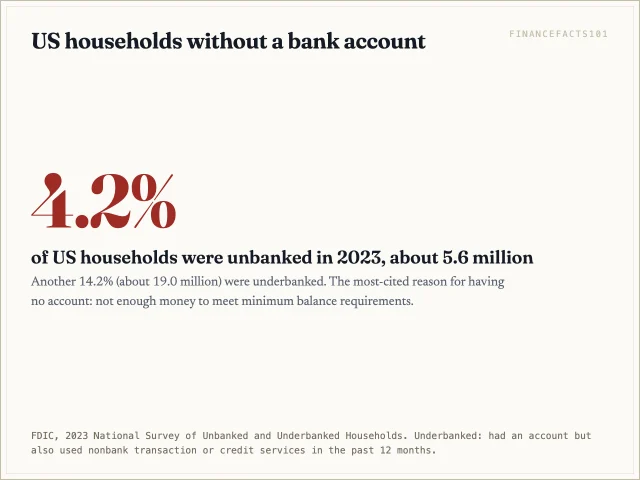
In the US, the FDIC's 2023 National Survey of Unbanked and Underbanked Households found that 4.2% of households, about 5.6 million, had no bank account. Another 14.2%, about 19.0 million, had an account but had also used nonbank services such as check cashing, money orders or payday loans in the past year. The most-cited reason for being unbanked was not having enough money to meet minimum balance requirements.
Globally the gap is far larger. The World Bank's Global Findex 2025, based on 2024 surveys, reports that nearly 80% of adults worldwide now have a financial account, up from 50% in 2011, but 1.3 billion adults still lack one.
People without access to formal credit still borrow. They borrow from relatives, employers, pawnshops and moneylenders, often at very high cost. In the US, the Consumer Financial Protection Bureau notes that a payday loan fee of $15 per $100 is common and "equates to an annual percentage rate of almost 400 percent for a two-week loan." Microfinance matters because it offers a cheaper, more structured alternative to that kind of borrowing, and because a repayment record with a regulated lender can become the credit history that opens up ordinary bank loans later.
Services Offered by Microfinance Institutions
A microfinance institution (MFI) can be a nonprofit loan fund, a licensed bank such as Grameen Bank, a credit union, or a community development financial institution (CDFI). Their product range is broader than the name suggests:
- Microloans for working capital, inventory, tools or equipment, often starting small and growing with each repaid loan.
- Savings accounts, sometimes with very low minimums, and in some programs a required savings deposit alongside the loan.
- Microinsurance: small life, health, crop or funeral policies priced for low incomes.
- Payments and transfers, including mobile money, which the World Bank's Findex links to much of the recent rise in account ownership in developing economies.
- Training and technical assistance: bookkeeping, pricing, cash-flow planning and business coaching. The SBA chooses its microloan intermediaries partly for their "experience in lending as well as management and technical assistance."
- Credit building, by reporting on-time payments to credit bureaus so borrowers can later qualify for mainstream credit.
Not every institution offers all six. In the US many microlenders are nonprofit loan funds that offer credit and coaching but not deposits, because taking deposits requires a bank or credit union charter.
How a Microloan Works
Microloans differ from bank loans less in their math than in their process. The group model, pioneered by Grameen Bank and still used by Grameen America in the US, is a good illustration.
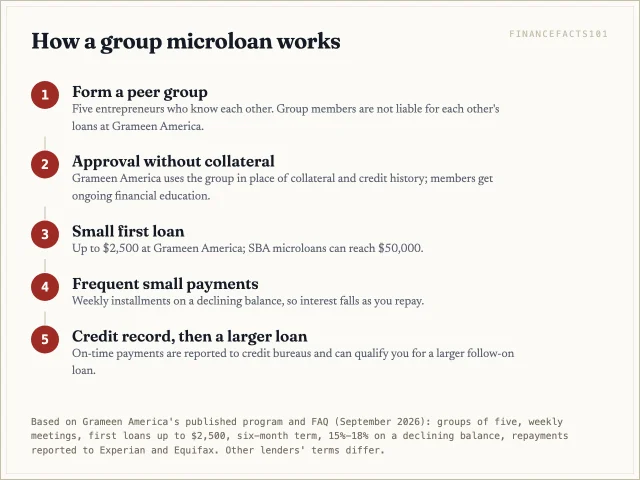
Grameen America's program page says five entrepreneurs form a peer group, meet weekly with a field employee, and take first-time loans "starting at no more than $2,500", repaid on a six-month schedule. Its FAQ states that "our interest rate ranges from 15%-18% on a declining balance" with no origination, late or monthly fees, that group members "are not financially responsible if other members default," and that repayments are reported to Experian and Equifax.
That last point matters. In the classic group model, members were jointly liable for one another's loans. Some lenders, Grameen America among them, now keep the group as a support and accountability structure rather than a guarantee. If a lender asks you to co-sign or guarantee a group member's debt, read that clause carefully; it is not universal.
"Declining balance" also matters. It means interest is charged only on what you still owe, the same way a car loan or mortgage works. Some lenders, particularly outside the US, quote a "flat" rate on the original amount for the whole term, which costs far more than the same number applied to a declining balance. Always ask for the APR.
Community Bank Micro-Lending in the US
Community banks, which the FDIC says make up 90% of insured institutions, are the natural local lenders for very small businesses. In practice they reach the smallest borrowers in three ways.
Direct small loans. Some community banks make small business loans or starter lines of credit themselves. The obstacle is cost: a small loan involves much of the same fixed underwriting and servicing work as a large one, so some banks set minimum loan sizes above what a new microbusiness needs.
Partnerships with microlenders and CDFIs. More commonly, a bank lends to, invests in or deposits money with a nonprofit lender that makes the small loans, and refers applicants it cannot approve. The SBA's microloan program works through exactly this kind of lender: the SBA lends to "specially designated intermediary lenders, which are nonprofit community-based organizations," and they make the loans. An OCC fact sheet on bank partnerships with CDFIs (September 2019) lists loans, investments, deposits, grants and referrals as the usual forms.
Community Reinvestment Act credit. Banks have a regulatory reason to do this. The same OCC fact sheet says "certain bank loans, services, and investments in CDFIs may be eligible for CRA consideration if the CDFI's activities promote community development and meet the CRA's geographic requirements." The FDIC made the same point in a 2014 guide for community banks: "Loans to and investments in qualifying CDFIs may help banks meet their CRA obligations." A 2023 overhaul of the CRA rules was blocked in court before it took effect, so banks are still examined under the framework in place since 1995, and the OCC and FDIC proposed further changes on July 31, 2026. The exact treatment depends on the rules in force when a bank acts.
If you are a borrower, the practical upshot is to ask your community bank two questions: does it make small loans of the size you need, and if not, which microlender does it work with? The SBA also publishes a list of microlenders by state.
Micro Loans for Individuals: Your US Options
"Microloan" in the US covers several different products. Some are for businesses only; some are personal. Your choice depends on what the money is for.
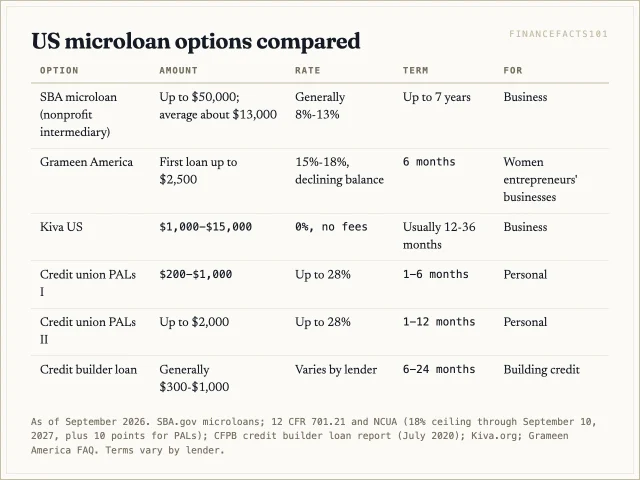
SBA microloans go up to $50,000, with rates the SBA says are "generally, between 8%-13%" and a maximum term of seven years. The money can pay for working capital, inventory, supplies, furniture, fixtures, machinery or equipment, but it "cannot be used to pay existing debts or to purchase real estate." The intermediary makes the credit decision and sets the terms.
Payday alternative loans (PALs) are the closest thing to a personal microloan from a regulated lender. Federal credit unions can make them under 12 CFR 701.21: PALs I run from $200 to $1,000 for one to six months, PALs II up to $2,000 for one to 12 months. The rate may be 1,000 basis points above the NCUA's general loan ceiling, which the NCUA board has kept at 18% through September 10, 2027, so PALs can charge up to 28%. The rule bars rollovers and limits a borrower to three PALs in any rolling six months. For PALs I, the NCUA caps the application fee at the lender's actual processing cost, up to $20, and requires one month of membership first.
Credit builder loans are designed for people with no credit score or a thin file. The CFPB describes the structure: the lender puts its own funds, "generally in the range of $300 to $1,000," into a locked account, you make payments over 6 to 24 months, and you receive the money at the end. Your payments are reported to Experian, Equifax and TransUnion.
Kiva US offers business loans of $1,000 to $15,000 at 0% interest with no fees, funded by crowdfunding. You first invite people you know to lend, then the loan goes public. Repayment usually takes 12 to 36 months.
Grameen America serves women entrepreneurs through the group model described above, at 15% to 18% on a declining balance.
What each costs on a small loan:
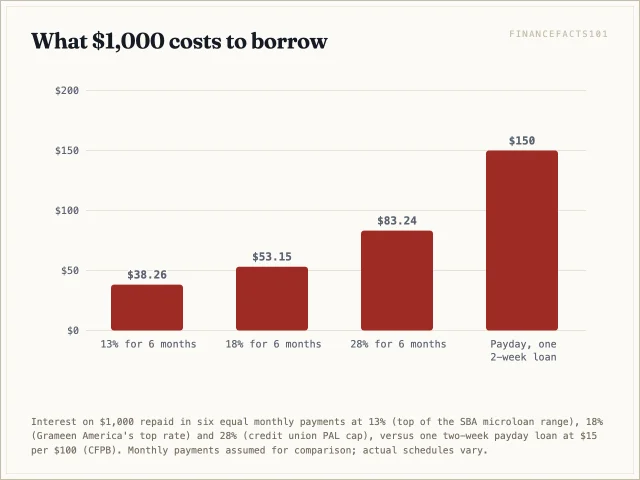
On $1,000 repaid in six monthly installments, 18% costs about $53 in interest and 28% about $83. Borrowing the same $1,000 through a payday loan at $15 per $100, where state law allows a loan that size, costs $150 for just the first two weeks, more than six months of a PAL at the maximum rate. Weekly payments, as Grameen America uses, cost slightly less than the monthly figures: about $47 at 18%.
Who Should Use Microfinance, and When
Microfinance fits a specific situation: you need a modest amount, you have a clear use for it, and you have a realistic way to repay it from income. Four situations where it tends to make sense:
- You run or are starting a very small business and banks have declined you. A microloan for inventory, a tool or a vehicle repair that keeps you working can pay for itself. The test is arithmetic, not optimism: will the loan add more to your monthly income than the payment takes out?
- You have no credit history and need one. A credit builder loan or a microlender that reports to bureaus creates a track record. A thin file is one of the main causes of bad credit and its costs, and a year of on-time payments is often enough to change the offers you get.
- You face a one-time emergency and the alternative is a payday loan. A credit union PAL at up to 28% is far cheaper than a 400% payday loan, provided you can repay it within the term.
- You have no collateral. Most microloans are unsecured or lightly secured. Banks usually want collateral to back a small-business loan, which is exactly what new borrowers lack.
When low-income borrowers should not use microfinance matters just as much:
- To cover a recurring monthly shortfall. A loan moves the gap to next month and adds interest. If your expenses routinely exceed income, a budget change or benefits check comes first.
- To pay off other debts. SBA microloans explicitly can't be used for that, and stacking a new loan on existing ones is risky. In the CFPB-funded study, the credit builder loan raised scores for people without existing debt but slightly lowered them on average for people who already had loans, and 39% of borrowers made at least one late payment on it.
- When the payment doesn't fit. Before borrowing, check what share of your income existing debt payments already take; the debt-to-income calculator does this in a minute.
A worked example: the average SBA microloan
Take the SBA's average microloan of $13,000, repaid monthly over five years. At 8%, the bottom of the SBA's typical range, the payment is $263.59 a month and total interest is $2,815.59. At 13%, the top of the range, the payment is $295.79 and total interest $4,747.40. The gap is about $32 a month, or $1,932 over the life of the loan. For a business owner, the question is whether the equipment or inventory the loan buys will add comfortably more than about $300 a month to cash flow. If it won't, the loan is too large or the plan needs work.
Why Microloan Rates Are Higher Than Bank Rates
Microloans often carry higher rates than bank loans, and critics sometimes treat that as proof of exploitation. The main reason is more mundane: small loans are expensive to make.
CGAP, a research group housed at the World Bank, put it plainly in its brief Are Microcredit Interest Rates Excessive? (February 2009): lending $100,000 in 1,000 loans of $100 each "will obviously require a lot more in staff salaries than making a single loan of $100,000." Using 2006 data, it found the median interest rate at sustainable MFIs worldwide was about 26%. Administrative costs, at about 11% of the loan portfolio, were the largest single part of that rate; the cost of funds was about 8%, and loan losses only about 1.9%. The 85% rates charged by Mexico's Compartamos, which drew wide criticism, were "truly exceptional"; fewer than 1% of borrowers paid rates that high.
A later CGAP study, Microcredit Interest Rates and Their Determinants: 2004–2011 (Rosenberg, Gaul, Ford and Tomilova, June 2013), used data from 866 MFIs reporting to the MIX database and found a global median interest yield of about 27% in 2011. Interest yield is interest and fee income as a share of the average loan portfolio; the authors note it probably understates the effective rates borrowers pay, often substantially. Rates were substantially lower in South Asia than elsewhere and varied most in Africa and Latin America.
Both sets of figures are more than a decade old and vary widely by country, but the logic still holds. A lender that charges less than its costs has to rely on donors to stay open. A lender charging far more than its costs deserves scrutiny. US options such as SBA microloans at 8% to 13% and Kiva's 0% loans exist because government funding or crowdfunded capital covers part of the cost.
What the Evidence Says About Microfinance and Poverty
For years microfinance was promoted as a cure for poverty, and the legacy version of this page repeated that claim. The best evidence is more modest.
In 2015 the American Economic Journal: Applied Economics published six randomized evaluations of microcredit in six countries. Summarizing them, economists Abhijit Banerjee, Dean Karlan and Jonathan Zinman found a pattern of "modestly positive, but not transformative, effects". Access to credit helped some households start or expand businesses and manage risk. On average, it did not lift incomes enough to move households out of poverty.
That is a useful way to think about a microloan. It is a financial tool, sometimes an important one. It works when the borrower has a productive use for the money, and it can hurt when the loan covers consumption the borrower can't afford. Savings, insurance and payment services, less glamorous than lending, often matter as much for keeping a household stable.
A Short History: From Irish Loan Funds to Grameen Bank
Small-loan lending to the poor long predates the word "microfinance." Economists Aidan Hollis and Arthur Sweetman trace one early system in The Irish Loan Funds, 1720-1920: Jonathan Swift gave £500 in the 1720s to be lent to "poor artizans of Dublin" in loans of under £10. After Parliament encouraged them in the 1830s, about 300 loan funds were operating by 1843, and at their mid-19th-century peak they lent to roughly 20% of Irish households.
The modern movement began with Muhammad Yunus. Grameen Bank's own history says it "started in 1976 as an action research pilot project" in Jobra village and became a bank in 1983. As of August 2026 it reports 10.63 million borrower members and a recovery rate of 95.66%. The bank also says 98% of its borrowers are women and that no collateral is required. Yunus and Grameen Bank shared the 2006 Nobel Peace Prize "for their efforts to create economic and social development from below."
Since then the model has spread and changed. Some lenders dropped joint liability, mobile money took over part of the cash handling in developing economies, and US programs grew up around nonprofit loan funds, CDFIs and credit unions rather than new banks. For how those mainstream institutions differ, see the overview of bank types, services and regulation.
FAQ
What is the difference between microfinance and microcredit?
Microcredit is lending only: small loans to people without access to bank credit. Microfinance is the broader term. It includes microcredit plus savings, insurance, payments and financial training. Most institutions started with credit and added the other services later.
Can an individual get a microloan without a business?
Yes, but the options are narrower. SBA microloans, Kiva US and Grameen America lend for business purposes. For personal needs, a federal credit union's payday alternative loan ($200 to $2,000, up to 28%) or a credit builder loan ($300 to $1,000 in the CFPB's description) is the usual route. You generally need to be a member of the credit union first.
Do microloans help build credit?
They can, if the lender reports to the credit bureaus and you pay on time. Grameen America reports to Experian and Equifax, and credit builder loans are designed to be reported to the credit bureaus; ask which ones. Late payments are reported too, so a microloan you struggle to repay can lower your score.
What interest rate do microloans charge?
It depends on the lender. In the US, SBA microloans generally run 8% to 13%, Grameen America charges 15% to 18% on a declining balance, federal credit union PALs can charge up to 28%, and Kiva US loans are 0%. Outside the US rates are often higher. CGAP found a global median interest yield of about 27% in 2011, the latest year in its multi-country study, close to the roughly 26% median it found at sustainable MFIs in 2006.
Sources
- U.S. Small Business Administration, Microloans — loans up to $50,000, average about $13,000, rates generally 8% to 13%, maximum term seven years, permitted and prohibited uses, nonprofit intermediary lenders; list of microlenders
- FDIC, 2023 National Survey of Unbanked and Underbanked Households — 4.2% of households (5.6 million) unbanked, 14.2% (19.0 million) underbanked
- FDIC, Quarterly Banking Profile, Second Quarter 2026 — community banks are 90% of insured institutions
- FDIC, FIL-26-2014: Strategies for Community Banks to Develop Partnerships with CDFIs — CDFI partnerships and CRA
- Office of the Comptroller of the Currency, Bank Partnerships With Community Development Financial Institutions (September 2019) — partnership forms and CRA consideration
- FDIC, Agencies Issue Joint Proposal Amending the Community Reinvestment Act Rules (July 31, 2026) — 2023 CRA rules enjoined before taking effect; OCC and FDIC proposed amendments
- Consumer Financial Protection Bureau, What are the costs and fees for a payday loan? — $15 per $100 common, almost 400% APR for a two-week loan
- Consumer Financial Protection Bureau, Targeting credit builder loans (July 2020) — structure, $300 to $1,000, 6 to 24 months, study findings
- eCFR, 12 CFR 701.21 — PALs I and PALs II amounts, terms, rate and rollover rules
- NCUA, Board extends loan interest rate ceiling (February 2026) — 18% ceiling through September 10, 2027; Access: payday alternative loans — PALs I application fee and membership rules
- World Bank, Global Findex 2025 press release (July 16, 2025) — nearly 80% of adults have an account; 1.3 billion do not
- Grameen America, Our Program and FAQ — group model, first loans up to $2,500, 15% to 18% declining-balance rate, credit bureau reporting
- Kiva, Borrow — US loans of $1,000 to $15,000 at 0% interest
- Grameen Bank, Introduction — 1976 origin, 1983 bank, 10.63 million members and 95.66% recovery rate as of August 2026
- NobelPrize.org, The Nobel Peace Prize 2006
- CGAP, Microcredit Interest Rates and Their Determinants: 2004–2011 (Rosenberg, Gaul, Ford and Tomilova, June 2013) — global median interest yield of about 27% in 2011, 866 MFIs reporting to MIX
- CGAP, Are Microcredit Interest Rates Excessive? (Rosenberg, Gonzalez and Narain, February 2009) — 26% median rate in 2006 and its cost components
- Banerjee, Karlan and Zinman, Six Randomized Evaluations of Microcredit: Introduction and Further Steps, American Economic Journal: Applied Economics 7(1), January 2015
- Hollis and Sweetman, The Evolution of a Microcredit Institution: The Irish Loan Funds, 1720-1920, University of Toronto working paper, 1996
 Next entry · No. 3,190Understanding Micro-Investing Platforms: Rounding Up Change for a Better Future
See also
-
 No. 5,108
12 Aug 2025
19 min
Turnkey Businesses: Franchises, Multi-Level Marketing, and Real Estate
Business Finance
No. 5,108
12 Aug 2025
19 min
Turnkey Businesses: Franchises, Multi-Level Marketing, and Real Estate
Business Finance -
 No. 4,823
19 Jul 2025
21 min
Understanding Swingline Loans: A Type of Short-Term Business Financing
Business Finance
No. 4,823
19 Jul 2025
21 min
Understanding Swingline Loans: A Type of Short-Term Business Financing
Business Finance -
 No. 4,791
17 Jul 2025
20 min
Understanding Subordination Agreements: Prioritizing Debts in Finance and Investment
Business Finance
No. 4,791
17 Jul 2025
20 min
Understanding Subordination Agreements: Prioritizing Debts in Finance and Investment
Business Finance -
 No. 4,662
07 Jul 2025
18 min
Silent Partners: The Role, Risks, and Rewards of Being a Limited Partner in Business
Business Finance
No. 4,662
07 Jul 2025
18 min
Silent Partners: The Role, Risks, and Rewards of Being a Limited Partner in Business
Business Finance -
 No. 4,635
04 Jul 2025
19 min
Understanding Shareholders Agreements: Key Provisions and Benefits for Institutional Investors
Business Finance
No. 4,635
04 Jul 2025
19 min
Understanding Shareholders Agreements: Key Provisions and Benefits for Institutional Investors
Business Finance -
 No. 4,609
02 Jul 2025
19 min
Understanding Series B Financing: The Next Stage of Funding for Businesses
Business Finance
No. 4,609
02 Jul 2025
19 min
Understanding Series B Financing: The Next Stage of Funding for Businesses
Business Finance