Understanding the Bell Curve: What it is and its Application in Finance

Understand the basics of a Bell Curve, including its definition, key elements, applications in finance, and limitations.
Definition of a Bell Curve
A bell curve, also known as the normal distribution, represents a symmetrical graphical model for data distribution. Its name comes from its distinct bell-shaped appearance. In a bell curve, the mean (average), mode, and median occur at the highest point on the curve. The curve’s shape is characterized by a single peak surrounded by decreasing frequency as we move away from the mean in both directions, forming a bell shape. The width of a bell curve depends on its standard deviation, which measures the spread or dispersion of data points from their average value. This statistical concept plays an essential role in finance and investment analysis due to its ability to model various financial phenomena accurately.
Understanding Bell Curves
The normal distribution is characterized by several key elements: the mean as the expected value, the mode representing the most likely outcome, and the median being the middle value of a dataset when arranged in ascending order. The bell curve’s symmetrical nature means that the mean, median, and mode coincide, making it an appealing model for analyzing data with these characteristics. In finance, bell curves are often used to assess securities’ historical performance and market sensitivity to potential future returns. By studying the normal distribution of historical returns, investors can make informed assumptions about the likelihood of different outcomes in a given investment opportunity.
Types of Distributions: Normal vs. Non-Normal
Not all financial data follow a normal distribution, as some securities may exhibit non-normal distributions with fatter tails compared to a bell curve. These distributions could indicate a greater probability of extreme returns, either positive or negative, which might be critical for investors to consider. Understanding the difference between normal and non-normal distributions is essential to effectively utilize statistical tools for financial analysis and risk management.
Characteristics of Bell Curves in Finance
In finance, bell curves can provide valuable insights when analyzing investment opportunities. The mean (average) represents the expected return on an investment, while the standard deviation depicts the volatility or variability around that mean. By examining a security’s historical returns as a bell curve, investors can assess its risk level and potential reward based on statistical analysis. Additionally, understanding percentiles and their relationship to the bell curve (standard deviations) allows for better evaluation of various performance scenarios.
Bell Curves in Performance Management
Beyond finance, bell curves are commonly used in performance management within organizations. By categorizing employee performance into tiers based on a bell curve, companies can effectively assess their workforce and make data-driven decisions regarding promotions, compensation, or termination. However, it is essential to recognize the limitations of this approach when dealing with smaller groups or non-normal distributions, as these methods might not accurately reflect individual merit or skill levels.
Advantages and Limitations of Bell Curves
Bell curves provide a valuable framework for analyzing data in finance and other fields. By understanding their properties, investors can make informed decisions based on historical performance trends and statistical analysis. However, it’s crucial to recognize the limitations of relying solely on bell curves, as they may not accurately represent real-world financial phenomena, and deviations from a normal distribution might lead to inaccurate predictions or misinterpreted results.
FAQs about Bell Curves
What is a bell curve in finance?
A: A bell curve in finance refers to the graphical representation of a normal probability distribution in statistical analysis. It’s an essential tool for assessing data and making informed decisions regarding investment opportunities, risk management, and performance evaluation.
How does a bell curve differ from a non-normal distribution?
A: Bell curves are characterized by symmetry around their mean and a normal distribution of data points. Non-normal distributions lack this symmetry and have fatter tails compared to bell curves, potentially indicating a higher probability of extreme outcomes.
What are the implications for investors in dealing with non-normal distributions?
A: Investors need to be aware that some financial phenomena do not follow normal distributions and may require alternative statistical models or methods for accurate analysis and prediction.
How can bell curves help in performance management?
A: Bell curves are used in performance management by categorizing employees based on their performance metrics into tiers, making it easier to assess overall workforce efficiency and make data-driven decisions.
What is the difference between mean, median, mode, and standard deviation in a bell curve?
A: The mean represents the average value of all data points, while the median is the middle value when arranged in order. Both the mean and median are equal to the mode in a symmetric bell curve. Standard deviation measures the spread or dispersion of data points around the mean.

Key Elements of a Bell Curve
A bell curve, also known as a normal distribution or Gaussian distribution, represents the probability distribution of continuous data where values cluster around the average value and decrease in frequency as they move further away from it. The term “bell curve” comes from its characteristic symmetric shape, which is often visualized as a bell with its highest point at the mean, mode, and median.
The Bell Curve’s Meaning
The mean, or expectation, is the average value of a dataset. In the context of a bell curve, it marks the highest point in the curve. This central positioning makes it an essential element for understanding the distribution of data points around this central point.
Additionally, two other critical concepts are closely related to the mean: the median and mode. The median represents the middle value when all values are arranged from least to greatest, whereas the mode refers to the most frequently occurring value in a dataset. In a bell curve, the mean, median, and mode all coincide, resulting in their equivalence due to the symmetry of the distribution.
The Bell Curve’s Symmetric Shape
The shape of a bell curve is characterized by its symmetry around the mean. Each side exhibits a mirror image of the other, with both sides decreasing in frequency as data points move further away from the center. This symmetry is significant because it reflects the balance between positive and negative values, which holds importance in various fields such as finance and economics.
The Role of Standard Deviation
Standard deviation is another important aspect of a bell curve. It describes the dispersion or spread of data points around the mean and determines the width of the curve. As a rule of thumb, approximately 68% of data points lie within one standard deviation of the mean, while around 95% fall within two standard deviations. Nearly all data points, roughly 99.7%, can be found within three standard deviations from the mean.
The Bell Curve in Finance
Bell curves are frequently utilized in finance and investment analysis for understanding securities’ returns and market sensitivity. The normal distribution assumption is employed to model stock price movements or volatility, making it a vital tool for investors and financial analysts. In finance, standard deviation represents the degree of risk associated with an investment and is calculated from historical data points.
Types of Distributions: Normal vs. Non-Normal
Not all data conform to the normal distribution (bell curve). Non-normal distributions differ from a bell curve in their shape, having heavier tails or skewness. The consequences of this difference can be significant for investors as non-normally distributed returns might result in larger negative outliers than anticipated. In contrast, a normal distribution assumes an equal likelihood of positive and negative events, making it crucial to understand the actual distribution type before relying on such assumptions.
Characteristics of a Bell Curve: Meaning, Mode, Median, Standard Deviation, and Symmetry
In summary, the key elements that define a bell curve are its mean (average value), mode (most frequently occurring value), median (middle value), standard deviation (spread or dispersion), and symmetry around the mean. The interplay between these components shapes the distinctive bell-like appearance of the distribution and forms an essential foundation for understanding various statistical concepts.

Bell Curves in Finance
A bell curve represents a normal probability distribution and is widely used for analyzing financial data, particularly returns from securities and market sensitivity. In finance, the term “bell curve” is also known as a normal distribution. It’s characterized by its symmetrical shape with a single peak at the mean and a downward slope on both sides, determined by the standard deviation.
Financial analysts frequently employ bell curves when assessing securities’ returns or market sensitivity, providing insight into expected future performance based on historical data. For instance, blue-chip stocks generally exhibit bell curve distributions with lower volatility and predictable patterns due to their stability. Investors can use the historical data of a stock’s past returns to form assumptions regarding possible future returns.
Investors often employ standard deviation in finance as a measure of volatility, which is essential when dealing with risk and uncertainty. For example, a higher standard deviation indicates a larger spread between potential returns, making it more risky for investors. Conversely, a lower standard deviation indicates a more predictable investment outcome.
In some cases, securities may not follow the bell curve distribution and instead exhibit non-normal distributions. Non-normal distributions differ from bell curves by having fatter tails, which indicate a greater probability of extreme events or outliers. This is particularly relevant for investors since it highlights the potential risks associated with holding assets that don’t conform to the normal distribution assumption.
While the bell curve offers valuable insights into financial data, its limitations should not be overlooked. The normal distribution assumption might not always hold true in finance due to factors such as skewness, excess kurtosis, or other non-normally distributed elements. In these situations, relying solely on the bell curve may result in unreliable conclusions or predictions.
In conclusion, understanding the concept of a bell curve and its applications in finance is vital for investors seeking to make informed decisions based on historical data. By recognizing both its advantages and limitations, investors can develop a well-rounded approach to risk management and performance analysis.
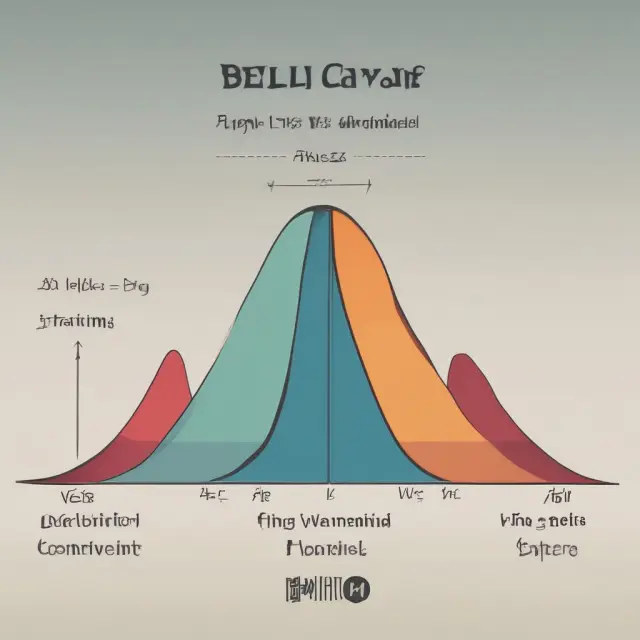
Types of Distributions: Normal vs. Non-Normal
A normal probability distribution, popularly known as a bell curve, represents the most common type of continuous distribution. It provides valuable insight into how data points are distributed around an average value (mean), which is crucial in finance and investment analysis. However, it’s essential to understand that not all financial phenomena conform to this symmetrical shape, and differences between normal and non-normal distributions have significant implications for investors.
Normal Distributions: Bell Curves
A normal distribution shows a symmetrical curve with a single peak, known as the mode, median, and mean. These three measures converge at the same location in a bell curve. The width of the curve is determined by its standard deviation, which illustrates the spread or dispersion of data points around the mean. In finance, a normal distribution, or bell curve, is commonly used to represent the probability of various investment outcomes based on historical data. For instance, stock price returns and market sensitivity are often analyzed using this assumption.
Non-Normal Distributions: Fat Tails and Skewness
In contrast to normal distributions, non-normal distributions feature asymmetrical shapes with heavier tails or skewness towards one side, as seen in the figure above. While some financial securities may display characteristics of a bell curve, others can exhibit extreme values or outliers that fall beyond three standard deviations from the mean. This is more common than expected due to various factors like market volatility, rare events, or other uncertainties.
Investment Implications: Understanding Distribution Shapes
Financial markets are influenced by a multitude of variables with complex relationships and interactions between them, making it essential for investors to recognize the differences between normal and non-normal distributions. By understanding the shape of data distributions, investors can make more informed decisions and improve their overall risk management strategies. For instance, if investors assume that stock returns follow a normal distribution while they are, in fact, skewed or exhibit heavy tails, it may lead to unreliable forecasts and misjudgments in portfolio allocation.
In conclusion, the bell curve is an essential tool for financial analysts and investors in understanding the distribution of various financial phenomena. However, it’s crucial to recognize that not all distributions follow a normal shape, as some investments may exhibit non-normal features that require different modeling techniques for accurate predictions. By acknowledging these differences and their implications, investors can effectively adapt their strategies to various market conditions and make more informed investment decisions.
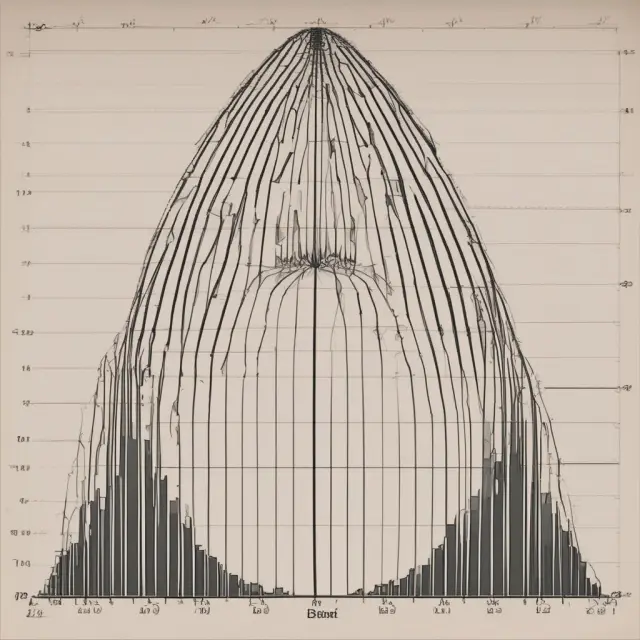
Characteristics of a Bell Curve
A bell curve, also known as the normal distribution, is a continuous probability distribution that follows a symmetric shape with its peak at the mean, median, and mode. This bell-like symmetry stems from the fact that most data points fall close to the mean, while fewer occurrences lie farther away. The curve’s width depends on the standard deviation – a measurement of how spread out or dispersed the data is around the average.
A bell curve consists of various key elements: the mean, median, mode, and standard deviation. These terms represent critical components that define the curve’s central tendency and spread.
The Mean (average): The mean represents the arithmetic average of all the values in a dataset. In a normal distribution, the mean is also the most frequent value or the point of highest probability. It signifies the center of symmetry for the bell curve.
The Median: The median, another measure of central tendency, can be defined as the middle value when data points are arranged in ascending order. In a symmetric normal distribution, the median coincides with the mean and mode.
The Mode: A mode refers to the most frequently occurring value or values in a dataset. In the context of a bell curve, the mode is the same as both the mean and median because the data points are symmetrical around their central tendency.
Standard Deviation (spread): Standard deviation describes how spread out or dispersed a dataset’s values are from its mean. It is an essential element that determines the width of the bell curve, with lower standard deviations producing narrower curves and higher ones resulting in wider distributions.
Calculating Percentiles: Once standard deviations have been established, you can determine percentiles. A percentile represents the value below which a certain percentage of observations fall. For example, the 50th percentile is equivalent to the median while the 68th and 95th percentiles correspond to one and two standard deviations away from the mean, respectively.
These characteristics form the foundation for understanding bell curves’ significance in various applications, including finance. In financial contexts, analysts employ these concepts to model securities’ returns, assess risk, and make informed investment decisions based on data that follows a normal distribution.

Bell Curves in Performance Management
The application of bell curves extends beyond statistics and economic analysis; they also play a crucial role in performance management for companies. Bell curve analysis enables organizations to categorize employees based on their performance levels. The graphical representation displays the distribution of employee performance, with the majority falling within an average range around the mean. High performers and low performers are then identified by the downward-sloping tails.
However, it is essential to recognize the limitations when using bell curves for evaluating performance. Bell curves can be misleading because they force groups of people into predefined categories—poor, average, or good—which may not accurately reflect their true abilities. This can lead to employees who may just be average being unfairly categorized as poor performers due to the need to fit everyone into specific quadrants defined by the curve.
In addition, real-world data often exhibit non-normal distributions, meaning that they do not follow a perfect bell curve shape. These deviations can include skewness or kurtosis that cannot be accounted for with a standard bell curve analysis. For instance, data sets can show asymmetric tails and outliers, making it more challenging to accurately assess performance based on a bell curve alone.
Despite these limitations, bell curves remain a popular tool in performance management due to their ability to provide an objective assessment of individual performances within a group. By visualizing the distribution of employee performance levels, organizations can identify areas for improvement and target development opportunities for each employee category. Furthermore, it allows managers to make informed decisions regarding staffing, promotions, and resource allocation based on performance metrics.
In conclusion, bell curves are powerful tools in analyzing data distributions that help gain insights into various aspects of finance and performance management. However, it is essential to acknowledge their limitations and be cautious when interpreting the results. While they provide valuable information regarding mean values and the dispersion of data points around the mean, they may not adequately represent all financial phenomena or real-world situations. By understanding both the advantages and disadvantages of bell curves, one can make more informed decisions in finance and performance management.
Limitations of Bell Curves
While bell curves, also known as normal distributions, offer many advantages for understanding and analyzing data in finance, they are not infallible tools. In certain situations, the assumptions behind a normal distribution may not hold true, leading to potential limitations and issues when relying solely on a bell curve analysis.
One limitation of using a bell curve is that real-life financial phenomena can often display non-normal distributions. In such cases, the data points deviate from the typical bell shape, which could lead to inaccurate results when modeling the data based on a normal distribution assumption. For example, stock market returns tend to have fatter tails than a normal distribution, meaning that extreme events (both positive and negative) are more likely to occur than predicted by a bell curve.
Another limitation of bell curves is their inherent categorization of individuals or data points into predefined groups, such as poor, average, and excellent performers. This approach can be problematic because it may not accurately represent the true distribution of abilities or returns. Furthermore, it can lead to misclassification, where some individuals who should be considered average are assigned to a lower category based on the need to fit the data points into a bell curve structure. This could potentially result in an unjust evaluation of individual performance or ability, particularly when dealing with small groups of data points.
Additionally, it’s important to keep in mind that no single statistical model is universally applicable in all situations. While the bell curve offers valuable insights for understanding normal distributions and their associated patterns, other statistical models might be more suitable for certain financial phenomena. For example, when modeling extreme events such as market crashes or financial crises, non-normal distributions like the Pareto distribution or the power law might be more appropriate to capture the underlying data’s long-tail behavior.
In conclusion, while bell curves are essential tools in finance for understanding the normal distribution and its associated characteristics, they have their limitations. By being aware of these limitations, investors and analysts can make informed decisions about when to use a bell curve analysis and when to consider alternative statistical models for better modeling accuracy and more effective investment strategies.
Bell Curve vs. Empirical Rule
A bell curve and the empirical rule are two interconnected concepts that help us understand and analyze data using probability distributions. Both concepts are essential in statistical analysis, especially when dealing with financial data. A normal distribution or a “bell curve” is a continuous probability distribution symmetrically shaped around its mean. It’s called a bell curve due to the symmetrical, bell-like shape of the graphical representation. The empirical rule, on the other hand, provides insight into how percentages of data points are distributed around the mean in a normal probability distribution.
Understanding the Empirical Rule
When it comes to analyzing large data sets, the empirical rule helps us determine the percentage of values that lie within certain standard deviations from the mean. It is also known as the “68-95-99.7 rule.” According to this rule:
– 68% of all values lie within one standard deviation of the mean.
– 95% of all values lie within two standard deviations of the mean.
– 99.7% of all values lie within three standard deviations of the mean.
Comparison between Bell Curve and Empirical Rule
The empirical rule is an essential tool for understanding a bell curve since it gives us insight into how percentages of data points distribute themselves around the mean. The symmetry of a bell curve means that the mean, median, and mode all lie at the same point, which is the highest point on the curve. The width of the bell curve is determined by its standard deviation, which defines its relative spread around the mean.
A normal probability distribution with a symmetrical shape implies equal probabilities for positive and negative deviations from the mean. By combining the bell curve and the empirical rule, we can infer that:
– Approximately 68% of the values within one standard deviation fall below or above the mean.
– Approximately 95% of values within two standard deviations fall below or above the mean.
– Approximately 99.7% of all values within three standard deviations fall below or above the mean.
Bell curves are essential tools in finance, and understanding their properties is vital for investors. By analyzing securities’ returns using a bell curve distribution, we can make assumptions about expected future returns based on historical data. In this context, the empirical rule provides valuable insight into how likely it is for these returns to fall within certain deviations from their mean.
In conclusion, the bell curve and the empirical rule are two powerful tools in statistical analysis that help us understand probability distributions and their relationship to real-world data. By familiarizing yourself with these concepts and their applications, you can effectively analyze financial data and make informed decisions.

Advantages of Bell Curves
A bell curve offers several advantages when used for analyzing data in finance. The main advantage lies in its ability to help investors and analysts gain a better understanding of the underlying patterns, distributions, and relationships within financial data. Some key benefits are:
1. Probability Analysis: Bell curves enable us to analyze probabilities for different events or outcomes. In finance, they can be used to assess the likelihood of various risks and returns, helping investors make informed decisions based on statistical evidence.
2. Simplification: Bell curves allow financial analysts to simplify complex data sets by representing them graphically in a clear and easily interpretable manner. This helps to quickly identify trends, patterns, and anomalies within the data.
3. Risk Management: Bell curves are useful tools for managing risk, as they help investors assess potential outcomes and their probabilities. They can be used to evaluate individual securities, portfolios, or broader market risks.
4. Modeling: The normal distribution assumption, which underlies the bell curve, is widely used in financial modeling. Bell curves are particularly useful when it comes to estimating the probability distributions for stock returns, interest rates, and other financial variables.
5. Decision Making: Bell curves provide valuable insights that can inform investment decisions by allowing investors to evaluate risks, returns, and various scenarios based on statistical data and probabilities. This information can be particularly useful when making portfolio allocation or asset management choices.
6. Performance Evaluation: In performance management, bell curves can be employed to analyze the distribution of employee performance data. By graphing the data as a bell curve, it becomes possible to identify trends, assess individual performance, and determine appropriate reward levels based on performance relative to peers.
By understanding these advantages of using a bell curve in finance, investors and analysts can improve their decision-making abilities, mitigate risks, and make more informed investment choices.

FAQs about Bell Curves
1. What is a bell curve and where does the term originate from? A bell curve is a graphical representation of a normal probability distribution, which displays a symmetrical bell-shaped curve with its highest point at the mean (average) of all data points collected. The name “bell curve” comes from the fact that it resembles a bell in shape.
2. How does a bell curve represent financial data? Bell curves are used to depict various forms of financial data, such as securities’ returns and market sensitivity, as well as other quantifiable aspects within the finance industry. They provide valuable insights into historical trends and help make predictions about future outcomes.
3. What is the significance of a bell curve in performance management? Bell curves are often employed by organizations for evaluating employee performance based on their role or position. The distribution represents the average, high performers, and low performers, which can assist in making informed decisions when it comes to promotions, hiring, and terminations.
4. What is the difference between a normal probability distribution (bell curve) and non-normal distributions? While bell curves are symmetrical around their means with smooth tails, non-normal distributions exhibit different properties such as skewness or excess kurtosis, which can result in heavier tails or a lack of symmetry. Understanding the differences between these distributions is essential for accurately modeling financial data and making sound investment decisions.
5. How are percentiles determined using standard deviations within a bell curve? The empirical rule states that approximately 68% of all data falls within one standard deviation from the mean, 95% falls within two standard deviations, and 99.7% falls within three standard deviations. This information can be used to determine percentiles for a given dataset.
6. What are some limitations of bell curves? While bell curves offer numerous benefits in understanding financial data and making informed decisions, it’s important to recognize their limitations. For example, they may not accurately represent certain financial phenomena that exhibit skewness or excess kurtosis. It is crucial to consider these limitations when interpreting data and drawing conclusions based on bell curve analyses.
 Next entry · No. 394Below-the-Line Advertising: A Cost-Effective and Targeted Marketing Strategy
See also
-
 No. 1,271
22 Aug 2024
23 min
Understanding the Empirical Rule in Finance: Probability Distributions and Investment Risk
Finance Policy
No. 1,271
22 Aug 2024
23 min
Understanding the Empirical Rule in Finance: Probability Distributions and Investment Risk
Finance Policy -
 No. 654
15 May 2024
21 min
The Central Limit Theorem (CLT): Understanding Its Key Components, Usefulness in Finance, and Formula
Financial Data Analysis
No. 654
15 May 2024
21 min
The Central Limit Theorem (CLT): Understanding Its Key Components, Usefulness in Finance, and Formula
Financial Data Analysis -
 No. 353
11 Apr 2024
19 min
Understanding Bar Charts: Techniques, Interpretations, and Comparisons
Financial Tools
No. 353
11 Apr 2024
19 min
Understanding Bar Charts: Techniques, Interpretations, and Comparisons
Financial Tools -
 No. 11
28 Mar 2024
17 min
Understanding Abnormal Returns and Their Significance in Finance
Investments
No. 11
28 Mar 2024
17 min
Understanding Abnormal Returns and Their Significance in Finance
Investments -
 No. 866
22 Jun 2024
19 min
Dun & Bradstreet (DNB): An In-depth Analysis of the Global Business Intelligence Company
Business Strategy
No. 866
22 Jun 2024
19 min
Dun & Bradstreet (DNB): An In-depth Analysis of the Global Business Intelligence Company
Business Strategy -
 No. 806
12 Jun 2024
19 min
Understanding Coverage Ratios: A Comprehensive Guide for Institutional Investors
Business Strategy
No. 806
12 Jun 2024
19 min
Understanding Coverage Ratios: A Comprehensive Guide for Institutional Investors
Business Strategy