Understanding Vulture Capitalists: The Prey on Distressed Companies for Profit

Understanding Vulture Capitalism: Learn about the strategies of investors who prey on distressed companies for profit.
Definition and Overview of a Vulture Capitalist
Vulture capitalists are investors specializing in purchasing distressed companies at significantly low prices. Their primary objective is to revive these struggling businesses through aggressive cost-cutting measures, aiming for a quick profit. In the event that they fail to turn around the company, vulture capitalists resort to selling off assets or engaging in asset stripping.
Understanding the role of a vulture capitalist necessitates an appreciation for their investment strategies and goals. These financial strategists wait for opportunities to emerge when markets are bearish, targeting companies with severely depressed prices. By acquiring these underperforming firms, vulture capitalists aim to maximize potential returns while minimizing risks.
Distress investors acquire stakes in companies that have been overlooked by financial institutions due to their poor financial health. When these firms fail to secure financing from banks or other investors, they often resort to accepting any help available, including that from vulture capitalists. Once onboard, the vulture capitalist will set forth ambitious financial goals with a short-term focus.
The vulture capitalist’s ultimate objective is to revive the business by implementing hefty cost-cutting exercises, such as layoffs and reducing employee benefits, to boost profits. However, if they are unable to succeed in this endeavor, they may choose to engage in asset stripping, selling off valuable assets like land, buildings, or machinery to generate returns.
In essence, vulture capitalists serve a crucial role in the economy by providing liquidity and capital to distressed firms while taking calculated risks to generate profits. Their actions can be controversial, with critics accusing them of driving unemployment and devastating communities. Nevertheless, their impact on the economy remains a topic of ongoing debate.
Investment Strategies: Cost-Cutting and Turnaround Plans
The primary investment strategy employed by vulture capitalists centers around cost-cutting. This approach focuses on reducing overhead expenses and optimizing operational efficiency to boost profits. To achieve this objective, vulture capitalists may consider implementing the following tactics:
- Downsizing workforce: Reducing employee headcount through layoffs or attrition.
- Outsourcing and offshoring: Contracting labor services to external providers in lower-cost locations.
- Eliminating non-essential expenses: Canceling memberships, subscriptions, and other discretionary spending.
- Improving supply chain management: Negotiating better deals with suppliers or restructuring the supply chain entirely.
- Reassessing capital expenditures: Deciding whether to maintain or eliminate planned investments in new projects.
- Dividend cuts: Suspending or reducing dividends to preserve cash for reinvestment.
- Refinancing debt: Extending loan maturities, restructuring debt, or converting debt into equity.
- Rationalizing product lines: Consolidating offerings and discontinuing underperforming products.
- Implementing price increases: Passing along higher costs to customers through increased prices.
- Tax optimization: Reducing tax liabilities by restructuring the business or utilizing tax incentives.
These cost-cutting measures aim to improve a company’s short-term financial performance and help attract potential buyers when it is time for a sale. However, vulture capitalists must be mindful that overly aggressive cuts may negatively impact the long-term health of their investments.
Conclusion:
Understanding the role of a vulture capitalist requires a nuanced appreciation for their investment strategies, goals, and controversial practices. These financial strategists play an essential role in providing liquidity and capital to distressed companies while generating profits through aggressive cost-cutting tactics.
While some criticisms suggest that these actions harm communities and drive unemployment, others argue that vulture capitalists contribute to economic efficiency by reallocating resources to more productive uses. Ultimately, the impact of vulture capitalism remains a contentious topic of debate within the investment community and beyond.
In future sections, we will delve deeper into the strategies employed by vulture capitalists when companies fail to turn around and explore the differences between vulture and venture capitalist investments. Stay tuned for further insights on this complex but fascinating aspect of finance.

Identifying Opportunities for Investment
Vulture capitalists, also known as distressed debt investors or corporate scavengers, specialize in purchasing companies that are financially ailing or near insolvency, with the aim to revive them and sell at a profit. Vulture capitalists target firms whose shares have plummeted in the market due to negative financial conditions, and whose prices have been artificially depressed due to a lack of financing options.
The investment process for vulture capitalists starts by identifying opportunities where other investors may see only risks or insurmountable challenges. These distressed companies often fail to attract financing from traditional lenders like banks. As a result, they are left with limited options, leaving the door wide open for vulture capitalists to swoop in and make an offer.
Vulture capitalists look for several factors before investing in a distressed company:
1. Financial Distress: The primary focus is on companies experiencing significant financial difficulties such as declining revenue, high debt levels, or weak cash flow.
2. Market Inefficiencies: Vulture capitalists search for discrepancies between the market’s perception of a company’s value and its actual potential worth. They believe that by taking corrective measures, they can significantly increase the company’s value and profitability.
3. Turnaround Potential: Vulture capitalists assess whether the distressed firm has the potential to be revived or restructured. The goal is to implement strategic changes that would lead to improved financial performance, such as cost cutting, operational improvements, or asset monetization.
4. Valuation Dislocations: Vulture capitalists aim to buy undervalued assets at a significant discount, giving them the potential for substantial returns when the market recognizes the true value of those assets.
In summary, vulture capitalists thrive on the challenges faced by distressed companies and see these as opportunities rather than insurmountable hurdles. They offer a unique perspective in the investment world, as they focus on buying at the bottom of the cycle and then working to bring the company back to life.
Turnaround Strategies: Cost-Cutting
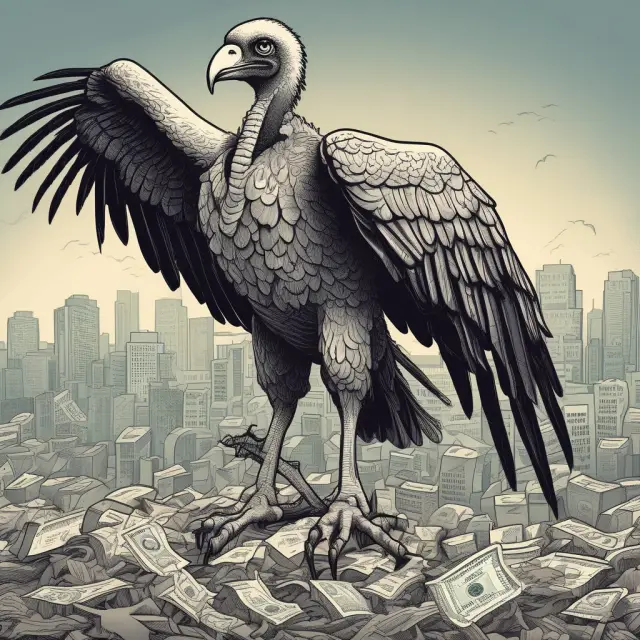
Vulture capitalists, known for their predatory investment strategies, aim to breathe life back into distressed companies and extract value from them. The primary tool in their arsenal for achieving a turnaround is aggressive cost cutting. This strategy involves reducing expenses wherever possible to increase profitability and potentially sell the business at a significant gain.
When a vulture capitalist acquires a struggling company, they often face challenges such as high debt levels, declining revenues, and inefficient operations. To address these issues and inject liquidity into the enterprise, the vulture capitalist will first assess the current state of affairs. Once a thorough analysis has been completed, the focus shifts to implementing cost-cutting measures designed to improve the company’s bottom line as soon as possible.
Job layoffs are one of the most common and contentious strategies employed by vulture capitalists to reduce costs. In some cases, entire departments may be dismantled, leading to significant unemployment. This approach is often met with criticism due to its negative impact on employees and their families. However, vulture capitalists justify these layoffs by arguing that they are necessary for the long-term viability of the business and to ensure a return on investment.
Another cost-cutting tactic includes renegotiating contracts with suppliers. By reducing the amount paid for raw materials or services, vulture capitalists can significantly lower their operating expenses. In some instances, they may even consider moving production offshore to countries where labor costs are lower to further boost profitability.
Closing underperforming locations is another popular cost-cutting measure. This may involve shuttering factories, stores, or offices that do not contribute substantially to the company’s overall profits. Though this approach can lead to short-term pain for employees and communities, it can help strengthen the company’s balance sheet by reducing its overhead costs.
The vulture capitalist may also consider selling non-core assets to generate additional cash. This might include divesting from underperforming business units or selling off real estate holdings. By shedding these assets, the firm can focus on its core competencies and improve overall performance.
In some cases, vulture capitalists may engage in asset stripping, which involves selling off the company’s most valuable assets piecemeal to the highest bidder. This approach is often taken when a turnaround appears unfeasible or when time runs out before bankruptcy proceedings begin. Though it may yield a lower overall return than a successful turnaround, it can still provide the vulture capitalist with a considerable profit.
It’s important to note that cost-cutting strategies are not always a guaranteed success. In some cases, these measures can backfire and lead to further problems for the company, such as damage to its reputation or employee morale. Moreover, they may fail to address the underlying issues plaguing the business, leading to only temporary improvements.
Despite their potential pitfalls, cost-cutting strategies remain a favored approach for vulture capitalists due to their relatively quick execution and the potential for substantial returns. By focusing on reducing expenses and improving profitability, these investors aim to revive struggling companies or, in the worst-case scenario, extract as much value as possible before moving on to their next investment opportunity.
Asset Stripping and Fire Sales
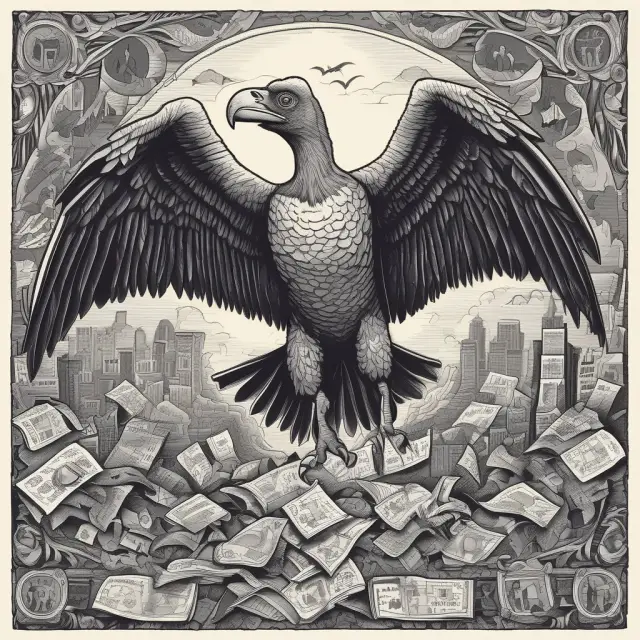
When a vulture capitalist purchases a struggling company that doesn’t respond favorably to aggressive cost-cutting efforts, they will often resort to asset stripping or fire sales. These tactics may not save the entire business but can generate profit for the investor.
Asset Stripping
The term “asset stripping” refers to the practice of selling off noncore assets in a company to extract value from the business and recoup losses. The goal is to sell assets at a price higher than their book value, thereby generating a positive return on investment (ROI) for the vulture capitalist.
Fire Sales
Fire sales represent extreme asset disposals during which assets are sold off quickly in bulk at substantially lower prices than normal market values. This strategy allows vulture capitalists to recover some of their original investment and minimize losses when a turnaround fails or becomes unfeasible. Fire sales can also help create liquidity for the firm, providing much-needed cash flow to pay off outstanding debts or make other investments.
Controversial Practices
Both asset stripping and fire sales have come under criticism from various stakeholders, including employees, communities, and governments, for their perceived negative impact on the companies, industries, and overall economy. Critics argue that these tactics can lead to significant job losses as vulture capitalists sell off assets or liquidate businesses entirely. The controversy surrounding these practices is a subject of ongoing debate in the investment community.
Economic Implications
Proponents argue that asset stripping plays an essential role in the market economy by freeing up resources and reallocating them to more productive uses. They believe this results in greater overall efficiency, economic growth, and job creation. On the other hand, critics argue that the practice can exacerbate unemployment and lead to negative social consequences for affected communities.
A Balanced Perspective
While asset stripping and fire sales are sometimes viewed negatively due to their potential impact on jobs and communities, they can also be beneficial in certain circumstances, such as when a company is underperforming, and other investors refuse to invest or lend capital. By stepping in and extracting value from these businesses through aggressive cost-cutting, asset stripping, or fire sales, vulture capitalists can help revive struggling companies and provide liquidity to markets. In doing so, they may also create opportunities for new investors to enter the scene and build upon the foundations laid by the vulture capitalist. Ultimately, a balanced perspective on asset stripping and fire sales acknowledges their potential benefits while recognizing the need for careful consideration of their impact on communities and employees.
In conclusion, understanding the role of vulture capitalists and their investment strategies, including asset stripping and fire sales, is crucial to appreciating the complexity of modern finance and investment dynamics. As investors continue to seek out opportunities in distressed companies, the need for a nuanced perspective on these controversial practices will only grow.
By exploring different perspectives and considering both the potential benefits and drawbacks of vulture capitalist tactics such as asset stripping and fire sales, we can gain a deeper understanding of the role they play within the larger economic landscape. This knowledge is essential for investors, policymakers, and the general public to make informed decisions regarding investment strategies, corporate governance, and economic policies that impact distressed businesses.

Differences between Vulture Capitalism and Venture Capitalism
When comparing vulture capitalism to venture capitalism (VC), two distinct investment philosophies emerge. While both types of investors play essential roles within financial markets, their approaches, motivations, and methods for generating returns significantly differ.
Vulture capitalists focus on acquiring stakes in distressed companies with the goal of restructuring or liquidating their assets. In contrast, venture capitalists invest in young businesses with promising growth potential. This section delves into the key differences between these two investment strategies and the unique characteristics that define each approach.
Vulture Capitalism: Revitalizing Troubled Firms
The primary objective of vulture capitalism is to purchase controlling stakes in companies with significant financial difficulties and subsequently reshape their operational landscape to increase profitability. This often involves implementing extensive cost-cutting measures, such as staff reductions or outsourcing labor, to enhance the company’s bottom line. Vulture capitalists also look for opportunities to sell off non-core assets, ultimately maximizing their returns as swiftly and efficiently as possible.
Venture Capitalism: Fostering Innovative Businesses
In contrast, venture capitalism aims at nurturing young businesses with high-growth potential by providing funding and strategic guidance in exchange for equity stakes. VCs are more interested in helping these nascent companies navigate their early stages of development and grow into successful, large-cap businesses that can generate substantial returns on investment. This approach requires a long-term perspective and an understanding of the risks associated with new business ventures.
Key Differences: A Comparison of Vulture and Venture Capitalism
Several factors distinguish the investment philosophies and methods used by vulture capitalists and venture capitalists (VCs). Below are some notable differences between the two:
1. Timeline and Focus
Vulture capitalism is characterized by a more aggressive, short-term focus on generating returns. The goal is to identify underperforming companies, make strategic changes to their operations, and sell them off or liquidate their assets for profit. In contrast, venture capitalism requires a long-term perspective, as the growth of the business may take several years before it yields significant returns on investment.
2. Investment Targets
Vulture capitalists typically target struggling companies that are nearing insolvency, while VCs invest in promising young businesses with high-growth potential. Vulture capitalists buy into distressed firms at low prices to maximize their returns, while VCs provide capital and strategic guidance in exchange for equity stakes.
3. Risk Tolerance
The risk profiles of the two investment strategies also differ. Vulture capitalism carries a lower risk profile due to the fact that the investments are made in established companies with known risks. In contrast, venture capitalism involves investing in new business ventures, which carry inherently higher levels of uncertainty and risk.
4. Value Addition
Vulture capitalists add value primarily by implementing cost-cutting measures and strategic restructuring to increase profitability. In contrast, VCs add value through their expertise, connections, and strategic guidance to help businesses grow and navigate challenges in their early stages of development.
In conclusion, vulture capitalism and venture capitalism represent two distinct investment philosophies that cater to different market niches. While vulture capitalists focus on acquiring stakes in troubled companies with the goal of restructuring or liquidating their assets for profit, venture capitalists invest in young businesses with high-growth potential, providing them with funding and strategic guidance to help grow into successful companies. Understanding these differences is essential for investors seeking to navigate various investment opportunities within financial markets.

Criticism of Vulture Capitalism
Vulture capitalists have long been a controversial presence in the financial world. Critics argue that vulture capitalists prioritize profits over people and communities, engaging in questionable practices that can lead to widespread job losses and economic instability. Here are some of the most common criticisms against these investors:
1. Aggressive Cost-Cutting
Vulture capitalists are often accused of prioritizing short-term profits through aggressive cost-cutting measures, such as outsourcing jobs, closing factories, and implementing wage cuts. This approach can result in significant job losses and financial hardship for affected communities. For example, a vulture capitalist may purchase a struggling company and then sell off its assets while laying off the workforce to maximize profits.
2. Preying on Distressed Communities
Some argue that vulture capitalists prey on distressed communities and economies, particularly those hit hard by recession or economic downturns. By focusing on buying up cheap assets in these areas, vulture capitalists can profit from the misery of local residents and businesses. This practice is often described as “picking over the bones” of a community in crisis.
3. Lack of Transparency
The lack of transparency surrounding the operations of vulture capitalist firms has raised concerns among critics. Many argue that these firms operate behind closed doors, making it difficult for investors and stakeholders to understand their investment strategies and decision-making processes. This opacity can lead to a perception of unethical practices or hidden agendas.
4. High Interest Rates
Vulture capitalists are also criticized for charging exorbitant interest rates on loans made to distressed companies. These high rates can further strain the financial situation of these struggling firms, making it more difficult for them to recover and potentially leading to bankruptcy.
5. Ethical Concerns
There have been ethical concerns raised regarding the actions taken by vulture capitalists. Some argue that their focus on maximizing profits at any cost can result in unethical or even illegal practices, such as price gouging, insider trading, or manipulating markets. Additionally, the potential for conflicts of interest between the vulture capitalist firm and its clients can raise serious ethical concerns.
Despite these criticisms, proponents argue that vulture capitalists play an essential role in the economy by providing much-needed capital to struggling companies and reallocating resources to more productive uses. They contend that without these investors, more businesses would be forced into bankruptcy, potentially costing taxpayers billions of dollars. However, it is important for vulture capitalists to operate ethically and transparently to ensure they are providing value to all stakeholders involved.
One prominent example of a successful vulture capitalist is Paul Singer and his hedge fund, Elliott Management Corporation. In 2014, Singer’s firm successfully forced Argentina into a debt restructuring by pursuing billions of dollars in payments owed to bondholders during the country’s financial crisis. While some argue that this strategy was necessary for Argentina’s economic recovery, others believe it led to significant hardship for Argentine citizens and further damaged the country’s reputation on the global stage.
Ultimately, the debate surrounding vulture capitalists is likely to continue as they remain a controversial presence in the financial world. While these investors can generate impressive returns for their clients, their impact on communities and economies raises important ethical questions that must be addressed. By promoting transparency, ethical practices, and open communication, vulture capitalists can help mitigate the negative perceptions surrounding their industry and focus on delivering value to all stakeholders involved.

Example of a Successful Vulture Capitalist: Bain Capital
Mitt Romney, former Massachusetts Governor and a prominent figure in American politics, rose to prominence during the Republican primaries of 2012 due to his tenure at Bain Capital, a private equity firm he co-founded in 1984. However, this success story was not without controversy. Romney labeled himself as a venture capitalist who turned around struggling companies and helped create jobs. His opponents, however, criticized him for preying on businesses and the people employed by them.
Bain Capital follows the vulture capitalist model, seeking opportunities to purchase distressed companies at rock bottom prices. Aggressive steps are then taken to revitalize these firms through cost-cutting measures like job layoffs. If unsuccessful in this endeavor, Bain Capital will resort to selling off valuable assets, such as land, buildings, and machinery, to generate profits.
The private equity firm’s success under Romney’s leadership lies in its ability to restructure struggling businesses and sell them at a profit. This approach has been both lauded and criticized for its short-term focus and potential impact on jobs. Romney’s opponents claimed that his actions led to increased unemployment, whereas supporters argued that he was an essential player in the economy, efficiently allocating resources and reviving firms.
One of the most contentious examples of Bain Capital’s investments was the takeover of GS Technologies (Bain Capital Partners LP) in 1993. The firm acquired control over the struggling steel company by buying a majority stake for just $5 million. Over the next few years, they cut jobs and sold off various subsidiaries, eventually selling the entire business for an impressive $200 million profit. This transaction generated significant controversy, with critics alleging that Romney’s actions led to widespread job losses while proponents claimed that he effectively restructured a failing business and turned it into a profitable entity.
Romney’s political opponents also scrutinized his role at Bain Capital during the 2012 presidential campaign. They accused him of being a vulture capitalist who destroyed companies and jobs solely for financial gain, despite his claims that he helped create jobs and revitalize businesses. This debate continued until the end of Romney’s unsuccessful bid for the presidency.
The term “vulture capitalism” came to the forefront during this campaign, shedding light on the investment strategies of firms like Bain Capital. Vulture capitalists have been a significant part of the American business landscape for decades. They focus on purchasing distressed companies at low prices and seeking ways to extract value from them, often by cutting costs and selling off assets. While some argue that vulture capitalists help revive struggling businesses, others view their actions as detrimental to both employees and communities.
Despite the criticisms against Bain Capital and its association with vulture capitalism, Romney’s political career and tenure at the firm cemented his reputation as a successful investor and businessman. This example highlights the complex nature of this type of investing and the ongoing debate surrounding its impact on jobs, communities, and the economy as a whole.

Economic Impact and Controversies Surrounding Vulture Capitalists
Vulture capitalists’ role in the economy remains a topic of fierce debate. While some argue that they are essential for economic growth, others criticize their predatory tactics and negative impact on communities and employees. In this section, we will explore both sides of the argument.
On the pro-vulture capitalist side, advocates claim that these investors play a crucial role in saving struggling companies and reallocating resources to more productive uses. By taking control of distressed firms, vulture capitalists are able to implement aggressive cost-cutting measures, which can lead to significant improvements in efficiency and profitability. Additionally, they often sell off non-core assets or entire businesses, enabling these resources to be utilized elsewhere in the economy. Some even argue that vulture capitalists may help prevent bankruptcies by providing much-needed financial support and pushing companies towards restructuring and turnaround efforts.
However, critics argue that vulture capitalists prioritize their own interests over those of the employees and communities affected by their investments. They are known for engaging in aggressive cost-cutting strategies like laying off workers or closing down facilities to boost profits. Vulture capitalists may also employ predatory practices, such as buying up debt at a discount with the intention of forcing companies into bankruptcy and then acquiring their assets at fire-sale prices. Furthermore, vulture capitalists often charge high interest rates on the loans they provide to struggling firms, exacerbating financial difficulties and adding to the overall burden for those already facing economic hardship.
One example of a successful vulture capitalist investment is the takeover of Chrysler by Cerberus Capital Management in 2007. The private equity firm acquired a controlling stake in Chrysler for $7.4 billion, saving the automaker from bankruptcy and ultimately selling it to Fiat in 2014 for $6.5 billion. Critics argue that this deal only served to enrich Cerberus Capital Management at the expense of Chrysler’s employees and their pension funds.
Famous investor Paul Singer, who made headlines for his successful bet on Argentine debt during the country’s financial crisis, is another example of a vulture capitalist whose tactics have drawn criticism. Singer, through his hedge fund Elliott Management, sought to recover bonds that were defaulted upon by Argentina in 2001. After several legal battles and negotiations, he was successful in securing full repayment for his investors. However, his actions resulted in significant financial hardship for the Argentine people, as the government was forced to divert resources towards debt payments instead of addressing social issues.
The controversy surrounding vulture capitalists is further complicated by their impact on communities and the broader economy. While some argue that they create jobs and help improve overall efficiency, others claim that they contribute to a race to the bottom in wages and labor standards, as well as increased inequality. In extreme cases, vulture capitalism has been linked to economic instability and social unrest, particularly when large-scale layoffs or bankruptcies occur.
In conclusion, understanding the role of vulture capitalists in the economy requires a nuanced perspective. While they may provide much-needed financial support to struggling firms and help allocate resources more efficiently, their aggressive cost-cutting tactics and potential negative impact on communities and employees raise valid concerns. The ongoing debate surrounding vulture capitalism underscores the importance of striking a balance between profitability and social responsibility in business practices.

Case Study: Argentina’s Debt Crisis
The controversy surrounding vulture capitalists often escalates when it comes to their actions during countries’ debt crises. One of the most prominent examples is Paul Singer and his hedge fund, Elliott Management, in relation to Argentina. In 1989 and 1990, Argentina suffered a severe economic crisis that led to widespread defaults on its debt. As part of this crisis, Argentina restructured over $41 billion worth of bonds at the turn of the century, reducing the interest rates and extending maturities to help ease their financial burden. However, Paul Singer’s Elliott Management Corporation decided not to participate in this restructuring process. Instead, they continued holding around $2.3 billion worth of Argentine bonds, which had matured before the debt restructuring offer.
Singer and his team waited patiently for a chance to profit from Argentina’s misfortune. In 2010, Argentina attempted to pay off its bondholders. However, Elliott Management demanded full payment on the original terms, rejecting Argentina’s offer of the restructured bonds. Singer and his hedge fund argued that they were entitled to the face value of their bonds due to Argentina’s breach of contract when it restructured other debt without including them in the agreement.
Argentina took this matter to the courts. The New York Supreme Court ruled in favor of Elliott Management, which meant Argentina was required to pay an additional $1.3 billion to the hedge fund – a decision that sparked controversy and outrage among many. Critics argued that Paul Singer’s actions demonstrated a lack of empathy for the people of Argentina during their time of need. On the other hand, supporters contended that the ruling served as a reminder of the importance of upholding contracts in business dealings.
Regardless of which side you take on this issue, it is evident that the case involving Elliott Management and Argentina highlights the polarizing nature of vulture capitalism. It illustrates how these investors can profit from countries’ financial struggles by taking advantage of loopholes or discrepancies in restructuring processes. The controversy surrounding Paul Singer and his investment firm also demonstrates the moral dilemma that arises when it comes to making money off other people’s misfortunes.
FAQ:
- What is a vulture capitalist? A vulture capitalist is an investor who buys distressed companies at a discounted price and attempts to revive the business through aggressive cost-cutting measures or asset stripping if needed.
- How does vulture capitalism differ from venture capitalism? Vulture capitalists target companies in distress with the goal of making quick profits, while venture capitalists invest in promising startups to help them grow and reach their potential.
- Is it ethical for vulture capitalists to buy distressed companies at rock bottom prices and make a profit? The ethics surrounding vulture capitalism are debated as some argue that these investments can revive struggling businesses, while others believe it’s immoral to profit off other people’s misfortunes.

FAQ
What is a vulture capitalist and how do they operate?
A vulture capitalist is an investor who purchases troubled companies whose prices have been severely depressed in the market. They aim to revive the business via aggressive cost-cutting measures, such as layoffs, or sell off assets if unsuccessful. Vulture capitalists’ investment strategies prioritize short-term gains and a quick turnaround, making them distinct from venture capitalists (VCs).
What motivates vulture capitalists?
Vulture capitalists invest in distressed companies seeking to extract value for themselves through cost-cutting measures or by selling off assets. Their goal is to maximize profits with minimal risk.
How do vulture capitalists make money?
Vulture capitalists’ profits come from reviving troubled businesses and selling them for a profit, aggressively cutting costs (layoffs), asset stripping, and charging high-interest rates for loans.
What is the difference between vulture capitalists and venture capitalists?
Vulture capitalists invest in distressed firms, focusing on short-term profits through cost-cutting or asset sales, while venture capitalists provide financing to startups with growth potential and nurture them into successful companies.
Are there criticisms against vulture capitalists?
Critics argue that vulture capitalists prioritize their own gains over the wellbeing of employees and communities by engaging in aggressive cost-cutting strategies and lending at high interest rates. Some believe they play a crucial role in reallocating resources and reviving struggling companies.
What is an example of a successful vulture capitalist?
Mitt Romney’s tenure at Bain Capital, where he co-founded the private equity firm in 1984, is considered one of the most notable examples of a successful vulture capitalist. Despite controversy surrounding his investment strategies and their impact on jobs, Romney’s approach to company revitalization remains influential within the industry.
What are the economic implications of vulture capitalism?
The debate over the role of vulture capitalists in the economy centers around the potential benefits, such as reallocating resources, versus the negative aspects like job losses and asset stripping. Some argue that vulture capitalists force companies to become more efficient, while others claim they contribute to unemployment and social unrest.
How does Argentina’s debt crisis relate to vulture capitalists?
The Argentine debt crisis involving Paul Singer and his hedge fund Elliott Management Corporation is a notable example of the controversial tactics used by vulture capitalists in seeking returns on their investments, often with significant consequences for governments and their people.
 Next entry · No. 5,557Vulture Funds: Investing in Distressed Assets for High-Risk, Potentially High-Reward Returns
See also
-
 No. 5,373
03 Sep 2025
21 min
Understanding Usury Rates: History, Applications, and Legal Implications
Business Finance
No. 5,373
03 Sep 2025
21 min
Understanding Usury Rates: History, Applications, and Legal Implications
Business Finance -
 No. 4,451
19 Jun 2025
17 min
Understanding Revenue Deficits: Meaning, Causes and Solutions for Businesses and Governments
Business Finance
No. 4,451
19 Jun 2025
17 min
Understanding Revenue Deficits: Meaning, Causes and Solutions for Businesses and Governments
Business Finance -
 No. 4,247
03 Jun 2025
21 min
Understanding Quick-Rinse Bankruptcies: Faster Turnaround for Companies in Distress
Business Finance
No. 4,247
03 Jun 2025
21 min
Understanding Quick-Rinse Bankruptcies: Faster Turnaround for Companies in Distress
Business Finance -
 No. 3,790
27 Apr 2025
22 min
Understanding Organic Sales: Growth Drivers and Benefits
Business Finance
No. 3,790
27 Apr 2025
22 min
Understanding Organic Sales: Growth Drivers and Benefits
Business Finance -
 No. 3,672
17 Apr 2025
19 min
Understanding the Omani Rial: A Comprehensive Guide for Institutional Investors
Business Finance
No. 3,672
17 Apr 2025
19 min
Understanding the Omani Rial: A Comprehensive Guide for Institutional Investors
Business Finance -
 No. 3,545
07 Apr 2025
19 min
Understanding Nonperforming Assets: Definition, Effects, and Recovery Strategies for Investors
Business Finance
No. 3,545
07 Apr 2025
19 min
Understanding Nonperforming Assets: Definition, Effects, and Recovery Strategies for Investors
Business Finance